WLNO: Wavelet-Laplace Neural Operator for Solving Partial Differential Equations
Pith reviewed 2026-06-30 14:54 UTC · model grok-4.3
The pith
Fusing a Haar wavelet branch with the Laplace Neural Operator improves performance on PDE problems with multi-scale features.
A machine-rendered reading of the paper's core claim, the machinery that carries it, and where it could break.
Core claim
The central discovery is that adding a single-level Haar DWT branch with independent 1x1 convolutions on subbands, fused by a sigmoid-gated weight initialized small, to the LNO's pole-residue formulation leads to better operator learning for transient and steady-state PDE dynamics, especially where spatial multi-scale structure is prominent.
What carries the argument
The parallel wavelet branch using Haar DWT and inverse DWT with learned convolutions per subband, adaptively weighted against the Laplace branch.
If this is right
- WLNO achieves higher accuracy than LNO on the same training data and hyperparameters for diffusion, Burgers, reaction-diffusion, Darcy flow, and 2D Navier-Stokes equations.
- The gains are largest for problems with sharp shock fronts and coherent vortical structures.
- The learnable gate allows the model to balance the contribution of the wavelet branch during training.
- The method provides an explicit way to extract multi-scale spatial features missing in pure Laplace-domain approaches.
Where Pith is reading between the lines
- Similar wavelet augmentations might enhance other neural operator architectures beyond LNO.
- Applying this to time-dependent problems with evolving multi-scale features could be a natural next test.
- The approach hints at benefits from combining different frequency decompositions in operator learning.
Load-bearing premise
That the observed improvements result from the wavelet branch and not from implementation variations or training differences despite claims of identical protocols.
What would settle it
Running the exact same LNO and WLNO models multiple times with reported random seeds and checking if the performance difference remains significant and consistent across runs.
Figures






read the original abstract
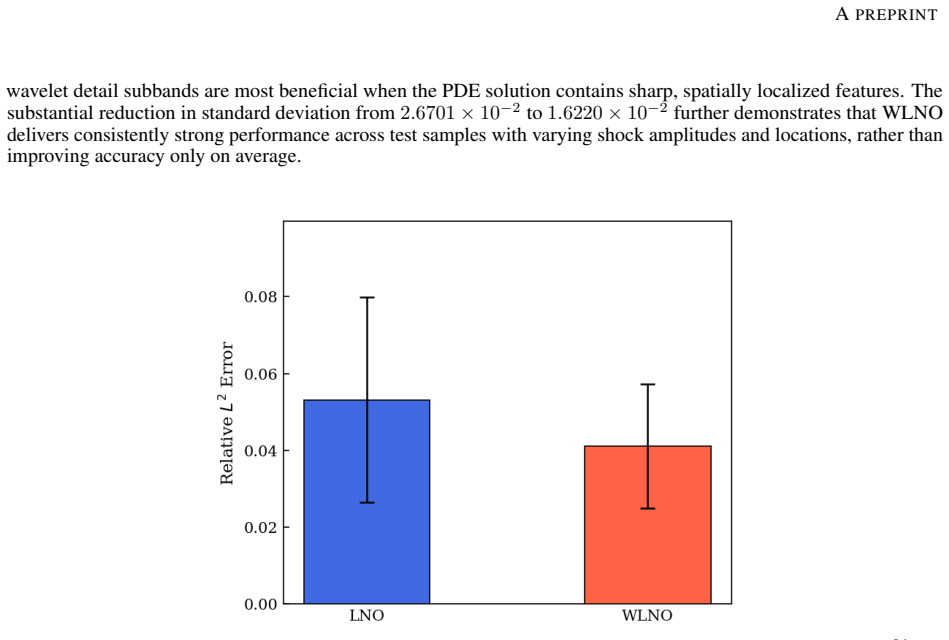
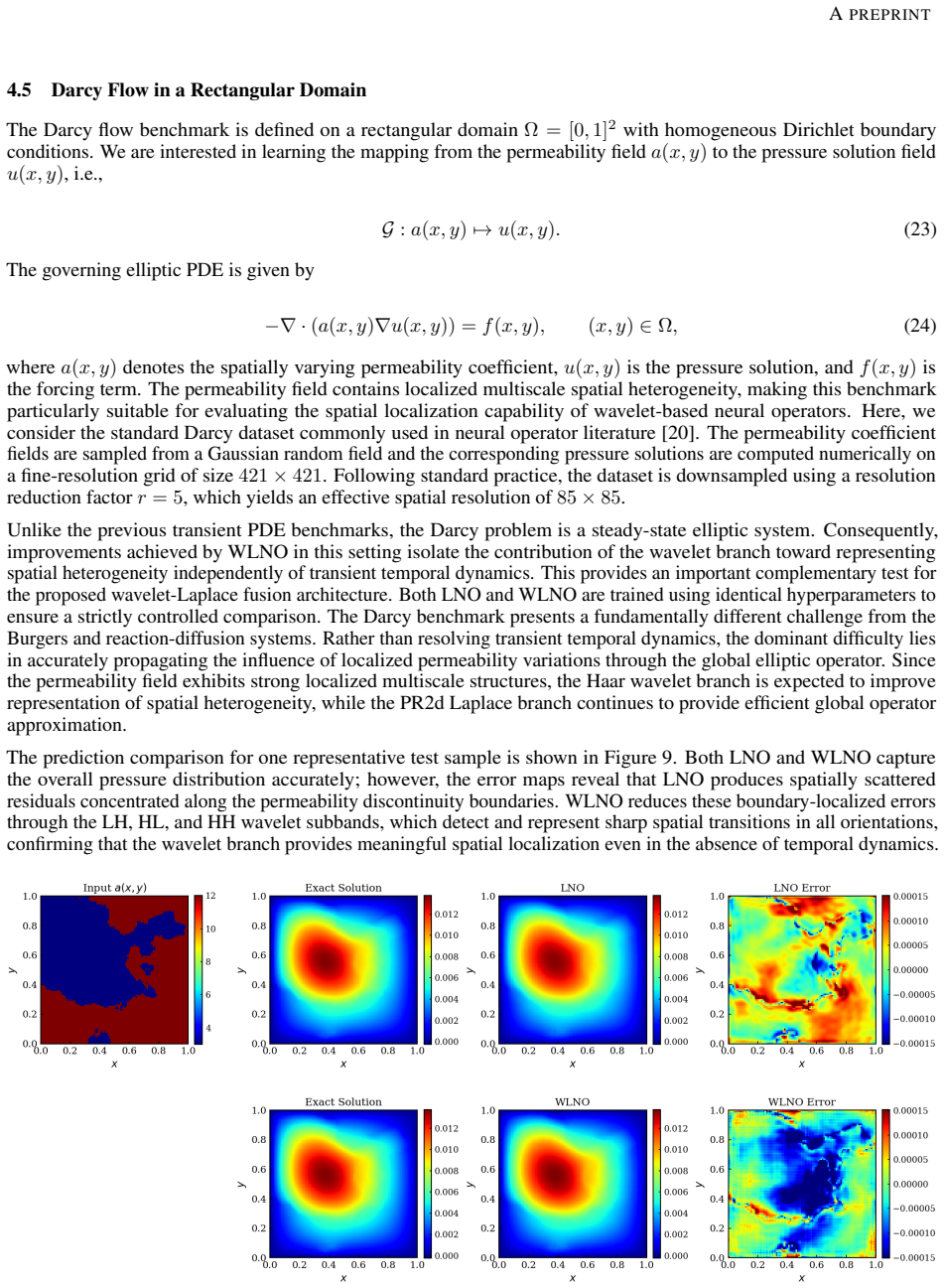
This work introduces the Wavelet-Laplace Neural Operator (WLNO), a novel neural operator that fuses Haar wavelet multi-scale spatial decomposition with the Laplace-domain pole-residue formulation of the Laplace Neural Operator (LNO). While LNO captures transient and steady-state dynamics through learnable system poles and residues, it lacks an explicit mechanism for extracting spatially localized multi-scale features inherent in complex PDE solutions. WLNO addresses this by augmenting the LNO core with a parallel single-level Haar discrete wavelet transform (DWT) branch that decomposes the lifted feature map into four frequency subbands: approximation (LL), horizontal detail (LH), vertical detail (HL), and diagonal detail (HH) and applies independent learned $1\times1$ convolutions to each subband before reconstruction via the inverse DWT. The two branches are fused through a learnable sigmoid-gated weight $\alpha_\mathrm{wav}$, initialized to give a small initial contribution to the wavelet branch, allowing the model to adaptively balance Laplace-domain dynamics against spatial multi-scale features throughout training. WLNO is evaluated against LNO on five benchmark PDE problems using identical hyperparameters, training data, and evaluation protocols: the diffusion equation, the Burgers equation, the reaction-diffusion system, Darcy flow, and the two-dimensional Navier-Stokes equation. WLNO consistently outperforms LNO on all five problems, with the most pronounced improvement on problems with strong spatial multi-scale structure, such as the Burgers equation with sharp shock fronts and the Navier-Stokes equation with coherent vortical structures, while remaining consistent across smoother and elliptic problems. These results demonstrate that wavelet-based multi-scale spatial decomposition is a principled and effective complement to Laplace-domain operator learning.
Editorial analysis
A structured set of objections, weighed in public.
Referee Report
Summary. The manuscript introduces the Wavelet-Laplace Neural Operator (WLNO), which augments the Laplace Neural Operator (LNO) with a parallel single-level Haar DWT branch. The branch decomposes lifted features into LL/LH/HL/HH subbands, applies independent learned 1x1 convolutions per subband, reconstructs via inverse DWT, and fuses the result with the LNO core through a learnable sigmoid-gated scalar alpha_wav (initialized for small initial wavelet contribution). WLNO is evaluated on five PDE benchmarks (diffusion, Burgers, reaction-diffusion, Darcy flow, 2D Navier-Stokes) using identical hyperparameters, data, and protocols to LNO, with the claim of consistent outperformance that is most pronounced on problems with strong spatial multi-scale structure.
Significance. If the reported gains are robustly attributable to the wavelet branch, the work would show that explicit multi-scale spatial decomposition can usefully complement Laplace-domain pole-residue modeling for neural operators. The adaptive gating mechanism and per-subband convolutions constitute a clean architectural extension that could be adopted in other frequency-domain operator frameworks.
major comments (2)
- [Experiments section] Experiments section (and abstract claim of outperformance): the manuscript states that identical hyperparameters, training data, and evaluation protocols are used, yet supplies neither ablation results (e.g., alpha_wav fixed at 0 or wavelet branch removed) nor multi-seed statistics, error bars, or variance estimates. Without these controls the observed deltas cannot be confidently attributed to the wavelet-Laplace fusion rather than optimizer stochasticity, initialization, or minor implementation differences.
- [Method section] Method section (description of fusion): the claim that the model 'adaptively balances' the two branches throughout training rests on the learned alpha_wav, but no analysis is provided of its converged values, sensitivity to initialization, or correlation with performance gains on the multi-scale problems (Burgers, Navier-Stokes). This leaves the mechanistic explanation for the reported improvements under-specified.
minor comments (2)
- [Abstract] Abstract: asserts 'consistent outperformance' and 'most pronounced improvement' without any numerical values, table references, or error metrics, which reduces the abstract's standalone informativeness.
- [Method section] Notation: the per-subband 1x1 convolution weights are described as 'independent learned' but their exact tensor shapes and how they interact with the lifted feature dimension are not stated explicitly, complicating re-implementation.
Simulated Author's Rebuttal
We thank the referee for the constructive comments on our manuscript. The points raised regarding experimental controls and analysis of the gating mechanism are valid and will be addressed through revisions to strengthen attribution of results and mechanistic understanding.
read point-by-point responses
-
Referee: [Experiments section] Experiments section (and abstract claim of outperformance): the manuscript states that identical hyperparameters, training data, and evaluation protocols are used, yet supplies neither ablation results (e.g., alpha_wav fixed at 0 or wavelet branch removed) nor multi-seed statistics, error bars, or variance estimates. Without these controls the observed deltas cannot be confidently attributed to the wavelet-Laplace fusion rather than optimizer stochasticity, initialization, or minor implementation differences.
Authors: We agree that the absence of ablations and statistical reporting limits confident attribution of the gains. In the revised manuscript we will add ablation experiments with the wavelet branch disabled (alpha_wav fixed at zero) and report results over multiple random seeds including means and standard deviations. revision: yes
-
Referee: [Method section] Method section (description of fusion): the claim that the model 'adaptively balances' the two branches throughout training rests on the learned alpha_wav, but no analysis is provided of its converged values, sensitivity to initialization, or correlation with performance gains on the multi-scale problems (Burgers, Navier-Stokes). This leaves the mechanistic explanation for the reported improvements under-specified.
Authors: We acknowledge that further analysis of alpha_wav is needed to support the adaptive balancing claim. The revision will report converged alpha_wav values per benchmark, include sensitivity experiments to different initializations, and examine correlations between alpha_wav and performance gains on multi-scale problems such as Burgers and Navier-Stokes. revision: yes
Circularity Check
No circularity: empirical architecture comparison with no derivation chain
full rationale
The paper proposes WLNO by augmenting LNO with a parallel Haar DWT branch and a learnable sigmoid-gated fusion weight alpha_wav. All load-bearing claims are empirical head-to-head results on five PDE benchmarks under stated identical hyperparameters and protocols. No first-principles derivation, uniqueness theorem, or prediction is offered that reduces by construction to fitted inputs or self-citations. The learnable gate and 1x1 convolutions are standard trainable components whose values are determined by optimization, not by definitional equivalence to the reported performance deltas. Self-citation to LNO is to prior independent work and does not substitute for the current empirical evidence.
Axiom & Free-Parameter Ledger
free parameters (2)
- alpha_wav
- per-subband 1x1 convolution weights
axioms (1)
- domain assumption Single-level Haar DWT decomposition into approximation and detail subbands extracts spatially localized multi-scale features relevant to PDE solutions.
Reference graph
Works this paper leans on
-
[1]
L. C. Evans, Partial Differential Equations, 2nd Edition, American Mathematical Society, 2010
2010
-
[2]
R. J. LeVeque, Finite V olume Methods for Hyperbolic Problems, Cambridge University Press, 2002
2002
-
[3]
Quarteroni, R
A. Quarteroni, R. Sacco, F. Saleri, Numerical Mathematics, 2nd Edition, Springer, 2007
2007
-
[4]
J. S. Hesthaven, G. Rozza, B. Stamm, Certified Reduced Basis Methods for Parametrized Partial Differential Equations, Springer, 2016
2016
-
[5]
Rozza, D
G. Rozza, D. B. P. Huynh, A. T. Patera, Reduced Basis Approximation and A Posteriori Error Estimation for Affinely Parametrized Elliptic Coercive Partial Differential Equations, Archives of Computational Methods in Engineering 15 (3) (2008) 229–275
2008
-
[6]
Benner, S
P. Benner, S. Gugercin, K. Willcox, A Survey of Projection-Based Model Reduction Methods for Parametric Dynamical Systems, SIAM Review 57 (4) (2015) 483–531
2015
-
[7]
J. S. Hesthaven, S. Ubbiali, Non-Intrusive Reduced Order Modeling of Nonlinear Problems Using Neural Networks, Journal of Computational Physics 363 (2018) 55–78
2018
- [8]
-
[9]
Bischof, M
R. Bischof, M. Piovarci, M. Kraus, S. Mishra, B. Bickel, Hypino: Multi-physics neural operators via hyperpinns and the method of manufactured solutions, Advances in Neural Information Processing Systems 38 (2026) 144798–144831
2026
-
[10]
A. Sojitra, O. San, Method of Manufactured Learning for Solver-free Training of Neural Operators, arXiv preprint arXiv:2511.12890 (2025)
-
[11]
LeCun, Y
Y . LeCun, Y . Bengio, G. Hinton, Deep learning, Nature 521 (7553) (2015) 436–444
2015
-
[12]
Goodfellow, Y
I. Goodfellow, Y . Bengio, A. Courville, Deep Learning, MIT Press, 2016
2016
-
[13]
Dissanayake, N
M. Dissanayake, N. Phan-Thien, Neural-Network-Based Approximations for Solving Partial Differential Equa- tions, Communications in Numerical Methods in Engineering 10 (3) (1994) 195–201
1994
-
[14]
I. E. Lagaris, A. Likas, D. I. Fotiadis, Artificial Neural Networks for Solving Ordinary and Partial Differential Equations, IEEE Transactions on Neural Networks 9 (5) (1998) 987–1000
1998
-
[15]
Kovachki, Z
N. Kovachki, Z. Li, B. Liu, K. Azizzadenesheli, K. Bhattacharya, A. Stuart, A. Anandkumar, Neural Operator: Learning Maps Between Function Spaces with Applications to PDEs, Journal of Machine Learning Research 24 (89) (2023) 1–97
2023
-
[16]
G. E. Karniadakis, I. G. Kevrekidis, L. Lu, P. Perdikaris, S. Wang, L. Yang, Physics-Informed Machine Learning, Nature Reviews Physics 3 (6) (2021) 422–440
2021
-
[17]
Cuomo, V
S. Cuomo, V . S. Di Cola, F. Giampaolo, G. Rozza, M. Raissi, F. Piccialli, Scientific Machine Learning through Physics-Informed Neural Networks: Where We Are and What’s Next, Journal of Scientific Computing 92 (3) (2022) 88
2022
-
[18]
G. C. Peng, M. Alber, A. Buganza Tepole, W. R. Cannon, S. De, S. Dura-Bernal, K. Garikipati, G. Karniadakis, W. W. Lytton, P. Perdikaris, et al., Multiscale Modeling Meets Machine Learning: What Can We Learn?, Archives of Computational Methods in Engineering 28 (2021) 1017–1037
2021
-
[19]
L. Lu, P. Jin, G. Pang, Z. Zhang, G. E. Karniadakis, Learning Nonlinear Operators via DeepONet Based on the Universal Approximation Theorem of Operators, Nature Machine Intelligence 3 (3) (2021) 218–229
2021
-
[20]
Z. Li, N. Kovachki, K. Azizzadenesheli, B. Liu, K. Bhattacharya, A. Stuart, A. Anandkumar, Fourier Neural Operator for Parametric Partial Differential Equations, arXiv preprint arXiv:2010.08895 (2020)
work page internal anchor Pith review Pith/arXiv arXiv 2010
-
[21]
Z. Li, N. Kovachki, K. Azizzadenesheli, B. Liu, K. Bhattacharya, A. Stuart, A. Anandkumar, Multipole Graph Neural Operator for Parametric Partial Differential Equations, Advances in Neural Information Processing Systems 33 (2020) 6755–6766
2020
-
[22]
G. Wen, Z. Li, K. Azizzadenesheli, A. Anandkumar, S. M. Benson, U-FNO-An Enhanced Fourier Neural Operator-Based Deep-Learning Model for Multiphase Flow, Advances in Water Resources 163 (2022) 104180
2022
-
[23]
Z. Li, D. Z. Huang, B. Liu, A. Anandkumar, Fourier Neural Operator with Learned Deformations for PDEs on General Geometries, Journal of Machine Learning Research 24 (388) (2023) 1–26
2023
- [24]
-
[25]
J. Pathak, S. Subramanian, P. Harrington, S. Raja, A. Chattopadhyay, M. Mardani, T. Kurth, D. Hall, Z. Li, K. Azizzadenesheli, et al., FourCastNet: A Global Data-Driven High-Resolution Weather Model using Adaptive Fourier Neural Operators, arXiv preprint arXiv:2202.11214 (2022)
work page internal anchor Pith review Pith/arXiv arXiv 2022
-
[26]
Y . Yang, A. F. Gao, J. C. Castellanos, Z. E. Ross, K. Azizzadenesheli, K. Bhattacharya, Seismic Wave Propagation and Inversion with Neural Operators, The Seismic Record 1 (3) (2021) 126–135
2021
- [27]
-
[28]
Daubechies, Ten Lectures on Wavelets, SIAM, 1992
I. Daubechies, Ten Lectures on Wavelets, SIAM, 1992
1992
-
[29]
Mallat, A Wavelet Tour of Signal Processing, 2nd Edition, Academic Press, 1999
S. Mallat, A Wavelet Tour of Signal Processing, 2nd Edition, Academic Press, 1999
1999
-
[30]
Tripura, S
T. Tripura, S. Chakraborty, Wavelet Neural Operator for Solving Parametric Partial Differential Equations in Computational Mechanics Problems, Computer Methods in Applied Mechanics and Engineering 404 (2023) 115783
2023
-
[31]
Bhattacharya, B
K. Bhattacharya, B. Hosseini, N. B. Kovachki, A. M. Stuart, Model Reduction and Neural Networks for Parametric PDEs, SMAI Journal of Computational Mathematics 7 (2021) 121–157
2021
-
[32]
T. Chen, H. Chen, Universal Approximation to Nonlinear Operators by Neural Networks with Arbitrary Activation Functions and its Application to Dynamical Systems, IEEE Transactions on Neural Networks 6 (4) (1995) 911–917
1995
-
[33]
S. Wang, H. Wang, P. Perdikaris, Improved Architectures and Training Algorithms for Deep Operator Networks with Applications to Geomechanics, Engineering with Computers 38 (6) (2022) 4651–4678
2022
-
[34]
T. de Wolff, G. Gola, D. Morrison, C. Kuthe, S. Chen, V . Oommen, J. Hao, G. E. Karniadakis, Multifidelity Deep Operator Networks, arXiv preprint arXiv:2204.09234 (2022)
-
[35]
FEDONet : Fourier-Embedded DeepONet for Spectrally Accurate Operator Learning
A. Sojitra, M. Dhingra, O. San, FEDONet: Fourier-embedded DeepONet for spectrally accurate operator learning, arXiv preprint arXiv:2509.12344 (2025)
work page internal anchor Pith review Pith/arXiv arXiv 2025
-
[36]
M. Abid, O. San, Spectral Embedding via Chebyshev Bases for Robust DeepONet Approximation, arXiv preprint arXiv:2512.09165 (2025)
work page internal anchor Pith review Pith/arXiv arXiv 2025
-
[37]
C. Lin, M. Maxey, Z. Li, G. E. Karniadakis, Operator Learning for Predicting Multiscale Bubble Growth Dynamics, The Journal of Chemical Physics 154 (10) (2021)
2021
- [38]
- [39]
- [40]
-
[41]
Vaswani, N
A. Vaswani, N. Shazeer, N. Parmar, J. Uszkoreit, L. Jones, A. N. Gomez, L. Kaiser, I. Polosukhin, Attention Is All You Need, in: Advances in Neural Information Processing Systems, V ol. 30, 2017
2017
-
[42]
Ronneberger, P
O. Ronneberger, P. Fischer, T. Brox, U-Net: Convolutional Networks for Biomedical Image Segmentation, in: Medical Image Computing and Computer-Assisted Intervention, 2015, pp. 234–241
2015
-
[43]
K. He, X. Zhang, S. Ren, J. Sun, Deep Residual Learning for Image Recognition, in: IEEE Conference on Computer Vision and Pattern Recognition, 2016, pp. 770–778
2016
-
[44]
Kissas, J
G. Kissas, J. H. Seidman, L. F. Guilhoto, V . M. Celli, L. Pigneur, P. Perdikaris, Learning Operators with Coupled Attention, Journal of Machine Learning Research 23 (215) (2022) 1–63
2022
-
[45]
Raonic, R
B. Raonic, R. Molinaro, T. De Ryck, T. Rohner, F. Bartolucci, R. Alaifari, S. Mishra, E. de Bézenac, Convolutional Neural Operators for Robust and Accurate Learning of PDEs, Advances in Neural Information Processing Systems 36 (2024)
2024
-
[46]
Poseidon: Efficient foundation models for PDEs
M. Herde, B. Raonic, T. Rohner, R. Käppeli, R. Molinaro, E. de Bézenac, S. Mishra, Poseidon: Efficient Foundation Models for PDEs, arXiv preprint arXiv:2405.19101 (2024)
-
[47]
Cao, Choose a transformer: Fourier or Galerkin, in: Advances in Neural Information Processing Systems, V ol
S. Cao, Choose a transformer: Fourier or Galerkin, in: Advances in Neural Information Processing Systems, V ol. 34, 2021, pp. 24924–24940
2021
-
[48]
Gaussian Error Linear Units (GELUs)
D. Hendrycks, K. Gimpel, Gaussian error linear units (GELUs), arXiv preprint arXiv:1606.08415 (2016)
work page internal anchor Pith review Pith/arXiv arXiv 2016
-
[49]
C. K. Chui, An Introduction to Wavelets, Academic Press, 1992. 20 APREPRINT
1992
-
[50]
Mallat, Group Invariant Scattering, Communications on Pure and Applied Mathematics 65 (10) (2012) 1331– 1398
S. Mallat, Group Invariant Scattering, Communications on Pure and Applied Mathematics 65 (10) (2012) 1331– 1398
2012
-
[51]
Bruna, S
J. Bruna, S. Mallat, Invariant Scattering Convolution Networks, IEEE Transactions on Pattern Analysis and Machine Intelligence 35 (8) (2013) 1872–1886
2013
-
[52]
P. Liu, H. Zhang, W. Lian, W. Zuo, Multi-Level Wavelet Convolutional Neural Networks, IEEE Access 7 (2019) 74973–74985
2019
-
[53]
Williams, R
T. Williams, R. Li, Wavelet Pooling for Convolutional Neural Networks, in: International Conference on Learning Representations, 2018
2018
-
[54]
Gupta, X
G. Gupta, X. Xiao, P. Bogdan, Multiwavelet-based Operator Learning for Differential Equations, Advances in Neural Information Processing Systems 34 (2021) 24048–24062
2021
-
[55]
Raissi, P
M. Raissi, P. Perdikaris, G. E. Karniadakis, Physics-Informed Neural Networks: A Deep Learning Frame- work for Solving Forward and Inverse Problems Involving Nonlinear Partial Differential Equations, Journal of Computational Physics 378 (2019) 686–707
2019
-
[56]
L. Lu, X. Meng, Z. Mao, G. E. Karniadakis, DeepXDE: A Deep Learning Library for Solving Differential Equations, SIAM Review 63 (1) (2021) 208–228
2021
-
[57]
A. D. Jagtap, G. E. Karniadakis, Extended Physics-Informed Neural Networks (XPINNs): A Generalized Space- Time Domain Decomposition Based Deep Learning Framework for Nonlinear Partial Differential Equations, Communications in Computational Physics 28 (5) (2020) 2002–2041
2020
-
[58]
Kharazmi, Z
E. Kharazmi, Z. Zhang, G. E. Karniadakis, hp-VPINNs: Variational Physics-Informed Neural Networks with Domain Decomposition, Computer Methods in Applied Mechanics and Engineering 374 (2021) 113547
2021
-
[59]
Goswami, M
S. Goswami, M. Yin, Y . Yu, G. E. Karniadakis, A Physics-Informed Variational DeepONet for Nonlinear Fracture Mechanics, Computer Methods in Applied Mechanics and Engineering 391 (2022) 114587
2022
-
[60]
Z. Li, H. Zheng, N. Kovachki, D. Jin, H. Chen, B. Liu, K. Azizzadenesheli, A. Anandkumar, Physics-Informed Neural Operator for Learning Partial Differential Equations, ACM/JMS Journal of Data Science 1 (3) (2024) 1–27
2024
-
[61]
P. R. Vlachas, J. Pathak, B. R. Hunt, T. P. Sapsis, M. Girvan, E. Ott, P. Koumoutsakos, Forecasting of Spatio- Temporal Chaotic Dynamics with Recurrent Neural Networks: A Comparative Study of Reservoir Computing and Backpropagation Algorithms, arXiv preprint arXiv:1910.05266 (2019)
-
[62]
Kreyszig, Advanced Engineering Mathematics, 10th Edition, John Wiley & Sons, 2010
E. Kreyszig, Advanced Engineering Mathematics, 10th Edition, John Wiley & Sons, 2010
2010
-
[63]
S.-L. J. Hu, F. Liu, B. Gao, H. Li, Pole-Residue Method for Numerical Dynamic Analysis, Journal of Engineering Mechanics 142 (8) (2016) 04016045
2016
-
[64]
Cao, S.-L
Q. Cao, S.-L. J. Hu, H. Li, Laplace- and Frequency-Domain Methods on Computing Transient Responses of Oscillators with Hysteretic Dampings to Deterministic Loading, Journal of Engineering Mechanics 149 (3) (2023) 04023005
2023
-
[65]
Instance Normalization: The Missing Ingredient for Fast Stylization
D. Ulyanov, A. Vedaldi, V . Lempitsky, Instance Normalization: The Missing Ingredient for Fast Stylization, arXiv preprint arXiv:1607.08022 (2016)
work page internal anchor Pith review Pith/arXiv arXiv 2016
-
[66]
D. P. Kingma, J. Ba, Adam: A Method for Stochastic Optimization, in: International Conference on Learning Representations, 2015
2015
-
[67]
Paszke, S
A. Paszke, S. Gross, F. Massa, A. Lerer, J. Bradbury, G. Chanan, T. Killeen, Z. Lin, N. Gimelshein, L. Antiga, et al., PyTorch: An Imperative Style, High-Performance Deep Learning Library, in: Advances in Neural Information Processing Systems, V ol. 32, 2019
2019
- [68]
discussion (0)
Sign in with ORCID, Apple, or X to comment. Anyone can read and Pith papers without signing in.