Hermite-NGP: Gradient-Augmented Hash Encoding for Learning PDEs
Pith reviewed 2026-06-30 13:18 UTC · model grok-4.3
The pith
Hermite-NGP augments hash encodings by storing mixed partial derivatives at vertices to enable analytic gradient computation for neural PDE solvers.
A machine-rendered reading of the paper's core claim, the machinery that carries it, and where it could break.
Core claim
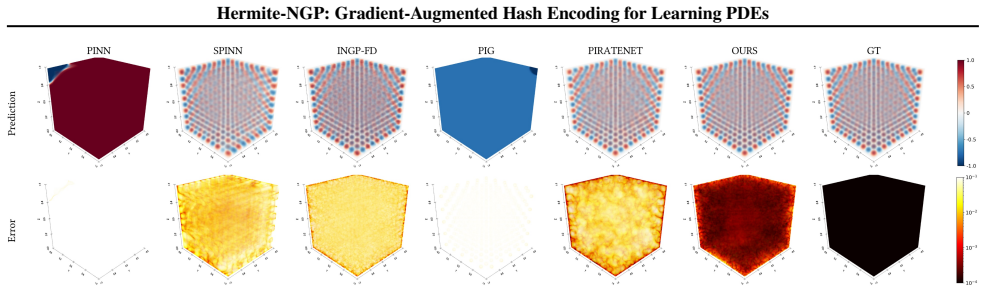
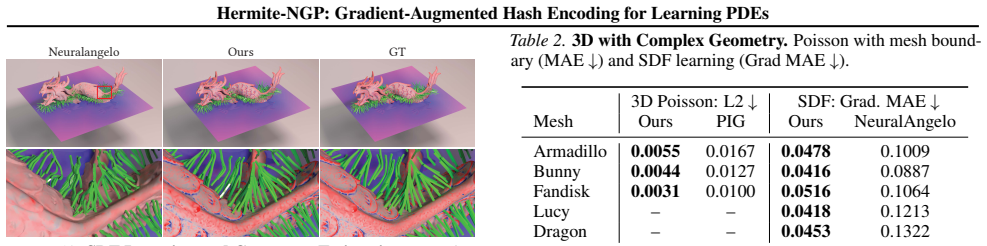
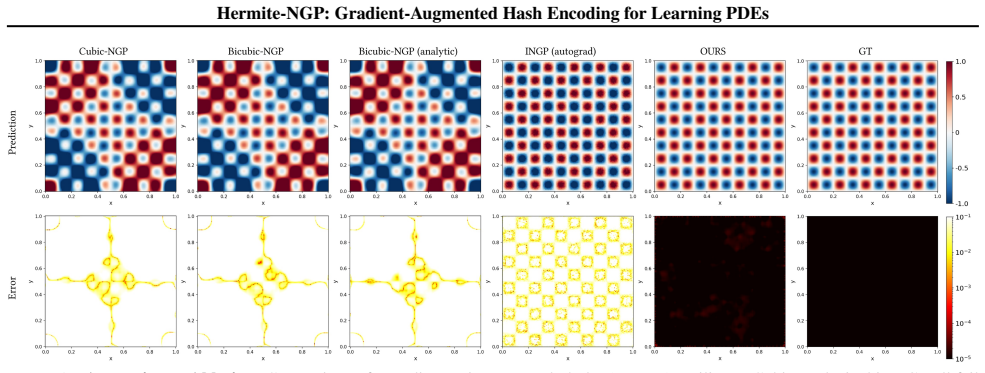
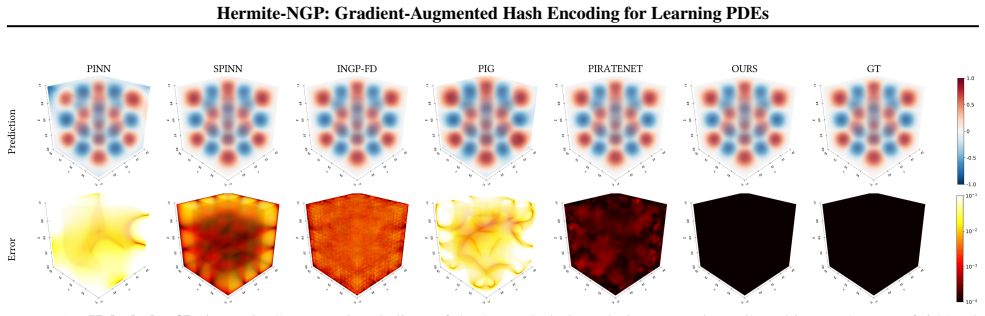
Hermite-NGP explicitly stores function values and mixed partial derivatives at hash grid vertices, allowing fully analytic evaluation of gradients, Jacobians, and Hessians via Hermite interpolation. This design preserves the efficiency and spatial adaptivity of NGP while supporting analytic differential operators up to second order. Combined with a multi-resolution curriculum training strategy analogous to multigrid V-cycles, the method achieves up to approximately 20 times lower error than prior neural PDE methods and reduces wall-clock convergence time by 2 to 10 times compared to other solvers.
What carries the argument
Gradient-augmented multi-resolution hash encoding that stores function values together with mixed partial derivatives at vertices and applies Hermite interpolation for analytic derivative evaluation.
If this is right
- Analytic derivatives remove the instability previously caused by automatic differentiation or finite differences in neural PDE training.
- The encoding supports efficient computation of first- and second-order differential operators while retaining NGP's spatial adaptivity.
- The multi-resolution curriculum enables stable coarse-to-fine optimization analogous to multigrid V-cycles.
- Models with up to 17 million parameters can be trained at per-epoch times as low as 3.5 ms.
- Error reductions and speed-ups hold across multiple 2D and 3D PDE benchmarks.
Where Pith is reading between the lines
- Memory cost per vertex rises because additional derivative components must be stored, which may constrain grid resolution on memory-limited hardware.
- The same storage-and-interpolation pattern could be applied to tasks outside PDEs that need reliable higher-order derivatives, such as sensitivity analysis or shape optimization.
- Performance on problems containing discontinuities would test whether Hermite interpolation introduces unwanted smoothing.
Load-bearing premise
Storing and interpolating mixed partial derivatives at hash vertices will remain numerically stable and will not introduce new artifacts during network optimization.
What would settle it
On any of the reported 2D or 3D PDE benchmarks, observing that derivative fields computed during training exhibit growing oscillations or produce final errors higher than those of a baseline NGP method using automatic differentiation.
Figures










read the original abstract
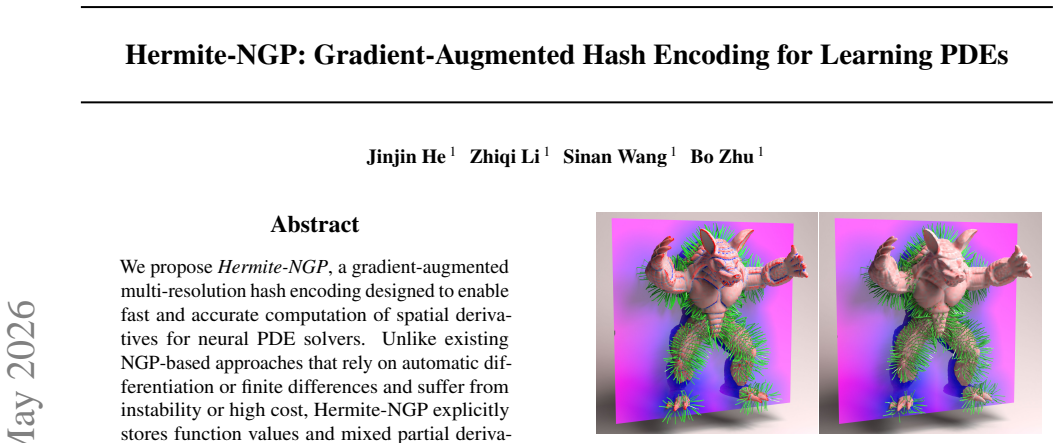
We propose Hermite-NGP, a gradient-augmented multi-resolution hash encoding designed to enable fast and accurate computation of spatial derivatives for neural PDE solvers. Unlike existing NGP-based approaches that rely on automatic differentiation or finite differences and suffer from instability or high cost, Hermite-NGP explicitly stores function values and mixed partial derivatives at hash grid vertices, allowing fully analytic evaluation of gradients, Jacobians, and Hessians via Hermite interpolation. This design preserves the efficiency and spatial adaptivity of NGP while supporting analytic differential operators up to second order. We further introduce a multi-resolution curriculum training strategy analogous to multigrid V-cycles to enable coarse-to-fine optimization. Across a range of 2D and 3D PDE benchmarks, Hermite-NGP achieves up to approximately 20 times lower error than prior neural PDE methods, and reduces wall-clock convergence time by 2 to 10 times compared to other solvers, with per-epoch training times as low as 3.5 ms for models with up to 17M parameters.
Editorial analysis
A structured set of objections, weighed in public.
Referee Report
Summary. The paper introduces Hermite-NGP, a gradient-augmented multi-resolution hash encoding for neural PDE solvers. It explicitly stores function values and mixed partial derivatives at hash grid vertices to support analytic evaluation of gradients, Jacobians, and Hessians via Hermite interpolation, avoiding automatic differentiation or finite differences. A multi-resolution curriculum training strategy is proposed. On 2D and 3D PDE benchmarks, the method is reported to achieve up to approximately 20 times lower error than prior neural PDE methods and 2 to 10 times faster wall-clock convergence, with per-epoch times as low as 3.5 ms for models up to 17M parameters.
Significance. If the performance claims hold under rigorous validation, the work addresses a key practical limitation in neural PDE solvers by enabling stable, low-cost analytic derivatives while retaining the spatial adaptivity of hash encodings. This could meaningfully advance scientific machine learning applications requiring accurate higher-order derivatives.
major comments (2)
- [§5] §5 (Experiments): The central performance claims of up to 20x error reduction and 2-10x faster convergence are load-bearing for the contribution, yet the manuscript provides no error bars, number of independent runs, or ablation studies isolating the contribution of explicit mixed-partial storage versus the curriculum strategy. This prevents assessment of whether gains are robust or sensitive to post-hoc choices.
- [§3.2] §3.2 (Encoding design): The assumption that explicitly storing and Hermite-interpolating mixed partial derivatives remains numerically stable under network optimization is asserted but not supported by dedicated stability analysis, condition-number bounds, or counter-example tests; this is load-bearing for the claim of artifact-free analytic operators.
minor comments (1)
- [Abstract] The abstract would benefit from naming the specific PDE classes (e.g., Poisson, Navier-Stokes) used in the benchmarks for immediate context.
Simulated Author's Rebuttal
We thank the referee for the constructive comments on our manuscript. We address each major comment below and will revise the paper accordingly to strengthen the presentation of results and supporting analysis.
read point-by-point responses
-
Referee: [§5] §5 (Experiments): The central performance claims of up to 20x error reduction and 2-10x faster convergence are load-bearing for the contribution, yet the manuscript provides no error bars, number of independent runs, or ablation studies isolating the contribution of explicit mixed-partial storage versus the curriculum strategy. This prevents assessment of whether gains are robust or sensitive to post-hoc choices.
Authors: We agree that the absence of error bars, multiple runs, and targeted ablations limits evaluation of robustness. In the revised manuscript we will report all benchmark results as means and standard deviations over at least five independent random seeds, and we will add ablation experiments that separately disable explicit mixed-partial storage and the multi-resolution curriculum while keeping all other factors fixed. revision: yes
-
Referee: [§3.2] §3.2 (Encoding design): The assumption that explicitly storing and Hermite-interpolating mixed partial derivatives remains numerically stable under network optimization is asserted but not supported by dedicated stability analysis, condition-number bounds, or counter-example tests; this is load-bearing for the claim of artifact-free analytic operators.
Authors: We acknowledge that a dedicated stability study is needed to substantiate the numerical claims. The revision will include a new subsection in §3.2 that reports (i) condition-number bounds for the local Hermite interpolation matrices, (ii) empirical monitoring of gradient and Hessian accuracy throughout training on the benchmark problems, and (iii) targeted counter-example tests on functions known to challenge high-order interpolants. revision: yes
Circularity Check
No significant circularity identified
full rationale
The paper introduces Hermite-NGP as a design choice that explicitly stores function values and mixed partial derivatives at hash vertices to enable analytic Hermite interpolation of derivatives up to second order, combined with a multi-resolution curriculum. No equations, predictions, or first-principles derivations are presented that reduce claimed performance gains to fitted quantities or inputs by construction. The empirical benchmarks on 2D/3D PDEs are external comparisons, and the method's internal consistency does not rely on self-citations or ansatzes that collapse to the target result. The derivation chain is therefore self-contained.
Axiom & Free-Parameter Ledger
Reference graph
Works this paper leans on
-
[1]
2d gaussian splatting for geometrically accurate radiance fields
Huang, B., Yu, Z., Chen, A., Geiger, A., and Gao, S. 2d gaussian splatting for geometrically accurate radiance fields. InACM SIGGRAPH 2024 conference papers, pp. 1–11,
2024
-
[2]
Dinf-grid: A neural dif- ferential equation solver with differentiable feature grids
Kairanda, N., Naik, S., Habermann, M., Sharma, A., Theobalt, C., and Golyanik, V . Dinf-grid: A neural dif- ferential equation solver with differentiable feature grids. arXiv preprint arXiv:2601.10715,
-
[3]
Kang, N., Oh, J., Hong, Y ., and Park, E. Pig: Physics- informed gaussians as adaptive parametric mesh repre- sentations.arXiv preprint arXiv:2412.05994,
-
[4]
Kingma, D. P. Adam: A method for stochastic optimization. arXiv preprint arXiv:1412.6980,
work page internal anchor Pith review Pith/arXiv arXiv
-
[5]
Nerfstudio: A modular framework for neural radiance field development
Tancik, M., Weber, E., Ng, E., Li, R., Yi, B., Wang, T., Kristoffersen, A., Austin, J., Salahi, K., Ahuja, A., et al. Nerfstudio: A modular framework for neural radiance field development. InACM SIGGRAPH 2023 conference proceedings, pp. 1–12,
2023
-
[6]
An Expert's Guide to Training Physics- informed Neural Networks,
Wang, S., Sankaran, S., Wang, H., and Perdikaris, P. An ex- pert’s guide to training physics-informed neural networks. arXiv preprint arXiv:2308.08468, 2023a. Wang, S., Li, B., Chen, Y ., and Perdikaris, P. Piratenets: Physics-informed deep learning with residual adaptive networks.Journal of Machine Learning Research, 25 (402):1–51, 2024b. Wang, S., Sanka...
-
[7]
The exact solution: u∗(t, x, y) =−tanh y 2 cos(ωt)− x 2 sin(ωt) .(42) This problem develops sharp gradients as fluid parcels stretch and fold under the mixing dynamics. For both Poisson 3D and SDF learning experiments, we evaluate on five Stanford meshes of varying geometric complexity: •Armadillo: High-genus mesh with intricate surface details •Bunny: Cl...
2040
-
[8]
forgetting
Loss Balancing.We use an adaptive gradient-based loss balancing scheme inspired by GradNorm (Chen et al., 2018). At each iteration, we compute the gradient norms of the PDE residual loss ( gpde) and boundary condition loss (gbc). When gbc >10 −8, the BC weight is updated via exponential moving average: λbc ←0.9·λ bc + 0.1· gpde gbc , λ bc ∈[1, λ max],(48)...
2018
-
[9]
Table 8.Architecture ablation on Helmholtz 2D (a= 20)
This suggests high-frequency solutions have finer spatial structure requiring more hash capacity. Table 8.Architecture ablation on Helmholtz 2D (a= 20). Top 10 configurations by L2 error. Hash Scale Lvls Params BestL 2 FinalL 2 16 2.0 8 4.21M 7.93e-5 6.97e-5 14 1.5 8 1.07M 3.33e-4 2.65e-4 14 2.0 6 805K 3.37e-4 2.89e-4 14 2.3 8 1.07M 5.00e-4 4.40e-4 12 2.0...
2024
discussion (0)
Sign in with ORCID, Apple, or X to comment. Anyone can read and Pith papers without signing in.