Lifted Schr\"odinger Bridges for Gaussian Mixture Endpoints: Projection Gaps and Path-Space Obstructions
Pith reviewed 2026-06-30 00:22 UTC · model grok-4.3
The pith
Augmenting Schrödinger bridges with component labels for Gaussian mixtures creates a projection gap that prevents recovery of the direct unlabeled solution.
A machine-rendered reading of the paper's core claim, the machinery that carries it, and where it could break.
Core claim
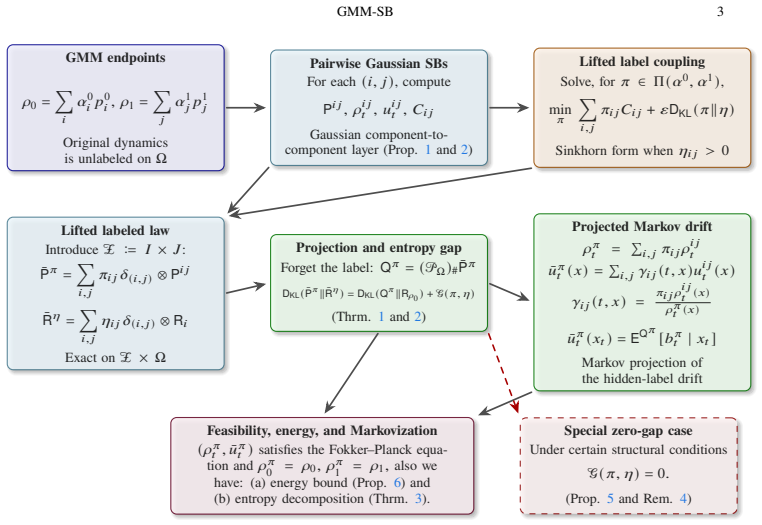
We introduce a lifted path-space construction in which each trajectory is augmented with a source--target component label. Consequently, the problem decomposes into Gaussian component-to-component Schrödinger bridges with explicit marginal, drift, and cost formulas, while the mixture-level assignment reduces to a finite-dimensional entropic coupling problem with a Sinkhorn scaling form. The projected law satisfies the original Gaussian-mixture endpoint constraints, but its relative entropy generally differs from the lifted relative entropy by a nonnegative conditional label-information gap. This gap reveals a path-space obstruction: the lifted optimizer cannot, in general, be identified with
What carries the argument
The lifted path-space construction augmenting trajectories with source-target component labels, which decomposes the mixture problem into component bridges and a finite-dimensional entropic coupling solved by Sinkhorn scaling.
If this is right
- The projected marginal flow has an explicit posterior-averaged Markov drift.
- The relative entropy of the projected law differs from the lifted relative entropy by the nonnegative label-information gap.
- A kinetic-energy upper bound holds for the projected process.
- The projection gap vanishes under a common path-potential condition.
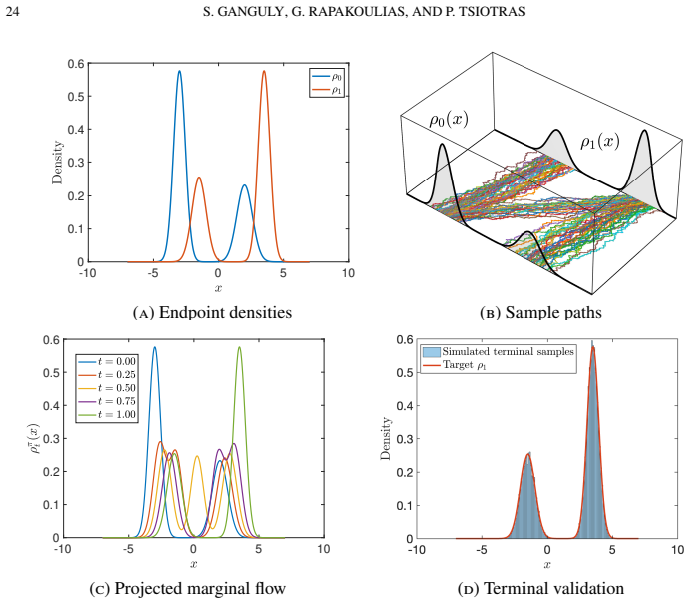
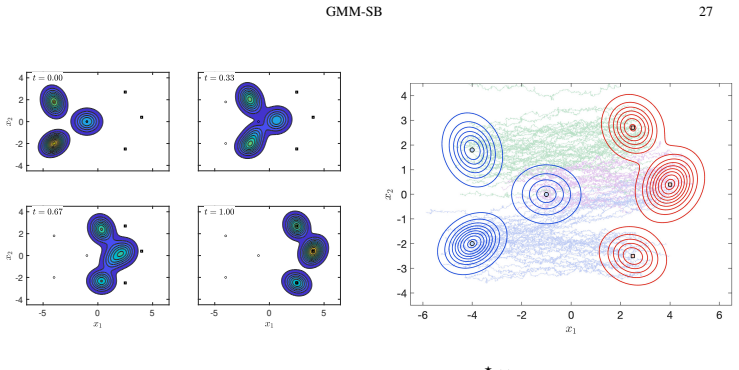
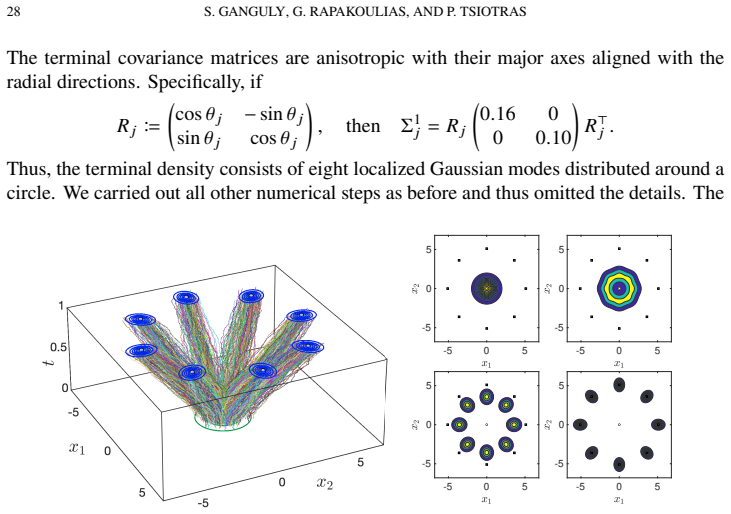
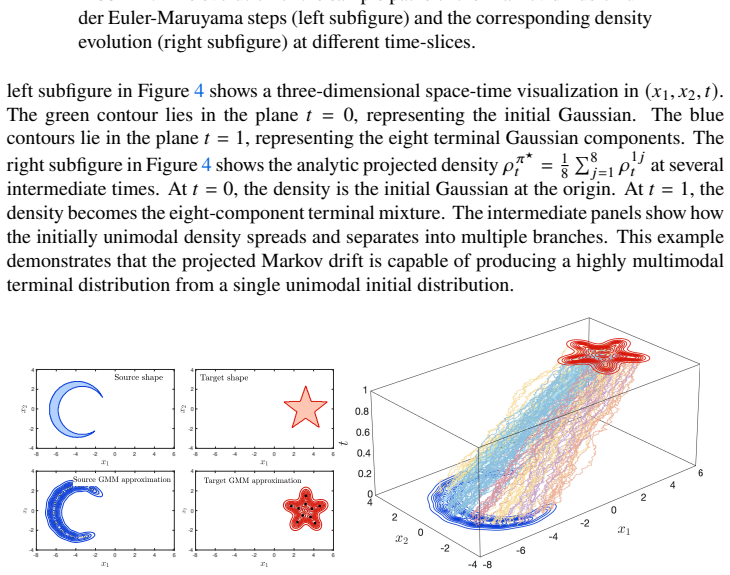
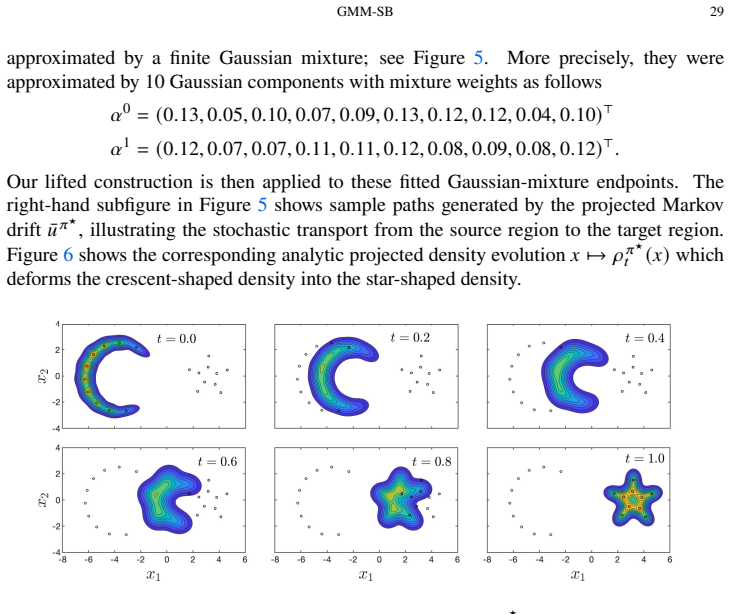
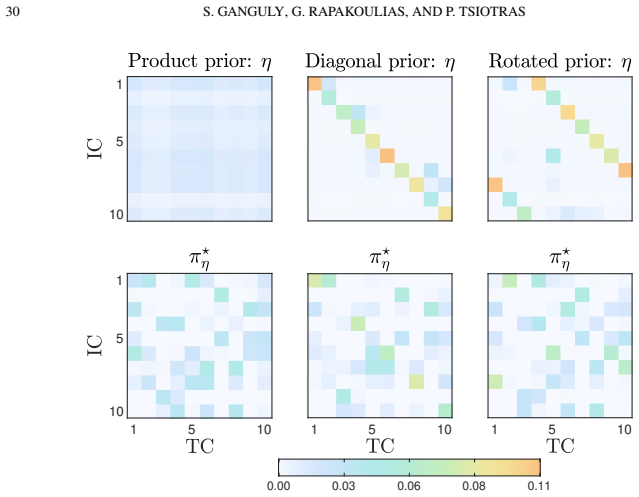
- Numerical illustrations demonstrate density and shape control under the lifted construction.
Where Pith is reading between the lines
- One may need to retain labels to achieve the true minimal entropy control for mixture endpoints rather than solving the unlabeled problem directly.
- Similar projection gaps may appear in other labeled extensions of optimal transport or stochastic control problems.
- Numerical comparison of lifted and direct solutions for low-component mixtures could quantify the typical size of the gap.
- The Sinkhorn coupling at mixture level may connect to assignment problems in other stochastic control settings with discrete choices.
Load-bearing premise
The assumption that the mixture problem decomposes into independent component-to-component Schrödinger bridges with the assignment solved by a finite-dimensional entropic coupling via Sinkhorn scaling.
What would settle it
Computing the relative entropy for both the projected lifted bridge and a direct numerical approximation of the unlabeled bridge on a two-component Gaussian mixture and checking whether they coincide or differ.
Figures
read the original abstract
We study stochastic density control between Gaussian-mixture endpoint distributions under Brownian prior dynamics. Since the direct Schr\"odinger bridge between Gaussian mixtures is generally not available in closed form, we introduce a lifted path-space construction in which each trajectory is augmented with a source--target component label. Consequently, the problem decomposes into Gaussian component-to-component Schr\"odinger bridges with explicit marginal, drift, and cost formulas, while the mixture-level assignment reduces to a finite-dimensional entropic coupling problem with a Sinkhorn scaling form. We then analyze the projection obtained by discarding or forgetting the label. By construction, the projected law satisfies the original Gaussian-mixture endpoint constraints, but its relative entropy generally differs from the lifted relative entropy by a nonnegative conditional label-information gap. This gap reveals a path-space obstruction: the lifted optimizer cannot, in general, be identified with the direct unlabeled Schr\"odinger bridge after projection. We also derive the posterior-averaged Markov drift associated with the projected marginal flow, prove a kinetic-energy upper bound, and identify a common path-potential condition under which the projection gap vanishes. Several numerical illustrations showing density and shape control are recorded for a self-contained exposition.
Editorial analysis
A structured set of objections, weighed in public.
Referee Report
Summary. The manuscript introduces a lifted path-space construction for the Schrödinger bridge problem between Gaussian mixture distributions under Brownian prior. Trajectories are augmented with source-target component labels, allowing decomposition into explicit component-to-component bridges and a Sinkhorn-solved assignment problem. The projection of the lifted optimizer satisfies the mixture marginals but differs in relative entropy from the direct bridge by a label-information gap, establishing a path-space obstruction. Additional results include the posterior-averaged drift, a kinetic-energy bound, and a vanishing condition for the gap, supported by numerical examples.
Significance. If the decomposition holds, the work offers a computationally tractable approach to Schrödinger bridges for mixtures via closed-form component solutions and finite-dimensional optimization, while highlighting an intrinsic obstruction in projecting labeled optima. The explicit drift derivation and vanishing condition provide concrete insights. The numerical illustrations demonstrate practical density and shape control. These contributions advance understanding of entropic optimal transport in mixture settings.
major comments (1)
- [Abstract] Abstract (paragraph beginning 'Consequently, the problem decomposes'): The assertion that the lifted problem decomposes into independent component-to-component Schrödinger bridges assumes that relative entropy separates across label pairs with no cross terms. Because the endpoint Gaussians overlap, the Brownian reference measure does not factorize cleanly with discrete labels; the optimal drift depends on the total evolving density, which can induce path-space correlations across components not captured by independent bridges. The constructed measure is feasible for the original marginals but need not be the global minimizer in the lifted space, so the reported label-information gap does not necessarily demonstrate an obstruction relative to the true direct Schrödinger bridge. A derivation establishing separation (or quantifying cross terms) is required to support the central claim.
Simulated Author's Rebuttal
We thank the referee for the careful reading and the insightful comment on the decomposition claim. We address the point directly below and will strengthen the manuscript accordingly.
read point-by-point responses
-
Referee: [Abstract] Abstract (paragraph beginning 'Consequently, the problem decomposes'): The assertion that the lifted problem decomposes into independent component-to-component Schrödinger bridges assumes that relative entropy separates across label pairs with no cross terms. Because the endpoint Gaussians overlap, the Brownian reference measure does not factorize cleanly with discrete labels; the optimal drift depends on the total evolving density, which can induce path-space correlations across components not captured by independent bridges. The constructed measure is feasible for the original marginals but need not be the global minimizer in the lifted space, so the reported label-information gap does not necessarily demonstrate an obstruction relative to the true direct Schrödinger bridge. A derivation establishing separation (or quantifying cross terms) is required to support the central
Authors: We agree that an explicit derivation of the separation is needed to fully support the claim. In the lifted construction the reference measure on path-label space is the mixture, over source-target label pairs (i,j), of the Brownian motion started from component i and ended at component j; labels are sampled from the discrete mixture weights independently of the path under the reference. This factorization implies that the relative entropy KL(P_lifted || R_lifted) decomposes exactly as the π-weighted sum of the individual component-bridge relative entropies plus the discrete KL on the label coupling. Consequently the optimization separates into independent Gaussian-to-Gaussian Schrödinger bridges (closed-form) and a finite-dimensional Sinkhorn problem; the optimal lifted drift is label-conditioned and does not involve the unlabeled total density. The projection onto unlabeled paths then produces the stated nonnegative label-information gap by the chain rule for relative entropy. We will insert this derivation as a new subsection in Section 2 of the revised manuscript, confirming both that the constructed measure is the global minimizer in the lifted space and that the gap constitutes a genuine obstruction to the direct bridge. revision: yes
Circularity Check
No significant circularity; derivation is self-contained construction on standard entropic OT
full rationale
The paper introduces a lifted construction augmenting paths with discrete labels, states that this yields independent Gaussian-to-Gaussian Schrödinger bridges plus a finite-dimensional Sinkhorn coupling (abstract and section on decomposition), then defines the projection gap as the nonnegative difference in relative entropy between the lifted optimizer and its label-forgetting projection. This gap is exhibited by direct comparison of the two measures and is not obtained by fitting any parameter to data or by renaming an input quantity. No equation reduces a claimed result to a self-referential definition, a fitted input called a prediction, or a load-bearing self-citation chain. The argument relies on standard properties of relative entropy, Brownian reference measures, and entropic optimal transport, all treated as external. The central obstruction claim is therefore a comparison between explicitly constructed objects rather than an identity forced by the paper's own inputs.
Axiom & Free-Parameter Ledger
axioms (2)
- standard math Standard properties of relative entropy and conditional mutual information
- domain assumption Existence of explicit marginal, drift, and cost formulas for Gaussian-to-Gaussian Schrödinger bridges under Brownian dynamics
invented entities (1)
-
Lifted trajectories augmented with source-target component labels
no independent evidence
Reference graph
Works this paper leans on
-
[1]
[ABG11] A. Arapostathis, V. S. Borkar, and M. K. Ghosh,Ergodic Control of Diffusion Processes, Encyclopedia of Mathematics and its Applications, Cambridge University Press, 2011, doi: https://doi.org/10.1017/CBO9781139003605. [AC24] D. O. Adu and Y. Chen,Schrödinger bridge over averaged systems, 2024, URL:https://arxiv. org/abs/2412.03294. [AEG26] D. O. A...
-
[2]
Springer-Verlag, Berlin, 2001, doi:https://doi.org/10.1007/978-3-662-13043-8. [MAJTC25] Y.Mei,M.Al-Jarrah,A.Taghvaei,andY.Chen,Flowmatchingforstochasticlinearcontrolsystems, Proceedings of the 7th Annual Learning for Dynamics & Control Conference (Necmiye Ozay, Laura Balzano, Dimitra Panagou, and Alessandro Abate, eds.), Proceedings of Machine Learning Re...
-
[3]
Springer-Verlag, Berlin, 1999, doi:https://doi.org/10.1007/978-3-662-06400-9. [San15] F. Santambrogio,Optimal Transport for Applied Mathematicians: Calculus of Variations, PDEs, and Modeling, Progress in Nonlinear Differential Equations and their Applications, vol. 87, Birkhäuser/Springer, Cham, 2015, doi:https://doi.org/10.1007/978-3-319-20828-2. [San23]...
discussion (0)
Sign in with ORCID, Apple, or X to comment. Anyone can read and Pith papers without signing in.