Machine-learned atomistic simulations reveal the basis of hydrogen-induced crack-plane transition in alpha-Fe
Pith reviewed 2026-06-30 00:02 UTC · model grok-4.3
The pith
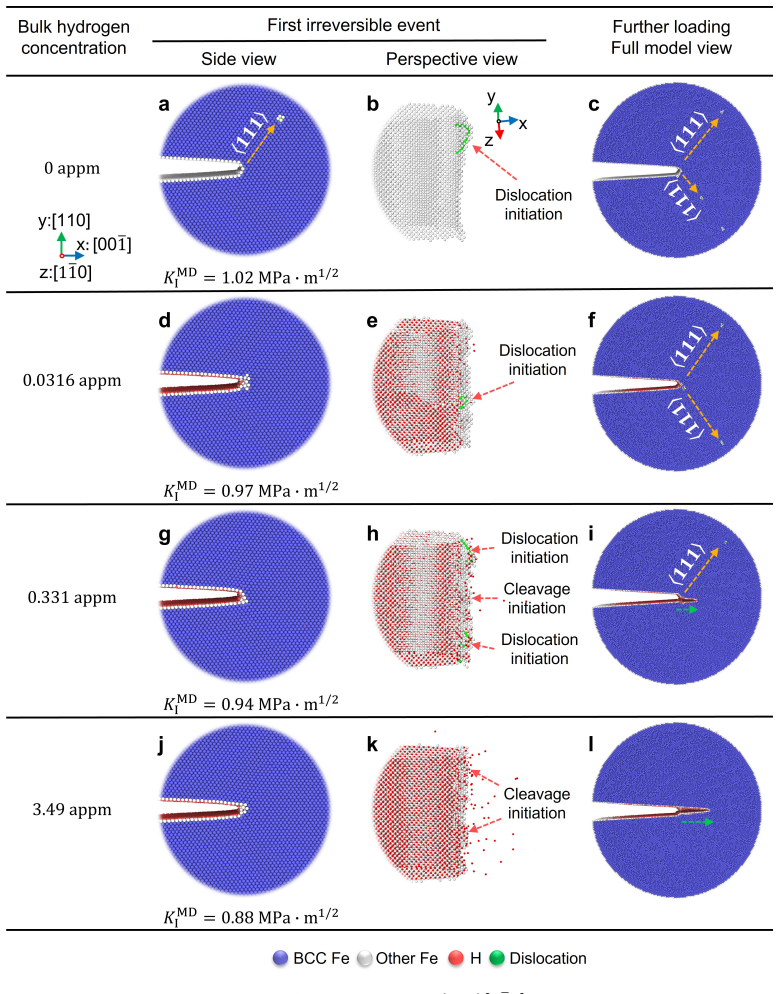
Hydrogen charging switches the (110)[1-10] crack in alpha-iron from dislocation emission to cleavage by lowering surface energy on {110} planes more than on {100}.
A machine-rendered reading of the paper's core claim, the machinery that carries it, and where it could break.
Core claim
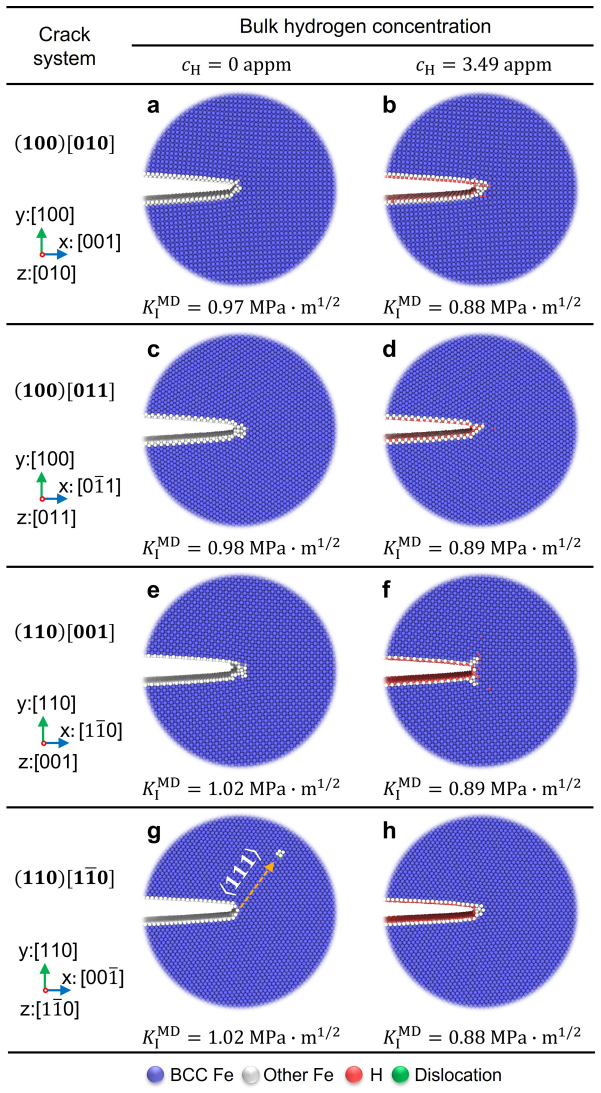
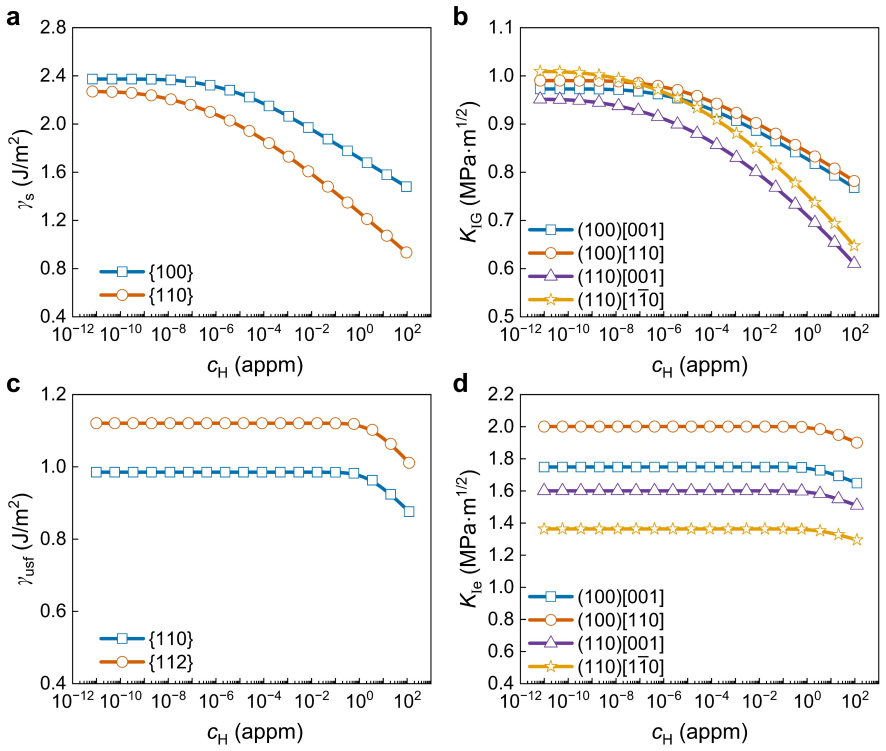
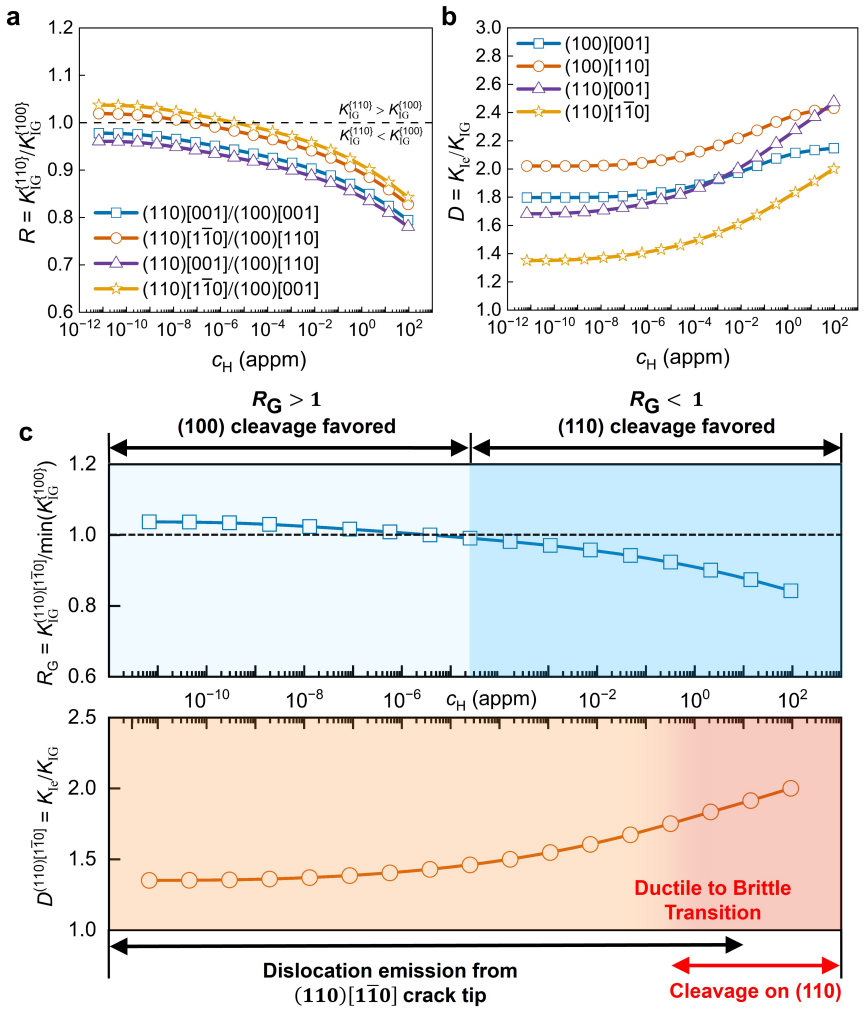
Hydrogen lowers the Griffith cleavage threshold of the {110} cleavage-plane family more strongly than that of {100}, and for the controlling (110)[1-10] crack a Rice-type descriptor shows surface-energy-controlled cleavage resistance decreases faster than unstable-stacking-fault-controlled emission resistance, producing a transition from dislocation emission in pure Fe to cleavage under hydrogen charging.
What carries the argument
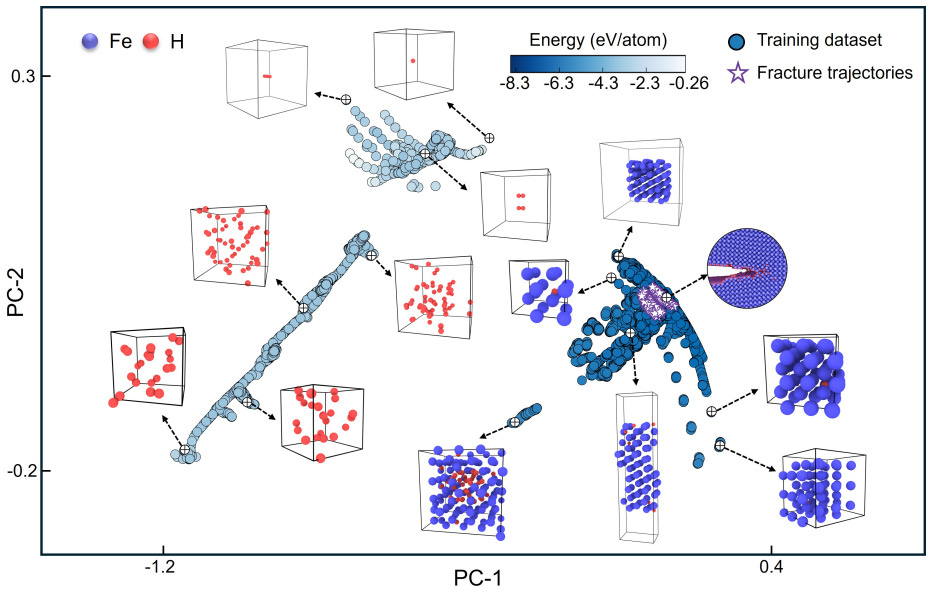
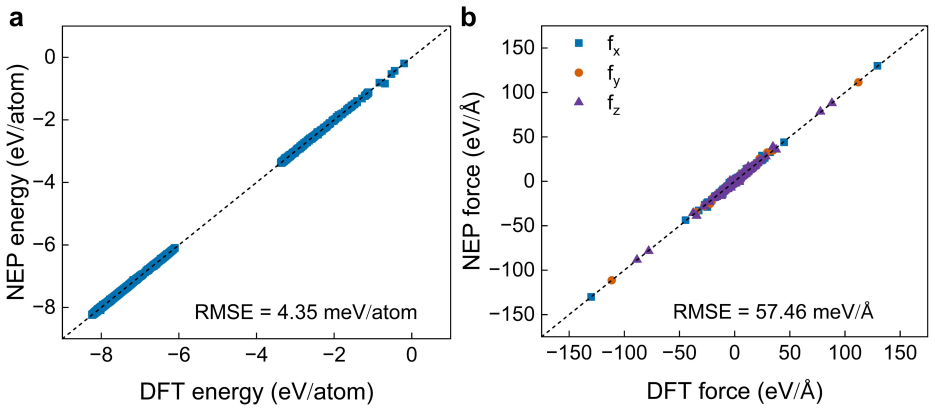
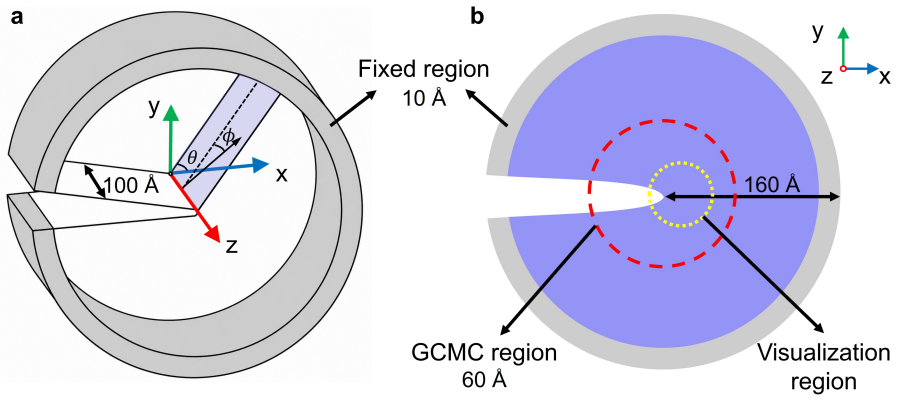
Neural-network potential for α-Fe/H trained on DFT data, used inside three-dimensional MD simulations coupled to grand-canonical Monte Carlo that lets the crack-tip region exchange hydrogen with a reservoir at fixed chemical potential.
If this is right
- Three of the four crack systems remain cleavage-dominated with or without hydrogen.
- Only the (110)[1-10] orientation changes its dominant mechanism under hydrogen charging.
- Hydrogen reduces the Griffith energy of {110} planes more than {100} planes.
- For the controlling crack, cleavage resistance drops faster than emission resistance according to the Rice descriptor.
Where Pith is reading between the lines
- The same energy ranking may explain why quasi-cleavage facets in ferritic steels often show a mixture of {100} and {110} planes rather than purely {100}.
- Crystal orientations that align cracks with the (110)[1-10] system could be more susceptible to hydrogen-assisted cleavage at moderate hydrogen levels.
- The result suggests that alloying or processing steps that alter hydrogen segregation energetics on {110} versus {100} surfaces could shift the transition threshold.
Load-bearing premise
The neural-network potential correctly ranks the relative energies of cleavage surfaces, unstable stacking faults, and hydrogen segregation at the crack tip across the four examined crack systems.
What would settle it
An experiment or higher-accuracy calculation that measures whether the (110)[1-10] crack emits dislocations or cleaves when the hydrogen chemical potential is raised to the value used in the simulations.
Figures
read the original abstract
Hydrogen-related fracture in body-centered cubic Fe and ferritic steels often appears as transgranular quasi-cleavage rather than purely intergranular failure, especially at low to moderate hydrogen contents. Fractography has suggested that hydrogen may change the dominant cleavage faceting from {100} toward {110}, but atomic-scale evidence for this possible crack-plane transition remains unclear. Here we construct an efficient neural-network potential for {\alpha}-Fe/H and combine large-scale, three-dimensional molecular dynamics with grand-canonical Monte Carlo (GCMC), allowing the near-tip crack-surface region and crack tip within a defined GCMC domain to exchange hydrogen with a reservoir at fixed chemical potential. A comparison of four crack systems identifies the controlling response: (100)[010], (100)[011], and (110)[001] remain cleavage-dominated, whereas the (110)[1-10] crack changes from dislocation emission in pure Fe to cleavage under hydrogen charging. The energetic origin is twofold. Hydrogen lowers the Griffith cleavage threshold of the {110} cleavage-plane family more strongly than that of {100}, and, for the controlling crack, a Rice-type energetic descriptor indicates that the surface-energy-controlled cleavage resistance decreases faster than the unstable-stacking-fault-controlled emission resistance, consistent with a weakened dislocation-emission shield. These results provide a thermodynamically consistent atomistic basis for a hydrogen-induced transgranular crack-plane transition in Fe.
Editorial analysis
A structured set of objections, weighed in public.
Referee Report
Summary. The manuscript develops a neural-network potential for the α-Fe/H system and performs large-scale 3D MD simulations coupled to GCMC to model hydrogen exchange at the crack tip. It compares four crack systems and reports that (100)[010], (100)[011], and (110)[001] remain cleavage-dominated while (110)[1-10] switches from dislocation emission (pure Fe) to cleavage under hydrogen charging. The origin is attributed to hydrogen lowering the Griffith threshold more strongly for {110} planes than {100} and to a Rice-type descriptor in which surface-energy-controlled cleavage resistance decreases faster than unstable-stacking-fault-controlled emission resistance.
Significance. If the potential rankings hold, the work supplies a thermodynamically consistent atomistic mechanism for the experimentally observed shift toward {110} faceting in hydrogen-assisted transgranular fracture of ferritic steels. The GCMC treatment of hydrogen chemical potential is a methodological strength that avoids ad-hoc hydrogen placement.
major comments (2)
- [Neural-network potential development and validation subsection] The central claim (abstract and results section on the four crack systems) rests on the NN potential correctly ordering Griffith cleavage energies for {100} vs. {110} families with and without H, and the Rice descriptor (surface energy vs. unstable stacking fault energy) for the (110)[1-10] orientation. No validation metrics, test-set errors, or direct DFT comparisons for these specific quantities are reported; any reversal in the relative rankings would render the reported transition an artifact of the potential rather than a physical result.
- [Simulation setup and GCMC domain description] No sensitivity tests or error propagation on the GCMC domain size, boundary conditions, or chemical-potential value are presented; these parameters directly control the hydrogen coverage at the crack tip that drives the claimed transition.
minor comments (2)
- The four crack systems are introduced without a summary table of their orientations, Burgers vectors, and expected slip systems; adding such a table would improve readability.
- The Rice descriptor is invoked but its precise definition (which surface energy and which unstable stacking fault) is not written explicitly; an equation would remove ambiguity.
Simulated Author's Rebuttal
We thank the referee for the constructive feedback and for recognizing the methodological strengths of the GCMC-coupled MD approach. We address each major comment below and will revise the manuscript accordingly to provide the requested validations and sensitivity analyses.
read point-by-point responses
-
Referee: [Neural-network potential development and validation subsection] The central claim (abstract and results section on the four crack systems) rests on the NN potential correctly ordering Griffith cleavage energies for {100} vs. {110} families with and without H, and the Rice descriptor (surface energy vs. unstable stacking fault energy) for the (110)[1-10] orientation. No validation metrics, test-set errors, or direct DFT comparisons for these specific quantities are reported; any reversal in the relative rankings would render the reported transition an artifact of the potential rather than a physical result.
Authors: We agree that direct DFT benchmarks for the Griffith cleavage energies (with and without H) and the relevant unstable stacking fault energies are necessary to substantiate the ordering and the Rice-type descriptor. In the revised manuscript we will add a dedicated validation subsection that reports (i) test-set errors of the NN potential on these quantities, (ii) direct DFT comparisons for surface energies of the {100} and {110} families at representative hydrogen coverages, and (iii) DFT versus NN values for the unstable stacking fault energies that enter the Rice descriptor. These additions will confirm that the relative rankings are preserved and not an artifact of the potential. revision: yes
-
Referee: [Simulation setup and GCMC domain description] No sensitivity tests or error propagation on the GCMC domain size, boundary conditions, or chemical-potential value are presented; these parameters directly control the hydrogen coverage at the crack tip that drives the claimed transition.
Authors: We concur that robustness to GCMC domain size, boundary conditions, and chemical-potential choice must be demonstrated. The revised manuscript will include a new sensitivity-analysis subsection that reports results obtained with (i) doubled GCMC domain volumes, (ii) chemical potentials varied by ±0.1 eV around the nominal value, and (iii) alternative boundary-condition treatments. These tests will show that the hydrogen-induced transition for the (110)[1-10] crack system persists, thereby confirming that the reported behavior is not sensitive to the specific parameter choices. revision: yes
Circularity Check
No circularity; results emerge from explicit dynamics
full rationale
The paper trains an NN potential on DFT configurations (external data) then performs large-scale MD+GCMC simulations. The reported crack-plane transition for the (110)[1-10] system and the relative Griffith/Rice descriptor rankings are direct outputs of the dynamics at fixed chemical potential, not quantities fitted inside the same run or defined in terms of themselves. No self-definitional steps, fitted-input predictions, or load-bearing self-citation chains appear in the derivation chain. The central claim remains independent of its inputs.
Axiom & Free-Parameter Ledger
axioms (1)
- domain assumption The neural-network potential reproduces the correct ordering of cleavage energies and unstable stacking-fault energies for the examined crack systems under hydrogen loading.
Reference graph
Works this paper leans on
-
[1]
Hydrogen-induced cracking in iron: Morphology and crack path dependence.Metallurgical transactions1,3143–3150 (1970)
Bernstein, I. Hydrogen-induced cracking in iron: Morphology and crack path dependence.Metallurgical transactions1,3143–3150 (1970)
1970
-
[2]
& Takai, K
Ogawa, K., Matsumoto, Y., Suzuki, H. & Takai, K. Hydrogen embrittlement susceptibility evaluation of tempered martensitic steels showing different fracture surface morphologies.ISIJ International59, 1705–1714 (2019)
2019
-
[3]
& Tsuji, N
Okada, K., Shibata, A., Matsumiya, H. & Tsuji, N. Origin of serrated markings on the hydrogen related quasi-cleavage fracture in low-carbon steel with ferrite microstructure.ISIJ International62,2081–2088 (2022)
2081
-
[4]
& Tsuji, N
Okada, K., Shibata, A. & Tsuji, N. Characteristics and formation mechanism of serrated markings on the hydrogen-related quasi-cleavage fracture in as quenched low-carbon martensitic steel.Scripta Materialia234,115568 (2023)
2023
-
[5]
& Tsuji, N
Okada, K., Shibata, A., Gong, W. & Tsuji, N. Effect of hydrogen on evolution of deformation mi- crostructure in low-carbon steel with ferrite microstructure.Acta Materialia225,117549 (2022). 22
2022
-
[6]
& Christien, F
Bestautte, J., Kalácska, S., Béchet, D., Obadia, Z. & Christien, F. Investigation of quasi-cleavage in a hydrogen charged maraging stainless steel.Corrosion Science218,111163 (2023)
2023
-
[7]
Möller, J. J. & Bitzek, E. Comparative study of embedded atom potentials for atomistic simulations of fracture inα-iron.Modelling and Simulation in Materials Science and Engineering22,045002 (2014)
2014
-
[8]
& Mori, H
Suzudo, T., Ebihara, K.-i., Tsuru, T. & Mori, H. Cleavages along{110}in bcc iron emit dislocations from the curved crack fronts.Scientific Reports12,19701 (2022)
2022
-
[9]
& Maresca, F
Zhang, L., Csányi, G., Van Der Giessen, E. & Maresca, F. Atomistic fracture in bcc iron revealed by active learning of Gaussian approximation potential.npj Computational Materials9,217 (2023)
2023
-
[10]
Meng, F.-S.et al.General-purpose neural network interatomic potential for theα-iron and hydrogen bi- nary system: Toward atomic-scale understanding of hydrogen embrittlement.Physical Review Materials 5,113606 (2021)
2021
-
[11]
& Ogata, S
Zhang, S., Meng, F., Fu, R. & Ogata, S. Highly efficient and transferable interatomic potentials forα- iron andα-iron/hydrogen binary systems using deep neural networks.Computational Materials Science 235,112843 (2024)
2024
-
[12]
& Curtin, W
Song, J. & Curtin, W. A nanoscale mechanism of hydrogen embrittlement in metals.Acta Materialia 59,1557–1569 (2011)
2011
-
[13]
& Curtin, W
Song, J. & Curtin, W. Atomic mechanism and prediction of hydrogen embrittlement in iron.Nature materials12,145–151 (2013)
2013
-
[14]
Fan, Z.et al.GPUMD: A package for constructing accurate machine-learned potentials and performing highly efficient atomistic simulations.The Journal of Chemical Physics157(2022)
2022
-
[15]
Xu, K.et al.GPUMD 4.0: a high-performance molecular dynamics package for versatile materials sim- ulations with machine-learned potentials.Materials Genome Engineering Advances3,e70028 (2025)
2025
-
[16]
S., Hume-Rothery, W
Basinski, Z. S., Hume-Rothery, W. & Sutton, A. The lattice expansion of iron.Proceedings of the Royal Society of London. Series A. Mathematical and Physical Sciences229,459–467 (1955)
1955
-
[17]
J., Agosta, D., Leisure, R
Adams, J. J., Agosta, D., Leisure, R. & Ledbetter, H. Elastic constants of monocrystal iron from 3to500K.Journal of applied physics100(2006)
2006
-
[18]
& Fu, C.-C
Hayward, E. & Fu, C.-C. Interplay between hydrogen and vacancies inα-Fe.Physical Review B– Condensed Matter and Materials Physics87,174103 (2013)
2013
-
[19]
Wang, T.et al.Hydrogen adsorption structures and energetics on iron surfaces at high coverage.The Journal of Physical Chemistry C118,4181–4188 (2014). 23
2014
-
[20]
Physical Review B27,5257 (1983)
De Schepper, L.et al.Positron annihilation on pure and carbon-dopedα-iron in thermal equilibrium. Physical Review B27,5257 (1983)
1983
-
[21]
& Yamaguchi, M
Itakura, M., Kaburaki, H. & Yamaguchi, M. First-principles study on the mobility of screw dislocations in bcc iron.Acta Materialia60,3698–3710 (2012)
2012
-
[22]
Dezerald, L.et al.Ab initio modeling of the two-dimensional energy landscape of screw dislocations in bcc transition metals.Physical Review B89,024104 (2014)
2014
-
[23]
Wakeda, M.et al.Chemical misfit origin of solute strengthening in iron alloys.Acta Materialia131, 445–456 (2017)
2017
-
[24]
Dislocations and cracks in anisotropic elasticity.Philosophical magazine3,625–646 (1958)
Stroh, A. Dislocations and cracks in anisotropic elasticity.Philosophical magazine3,625–646 (1958)
1958
-
[25]
& Jin, Z.Fracture mechanics(Academic press, 2011)
Sun, C.-T. & Jin, Z.Fracture mechanics(Academic press, 2011)
2011
-
[26]
Rice, J. R. Dislocation nucleation from a crack tip: an analysis based on the Peierls concept.Journal of the Mechanics and Physics of Solids40,239–271 (1992)
1992
-
[27]
& Beltz, G
Sun, Y. & Beltz, G. E. Dislocation nucleation from a crack tip: a formulation based on anisotropic elasticity.Journal of the Mechanics and Physics of Solids42,1905–1932 (1994)
1905
-
[28]
& Curtin, W
Andric, P. & Curtin, W. A. Atomistic modeling of fracture.Modelling and Simulation in Materials Science and Engineering27,013001 (2019)
2019
-
[29]
& Olsson, P
Hiremath, P., Melin, S. & Olsson, P. A. Phosphorus driven embrittlement and atomistic crack behavior in tungsten grain boundaries.Computational Materials Science244,113194 (2024)
2024
-
[30]
& De Koning, M
Freitas, R., Asta, M. & De Koning, M. Nonequilibrium free-energy calculation of solids using LAMMPS. Computational Materials Science112,333–341 (2016). 24
2016
discussion (0)
Sign in with ORCID, Apple, or X to comment. Anyone can read and Pith papers without signing in.