Integrated photon-pair sources on periodically poled thin-film lithium tantalate
Pith reviewed 2026-06-29 23:59 UTC · model grok-4.3
The pith
Periodically poled thin-film lithium tantalate waveguides generate photon pairs through spontaneous parametric down-conversion.
A machine-rendered reading of the paper's core claim, the machinery that carries it, and where it could break.
Core claim
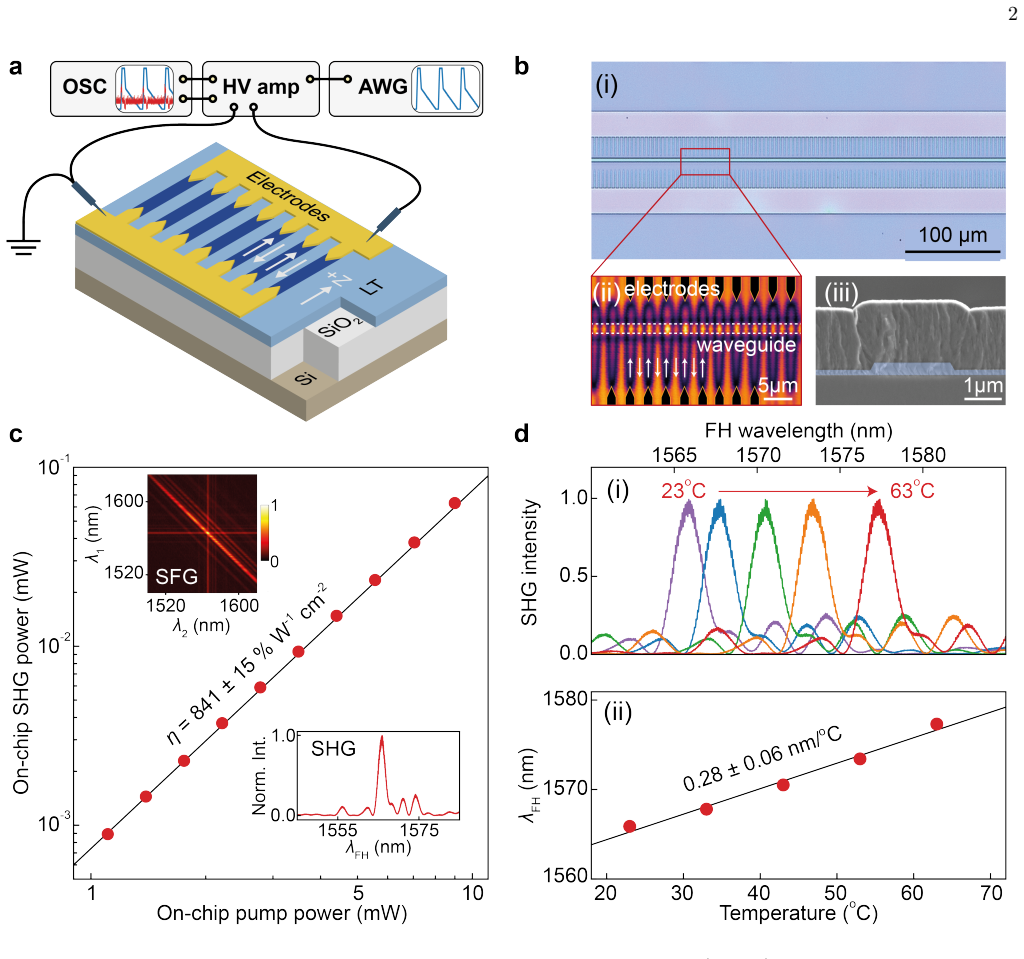
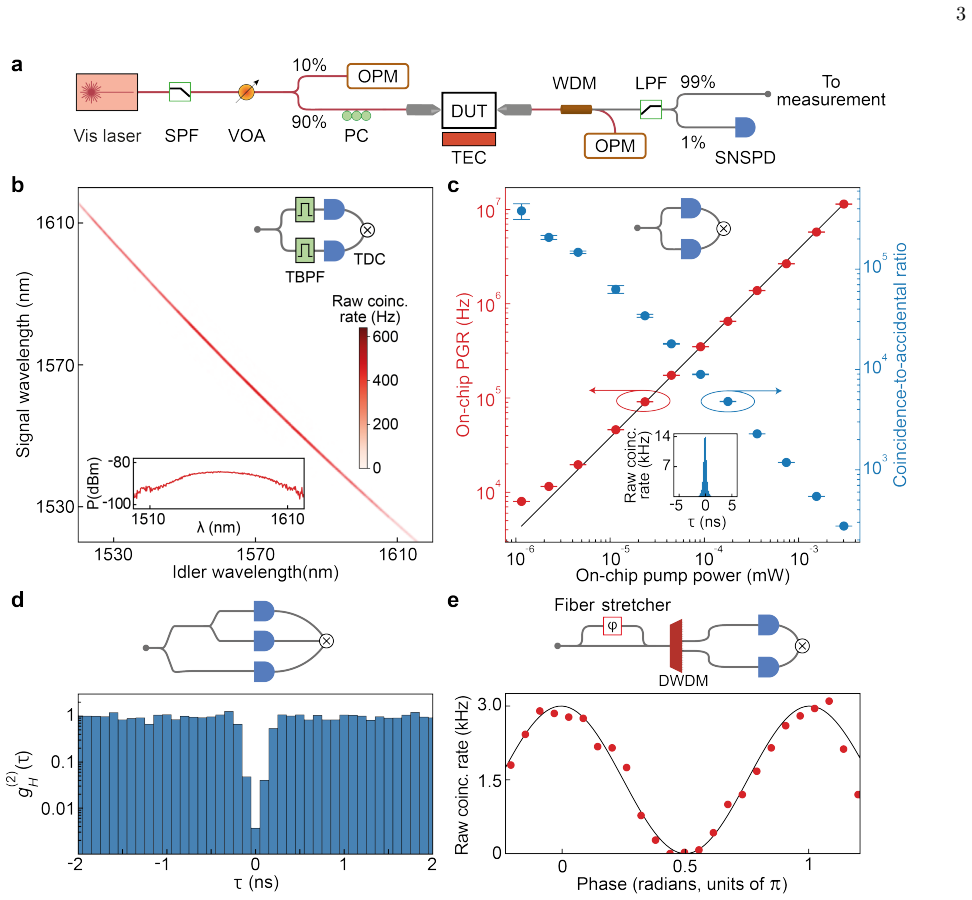
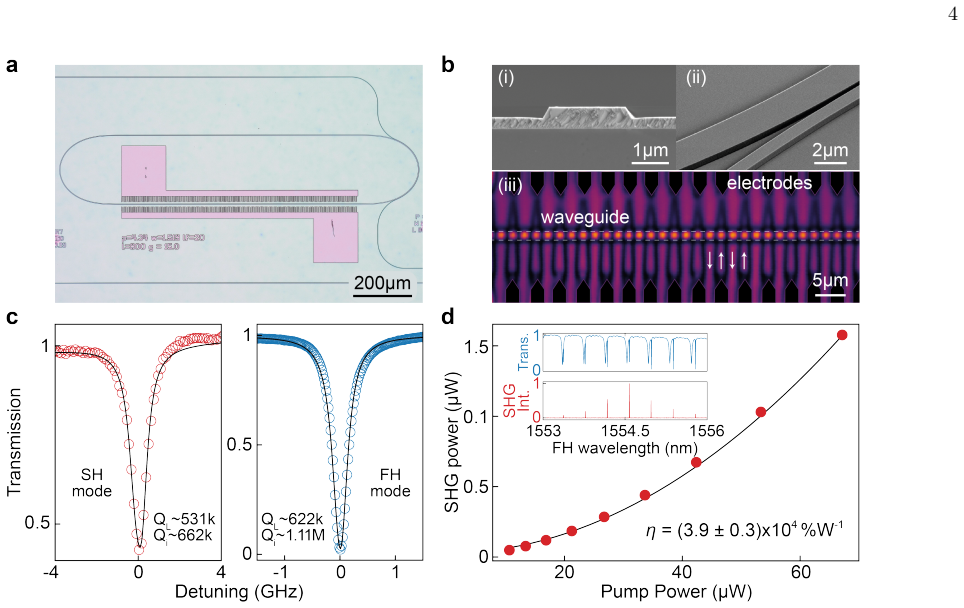
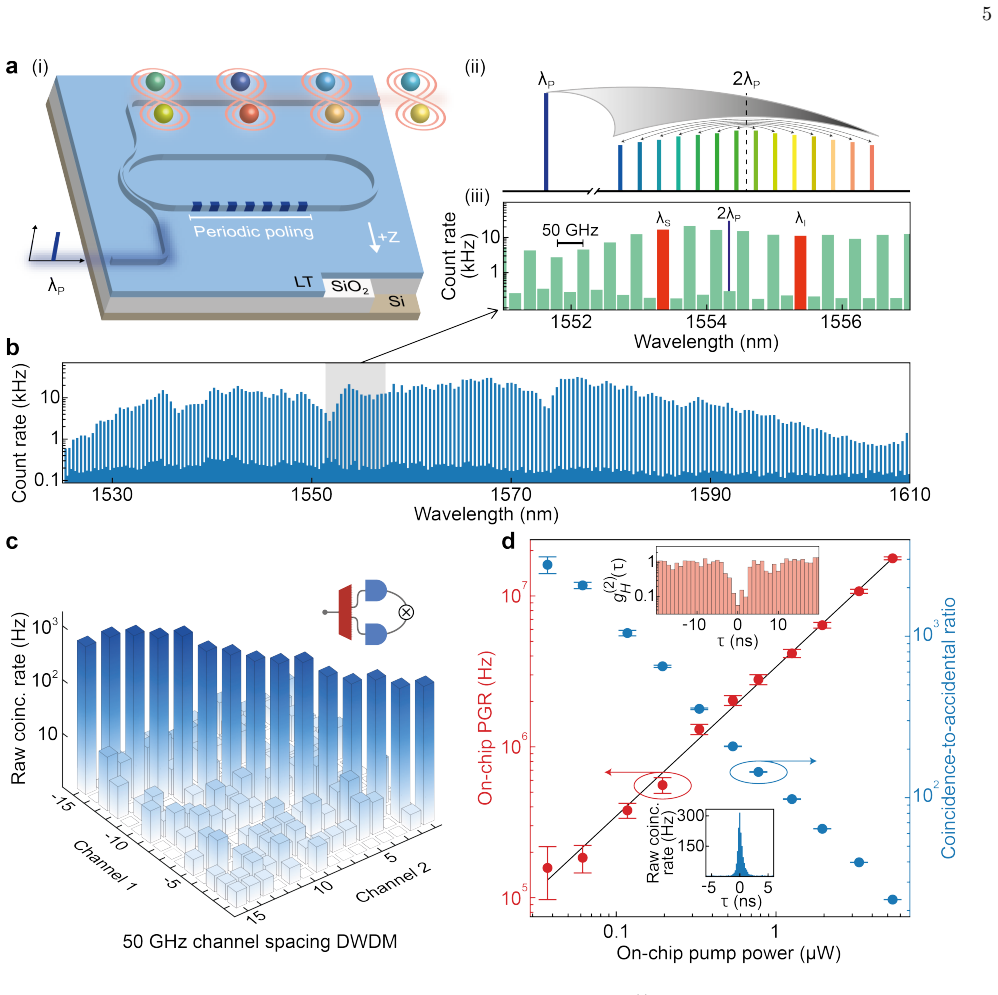
By combining high-quality periodic poling with low-loss nanophotonic waveguides on thin-film lithium tantalate, the authors realize SPDC photon-pair sources in both traveling-wave and resonant configurations. Straight waveguides deliver broadband generation at 2.1 GHz mW^{-1} with CAR up to 3.8 times 10 to the fifth, g_H^{(2)}(0) of 0.0018, and 98.9 percent Franson visibility. Racetrack resonators produce a broad quantum frequency comb across telecom C and L bands with 11 GHz mW^{-1} GHz^{-1} spectral brightness.
What carries the argument
Periodically poled thin-film lithium tantalate nanophotonic waveguides that supply quasi-phase matching for spontaneous parametric down-conversion in both straight and resonant geometries.
If this is right
- Straight waveguides deliver broadband photon pairs at 2.1 GHz mW^{-1} efficiency with CAR reaching 3.8 times 10 to the fifth.
- Racetrack resonators produce a quantum frequency comb spanning C and L bands with 11 GHz mW^{-1} GHz^{-1} spectral brightness.
- Heralded single-photon purity reaches g_H^{(2)}(0) equal to 0.0018 and time-energy entanglement visibility reaches 98.9 percent.
- The metrics position TFLT as competitive with other chi(2) integrated platforms for quantum light generation.
Where Pith is reading between the lines
- TFLT's reported high damage threshold could support higher pump powers in the same footprint than platforms limited by photorefractive effects.
- The frequency comb structure naturally supports wavelength-multiplexed quantum communication without additional filtering stages.
- Monolithic integration of these sources with other TFLT components could reduce loss in more complex quantum photonic circuits.
Load-bearing premise
The measured coincidences and correlations come only from SPDC enabled by the periodic poling in the TFLT structures, not from fabrication defects, fluorescence, or other noise.
What would settle it
Comparable coincidence rates measured in otherwise identical but unpoled TFLT waveguides would show that the reported photon pairs do not require the periodic poling.
Figures
read the original abstract
Chip-integrated photon-pair sources based on spontaneous parametric down-conversion (SPDC) have emerged as a promising solution for scalable quantum light generation. Thin-film lithium tantalate (TFLT) is a compelling $\chi^{(2)}$ platform, combining strong nonlinearity with a high optical-damage threshold, weak photorefractive response, and ferroelectricity that enables quasi-phase matching. However, SPDC-based photon-pair generation on TFLT has not yet been demonstrated. Here, we combine high-quality periodic poling with low-loss nanophotonic waveguides to realize photon-pair sources on TFLT in both traveling-wave and resonant configurations. In periodically poled straight waveguides, we achieve broadband photon-pair generation with high efficiency ($2.1~\mathrm{GHz}~\mathrm{mW}^{-1}$) and coincidence-to-accidental ratio (up to $3.8\times10^{5}$). We further confirm high-purity single-photon operation via heralded second-order correlation ($g^{(2)}_\mathrm{H}(0) = 0.0018 \pm 0.0002$) and high-fidelity time-energy entanglement through Franson interference (visibility of $98.9 \pm 0.5\%$). In periodically poled racetrack resonators, we map out a broad quantum frequency comb spanning the telecom C- and L-bands. By isolating individual frequency-correlated pairs, we measure a high spectral brightness of $11~\mathrm{GHz}~\mathrm{mW}^{-1}~\mathrm{GHz}^{-1}$. These results are competitive with the state of the art across $\chi^{(2)}$ integrated platforms, positioning TFLT as a strong contender for integrated quantum light sources, with applications in wavelength-multiplexed quantum communications and photonic quantum information processing.
Editorial analysis
A structured set of objections, weighed in public.
Referee Report
Summary. The manuscript reports the first demonstration of SPDC-based photon-pair sources on periodically poled thin-film lithium tantalate (TFLT) in both straight nanophotonic waveguides and racetrack resonators. Key results include broadband generation with 2.1 GHz mW^{-1} efficiency and CAR up to 3.8×10^5 in waveguides, plus g^{(2)}_H(0) = 0.0018 ± 0.0002 and 98.9 ± 0.5% Franson visibility; resonators yield a quantum frequency comb across C/L bands with 11 GHz mW^{-1} GHz^{-1} spectral brightness. Metrics are supported by power dependence, unpoled controls, and correlation measurements.
Significance. If the reported metrics and controls hold, this establishes TFLT as a competitive χ^{(2)} platform for integrated quantum light sources, with advantages in optical damage threshold and photorefractive stability over related materials. The dual waveguide/resonator geometries and high CAR/purity/entanglement values position the work for applications in multiplexed quantum communications. The experimental attribution to SPDC via multiple independent checks is a strength.
minor comments (3)
- [§4] The efficiency value of 2.1 GHz mW^{-1} (abstract and §4) should explicitly state the collection efficiency, coupling losses, and detection efficiency used in the normalization to allow direct comparison with other platforms.
- [Figure 3] Figure 3 (or equivalent) showing the quantum frequency comb would benefit from an inset or table listing the measured FSR, linewidths, and pair isolation method to clarify how individual frequency-correlated pairs were selected.
- [§5] The manuscript should add a brief comparison table (perhaps in §5) of the reported metrics against recent TFLT or LN thin-film SPDC results to quantify competitiveness.
Simulated Author's Rebuttal
We thank the referee for their positive assessment of our work demonstrating the first SPDC photon-pair sources on TFLT, including the reported efficiencies, CAR, purity, entanglement visibility, and spectral brightness. The recommendation for minor revision is noted, but the report contains no specific major comments requiring response.
Circularity Check
No significant circularity
full rationale
The paper is a purely experimental demonstration of SPDC photon-pair sources on poled TFLT, reporting directly measured quantities (efficiency 2.1 GHz mW^{-1}, CAR up to 3.8e5, g^{(2)}_H(0)=0.0018, Franson visibility 98.9%, spectral brightness 11 GHz mW^{-1} GHz^{-1}) from waveguide and resonator devices. No derivation chains, equations, fitted parameters presented as predictions, or self-citations that bear central claims exist in the provided text. The results rest on experimental controls, spectra, and comparisons to unpoled devices, making the report self-contained against external benchmarks with no reduction of outputs to inputs by construction.
Axiom & Free-Parameter Ledger
axioms (1)
- domain assumption Standard assumptions of quasi-phase matching and SPDC in periodically poled χ(2) materials apply to TFLT.
Reference graph
Works this paper leans on
-
[1]
Integrated photon-pair sources on periodically poled thin-film lithium tantalate
These advantages have driven rapid advancement in the thin-film lithium tantalate (TFLT) platform, including demonstrations of low-loss waveguides31, high-speed electro-optic modulators 27,32, and efficientχ (2) nonlinear frequency conversion 28,33–35. Despite impressive progress in classical photonics, the platform’s potential for quantum light generatio...
work page internal anchor Pith review Pith/arXiv arXiv 2026
-
[2]
In this context, the weak pho- torefractive response and high optical damage threshold of LT provide key advantages, enabling stable operation in regimes that are challenging for otherχ (2) platforms. Looking forward, the combination of wafer-scale TFLT fabrication, strongχ (2) nonlinearity, high refractive- index contrast, and electro-optic functionality...
discussion (0)
Sign in with ORCID, Apple, or X to comment. Anyone can read and Pith papers without signing in.