Dissipative preparation of injective tensor network states
Pith reviewed 2026-06-30 00:43 UTC · model grok-4.3
The pith
Geometrically local dissipative processes prepare any injective tensor network state as their unique steady state in logarithmic time.
A machine-rendered reading of the paper's core claim, the machinery that carries it, and where it could break.
Core claim
The authors demonstrate that the injectivity property of the tensors permits construction of a geometrically local Lindbladian (or discrete channel) for which the target tensor network state is the unique fixed point; the resulting spectral gap of the generator guarantees that the system converges to within ε of the N-site target in O(log(N/ε)) time for every injective MPS and for every highly injective higher-dimensional tensor network state.
What carries the argument
A geometrically local dissipative generator (continuous Lindbladian or discrete-time map) engineered so that the injective tensor network state is its unique steady state, with the injectivity condition ensuring a sufficiently large spectral gap for rapid mixing.
If this is right
- Every injective one-dimensional matrix product state reaches ε accuracy after O(log(N/ε)) evolution time.
- Highly injective tensor network states in two and higher dimensions exhibit rapid mixing under the constructed processes, again in O(log(N/ε)) time.
- The approach yields a polynomial speedup relative to known unitary protocols on lattices and an exponential speedup on general bounded-degree graphs.
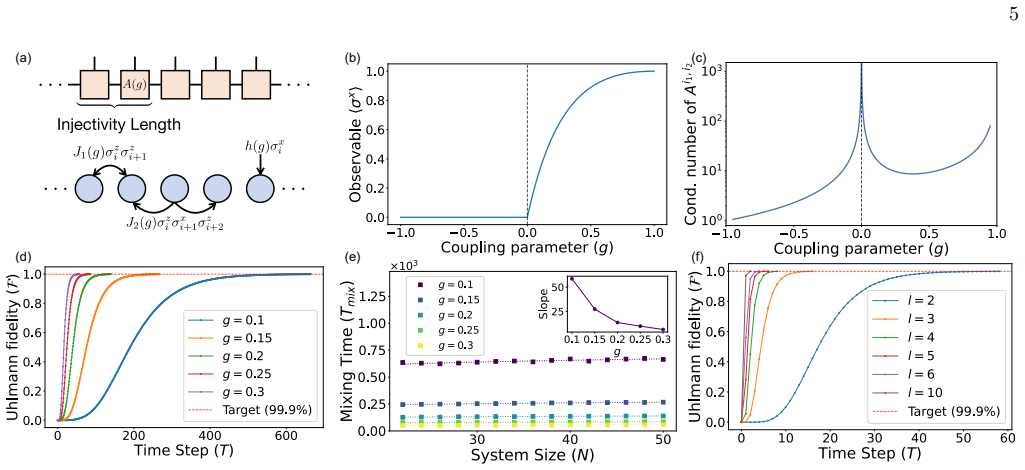
- Numerical evidence indicates that the dissipative protocol can still prepare the target state rapidly even when the tensors fall outside the strict high-injectivity regime.
Where Pith is reading between the lines
- The same local dissipation might remain effective for states that are only approximately injective or that arise as ground states of gapped Hamiltonians.
- On noisy intermediate-scale quantum hardware the inherent robustness of dissipative preparation could reduce the overhead of active error correction during state preparation.
- The construction suggests a systematic route for turning tensor-network injectivity into fast-mixing open-system dynamics on arbitrary graphs.
- One could test whether relaxing geometric locality while preserving the steady-state condition further improves the scaling.
Load-bearing premise
The local tensors of the network must satisfy the injectivity (or high-injectivity) condition, which is required both for uniqueness of the steady state and for the logarithmic mixing-time bound.
What would settle it
An explicit injective tensor network state on N sites together with a concrete lower bound showing that every geometrically local dissipative process having that state as unique steady state requires mixing time super-logarithmic in N (or in 1/ε) would falsify the claimed scaling.
Figures
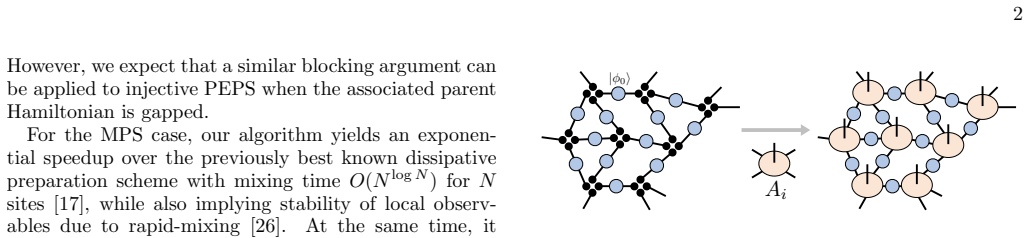
read the original abstract
The preparation of tensor network states is a fundamental prerequisite for a wide range of quantum simulation tasks. While many unitary protocols for preparing these states have been investigated, dissipative state preparation provides a powerful alternative since it can be robust to noise and initialization errors. In this paper, we construct both continuous-time and discrete-time geometrically local dissipative processes whose unique steady state is a given injective tensor network state. Our method prepares all injective matrix product states on $N$ sites to an error $\varepsilon$ in $O(\log (N/\varepsilon))$ time, yielding an exponential improvement over previously known dissipative preparation schemes. For two and higher-dimensional tensor network states, we prove that when the tensors of the state are \emph{highly injective}, the constructed dissipative processes are rapid-mixing i.e., they prepare a state $\varepsilon$-close to the $N$-site target state in $O( \log (N/\varepsilon))$ time. For these states, our approach provides a polynomial speedup over known unitary methods for states defined on lattices and an exponential speedup for states on general bounded-degree graphs. We corroborate our theoretical results with numerical studies that indicate that the dissipative protocol can rapidly prepares states outside the high-injectivity assumption.
Editorial analysis
A structured set of objections, weighed in public.
Referee Report
Summary. The manuscript constructs geometrically local dissipative processes (continuous-time and discrete-time) whose unique steady state is any given injective tensor network state. For injective matrix product states on N sites it proves preparation to error ε in O(log(N/ε)) time, an exponential improvement over prior dissipative schemes. For two- and higher-dimensional tensor networks whose tensors satisfy a high-injectivity condition, the constructed processes are rapid-mixing and achieve the same O(log(N/ε)) scaling; this yields a polynomial speedup relative to known unitary protocols on lattices and an exponential speedup on general bounded-degree graphs. Numerical experiments are presented to indicate that the protocol remains effective even when the high-injectivity assumption is relaxed.
Significance. If the proofs are correct, the result supplies a substantial improvement in the efficiency of dissipative preparation of tensor-network states, which are ubiquitous in quantum simulation and many-body physics. The logarithmic scaling under a well-defined injectivity condition, together with the explicit construction of both continuous- and discrete-time generators, is a clear technical advance. The numerical evidence of robustness beyond the strict assumption adds practical value.
minor comments (3)
- [Abstract] The abstract contains an awkward line break inside the sentence describing the higher-dimensional result; this should be corrected for readability.
- The precise quantitative comparison to previous dissipative preparation times (the claimed exponential improvement) should be stated explicitly, with citations, in the introduction or a dedicated comparison subsection.
- Notation for the high-injectivity condition and the associated spectral-gap lower bound should be introduced once and used consistently throughout the proofs and statements of theorems.
Simulated Author's Rebuttal
We thank the referee for their positive assessment of the manuscript, accurate summary of the results, and recommendation for minor revision. The report correctly identifies the exponential improvement in dissipative preparation time for 1D injective MPS and the rapid mixing under high injectivity in higher dimensions.
Circularity Check
No significant circularity in derivation chain
full rationale
The paper explicitly constructs new continuous- and discrete-time geometrically local dissipative processes with the target injective TN state as unique steady state (conditioned on injectivity). Logarithmic mixing bounds are derived for the high-injectivity case via rapid-mixing analysis. No load-bearing step reduces by construction to a fitted parameter, self-citation chain, or renamed input; the O(log(N/ε)) claims are proven under stated assumptions rather than re-expressing prior results. The derivation is self-contained against external benchmarks.
Axiom & Free-Parameter Ledger
Forward citations
Cited by 1 Pith paper
-
Static features from mixing in short- and long-range Lindbladians: Markov property and correlations
Rapid mixing and frustration-freeness in short- and long-range Lindbladians imply polynomial decay of MI and CMI in fixed points, and long-range non-commuting Gibbs states satisfy local Markov property at any temperature.
Reference graph
Works this paper leans on
-
[1]
C. W. Bauer, Z. Davoudi, N. Klco, and M. J. Savage, Quantum simulation of fundamental particles and forces, Nature Reviews Physics5, 420 (2023)
2023
-
[2]
Cerezo, A
M. Cerezo, A. Arrasmith, R. Babbush, S. C. Benjamin, S. Endo, K. Fujii, J. R. McClean, K. Mitarai, X. Yuan, L. Cincio,et al., Variational quantum algorithms, Nature Reviews Physics3, 625 (2021)
2021
-
[3]
A. Y. Kitaev, Fault-tolerant quantum computation by anyons, Annals of physics303, 2 (2003)
2003
-
[4]
Giovannetti, S
V. Giovannetti, S. Lloyd, and L. Maccone, Quantum metrology, Physical review letters96, 010401 (2006)
2006
-
[5]
J. I. Cirac, D. P´ erez-Garc´ ıa, N. Schuch, and F. Ver- straete, Matrix product states and projected entangled pair states: Concepts, symmetries, theorems, Rev. Mod. Phys.93, 045003 (2021)
2021
-
[6]
Sch¨ on, E
C. Sch¨ on, E. Solano, F. Verstraete, J. I. Cirac, and M. M. Wolf, Sequential generation of entangled multi- qubit states, Physical review letters95, 110503 (2005)
2005
-
[7]
Z.-Y. Wei, D. Malz, and J. I. Cirac, Sequential genera- tion of projected entangled-pair states, Physical Review Letters128, 010607 (2022)
2022
-
[8]
D. Malz, G. Styliaris, Z.-Y. Wei, and J. I. Cirac, Prepa- ration of matrix product states with log-depth quantum circuits, Phys. Rev. Lett.132, 040404 (2024)
2024
-
[9]
Sahay and R
R. Sahay and R. Verresen, Classifying one-dimensional quantum states prepared by a single round of measure- ments, PRX Quantum6, 010329 (2025)
2025
-
[10]
Zhang, S
Y. Zhang, S. Gopalakrishnan, and G. Styliaris, Charac- terizing matrix-product states and projected entangled- pair states preparable via measurement and feedback, PRX Quantum5, 040304 (2024)
2024
-
[11]
D. T. Stephen and O. Hart, Preparing matrix prod- uct states via fusion: Constraints and extensions, arXiv:2404.16360 10.48550/arXiv.2404.16360 (2024)
-
[12]
Y. Ren, N. Tantivasadakarn, and D. J. Williamson, Effi- cient preparation of solvable anyons with adaptive quan- tum circuits, Physical Review X15, 031060 (2025)
2025
-
[13]
Y. Ge, A. Moln´ ar, and J. I. Cirac, Rapid adiabatic prepa- ration of injective projected entangled pair states and gibbs states, Physical Review Letters116, 10.1103/phys- revlett.116.080503 (2016)
-
[14]
Fannes, B
M. Fannes, B. Nachtergaele, and R. F. Werner, Finitely correlated states on quantum spin chains, Communica- tions in mathematical physics144, 443 (1992)
1992
-
[15]
Nachtergaele, The spectral gap for some spin chains with discrete symmetry breaking, Communications in 7 mathematical physics175, 565 (1996)
B. Nachtergaele, The spectral gap for some spin chains with discrete symmetry breaking, Communications in 7 mathematical physics175, 565 (1996)
1996
-
[16]
P´ erez-Garc´ ıa, F
D. P´ erez-Garc´ ıa, F. Verstraete, J. I. Cirac, and M. M. Wolf, Peps as unique ground states of local hamiltonians, Quantum Information and Computation8, 0650 (2008)
2008
-
[17]
Verstraete, M
F. Verstraete, M. M. Wolf, and J. Ignacio Cirac, Quan- tum computation and quantum-state engineering driven by dissipation, Nature physics5, 633 (2009)
2009
-
[18]
Kraus, H
B. Kraus, H. P. B¨ uchler, S. Diehl, A. Kantian, A. Micheli, and P. Zoller, Preparation of entangled states by quan- tum markov processes, Physical Review A—Atomic, Molecular, and Optical Physics78, 042307 (2008)
2008
-
[19]
S. Roy, J. Chalker, I. Gornyi, and Y. Gefen, Measurement-induced steering of quantum systems, Physical review research2, 033347 (2020)
2020
-
[20]
L. Zhou, S. Choi, and M. D. Lukin, Symmetry-protected dissipative preparation of matrix product states, Physical Review A104, 032418 (2021)
2021
-
[21]
T. S. Cubitt, Dissipative ground state preparation and the dissipative quantum eigensolver, arXiv preprint arXiv:2303.11962 10.48550/arXiv.2303.11962 (2023)
-
[22]
F. G. Brandao and M. J. Kastoryano, Finite correlation length implies efficient preparation of quantum thermal states, Communications in Mathematical Physics365, 1 (2019)
2019
-
[23]
C.-F. Chen, M. J. Kastoryano, F. G. Brand˜ ao, and A. Gily´ en, Quantum thermal state preparation, arXiv preprint arXiv:2303.18224 (2023)
work page internal anchor Pith review Pith/arXiv arXiv 2023
-
[24]
C. Rouz´ e, D. S. Fran¸ ca, and´A. M. Alhambra, Optimal quantum algorithm for gibbs state preparation, arXiv preprint arXiv:2411.04885 (2024)
-
[25]
T. Bergamaschi and C.-F. Chen, Quantum spin chains thermalize at all temperatures, arXiv preprint arXiv:2510.08533 (2025)
-
[26]
T. S. Cubitt, A. Lucia, S. Michalakis, and D. Perez- Garcia, Stability of local quantum dissipative systems, Communications in Mathematical Physics337, 1275 (2015)
2015
- [27]
-
[28]
Verstraete, M
F. Verstraete, M. M. Wolf, D. Perez-Garcia, and J. I. Cirac, Criticality, the area law, and the computational power of projected entangled pair states, Phys. Rev. Lett. 96, 220601 (2006)
2006
-
[29]
N. P. Breuckmann and J. N. Eberhardt, Quantum low- density parity-check codes, PRX Quantum2, 040101 (2021)
2021
-
[30]
M. B. Hastings, J. Haah, and R. O’Donnell, Fiber bun- dle codes: breaking the n1/2 polylog(n) barrier for quan- tum ldpc codes, inProceedings of the 53rd Annual ACM SIGACT Symposium on Theory of Computing, STOC 2021 (Association for Computing Machinery, New York, NY, USA, 2021) p. 1276–1288
2021
-
[31]
Schuch, I
N. Schuch, I. Cirac, and D. P´ erez-Garc´ ıa, Peps as ground states: Degeneracy and topology, Annals of Physics325, 2153 (2010)
2010
-
[32]
Lancien and D
C. Lancien and D. P´ erez-Garc´ ıa, Correlation length in random mps and peps, Annales Henri Poincar´ e23, 141 (2022)
2022
-
[33]
Kashyap, G
V. Kashyap, G. Styliaris, S. Mouradian, J. I. Cirac, and R. Trivedi, Accuracy guarantees and quantum advantage in analog open quantum simulation with and without noise, Phys. Rev. X15, 021017 (2025)
2025
-
[34]
Zanardi, J
P. Zanardi, J. Marshall, and L. Campos Venuti, Dissipa- tive universal lindbladian simulation, Phys. Rev. A93, 022312 (2016)
2016
-
[35]
Lucia, T
A. Lucia, T. S. Cubitt, S. Michalakis, and D. P´ erez- Garc´ ıa, Rapid mixing and stability of quantum dissipa- tive systems, Phys. Rev. A91, 040302(R) (2015)
2015
-
[36]
Schuch, D
N. Schuch, D. P´ erez-Garc´ ıa, and I. Cirac, Classifying quantum phases using matrix product states and pro- jected entangled pair states, Phys. Rev. B84, 165139 (2011)
2011
-
[37]
Malz and R
D. Malz and R. Trivedi, Computational complexity of iso- metric tensor-network states, PRX Quantum6, 020310 (2025)
2025
-
[38]
Verstraete, J
F. Verstraete, J. I. Cirac, J. I. Latorre, E. Rico, and M. M. Wolf, Renormalization-group transformations on quan- tum states, Phys. Rev. Lett.94, 140601 (2005)
2005
-
[39]
Cleve and C
R. Cleve and C. Wang, Efficient Quantum Algorithms for Simulating Lindblad Evolution, in44th International Colloquium on Automata, Languages, and Programming (ICALP 2017), Leibniz International Proceedings in In- formatics (LIPIcs), Vol. 80, edited by I. Chatzigiannakis, P. Indyk, F. Kuhn, and A. Muscholl (Schloss Dagstuhl – Leibniz-Zentrum f¨ ur Informat...
2017
-
[40]
Kliesch, T
M. Kliesch, T. Barthel, C. Gogolin, M. Kastoryano, and J. Eisert, Dissipative quantum church-turing theorem, Phys. Rev. Lett.107, 120501 (2011)
2011
- [41]
-
[42]
V. G. Vizing, On an estimate of the chromatic class of a p-graph, Diskret. Analiz , 25 (1964)
1964
-
[43]
M. M. Wolf, G. Ortiz, F. Verstraete, and J. I. Cirac, Quantum phase transitions in matrix product systems, Phys. Rev. Lett.97, 110403 (2006)
2006
-
[44]
Bhatia,Matrix Analysis, Graduate Texts in Mathe- matics, Vol
R. Bhatia,Matrix Analysis, Graduate Texts in Mathe- matics, Vol. 169 (Springer-Verlag, New York, 1997)
1997
-
[45]
Dissipative preparation of injective tensor network states
M. B. Hastings and T. Koma, Spectral gap and expo- nential decay of correlations, Communications in Math- ematical Physics265, 781–804 (2006). 8 Supplemental material to “Dissipative preparation of injective tensor network states” Drishti Baruah,1,2,∗ Georgios Styliaris,1,2 J. Ignacio Cirac, 1,2 and Rahul Trivedi1,2,† 1Max Planck Institute of Quantum Opti...
2006
-
[46]
Under theδ-isometry condition withδ≤1/2, the following bounds hold:
Preliminaries Lemma 3(Local Parent Hamiltonian Bounds).For any edgee= (i, j), leth i,j be the local parent Hamiltonian term and ˜hi,j be the projector term composed of isometric tensors. Under theδ-isometry condition withδ≤1/2, the following bounds hold:
-
[47]
The deviation from the ideal projector is bounded by∥h i,j − ˜hi,j∥ ≤8δ
-
[48]
The local spectral gap ofh i,j is lower-bounded by∆ hi,j ≥1−8δ, where the spectral gap is defined to be the difference in energy between its first excited state and ground state
-
[49]
Proof.SupposeA i has a singular value decompositionA i =U iΣiV † i for unitariesU i, Vi
The operator norm is bounded by∥h i,j∥ ≤4. Proof.SupposeA i has a singular value decompositionA i =U iΣiV † i for unitariesU i, Vi. Theδ-isometry condition implies∥A † i Ai −I∥= Σ2 i −I ≤δ, which yields ∥Σi −I∥ ≤max 1− √ 1−δ, √ 1 +δ−1 ≤max δ 1 + √ 1−δ , δ 1 + √ 1 +δ ≤δ. Let ˜hi,j be defined by replacing the local tensors with perfect isometries: ˜hi,j = ....
-
[50]
(4) consisting of jump operatorsL α,(i,j)
Mixing time analysis Recall the Parent LindbladianLdefined in Eq. (4) consisting of jump operatorsL α,(i,j). SupposeP Si,j is the projector onto the ground-state subspace ofh i,j andP S⊥ i,j is the projector onto its orthogonal complement. These satisfyL α,(i,j)PSi,j = 0. ThusL α,(i,j) =L α,(i,j)PS⊥ i,j . Lemma 6(Effective Hamiltonian and Interference Bou...
discussion (0)
Sign in with ORCID, Apple, or X to comment. Anyone can read and Pith papers without signing in.