Extracting Universal Entanglement Scaling from Mixed Fermionic Gaussian States via Entanglement Projected Entropy
Pith reviewed 2026-06-30 00:39 UTC · model grok-4.3
The pith
Entanglement projected entropy extracts universal conformal scaling from mixed fermionic Gaussian states by projecting purification partners onto the physical complement using only the covariance matrix.
A machine-rendered reading of the paper's core claim, the machinery that carries it, and where it could break.
Core claim
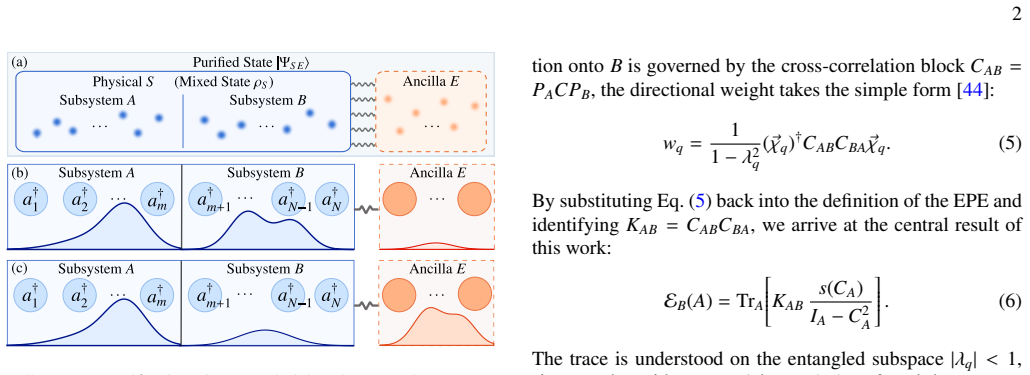
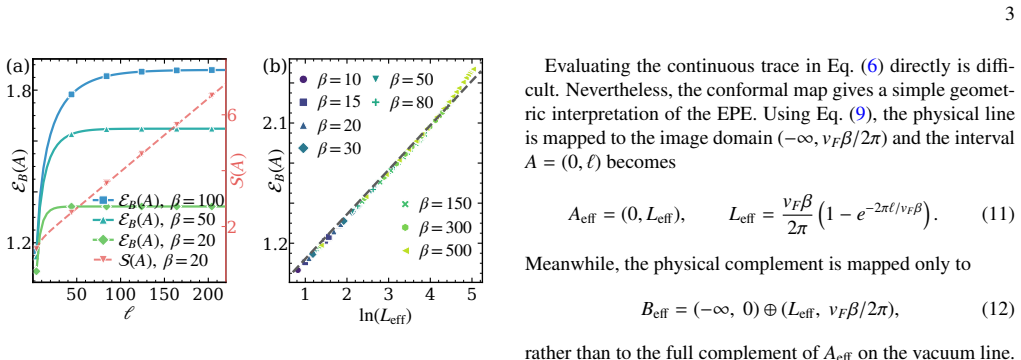
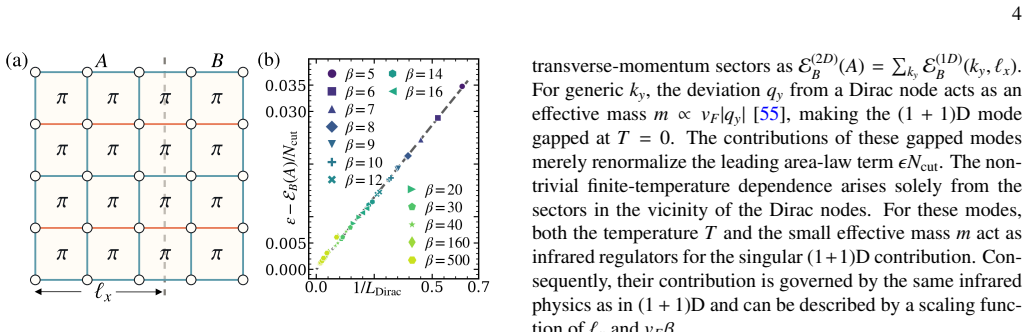
By resolving subsystem entropy into Gaussian entropy channels and projecting their purification partners onto the physical complement, the entanglement projected entropy yields a closed-form expression in terms of the physical covariance matrix that removes the volume-law mixed-state background and recovers the zero-temperature conformal scaling with the c/3 coefficient in one-dimensional free-fermion chains, while revealing a universal finite-temperature scaling collapse governed by a Dirac infrared length in two-dimensional half-filled pi-flux models.
What carries the argument
The entanglement projected entropy (EPE), a purification-independent Gaussian spatial filter obtained by projecting purification partners onto the physical complement.
If this is right
- In one-dimensional free-fermion chains the volume-law mixed-state background is removed and the c/3 conformal coefficient is recovered.
- In two-dimensional half-filled pi-flux models a universal finite-temperature scaling collapse appears, controlled by the low-energy Dirac velocity.
- EPE functions as an entropy-channel filter that exposes boundary-sensitive universal scaling hidden beneath mixed-state entropy.
- The closed-form expression depends only on the physical covariance matrix, enabling direct evaluation without explicit purification.
Where Pith is reading between the lines
- The same projection technique could be tested on other Gaussian states with different symmetries to check whether the scaling recovery remains exact.
- Numerical simulations of finite-temperature chains could use EPE to extract effective central charges without zero-temperature extrapolation.
- Experimental measurements of covariance matrices in quantum simulators might allow direct application of EPE to mixed-state data.
- The method suggests that similar channel-projection filters could be constructed for bosonic Gaussian states or other free models.
Load-bearing premise
The projection step that maps purification partners onto the physical complement can be performed using only the physical covariance matrix without requiring additional information about the purifying system or non-Gaussian corrections.
What would settle it
Compute the entanglement projected entropy for a one-dimensional free-fermion chain at finite temperature and verify whether the result for large subsystems exactly follows the zero-temperature conformal form with coefficient c/3.
Figures
read the original abstract
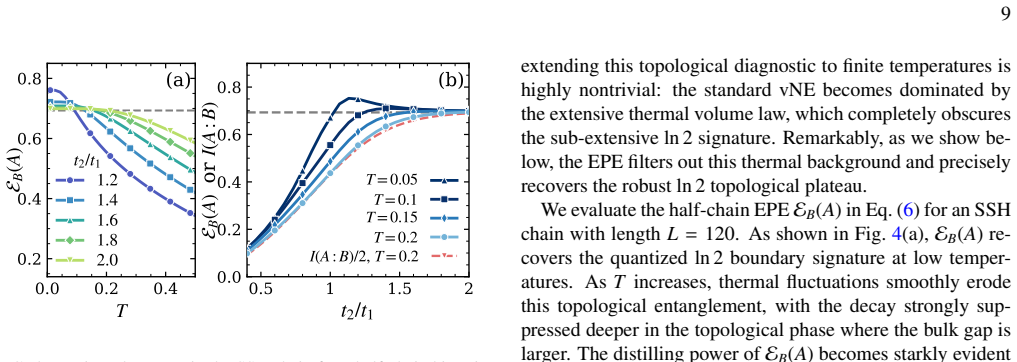
Identifying spatial quantum correlations in mixed states is challenging because thermal mixed-state contributions obscure the entanglement encoded in subsystem entropy. Here, we introduce the entanglement projected entropy (EPE), a purification-independent Gaussian spatial filter for mixed fermionic states. By resolving subsystem entropy into Gaussian entropy channels and projecting their purification partners onto the physical complement, we obtain a closed-form expression in terms of the physical covariance matrix. In a one-dimensional free-fermion chain, it removes the volume-law mixed-state background and recovers the zero-temperature conformal scaling with the $c/3$ coefficient. In a two-dimensional half-filled $\pi$-flux model, it reveals a universal finite-temperature scaling collapse governed by a Dirac infrared length fixed by the low-energy velocity. These results establish EPE as an entropy-channel filter that exposes boundary-sensitive universal scaling hidden beneath mixed-state entropy.
Editorial analysis
A structured set of objections, weighed in public.
Referee Report
Summary. The paper introduces the entanglement projected entropy (EPE) as a purification-independent Gaussian spatial filter for mixed fermionic states. By resolving subsystem entropy into Gaussian entropy channels and projecting their purification partners onto the physical complement, it derives a closed-form expression depending only on the physical covariance matrix. In a 1D free-fermion chain this removes the volume-law mixed-state background and recovers zero-temperature conformal scaling with the c/3 coefficient; in a 2D half-filled π-flux model it reveals a universal finite-temperature scaling collapse governed by a Dirac infrared length set by the low-energy velocity.
Significance. If the central construction is valid, EPE offers a practical route to isolate boundary-sensitive universal entanglement scaling from thermal or mixed-state volume-law contributions in fermionic Gaussian systems using only the physical covariance matrix. The reported recovery of conformal scaling and finite-temperature collapse would make the quantity a useful diagnostic for studying how universal features persist or collapse under mixing.
major comments (1)
- [Definition of EPE / main construction] The load-bearing step is the assertion that the projection of purification partners onto the physical complement can be performed using only the physical covariance matrix without reference to the choice of purifying modes or additional information about the environment. The manuscript must supply an explicit derivation (likely in the section defining EPE) showing that the projection operator is uniquely fixed by the physical CM entries and is invariant under different Gaussian purifications; otherwise the claimed purification-independence and volume-law subtraction do not hold for arbitrary mixed Gaussian states.
Simulated Author's Rebuttal
We thank the referee for their careful reading and for identifying the central point requiring explicit justification in the definition of the entanglement projected entropy. We address the major comment below and will revise the manuscript to incorporate the requested derivation.
read point-by-point responses
-
Referee: The load-bearing step is the assertion that the projection of purification partners onto the physical complement can be performed using only the physical covariance matrix without reference to the choice of purifying modes or additional information about the environment. The manuscript must supply an explicit derivation (likely in the section defining EPE) showing that the projection operator is uniquely fixed by the physical CM entries and is invariant under different Gaussian purifications; otherwise the claimed purification-independence and volume-law subtraction do not hold for arbitrary mixed Gaussian states.
Authors: We agree that the manuscript requires an explicit derivation to establish that the projection is uniquely fixed by the physical covariance matrix and invariant under Gaussian purifications. In the revised manuscript we will add a dedicated subsection in the EPE definition that derives the projection operator directly from the physical CM blocks, shows its uniqueness for any valid mixed Gaussian state, and proves invariance by explicit transformation under changes of purifying modes. This will confirm that the volume-law subtraction is purification-independent as claimed. revision: yes
Circularity Check
No circularity: EPE expression derived from physical covariance matrix without self-referential reduction
full rationale
The abstract and description present the EPE as obtained by resolving subsystem entropy into Gaussian channels and projecting purification partners, yielding a closed-form result explicitly in terms of the physical covariance matrix alone. No quoted equation or step reduces the claimed output to a fitted parameter, self-citation chain, or input by construction; the physical CM is an independent input for the mixed Gaussian state, and the projection is asserted to be expressible from it without additional purification details. This satisfies the self-contained criterion with no load-bearing self-definition or renaming of known results.
Axiom & Free-Parameter Ledger
Reference graph
Works this paper leans on
-
[1]
Amico, R
L. Amico, R. Fazio, A. Osterloh, and V . Vedral, Entanglement in many-body systems, Rev. Mod. Phys.80, 517 (2008)
2008
-
[2]
Calabrese and J
P. Calabrese and J. Cardy, Entanglement entropy and quantum field theory, Journal of Statistical Mechanics: Theory and Ex- periment2004, P06002 (2004)
2004
-
[3]
Eisert, M
J. Eisert, M. Cramer, and M. B. Plenio, Colloquium: Area laws for the entanglement entropy, Rev. Mod. Phys.82, 277 (2010)
2010
-
[4]
Vidal, J
G. Vidal, J. I. Latorre, E. Rico, and A. Kitaev, Entanglement in quantum critical phenomena, Phys. Rev. Lett.90, 227902 (2003)
2003
-
[5]
Calabrese and J
P. Calabrese and J. Cardy, Entanglement entropy and conformal field theory, Journal of Physics A: Mathematical and Theoreti- cal42, 504005 (2009)
2009
-
[6]
Kitaev and J
A. Kitaev and J. Preskill, Topological entanglement entropy, Phys. Rev. Lett.96, 110404 (2006)
2006
-
[7]
Levin and X.-G
M. Levin and X.-G. Wen, Detecting topological order in a ground state wave function, Phys. Rev. Lett.96, 110405 (2006)
2006
-
[8]
Chen, Z.-C
X. Chen, Z.-C. Gu, and X.-G. Wen, Local unitary transforma- tion, long-range quantum entanglement, wave function renor- malization, and topological order, Phys. Rev. B82, 155138 (2010)
2010
-
[9]
Ryu and T
S. Ryu and T. Takayanagi, Holographic Derivation of Entan- glement Entropy from the anti–de Sitter Space/Conformal Field Theory Correspondence, Phys. Rev. Lett.96, 181602 (2006)
2006
-
[10]
M. A. Nielsen and I. L. Chuang,Quantum Computation and Quantum Information(Cambridge University Press, 2010)
2010
-
[11]
Bombelli, R
L. Bombelli, R. K. Koul, J. Lee, and R. D. Sorkin, Quantum source of entropy for black holes, Phys. Rev. D34, 373 (1986)
1986
-
[12]
Srednicki, Entropy and area, Phys
M. Srednicki, Entropy and area, Phys. Rev. Lett.71, 666 (1993)
1993
-
[13]
M. M. Wolf, Violation of the entropic area law for fermions, Phys. Rev. Lett.96, 010404 (2006)
2006
-
[14]
Gioev and I
D. Gioev and I. Klich, Entanglement entropy of fermions in any dimension and the widom conjecture, Phys. Rev. Lett.96, 100503 (2006)
2006
-
[15]
Swingle, Entanglement entropy and the fermi surface, Phys
B. Swingle, Entanglement entropy and the fermi surface, Phys. Rev. Lett.105, 050502 (2010)
2010
-
[16]
Di Francesco, P
P. Di Francesco, P. Mathieu, and D. S´en´echal,Conformal Field Theory(Springer New York, 1997)
1997
-
[17]
Holzhey, F
C. Holzhey, F. Larsen, and F. Wilczek, Geometric and renor- malized entropy in conformal field theory, Nuclear Physics B 424, 443 (1994)
1994
-
[18]
M. M. Wolf, F. Verstraete, M. B. Hastings, and J. I. Cirac, Area laws in quantum systems: Mutual information and correlations, Phys. Rev. Lett.100, 070502 (2008)
2008
-
[19]
Peschel and V
I. Peschel and V . Eisler, Reduced density matrices and entan- glement entropy in free lattice models, J. Phys. A: Math. Theor. 42, 504003 (2009)
2009
-
[20]
M. P. Hertzberg and F. Wilczek, Some calculable contributions to entanglement entropy, Phys. Rev. Lett.106, 050404 (2011)
2011
-
[21]
Horodecki, P
R. Horodecki, P. Horodecki, M. Horodecki, and K. Horodecki, Quantum entanglement, Rev. Mod. Phys.81, 865 (2009)
2009
-
[22]
Henderson and V
L. Henderson and V . Vedral, Classical, quantum and total cor- relations, J. Phys. A: Math. Gen.34, 6899 (2001)
2001
-
[23]
Iaconis, S
J. Iaconis, S. Inglis, A. B. Kallin, and R. G. Melko, Detecting classical phase transitions with renyi mutual information, Phys. Rev. B87, 195134 (2013)
2013
-
[24]
Vidal and R
G. Vidal and R. F. Werner, Computable measure of entangle- ment, Phys. Rev. A65, 032314 (2002)
2002
-
[25]
M. B. Plenio, Logarithmic negativity: A full entanglement monotone that is not convex, Phys. Rev. Lett.95, 090503 (2005)
2005
-
[26]
Calabrese, J
P. Calabrese, J. Cardy, and E. Tonni, Entanglement negativity in quantum field theory, Phys. Rev. Lett.109, 130502 (2012)
2012
-
[27]
Calabrese, J
P. Calabrese, J. Cardy, and E. Tonni, Finite temperature entan- glement negativity in conformal field theory, Journal of Physics A: Mathematical and Theoretical48, 015006 (2015)
2015
-
[28]
Eisler and Z
V . Eisler and Z. Zimbor´as, On the partial transpose of fermionic gaussian states, New Journal of Physics17, 053048 (2015)
2015
-
[29]
Coser, E
A. Coser, E. Tonni, and P. Calabrese, Towards the entanglement negativity of two disjoint intervals for a one dimensional free fermion, Journal of Statistical Mechanics: Theory and Experi- ment2016, 033116 (2016)
2016
-
[30]
Ruggiero, V
P. Ruggiero, V . Alba, and P. Calabrese, Negativity spectrum of one-dimensional conformal field theories, Phys. Rev. B94, 195121 (2016)
2016
-
[31]
Shapourian, K
H. Shapourian, K. Shiozaki, and S. Ryu, Partial time-reversal transformation and entanglement negativity in fermionic sys- tems, Phys. Rev. B95, 165101 (2017)
2017
-
[32]
Shapourian and S
H. Shapourian and S. Ryu, Finite-temperature entanglement negativity of free fermions, Journal of Statistical Mechanics: Theory and Experiment2019, 043106 (2019)
2019
-
[33]
B. M. Terhal, M. Horodecki, D. W. Leung, and D. P. DiVin- cenzo, The entanglement of purification, Journal of Mathemat- ical Physics43, 4286 (2002)
2002
-
[34]
Nguyen, T
P. Nguyen, T. Devakul, M. G. Halpern, J. Hough, and B. Swingle, Entanglement of purification: from spin chains to holography, Journal of High Energy Physics2018, 98 (2018)
2018
-
[35]
Takayanagi and K
T. Takayanagi and K. Umemoto, Entanglement of purification through holographic duality, Nature Physics14, 573 (2018)
2018
-
[36]
Bueno and H
P. Bueno and H. Casini, Reflected entropy, symmetries and free fermions, Journal of High Energy Physics2020, 103 (2020)
2020
-
[37]
Dutta and T
S. Dutta and T. Faulkner, A canonical purification for the entan- glement wedge cross-section, Journal of High Energy Physics 2021, 178 (2021)
2021
-
[38]
R. R. Tucci, Entanglement of distillation and conditional mu- tual information (2002), arXiv:quant-ph/0202144 [quant-ph]
work page internal anchor Pith review Pith/arXiv arXiv 2002
-
[39]
squashed entanglement
M. Christandl and A. Winter, “squashed entanglement”: An ad- ditive entanglement measure, Journal of Mathematical Physics 45, 829 (2004)
2004
-
[40]
Affleck and J
I. Affleck and J. B. Marston, Large-nlimit of the heisenberg- hubbard model: Implications for high-tc superconductors, Phys. Rev. B37, 3774 (1988)
1988
-
[41]
Lagrangian representation for fermionic linear optics
S. Bravyi, Lagrangian representation for fermionic linear optics (2004), arXiv:quant-ph/0404180 [quant-ph]. 6
work page internal anchor Pith review Pith/arXiv arXiv 2004
-
[42]
Peschel, Calculation of reduced density matrices from corre- lation functions, J
I. Peschel, Calculation of reduced density matrices from corre- lation functions, J. Phys. A: Math. Gen.36, L205 (2003)
2003
-
[43]
Windt, A
B. Windt, A. Jahn, J. Eisert, and L. Hackl, Local optimization on pure Gaussian state manifolds, SciPost Phys.10, 066 (2021)
2021
-
[44]
See supplemental material for more details
-
[45]
Fidkowski, Entanglement spectrum of topological insulators and superconductors, Phys
L. Fidkowski, Entanglement spectrum of topological insulators and superconductors, Phys. Rev. Lett.104, 130502 (2010)
2010
-
[46]
W. P. Su, J. R. Schrieffer, and A. J. Heeger, Solitons in poly- acetylene, Phys. Rev. Lett.42, 1698 (1979)
1979
-
[47]
Giamarchi,Quantum Physics in One Dimension(Oxford University Press, Oxford, 2003)
T. Giamarchi,Quantum Physics in One Dimension(Oxford University Press, Oxford, 2003)
2003
-
[48]
V . E. Korepin, Universality of entropy scaling in one dimen- sional gapless models, Phys. Rev. Lett.92, 096402 (2004)
2004
-
[49]
Casini and M
H. Casini and M. Huerta, Entanglement entropy in free quan- tum field theory, J. Phys. A: Math. Theor.42, 504007 (2009)
2009
-
[50]
Cardy and C
J. Cardy and C. P. Herzog, Universal thermal corrections to sin- gle interval entanglement entropy for two dimensional confor- mal field theories, Phys. Rev. Lett.112, 171603 (2014)
2014
-
[51]
X. Chen, G. Y . Cho, T. Faulkner, and E. Fradkin, Scaling of entanglement in 2+1-dimensional scale-invariant field theories, J. Stat. Mech.: Theory Exp.2015(2), P02010
2015
-
[52]
X. Chen, W. Witczak-Krempa, T. Faulkner, and E. Fradkin, Two-cylinder entanglement entropy under a twist, Journal of Statistical Mechanics: Theory and Experiment2017, 043104 (2017)
2017
-
[53]
Jin, H.-H
H.-K. Jin, H.-H. Tu, and Y .-H. Zhang, Dirac and chiral spin liquids on spin-1/2 square-lattice heisenberg antiferromagnet, Physical Review B112, 035159 (2025)
2025
-
[54]
Casini and M
H. Casini and M. Huerta, Universal terms for the entanglement entropy in 2+1 dimensions, Nuclear Physics B764, 183 (2007)
2007
-
[55]
Casini, C
H. Casini, C. D. Fosco, and M. Huerta, Entanglement and alpha entropies for a massive Dirac field in two dimensions, J. Stat. Mech.2005, P07007 (2005)
2005
-
[56]
Extracting Universal Entanglement Scaling from Mixed Fermionic Gaussian States via Entanglement Projected Entropy
R. Haag,Local Quantum Physics: Fields, Particles, Algebras, 2nd ed. (Springer, Berlin, Heidelberg, 2012). 7 Supplementary Material for “Extracting Universal Entanglement Scaling from Mixed Fermionic Gaussian States via Entanglement Projected Entropy” Jia-Wen Tao1 and Hui-Ke Jin1,∗ 1School of Physical Science and Technology, ShanghaiTech University, Shangh...
2012
discussion (0)
Sign in with ORCID, Apple, or X to comment. Anyone can read and Pith papers without signing in.