Leveraging Gauge Freedom for Learning Non-Gradient Population Dynamics of Stochastic Systems
Pith reviewed 2026-06-30 12:08 UTC · model grok-4.3
The pith
A weak formulation of the continuity equation allows inference of non-gradient vector fields for population dynamics.
A machine-rendered reading of the paper's core claim, the machinery that carries it, and where it could break.
Core claim
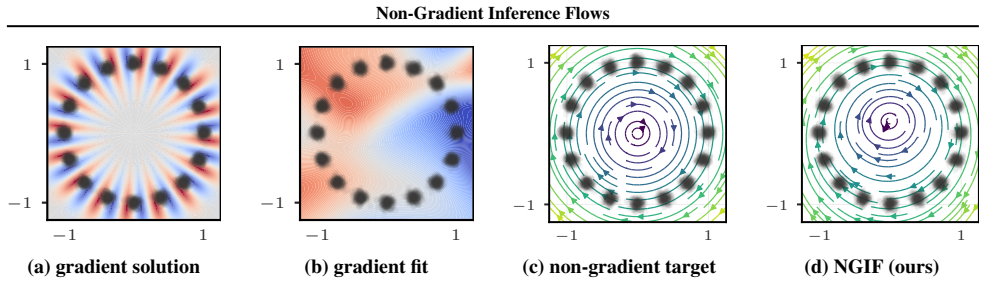
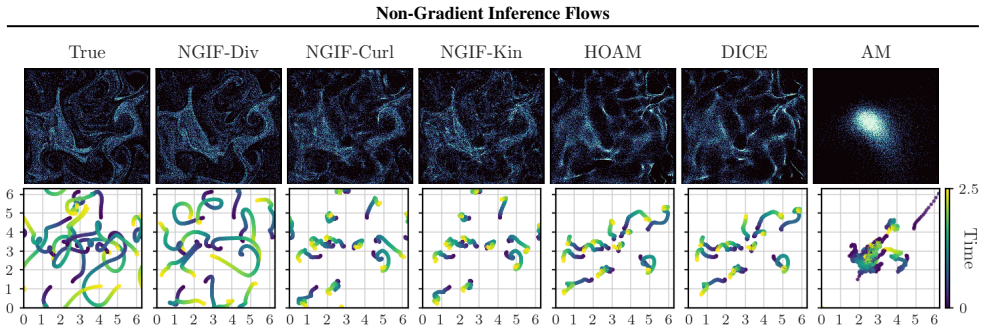
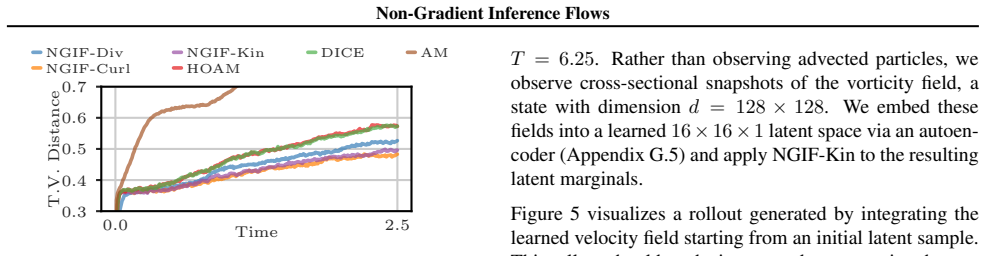
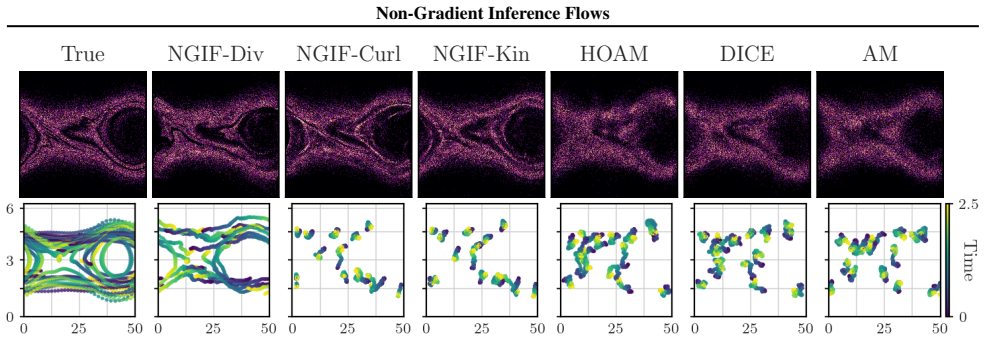
Among all admissible flows compatible with observed population dynamics, gradient flows minimize kinetic energy. NGIF leverages gauge freedom by using a weak formulation of the continuity equation to learn general vector fields and to select criteria other than minimal kinetic energy. On a variety of low- and high-dimensional physics problems this yields improved distributional accuracy over gradient-restricted baselines and better recovery of non-potential transport.
What carries the argument
The weak formulation of the continuity equation, which constrains the evolution of the population density without forcing the vector field to be the gradient of a potential.
If this is right
- General vector fields become admissible for population-dynamics inference rather than only gradients.
- Distributional accuracy improves on problems that contain non-potential transport.
- The same weak-equation approach can be applied to both low- and high-dimensional stochastic systems.
- Selection criteria other than minimal kinetic energy can be imposed during learning.
Where Pith is reading between the lines
- The method may extend to other transport problems where the driving field is known to be non-conservative.
- Similar gauge choices could be introduced in related PDE-constrained learning settings that currently default to energy-minimizing solutions.
Load-bearing premise
The weak form of the continuity equation alone determines a stable and unique non-gradient vector field from data.
What would settle it
Generate synthetic data from a known non-gradient vector field, apply NGIF, and check whether the learned field reproduces the true non-gradient component and matches the observed distributions more closely than a gradient-only baseline.
Figures
read the original abstract
Existing work on population dynamics inference often focuses on flows arising from vector fields that are the gradients of scalar potentials. Among all admissible flows that are compatible with the population dynamics, gradient flows are optimal in a specific sense: they minimize kinetic energy. The selection of fields based on different criteria corresponds to a gauge freedom when determining population dynamics, which we leverage in this work. We propose Non-Gradient Inference Flows (NGIF), an algorithm to infer non-gradient population dynamics using a weak formulation of the continuity equation. This allows us to parameterize general vector fields and choose other selection criteria beyond minimal kinetic energy. We demonstrate on a variety of low- and high-dimensional physics problems that this more general approach improves distributional accuracy over gradient-restricted baselines and better captures non-potential transport.
Editorial analysis
A structured set of objections, weighed in public.
Referee Report
Summary. The paper introduces Non-Gradient Inference Flows (NGIF), which leverages gauge freedom in admissible flows compatible with observed population dynamics. By using a weak formulation of the continuity equation, NGIF parameterizes general vector fields (beyond gradient flows that minimize kinetic energy) and selects alternative criteria. Empirical results on low- and high-dimensional physics problems are claimed to show improved distributional accuracy and better capture of non-potential transport relative to gradient-restricted baselines.
Significance. If the central technical claim holds, the work would meaningfully broaden population-dynamics inference beyond the common gradient-flow restriction, enabling modeling of a larger class of stochastic systems via explicit use of gauge freedom.
major comments (2)
- [Abstract] Abstract and method description: the weak continuity equation only enforces ∫[∂tρ ϕ + v·∇ϕ ρ] = 0 for test functions ϕ, which constrains solely the divergence of the probability flux. No regularization, boundary conditions, or gauge-fixing term is stated that would select a unique representative of the divergence-free (solenoidal) component; this under-determination is load-bearing for the claim that NGIF stably captures non-gradient dynamics.
- [Abstract] Abstract: the central empirical claim of improved distributional accuracy is stated without any quantitative metrics, baseline specifications, error bars, or dataset details, preventing verification that the reported gains arise from the non-gradient parameterization rather than optimization artifacts.
Simulated Author's Rebuttal
We thank the referee for the constructive comments. We address each major point below and indicate the revisions we will make to improve clarity and rigor.
read point-by-point responses
-
Referee: [Abstract] Abstract and method description: the weak continuity equation only enforces ∫[∂tρ ϕ + v·∇ϕ ρ] = 0 for test functions ϕ, which constrains solely the divergence of the probability flux. No regularization, boundary conditions, or gauge-fixing term is stated that would select a unique representative of the divergence-free (solenoidal) component; this under-determination is load-bearing for the claim that NGIF stably captures non-gradient dynamics.
Authors: We agree that the weak form constrains only the divergence of the flux, which is the mathematical origin of the gauge freedom we seek to leverage. NGIF exploits this by directly parameterizing general (non-gradient) vector fields with neural networks; the data-driven optimization under the weak loss then selects the solenoidal component that matches observed dynamics rather than minimizing kinetic energy. However, the manuscript does not explicitly describe how this selection occurs or any auxiliary regularization. We will revise the method section to clarify the role of the neural parameterization in determining the representative, note any boundary conditions employed, and discuss stability of the learned non-gradient fields. revision: yes
-
Referee: [Abstract] Abstract: the central empirical claim of improved distributional accuracy is stated without any quantitative metrics, baseline specifications, error bars, or dataset details, preventing verification that the reported gains arise from the non-gradient parameterization rather than optimization artifacts.
Authors: The abstract is intentionally high-level. The full experimental section reports quantitative metrics (distributional distances), explicit gradient-flow baselines, error bars across runs, and the low- and high-dimensional physics datasets. To address the concern, we will revise the abstract to include a concise statement of the key quantitative improvements and baseline comparisons. revision: yes
Circularity Check
No circularity in derivation chain
full rationale
The paper grounds its NGIF method in the standard weak formulation of the continuity equation together with the established mathematical notion of gauge freedom for selecting among admissible vector fields. No load-bearing step reduces by the paper's own equations or self-citation to a fitted parameter renamed as a prediction, a self-definitional loop, or an ansatz smuggled via prior work by the same authors. The central claim that the weak form permits parameterization of general (including non-gradient) fields follows directly from the divergence constraint without circular redefinition of inputs as outputs.
Axiom & Free-Parameter Ledger
axioms (1)
- domain assumption The continuity equation holds for the population dynamics under consideration.
Reference graph
Works this paper leans on
-
[1]
doi: 10.1007/978-1-4612-0883-9
ISBN 978-1-4612-6934-2 978-1-4612-0883-9. doi: 10.1007/978-1-4612-0883-9. URLhttp://link. springer.com/10.1007/978-1-4612-0883-9. Dresdner, G., Kochkov, D., Norgaard, P., Zepeda-N ´u˜nez, L., Smith, J. A., Brenner, M. P., and Hoyer, S. Learn- ing to correct spectral methods for simulating turbulent flows. 2022. doi: 10.48550/ARXIV .2207.00556. URL https:/...
-
[2]
ISSN 1553-5231. doi: 10.3934/dcds.2014.34
-
[3]
Neklyudov, K., Brekelmans, R., Severo, D., and Makhzani, A
URLhttp://aimsciences.org//article/ doi/10.3934/dcds.2014.34.1533. Neklyudov, K., Brekelmans, R., Severo, D., and Makhzani, A. Action matching: Learning stochastic dynamics from samples. InInternational conference on machine learn- ing, pp. 25858–25889. PMLR, 2023. Parra, G. and Tobar, F. Spectral mixture kernels for multi-output gaussian processes. In Gu...
-
[4]
URLhttp://arxiv.org/abs/2506.01502. arXiv:2506.01502 [cs]. Petrovi´c, K., Atanackovic, L., Kapusniak, K., Bronstein, M. M., Bose, J., and Tong, A. Curly Flow Matching for Learning Non-gradient Field Dynamics. InICLR 2025 Workshop on Machine Learning for Genomics Ex- plorations, 2025. URLhttps://openreview.net/ forum?id=Cv84fXtQPJ. Scarvelis, C. and Solomo...
-
[5]
URLhttps://openreview.net/forum?id= v3y68gz-WEz. Schiebinger, G., Shu, J., Tabaka, M., Cleary, B., Subra- manian, V ., Solomon, A., Gould, J., Liu, S., Lin, S., Berube, P., Lee, L., Chen, J., Brumbaugh, J., Rigollet, P., Hochedlinger, K., Jaenisch, R., Regev, A., and Lan- der, E. S. Optimal-Transport Analysis of Single-Cell Gene Expression Identifies Deve...
-
[6]
Sutherland, D
URLhttps://openreview.net/forum?id= Iguyg0LULD. Sutherland, D. J. and Schneider, J. On the error of random fourier features. InProceedings of the Thirty-First Con- ference on Uncertainty in Artificial Intelligence, UAI’15, pp. 862–871, Arlington, Virginia, USA, 2015. AUAI Press. ISBN 9780996643108. Terpin, A., Lanzetti, N., Gadea, M., and Dorfler, F. Lear...
2015
discussion (0)
Sign in with ORCID, Apple, or X to comment. Anyone can read and Pith papers without signing in.