Orbital-Engineered Altermagnetism in Two-Dimensional Square Lattices
Pith reviewed 2026-06-29 23:44 UTC · model grok-4.3
The pith
Dual-orbital configurations in antiferromagnetic square lattices lift Kramers degeneracy to produce d-wave or g-wave altermagnetic states through orbital anisotropy in same-spin hopping.
A machine-rendered reading of the paper's core claim, the machinery that carries it, and where it could break.
Core claim
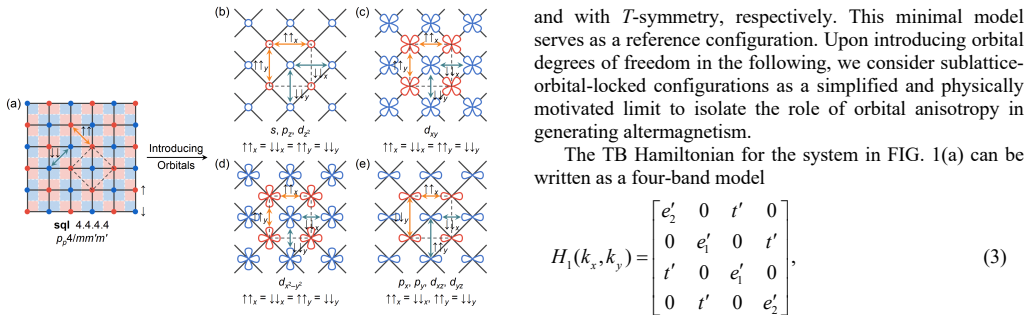
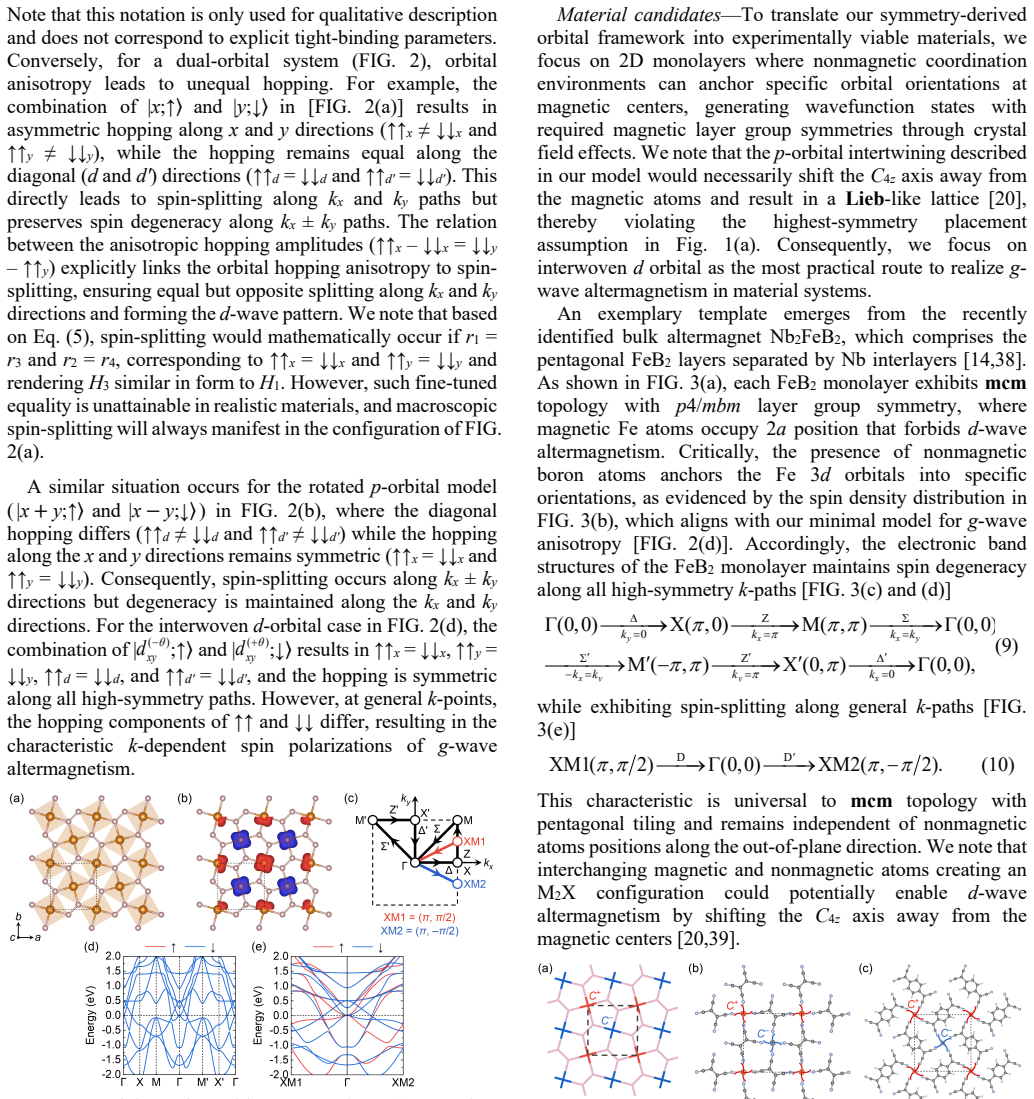
Within the minimal antiferromagnetic square-lattice model, single-orbital lattices remain spin-degenerate, whereas interwoven dual-orbital configurations lift Kramers degeneracy and generate d-wave or g-wave altermagnetic states. The spin-splitting originates from orbital anisotropy in the same-spin hopping channels. Guided by this framework, M-TCNX (M = Cr, Mn, Fe; TCNX = TCNE, TCNQ) metal-organic framework monolayers with mcm topology are identified as candidate g-wave altermagnets.
What carries the argument
Interwoven dual-orbital configurations that introduce orbital anisotropy into the same-spin hopping channels of the antiferromagnetic square lattice.
If this is right
- Single-orbital lattices stay spin-degenerate under antiferromagnetic order.
- Dual-orbital lattices generate even-parity spin splitting with explicit d-wave or g-wave symmetry.
- M-TCNX monolayers realize g-wave altermagnetism according to the orbital-anisotropy framework.
- Orbital character supplies a symmetry-explicit design principle for altermagnetism in 2D square lattices.
Where Pith is reading between the lines
- The same orbital-anisotropy principle could be tested in other two-dimensional lattices that admit dual-orbital antiferromagnetic order.
- Experimental probes of spin splitting in fabricated M-TCNX monolayers would provide a direct check on the minimal-model predictions.
- Materials with weak spin-orbit coupling but accessible orbital degrees of freedom become viable platforms for altermagnetic devices.
Load-bearing premise
The minimal tight-binding model with only orbital anisotropy and no other interactions such as lattice relaxation or residual spin-orbit terms is sufficient to predict altermagnetic order and to identify material candidates.
What would settle it
Direct observation of spin degeneracy persisting in dual-orbital square-lattice antiferromagnets, or the absence of the predicted g-wave splitting in M-TCNX monolayers, would falsify the mechanism.
Figures

read the original abstract
Altermagnetism is characterized by even-parity spin-momentum locking in spin-split bands despite zero net magnetization and negligible spin-orbit coupling. Here, we formulate a microscopic framework that links altermagnetic splitting in two-dimensional (2D) square lattices to orbital character. Using tight-binding models and symmetry analysis, we show that, within the minimal antiferromagnetic square-lattice model, single-orbital lattices remain spin-degenerate, whereas interwoven dual-orbital configurations lift Kramers degeneracy and generate d-wave or g-wave altermagnetic states. The spin-splitting originates from orbital anisotropy in the same-spin hopping channels. Guided by this framework, we identify M-TCNX (M = Cr, Mn, Fe; TCNX = TCNE, TCNQ) metal-organic framework monolayers with mcm topology as candidate g-wave altermagnets. Our work provides a symmetry-explicit wavefunction-level design framework for orbital-controlled altermagnetism in 2D square lattices.
Editorial analysis
A structured set of objections, weighed in public.
Referee Report
Summary. The manuscript develops a symmetry-plus-tight-binding framework for altermagnetism in 2D antiferromagnetic square lattices. It argues that single-orbital models remain spin-degenerate while interwoven dual-orbital configurations produce d-wave or g-wave spin splitting solely from orbital anisotropy in same-spin hopping channels, and identifies M-TCNX (M=Cr,Mn,Fe; TCNX=TCNE,TCNQ) monolayers with mcm topology as g-wave altermagnet candidates.
Significance. If the minimal-model predictions hold for the proposed materials, the work supplies an orbital-engineering design rule that could guide discovery of SOC-free altermagnets in 2D metal-organic frameworks. The explicit linkage between orbital character and even-parity spin-momentum locking is a constructive contribution to the altermagnetism literature.
major comments (3)
- [final section / candidate identification] The central claim that M-TCNX monolayers realize g-wave altermagnetism rests on symmetry matching to the mcm topology (final section) without an explicit orbital mapping or derivation of the TB hopping parameters from the actual monolayer structure; this leaves the candidate identification unsupported by the minimal-model assumptions.
- [§3 / tight-binding analysis] The assertion that spin splitting originates exclusively from orbital anisotropy in same-spin hopping (abstract and §3) is not accompanied by the explicit model Hamiltonians, band-structure calculations, or error analysis needed to confirm that Kramers degeneracy is lifted and that residual SOC or lattice-relaxation terms remain negligible.
- [M-TCNX identification paragraph] The weakest-assumption point—that the minimal AFM square-lattice TB model with only orbital anisotropy suffices to predict stable altermagnetic order in M-TCNX—is load-bearing for the candidate claim but is not tested against the real crystal geometry or verified by confirming the required AFM configuration and hopping signs.
minor comments (2)
- [Methods / model definition] Notation for the dual-orbital basis and the definition of the mcm topology should be introduced with a figure or explicit matrix representation to improve readability.
- [abstract] The abstract states the framework is 'parameter-free' in spirit, yet the TB parameters are chosen by hand; a brief statement clarifying the selection criteria would remove ambiguity.
Simulated Author's Rebuttal
We thank the referee for the constructive comments and for recognizing the potential of our orbital-engineering framework. We respond point-by-point to the major comments below.
read point-by-point responses
-
Referee: [final section / candidate identification] The central claim that M-TCNX monolayers realize g-wave altermagnetism rests on symmetry matching to the mcm topology (final section) without an explicit orbital mapping or derivation of the TB hopping parameters from the actual monolayer structure; this leaves the candidate identification unsupported by the minimal-model assumptions.
Authors: The identification of M-TCNX monolayers rests on rigorous symmetry matching between the mcm topology and the g-wave altermagnetic state generated by our dual-orbital minimal model. This constitutes a design rule rather than a quantitative prediction; explicit first-principles derivation of hoppings lies outside the scope of the symmetry-plus-TB framework. We will revise the final section to state the symmetry correspondence more explicitly and to qualify the candidates as warranting future DFT validation, while preserving the minimal-model logic. revision: partial
-
Referee: [§3 / tight-binding analysis] The assertion that spin splitting originates exclusively from orbital anisotropy in same-spin hopping (abstract and §3) is not accompanied by the explicit model Hamiltonians, band-structure calculations, or error analysis needed to confirm that Kramers degeneracy is lifted and that residual SOC or lattice-relaxation terms remain negligible.
Authors: Section 3 derives the lifting of Kramers degeneracy from orbital anisotropy via symmetry-allowed same-spin hopping terms. We will add the explicit 4 imes4 (single-orbital) and 8×8 (dual-orbital) Hamiltonian matrices together with representative band-structure plots for the minimal models. Because the manuscript addresses the SOC-free altermagnetic limit by definition, we will insert a short discussion noting that residual SOC and relaxation are expected to be weak in these 2D MOFs on the basis of existing literature, while acknowledging that quantitative bounds require separate calculations. revision: yes
-
Referee: [M-TCNX identification paragraph] The weakest-assumption point—that the minimal AFM square-lattice TB model with only orbital anisotropy suffices to predict stable altermagnetic order in M-TCNX—is load-bearing for the candidate claim but is not tested against the real crystal geometry or verified by confirming the required AFM configuration and hopping signs.
Authors: The minimal model supplies a topology-based selection criterion under the assumption of AFM order and orbital-anisotropic hoppings consistent with mcm symmetry. We agree that direct verification against the actual monolayer geometry and hopping signs is not performed. The identification paragraph will be rewritten to present M-TCNX explicitly as symmetry-selected candidates, stating the underlying assumptions and recommending future first-principles confirmation of the AFM configuration and electronic structure. revision: yes
Circularity Check
Minimal TB model derivation is self-contained; no circular reduction to inputs
full rationale
The paper constructs a minimal antiferromagnetic square-lattice tight-binding model from orbital anisotropy and symmetry analysis. It demonstrates that single-orbital lattices remain spin-degenerate while dual-orbital configurations produce d- or g-wave splitting via same-spin hopping anisotropy. This follows directly from the model's Hamiltonian definitions and symmetry constraints without fitting to external data or self-referential inputs. M-TCNX candidates are identified by symmetry matching to the mcm topology rather than by parameter fitting or self-citation chains. No load-bearing steps reduce by construction to the target result; the framework is independent and uses standard methods.
Axiom & Free-Parameter Ledger
axioms (1)
- domain assumption The minimal antiferromagnetic square-lattice model suffices to capture altermagnetic splitting without additional interactions.
Reference graph
Works this paper leans on
-
[1]
Y. Che, Y. Chen, X. Liu, H. Lv, X. Wu, and J. Yang, Inverse Design of 2D Altermagnetic Metal-Organic Framework Monolayers from Hückel Theory of Nonbonding Molecular Orbitals, JACS Au 5, 381 (2025). [17] S. Bhowal and N. A. Spaldin, Ferroically Ordered Magnetic Octupoles in d-Wave Altermagnets, Phys. Rev. X 14, 011019 (2024). [18] Y. Che, Y. Guo, H. Lv, X....
-
[2]
Altermagnetic Metal-Organic Frameworks
L. Camerano, A. O. Fumega, J. L. Lado, A. Stroppa, and G. Profeta, Multiferroic nematic d-wave altermagnetism driven by orbital-order on the honeycomb lattice, npj 2D Mater. Appl. 9, 75 (2025). [36] Z. Zhang, Z.-M. Yu, G.-B. Liu, and Y. Yao, MagneticTB: A package for tight-binding model of magnetic and non-magnetic materials, Comput. Phys. Commun. 270, 10...
work page internal anchor Pith review Pith/arXiv arXiv 2025
discussion (0)
Sign in with ORCID, Apple, or X to comment. Anyone can read and Pith papers without signing in.