Theoretical Analysis of Sparse Optimization with Reparameterization, Weight Decay, and Adaptive Learning Rate
Pith reviewed 2026-06-30 11:45 UTC · model grok-4.3
The pith
ReWA achieves greater sparsity than ℓ1 regularization in ResNets while preserving test accuracy on CIFAR-10 and ImageNet.
A machine-rendered reading of the paper's core claim, the machinery that carries it, and where it could break.
Core claim
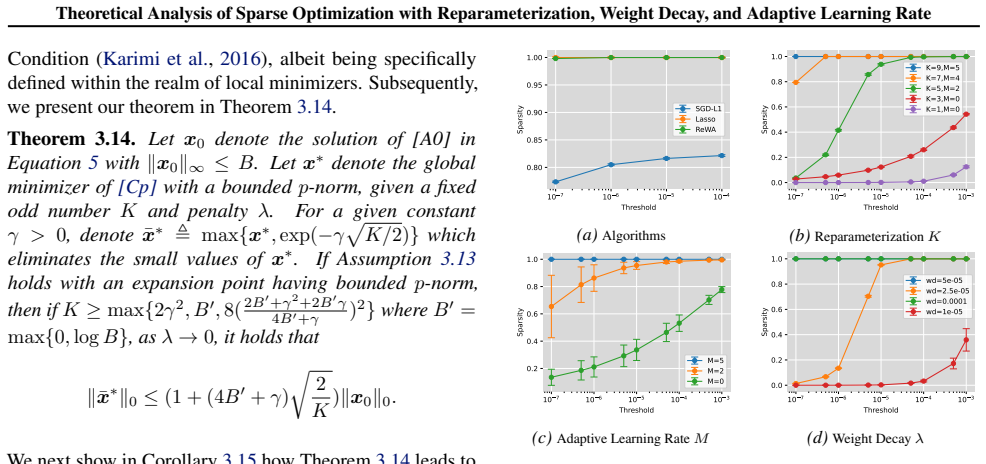
ReWA is closely connected to ℓ_p-regularization, yet it unveils a distinct optimization landscape that helps mitigate instability issues. Experiments on CIFAR-10 and ImageNet with ResNets demonstrate that ReWA leads to significant sparsity improvements over the ℓ1-regularization approach while preserving test accuracy.
What carries the argument
ReWA, the combination of reparameterization, weight decay, and adaptive learning rate that produces a distinct optimization landscape connected to but different from ℓ_p regularization.
If this is right
- ReWA mitigates instability issues of ℓ_p regularization for 0 < p < 1.
- ReWA produces significant sparsity improvements over ℓ1 regularization.
- Test accuracy remains comparable to ℓ1 regularization on CIFAR-10 and ImageNet with ResNets.
Where Pith is reading between the lines
- The method may allow training of models with fewer active parameters from the start, lowering memory use during inference on constrained hardware.
- It could reduce reliance on separate pruning pipelines that require additional fine-tuning after initial training.
- The same combination of techniques might be tested on other model families such as transformers to check whether the sparsity gain generalizes.
Load-bearing premise
The distinct optimization landscape created by the combination of reparameterization, weight decay, and adaptive learning rate actually mitigates the instability issues of ℓ_p regularization for 0 < p < 1.
What would settle it
Repeating the CIFAR-10 and ImageNet experiments with ResNets and finding that ReWA produces no measurable increase in sparsity or causes a drop in test accuracy relative to ℓ1 regularization would disprove the central claim.
Figures



read the original abstract
Sparse optimization is a fundamental challenge in various practical applications. A popular approach to sparse optimization is $\ell_p$ regularization. However, it may encounter optimization instability due to the unbounded gradients when $0<p<1$. In this paper, we introduce a novel approach to sparse optimization termed ReWA, based on Reparameterization, Weight decay, and Adaptive learning rate. ReWA is closely connected to $\ell_p$-regularization, yet it unveils a distinct optimization landscape that helps mitigate instability issues. Experiments on CIFAR-10 and ImageNet with ResNets demonstrate that ReWA leads to significant sparsity improvements over the $\ell_1$-regularization approach while preserving test accuracy.
Editorial analysis
A structured set of objections, weighed in public.
Referee Report
Summary. The manuscript introduces ReWA, a sparse optimization method based on reparameterization, weight decay, and adaptive learning rates. It claims a close theoretical connection to ℓ_p regularization (for 0 < p < 1) while asserting a distinct optimization landscape that mitigates the instability caused by unbounded gradients. Experiments on CIFAR-10 and ImageNet using ResNets are reported to yield significant sparsity gains over ℓ1 regularization without loss of test accuracy.
Significance. If the claimed theoretical connection and landscape analysis hold and the empirical gains prove robust, the work could provide a practical route to sparsity in deep networks that avoids known difficulties with non-convex regularizers. The combination of reparameterization with adaptive rates is a potentially useful direction, but its value depends on the rigor of the supporting derivations and controls.
major comments (2)
- [Abstract] Abstract: the central claim of a 'distinct optimization landscape that helps mitigate instability issues' is asserted without any derivation, equation, or landscape analysis visible; the connection to ℓ_p regularization therefore cannot be evaluated for correctness or novelty.
- [Experiments] Experiments (CIFAR-10 / ImageNet results): the reported 'significant sparsity improvements' are stated without error bars, multiple runs, statistical tests, or ablation controls separating the contributions of reparameterization, weight decay, and the adaptive rate; this leaves the empirical claim load-bearing but unsupported.
Simulated Author's Rebuttal
We thank the referee for the constructive comments. We address the two major points below, clarifying the location of the theoretical material and committing to improved experimental reporting.
read point-by-point responses
-
Referee: [Abstract] Abstract: the central claim of a 'distinct optimization landscape that helps mitigate instability issues' is asserted without any derivation, equation, or landscape analysis visible; the connection to ℓ_p regularization therefore cannot be evaluated for correctness or novelty.
Authors: The abstract is a high-level summary. The explicit connection to ℓ_p regularization for 0 < p < 1, the reparameterization that produces an equivalent but distinct landscape, and the derivation showing bounded gradients (thereby mitigating the instability of direct ℓ_p penalties) appear in Section 3, with the relevant equations, landscape plots, and proofs. We will add a sentence to the abstract directing readers to Section 3. revision: partial
-
Referee: [Experiments] Experiments (CIFAR-10 / ImageNet results): the reported 'significant sparsity improvements' are stated without error bars, multiple runs, statistical tests, or ablation controls separating the contributions of reparameterization, weight decay, and the adaptive rate; this leaves the empirical claim load-bearing but unsupported.
Authors: The current version indeed reports single-run results without error bars, statistical tests, or component-wise ablations. We will rerun the CIFAR-10 and ImageNet experiments with at least three independent seeds, add error bars and significance tests, and include ablations that isolate reparameterization, weight decay, and the adaptive rate schedule. revision: yes
Circularity Check
No significant circularity identified
full rationale
The provided abstract and surrounding context present ReWA as a novel combination of reparameterization, weight decay, and adaptive learning rate that is connected to but distinct from ℓ_p regularization, with empirical results on CIFAR-10 and ImageNet. No derivation chain, equations, fitted parameters renamed as predictions, or self-citations are visible in the material. The central claim of a distinct optimization landscape mitigating instability is stated without reduction to prior inputs or self-referential definitions. The derivation is therefore self-contained against external benchmarks, with no load-bearing steps that collapse by construction.
Axiom & Free-Parameter Ledger
Reference graph
Works this paper leans on
-
[1]
write newline
" write newline "" before.all 'output.state := FUNCTION n.dashify 't := "" t empty not t #1 #1 substring "-" = t #1 #2 substring "--" = not "--" * t #2 global.max substring 't := t #1 #1 substring "-" = "-" * t #2 global.max substring 't := while if t #1 #1 substring * t #2 global.max substring 't := if while FUNCTION format.date year duplicate empty "emp...
-
[2]
and Warmuth, M
Amid, E. and Warmuth, M. K. Winnowing with gradient descent. In Conference on Learning Theory, pp.\ 163--182. PMLR, 2020
2020
-
[3]
Implicit regularization in deep matrix factorization
Arora, S., Cohen, N., Hu, W., and Luo, Y. Implicit regularization in deep matrix factorization. In Advances in Neural Information Processing Systems, pp.\ 7411--7422, 2019
2019
-
[4]
Bradley, P. S. and Mangasarian, O. L. Feature selection via concave minimization and support vector machines. In International Conference on Machine Learning, pp.\ 82--90. Morgan Kaufmann, 1998
1998
-
[5]
Improving network slimming with nonconvex regularization
Bui, K., Park, F., Zhang, S., Qi, Y., and Xin, J. Improving network slimming with nonconvex regularization. IEEE Access, 9: 0 107590--107601, 2021
2021
-
[6]
Candes, E. J. The restricted isometry property and its implications for compressed sensing. Comptes Rendus Mathematique, 346 0 (9-10): 0 589--592, 2008
2008
-
[7]
Candes, E. J. and Tao, T. Near-optimal signal recovery from random projections: Universal encoding strategies? IEEE Transactions on Information Theory, 52 0 (12): 0 5406--5425, 2006
2006
-
[8]
Exact reconstruction of sparse signals via nonconvex minimization
Chartrand, R. Exact reconstruction of sparse signals via nonconvex minimization. IEEE Signal Processing Letters, 14 0 (10): 0 707--710, 2007
2007
-
[9]
Fast algorithms for nonconvex compressive sensing: Mri reconstruction from very few data
Chartrand, R. Fast algorithms for nonconvex compressive sensing: Mri reconstruction from very few data. In IEEE International Symposium on Biomedical Imaging, pp.\ 262--265. IEEE, 2009
2009
-
[10]
and Staneva, V
Chartrand, R. and Staneva, V. Restricted isometry properties and nonconvex compressive sensing. Inverse Problems, 24 0 (3): 0 035020, 2008
2008
-
[11]
Strong np-hardness for sparse optimization with concave penalty functions
Chen, Y., Ge, D., Wang, M., Wang, Z., Ye, Y., and Yin, H. Strong np-hardness for sparse optimization with concave penalty functions. In International Conference on Machine Learning, pp.\ 740--747. PMLR, 2017
2017
-
[12]
On lazy training in differentiable programming
Chizat, L., Oyallon, E., and Bach, F. On lazy training in differentiable programming. In Advances in Neural Information Processing Systems, volume 32, pp.\ 2933--2943, 2019
2019
-
[13]
More is less: Inducing sparsity via overparameterization
Chou, H.-H., Maly, J., and Rauhut, H. More is less: Inducing sparsity via overparameterization. arXiv preprint arXiv:2112.11027, 2021
-
[14]
Representation costs of linear neural networks: Analysis and design
Dai, Z., Karzand, M., and Srebro, N. Representation costs of linear neural networks: Analysis and design. In Advances in Neural Information Processing Systems, pp.\ 26884--26896, 2021
2021
-
[15]
Imagenet: A large-scale hierarchical image database
Deng, J., Dong, W., Socher, R., Li, L.-J., Li, K., and Fei-Fei, L. Imagenet: A large-scale hierarchical image database. In IEEE Conference on Computer Vision and Pattern Recognition, pp.\ 248--255. IEEE, 2009
2009
-
[16]
Duarte-Carvajalino, J. M. and Sapiro, G. Learning to sense sparse signals: Simultaneous sensing matrix and sparsifying dictionary optimization. IEEE Transactions on Image Processing, 18 0 (7): 0 1395--1408, 2009
2009
-
[17]
and Li, R
Fan, J. and Li, R. Variable selection via nonconcave penalized likelihood and its oracle properties. Journal of the American Statistical Association, 96 0 (456): 0 1348--1360, 2001
2001
-
[18]
Understanding implicit regularization in over-parameterized single index model
Fan, J., Yang, Z., and Yu, M. Understanding implicit regularization in over-parameterized single index model. Journal of the American Statistical Association, 118 0 (544): 0 2315--2328, 2023
2023
-
[19]
E., Pang, J.-S., Shen, X., and W \"a chter, A
Feng, M., Mitchell, J. E., Pang, J.-S., Shen, X., and W \"a chter, A. Complementarity formulations of l0-norm optimization problems. Technical report, Industrial Engineering and Management Sciences, Northwestern University, 2013
2013
-
[20]
Frank, L. E. and Friedman, J. H. A statistical view of some chemometrics regression tools. Technometrics, 35 0 (2): 0 109--135, 1993
1993
-
[21]
Fu, W. J. Penalized regressions: the bridge versus the lasso. Journal of Computational and Graphical Statistics, 7 0 (3): 0 397--416, 1998
1998
-
[22]
Sign-in to the lottery: Reparameterizing sparse training
Gadhikar, A., Jacobs, T., Burkholz, R., et al. Sign-in to the lottery: Reparameterizing sparse training. Advances in Neural Information Processing Systems, 38: 0 117941--117971, 2026
2026
-
[23]
George, E. I. The variable selection problem. Journal of the American Statistical Association, 95 0 (452): 0 1304--1308, 2000
2000
-
[24]
The implicit bias of depth: How incremental learning drives generalization
Gissin, D., Shalev-Shwartz, S., and Daniely, A. The implicit bias of depth: How incremental learning drives generalization. In International Conference on Learning Representations, 2020
2020
-
[25]
Least absolute shrinkage is equivalent to quadratic penalization
Grandvalet, Y. Least absolute shrinkage is equivalent to quadratic penalization. In International Conference on Artificial Neural Networks, pp.\ 201--206. Springer, 1998
1998
-
[26]
D., Soudry, D., and Srebro, N
Gunasekar, S., Lee, J. D., Soudry, D., and Srebro, N. Implicit bias of gradient descent on linear convolutional networks. In Advances in Neural Information Processing Systems, pp.\ 9482--9491, 2018
2018
-
[27]
Han, S., Pool, J., Tran, J., and Dally, W. J. Learning both weights and connections for efficient neural network. In Advances in Neural Information Processing Systems, pp.\ 1135--1143, 2015
2015
-
[28]
Han, S., Mao, H., and Dally, W. J. Deep compression: Compressing deep neural network with pruning, trained quantization and huffman coding. In International Conference on Learning Representations, 2016
2016
-
[29]
D., and Zadeh, R
Hastie, T., Mazumder, R., Lee, J. D., and Zadeh, R. Matrix completion and low-rank svd via fast alternating least squares. Journal of Machine Learning Research, 16: 0 3367--3402, 2015
2015
-
[30]
Deep residual learning for image recognition
He, K., Zhang, X., Ren, S., and Sun, J. Deep residual learning for image recognition. In Proceedings of the IEEE Conference on Computer Vision and Pattern Recognition, pp.\ 770--778, 2016
2016
-
[31]
Hoff, P. D. Lasso, fractional norm and structured sparse estimation using a hadamard product parametrization. Computational Statistics & Data Analysis, 115: 0 186--198, 2017
2017
-
[32]
Phase transition and higher order analysis of l_q regularization under dependence
Huang, H., Zeng, P., and Yan, Q. Phase transition and higher order analysis of l_q regularization under dependence. arXiv preprint arXiv:2211.10541, 2022
-
[33]
Hunter, D. R. and Li, R. Variable selection using mm algorithms. Annals of Statistics, 33 0 (4): 0 1617--1642, 2005
2005
-
[34]
and Burkholz, R
Jacobs, T. and Burkholz, R. Mask in the mirror: Implicit sparsification. In International Conference on Learning Representations, volume 2025, pp.\ 36221--36245, 2025
2025
-
[35]
Mirror, mirror of the flow: How does regularization shape implicit bias? In Forty-second International Conference on Machine Learning, 2025
Jacobs, T., Zhou, C., and Burkholz, R. Mirror, mirror of the flow: How does regularization shape implicit bias? In Forty-second International Conference on Machine Learning, 2025. URL https://openreview.net/forum?id=MLiR9LS5PW
2025
-
[36]
Neural tangent kernel: Convergence and generalization in neural networks
Jacot, A., Gabriel, F., and Hongler, C. Neural tangent kernel: Convergence and generalization in neural networks. Advances in Neural Information Processing Systems, 31: 0 8580--8589, 2018
2018
-
[37]
Feature learning in l_2 -regularized dnns: Attraction/repulsion and sparsity
Jacot, A., Golikov, E., Hongler, C., and Gabriel, F. Feature learning in l_2 -regularized dnns: Attraction/repulsion and sparsity. arXiv preprint arXiv:2205.15809, 2022
-
[38]
P., and Gunasekar, S
Jagadeesan, M., Razenshteyn, I. P., and Gunasekar, S. Inductive bias of multi-channel linear convolutional networks with bounded weight norm. In Conference on Learning Theory, pp.\ 2276--2325. PMLR, 2022
2022
-
[39]
Kang, H., Mina, R. J. L., Madjid, S. R. H., Yoon, J., Hasegawa-Johnson, M., Hwang, S. J., and Yoo, C. D. Forget-free continual learning with winning subnetworks. In International Conference on Machine Learning, pp.\ 10734--10750. PMLR, 2022
2022
-
[40]
Linear convergence of gradient and proximal-gradient methods under the polyak- ojasiewicz condition
Karimi, H., Nutini, J., and Schmidt, M. Linear convergence of gradient and proximal-gradient methods under the polyak- ojasiewicz condition. In Joint European Conference on Machine Learning and Knowledge Discovery in Databases, pp.\ 795--811. Springer, 2016
2016
-
[41]
Kingma, D. P. Adam: A method for stochastic optimization. arXiv preprint arXiv:1412.6980, 2014
work page internal anchor Pith review Pith/arXiv arXiv 2014
-
[42]
Kolb, C., M \"u ller, C. L., Bischl, B., and R \"u gamer, D. Smoothing the edges: A general framework for smooth optimization in sparse regularization using hadamard overparametrization. arXiv preprint arXiv:2307.03571, 2023
work page internal anchor Pith review Pith/arXiv arXiv 2023
-
[43]
Learning multiple layers of features from tiny images
Krizhevsky, A., Hinton, G., et al. Learning multiple layers of features from tiny images. Technical report, University of Toronto, 2009
2009
-
[44]
M., Salman, H., and Madry, A
Leclerc, G., Ilyas, A., Engstrom, L., Park, S. M., Salman, H., and Madry, A. Ffcv: Accelerating training by removing data bottlenecks. In Proceedings of the IEEE/CVF Conference on Computer Vision and Pattern Recognition, pp.\ 12011--12020, 2023
2023
-
[45]
Sparse signal recovery via tail hadamard product parametrization
Li, D., Li, G., Ma, C., Yang, A., and Li, S. Sparse signal recovery via tail hadamard product parametrization. In China Automation Congress, pp.\ 7504--7509. IEEE, 2021 a
2021
-
[46]
The tail-hadamard product parametrization algorithm for compressed sensing
Li, G., Li, S., Li, D., and Ma, C. The tail-hadamard product parametrization algorithm for compressed sensing. Signal Processing, 205: 0 108853, 2023
2023
-
[47]
Li, H., Kadav, A., Durdanovic, I., Samet, H., and Graf, H. P. Pruning filters for efficient convnets. In International Conference on Learning Representations, 2017
2017
-
[48]
V., Hegde, C., and Wong, K
Li, J., Nguyen, T. V., Hegde, C., and Wong, K. W. Implicit sparse regularization: The impact of depth and early stopping. In Advances in Neural Information Processing Systems, pp.\ 28298--28309, 2021 b
2021
-
[49]
D., and Arora, S
Li, Z., Wang, T., Lee, J. D., and Arora, S. Implicit bias of gradient descent on reparametrized models: On equivalence to mirror descent. In Advances in Neural Information Processing Systems, 2022
2022
-
[50]
Robust training under label noise by over-parameterization
Liu, S., Zhu, Z., Qu, Q., and You, C. Robust training under label noise by over-parameterization. In International Conference on Machine Learning, pp.\ 14153--14172. PMLR, 2022
2022
-
[51]
and Wang, Z
Liu, Z. and Wang, Z. spred: Solving l1 penalty with sgd. In International Conference on Machine Learning, pp.\ 43407--43422. PMLR, 2023
2023
-
[52]
and Hutter, F
Loshchilov, I. and Hutter, F. Decoupled weight decay regularization. In International Conference on Learning Representations, 2019
2019
-
[53]
Louizos, C., Welling, M., and Kingma, D. P. Learning sparse neural networks through l_0 regularization. In International Conference on Learning Representations, 2018
2018
-
[54]
Lustig, M., Donoho, D., and Pauly, J. M. Sparse mri: The application of compressed sensing for rapid mr imaging. Magnetic Resonance in Medicine, 58 0 (6): 0 1182--1195, 2007
2007
-
[55]
L., Santos, J
Lustig, M., Donoho, D. L., Santos, J. M., and Pauly, J. M. Compressed sensing mri. IEEE Signal Processing Magazine, 25 0 (2): 0 72--82, 2008
2008
-
[56]
Ma, J. and Fattahi, S. Blessing of nonconvexity in deep linear models: Depth flattens the optimization landscape around the true solution. arXiv preprint arXiv:2207.07612, 2022
-
[57]
and Solo, V
Marjanovic, G. and Solo, V. On _q optimization and matrix completion. IEEE Transactions on Signal Processing, 60 0 (11): 0 5714--5724, 2012
2012
-
[58]
and Solo, V
Marjanovic, G. and Solo, V. On exact _q denoising. In IEEE International Conference on Acoustics, Speech and Signal Processing, pp.\ 6068--6072. IEEE, 2013
2013
-
[59]
H., Aldroubi, A., Sanei, S., and Chambers, J
Marvasti, F., Amini, A., Haddadi, F., Soltanolkotabi, M., Khalaj, B. H., Aldroubi, A., Sanei, S., and Chambers, J. A unified approach to sparse signal processing. EURASIP Journal on Advances in Signal Processing, 2012 0 (1): 0 1--45, 2012
2012
-
[60]
Mousavi, S., Rezaee Taghiabadi, M. M., and Ayanzadeh, R. A survey on compressive sensing: Classical results and recent advancements. arXiv preprint arXiv:1908.01014, 2019
-
[61]
Natarajan, B. K. Sparse approximate solutions to linear systems. SIAM Journal on Computing, 24 0 (2): 0 227--234, 1995 a
1995
-
[62]
Natarajan, B. K. Sparse approximate solutions to linear systems. SIAM Journal on Computing, 24 0 (2): 0 227--234, 1995 b
1995
-
[63]
In search of the real inductive bias: On the role of implicit regularization in deep learning
Neyshabur, B., Tomioka, R., and Srebro, N. In search of the real inductive bias: On the role of implicit regularization in deep learning. In International Conference on Learning Representations Workshop, 2015
2015
-
[64]
A function space view of bounded norm infinite width relu nets: The multivariate case
Ongie, G., Willett, R., Soudry, D., and Srebro, N. A function space view of bounded norm infinite width relu nets: The multivariate case. In International Conference on Learning Representations, 2020
2020
-
[65]
Task-specific skill localization in fine-tuned language models
Panigrahi, A., Saunshi, N., Zhao, H., and Arora, S. Task-specific skill localization in fine-tuned language models. In International Conference on Machine Learning, pp.\ 27011--27033. PMLR, 2023
2023
-
[66]
and Nowak, R
Parhi, R. and Nowak, R. D. Banach space representer theorems for neural networks and ridge splines. Journal of Machine Learning Research, 22 0 (43): 0 1--40, 2021
2021
-
[67]
and Nowak, R
Parhi, R. and Nowak, R. D. Deep learning meets sparse regularization: A signal processing perspective. IEEE Signal Processing Magazine, 40 0 (6): 0 63--74, 2023
2023
-
[68]
and Ergen, T
Pilanci, M. and Ergen, T. Neural networks are convex regularizers: Exact polynomial-time convex optimization formulations for two-layer networks. In International Conference on Machine Learning, pp.\ 7695--7705. PMLR, 2020
2020
-
[69]
Label noise (stochastic) gradient descent implicitly solves the lasso for quadratic parametrisation
Pillaud-Vivien, L., Reygner, J., and Flammarion, N. Label noise (stochastic) gradient descent implicitly solves the lasso for quadratic parametrisation. In Conference on Learning Theory, pp.\ 2127--2159. PMLR, 2022
2022
-
[70]
and Peyr \'e , G
Poon, C. and Peyr \'e , G. Smooth bilevel programming for sparse regularization. In Advances in Neural Information Processing Systems, pp.\ 1543--1555, 2021
2021
-
[71]
and Peyr \'e , G
Poon, C. and Peyr \'e , G. Smooth over-parameterized solvers for non-smooth structured optimization. Mathematical Programming, 201 0 (1): 0 897--952, 2023
2023
-
[72]
and Mancera, L
Portilla, J. and Mancera, L. L0-based sparse approximation: Two alternative methods and some applications. In Wavelets XII, volume 6701, pp.\ 697--711. SPIE, 2007
2007
-
[73]
Rennie, J. D. M. and Srebro, N. Fast maximum margin matrix factorization for collaborative prediction. In International Conference on Machine Learning, pp.\ 713--719. ACM, 2005
2005
-
[74]
Stable sparse approximations via nonconvex optimization
Saab, R., Chartrand, R., and Yilmaz, O. Stable sparse approximations via nonconvex optimization. In IEEE International Conference on Acoustics, Speech and Signal Processing, pp.\ 3885--3888. IEEE, 2008
2008
-
[75]
How do infinite width bounded norm networks look in function space? In Conference on Learning Theory, pp.\ 2667--2690
Savarese, P., Evron, I., Soudry, D., and Srebro, N. How do infinite width bounded norm networks look in function space? In Conference on Learning Theory, pp.\ 2667--2690. PMLR, 2019
2019
-
[76]
Winning the lottery with continuous sparsification
Savarese, P., Silva, H., and Maire, M. Winning the lottery with continuous sparsification. In Advances in Neural Information Processing Systems, 2020
2020
-
[77]
M., Pascanu, R., Latham, P
Schwarz, J., Jayakumar, S. M., Pascanu, R., Latham, P. E., and Teh, Y. W. Powerpropagation: A sparsity inducing weight reparameterisation. In Advances in Neural Information Processing Systems, pp.\ 28889--28903, 2021
2021
-
[78]
Srebro, N., Rennie, J. D. M., and Jaakkola, T. S. Maximum-margin matrix factorization. In Advances in Neural Information Processing Systems, pp.\ 1329--1336, 2004
2004
-
[79]
A tutorial on sparse signal reconstruction and its applications in signal processing
Stankovi \'c , L., Sejdi \'c , E., Stankovi \'c , S., Dakovi \'c , M., and Orovi \'c , I. A tutorial on sparse signal reconstruction and its applications in signal processing. Circuits, Systems, and Signal Processing, 38: 0 1206--1263, 2019
2019
-
[80]
and Li, Y
Sun, Y. and Li, Y. Dice: Leveraging sparsification for out-of-distribution detection. In European Conference on Computer Vision, pp.\ 691--708. Springer, 2022
2022
discussion (0)
Sign in with ORCID, Apple, or X to comment. Anyone can read and Pith papers without signing in.