Thermal PBE in warm dense matter: Does it matter and is it accurate?
Pith reviewed 2026-06-29 23:19 UTC · model grok-4.3
The pith
Thermal PBE derived from conditional probability density functional theory improves energies, forces, pressures, and densities in warm dense matter to match path integral Monte Carlo references.
A machine-rendered reading of the paper's core claim, the machinery that carries it, and where it could break.
Core claim
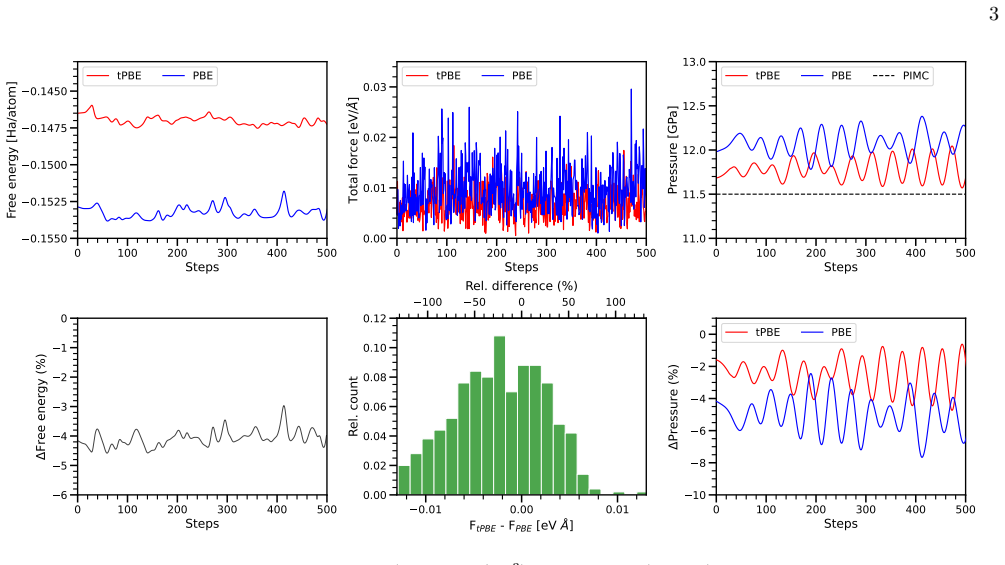
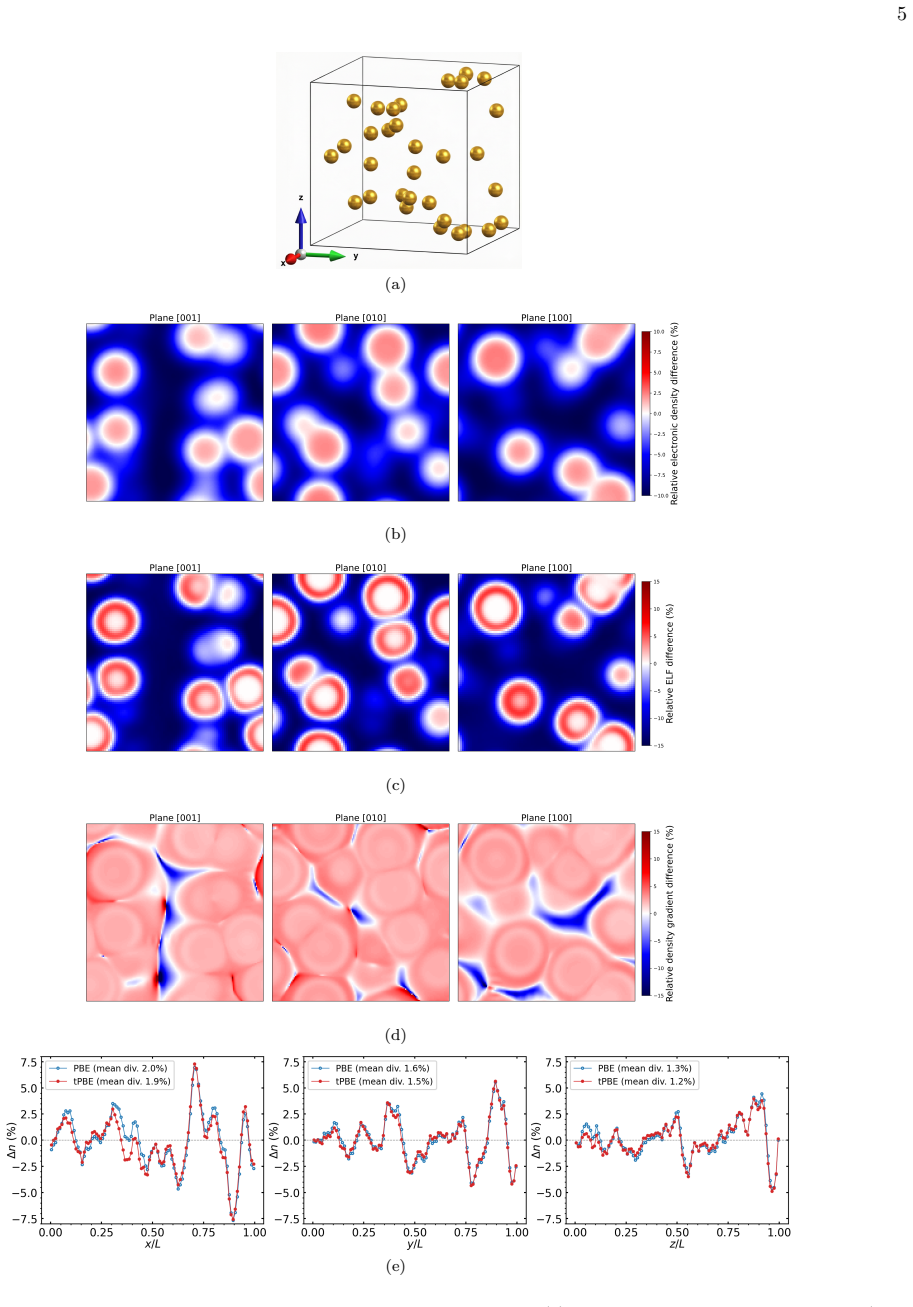
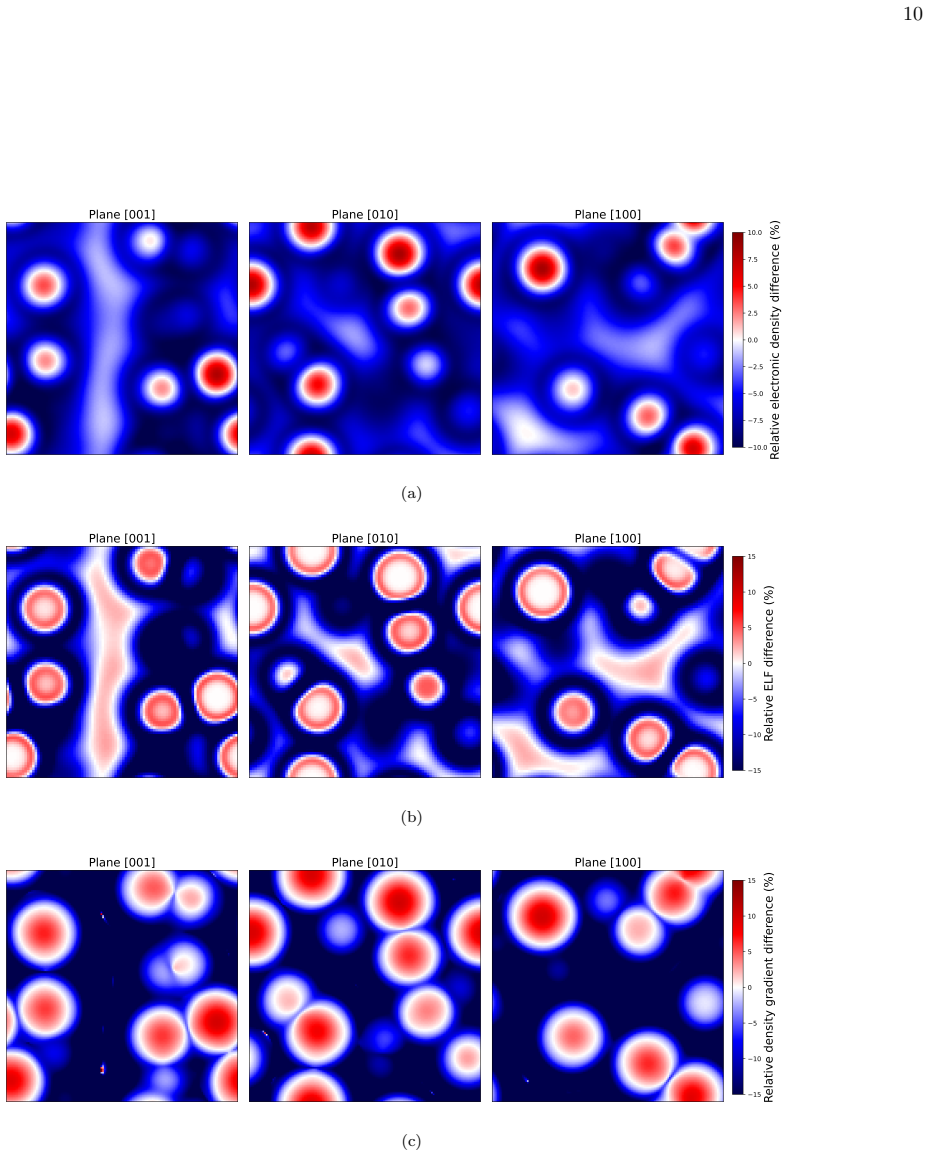
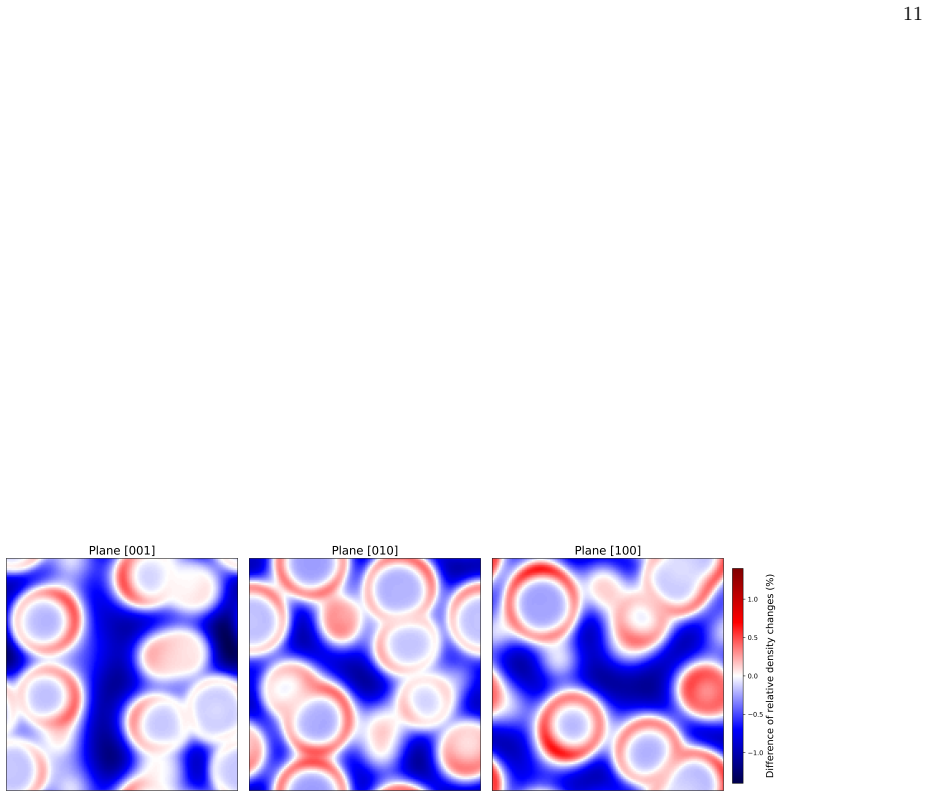
Thermal PBE exhibits close agreement with path integral Monte Carlo reference data at negligible additional computational cost, significantly improving the description of warm dense matter properties including energies, forces, pressures, and electronic charge densities over LDA, PBE, and thermal LDA.
What carries the argument
Thermal PBE functional, the temperature-dependent extension of the PBE generalized gradient approximation for the exchange-correlation free energy.
If this is right
- Kohn-Sham calculations of warm dense matter can reach higher accuracy for thermodynamic and structural properties without raising computational cost.
- Electronic charge densities from thermal PBE become reliable enough for post-processing analyses that depend on accurate density profiles.
- Forces computed with thermal PBE support molecular dynamics runs whose trajectories better reflect finite-temperature exchange-correlation effects.
- Pressure estimates in the warm dense regime improve, affecting equations of state used in high-energy-density physics modeling.
Where Pith is reading between the lines
- Similar temperature extensions could be applied to other generalized gradient approximations to test whether the improvement is specific to PBE or generic to the functional form.
- The negligible extra cost makes thermal PBE a practical default for production warm dense matter runs where path integral Monte Carlo remains prohibitive.
- If the conditional probability approach generalizes, it may supply a systematic route to temperature-dependent versions of hybrid or meta-GGA functionals.
Load-bearing premise
The temperature dependence derived from conditional probability density functional theory accurately captures exchange-correlation effects in the warm dense matter regime.
What would settle it
A new path integral Monte Carlo calculation for a warm dense hydrogen or aluminum system at a density and temperature where thermal PBE currently shows close agreement; if the new reference deviates while thermal PBE stays fixed, the claim is falsified.
Figures
read the original abstract
Conditional probability density functional theory has recently been used to derive the temperature dependence of the Perdew-Burke-Ernzerhof (PBE) generalized gradient approximation (GGA) for the exchange-correlation (XC) free energy. We implement and systematically benchmark thermal PBE within Kohn-Sham density functional theory calculations of warm dense matter. Comparisons with the local density approximation (LDA) and PBE functionals, as well as thermal LDA, show that thermal PBE significantly improves the description of warm dense matter properties, including energies, forces, pressures, and electronic charge densities. In particular, thermal PBE exhibits close agreement with path integral Monte Carlo (PIMC) reference data at negligible additional computational cost. This work demonstrates the practical utility of thermal PBE as an accurate semilocal functional for simulations in the warm dense regime.
Editorial analysis
A structured set of objections, weighed in public.
Referee Report
Summary. The manuscript implements the temperature-dependent PBE exchange-correlation free-energy functional (thermal PBE) obtained from conditional probability density functional theory within Kohn-Sham DFT. Systematic benchmarks against LDA, zero-temperature PBE, thermal LDA, and path-integral Monte Carlo (PIMC) reference data are presented for warm-dense-matter properties including total energies, forces, pressures, and electronic charge densities. The central claim is that thermal PBE yields significant improvements over standard functionals while maintaining close quantitative agreement with PIMC at essentially the same computational cost, establishing its practical utility for WDM simulations.
Significance. If the reported benchmarks are robust, the work supplies a low-cost, semilocal functional that meaningfully extends the accuracy of KS-DFT into the warm-dense regime without requiring the expense of PIMC or orbital-free methods. This would be directly useful for high-energy-density physics applications. The paper also supplies concrete evidence that temperature dependence in the GGA can be beneficial, which is a useful data point for functional development.
major comments (2)
- [§4] §4 (Results) and associated figures/tables: the manuscript asserts 'significant improvements' and 'close agreement with PIMC' yet provides no tabulated mean-absolute errors, root-mean-square deviations, or statistical uncertainties on the PIMC comparisons, nor does it state the number of independent state points, the precise temperature-density grid, or the materials examined. Without these quantitative details the central claim cannot be evaluated.
- [§2] §2 (Theory): the temperature dependence of the PBE functional is imported from the conditional-probability derivation without any additional analysis or sensitivity test of how the underlying assumptions (conditional probability framework, neglect of higher-order thermal corrections) perform when degeneracy parameters and correlation lengths enter the WDM regime. This transfer is load-bearing for all reported gains.
minor comments (2)
- [§3] Notation for the thermal enhancement factor and the temperature-dependent gradient correction is introduced without an explicit equation reference in the methods section, making it difficult to reproduce the implementation.
- [Figure 3] Figure captions do not list the exact functional forms or parameter values used for the thermal LDA comparison, reducing clarity.
Simulated Author's Rebuttal
We thank the referee for the constructive feedback and the recommendation for major revision. We address each major comment below and will revise the manuscript to strengthen the quantitative presentation of results.
read point-by-point responses
-
Referee: [§4] §4 (Results) and associated figures/tables: the manuscript asserts 'significant improvements' and 'close agreement with PIMC' yet provides no tabulated mean-absolute errors, root-mean-square deviations, or statistical uncertainties on the PIMC comparisons, nor does it state the number of independent state points, the precise temperature-density grid, or the materials examined. Without these quantitative details the central claim cannot be evaluated.
Authors: We agree that explicit quantitative metrics are needed to rigorously support the claims. In the revised manuscript we will add a dedicated table reporting mean-absolute errors and root-mean-square deviations for total energies, pressures, forces, and electronic densities relative to PIMC. The table will also list the exact number of independent state points, the full temperature-density grid (including the range of degeneracy parameters), and the materials examined (hydrogen and aluminum). This addition will allow direct evaluation of the reported improvements and agreement. revision: yes
-
Referee: [§2] §2 (Theory): the temperature dependence of the PBE functional is imported from the conditional-probability derivation without any additional analysis or sensitivity test of how the underlying assumptions (conditional probability framework, neglect of higher-order thermal corrections) perform when degeneracy parameters and correlation lengths enter the WDM regime. This transfer is load-bearing for all reported gains.
Authors: The temperature dependence follows directly from the conditional-probability density-functional derivation, which is constructed to be applicable across degeneracy regimes. While the manuscript does not contain separate sensitivity tests of higher-order corrections, the systematic benchmarks against PIMC data for multiple properties over a range of WDM conditions (including varying degeneracy parameters) provide empirical validation that the assumptions remain effective in the target regime. The close quantitative match with PIMC therefore serves as the primary test of the transfer's validity. revision: no
Circularity Check
Minor self-citation to prior thermal PBE derivation; central claims grounded by external PIMC benchmarks
full rationale
The manuscript cites a recent external derivation of the temperature-dependent PBE functional via conditional probability density functional theory but performs no derivation itself. Its claims of improved accuracy rest on direct numerical comparisons to independent path-integral Monte Carlo reference data for energies, forces, pressures, and densities. This external validation supplies independent grounding, so the self-citation is not load-bearing and no step reduces by construction to the paper's own inputs.
Axiom & Free-Parameter Ledger
axioms (1)
- domain assumption The conditional probability density functional theory derivation of the temperature dependence of PBE is valid and transferable to warm dense matter.
Reference graph
Works this paper leans on
-
[1]
J. Vorberger, F. Graziani, D. Riley, A. D. Baczewski, I. Baraffe, M. Bethkenhagen, S. Blouin, M. P. B¨ ohme, M. Bonitz, M. Bussmann, A. Casner, W. Cayzac, P. Cel- liers, G. Chabrier, N. Chamel, D. Chapman, M. Chen, J. Cl´ erouin, G. Collins, F. Coppari, T. D¨ oppner, T. Dorn- heim, L. B. Fletcher, D. O. Gericke, S. Glenzer, A. F. Goncharov, G. Gregori, S....
-
[2]
Graziani, M
F. Graziani, M. P. Desjarlais, R. Redmer, and S. B. Trickey, eds.,Frontiers and Challenges in Warm Dense Matter, Lecture Notes in Computational Science and Engineering, Vol. 96 (Springer International Publishing, Cham, Switzerland, 2014)
2014
-
[3]
Bonitz, T
M. Bonitz, T. Dornheim, Z. A. Moldabekov, S. Zhang, P. Hamann, H. K¨ ahlert, A. Filinov, K. Ramakrishna, and J. Vorberger, Ab initio simulation of warm dense matter, Physics of Plasmas27, 042710 (2020)
2020
-
[4]
Bonitz, J
M. Bonitz, J. Vorberger, M. Bethkenhagen, M. P. B¨ ohme, D. M. Ceperley, A. Filinov, T. Gawne, F. Graziani, G. Gregori, P. Hamann, S. B. Hansen, M. Holzmann, S. X. Hu, H. K¨ ahlert, V. V. Karasiev, U. Kleinschmidt, L. Kordts, C. Makait, B. Militzer, Z. A. Moldabekov, C. Pierleoni, M. Preising, K. Ramakrishna, R. Redmer, S. Schwalbe, P. Svensson, and T. Do...
2024
-
[5]
Dornheim, Z
T. Dornheim, Z. A. Moldabekov, K. Ramakrishna, P. To- lias, A. D. Baczewski, D. Kraus, T. R. Preston, D. A. Chapman, M. P. B¨ ohme, T. D¨ oppner, F. Graziani, M. Bonitz, A. Cangi, and J. Vorberger, Electronic den- sity response of warm dense matter, Physics of Plasmas 30, 032705 (2023)
2023
-
[6]
Saumon, W
D. Saumon, W. B. Hubbard, G. Chabrier, and H. M. van Horn, The role of the molecular-metallic transition of hydrogen in the evolution of jupiter, saturn, and brown dwarfs, Astrophys. J391, 827 (1992)
1992
-
[7]
Militzer, W
B. Militzer, W. B. Hubbard, J. Vorberger, I. Tamblyn, and S. A. Bonev, A massive core in jupiter predicted from first-principles simulations, The Astrophysical Jour- nal688, L45 (2008)
2008
-
[8]
Vorberger, I
J. Vorberger, I. Tamblyn, B. Militzer, and S. A. Bonev, Hydrogen-helium mixtures in the interiors of giant plan- ets, Phys. Rev. B75, 024206 (2007)
2007
-
[9]
Nettelmann, J
N. Nettelmann, J. J. Fortney, U. Kramm, and R. Redmer, Thermal evolution and structure models of the transiting super-earth gj 1214b, The Astrophysical Journal733, 2 (2011)
2011
-
[10]
A. L. Kritcher, D. C. Swift, T. D¨ oppner, B. Bachmann, L. X. Benedict, G. W. Collins, J. L. DuBois, F. El- sner, G. Fontaine, J. A. Gaffney, S. Hamel, A. Lazicki, W. R. Johnson, N. Kostinski, D. Kraus, M. J. MacDon- ald, B. Maddox, M. E. Martin, P. Neumayer, A. Nikroo, J. Nilsen, B. A. Remington, D. Saumon, P. A. Sterne, W. Sweet, A. A. Correa, H. D. Whi...
2020
-
[11]
Betti and O
R. Betti and O. Hurricane, Inertial-confinement fusion with lasers, Nature Physics12, 435 (2016)
2016
-
[12]
Zastrau, P
U. Zastrau, P. Sperling, M. Harmand, A. Becker, T. Bor- nath, R. Bredow, S. Dziarzhytski, T. Fennel, L. B. Fletcher, E. F¨ orster, S. G¨ ode, G. Gregori, V. Hilbert, D. Hochhaus, B. Holst, T. Laarmann, H. J. Lee, T. Ma, J. P. Mithen, R. Mitzner, C. D. Murphy, M. Nakatsut- sumi, P. Neumayer, A. Przystawik, S. Roling, M. Schulz, B. Siemer, S. Skruszewicz, J...
2014
-
[13]
L. B. Fletcher, H. J. Lee, T. D¨ oppner, E. Galtier, B. Na- gler, P. Heimann, C. Fortmann, S. LePape, T. Ma, M. Millot, A. Pak, D. Turnbull, D. A. Chapman, D. O. Gericke, J. Vorberger, T. White, G. Gregori, M. Wei, B. Barbrel, R. W. Falcone, C.-C. Kao, H. Nuhn, J. Welch, U. Zastrau, P. Neumayer, J. B. Hastings, and S. H. Glen- zer, Ultrabright x-ray laser...
2015
-
[14]
T. Tschentscher, C. Bressler, J. Gr¨ unert, A. Madsen, A. P. Mancuso, M. Meyer, A. Scherz, H. Sinn, and U. Zastrau, Photon beam transport and scientific in- struments at the european xfel, Applied Sciences7, 10.3390/app7060592 (2017)
-
[15]
Falk, Experimental methods for warm dense matter research, High Power Laser Science and Engineering6, e59 (2018)
K. Falk, Experimental methods for warm dense matter research, High Power Laser Science and Engineering6, e59 (2018)
2018
-
[16]
Dornheim, S
T. Dornheim, S. Groth, J. Vorberger, and M. Bonitz, Ab initio path integral monte carlo results for the dynamic structure factor of correlated electrons: From the elec- tron liquid to warm dense matter, Phys. Rev. Lett.121, 255001 (2018)
2018
-
[17]
Dornheim, S
T. Dornheim, S. Groth, and M. Bonitz, The uniform elec- tron gas at warm dense matter conditions, Physics Re- ports744, 1 (2018)
2018
-
[18]
F. D. Malone, N. S. Blunt, E. W. Brown, D. K. K. Lee, J. S. Spencer, W. M. C. Foulkes, and J. J. Shepherd, Ac- curate exchange-correlation energies for the warm dense electron gas, Phys. Rev. Lett.117, 115701 (2016)
2016
-
[19]
E. W. Brown, B. K. Clark, J. L. DuBois, and D. M. Ceperley, Path-integral monte carlo simulation of the warm dense homogeneous electron gas, Phys. Rev. Lett. 110, 146405 (2013)
2013
-
[20]
Dornheim, J
T. Dornheim, J. Vorberger, S. Groth, N. Hoffmann, Z. A. Moldabekov, and M. Bonitz, The static local field correc- tion of the warm dense electron gas: An ab initio path integral monte carlo study and machine learning repre- sentation, The Journal of Chemical Physics151, 194104 (2019)
2019
-
[21]
B¨ ohme, Z
M. B¨ ohme, Z. A. Moldabekov, J. Vorberger, and T. Dorn- heim, Static electronic density response of warm dense 13 hydrogen: Ab initio path integral monte carlo simula- tions, Phys. Rev. Lett.129, 066402 (2022)
2022
-
[22]
Dornheim, T
T. Dornheim, T. D¨ oppner, P. Tolias, M. P. B¨ ohme, L. B. Fletcher, T. Gawne, F. R. Graziani, D. Kraus, M. J. Mac- Donald, Z. A. Moldabekov, S. Schwalbe, D. O. Gericke, and J. Vorberger, Unraveling electronic correlations in warm dense quantum plasmas, Nature Communications 16, 5103 (2025)
2025
-
[23]
Hohenberg and W
P. Hohenberg and W. Kohn, Inhomogeneous electron gas, Phys. Rev.136, B864 (1964)
1964
-
[24]
N. D. Mermin, Thermal properties of the inhomogeneous electron gas, Phys. Rev.137, A1441 (1965)
1965
-
[25]
Kohn and L
W. Kohn and L. J. Sham, Self-consistent equations in- cluding exchange and correlation effects, Phys. Rev.140, A1133 (1965)
1965
-
[26]
D. M. Ceperley and B. J. Alder, Ground state of the electron gas by a stochastic method, Phys. Rev. Lett. 45, 566 (1980)
1980
-
[27]
V. V. Karasiev, T. Sjostrom, J. Dufty, and S. B. Trickey, Accurate homogeneous electron gas exchange-correlation free energy for local spin-density calculations, Phys. Rev. Lett.112, 076403 (2014)
2014
-
[28]
Dornheim, S
T. Dornheim, S. Groth, T. Sjostrom, F. D. Malone, W. M. C. Foulkes, and M. Bonitz, Ab initio quantum monte carlo simulation of the warm dense electron gas in the thermodynamic limit, Phys. Rev. Lett.117, 156403 (2016)
2016
-
[29]
Groth, T
S. Groth, T. Dornheim, T. Sjostrom, F. D. Malone, W. M. C. Foulkes, and M. Bonitz, Ab initio exchange- correlation free energy of the uniform electron gas at warm dense matter conditions, Phys. Rev. Lett.119, 135001 (2017)
2017
-
[30]
V. V. Karasiev, S. X. Hu, K. P. Hilleke, A. A. Ellaboudy, D. I. Mihaylov, and S. B. Trickey, Thermal exchange- correlation functionals: Capturing quantum electron be- havior in warm, dense plasmas, Physics of Plasmas33, 030501 (2026)
2026
-
[31]
J. C. Smith, A. Pribram-Jones, and K. Burke, Exact ther- mal density functional theory for a model system: Corre- lation components and accuracy of the zero-temperature exchange-correlation approximation, Phys. Rev. B93, 245131 (2016)
2016
-
[32]
V. V. Karasiev, L. Calder´ ın, and S. B. Trickey, Im- portance of finite-temperature exchange correlation for warm dense matter calculations, Phys. Rev. E93, 063207 (2016)
2016
-
[33]
V. V. Karasiev, J. W. Dufty, and S. B. Trickey, Nonem- pirical semilocal free-energy density functional for matter under extreme conditions, Phys. Rev. Lett.120, 076401 (2018)
2018
-
[34]
Ramakrishna, T
K. Ramakrishna, T. Dornheim, and J. Vorberger, Influ- ence of finite temperature exchange-correlation effects in hydrogen, Phys. Rev. B101, 195129 (2020)
2020
-
[35]
Ramakrishna, T
K. Ramakrishna, T. Dornheim, M. Lokamani, and J. Vorberger, Erratum: Influence of finite temperature exchange-correlation effects in hydrogen [Phys. Rev. B 101, 195129 (2020)], Phys. Rev. B112, 119901 (2025)
2020
-
[36]
D. I. Mihaylov, V. V. Karasiev, and S. X. Hu, Ther- mal hybrid exchange-correlation density functional for improving the description of warm dense matter, Phys. Rev. B101, 245141 (2020)
2020
-
[37]
V. V. Karasiev, S. X. Hu, M. Zaghoo, and T. R. Boehly, Exchange-correlation thermal effects in shocked deu- terium: Softening the principal hugoniot and thermo- physical properties, Phys. Rev. B99, 214110 (2019)
2019
-
[38]
Holst, M
B. Holst, M. French, and R. Redmer, Electronic transport coefficients from ab initio simulations and application to dense liquid hydrogen, Phys. Rev. B83, 235120 (2011)
2011
-
[39]
Ramakrishna, M
K. Ramakrishna, M. Lokamani, and A. Cangi, Electri- cal conductivity of warm dense hydrogen from ohm’s law and time-dependent density functional theory, Electronic Structure6, 045008 (2024)
2024
-
[40]
J. Kozlowski, D. Perchak, and K. Burke, Gener- alized gradient approximation made thermal (2023), arXiv:2308.03319
-
[41]
J. P. Perdew and A. Zunger, Self-interaction correction to density-functional approximations for many-electron systems, Phys. Rev. B23, 5048 (1981)
1981
-
[42]
J. P. Perdew and Y. Wang, Accurate and simple ana- lytic representation of the electron-gas correlation energy, Phys. Rev. B45, 13244 (1992)
1992
-
[43]
S. H. Vosko, L. Wilk, and M. Nusair, Accurate spin- dependent electron liquid correlation energies for local spin density calculations: a critical analysis, Canadian Journal of Physics58, 1200 (1980)
1980
-
[44]
Lehtola, C
S. Lehtola, C. Steigemann, M. J. Oliveira, and M. A. Marques, Recent developments in libxc — a comprehen- sive library of functionals for density functional theory, SoftwareX7, 1 (2018)
2018
-
[45]
M. A. Marques, M. J. Oliveira, and T. Burnus, Libxc: A library of exchange and correlation functionals for den- sity functional theory, Computer Physics Communica- tions183, 2272 (2012)
2012
-
[46]
S. X. Hu, B. Militzer, V. N. Goncharov, and S. Skupsky, First-principles equation-of-state table of deuterium for inertial confinement fusion applications, Phys. Rev. B84, 224109 (2011)
2011
-
[47]
Kresse and J
G. Kresse and J. Hafner, Ab initio molecular dynamics for liquid metals, Phys. Rev. B47, 558 (1993)
1993
-
[48]
Kresse and D
G. Kresse and D. Joubert, From ultrasoft pseudopoten- tials to the projector augmented-wave method, Phys. Rev. B59, 1758 (1999)
1999
-
[49]
Kresse and J
G. Kresse and J. Furthm¨ uller, Efficiency of ab-initio total energy calculations for metals and semiconductors using a plane-wave basis set, Computational Materials Science 6, 15 (1996)
1996
-
[50]
Kresse and J
G. Kresse and J. Furthm¨ uller, Efficient iterative schemes for ab initio total-energy calculations using a plane-wave basis set, Phys. Rev. B54, 11169 (1996)
1996
-
[51]
W. G. Hoover, Canonical dynamics: Equilibrium phase- space distributions, Phys. Rev. A31, 1695 (1985)
1985
-
[52]
Baldereschi, Mean-value point in the brillouin zone, Phys
A. Baldereschi, Mean-value point in the brillouin zone, Phys. Rev. B7, 5212 (1973)
1973
-
[53]
A. D. Becke and K. E. Edgecombe, A simple measure of electron localization in atomic and molecular systems, The Journal of Chemical Physics92, 5397 (1990)
1990
-
[54]
Moldabekov, S
Z. Moldabekov, S. Schwalbe, M. P. B¨ ohme, J. Vorberger, X. Shao, M. Pavanello, F. R. Graziani, and T. Dornheim, Bound-state breaking and the importance of thermal ex- change–correlation effects in warm dense hydrogen, Jour- nal of Chemical Theory and Computation20, 68 (2024)
2024
-
[55]
J. T. Willman, K. Nguyen-Cong, A. S. Williams, A. B. Belonoshko, S. G. Moore, A. P. Thompson, M. A. Wood, and I. I. Oleynik, Machine learning interatomic potential for simulations of carbon at extreme conditions, Phys. Rev. B106, L180101 (2022)
2022
-
[56]
Nikolov, K
S. Nikolov, K. Ramakrishna, A. Rohskopf, M. Lokamani, J. Tranchida, J. Carpenter, A. Cangi, and M. A. Wood, 14 Probing iron in earth’s core with molecular-spin dynam- ics, Proceedings of the National Academy of Sciences 121, e2408897121 (2024)
2024
-
[57]
Kumar, X
S. Kumar, X. Jing, J. E. Pask, and P. Suryanarayana, On- the-fly machine learned force fields for the study of warm dense matter: Application to diffusion and viscosity of ch, Physics of Plasmas31, 043905 (2024)
2024
-
[58]
Kumar, H
S. Kumar, H. Tahmasbi, K. Ramakrishna, M. Lokamani, S. Nikolov, J. Tranchida, M. A. Wood, and A. Cangi, Transferable interatomic potential for aluminum from ambient conditions to warm dense matter, Phys. Rev. Res.5, 033162 (2023)
2023
-
[59]
R. K. Lindsey, S. Bastea, S. Hamel, Y. Lyu, N. Gold- man, and V. Lordi, Chimes carbon 2.0: A transferable machine-learned interatomic model harnessing multifi- delity training data, npj Computational Materials11, 26 (2025)
2025
-
[60]
French, G
M. French, G. R¨ opke, M. Sch¨ orner, M. Bethkenhagen, M. P. Desjarlais, and R. Redmer, Electronic transport coefficients from density functional theory across the plasma plane, Phys. Rev. E105, 065204 (2022)
2022
-
[61]
A. D. Baczewski, L. Shulenburger, M. P. Desjarlais, S. B. Hansen, and R. J. Magyar, X-ray thomson scattering in warm dense matter without the chihara decomposition, Phys. Rev. Lett.116, 115004 (2016)
2016
-
[62]
Ramakrishna, A
K. Ramakrishna, A. Cangi, T. Dornheim, A. Baczewski, and J. Vorberger, First-principles modeling of plasmons in aluminum under ambient and extreme conditions, Phys. Rev. B103, 125118 (2021)
2021
-
[63]
Ramakrishna, M
K. Ramakrishna, M. Lokamani, A. Baczewski, J. Vor- berger, and A. Cangi, Electrical conductivity of iron in earth’s core from microscopic ohm’s law, Phys. Rev. B 107, 115131 (2023)
2023
-
[64]
Z. A. Moldabekov, M. Lokamani, J. Vorberger, A. Cangi, and T. Dornheim, Assessing the accuracy of hybrid exchange-correlation functionals for the density response of warm dense electrons, The Journal of Chemical Physics158, 094105 (2023)
2023
-
[65]
Z. A. Moldabekov, M. Lokamani, J. Vorberger, A. Cangi, and T. Dornheim, Non-empirical mixing coefficient for hybrid xc functionals from analysis of the xc kernel, The Journal of Physical Chemistry Letters14, 1326 (2023)
2023
-
[66]
D. J. Singh and L. Nordstr¨ om,Planewaves, Pseudopo- tentials, and the LAPW Method, 2nd ed. (Springer Sci- ence+Business Media, New York, NY, 2006)
2006
-
[67]
J. K. Dewhurst, Elk, an all-electron full-potential lin- earised augmented plane wave (fp-lapw) code,http: //elk.sourceforge.net(2025)
2025
discussion (0)
Sign in with ORCID, Apple, or X to comment. Anyone can read and Pith papers without signing in.