Subspace-Guided Semantic and Topological Invariant Registration for Annotation-Free Ultrasound Plane Quality Control
Pith reviewed 2026-06-29 23:10 UTC · model grok-4.3
The pith
STR IQ scores ultrasound plane quality by registering queries to variance-driven anchors inside orthogonal subspaces, without any per-plane labels.
A machine-rendered reading of the paper's core claim, the machinery that carries it, and where it could break.
Core claim
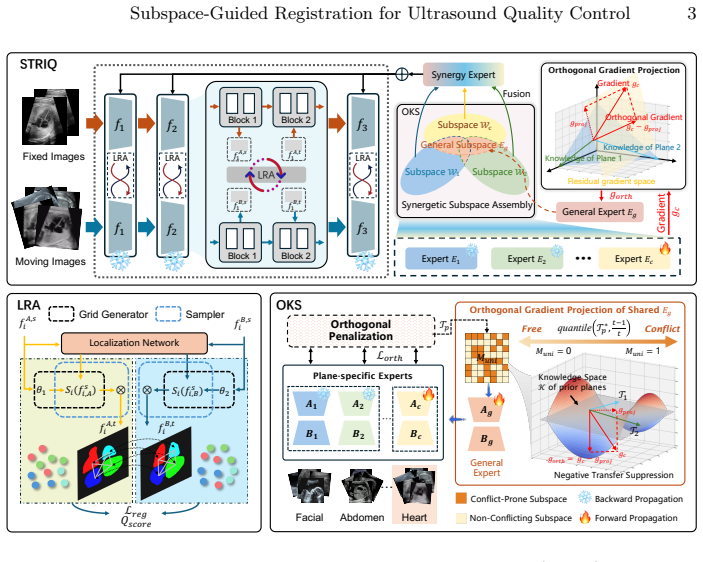
STR IQ recasts annotation-free US plane quality control as a subspace-guided consistency measurement problem. It uses a Latent Registration Aligner to establish hierarchical feature-space correspondences between query images and variance-driven anchors autonomously distilled from unlabeled data, while an Orthogonal Knowledge Subspace module decomposes representations into mutually orthogonal subspaces to prevent inter-plane interference and ground the quality metric in principled subspace proximity.
What carries the argument
The Latent Registration Aligner (LRA) together with the Orthogonal Knowledge Subspace (OKS), which together produce hierarchical correspondences to variance-driven anchors and enforce orthogonal plane-specific representations.
If this is right
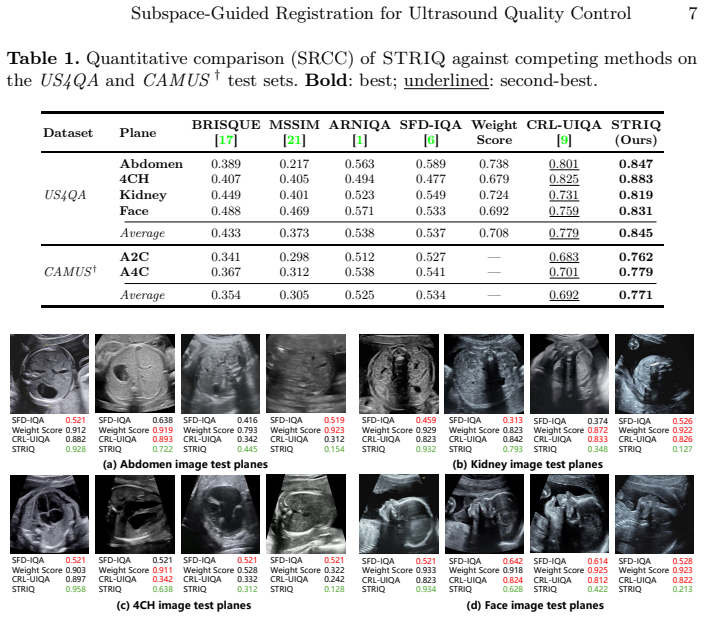
- STR IQ reaches state-of-the-art correlation with clinical quality scores on the in-house US4QA and public CAMUS datasets.
- The framework supplies real-time, annotation-free quality control usable both during live scanning and for retrospective audits.
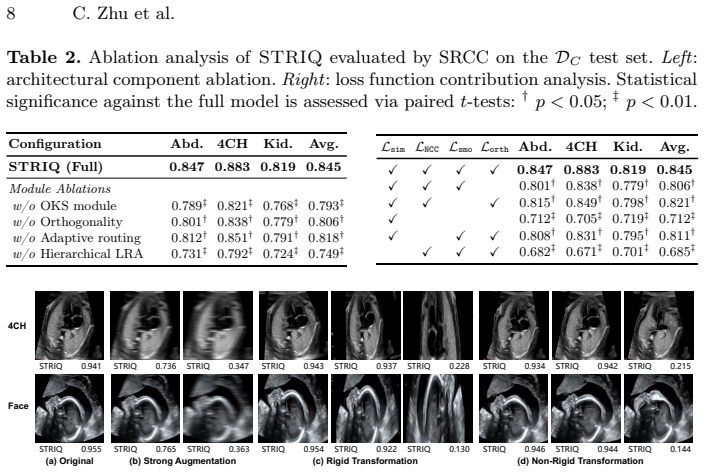
- The OKS module isolates plane-specific knowledge, eliminating negative transfer between anatomical views.
- Variance spectrum distillation produces anchors that remain stable under the spatial deformations typical of clinical ultrasound acquisition.
Where Pith is reading between the lines
- The same anchor-plus-orthogonal-subspace pattern could be tested on other 2-D or 3-D imaging modalities that currently rely on heavy annotation for quality scoring.
- If the variance anchors prove stable across scanner vendors, the method could serve as a foundation for vendor-agnostic quality dashboards in hospital PACS systems.
- Because the method operates without labels, it opens the possibility of continuous self-supervised fine-tuning on incoming clinical streams.
Load-bearing premise
Variance-driven anchors distilled from unlabeled data serve as structurally stable prototypes that support reliable hierarchical feature correspondences across deformed clinical images.
What would settle it
Run STRIQ on a held-out ultrasound dataset acquired on different machines or containing unseen pathologies and measure whether its quality scores lose correlation with expert clinical ratings below the level reported on US4QA and CAMUS.
Figures
read the original abstract
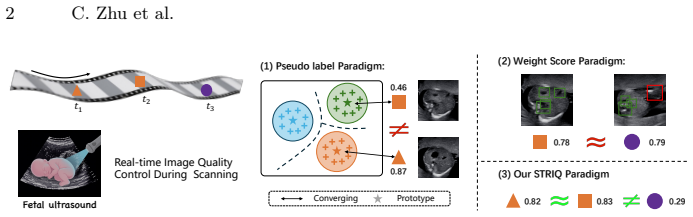
Reliable quality control (QC) of ultrasound images is essential for both real-time acquisition guidance and retrospective clinical audit, yet existing approaches rely heavily on per-plane annotations, or employ pseudo-labeling prone to systematic bias under spatial deformations inherent in clinical acquisition. We present STRIQ, a registration-driven framework that recasts annotation-free US plane quality control as a subspace-guided consistency measurement problem. Specifically, STRIQ introduces a Latent Registration Aligner (LRA) to establish hierarchical feature space correspondences between query images and variance-driven anchors, which are autonomously distilled from unlabeled data via a variance spectrum criterion to serve as structurally stable prototypes. To further disambiguate anatomical planes and mitigate negative knowledge transfer, we propose an Orthogonal Knowledge Subspace (OKS) module. The OKS decomposes plane-specific representations into mutually orthogonal subspaces, enabling fine-grained expert collaboration while preventing inter-plane interference, ensuring that the quality metric is grounded in principled subspace proximity. Extensive experiments on the in-house US4QA and public CAMUS datasets demonstrate that STRIQ achieves state-of-the-art correlation with clinical quality scores, establishing a new paradigm for annotation-free, real-time reliable ultrasound quality control. Our code is available at https://github.com/zhcz328/STRIQ.
Editorial analysis
A structured set of objections, weighed in public.
Referee Report
Summary. The paper proposes STRIQ, a registration-driven framework that recasts annotation-free ultrasound plane quality control as a subspace-guided consistency measurement problem. It introduces a Latent Registration Aligner (LRA) to establish hierarchical feature correspondences between query images and variance-driven anchors autonomously distilled from unlabeled data via a variance spectrum criterion, which are claimed to serve as structurally stable prototypes. An Orthogonal Knowledge Subspace (OKS) module decomposes plane-specific representations into mutually orthogonal subspaces to disambiguate anatomical planes and prevent negative transfer. Experiments on the in-house US4QA and public CAMUS datasets are reported to achieve state-of-the-art correlation with clinical quality scores, establishing a new paradigm for annotation-free, real-time US QC.
Significance. If the central claims hold, the work offers a potentially impactful annotation-free method for real-time and retrospective ultrasound quality control that avoids the biases of pseudo-labeling under clinical deformations, with possible benefits for acquisition guidance and audit workflows. The use of variance-driven anchors and orthogonal subspaces represents a novel technical approach in this domain.
major comments (1)
- [§3.2] §3.2: The variance spectrum criterion for distilling anchors from unlabeled data is presented as producing structurally stable prototypes, but the manuscript provides no ablation studies, perturbation analysis, or consistency metrics demonstrating that these anchors remain invariant under the spatial deformations, speckle variations, and probe-angle changes inherent to clinical ultrasound acquisition. This invariance is load-bearing for the claim that the OKS subspace proximity metric reliably reflects plane quality rather than acquisition artifacts.
minor comments (1)
- The abstract and method descriptions refer to 'hierarchical feature space correspondences' and 'fine-grained expert collaboration' without providing the precise definitions or algorithmic steps for how LRA implements the hierarchy or how OKS enforces orthogonality (e.g., via explicit loss terms or projection operators).
Simulated Author's Rebuttal
We thank the referee for their constructive feedback. We provide a point-by-point response to the major comment below.
read point-by-point responses
-
Referee: [§3.2] §3.2: The variance spectrum criterion for distilling anchors from unlabeled data is presented as producing structurally stable prototypes, but the manuscript provides no ablation studies, perturbation analysis, or consistency metrics demonstrating that these anchors remain invariant under the spatial deformations, speckle variations, and probe-angle changes inherent to clinical ultrasound acquisition. This invariance is load-bearing for the claim that the OKS subspace proximity metric reliably reflects plane quality rather than acquisition artifacts.
Authors: We appreciate the referee highlighting the need for explicit validation of anchor stability. The variance spectrum criterion selects anchors from high-variance directions in the unlabeled feature distribution to serve as structurally stable prototypes. The original manuscript presents end-to-end results on US4QA and CAMUS (datasets containing clinical deformations, speckle, and probe variations) as supporting evidence for the overall framework, including the OKS proximity metric. However, we acknowledge that dedicated ablation studies, perturbation analyses, and consistency metrics under controlled deformations were not included. In the revised manuscript we will add these experiments, including quantitative consistency metrics on simulated spatial deformations, speckle variations, and probe-angle perturbations, to directly substantiate the invariance claim. revision: yes
Circularity Check
No circularity in derivation chain
full rationale
The manuscript describes STRIQ as a registration-driven framework using LRA for hierarchical correspondences and OKS for orthogonal subspaces, with anchors distilled via a variance spectrum criterion on unlabeled data. No equations, fitted parameters, or derivations are exhibited in the provided text that reduce any quality metric, prediction, or invariance claim to a self-definition, fitted input renamed as output, or self-citation chain. The central results are presented as empirical correlations on US4QA and CAMUS datasets rather than closed mathematical loops. The derivation remains self-contained against external benchmarks with no load-bearing reductions to inputs by construction.
Axiom & Free-Parameter Ledger
axioms (1)
- domain assumption Variance spectrum criterion on unlabeled data yields structurally stable prototypes suitable for registration anchors.
invented entities (2)
-
Latent Registration Aligner (LRA)
no independent evidence
-
Orthogonal Knowledge Subspace (OKS)
no independent evidence
Reference graph
Works this paper leans on
-
[1]
In: Proceedings of the IEEE/CVF Winter Conference on Applications of Computer Vision
Agnolucci, L., Galteri, L., Bertini, M., Del Bimbo, A.: Arniqa: Learning distortion manifold for image quality assessment. In: Proceedings of the IEEE/CVF Winter Conference on Applications of Computer Vision. pp. 189–198 (2024)
2024
-
[2]
IEEE transactions on medical imaging38(8), 1788–1800 (2019)
Balakrishnan, G., Zhao, A., Sabuncu, M.R., Guttag, J., Dalca, A.V.: Voxelmorph: a learning framework for deformable medical image registration. IEEE transactions on medical imaging38(8), 1788–1800 (2019)
2019
-
[3]
Carvalho, J.S., Allan, L., Chaoui, R., Copel, J., DeVore, G., Hecher, K., Lee, W., Munoz, H., Paladini, D., Tutschek, B., et al.: Isuog practice guidelines (updated): sonographic screening examination of the fetal heart (2013)
2013
-
[4]
Medical Image Analysis100, 103385 (2025)
Chen, J., Liu, Y., Wei, S., Bian, Z., Subramanian, S., Carass, A., Prince, J.L., Du, Y.: A survey on deep learning in medical image registration: New technologies, uncertainty, evaluation metrics, and beyond. Medical Image Analysis100, 103385 (2025)
2025
-
[5]
In: Medical Image Computing and Computer Assisted Intervention – MICCAI 2023
Czolbe, S., Krause, O., Feragen, A.: Semantic similarity metrics for learned image registration. In: Medical Image Computing and Computer Assisted Intervention – MICCAI 2023. pp. 705–715. Springer (2023)
2023
-
[6]
In: Proceedings of the IEEE/CVF Conference on Com- puter Vision and Pattern Recognition
Dong, G., Liao, X., Li, M., Guo, G., Ren, C.: Exploring semantic feature discrim- ination for perceptual image super-resolution and opinion-unaware no-reference image quality assessment. In: Proceedings of the IEEE/CVF Conference on Com- puter Vision and Pattern Recognition. pp. 28176–28187 (2025) 10 C. Zhu et al
2025
-
[7]
IEEE journal of biomedical and health informatics24(4), 931–942 (2019)
Dong, J., Liu, S., Liao, Y., Wen, H., Lei, B., Li, S., Wang, T.: A generic quality control framework for fetal ultrasound cardiac four-chamber planes. IEEE journal of biomedical and health informatics24(4), 931–942 (2019)
2019
-
[8]
Dudley, N.J., Griffith, K., Houldsworth, G., Holloway, M., Dunn, M.A.: Guidelines forthesafeuseofdiagnosticultrasoundequipment.Ultrasound18(2),52–59(2010)
2010
-
[9]
In: International Conference on Medical Image Computing and Computer-Assisted Intervention
Guo, J., Lin, J., Tan, G., Lu, Y., Gao, Z., Li, S., Li, K.: Unsupervised ultra- sound image quality assessment with score consistency and relativity co-learning. In: International Conference on Medical Image Computing and Computer-Assisted Intervention. pp. 734–743. Springer (2024)
2024
-
[10]
IEEE Journal of Biomedical and Health Informatics (2025)
Jiang, C., Zhu, C., Guo, H., Tan, G., Liu, C., Li, K.: Mcbl-unet: A hybrid mamba- cnn boundary enhanced light-weight unet for placenta ultrasound image segmen- tation. IEEE Journal of Biomedical and Health Informatics (2025)
2025
-
[11]
PLoS Medicine22(11), e1004709 (2025)
Karim, J.N., Broughan, J.M., Aldridge, N., Pandya, P., McHugh, A., Papa- georghiou, A.T., study group, A.: Impact of first-trimester ultrasound on early detection of major fetal anomalies: Nationwide population-based study of over 1 million pregnancies. PLoS Medicine22(11), e1004709 (2025)
2025
-
[12]
IEEE Trans- actions on Medical Imaging38(9), 2198–2210 (2019)
Leclerc, S., Smistad, E., Pedrosa, J., Østvik, A., Cervenansky, F., Espinosa, F., Espeland, T., Berg, E.A.R., Jodoin, P.M., Grenier, T., et al.: Deep learning for seg- mentation using an open large-scale dataset in 2d echocardiography. IEEE Trans- actions on Medical Imaging38(9), 2198–2210 (2019)
2019
-
[13]
In: International Conference on Medical Image Computing and Computer-Assisted Intervention
Lin, X., Xiang, Y., Yu, L., Yan, Z.: Beyond adapting sam: Towards end-to-end ul- trasound image segmentation via auto prompting. In: International Conference on Medical Image Computing and Computer-Assisted Intervention. pp. 24–34. Springer (2024)
2024
-
[14]
Medical image analysis58, 101548 (2019)
Lin, Z., Li, S., Ni, D., Liao, Y., Wen, H., Du, J., Chen, S., Wang, T., Lei, B.: Multi- task learning for quality assessment of fetal head ultrasound images. Medical image analysis58, 101548 (2019)
2019
-
[15]
arXiv preprint arXiv:2502.13511 (2025)
Liu, R., Li, H., Gu, Y., Wang, Z., Li, S., Zeng, M.: A survey on deep learning-based medical image registration. arXiv preprint arXiv:2502.13511 (2025)
- [16]
-
[17]
IEEE Transactions on image processing21(12), 4695–4708 (2012)
Mittal, A., Moorthy, A.K., Bovik, A.C.: No-reference image quality assessment in the spatial domain. IEEE Transactions on image processing21(12), 4695–4708 (2012)
2012
-
[18]
arXiv preprint arXiv:2307.02462 (2023)
Raina, D., Ntentia, D., Chandrashekhara, S., Voyles, R., Saha, S.K.: Expert- agnostic ultrasound image quality assessment using deep variational clustering. arXiv preprint arXiv:2307.02462 (2023)
-
[19]
Bmj345(2012)
Sedgwick, P.: Pearson’s correlation coefficient. Bmj345(2012)
2012
-
[20]
Bmj349(2014)
Sedgwick, P.: Spearman’s rank correlation coefficient. Bmj349(2014)
2014
-
[21]
IEEE transactions on image processing 13(4), 600–612 (2004)
Wang, Z., Bovik, A.C., Sheikh, H.R., Simoncelli, E.P.: Image quality assessment: from error visibility to structural similarity. IEEE transactions on image processing 13(4), 600–612 (2004)
2004
-
[22]
IEEE transactions on cybernetics47(5), 1336–1349 (2017)
Wu, L., Cheng, J.Z., Li, S., Lei, B., Wang, T., Ni, D.: Fuiqa: fetal ultrasound image quality assessment with deep convolutional networks. IEEE transactions on cybernetics47(5), 1336–1349 (2017)
2017
-
[23]
In: 2024 IEEE International Conference on Bioinformatics and Biomedicine (BIBM)
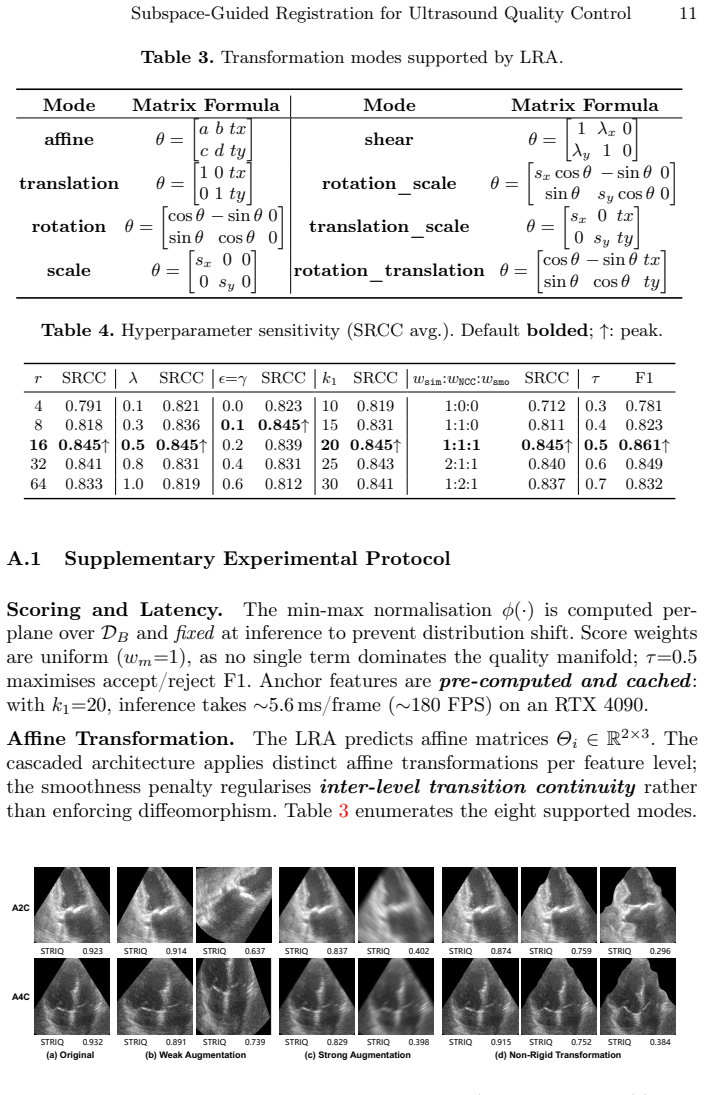
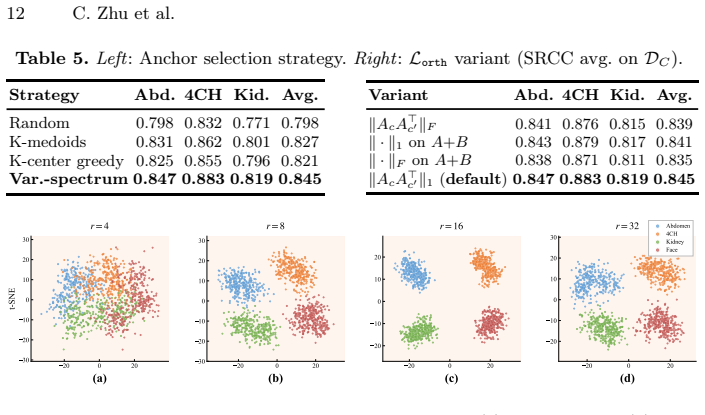
Zhu, C., Lin, J., Tan, G., Zhu, N., Li, K., Wang, C., Li, S.: Advancing ultrasound medical continuous learning with task-specific generalization and adaptability. In: 2024 IEEE International Conference on Bioinformatics and Biomedicine (BIBM). pp. 3019–3025. IEEE (2024) Subspace-Guided Registration for Ultrasound Quality Control 11 Table 3.Transformation ...
2024
discussion (0)
Sign in with ORCID, Apple, or X to comment. Anyone can read and Pith papers without signing in.