REVIEW 3 major objections 1 minor 10 references
An offline-to-online imitation learning framework mitigates distribution shift in robotics by broadening coverage with supplementary demonstrations and adapting online via self-supervised learning.
Reviewed by Pith at T0; open to challenge. T0 means a machine referee read the full paper against a public rubric. the ladder, T0–T4 →
Proposes a multi-phase imitation learning framework using supplementary demonstrations with a discriminator offline and self-supervised adaptation online to mitigate distribution shift in robotic control, claiming superior robustness in MuJoCo evaluations.
T0 review reviewed 2026-06-29 challenge →
load-bearing objection The paper describes a multi-phase offline-to-online imitation learning scheme using a discriminator and shift-triggered adaptation, but the abstract supplies no numbers, ablations, or details on detection and data sourcing, so the superiority claims cannot be assessed. the 3 major comments →
How to Mitigate the Distribution Shift Problem in Robotics Control: A Robust and Adaptive Approach Based on Offline to Online Imitation Learning
The pith
A machine-rendered reading of the paper's core claim, the machinery that carries it, and where it could break.
The reading
Core claim
The framework handles distribution shift in a lifelong, multi-phase scheme: offline learning leverages supplementary demonstrations and a discriminator to broaden policy coverage, while the online inference phase detects shifts and conducts self-supervised imitation learning to adapt the policy, resulting in better performance than baseline algorithms.
What carries the argument
The discriminator used in offline training to incorporate supplementary demonstrations for broader coverage, combined with shift detection to trigger self-supervised online adaptation.
Load-bearing premise
Supplementary demonstrations are available and sufficient to broaden state-action coverage, and distribution shift can be reliably detected to trigger effective adaptation.
What would settle it
An experiment showing that removing the supplementary demonstrations or failing to detect shifts leads to performance no better than baselines would falsify the claim.
If this is right
- The policy achieves greater robustness to unseen states through expanded training coverage.
- Self-supervised adaptation enables the policy to improve in online environments without additional expert input.
- The method demonstrates superior performance in continuous control tasks like those in MuJoCo compared to standard imitation learning approaches.
- Distribution shift can be managed through a combination of preemptive broadening and reactive adaptation.
Where Pith is reading between the lines
- Such a framework might extend to real-world robotic systems where initial demonstrations are limited.
- It could connect to other reinforcement learning methods that use experience replay or uncertainty estimation for shift detection.
- Testing on physical robots would reveal if simulation results hold under real sensor noise and dynamics.
Editorial analysis
A structured set of objections, weighed in public.
Referee Report
Summary. The paper proposes a robust offline-to-adaptive-online imitation learning framework to address distribution shift in robotics control. In the offline phase, supplementary demonstrations are used with a discriminator to broaden state-action coverage and train a more robust policy. In the online phase, distribution shift is detected to trigger self-supervised imitation learning from online experiences for adaptation. The abstract claims that extensive MuJoCo evaluations show better robustness to distribution shift and better adaptation than baselines.
Significance. If the empirical superiority holds with proper controls and ablations, the multi-phase framework could offer a practical way to improve robustness in imitation learning for robotics by combining coverage expansion offline with triggered online adaptation. No machine-checked proofs, parameter-free derivations, or reproducible code are described, so the contribution would rest entirely on the strength of the experimental validation.
major comments (3)
- [Abstract] Abstract: the claim that the method 'exhibits better robustness to distribution shift and better adaptation performance' supplies no quantitative results, error bars, dataset details, success rates, or ablation studies, so it is impossible to assess whether the data supports the central claim of superiority.
- [Abstract] Abstract (online phase description): no details are given on the distribution shift detection criterion (e.g., threshold on discriminator output, state visitation statistics, or prediction error), which is load-bearing for triggering the self-supervised adaptation step; without this, gains cannot be attributed to the proposed scheme.
- [Abstract] Abstract (offline phase description): the assumption that supplementary demonstrations are available, sufficient, and non-redundant to broaden coverage via the discriminator is stated without evidence on sourcing or coverage metrics, undermining the attribution of robustness gains to the framework.
minor comments (1)
- [Abstract] The final sentence of the abstract contains awkward phrasing ('superior performance of our framework against the distribution shift') that could be clarified for readability.
Simulated Author's Rebuttal
We thank the referee for the careful reading and specific comments on the abstract. We agree that the abstract can be improved by incorporating additional details from the main text to better support the claims. We will revise the abstract accordingly while preserving its conciseness.
read point-by-point responses
-
Referee: [Abstract] Abstract: the claim that the method 'exhibits better robustness to distribution shift and better adaptation performance' supplies no quantitative results, error bars, dataset details, success rates, or ablation studies, so it is impossible to assess whether the data supports the central claim of superiority.
Authors: We acknowledge that the abstract, being a high-level summary, omits specific quantitative details. The full manuscript presents these in Section 5, including tables with success rates, error bars, dataset descriptions, and ablation studies comparing to baselines. To address this, we will revise the abstract to include brief references to key quantitative outcomes from the MuJoCo evaluations. revision: yes
-
Referee: [Abstract] Abstract (online phase description): no details are given on the distribution shift detection criterion (e.g., threshold on discriminator output, state visitation statistics, or prediction error), which is load-bearing for triggering the self-supervised adaptation step; without this, gains cannot be attributed to the proposed scheme.
Authors: The distribution shift detection criterion, based on a threshold applied to the discriminator output, is detailed in Section 4.2 of the manuscript. We agree the abstract should reference this mechanism to clarify attribution of the online adaptation gains, and we will add a concise description of the detection approach in the revised abstract. revision: yes
-
Referee: [Abstract] Abstract (offline phase description): the assumption that supplementary demonstrations are available, sufficient, and non-redundant to broaden coverage via the discriminator is stated without evidence on sourcing or coverage metrics, undermining the attribution of robustness gains to the framework.
Authors: The sourcing of supplementary demonstrations, their role in broadening coverage, and associated coverage metrics are explained in Sections 3 and 5.1, with experimental validation in the results. We will revise the abstract to note the use of supplementary demonstrations for coverage expansion as supported by the evaluations. revision: yes
Circularity Check
No circularity: empirical framework with no derivations or self-referential fits
full rationale
The paper describes an offline-to-online imitation learning framework that uses a discriminator on supplementary demonstrations and shift detection for adaptation. No equations, derivations, or parameter-fitting steps appear in the abstract or described method. Claims rest on empirical MuJoCo results rather than any reduction of outputs to inputs by construction. No self-citations, uniqueness theorems, or ansatzes are invoked in the provided text. The central performance claims are externally falsifiable via the reported experiments and do not collapse into self-definition or fitted-input renaming.
Axiom & Free-Parameter Ledger
Cite this review
Pith. "Pith review of How to Mitigate the Distribution Shift Problem in Robotics Control: A Robust and Adaptive Approach Based on Offline to Online Imitation Learning." pith.science (2026). https://pith.science/paper/KKWFDM4L
@misc{pith2026260525414,
  author       = {Pith},
  title        = {Pith review of: How to Mitigate the Distribution Shift Problem in Robotics Control: A Robust and Adaptive Approach Based on Offline to Online Imitation Learning},
  year         = {2026},
  howpublished = {\url{https://pith.science/paper/KKWFDM4L}},
  note         = {Machine review of arXiv:2605.25414}
}
read the original abstract
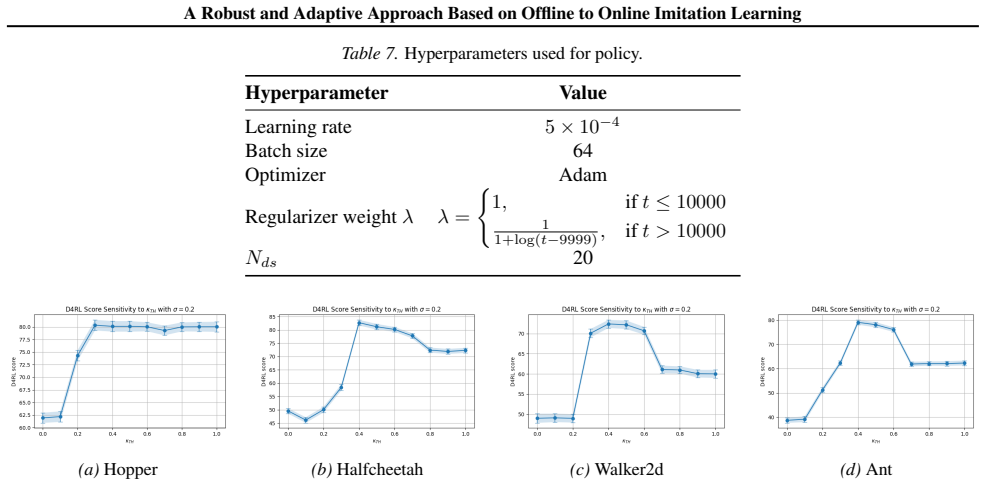
Distribution shift in imitation learning refers to the problem that the agent cannot plan proper actions for a state that has not been visited during the training. This problem can be largely attributed to the inherently narrow state-action coverage provided by expert demonstrations over the full environment. In this paper, we propose a robust offline to adaptive online imitation learning framework that handles the distribution shift problem in a lifelong, multi-phase scheme. In the offline learning phase, we leverage supplementary demonstrations to broaden the state-action coverage of the policy by utilizing a discriminator to effectively train the policy with supplementary demonstrations, thereby enhancing the robustness of the policy to distribution shift. In the subsequent online inference phase, our framework detects the occurrence of distribution shift and conducts self-supervised imitation learning from online experiences to adapt the policy to the online environments. Through extensive evaluations in MuJoCo environments, we demonstrate that our method exhibits better robustness to distribution shift and better adaptation performance to online environments than the baseline algorithms, which indicates superior performance of our framework against the distribution shift.
Figures


Reference graph
Works this paper leans on
-
[1]
D4RL: Datasets for Deep Data-Driven Reinforcement Learning
URL https://openreview.net/forum? id=8egnwady4b. du Plessis, M. C., Niu, G., and Sugiyama, M. Class- prior estimation for learning from positive and un- labeled data.Machine Learning, 106(4):463–492, November 2016. ISSN 1573-0565. doi: 10.1007/ s10994-016-5604-6. URL http://dx.doi.org/ 10.1007/s10994-016-5604-6. Fu, J., Kumar, A., Nachum, O., Tucker, G., ...
work page internal anchor Pith review Pith/arXiv arXiv doi:10.1007/s10994-016-5604-6 2016
-
[2]
doi: 10.1109/TVT.2024.3382309. Ho, J. and Ermon, S. Generative adversarial imitation learn- ing, 2016. URL https://arxiv.org/abs/1606. 03476. Ke, L., Zhang, Y ., Deshpande, A., Srinivasa, S., and Gupta, A. Ccil: Continuity-based data augmentation for correc- tive imitation learning.arXiv preprint arXiv:2310.12972, 2023. Kemker, R., McClure, M., Abitino, A...
-
[3]
PMLR. URL https://proceedings.mlr. press/v48/thomasa16.html. Umut Ciftci, Y ., Feng, Z., and Bansal, S. Safe-gil: Safety guided imitation learning.arXiv e-prints, pp. arXiv–2404, 2024. Wang, Q., McCarthy, R., Bulens, D. C., McGuinness, K., O’Connor, N. E., Sanchez, F. R., Gürtler, N., Wid- maier, F., and Redmond, S. J. Improving behavioural cloning with p...
-
[4]
In: 2020 IEEE/RSJ International Conference on Intelligent Robots and Systems (IROS)
doi: 10.1109/IROS45743.2020.9341014. Yoon, H.-S., Hwang, J.-H., Kim, C., Son, E. I., Yoo, S.-W., and Seo, S.-W. Adaptive robot traversability estimation based on self-supervised online continual learning in unstructured environments.IEEE Robotics and Automation Letters, 9(6):4902–4909, 2024. doi: 10.1109/LRA.2024.3386451. Yu, T., Thomas, G., Yu, L., Ermon...
-
[5]
Non-negativityBy the definitions of conditional and marginal probability densities, πE(a|s)≥0, p E(s)≥0⇒p E(s, a)≥0∀(s, a)
-
[6]
NormalizationWe must show that the integral over the full space equals 1: Z S Z A pE(s, a)da ds= Z S pE(s) Z A πE(a|s)da ds(16) = Z S pE(s)·1ds= Z S pE(s)ds= 1(17) Thus,p E(s, a)is a properly normalized joint probability density function. B.3. Difference from GAIL The online learning procedure of the RAIL framework closely resembles that of GAIL, wherein ...
-
[7]
Unlike GAIL, RAIL introduces an additional regularization term to the discriminator objective function (eq. (3))
-
[8]
GAIL employs TRPO (Schulman et al., 2015) to update the policy using the discriminator output, whereas RAIL adopts a weighted BC approach for policy updates that enables the online agent to stably adapt to the online environment
2015
-
[9]
In contrast, RAIL forgoes exploration and instead relies solely on the self-supervised learning signal derived from the current action
In GAIL, action sampling is guided by online exploration to discover improved actions (Ablett et al., 2023). In contrast, RAIL forgoes exploration and instead relies solely on the self-supervised learning signal derived from the current action
2023
-
[10]
GAIL is better aligned with scenarios that benefit from online exploration, whereas RAIL is more suitable for settings requiring online adaptation
In summary, the differences between RAIL and GAIL are not limited to the discriminator training process; they also reflect differing algorithmic suitability depending on the task setting. GAIL is better aligned with scenarios that benefit from online exploration, whereas RAIL is more suitable for settings requiring online adaptation. 13 A Robust and Adapt...
2021
This paper was first reviewed by grok-4.3 on June 29, 2026.
discussion (0)
Sign in with ORCID, Apple, or X to comment. Anyone can read and Pith papers without signing in.