Geometric Flow Matching for Molecular Conformation Generation via Manifold Decomposition
Pith reviewed 2026-06-29 22:14 UTC · model grok-4.3
The pith
GO-Flow generates accurate 3D molecular conformations by decomposing the process into translation, rotation on SO(3), and conformation subspaces with tailored transports.
A machine-rendered reading of the paper's core claim, the machinery that carries it, and where it could break.
Core claim
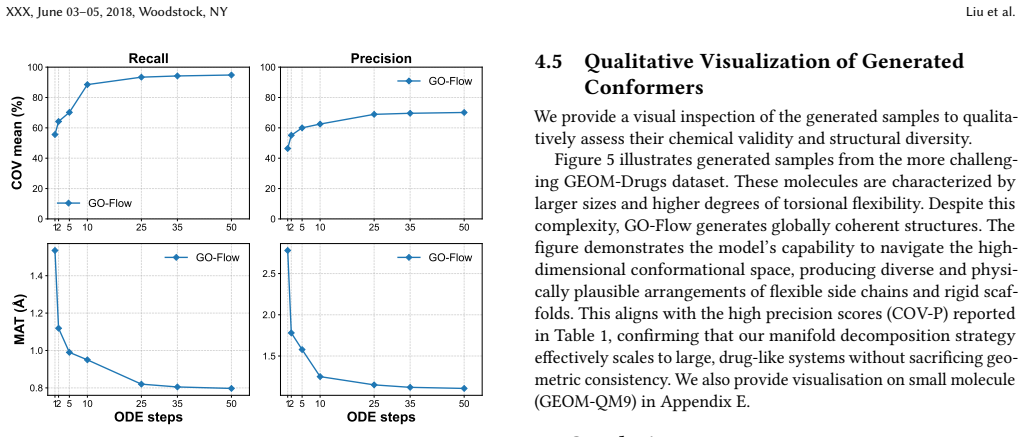
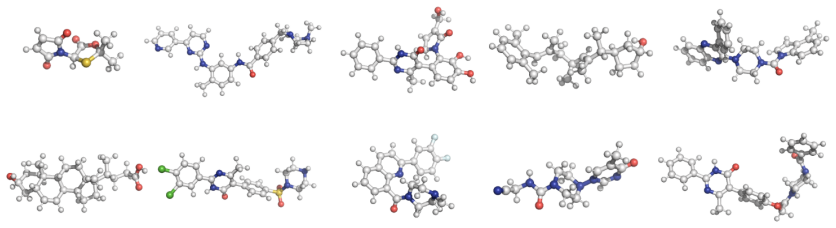
GO-Flow decomposes molecular conformation generation into translation space with linear optimal transport, rotation space with geodesic flows on SO(3), and conformation space with entropic optimal transport. Combined with equivariant architectures, this decomposition aligns the generative paths with molecular degrees of freedom, produces straighter probability paths on the correct manifolds, and yields state-of-the-art generation quality on GEOM-Drugs and GEOM-QM9 while supporting high-fidelity sampling in as few as 50 steps.
What carries the argument
Manifold decomposition of the generation process into translation, rotation on SO(3), and conformation subspaces, each paired with a matching optimal transport plan.
If this is right
- Sampling requires far fewer steps because the learned paths are straighter on the appropriate manifolds.
- Equivariant networks produce conformations that remain consistent under global rotations.
- Geometric validity improves because the model no longer has to discover stiff bond constraints from data alone.
- Performance reaches state-of-the-art levels on the GEOM-Drugs and GEOM-QM9 benchmarks.
Where Pith is reading between the lines
- The same three-way split could be tested on other rigid-body systems such as protein backbones where global pose separates from internal torsions.
- Training data efficiency might increase because the inductive bias removes the need to learn elementary geometry from scratch.
- Ablations that replace one of the three transport plans with Euclidean transport would quantify how much each manifold choice contributes to the observed gains.
Load-bearing premise
That the chosen split into these three subspaces with linear, geodesic, and entropic transports will produce physically plausible intermediate structures during the generative process.
What would settle it
Sample molecules from the trained model and measure the fraction that violate standard bond-length or bond-angle tolerances relative to the same baselines without the decomposition.
Figures




read the original abstract
The generation of accurate 3D molecular conformations is a pivotal challenge in computational chemistry and drug discovery. Recently, diffusion and flow matching models have achieved remarkable success. However, there is a critical misalignment between their mathematical formulation and the physical reality of molecules. Existing approaches predominantly treat molecules as unstructured point clouds in Cartesian space, overlooking the intrinsic hierarchical mechanics where bond lengths and bond angles are relatively stiff, whereas torsion angles constitute the dominant flexible degrees of freedom. This lack of manifold awareness forces models to relearn fundamental geometric constraints from scratch, often leading to physically implausible intermediate structures. To address this, we propose GO-Flow that aligns generative modeling with molecular geometry via manifold decomposition. Instead of forcing motion through Euclidean space, GO-Flow decomposes the generation process into three physically motivated subspaces: translation space with linear optimal transport, rotation space with geodesic flows on $SO(3)$, and conformation space with entropic optimal transport. This decomposition injects geometric inductive biases and makes the generative paths better aligned with molecular degrees of freedom. When combined with equivariant neural architectures, it encourages rotation-consistent generation and improves geometric validity. Extensive experiments on GEOM-Drugs and GEOM-QM9 demonstrate that GO-Flow achieves state-of-the-art generation quality. Notably, by learning straighter probability paths on the correct manifolds naturally, our method enables high-fidelity sampling with as few as 50 steps, effectively bridging the gap between structural precision and computational efficiency.
Editorial analysis
A structured set of objections, weighed in public.
Referee Report
Summary. The manuscript proposes GO-Flow, a flow matching model for 3D molecular conformation generation that decomposes the process into three subspaces—translation (linear optimal transport), rotation (geodesic flows on SO(3)), and conformation (entropic optimal transport)—to better align with molecular degrees of freedom. Combined with equivariant architectures, the method claims state-of-the-art generation quality on GEOM-Drugs and GEOM-QM9 while enabling high-fidelity sampling in as few as 50 steps by learning straighter paths on the appropriate manifolds.
Significance. If the reported results hold, the work offers a meaningful advance by injecting geometric inductive biases into flow matching, potentially improving both physical plausibility and sampling efficiency for molecular generation tasks. The manifold decomposition and choice of manifold-specific optimal transport constitute a clear strength relative to unstructured point-cloud baselines.
minor comments (2)
- [Abstract] Abstract: the SOTA claim would be strengthened by briefly citing the key quantitative metrics (e.g., validity, RMSD) and the primary baselines against which superiority is measured.
- [Method] The implementation details for combining the three subspace flows into a single equivariant network (e.g., how the SO(3) geodesic is discretized and back-propagated) could be expanded for reproducibility.
Simulated Author's Rebuttal
We thank the referee for the positive assessment of our work on GO-Flow and the recommendation for minor revision. The report does not list any specific major comments, so we have no individual points to rebut or revise at this stage. We are encouraged that the geometric inductive biases from manifold decomposition are viewed as a strength.
Circularity Check
No significant circularity; derivation is self-contained proposal
full rationale
The provided abstract and description outline a proposed manifold decomposition (translation with linear OT, SO(3) geodesic flows, conformation with entropic OT) combined with equivariant networks. No equations, fitted parameters, or predictions are shown that reduce by construction to the inputs. No self-citations are invoked as load-bearing uniqueness theorems. The SOTA claim and sampling efficiency are presented as experimental outcomes rather than tautological re-statements of the method. This matches the default expectation of non-circularity for a methods paper whose central contribution is an architectural choice with independent empirical validation.
Axiom & Free-Parameter Ledger
axioms (1)
- domain assumption Bond lengths and bond angles are relatively stiff whereas torsion angles constitute the dominant flexible degrees of freedom.
invented entities (1)
-
GO-Flow manifold decomposition
no independent evidence
Reference graph
Works this paper leans on
-
[1]
Simon Axelrod and Rafael Gomez-Bombarelli. 2022. GEOM, energy-annotated molecular conformations for property prediction and molecular generation.Sci- entific Data9, 1 (2022), 185
2022
-
[2]
Samuel R Buss and Jay P Fillmore. 2001. Spherical averages and applications to spherical splines and interpolation.ACM Transactions on Graphics (TOG)20, 2 (2001), 95–126
2001
-
[3]
Zhonglin Cao, Mario Geiger, Allan Dos Santos Costa, Danny Reidenbach, Karsten Kreis, Tomas Geffner, Franco Pellegrini, Guoqing Zhou, and Emine Kucukbenli
- [4]
-
[5]
Suresh Dara, Swetha Dhamercherla, Surender Singh Jadav, CH Madhu Babu, and Mohamed Jawed Ahsan. 2022. Machine learning in drug discovery: a review. Artificial intelligence review55, 3 (2022), 1947–1999
2022
-
[6]
Bo Ding, Yue Weng, Yunqing Liu, Chunlan Song, Le Yin, Jiafan Yuan, Yanrui Ren, Aiwen Lei, and Chien-Wei Chiang. 2019. Selective photoredox trifluoromethyla- tion of tryptophan-containing peptides.European Journal of Organic Chemistry 2019, 46 (2019), 7596–7605
2019
- [7]
-
[8]
Octavian Ganea, Lagnajit Pattanaik, Connor Coley, Regina Barzilay, Klavs Jensen, William Green, and Tommi Jaakkola. 2021. Geomol: Torsional geometric gen- eration of molecular 3d conformer ensembles.Advances in Neural Information Processing Systems34 (2021), 13757–13769
2021
-
[9]
Andreas René Geist, Jonas Frey, Mikel Zhobro, Anna Levina, and Georg Martius
-
[10]
InProceedings of the 41st International Conference on Machine Learning (Proceedings of Machine Learning Research, Vol
Learning with 3D rotations, a hitchhiker’s guide to SO(3). InProceedings of the 41st International Conference on Machine Learning (Proceedings of Machine Learning Research, Vol. 235), Ruslan Salakhutdinov, Zico Kolter, Katherine Heller, Adrian Weller, Nuria Oliver, Jonathan Scarlett, and Felix Berkenkamp (Eds.). PMLR, 15331–15350. https://proceedings.mlr....
-
[11]
Majdi Hassan, Nikhil Shenoy, Jungyoon Lee, Hannes Stärk, Stephan Thaler, and Dominique Beaini. 2024. Et-flow: Equivariant flow-matching for molecular conformer generation.Advances in Neural Information Processing Systems37 (2024), 128798–128824
2024
-
[12]
Paul CD Hawkins, A Geoffrey Skillman, Gregory L Warren, Benjamin A Ellingson, and Matthew T Stahl. 2010. Conformer generation with OMEGA: algorithm and validation using high quality structures from the Protein Databank and Cambridge Structural Database.Journal of chemical information and modeling 50, 4 (2010), 572–584
2010
-
[13]
Xin He, Wenqi Fan, Yili Wang, Chengyi Liu, Rui Miao, Xin Juan, and Xin Wang
-
[14]
Graph Defense Diffusion Model.arXiv preprint arXiv:2501.11568(2025)
work page internal anchor Pith review Pith/arXiv arXiv 2025
-
[15]
Evan G Hemingway and Oliver M O’Reilly. 2018. Perspectives on Euler angle singularities, gimbal lock, and the orthogonality of applied forces and applied moments.Multibody system dynamics44, 1 (2018), 31–56
2018
-
[16]
Jonathan Ho, Ajay Jain, and Pieter Abbeel. 2020. Denoising diffusion probabilistic models.Advances in neural information processing systems33 (2020), 6840–6851
2020
-
[17]
Scott A Hollingsworth and Ron O Dror. 2018. Molecular dynamics simulation for all.Neuron99, 6 (2018), 1129–1143
2018
-
[18]
Hanxu Hu, Yunqing Liu, Zhongyi Yu, and Laura Perez-Beltrachini. 2023. Im- proving user controlled table-to-text generation robustness. InFindings of the Association for Computational Linguistics: EACL 2023. 2317–2324
2023
-
[19]
Bowen Jing, Gabriele Corso, Jeffrey Chang, Regina Barzilay, and Tommi Jaakkola
-
[20]
Torsional diffusion for molecular conformer generation.Advances in neural information processing systems35 (2022), 24240–24253
2022
-
[21]
Wolfgang Kabsch. 1976. A solution for the best rotation to relate two sets of vectors.Foundations of Crystallography32, 5 (1976), 922–923
1976
-
[22]
Greg Landrum et al. 2013. RDKit: A software suite for cheminformatics, com- putational chemistry, and predictive modeling.Greg Landrum8, 31.10 (2013), 5281
2013
-
[23]
Jiatong Li, Junxian Li, Yunqing Liu, Dongzhan Zhou, and Qing Li. [n. d.]. Tomg- bench: Evaluating llms on text-based open molecule generation. ([n. d.])
-
[24]
Jiatong Li, Junxian Li, Weida Wang, Yunqing Liu, Changmeng Zheng, Dongzhan Zhou, Xiao-yong Wei, and Qing Li. 2024. Speak-to-Structure: Evaluating LLMs in Open-domain Natural Language-Driven Molecule Generation.arXiv preprint arXiv:2412.14642(2024)
work page internal anchor Pith review Pith/arXiv arXiv 2024
-
[25]
Jiatong Li, Yunqing Liu, Wenqi Fan, Xiao-Yong Wei, Hui Liu, Jiliang Tang, and Qing Li. 2024. Empowering molecule discovery for molecule-caption transla- tion with large language models: A chatgpt perspective.IEEE transactions on knowledge and data engineering36, 11 (2024), 6071–6083
2024
-
[26]
Jiatong Li, Yunqing Liu, Wei Liu, Jingdi Lei, Di Zhang, Wenqi Fan, Dongzhan Zhou, Yuqiang Li, and Qing Li. 2026. Molreflect: Towards in-context fine-grained alignments between molecules and texts.IEEE Transactions on Knowledge and Data Engineering(2026)
2026
-
[27]
Yaron Lipman, Ricky T. Q. Chen, Heli Ben-Hamu, Maximilian Nickel, and Matthew Le. 2023. Flow Matching for Generative Modeling. InThe Eleventh International Conference on Learning Representations. https://openreview.net/ forum?id=PqvMRDCJT9t
2023
- [28]
-
[29]
Chengyi Liu, Jiahao Zhang, Shijie Wang, Wenqi Fan, and Qing Li. 2025. Score- based generative diffusion models for social recommendations.IEEE Transactions on Knowledge and Data Engineering(2025)
2025
-
[30]
Yunqing Liu, Wenqi Fan, Xiaoyong Wei, and Li Qing. 2025. GLProtein: Global- and-Local Structure Aware Protein Representation Learning. InFindings of the Association for Computational Linguistics: EMNLP 2025. Association for Computa- tional Linguistics, Suzhou, China
2025
-
[31]
Yunqing Liu, Yi Zhou, and Wenqi Fan. 2026. Enhancing Molecular Property Predictions by Learning from Bond Modelling and Interactions. InThe Fourteenth International Conference on Learning Representations. https://openreview.net/ forum?id=S4bJQ4p9hx
2026
-
[32]
Shitong Luo, Chence Shi, Minkai Xu, and Jian Tang. 2021. Predicting molecular conformation via dynamic graph score matching.Advances in neural information processing systems34 (2021), 19784–19795
2021
-
[33]
Elman Mansimov, Omar Mahmood, Seokho Kang, and Kyunghyun Cho. 2019. Molecular geometry prediction using a deep generative graph neural network. Scientific reports9, 1 (2019), 20381
2019
-
[34]
Jiwoong Park and Yang Shen. 2024. Equivariant blurring diffusion for hierarchical molecular conformer generation.Advances in Neural Information Processing Systems37 (2024), 131645–131675. XXX, June 03–05, 2018, Woodstock, NY Liu et al
2024
-
[35]
Anastasiia V Sadybekov and Vsevolod Katritch. 2023. Computational approaches streamlining drug discovery.Nature616, 7958 (2023), 673–685
2023
-
[36]
Chence Shi, Shitong Luo, Minkai Xu, and Jian Tang. 2021. Learning gradient fields for molecular conformation generation. InInternational conference on machine learning. PMLR, 9558–9568
2021
-
[37]
Gregor Simm and Jose Miguel Hernandez-Lobato. 2020. A Generative Model for Molecular Distance Geometry. InProceedings of the 37th International Confer- ence on Machine Learning (Proceedings of Machine Learning Research, Vol. 119), Hal Daumé III and Aarti Singh (Eds.). PMLR, 8949–8958. https://proceedings. mlr.press/v119/simm20a.html
2020
-
[38]
Sakshi Singh, Qanita Bani Baker, and Dev Bukhsh Singh. 2022. Molecular docking and molecular dynamics simulation. InBioinformatics. Elsevier, 291–304
2022
-
[39]
Daniel GA Smith, Lori A Burns, Andrew C Simmonett, Robert M Parrish, Matthew C Schieber, Raimondas Galvelis, Peter Kraus, Holger Kruse, Roberto Di Remigio, Asem Alenaizan, et al . 2020. PSI4 1.4: Open-source software for high-throughput quantum chemistry.The Journal of chemical physics152, 18 (2020)
2020
-
[40]
Fabien Vincent, Arsenio Nueda, Jonathan Lee, Monica Schenone, Marco Prunotto, and Mark Mercola. 2022. Phenotypic drug discovery: recent successes, lessons learned and new directions.Nature Reviews Drug Discovery21, 12 (2022), 899–914
2022
-
[41]
Elhag, Navdeep Jaitly, Joshua M
Yuyang Wang, Ahmed A. Elhag, Navdeep Jaitly, Joshua M. Susskind, and Miguel Ángel Bautista. 2024. Swallowing the Bitter Pill: Simplified Scalable Conformer Generation. InForty-first International Conference on Machine Learn- ing
2024
-
[42]
Yue Weng, Bo Ding, Yunqing Liu, Chunlan Song, Lo-Ying Chan, and Chien-Wei Chiang. 2021. Late-stage photoredox C–H amidation of N-unprotected indole derivatives: Access to n-(indol-2-yl) amides.Organic Letters23, 7 (2021), 2710– 2714
2021
-
[43]
Minkai Xu, Shitong Luo, Yoshua Bengio, Jian Peng, and Jian Tang. 2021. Learn- ing Neural Generative Dynamics for Molecular Conformation Generation. In International Conference on Learning Representations. https://openreview.net/ forum?id=pAbm1qfheGk
2021
-
[44]
Minkai Xu, Wujie Wang, Shitong Luo, Chence Shi, Yoshua Bengio, Rafael Gomez- Bombarelli, and Jian Tang. 2021. An end-to-end framework for molecular con- formation generation via bilevel programming. InInternational conference on machine learning. PMLR, 11537–11547
2021
-
[45]
Minkai Xu, Lantao Yu, Yang Song, Chence Shi, Stefano Ermon, and Jian Tang. 2022. GeoDiff: A Geometric Diffusion Model for Molecular Conformation Generation. InInternational Conference on Learning Representations. https://openreview.net/ forum?id=PzcvxEMzvQC
2022
-
[46]
Zihuai Zhao, Wenqi Fan, Jiatong Li, Yunqing Liu, Xiaowei Mei, Yiqi Wang, Zhen Wen, Fei Wang, Xiangyu Zhao, Jiliang Tang, et al. 2024. Recommender systems in the era of large language models (llms).IEEE Transactions on Knowledge and Data Engineering36, 11 (2024), 6889–6907. Geometric Flow Matching for Molecular Conformation Generation via Manifold Decompos...
2024
discussion (0)
Sign in with ORCID, Apple, or X to comment. Anyone can read and Pith papers without signing in.