Superfluid fraction and effective ion mass in the crystalline crust of a neutron star: role of interband response
Pith reviewed 2026-06-29 20:41 UTC · model grok-4.3
The pith
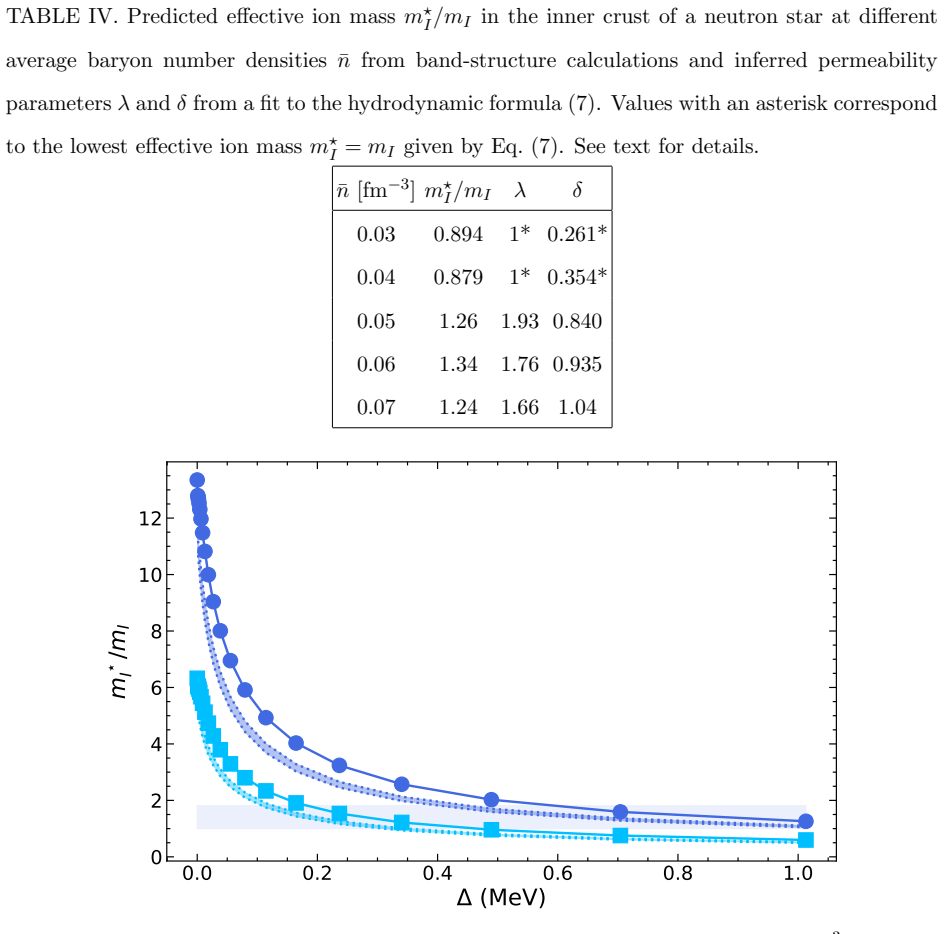
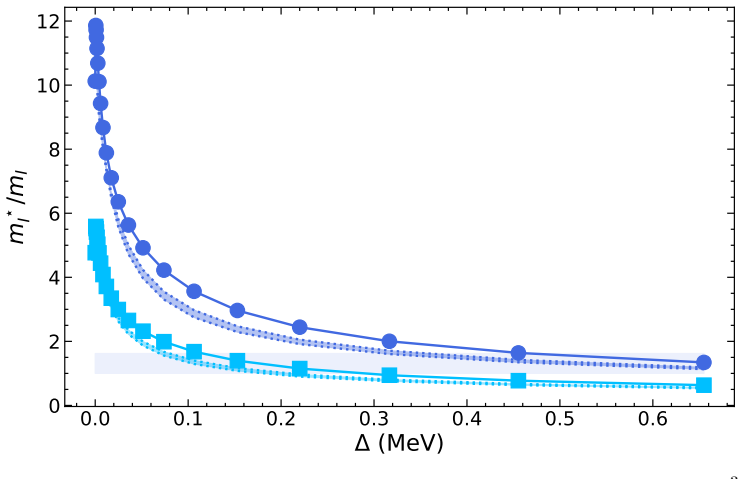
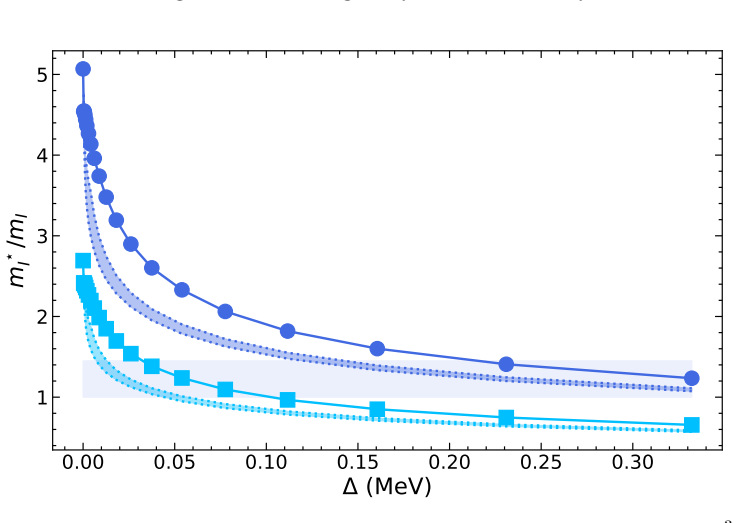
The interband response enhances the neutron superfluid fraction in a neutron star's inner crust, keeping effective ion masses close to the mass of quantum-mechanically bound nucleons for realistic pairing gaps.
A machine-rendered reading of the paper's core claim, the machinery that carries it, and where it could break.
Core claim
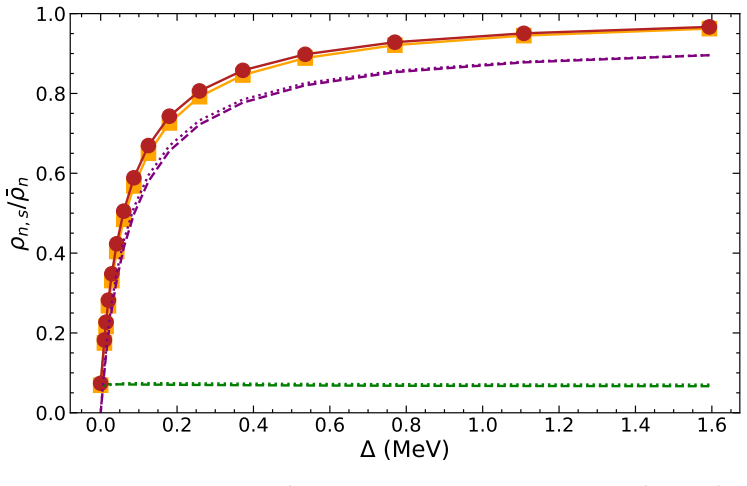
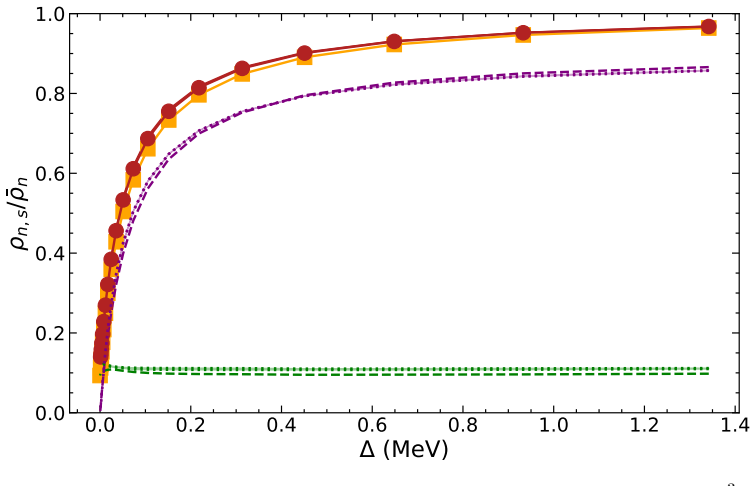
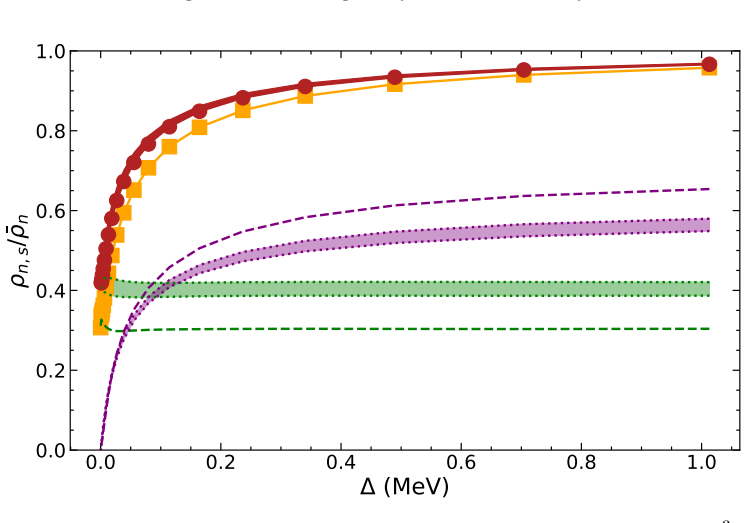
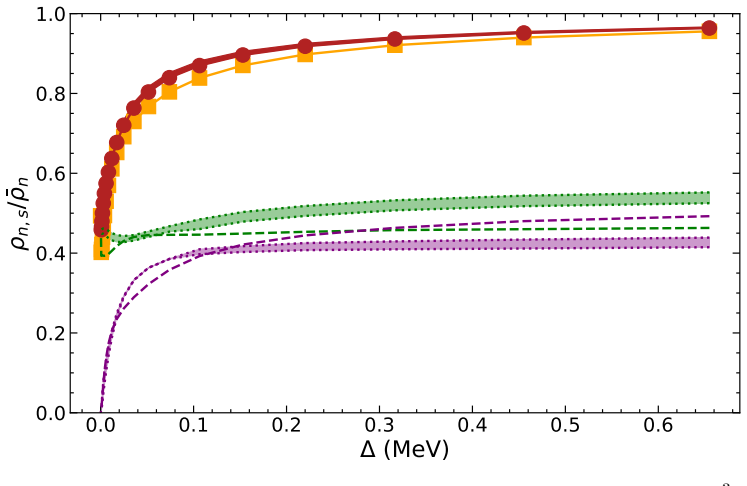
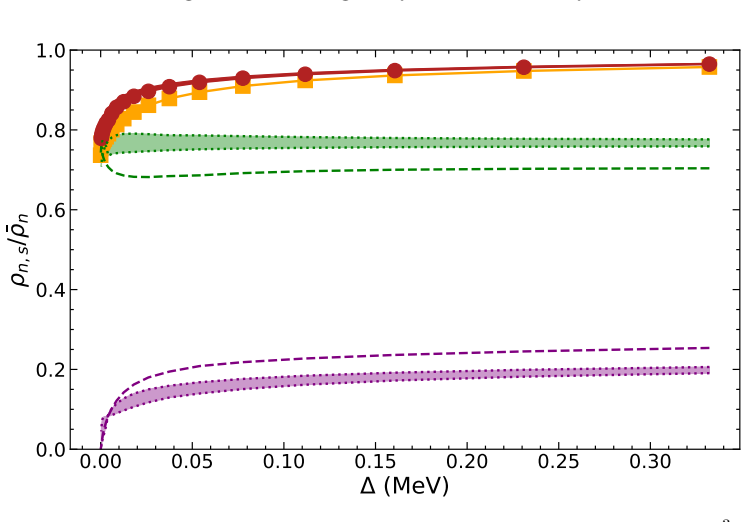
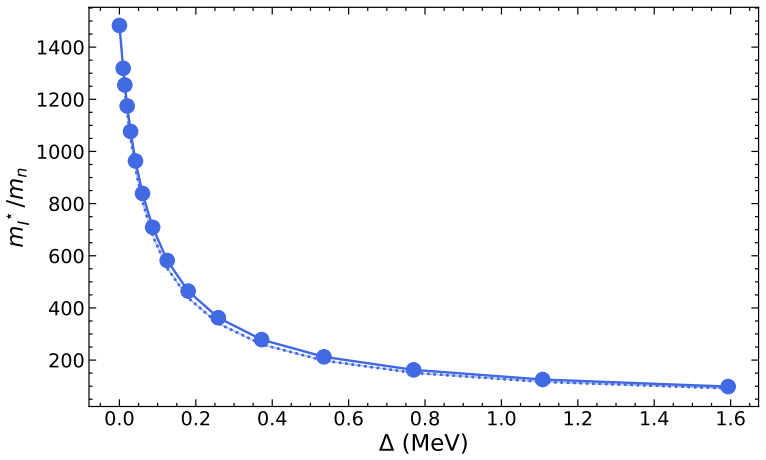
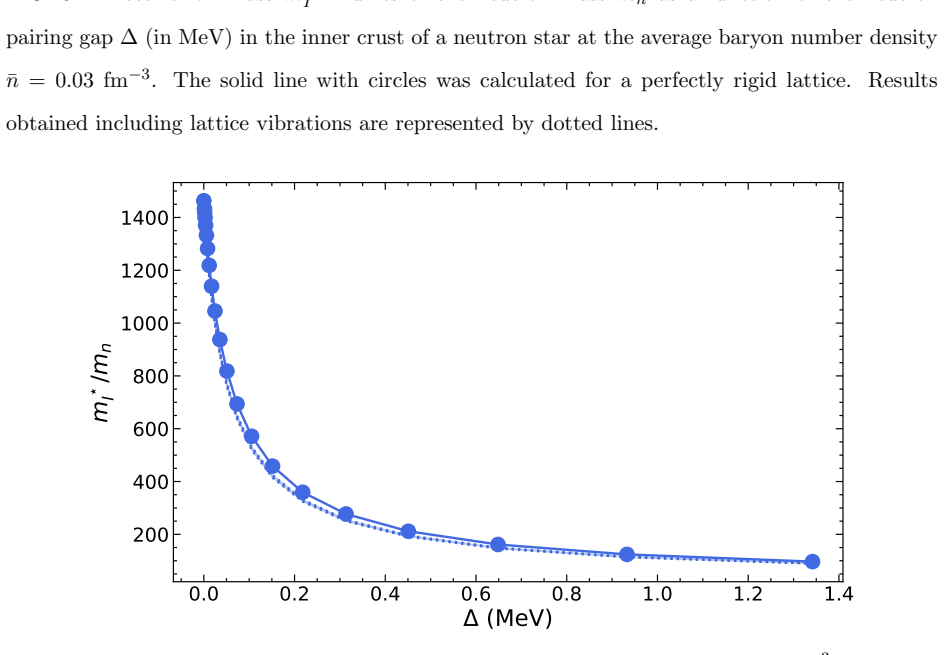
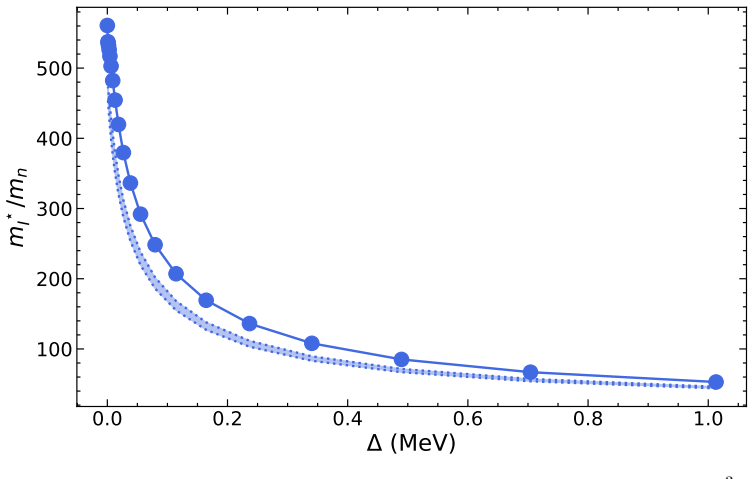
The neutron superfluid density obtained from the band-structure calculation is formally identical to the entrainment matrix of a homogeneous neutron-proton superfluid mixture. Three-dimensional calculations that include ion zero-point motion show that the interband contribution raises the superfluid fraction, so that the effective mass of each ion remains close to the mass of the nucleons that are quantum-mechanically bound inside it, provided the neutron pairing gap takes realistic values. The relative weight of intraband and interband terms changes across the crust, and the results differ from those of classical hydrodynamic models that adopt different permeability assumptions for the ions
What carries the argument
Interband response within the linear response theory of the self-consistent time-dependent Hartree-Fock-Bogoliubov equations, which augments the intraband contribution to the superfluid density.
If this is right
- The neutron superfluid fraction is larger once the interband term is retained.
- Effective ion masses stay near the mass of bound nucleons rather than rising substantially.
- A single microscopic framework now describes entrainment both in the inner crust and in the outer core.
- The balance between intraband and interband contributions varies with depth in the crust when ion zero-point motion is included.
- Classical hydrodynamic models with different ion permeability prescriptions give different numerical values.
Where Pith is reading between the lines
- The same formalism could be used to recompute entrainment in other regions where density inhomogeneities occur, such as near the crust-core interface.
- The predicted ion masses could be inserted into global neutron-star oscillation codes to test whether the change alters observable mode frequencies.
- Extending the calculation beyond the Bardeen-Cooper-Schrieffer level would show how sensitive the enhancement is to the treatment of pairing.
Load-bearing premise
The Bardeen-Cooper-Schrieffer approximation remains valid inside the self-consistent time-dependent Hartree-Fock-Bogoliubov description of pairing in the inhomogeneous crust.
What would settle it
An observational constraint on the effective ion mass, for example from the recovery timescale of a pulsar glitch or from the frequency of a crustal oscillation mode, that lies well outside the narrow range predicted for realistic pairing gaps would falsify the result.
Figures
read the original abstract
Neutron superfluidity in the inner crust of a neutron star is further investigated, focusing on the role of the interband response in the superfluid fraction and the effective mass of crustal ions induced by their motion through the superfluid. Calculations are performed within the linear response theory of the self-consistent time-dependent Hartree-Fock-Bogoliubov equations with Skyrme nuclear energy density functionals in the Bardeen-Cooper-Schrieffer approximation. The absence of interband response in previous analyses is clarified. The neutron superfluid density is formally shown to be consistent with the entrainment matrix derived earlier in homogeneous neutron-proton superfluid mixture, thus providing a unified description of entrainment effects in the inner crust and outer core of a neutron star within the same microscopic framework. The relative importance of the intraband and interband responses in different regions of the crust is numerically assessed from three-dimensional band-structure calculations, taking into account quantum zero-point motion of ions about their equilibrium position. The neutron superfluid fraction is found to be enhanced by the interband response, resulting in effective ion masses that remain close to the mass of quantum mechanically bound nucleons for realistic neutron pairing gaps. Results are compared to predictions from classical hydrodynamics with different prescriptions for the permeability of ions to superfluidity.
Editorial analysis
A structured set of objections, weighed in public.
Referee Report
Summary. The manuscript investigates neutron superfluidity in the inner crust of neutron stars, focusing on the enhancement of the superfluid fraction due to interband response within linear response theory applied to self-consistent time-dependent Hartree-Fock-Bogoliubov equations in the BCS approximation using Skyrme energy density functionals. It formally demonstrates consistency between the neutron superfluid density and the entrainment matrix from prior homogeneous neutron-proton superfluid mixture calculations, provides a unified description of entrainment across crust and core, and reports 3D band-structure numerical results (including ion zero-point motion) showing that interband effects keep effective ion masses close to the quantum-mechanically bound nucleon mass for realistic pairing gaps, in contrast to classical hydrodynamic predictions with varying ion permeability.
Significance. If the central numerical findings hold, the work supplies a microscopic unified framework for entrainment effects spanning the inner crust and outer core, with direct relevance to neutron-star dynamics including pulsar glitches and r-mode oscillations. The explicit separation of intraband and interband contributions, incorporation of quantum zero-point motion, and side-by-side comparison with classical hydrodynamics constitute concrete strengths that advance the field beyond purely phenomenological treatments.
major comments (2)
- [Computational method section (BCS approximation within self-consistent TDHFB)] Computational method section (BCS approximation within self-consistent TDHFB): the central claim that interband response produces a sufficient enhancement of the superfluid fraction rests on the local solution of the gap equation in a periodic potential; the manuscript does not address whether amplitude and phase fluctuations (known to be relevant near the neutron drip line) would suppress the interband matrix elements and thereby eliminate the reported reduction of effective ion masses toward the bound-nucleon value.
- [Numerical results and band-structure calculations] Numerical results and band-structure calculations: the headline statement that effective ion masses remain close to the bound-nucleon mass for realistic pairing gaps is presented without reported error bars, convergence tests with respect to Brillouin-zone sampling or basis size, or sensitivity scans over the Skyrme parameters and gap values, leaving the quantitative robustness of the interband-enhancement claim difficult to assess.
minor comments (3)
- [Abstract] The abstract states that results are compared to classical hydrodynamics but does not specify which permeability prescriptions are used or quote the numerical differences obtained.
- [Formal consistency demonstration] Notation for the entrainment matrix and superfluid density should be cross-referenced explicitly to the earlier homogeneous-mixture derivation to clarify the consistency step.
- [Figures and tables] Figure captions and table legends would benefit from explicit listing of the Skyrme functional, pairing-gap value, and lattice parameters employed in each panel or row.
Simulated Author's Rebuttal
We thank the referee for the careful reading of our manuscript and the constructive comments. We address the two major comments point by point below, indicating planned revisions where appropriate.
read point-by-point responses
-
Referee: Computational method section (BCS approximation within self-consistent TDHFB): the central claim that interband response produces a sufficient enhancement of the superfluid fraction rests on the local solution of the gap equation in a periodic potential; the manuscript does not address whether amplitude and phase fluctuations (known to be relevant near the neutron drip line) would suppress the interband matrix elements and thereby eliminate the reported reduction of effective ion masses toward the bound-nucleon value.
Authors: Our calculations are performed strictly within the BCS approximation to the self-consistent TDHFB equations, which is the standard mean-field framework for such studies of neutron superfluidity in the crust. In this approximation the gap equation is solved locally and the interband matrix elements are computed from the resulting band structure. We acknowledge that amplitude and phase fluctuations, neglected in BCS, could in principle modify the results near the neutron drip line. However, the interband enhancement arises directly from the periodic potential and the band structure within the BCS treatment, and we expect this feature to persist for the realistic pairing gaps considered. A quantitative investigation of fluctuation effects lies beyond the BCS framework and the scope of the present work. We will add a short discussion of this limitation of the BCS approximation in the revised manuscript. revision: partial
-
Referee: Numerical results and band-structure calculations: the headline statement that effective ion masses remain close to the bound-nucleon mass for realistic pairing gaps is presented without reported error bars, convergence tests with respect to Brillouin-zone sampling or basis size, or sensitivity scans over the Skyrme parameters and gap values, leaving the quantitative robustness of the interband-enhancement claim difficult to assess.
Authors: We agree that explicit documentation of numerical convergence and parameter sensitivities would improve the presentation. Although the reported 3D band-structure results were obtained after verifying convergence with respect to Brillouin-zone sampling and basis size, these checks were not included in the manuscript. In the revised version we will add a dedicated subsection (or appendix) presenting convergence tests for k-point sampling and basis size, together with sensitivity scans over the Skyrme functionals and a range of realistic pairing gaps. Estimated uncertainties will be indicated where feasible. revision: yes
Circularity Check
Self-citation links superfluid density consistency to prior entrainment matrix
specific steps
-
self citation load bearing
[Abstract]
"The neutron superfluid density is formally shown to be consistent with the entrainment matrix derived earlier in homogeneous neutron-proton superfluid mixture, thus providing a unified description of entrainment effects in the inner crust and outer core of a neutron star within the same microscopic framework."
The consistency demonstration directly references and relies upon the author's prior derivation for the homogeneous case to establish the unified framework, even though the present inhomogeneous calculations are performed separately.
full rationale
The paper's numerical band-structure results on interband vs intraband response and the resulting superfluid fraction enhancement are obtained from independent 3D calculations within the TDHFB+BCS framework and do not reduce to prior work. However, the explicit formal consistency step with the author's earlier homogeneous entrainment matrix introduces a self-citation element that supports the unified description claim. This matches a minor self-citation load-bearing pattern without making the central numerical findings circular. No self-definitional, fitted-prediction, or ansatz-smuggling reductions are present in the provided text.
Axiom & Free-Parameter Ledger
free parameters (2)
- Skyrme functional parameters
- neutron pairing gap =
realistic values
axioms (2)
- domain assumption Bardeen-Cooper-Schrieffer approximation remains valid for pairing in the inhomogeneous crust
- domain assumption Linear response theory accurately captures the dynamics of the self-consistent TDHFB equations
Reference graph
Works this paper leans on
-
[1]
Antonopoulou, B
D. Antonopoulou, B. Haskell, and C. M. Espinoza, Reports on Progress in Physics85, 126901 (2022)
2022
-
[2]
S. Zhou, E. G¨ ugercino˘ glu, J. Yuan, M. Ge, and C. Yu, Universe8, 641 (2022)
2022
-
[3]
V. Allard and N. Chamel, Phys. Rev. Lett.132, 181001 (2024), URLhttps://link.aps. org/doi/10.1103/PhysRevLett.132.181001
-
[4]
Allard and N
V. Allard and N. Chamel, European Physical Journal A60, 116 (2024)
2024
-
[5]
Allard and N
V. Allard and N. Chamel, Universe11, 140 (2025). 47
2025
-
[6]
C. J. Pethick, N. Chamel, and S. Reddy, Progress of Theoretical Physics Supplement186, 9 (2010)
2010
-
[7]
Chamel and B
N. Chamel and B. Carter, MNRAS368, 796 (2006)
2006
-
[8]
Carter, N
B. Carter, N. Chamel, and P. Haensel, International Journal of Modern Physics D15, 777 (2006)
2006
-
[9]
Chamel and P
N. Chamel and P. Haensel, Living Reviews in Relativity11, 10 (2008)
2008
-
[10]
Chamel, J
N. Chamel, J. M. Pearson, and N. Shchechilin, inEuropean Physical Journal Web of Confer- ences(EDP, 2022), vol. 274 ofEuropean Physical Journal Web of Conferences, p. 07013
2022
-
[11]
Carter, N
B. Carter, N. Chamel, and P. Haensel, Nucl. Phys. A748, 675 (2005)
2005
-
[12]
Chamel, Nucl
N. Chamel, Nucl. Phys. A747, 109 (2005)
2005
-
[13]
Kashiwaba and T
Y. Kashiwaba and T. Nakatsukasa, Phys. Rev. C100, 035804 (2019)
2019
-
[14]
Yoshimura and K
K. Yoshimura and K. Sekizawa, Phys. Rev. C109, 065804 (2024)
2024
-
[15]
Almirante and M
G. Almirante and M. Urban, Phys. Rev. C109, 045805 (2024)
2024
-
[16]
G. Almirante and M. Urban, Phys. Rev. C110, 065802 (2024), URLhttps://link.aps. org/doi/10.1103/PhysRevC.110.065802
-
[17]
N. N. Shchechilin, N. Chamel, J. M. Pearson, A. I. Chugunov, and A. Y. Potekhin, Phys. Rev. C109, 055802 (2024)
2024
-
[18]
R. I. Epstein and G. Baym, ApJ328, 680 (1988)
1988
-
[19]
Andersson, K
N. Andersson, K. Glampedakis, W. C. G. Ho, and C. M. Espinoza, Phys. Rev. Lett.109, 241103 (2012)
2012
-
[20]
Chamel, Phys
N. Chamel, Phys. Rev. Lett.110, 011101 (2013)
2013
-
[21]
Delsate, N
T. Delsate, N. Chamel, N. G¨ urlebeck, A. F. Fantina, J. M. Pearson, and C. Ducoin, Phys. Rev. D94, 023008 (2016)
2016
-
[22]
Andersson, Universe7, 17 (2021)
N. Andersson, Universe7, 17 (2021)
2021
-
[23]
Passamonti, N
A. Passamonti, N. Andersson, and P. Pnigouras, MNRAS514, 1494 (2022)
2022
-
[24]
Dinh Thi, A
H. Dinh Thi, A. F. Fantina, and F. Gulminelli, A&A672, A160 (2023)
2023
-
[25]
Dinh Thi, A
H. Dinh Thi, A. F. Fantina, and F. Gulminelli, A&A677, A174 (2023)
2023
-
[26]
Z. Meisel, A. Deibel, L. Keek, P. Shternin, and J. Elfritz, Journal of Physics G: Nuclear and Particle Physics45, 093001 (2018), URLhttps://doi.org/10.1088/1361-6471/aad171
-
[27]
Chamel, D
N. Chamel, D. Page, and S. Reddy, Phys. Rev. C87, 035803 (2013)
2013
-
[28]
Chamel, D
N. Chamel, D. Page, and S. Reddy, inJournal of Physics Conference Series(IOP, 2016), vol. 48 665 ofJournal of Physics Conference Series, p. 012065
2016
-
[29]
A. J. Leggett, Phys. Rev. Lett.25, 1543 (1970)
1970
-
[30]
G. Chauveau, C. Maury, F. Rabec, C. Heintze, G. Brochier, S. Nascimbene, J. Dalibard, J. Beugnon, S. M. Roccuzzo, and S. Stringari, Phys. Rev. Lett.130, 226003 (2023), URL https://link.aps.org/doi/10.1103/PhysRevLett.130.226003
-
[31]
J. Tao, M. Zhao, and I. B. Spielman, Phys. Rev. Lett.131, 163401 (2023), URLhttps: //link.aps.org/doi/10.1103/PhysRevLett.131.163401
-
[32]
Biagioni, N
G. Biagioni, N. Antolini, B. Donelli, L. Pezz` e, A. Smerzi, M. Fattori, A. Fioretti, C. Gabbanini, M. Inguscio, L. Tanzi, et al., Nature629, 773 (2024), ISSN 1476-4687, publisher: Nature Publishing Group, URLhttps://www.nature.com/articles/s41586-024-07361-9
2024
-
[33]
R. I. Epstein, ApJ333, 880 (1988)
1988
-
[34]
A. D. Sedrakian, Astrophys. Space Sci.236, 267 (1996)
1996
-
[35]
Magierski and A
P. Magierski and A. Bulgac, Nuclear Physics A738, 143 (2004), ISSN 0375-9474, proceedings of the 8th International Conference on Clustering Aspects of Nuclear Structure and Dynamics, URLhttps://www.sciencedirect.com/science/article/pii/S0375947404005603
2004
-
[36]
Chamel, S
N. Chamel, S. Goriely, J. M. Pearson, and M. Onsi, Phys. Rev. C81, 045804 (2010)
2010
-
[37]
Martin and M
N. Martin and M. Urban, Phys. Rev. C94, 065801 (2016)
2016
-
[38]
Chamel, Phys
N. Chamel, Phys. Rev. C85, 035801 (2012)
2012
-
[39]
Carter, N
B. Carter, N. Chamel, and P. Haensel, Nuclear Physics A759, 441 (2005)
2005
-
[40]
Chamel, Phys
N. Chamel, Phys. Rev. C111, 045803 (2025), URLhttps://link.aps.org/doi/10.1103/ PhysRevC.111.045803
2025
-
[41]
Watanabe and C
G. Watanabe and C. J. Pethick, Phys. Rev. Lett.119, 062701 (2017)
2017
-
[42]
Minami and G
Y. Minami and G. Watanabe, Physical Review Research4, 033141 (2022)
2022
-
[43]
Chamel, Phys
N. Chamel, Phys. Rev. C111, 055803 (2025), URLhttps://link.aps.org/doi/10.1103/ PhysRevC.111.055803
2025
-
[44]
D. P¸ ecak, A. Zdanowicz, N. Chamel, P. Magierski, and G. Wlaz lowski, Phys. Rev. X14, 041054 (2024), URLhttps://link.aps.org/doi/10.1103/PhysRevX.14.041054
-
[45]
G. Almirante and M. Urban, Phys. Rev. Lett.135, 132701 (2025), URLhttps://link.aps. org/doi/10.1103/mg61-gw93
-
[46]
Almirante, Particles9(2026), ISSN 2571-712X, URLhttps://www.mdpi.com/2571-712X/ 9/1/22
G. Almirante, Particles9(2026), ISSN 2571-712X, URLhttps://www.mdpi.com/2571-712X/ 9/1/22. 49
2026
-
[47]
G. Almirante, T. Kaskitsi, and M. Urban, Phys. Rev. C (2026), URLhttps://link.aps. org/doi/10.1103/v5mk-9pb4
-
[48]
Ring and P
P. Ring and P. Schuck,The Nuclear Many-Body Problem(Springer, 1980)
1980
-
[49]
Blaizot and G
J. Blaizot and G. Ribka,Quantum Theory of Finite Systems(The MIT Press, 1986)
1986
-
[50]
Dobaczewski, H
J. Dobaczewski, H. Flocard, and J. Treiner, Nucl. Phys. A422, 103 (1984)
1984
-
[51]
Dobaczewski, W
J. Dobaczewski, W. Nazarewicz, T. R. Werner, J. F. Berger, C. R. Chinn, and J. Decharg´ e, Phys. Rev. C53, 2809 (1996)
1996
-
[52]
Bender, P.-H
M. Bender, P.-H. Heenen, and P.-G. Reinhard, Reviews of Modern Physics75, 121 (2003)
2003
-
[53]
J. M. Pearson, N. Chamel, A. Y. Potekhin, A. F. Fantina, C. Ducoin, A. K. Dutta, and S. Goriely, MNRAS481, 2994 (2018)
2018
-
[54]
Allard and N
V. Allard and N. Chamel, Phys. Rev. C103, 025804 (2021)
2021
-
[55]
Chamel and V
N. Chamel and V. Allard, Phys. Rev. C100, 065801 (2019)
2019
-
[56]
Kittel,Quantum Theory of Solids(John Wiley and Sons, 1966)
C. Kittel,Quantum Theory of Solids(John Wiley and Sons, 1966)
1966
-
[57]
Allard and N
V. Allard and N. Chamel, Phys. Rev. C108, 015801 (2023)
2023
-
[58]
Chamel, S
N. Chamel, S. Goriely, and J. M. Pearson, Phys. Rev. C80, 065804 (2009)
2009
-
[59]
Shockley, Phys
W. Shockley, Phys. Rev.52, 866 (1937), URLhttps://link.aps.org/doi/10.1103/ PhysRev.52.866
1937
-
[60]
R. P. Feynman, Physical Review56, 340 (1939)
1939
-
[61]
M. Onsi, A. K. Dutta, H. Chatri, S. Goriely, N. Chamel, and J. M. Pearson, Phys. Rev. C 77, 065805 (2008)
2008
-
[62]
L. G. Cao, U. Lombardo, C. W. Shen, and N. V. Giai, Phys. Rev. C73, 014313 (2006)
2006
-
[63]
N. Chamel, J. M. Pearson, and N. N. Shchechilin, Phys. Rev. C110, 045808 (2024), URL https://link.aps.org/doi/10.1103/PhysRevC.110.045808
-
[64]
D. A. Baiko, A. Y. Potekhin, and D. G. Yakovlev, Phys. Rev. E64, 057402 (2001)
2001
-
[65]
Chamel, S
N. Chamel, S. Naimi, E. Khan, and J. Margueron, Phys. Rev. C75, 055806 (2007)
2007
-
[66]
Hama and M
J. Hama and M. Watanabe, Journal of Physics Condensed Matter4, 4583 (1992)
1992
-
[67]
Gilat and L
G. Gilat and L. J. Raubenheimer, Physical Review144, 390 (1966)
1966
-
[68]
Peotta and P
S. Peotta and P. T¨ orm¨ a, Nature Communications6, 8944 (2015)
2015
- [69]
-
[70]
K. Yoshimura and K. Sekizawa, arXiv e-prints arXiv:2601.13636 (2026), 2601.13636. 50
discussion (0)
Sign in with ORCID, Apple, or X to comment. Anyone can read and Pith papers without signing in.