Pulse magnet of 10 T for power laser experiments with x-ray free-electron laser diagnostics
Pith reviewed 2026-06-29 19:45 UTC · model grok-4.3
The pith
A platform integrating a 10 T pulsed magnet with high-power laser and XFEL allows studies of magnetized matter in extreme conditions.
A machine-rendered reading of the paper's core claim, the machinery that carries it, and where it could break.
Core claim
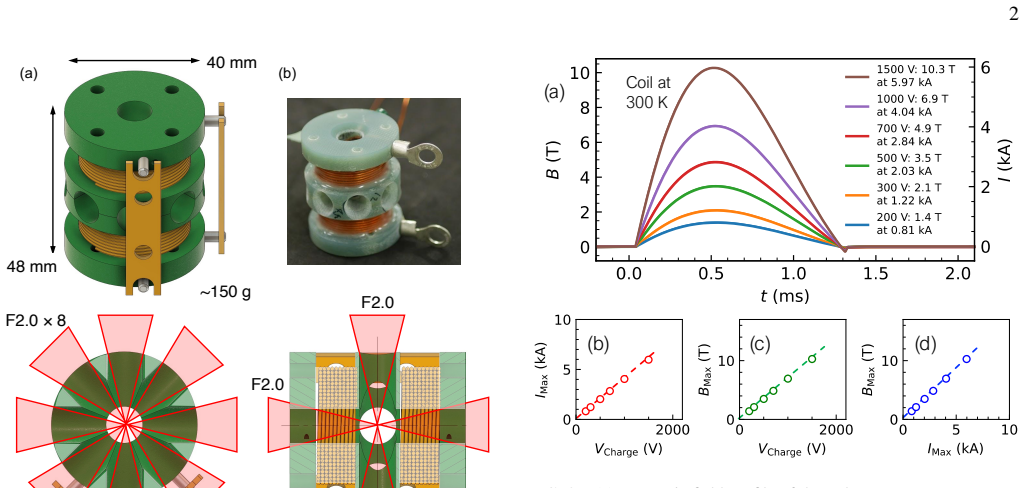
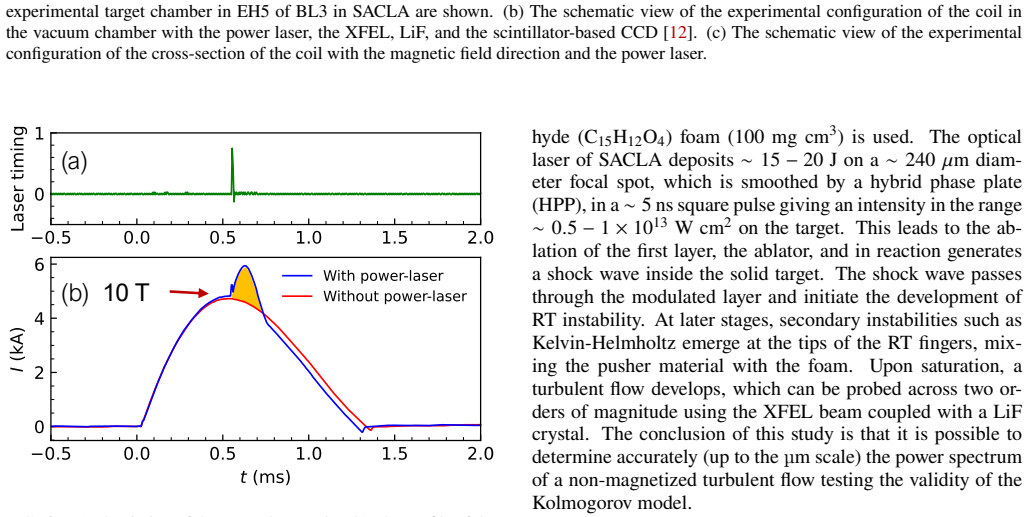
The authors describe a system where a 2 kV, 4.8 kJ pulsed power source produces up to 10 kA current through a split-pair coil to create a 10 T field at 6 kA, with 1 cm access every 45 degrees in the equatorial plane and 90 degrees in the poloidal plane, all synchronized with the laser and XFEL.
What carries the argument
The split-pair coil pulsed magnet system that generates the high magnetic field while providing diagnostic access angles.
If this is right
- Studies of shock propagation in magnetized high-energy-density matter become possible with XFEL probing.
- Growth of instabilities can be observed under strong magnetic fields using the combined diagnostics.
- Turbulent plasma dynamics in extreme conditions can be investigated with the new platform.
- New opportunities arise for laboratory astrophysics and inertial confinement fusion research involving magnetic fields.
Where Pith is reading between the lines
- Such a platform might enable direct comparison of magnetized and unmagnetized cases in the same experiment.
- Extensions could include higher field strengths or different coil geometries for varied access.
- This synchronization method could be adapted to other high-energy-density facilities.
Load-bearing premise
The pulsed power system can reliably produce the 6 kA current needed for 10 T while maintaining precise synchronization with the laser and XFEL and the required diagnostic access angles in vacuum.
What would settle it
A test run where the achieved magnetic field is below 10 T at 6 kA or where the timing synchronization fails to align the pulses within the required window.
Figures
read the original abstract
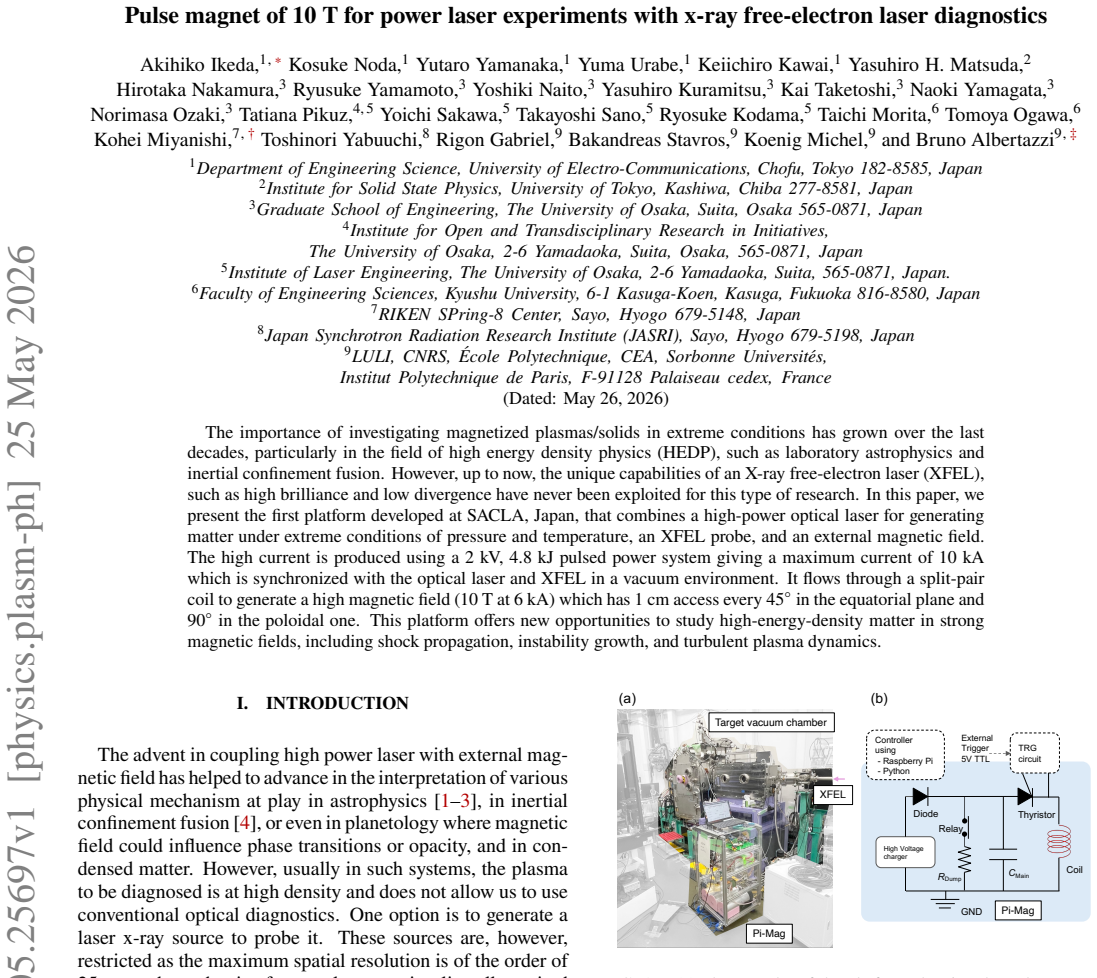
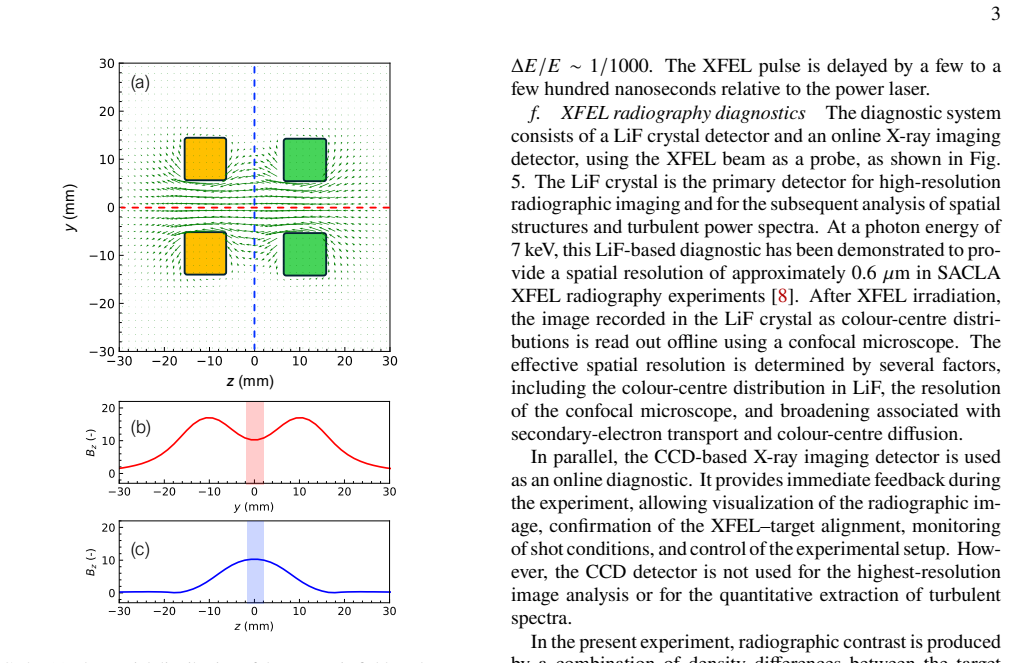
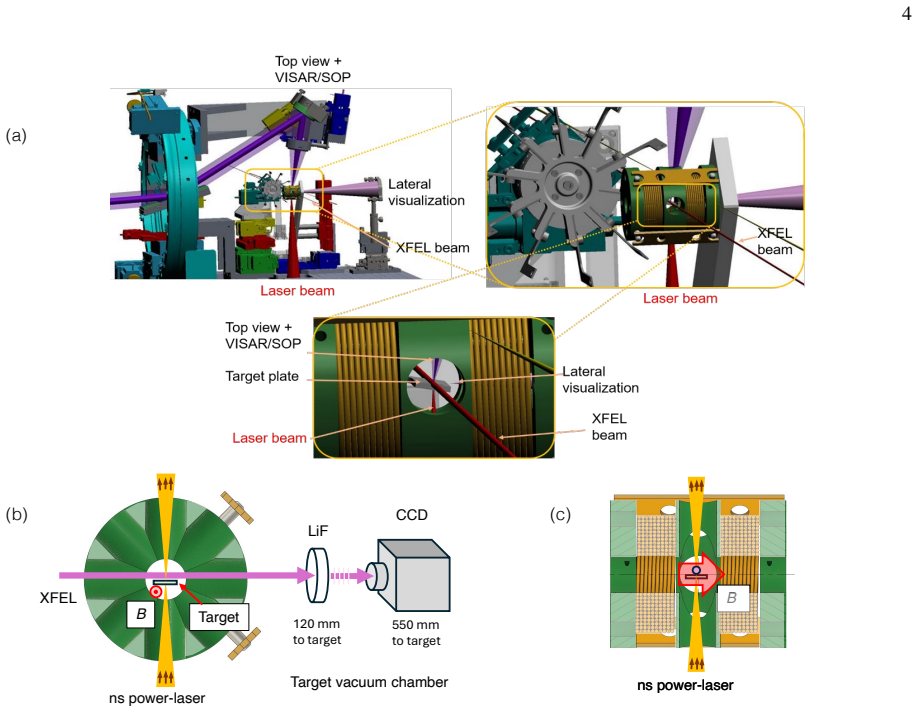
The importance of investigating magnetized plasmas/solids in extreme conditions has grown over the last decades, particularly in the field of high energy density physics (HEDP), such as laboratory astrophysics and inertial confinement fusion. However, up to now, the unique capabilities of an X-ray free-electron laser (XFEL), such as high brilliance and low divergence have never been exploited for this type of research. In this paper, we present the first platform developed at SACLA, Japan, that combines a high-power optical laser for generating matter under extreme conditions of pressure and temperature, an XFEL probe, and an external magnetic field. The high current is produced using a 2 kV, 4.8 kJ pulsed power system giving a maximum current of 10 kA which is synchronized with the optical laser and XFEL in a vacuum environment. It flows through a split-pair coil to generate a high magnetic field (10 T at 6 kA) which has 1 cm access every 45$^{\circ}$ in the equatorial plane and 90$^{\circ}$ in the poloidal one. This platform offers new opportunities to study high-energy-density matter in strong magnetic fields, including shock propagation, instability growth, and turbulent plasma dynamics.
Editorial analysis
A structured set of objections, weighed in public.
Referee Report
Summary. The manuscript describes the development of the first platform at SACLA combining a high-power optical laser for extreme conditions, an XFEL probe, and an external 10 T magnetic field generated by a split-pair coil driven by a 2 kV, 4.8 kJ pulsed power system (max 10 kA, 10 T at 6 kA) synchronized in vacuum with 1 cm diagnostic access every 45° equatorial and 90° poloidal.
Significance. If the described integration and performance hold, the platform would enable new XFEL-based studies of magnetized HEDP matter including shock propagation, instabilities, and turbulence, representing a meaningful technical advance for laboratory astrophysics and ICF research.
major comments (2)
- [Abstract] Abstract: the central claim of a functional 10 T platform synchronized with laser and XFEL is unsupported by any measured B-field maps, current waveforms, timing jitter data, or integrated-shot results; only nominal specifications are given.
- The assumption that the pulsed power system reliably delivers 6 kA to produce 10 T while preserving vacuum compatibility and access angles without interference is presented without verification and is load-bearing for the claim of a working platform.
Simulated Author's Rebuttal
We thank the referee for the constructive review of our manuscript on the 10 T pulsed magnet platform at SACLA. We agree that the current text relies primarily on design specifications and nominal performance values. We will revise the manuscript to clarify the distinction between designed capabilities and experimentally verified performance, and to temper claims of a fully functional integrated platform accordingly.
read point-by-point responses
-
Referee: [Abstract] Abstract: the central claim of a functional 10 T platform synchronized with laser and XFEL is unsupported by any measured B-field maps, current waveforms, timing jitter data, or integrated-shot results; only nominal specifications are given.
Authors: We accept this criticism. The abstract and body present the platform as operational based on the engineering specifications of the 2 kV/4.8 kJ supply, split-pair coil (10 T at 6 kA), vacuum integration, and timing synchronization, without including measured B-field maps, current traces, jitter data, or results from combined laser/XFEL shots. The manuscript is a technical description of the developed hardware rather than a performance validation study. We will revise the abstract and introduction to state that the platform has been constructed and installed with the listed nominal parameters, while noting that detailed characterization and first integrated experiments are ongoing or will be reported separately. revision: partial
-
Referee: The assumption that the pulsed power system reliably delivers 6 kA to produce 10 T while preserving vacuum compatibility and access angles without interference is presented without verification and is load-bearing for the claim of a working platform.
Authors: The text describes the calculated field from the coil geometry at 6 kA, the mechanical design providing 1 cm access at the stated angles, and the vacuum-compatible mounting. No measured current waveforms, field maps, or interference tests with the laser/XFEL beams are provided. We agree this leaves the reliability and interference-free operation unverified in the manuscript. We will add a short section on commissioning tests performed to date (if any basic functionality checks exist) or revise the language throughout to present these as design targets rather than demonstrated outcomes. revision: partial
Circularity Check
No circularity: hardware platform description with no derivations or predictions
full rationale
The paper is an engineering report describing the design and nominal specifications of a pulsed magnet system (2 kV/4.8 kJ driver, split-pair coil for 10 T at 6 kA, synchronization with laser/XFEL, access angles). No equations, fitted parameters, predictions, or derivation chains appear in the abstract or described content. No self-citations are invoked to justify a mathematical result. The reader's assessment of 0.0 circularity is confirmed; claims rest on hardware implementation rather than any self-referential reduction. This is a standard experimental methods paper without load-bearing derivations.
Axiom & Free-Parameter Ledger
Reference graph
Works this paper leans on
-
[1]
At a photon energy of 7 keV, this LiF-based diagnostic has been demonstrated to pro- vide a spatial resolution of approximately 0.6𝜇m in SACLA XFEL radiography experiments [8]
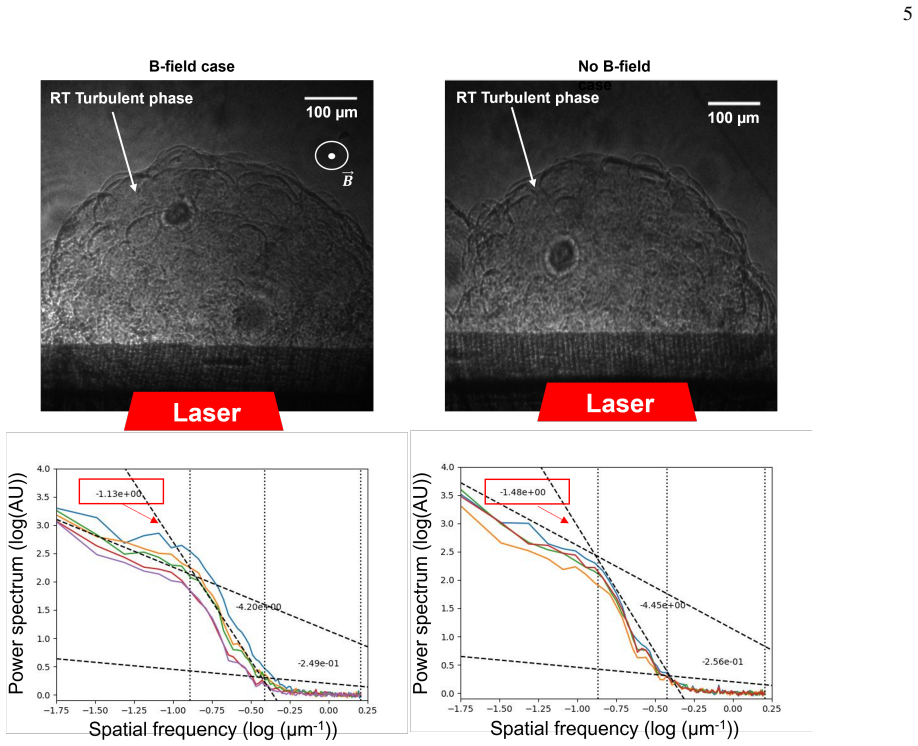
The LiF crystal is the primary detector for high-resolution radiographic imaging and for the subsequent analysis of spatial structures and turbulent power spectra. At a photon energy of 7 keV, this LiF-based diagnostic has been demonstrated to pro- vide a spatial resolution of approximately 0.6𝜇m in SACLA XFEL radiography experiments [8]. After XFEL irrad...
2023
-
[2]
Albertazzi, J
B. Albertazzi, J. B ´eard, A. Ciardi, T. Vinci, J. Albrecht, J. Bil- lette, T. Burris-Mog, S. N. Chen, D. Da Silva, S. Dittrich, T. Herrmannsd ¨orfer, B. Hirardin, F. Kroll, M. Nakatsutsumi, S. Nitsche, C. Riconda, L. Romagnagni, H.-P. Schlenvoigt, S. Simond, E. Veuillot, T. E. Cowan, O. Portugall, H. P´epin, and J. Fuchs, Production of large volume, stro...
2013
-
[3]
Albertazzi, A
B. Albertazzi, A. Ciardi, M. Nakatsutsumi, T. Vinci, J. B ´eard, R. Bonito, J. Billette, M. Borghesi, Z. Burkley, S. N. Chen, T. E. Cowan, T. Herrmannsd ¨orfer, D. P. Higginson, F. Kroll, S. A. Pikuz, K. Naughton, L. Romagnani, C. Riconda, G. Revet, R. Riquier, H.-P. Schlenvoigt, I. Y. Skobelev, A. Faenov, A. Soloviev, M. Huarte-Espinosa, A. Frank, O. Por...
2014
-
[4]
Mabey, B
P. Mabey, B. Albertazzi, G. Rigon, J.-R. Marqu `es, C. A. J. Palmer, J. Topp-Mugglestone, P. Perez-Martin, F. Kroll, F. E. Brack, T. E. Cowan, U. Schramm, K. Falk, G. Gregori, E. Falize, and M. Koenig, Laboratory study of bilateral supernova rem- nants and continuous mhd shocks, The Astrophysical Journal 896, 167 (2020)
2020
-
[5]
J. D. Moody, Boosting inertial-confinement-fusion yield with magnetized fuel, Physics14, 51 (2021)
2021
-
[6]
Ishikawa, H
T. Ishikawa, H. Aoyagi, T. Asaka, Y. Asano, N. Azumi, T. Bizen, H. Ego, K. Fukami, T. Fukui, Y. Furukawa, S. Goto, H. Hanaki, T. Hara, T. Hasegawa, T. Hatsui, A. Higashiya, T. Hirono, N. Hosoda, M. Ishii, T. Inagaki, Y. Inubushi, T. Itoga, Y. Joti, M. Kago, T. Kameshima, H. Kimura, Y. Kirihara, A. Kiy- omichi, T. Kobayashi, C. Kondo, T. Kudo, H. Maesaka, ...
2012
-
[7]
Inubushi, T
Y. Inubushi, T. Yabuuchi, T. Togashi, K. Sueda, K. Miyan- ishi, Y. Tange, N. Ozaki, T. Matsuoka, R. Kodama, T. Osaka, S. Matsuyama, K. Yamauchi, H. Yumoto, T. Koyama, H. Ohashi, K. Tono, and M. Yabashi, Development of an experimental plat- form for combinative use of an xfel and a high-power nanosec- ond laser, Appl. Sci.10, 2224 (2020)
2020
-
[8]
A. Y. Faenov, T. A. Pikuz, P. Mabey, B. Albertazzi, T. Michel, G. Rigon, S. A. Pikuz, A. Buzmakov, S. Makarov, N. Ozaki, T. Matsuoka, K. Katagiri, K. Miyanishi, K. Takahashi, K. A. Tanaka, Y. Inubushi, T. Togashi, T. Yabuuchi, M. Yabashi, A. Casner, R. Kodama, and M. Koenig, Advanced high reso- lution x-ray diagnostic for hedp experiments, Sci. Rep.8, 164...
2018
-
[9]
Rigon, B
G. Rigon, B. Albertazzi, T. Pikuz, P. Mabey, T. Michel, J.- R. Marqu `es, C. A. J. Palmer, J. Topp-Mugglestone, P. Perez- Martin, F. Kroll, F. E. Brack, T. E. Cowan, U. Schramm, K. Falk, G. Gregori, E. Falize, and M. Koenig, Micron-scale phenomena observed in a turbulent laser-produced plasma, Nat. Commun. 12, 2679 (2021)
2021
-
[10]
Katagiri, T
K. Katagiri, T. Pikuz, L. Fang, B. Albertazzi, S. Egashira, Y. In- ubushi, G. Kamimura, R. Kodama, M. Koenig, B. Kozioziem- ski, G. Masaoka, K. Miyanishi, H. Nakamura, M. Ota, G. Rigon, Y. Sakawa, T. Sano, F. Schoofs, Z. J. Smith, K. Sueda, T. To- gashi, T. Vinci, Y. Wang, M. Yabashi, T. Yabuuchi, L. E. Dresselhaus-Marais, and N. Ozaki, Transonic dislocat...
2023
-
[11]
Albertazzi, N
B. Albertazzi, N. Ozaki, V. Zhakhovsky, A. Faenov, H. Habara, M. Harmand, N. Hartley, D. Ilnitsky, N. Inogamov, Y. In- ubushi, T. Ishikawa, T. Katayama, T. Koyama, M. Koenig, A. Krygier, T. Matsuoka, S. Matsuyama, E. McBride, K. P. Migdal, G. Morard, H. Ohashi, T. Okuchi, T. Pikuz, N. Purev- jav, O. Sakata, Y. Sano, T. Sato, T. Sekine, Y. Seto, K. Taka- h...
2017
-
[12]
Katagiri, N
K. Katagiri, N. Ozaki, Y. Umeda, T. Irifune, N. Kamimura, K. Miyanishi, T. Sano, T. Sekine, and R. Kodama, Shock re- sponse of full density nanopolycrystalline diamond, Phys. Rev. Lett.125, 185701 (2020)
2020
-
[13]
Kameshima, A
T. Kameshima, A. Takeuchi, K. Uesugi, T. Kudo, Y. Kohmura, K. Tamasaku, K. Muramatsu, T. Yanagitani, M. Yabashi, and T. Hatsui, Development of an X-ray imaging detector to resolve 200 nm line-and-space patterns by using transparent ceram- ics layers bonded by solid-state diffusion, Opt. Lett.44, 1403 (2019)
2019
-
[14]
Ikeda, K
A. Ikeda, K. Noda, K. Shimbori, K. Seki, D. Bhoi, A. Ishita, J. Nakamura, K. Matsubayashi, and K. Akiba, A concise 40 T pulse magnet for condensed matter experiments, J. Appl. Phys. 136, 175902 (2024)
2024
-
[15]
Goldstein, Major Unsolved Problems in Space Plasma Physics, Astrophys
M. Goldstein, Major Unsolved Problems in Space Plasma Physics, Astrophys. Space Sci.277, 349 (2001)
2001
-
[16]
C. Y. Tu and E. Marsch, MHD structures, waves and turbulence in the solar wind: Observations and theories, Space Sci. Rev. 73, 1 (1995)
1995
-
[17]
Sridhar and P
S. Sridhar and P. Goldreich, Toward a theory of interstellar turbulence. I: Weak Alfv´enic turbulence, Astrophys. J.432, 612 (1994)
1994
-
[18]
Goldreich and S
P. Goldreich and S. Sridhar, Toward a theory of interstellar turbulence. 2: Strong Alfv ´enic turbulence, Astrophys. J.438, 763 (1995)
1995
-
[19]
E. T. Vishniac and J. Cho, The Anisotropy of Magnetohydrody- namic Alfv´enic Turbulence, Astrophys. J.539, 273 (2000)
2000
-
[20]
A. A. Schekochihin, MHD Turbulence: A Biased Review, J. Plasma Phys.88, Issue 5 (2022)
2022
discussion (0)
Sign in with ORCID, Apple, or X to comment. Anyone can read and Pith papers without signing in.