FLOATBench: A Dataset and Benchmark for Floating Offshore Wind Turbine Tower Fatigue
Pith reviewed 2026-06-29 21:29 UTC · model grok-4.3
The pith
FLOATBench supplies the first public tabular benchmark of fatigue-damage labels for 22 MW floating offshore wind turbine towers together with a regime-aware evaluation protocol.
A machine-rendered reading of the paper's core claim, the machinery that carries it, and where it could break.
Core claim
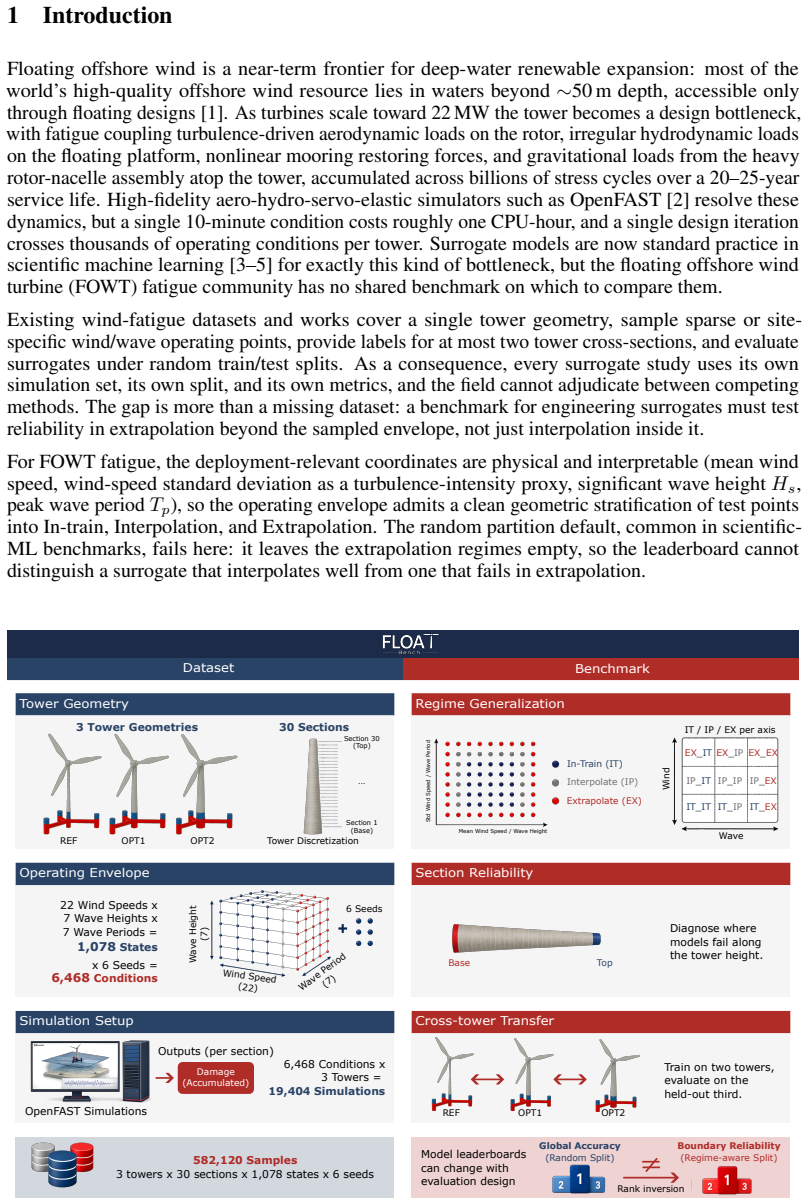
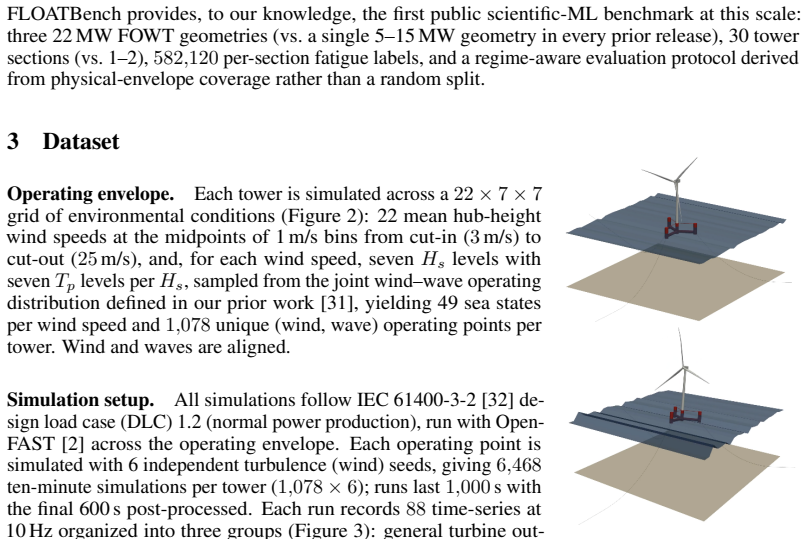
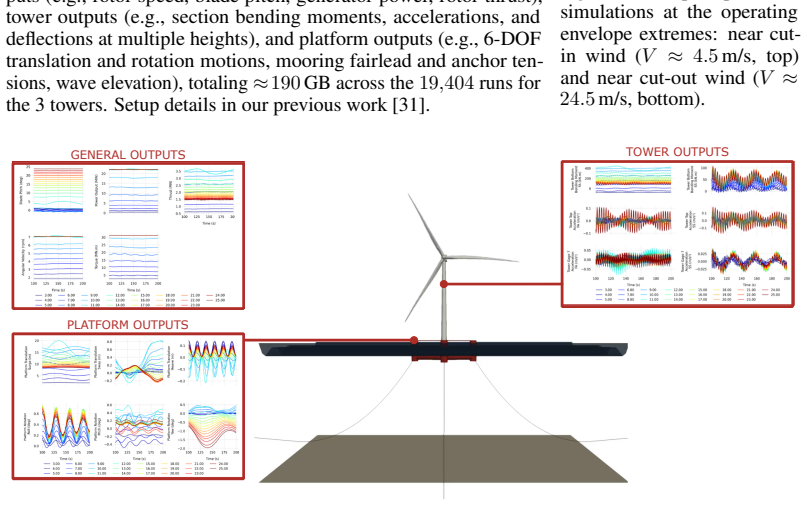
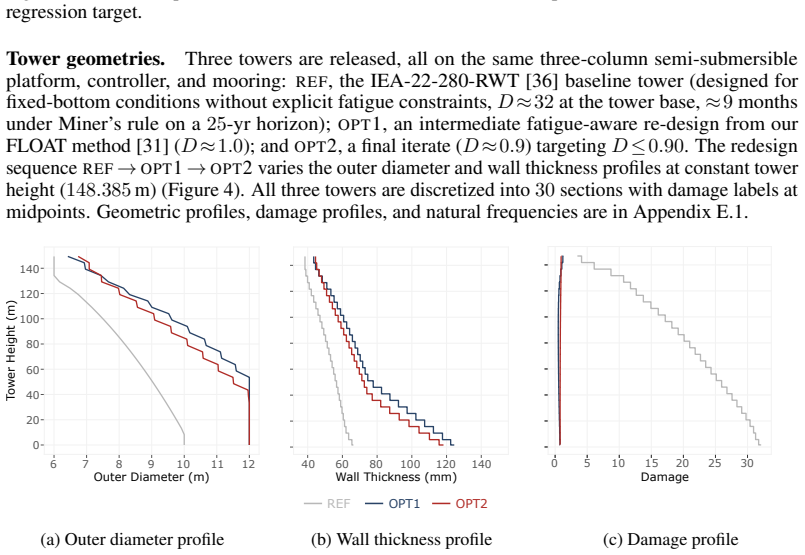
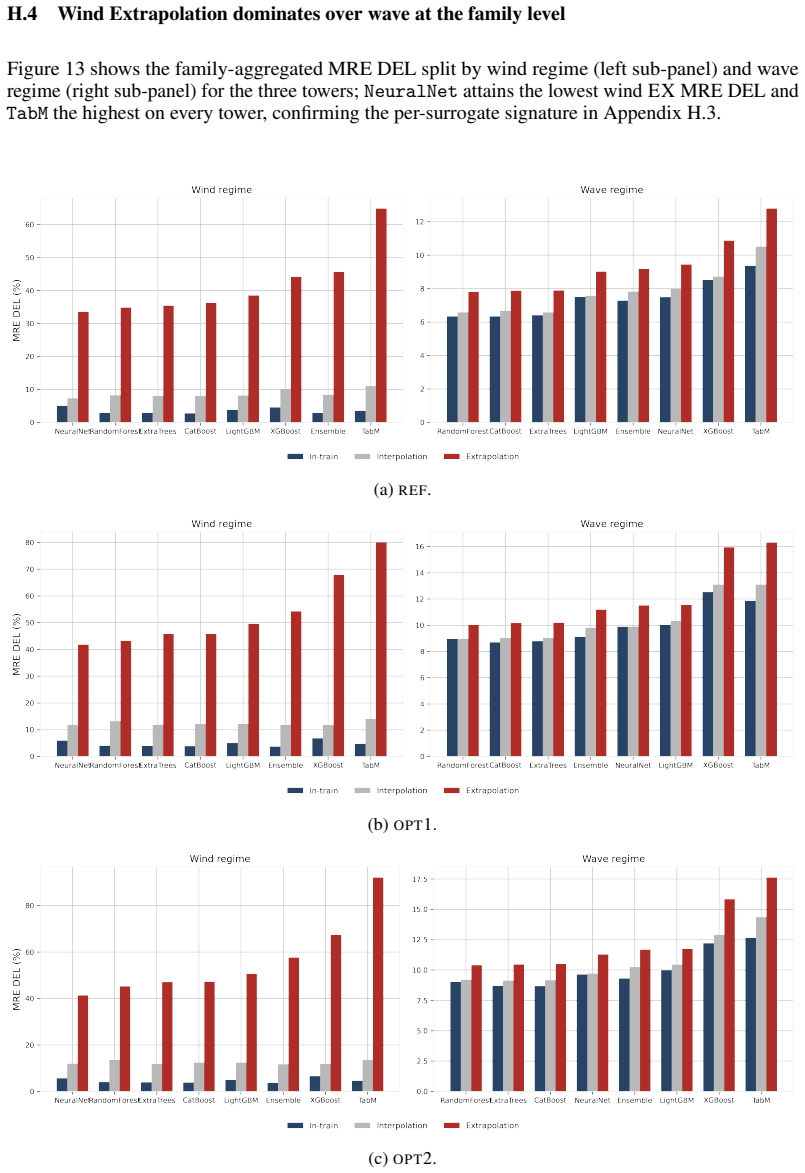
FLOATBench supplies 582120 per-section fatigue-damage labels derived from 19404 OpenFAST simulations across three 22 MW FOWT towers, each tower contributing 6468 simulations at 1078 aligned wind-wave points with six turbulence seeds, and partitions the operating envelope with an alpha-shape method so that test points fall into in-train, interpolation, or extrapolation regimes; the accompanying harness runs three protocol levels that reveal performance differences invisible under random splits.
What carries the argument
The regime-aware alpha-shape partition of the joint wind/wave operating envelope that stratifies test points into in-train, interpolation, and extrapolation regimes for the three evaluation protocols.
If this is right
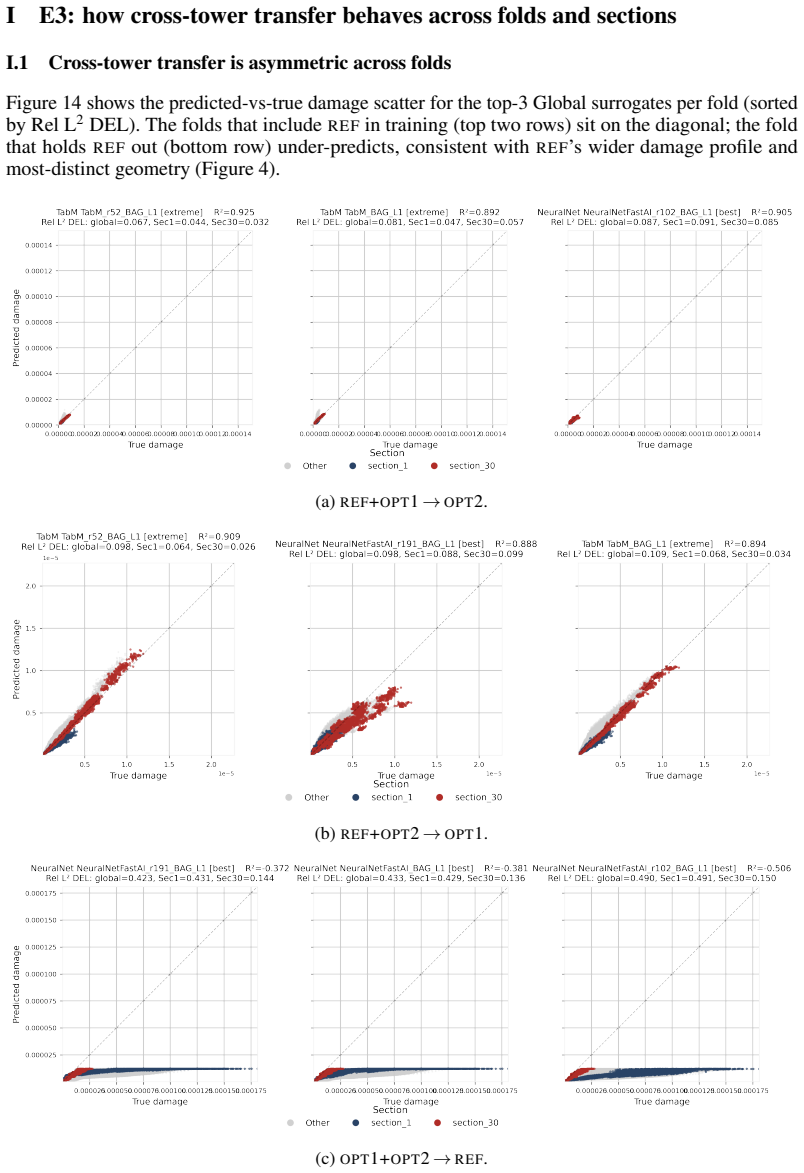
- Consistent ranking of surrogate models becomes possible across different tower geometries via the cross-tower transfer protocol.
- Models that perform well globally may still fail in extrapolation regimes, requiring separate reporting of the three protocol scores.
- The benchmark supports surrogate development for certification and design optimization of larger floating turbines.
- The same regime-aware protocol can be reused for other engineering surrogates defined over bounded physical envelopes.
Where Pith is reading between the lines
- Widespread adoption could reduce repeated high-fidelity runs by letting teams start from the same labeled operating points.
- The cross-tower transfer task offers a natural test bed for domain-adaptation methods that move fatigue models between turbine scales or site conditions.
- Extension to blade or mooring fatigue would require only new section labels on the same simulation runs.
Load-bearing premise
The high-fidelity OpenFAST simulations supply accurate ground-truth fatigue damage labels that match real-world tower behavior.
What would settle it
Direct comparison of OpenFAST-computed fatigue values against measured fatigue from instrumented full-scale 22 MW floating turbines operating at the same wind-wave points.
Figures

read the original abstract
Most of the world's offshore wind resource lies in waters too deep for fixed-bottom foundations, making floating offshore wind turbines (FOWTs) essential for deep-water deployment. As the industry scales toward $22$ MW class designs, tower fatigue becomes increasingly critical because larger structures amplify the coupled aero-hydro-servo-elastic loads induced by continuous wind and wave excitation. Accurate fatigue-damage prediction is therefore central to certification, design optimization, and cost reduction. Yet the field lacks a shared surrogate benchmark: studies report different simulations, splits, and metrics, making methods difficult to compare. We present FLOATBench, a public tabular benchmark with $582{,}120$ per-section fatigue-damage labels across three $22$ MW FOWT tower geometries, derived from $19{,}404$ high-fidelity OpenFAST simulations across the three towers ($6{,}468$ per tower: $1{,}078$ aligned wind/wave operating points $\times$ six turbulence seeds), labeled at $30$ cross-sections per tower. FLOATBench includes a regime-aware alpha-shape partition of the joint wind/wave operating envelope, stratifying test points into in-train, interpolation, and extrapolation regimes. It is paired with a reproducible evaluation harness covering three protocol levels: random validation (E1), within-tower regime-aware evaluation (E2), and cross-tower transfer (E3). The regime-aware protocol reveals rank shifts between global and extrapolation performance that random-split leaderboards cannot detect. To the authors' knowledge, FLOATBench is the first FOWT fatigue benchmark for tabular surrogate modeling, and offers an evaluation protocol that generalizes to engineering surrogates defined over physical operating envelopes. Dataset and code available at: https://github.com/Joao97ribeiro/FLOATBench.
Editorial analysis
A structured set of objections, weighed in public.
Referee Report
Summary. The paper introduces FLOATBench, a public tabular benchmark with 582,120 fatigue-damage labels derived from 19,404 OpenFAST simulations across three 22 MW FOWT tower geometries (6,468 simulations per tower). It defines a regime-aware alpha-shape partition of the joint wind/wave operating envelope to stratify points into in-train, interpolation, and extrapolation regimes, and supplies a reproducible evaluation harness with three protocols: random validation (E1), within-tower regime-aware evaluation (E2), and cross-tower transfer (E3). The central claim is that this is the first such benchmark for tabular surrogate modeling of FOWT fatigue and that the regime-aware protocol exposes rank shifts invisible to random splits.
Significance. If the simulation-derived labels are accepted as ground truth, FLOATBench supplies the first standardized, large-scale resource for comparing tabular surrogates on FOWT fatigue, together with an evaluation protocol that generalizes to other engineering domains defined over physical envelopes. The public dataset and code directly address the reproducibility and comparability problems noted in the abstract.
major comments (1)
- [Abstract / simulation setup] Abstract and simulation-description section: the fatigue labels are presented as high-fidelity ground truth obtained via rainflow counting and S-N integration on OpenFAST time series, yet no cross-validation against tank tests, full-scale measurements, or alternative codes is cited or performed. Because every downstream surrogate ranking and the claimed generalization of the E1/E2/E3 protocol rest on these labels, the absence of demonstrated accuracy against experimental data is load-bearing for the benchmark's utility.
minor comments (1)
- [Regime partition description] The alpha-shape partition is described only at a high level; a short paragraph or figure clarifying the exact alpha parameter choice and sensitivity would improve reproducibility of the regime definitions.
Simulated Author's Rebuttal
We thank the referee for highlighting the importance of validating the simulation-derived fatigue labels. We address the concern directly below and outline targeted revisions.
read point-by-point responses
-
Referee: [Abstract / simulation setup] Abstract and simulation-description section: the fatigue labels are presented as high-fidelity ground truth obtained via rainflow counting and S-N integration on OpenFAST time series, yet no cross-validation against tank tests, full-scale measurements, or alternative codes is cited or performed. Because every downstream surrogate ranking and the claimed generalization of the E1/E2/E3 protocol rest on these labels, the absence of demonstrated accuracy against experimental data is load-bearing for the benchmark's utility.
Authors: We agree that the manuscript would benefit from explicit discussion of the validation status of the OpenFAST labels. Performing new tank tests or full-scale measurements lies outside the scope of this benchmark paper, which focuses on providing a standardized, reproducible dataset and evaluation protocols for surrogate modeling. However, we will revise the simulation-setup section to (i) cite existing validation literature for OpenFAST on FOWT configurations (e.g., IEA Wind Tasks 23, 30, and related OC4/OC5/OC6 campaigns comparing OpenFAST outputs to wave-tank and full-scale data), (ii) add a short limitations paragraph clarifying that the labels constitute high-fidelity simulation outputs rather than direct experimental measurements, and (iii) state that the benchmark's primary contribution is consistent, large-scale labels enabling fair comparison of tabular surrogates under the E1/E2/E3 protocols. These changes will make the reliance on simulation data transparent without altering the dataset or protocols. revision: partial
Circularity Check
No circularity: benchmark consists of new simulation data and evaluation protocols
full rationale
The paper generates 582,120 fatigue-damage labels from 19,404 OpenFAST runs across three tower geometries and defines three evaluation protocols (E1 random validation, E2 regime-aware within-tower, E3 cross-tower transfer) plus an alpha-shape partition of the operating envelope. No equations, fitted parameters, or predictions are presented that reduce by construction to their own inputs. No self-citations are invoked as load-bearing uniqueness theorems or ansatzes. The central contribution is data creation and protocol definition rather than any derivation chain, making the reader's 0.0 assessment correct. Concerns about OpenFAST fidelity against experiments are correctness/validity issues, not circularity.
Axiom & Free-Parameter Ledger
axioms (1)
- domain assumption High-fidelity OpenFAST simulations accurately represent real-world fatigue damage in FOWT towers
Reference graph
Works this paper leans on
-
[1]
Tavares, Jie Zhang, and Faez Ahmed
João Alves Ribeiro, Bruno Alves Ribeiro, Francisco Pimenta, Sérgio M.O. Tavares, Jie Zhang, and Faez Ahmed. Offshore wind turbine tower design and optimization: A review and AI-driven future directions. Applied Energy, 397:126294, 2025. ISSN 0306-2619. doi: 10.1016/j.apenergy.2025.126294
-
[2]
The new modularization framework for the FAST wind turbine CAE tool
Jason Jonkman. The new modularization framework for the FAST wind turbine CAE tool. In51st AIAA Aerospace Sciences Meeting including the New Horizons Forum and Aerospace Exposition, 2013. doi: 10.2514/6.2013-202. Software: NREL (2024), OpenFAST: Open-source wind turbine simulation tool, v3.5,https://github.com/OpenFAST/openfast
-
[3]
Drivaernet++: A large-scale multimodal car dataset with computational fluid dynamics simulations and deep learning benchmarks
Mohamed Elrefaie, Florin Morar, Angela Dai, and Faez Ahmed. Drivaernet++: A large-scale multimodal car dataset with computational fluid dynamics simulations and deep learning benchmarks. In A. Globerson, L. Mackey, D. Belgrave, A. Fan, U. Paquet, J. Tomczak, and C. Zhang, editors,Advances in Neural Information Processing Systems, volume 37, pages 499–536....
2024
-
[4]
Carbench: A comprehensive benchmark for neural surrogates on high-fidelity 3d car aerodynamics, 2025
Mohamed Elrefaie, Dule Shu, Matt Klenk, and Faez Ahmed. Carbench: A comprehensive benchmark for neural surrogates on high-fidelity 3d car aerodynamics, 2025. arXiv preprint arXiv:2512.07847
-
[5]
PDEBench: An extensive benchmark for scientific machine learn- ing
Makoto Takamoto, Timothy Praditia, Raphael Leiteritz, Dan MacKinlay, Francesco Alesiani, Dirk Pflüger, and Mathias Niepert. PDEBench: An extensive benchmark for scientific machine learn- ing. InThirty-sixth Conference on Neural Information Processing Systems Datasets and Bench- marks Track, 2022. URL https://proceedings.neurips.cc/paper_files/paper/2022/h...
2022
-
[6]
PINNacle: A comprehensive benchmark of physics-informed neural networks for solving PDEs
Zhongkai Hao, Jiachen Yao, Chang Su, Hang Su, Ziao Wang, Fanzhi Lu, Zeyu Xia, Yichi Zhang, Songming Liu, Lu Lu, and Jun Zhu. PINNacle: A comprehensive benchmark of physics-informed neural networks for solving PDEs. InThe Thirty-eight Conference on Neural Information Processing Systems Datasets and Benchmarks Track, 2024. URL https://proceedings.neurips.cc...
2024
-
[7]
Dalziel, Drummond Buschman Fielding, Daniel Fortunato, Jared A
Ruben Ohana, Michael McCabe, Lucas Thibaut Meyer, Rudy Morel, Fruzsina Julia Agocs, Miguel Beneitez, Marsha Berger, Blakesley Burkhart, Stuart B. Dalziel, Drummond Buschman Fielding, Daniel Fortunato, Jared A. Goldberg, Keiya Hirashima, Yan-Fei Jiang, Rich Kerswell, Suryanarayana Maddu, Jonah M. Miller, Payel Mukhopadhyay, Stefan S. Nixon, Jeff Shen, Roma...
2024
-
[8]
LIPS - learning industrial physical simulation benchmark suite
Milad Leyli-abadi, Antoine Marot, Jérôme Picault, David Danan, Mouadh Yagoubi, Benjamin Donnot, Seif-Eddine Attoui, Pavel Dimitrov, Asma Farjallah, and Clement Etienam. LIPS - learning industrial physical simulation benchmark suite. InThirty-sixth Conference on Neural Information Processing Systems Datasets and Benchmarks Track, 2022. URL https://proceedi...
2022
-
[9]
AirfRANS: High fi- delity computational fluid dynamics dataset for approximating reynolds-averaged navier–stokes solu- tions
Florent Bonnet, Jocelyn Ahmed Mazari, Paola Cinnella, and Patrick Gallinari. AirfRANS: High fi- delity computational fluid dynamics dataset for approximating reynolds-averaged navier–stokes solu- tions. InThirty-sixth Conference on Neural Information Processing Systems Datasets and Bench- marks Track, 2022. URL https://proceedings.neurips.cc/paper_files/p...
2022
-
[10]
OpenFWI: Large-scale multi-structural benchmark datasets for full waveform inversion
Chengyuan Deng, Shihang Feng, Hanchen Wang, Xitong Zhang, Peng Jin, Yinan Feng, Qili Zeng, Yinpeng Chen, and Youzuo Lin. OpenFWI: Large-scale multi-structural benchmark datasets for full waveform inversion. InThirty-sixth Conference on Neural Information Processing Systems Datasets and Benchmarks Track, 2022. URL https://proceedings.neurips.cc/paper_files...
2022
-
[11]
Stephan Rasp, Stephan Hoyer, Alexander Merose, Ian Langmore, Peter Battaglia, Tyler Russell, Alvaro Sanchez-Gonzalez, Vivian Yang, Rob Carver, Shreya Agrawal, Matthew Chantry, Zied Ben Bouallegue, Peter Dueben, Carla Bromberg, Jared Sisk, Luke Barrington, Aaron Bell, and Fei Sha. WeatherBench 2: A benchmark for the next generation of data-driven global we...
-
[12]
Lawrence Zitnick, and Zachary Ulissi
Lowik Chanussot, Abhishek Das, Siddharth Goyal, Thibaut Lavril, Muhammed Shuaibi, Morgane Riviere, Kevin Tran, Javier Heras-Domingo, Caleb Ho, Weihua Hu, Aini Palizhati, Anuroop Sriram, Brandon Wood, Junwoong Yoon, Devi Parikh, C. Lawrence Zitnick, and Zachary Ulissi. Open Catalyst 2020 (OC20) dataset and community challenges.ACS Catalysis, 11(10):6059–60...
-
[13]
Alexander Dunn, Qi Wang, Alex Ganose, Daniel Dopp, and Anubhav Jain. Benchmarking materials prop- erty prediction methods: the MatBench test set and Automatminer reference algorithm.npj Computational Materials, 6(1):138, 2020. doi: 10.1038/s41524-020-00406-3
-
[14]
H. Edelsbrunner, D. Kirkpatrick, and R. Seidel. On the shape of a set of points in the plane.IEEE Trans. Inf. Theor., 29(4):551–559, September 1983. ISSN 0018-9448. doi: 10.1109/TIT.1983.1056714
-
[15]
50 Years of Load Simulation of the NREL 5MW OC4 Floating Wind Turbine, 2024
Francesco Papi and Alessandro Bianchini. 50 Years of Load Simulation of the NREL 5MW OC4 Floating Wind Turbine, 2024. doi: 10.5281/zenodo.10514143
-
[16]
N. Dimitrov, M. C. Kelly, A. Vignaroli, and J. Berg. From wind to loads: wind turbine site-specific load estimation with surrogate models trained on high-fidelity load databases.Wind Energy Science, 3(2): 767–790, 2018. doi: 10.5194/wes-3-767-2018
-
[17]
René M.M. Slot, John D. Sørensen, Bruno Sudret, Lasse Svenningsen, and Morten L. Thøgersen. Surrogate model uncertainty in wind turbine reliability assessment.Renewable Energy, 151:1150–1162, 2020. ISSN 0960-1481. doi: 10.1016/j.renene.2019.11.101
-
[18]
R. Haghi and C. Crawford. Data-driven surrogate model for wind turbine damage equivalent load.Wind Energy Science, 9(11):2039–2062, 2024. doi: 10.5194/wes-9-2039-2024
-
[19]
D. Singh, R. Dwight, and A. Viré. Probabilistic surrogate modeling of damage equivalent loads on onshore and offshore wind turbines using mixture density networks.Wind Energy Science, 9(10):1885–1904, 2024. doi: 10.5194/wes-9-1885-2024
-
[20]
On long-term fatigue damage estimation for a floating offshore wind turbine using a surrogate model.Renewable Energy, 225:120238,
Ding Peng Liu, Giulio Ferri, Taemin Heo, Enzo Marino, and Lance Manuel. On long-term fatigue damage estimation for a floating offshore wind turbine using a surrogate model.Renewable Energy, 225:120238,
-
[21]
doi: 10.1016/j.renene.2024.120238
ISSN 0960-1481. doi: 10.1016/j.renene.2024.120238
-
[22]
Singh, E
D. Singh, E. Haugen, K. Laugesen, R. P. Dwight, and A. Viré. Data-driven probabilistic surrogate model for floating wind turbine lifetime damage equivalent load prediction.Wind Energy Science, 10(12):2865–2888,
-
[23]
doi: 10.5194/wes-10-2865-2025
-
[24]
Chao Ren and Yihan Xing. Ak-mdamax: Maximum fatigue damage assessment of wind turbine towers considering multi-location with an active learning approach.Renewable Energy, 215:118977, 2023. ISSN 0960-1481. doi: 10.1016/j.renene.2023.118977
-
[25]
A surrogate modeling approach for fatigue damage assessment of floating wind turbines
Kolja Müller and Po Wen Cheng. A surrogate modeling approach for fatigue damage assessment of floating wind turbines. InProceedings of the ASME 2018 37th International Conference on Ocean, Offshore and Arctic Engineering (OMAE), V olume 10: Ocean Renewable Energy, page V010T09A065, 06 2018. doi: 10.1115/OMAE2018-78219
-
[26]
Xinyu Yuan, Qian Huang, Dongran Song, E Xia, Zhao Xiao, Jian Yang, Mi Dong, Renyong Wei, Solomin Evgeny, and Young-Hoon Joo. Fatigue load modeling of floating wind turbines based on vine copula theory and machine learning.Journal of Marine Science and Engineering, 12(8), 2024. ISSN 2077-1312. doi: 10.3390/jmse12081275
-
[27]
Guanhua Zhao, Sheng Dong, and Yuliang Zhao. Fatigue reliability analysis of floating offshore wind turbines under the random environmental conditions based on surrogate model.Ocean Engineering, 314: 119686, 2024. ISSN 0029-8018. doi: 10.1016/j.oceaneng.2024.119686
-
[28]
F. Schmidt, C. Hübler, and R. Rolfes. Kriging meta-models for damage equivalent load assessment of idling offshore wind turbines.Wind Energy Science, 10(12):3069–3089, 2025. doi: 10.5194/wes-10-3069-2025
-
[29]
Luis David Avendaño-Valencia, Imad Abdallah, and Eleni Chatzi. Virtual fatigue diagnostics of wake- affected wind turbine via gaussian process regression.Renewable Energy, 170:539–561, 2021. ISSN 0960-1481. doi: 10.1016/j.renene.2021.02.003
-
[30]
Niklas Requate and Tobias Meyer. Database of Short Term Damage Equivalent Loads (DEL) of IWT7.5MW wind turbine depending on wind, TI, yaw and derating, 2023. doi: 10.5281/zenodo.8385296
-
[31]
Kolja Müller and Po Wen Cheng. Validation of uncertainty in iec damage calculations based on measurements from alpha ventus.Energy Procedia, 94:133–145, 2016. ISSN 1876-6102. doi: 10.1016/j.egypro.2016.09.208. 13th Deep Sea Offshore Wind R&D Conference, EERA Deep- Wind’2016. 37
-
[32]
Deliverable 2.3 Design Load Case Database for Code-to-Code Comparison, 2023
Francesco Papi, Robert Behrens De Luna, Joseph Saverin, David Marten, Cyril Compbreau, Gerardo Mirra, Giancarlo Troise, and Alessandro Bianchini. Deliverable 2.3 Design Load Case Database for Code-to-Code Comparison, 2023. doi: 10.5281/zenodo.8383686
- [33]
-
[34]
Wind energy generation systems - part 3-2: Design requirements for floating offshore wind turbines
IEC 61400-3-2:2019. Wind energy generation systems - part 3-2: Design requirements for floating offshore wind turbines. Standard, International Electrotechnical Commission, Geneva, CH, 2019. URL https://webstore.iec.ch/en/publication/29244
2019
-
[35]
Fatigue of metals subjected to varying stress.Proceedings of the Kyushu Branch of Japan Society of Mechanical Engineering, pages 37–40, 1968
M Matsuishi and T Endo. Fatigue of metals subjected to varying stress.Proceedings of the Kyushu Branch of Japan Society of Mechanical Engineering, pages 37–40, 1968. URLhttps://www.semanticscholar. org/paper/467c88ec1feaa61400ab05fbe8b9f69046e59260
1968
-
[36]
S.D. Downing and D.F. Socie. Simple rainflow counting algorithms.International Journal of Fatigue, 4 (1):31–40, 1982. ISSN 0142-1123. doi: 10.1016/0142-1123(82)90018-4
-
[37]
Fatigue design of offshore steel structures
DNV-RP-C203. Fatigue design of offshore steel structures. Standard, DNV , Høvik, NO, 2024. URL https://www.dnv.com/oilgas/download/ dnv-rp-c203-fatigue-design-of-offshore-steel-structures/
2024
-
[38]
Definition of the iea wind 22-megawatt offshore reference wind turbine
Frederik Zahle, Thanasis Barlas, Kenneth Lonbaek, Pietro Bortolotti, Daniel Zalkind, Lu Wang, Casper Labuschagne, Latha Sethuraman, and Garrett Barter. Definition of the iea wind 22-megawatt offshore reference wind turbine. Technical report, National Renewable Energy Laboratory & Technical University of Denmark, Golden, CO, USA & Lyngby, DNK, 04 2024. doi...
-
[39]
Datasheets for datasets.Commun
Timnit Gebru, Jamie Morgenstern, Briana Vecchione, Jennifer Wortman Vaughan, Hanna Wallach, Hal Daumé III, and Kate Crawford. Datasheets for datasets.Commun. ACM, 64(12):86–92, November
- [40]
-
[41]
Xgboost: A scalable tree boosting system
Tianqi Chen and Carlos Guestrin. Xgboost: A scalable tree boosting system. InProceedings of the 22nd ACM SIGKDD International Conference on Knowledge Discovery and Data Mining, KDD ’16, page 785–794, New York, NY , USA, 2016. Association for Computing Machinery. ISBN 9781450342322. doi: 10.1145/2939672.2939785
-
[42]
LightGBM: A highly efficient gradient boosting decision tree
Guolin Ke, Qi Meng, Thomas Finley, Taifeng Wang, Wei Chen, Weidong Ma, Qiwei Ye, and Tie-Yan Liu. LightGBM: A highly efficient gradient boosting decision tree. InAdvances in Neural Information Processing Systems (NeurIPS), volume 30, pages 3146–3154, 2017. URL https://papers.nips.cc/ paper_files/paper/2017/hash/6449f44a102fde848669bdd9eb6b76fa-Abstract.html
2017
-
[43]
CatBoost: Unbiased boosting with categorical features
Liudmila Prokhorenkova, Gleb Gusev, Aleksandr V orobev, Anna Veronika Dorogush, and Andrey Gulin. CatBoost: Unbiased boosting with categorical features. InAdvances in Neural Information Processing Systems (NeurIPS), volume 31, pages 6638–6648, 2018. URL https://papers.nips.cc/paper_ files/paper/2018/hash/14491b756b3a51daac41c24863285549-Abstract.html
2018
-
[44]
Fastai: A layered api for deep learning.Information, 11(2), 2020
Jeremy Howard and Sylvain Gugger. Fastai: A layered api for deep learning.Information, 11(2), 2020. ISSN 2078-2489. doi: 10.3390/info11020108
-
[45]
AutoGluon-Tabular: Robust and Accurate AutoML for Structured Data
Nick Erickson, Jonas Mueller, Alexander Shirkov, Hang Zhang, Pedro Larroy, Mu Li, and Alexander Smola. Autogluon-tabular: Robust and accurate automl for structured data, 2020. arXiv preprint arXiv:2003.06505
work page internal anchor Pith review Pith/arXiv arXiv 2020
-
[46]
Extremely randomized trees.Machine Learning, 63(1): 3–42, 2006
Pierre Geurts, Damien Ernst, and Louis Wehenkel. Extremely randomized trees.Machine Learning, 63(1): 3–42, 2006. doi: 10.1007/s10994-006-6226-1
-
[47]
Random forests.Machine Learning, 45(1):5–32, 2001
Leo Breiman. Random forests.Machine Learning, 45(1):5–32, 2001. doi: 10.1023/A:1010933404324
-
[48]
Tabm: Advancing tabular deep learning with parameter-efficient ensembling
Yury Gorishniy, Akim Kotelnikov, and Artem Babenko. Tabm: Advancing tabular deep learning with parameter-efficient ensembling. InThe Thirteenth International Conference on Learning Representations,
-
[49]
URLhttps://iclr.cc/virtual/2025/poster/29590
2025
-
[50]
Machine Learning for Materials
Bruno Alves Ribeiro, João Alves Ribeiro, Faez Ahmed, Hugo Penedones, Jorge Belinha, Luís Sarmento, Miguel Anibal Bessa, and Sérgio Tavares. SimuStruct: simulated structural plate with holes dataset with machine learning applications. InWorkshop on “Machine Learning for Materials” ICLR 2023, pages 1–10, 2023. URLhttps://iclr.cc/virtual/2023/14174. 38
2023
-
[51]
João Alves Ribeiro, Sérgio M. O. Tavares, and Marco Parente. Stress–strain evaluation of structural parts using artificial neural networks.Proceedings of the Institution of Mechanical Engineers, Part L: Journal of Materials: Design and Applications, 235(6):1271–1286, 2021. doi: 10.1177/1464420721992445
-
[52]
João Alves Ribeiro, Luís Gomes, and Sérgio M. O. Tavares. Artificial neural networks applied in mechanical structural design.Journal of Computation and Artificial Intelligence in Mechanics and Biomechanics, 1(1): 14–21, 04 2021. doi: 10.5281/zenodo.4669797
-
[53]
Sérgio M. O. Tavares, João Alves Ribeiro, Bruno Alves Ribeiro, and Paulo M. S. T. de Castro. Aircraft structural design and life-cycle assessment through digital twins.Designs, 8(2):29, 2024. doi: 10.3390/designs8020029
-
[54]
Ensemble selection from libraries of models
Rich Caruana, Alexandru Niculescu-Mizil, Geoff Crew, and Alex Ksikes. Ensemble selection from libraries of models. InProceedings of the Twenty-First International Conference on Machine Learning, ICML ’04, page 18, New York, NY , USA, 2004. Association for Computing Machinery. ISBN 1581138385. doi: 10.1145/1015330.1015432
-
[55]
Accurate predictions on small data with a tabular foundation model.Nature, 637(8045):319–326, 2025
Noah Hollmann, Samuel Müller, Lennart Purucker, Arjun Krishnakumar, Max Körfer, Shi Bin Hoo, Robin Tibor Schirrmeister, and Frank Hutter. Accurate predictions on small data with a tabular foundation model.Nature, 637(8045):319–326, 2025. doi: 10.1038/s41586-024-08328-6
-
[56]
TabICL: A tabular foundation model for in-context learning on large data, 2025
Jingang QU, David Holzmüller, Gaël Varoquaux, and Marine Le Morvan. TabICL: A tabular foundation model for in-context learning on large data, 2025. URL https://icml.cc/virtual/2025/poster/ 46681
2025
-
[57]
Maddix, Junming Yin, Nick Erickson, Abdul Fatir Ansari, Boran Han, Shuai Zhang, Leman Akoglu, Christos Faloutsos, Michael W
Xiyuan Zhang, Danielle C. Maddix, Junming Yin, Nick Erickson, Abdul Fatir Ansari, Boran Han, Shuai Zhang, Leman Akoglu, Christos Faloutsos, Michael W. Mahoney, Cuixiong Hu, Huzefa Rangwala, George Karypis, and Bernie Wang. Mitra: Mixed synthetic priors for enhancing tabular foundation models, 2025. URLhttps://neurips.cc/virtual/2025/loc/san-diego/poster/115625
2025
-
[58]
B. Efron. Bootstrap methods: Another look at the jackknife.The Annals of Statistics, 7(1):1–26, 1979. doi: 10.1214/aos/1176344552. 39
discussion (0)
Sign in with ORCID, Apple, or X to comment. Anyone can read and Pith papers without signing in.