Superconductivity and electronic structure evolution in the enforced semimetal Fe-doped ZrTe₂
Pith reviewed 2026-06-29 19:24 UTC · model grok-4.3
The pith
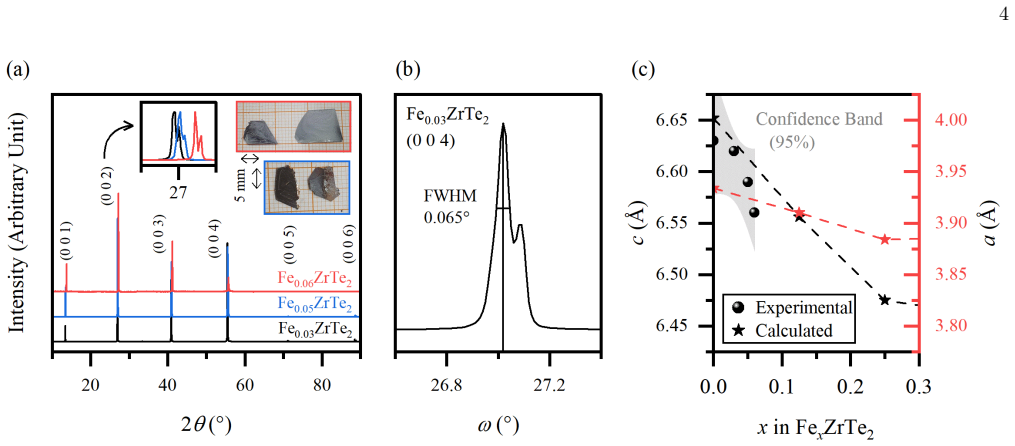
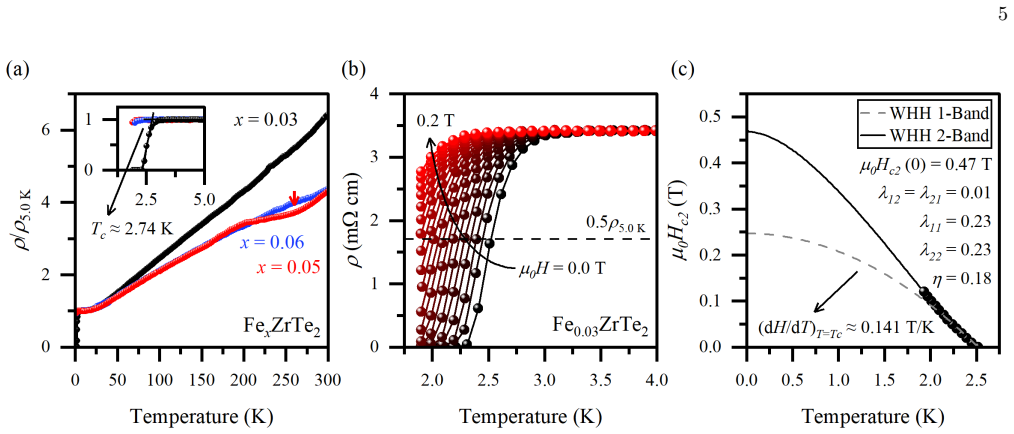
Fe intercalation in ZrTe2 produces superconductivity reaching 2.74 K at x=0.03 while preserving the enforced semimetal state.
A machine-rendered reading of the paper's core claim, the machinery that carries it, and where it could break.
Core claim
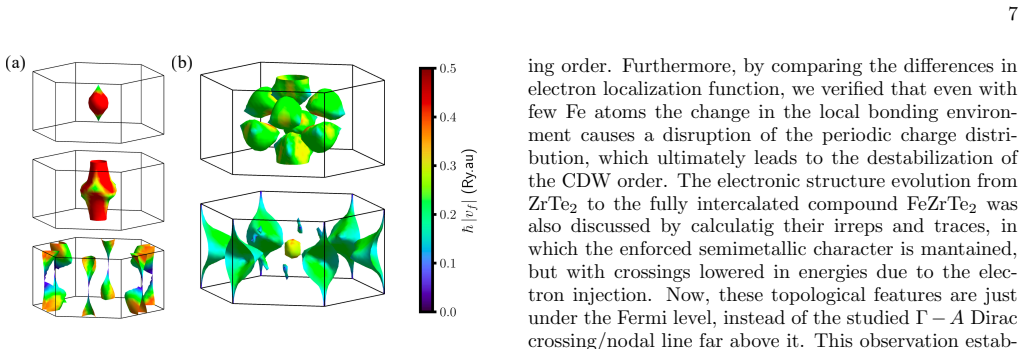
Fe intercalation in ZrTe2 induces a superconducting state with maximum Tc of 2.74 K at x=0.03. The topological band structure remains nontrivial, with crossings shifted below EF, and a van Hove singularity appears near EF at x=0.125, which may drive the superconductivity through enhanced DOS at EF. The compound preserves the enforced semimetal classification.
What carries the argument
The van Hove singularity near the Fermi level at x=0.125, which produces an enhancement of the density of states at EF and is proposed to associate with the superconducting order.
If this is right
- The nontrivial topological features of pristine ZrTe2 survive Fe intercalation, with only a small downward shift of the band crossings.
- Superconductivity appears at low iron content while the enforced semimetal classification is retained.
- The position of the van Hove singularity relative to EF depends on the Fe concentration and the Te-Zr interlayer spacing.
- The density of states at EF is enhanced specifically at x=0.125 through the unfolding of the band structure.
Where Pith is reading between the lines
- Pressure or uniaxial strain experiments that move the van Hove singularity away from EF while keeping the same Fe content could test whether the singularity is required for superconductivity.
- Mapping the superconducting dome versus Fe content with finer steps around x=0.03 and x=0.125 would clarify whether the Tc maximum coincides with the singularity position or with a separate doping window.
- Replacing Fe with other 3d metals could shift the singularity location and reveal whether the enhanced DOS is the dominant pairing factor across the series.
Load-bearing premise
That the observed superconductivity arises from the van Hove singularity near the Fermi level rather than from other changes caused by iron doping such as altered phonons or impurity scattering.
What would settle it
A sample at x=0.125 that lacks the calculated van Hove singularity yet still shows superconductivity, or a sample with the singularity present that remains nonsuperconducting.
Figures
read the original abstract
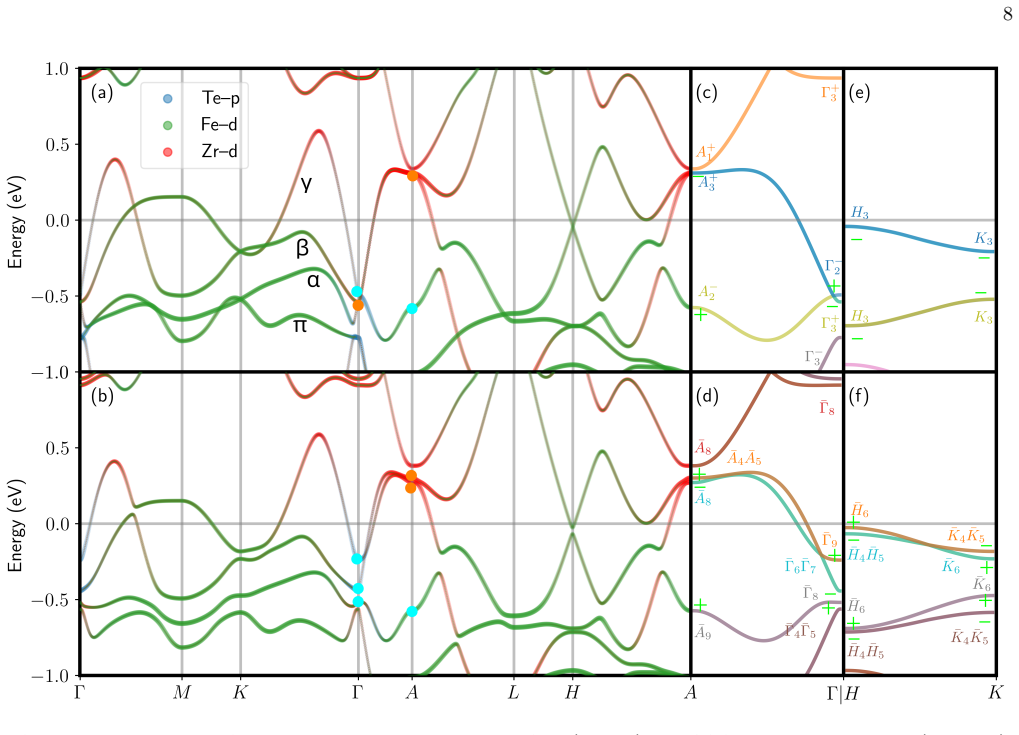
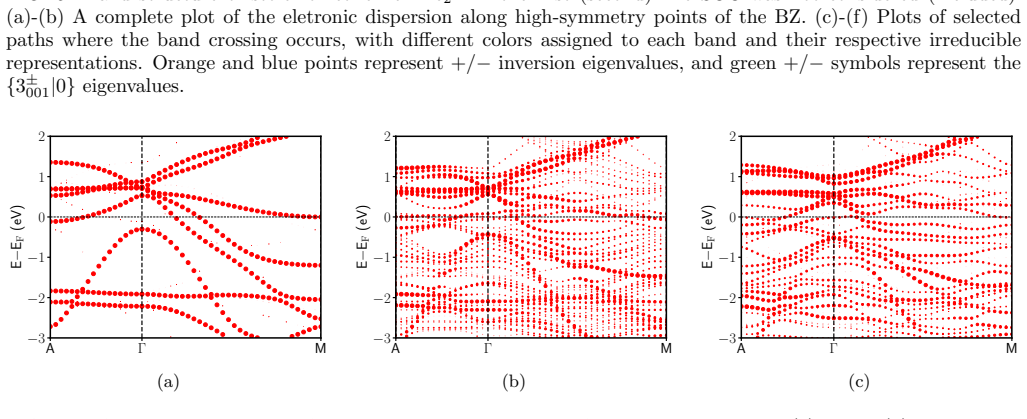
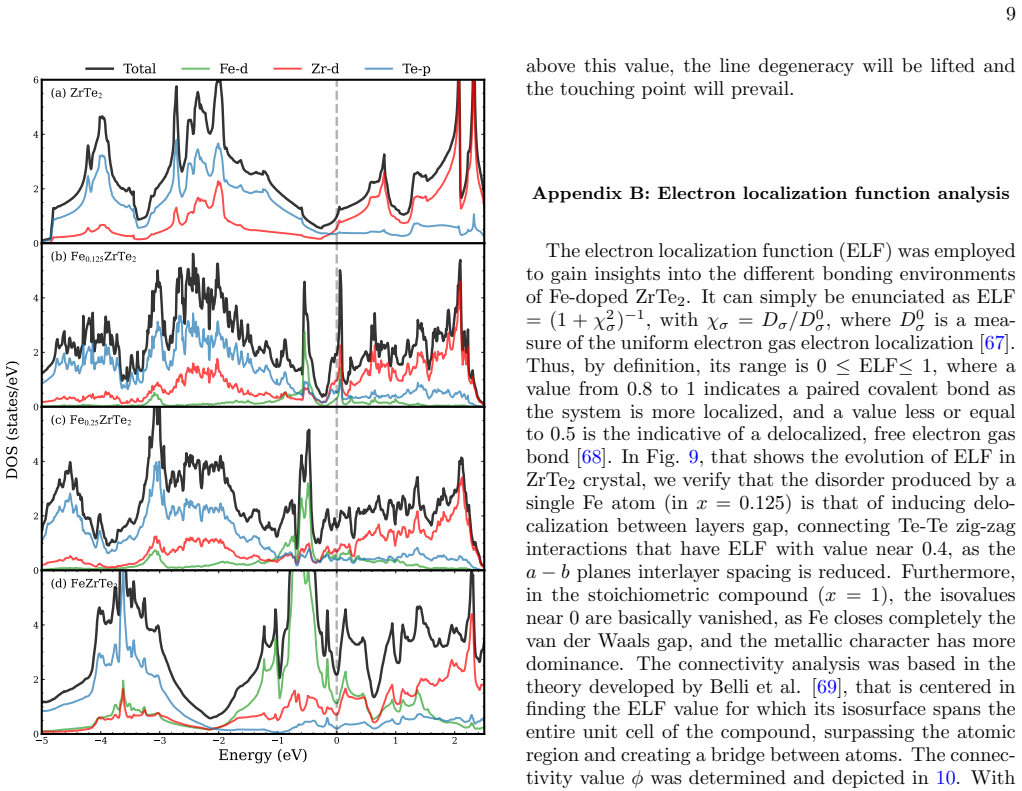
ZrTe$_2$ is an outstanding layered semimetal due to the topologically nontrivial electronic structure. In this work, we present an investigation of the electronic evolution of ZrTe$_2$ in the presence of Fe intercalation, namely Fe$_{x}$ZrTe$_2$ ($x= 0 - 0.25$), scrutinized by both experimental measurements and \textit{ab} initio calculations. While the first reveals a superconducting state with a maximum critical temperature $T_c = 2.74$ K ($x=$ 0.03), the latter indicates that the topological features of the pristine ZrTe$_2$ is sensitive to the distance between Te atoms and Zr layers. Also, the intercalation of Fe does not modify the non-trivial electronic band structure unlike the band crossings are now shifted slightly below $E_{F}$. In particular, a van Hove singularity near the Fermi level for a Fe content of $x=0.125$ is observed in the density of states, indicating that the superconducting order may be associated with features of the unfolded band structure and the concomitant enhancement of the density of states at $E_F$. Finally, our results reveal that the new compound with inclusion of Fe intercalation preserves the enforced semimetal classification.
Editorial analysis
A structured set of objections, weighed in public.
Referee Report
Summary. The manuscript investigates Fe intercalation in ZrTe₂ (Fe_x ZrTe₂, x=0-0.25) via experiment and DFT. Experimentally, superconductivity emerges with maximum T_c = 2.74 K at x=0.03. DFT shows that Fe doping preserves the topological band features of pristine ZrTe₂ (with crossings shifted slightly below E_F), introduces a van Hove singularity near E_F at x=0.125 that enhances DOS(E_F), and maintains the enforced semimetal classification. The authors suggest the superconducting order may be associated with the unfolded band structure and DOS enhancement at E_F.
Significance. If the mechanistic link between the vHS-induced DOS peak and superconductivity can be established, the work would contribute to understanding doping-tuned superconductivity in topologically nontrivial semimetals. The preservation of enforced semimetal character under intercalation is a potentially useful observation, but the current evidence for the vHS-superconductivity association is correlative rather than quantitative.
major comments (2)
- [Abstract / Results] Abstract and results sections: maximum T_c occurs at x=0.03 while the vHS and DOS(E_F) enhancement are reported only at x=0.125. The central claim that superconductivity is associated with the vHS requires explicit demonstration that DOS(E_F) is elevated at the optimal doping (or that the vHS shifts continuously through E_F near x=0.03). Without DOS(x) curves or rigid-band analysis bridging this gap, the association remains an untested correlation.
- [Experimental Methods / Results] Experimental section: no tables of raw resistivity or susceptibility data, no error bars on T_c values, and no explicit comparison to undoped ZrTe₂ controls are provided. This makes it impossible to assess the robustness of the reported T_c(x) dome or to rule out impurity or disorder effects.
minor comments (2)
- [Abstract] Notation: the abstract uses both “enforced semimetal” and “topologically nontrivial electronic structure” without a clear definition or reference to the precise topological invariant being preserved.
- [Figures] Figure clarity: band-structure plots should include the Fermi level position and label the vHS explicitly for each x value shown.
Simulated Author's Rebuttal
We thank the referee for their thorough review and constructive feedback on our manuscript. We address each major comment below and have revised the manuscript to strengthen the presentation where the concerns are valid.
read point-by-point responses
-
Referee: [Abstract / Results] Abstract and results sections: maximum T_c occurs at x=0.03 while the vHS and DOS(E_F) enhancement are reported only at x=0.125. The central claim that superconductivity is associated with the vHS requires explicit demonstration that DOS(E_F) is elevated at the optimal doping (or that the vHS shifts continuously through E_F near x=0.03). Without DOS(x) curves or rigid-band analysis bridging this gap, the association remains an untested correlation.
Authors: The referee correctly identifies a gap between the doping levels. The vHS is explicitly calculated only at x=0.125, while the experimental Tc maximum is at x=0.03. We agree that a direct link requires bridging this range. We have now performed additional DFT calculations at x=0.03, 0.06, and 0.09. These show that the vHS shifts continuously toward EF with decreasing x, producing a measurable DOS(EF) enhancement already at x=0.03 relative to the pristine case. The new results and a rigid-band analysis will be added to the revised manuscript and supplementary information. revision: yes
-
Referee: [Experimental Methods / Results] Experimental section: no tables of raw resistivity or susceptibility data, no error bars on T_c values, and no explicit comparison to undoped ZrTe₂ controls are provided. This makes it impossible to assess the robustness of the reported T_c(x) dome or to rule out impurity or disorder effects.
Authors: We acknowledge that the experimental presentation can be improved for clarity and reproducibility. In the revised manuscript we will (i) add error bars to all Tc values extracted from resistivity and susceptibility, (ii) include a direct comparison plot of resistivity for x=0 (undoped) versus the doped samples showing the absence of superconductivity down to 0.3 K in the parent compound, and (iii) provide representative raw resistivity curves in a new supplementary table. Full raw datasets will be deposited in a public repository and noted in the manuscript. revision: yes
Circularity Check
No circularity; association presented as observational correlation
full rationale
The paper reports experimental Tc maximum at x=0.03 alongside DFT results locating a van Hove singularity at x=0.125, then states that superconductivity 'may be associated with' the DOS enhancement. This is an interpretive remark, not a derivation, fitted prediction, or self-referential definition. No equations reduce the claimed mechanism to its own inputs, no self-citation chain is load-bearing, and the topological classification is independently computed. The derivation chain is therefore self-contained against external benchmarks.
Axiom & Free-Parameter Ledger
axioms (1)
- domain assumption The topological classification of pristine ZrTe2 as an enforced semimetal remains valid after Fe intercalation.
Reference graph
Works this paper leans on
-
[1]
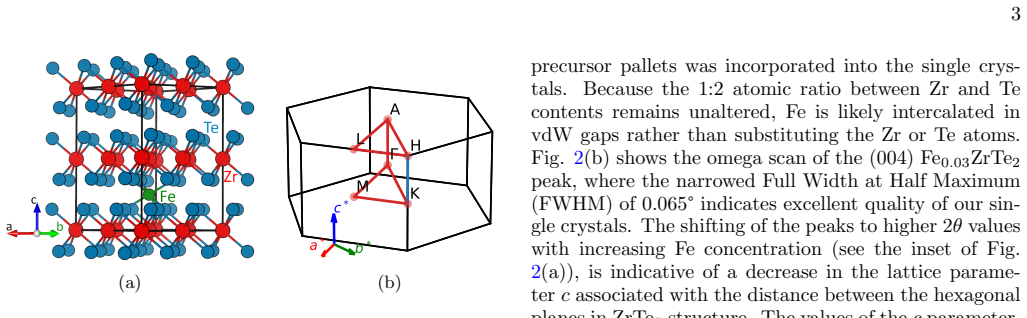
1: (a) Crystal structure of Fe-doped ZrTe 2 in the 2×2×2 supercell employed in DFT calculations, repre- senting the octahedral intercalation site
have all the symmetries of the SG, and 3 (a) H K A L M b *a * c * (b) FIG. 1: (a) Crystal structure of Fe-doped ZrTe 2 in the 2×2×2 supercell employed in DFT calculations, repre- senting the octahedral intercalation site. (b) 1st Brillouin Zone of SG 164 with highlighted path (red) used to plot the dispersion curves, and extra pathH−K(blue) where the othe...
2024
-
[2]
Manzeli, D
S. Manzeli, D. Ovchinnikov, D. Pasquier, O. V. Yazyev, and A. Kis, 2D transition metal dichalcogenides, Nature Reviews Materials2, 17033 (2017)
2017
-
[3]
Q. H. Wang, K. Kalantar-Zadeh, A. Kis, J. N. Cole- man, and M. S. Strano, Electronics and optoelectronics of two-dimensional transition metal dichalcogenides, Na- ture Nanotechnology7, 699 (2012)
2012
-
[4]
Chhowalla, H
M. Chhowalla, H. S. Shin, G. Eda, L.-J. Li, K. P. Loh, and H. Zhang, The chemistry of two-dimensional lay- ered transition metal dichalcogenide nanosheets, Nature Chemistry5, 263 (2013)
2013
-
[5]
C.-S. Lian, Interplay of charge ordering and supercon- ductivity in two-dimensional 2H group v transition-metal dichalcogenides, Physical Review B107, 10.1103/Phys- RevB.107.045431 (2023)
-
[6]
A. Yu. Ledneva, G. E. Chebanova, S. B. Artemkina, and A. N. Lavrov, Crystalline and nanostructured materi- als based on transition metal dichalcogenides: Synthesis and electronic properties, Journal of Structural Chem- istry63, 176 (2022)
2022
-
[7]
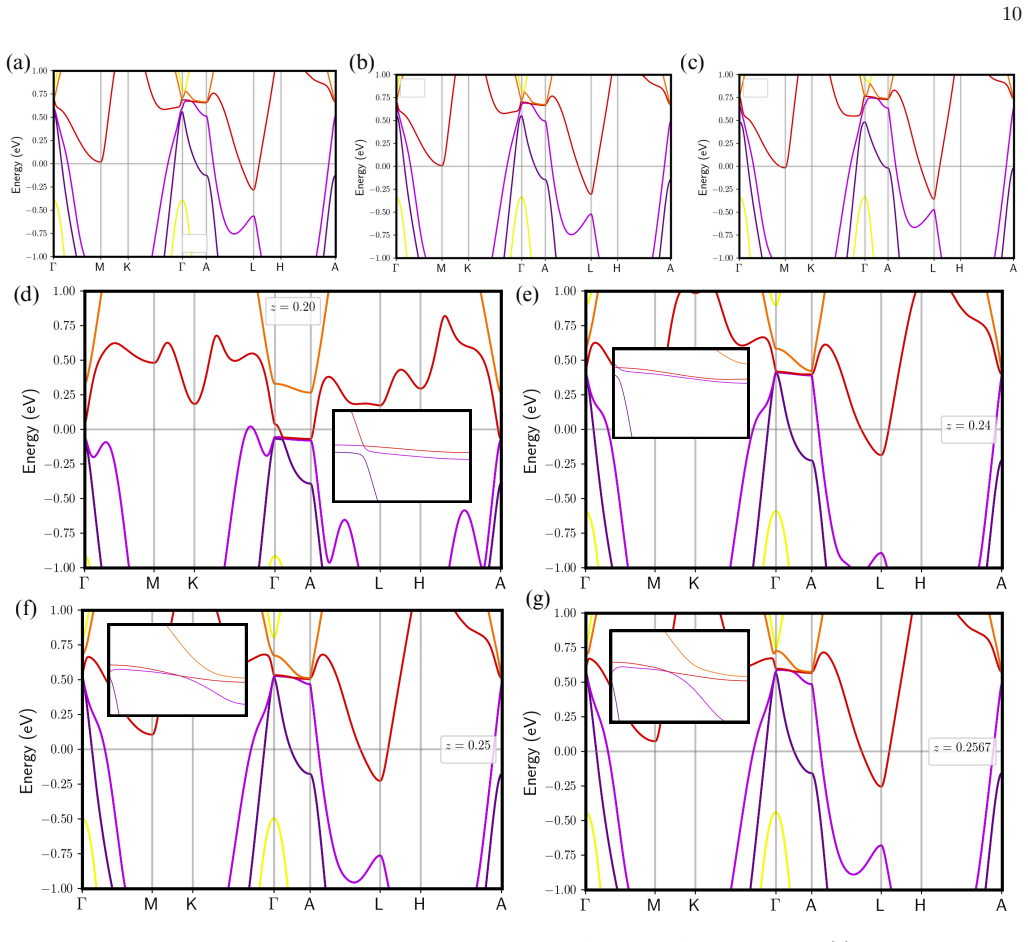
B. T. Zhou, N. F. Q. Yuan, H.-L. Jiang, and K. T. Law, Ising superconductivity and Majorana fermions in transition-metal dichalcogenides, Physical Review B93, 10 ( a ) ( b ) ( c ) ( d ) ( e ) ( f ) ( g ) FIG. 8: Band structures of pristine ZrTe 2 in other unit cell configurations for comparison: (a) synchrotron X-ray powder diffraction experiment [18],a= ...
2016
-
[8]
G. H. Han, D. L. Duong, D. H. Keum, S. J. Yun, and Y. H. Lee, Van der Waals Metallic Transition Metal Dichalcogenides, Chemical Reviews118, 6297 (2018)
2018
-
[9]
D. Bhoi, S. Khim, W. Nam, B. S. Lee, C. Kim, B.-G. Jeon, B. H. Min, S. Park, and K. H. Kim, Interplay of charge density wave and multiband superconductivity in 2H-PdxTaSe2, Scientific Reports6, 24068 (2016)
2016
-
[10]
M. S. Bahramy, O. J. Clark, B.-J. Yang, J. Feng, L. Baw- den, J. M. Riley, I. Markovi´ c, F. Mazzola, V. Sunko, D. Biswas, S. P. Cooil, M. Jorge, J. W. Wells, M. Lean- dersson, T. Balasubramanian, J. Fujii, I. Vobornik, J. E. Rault, T. K. Kim, M. Hoesch, K. Okawa, M. Asakawa, T. Sasagawa, T. Eknapakul, W. Meevasana, and P. D. C. King, Ubiquitous formation...
2018
-
[11]
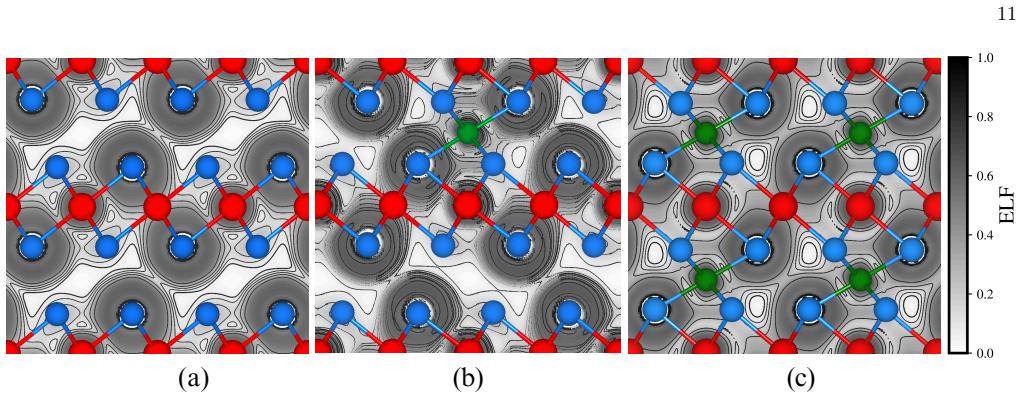
P. P. Ferreira, A. L. R. Manesco, T. T. Dorini, L. E. Correa, G. Weber, A. J. S. Machado, and L. T. F. Eleno, Strain engineering the topological type-II Dirac semimetal${\mathrm{NiTe}} {2}$, Physical Review B 103, 125134 (2021). 11 ( a ) ( b ) ( c ) FIG. 9: ELF plotted in the plane (hkl) = (110) for: (a) cell of pristine ZrTe 2 , (b) cell of Fe 0.125ZrTe2...
2021
-
[12]
F. Fei, X. Bo, R. Wang, B. Wu, J. Jiang, D. Fu, M. Gao, H. Zheng, Y. Chen, X. Wang, H. Bu, F. Song, X. Wan, B. Wang, and G. Wang, Nontrivial Berry phase and type- II Dirac transport in the layered material PdT e 2, Phys- ical Review B96, 041201 (2017)
2017
-
[13]
I. Kar, J. Chatterjee, L. Harnagea, Y. Kushnirenko, A. V. Fedorov, D. Shrivastava, B. B¨ uchner, P. Mahadevan, and S. Thirupathaiah, Metal-chalcogen bond-length induced electronic phase transition from semiconductor to topo- logical semimetal in Zr X 2 ( X = Se and Te), Physical Review B101, 165122 (2020)
2020
-
[14]
Belopolski, S.-Y
I. Belopolski, S.-Y. Xu, Y. Ishida, X. Pan, P. Yu, D. S. Sanchez, H. Zheng, M. Neupane, N. Alidoust, G. Chang, T.-R. Chang, Y. Wu, G. Bian, S.-M. Huang, C.-C. Lee, D. Mou, L. Huang, Y. Song, B. Wang, G. Wang, Y.-W. Yeh, N. Yao, J. E. Rault, P. Le F` evre, F. Bertran, H.-T. Jeng, T. Kondo, A. Kaminski, H. Lin, Z. Liu, F. Song, S. Shin, and M. Z. Hasan, Fer...
2016
-
[15]
K. E. Wagner, E. Morosan, Y. S. Hor, J. Tao, Y. Zhu, T. Sanders, T. M. McQueen, H. W. Zandbergen, A. J. Williams, D. V. West, and R. J. Cava, Tun- ing the charge density wave and superconductivity in ${\text{Cu}} {x}{\text{TaS}} {2}$, Physical Review B78, 104520 (2008)
2008
-
[16]
Morosan, K
E. Morosan, K. E. Wagner, L. L. Zhao, Y. Hor, A. J. Williams, J. Tao, Y. Zhu, and R. J. Cava, Multiple elec- tronic transitions and superconductivity in Pdx TiSe2, Physical Review B - Condensed Matter and Materials Physics81, 094524 (2010)
2010
-
[17]
Kiswandhi, J
A. Kiswandhi, J. S. Brooks, H. B. Cao, J. Q. Yan, D. Mandrus, Z. Jiang, and H. D. Zhou, Competition between the structural phase transi- tion and superconductivity in Ir${} {1\ensuremath{- }x}$Pt${} {x}$Te${} {2}$as revealed by pressure ef- fects, Physical Review B87, 121107 (2013)
2013
-
[18]
Chang, P.-J
T.-R. Chang, P.-J. Chen, G. Bian, S.-M. Huang, H. Zheng, T. Neupert, R. Sankar, S.-Y. Xu, I. Be- lopolski, G. Chang, B. Wang, F. Chou, A. Bansil, H.- T. Jeng, H. Lin, and M. Z. Hasan, Topological Dirac surface states and superconducting pairing correlations in${\mathrm{PbTaSe}} {2}$, Physical Review B93, 245130 (2016)
2016
-
[19]
E. G. Shkvarina, A. A. Titov, A. S. Shkvarin, J. R. Plaisier, L. Gigli, and A. N. Titov, Thermal stability of the layered modification of Cu0.5ZrTe2 in the tempera- ture range 25–900 ◦C, Acta Crystallographica Section C: Structural Chemistry74, 1020 (2018)
2018
-
[20]
Tsipas, D
P. Tsipas, D. Tsoutsou, S. Fragkos, R. Sant, C. Alvarez, H. Okuno, G. Renaud, R. Alcotte, T. Baron, and A. Di- moulas, Massless Dirac Fermions in ZrTe2 Semimetal Grown on InAs(111) by van der Waals Epitaxy, ACS Nano12, 1696 (2018)
2018
-
[21]
Nguyen, N
T. Nguyen, N. Aryal, B. K. Pokharel, L. Harnagea, D. Mierstchin, D. Popovi´ c, D. E. Graf, and K. Shrestha, Fermiology of the Dirac type-II semimetal candidates (Ni,Zr)${\mathrm{Te}} {2}$using de Haas–van Alphen oscillations, Physical Review B106, 075154 (2022)
2022
-
[22]
A. J. S. Machado, N. P. Baptista, B. S. De Lima, N. Chaia, T. W. Grant, L. E. Corrˆ ea, S. T. Renosto, A. C. Scaramussa, R. F. Jardim, M. S. Torikachvili, J. A. 12 Aguiar, O. C. Cigarroa, L. T. F. Eleno, and Z. Fisk, Ev- idence for topological behavior in superconducting Cu x ZrTe 2 - y, Physical Review B95, 144505 (2017)
2017
-
[23]
L. E. Correa, L. R. de Faria, F. Abud, M. S. da Luz, M. S. Torikachvili, and A. J. S. Machado, Two-band supercon- ductivity in Pt-intercalated ZrTe2, a Dirac semimetal, Physica C: Superconductivity and its Applications627, 1354606 (2024)
2024
-
[24]
L. E. Correa, P. P. Ferreira, L. R. de Faria, T. T. Dorini, M. S. da Luz, Z. Fisk, M. S. Torikachvili, L. T. F. Eleno, and A. J. S. Machado, Evidence for multiband supercon- ductivity and charge density waves in Ni-doped ZrTe2, Journal of Alloys and Compounds907, 164477 (2022)
2022
-
[25]
L. E. Correa, L. R. de Faria, R. S. Cardoso, N. Chaia, M. S. da Luz, M. S. Torikachvili, and A. J. S. Machado, Growth of pure and intercalated ZrTe2, TiTe2 and HfTe2 dichalcogenide single crystals by isothermal chemical va- por transport, Journal of Crystal Growth595, 126819 (2022)
2022
-
[26]
P. Giannozzi and coauthors, Quantum espresso: A modu- lar and open-source software project for quantum simula- tions of materials, Journal of Physics: Condensed Matter 21, 395502 (2009)
2009
-
[27]
Giannozzi, O
P. Giannozzi, O. Andreussi, T. Brumme, O. Bunau, M. Buongiorno Nardelli, M. Calandra, R. Car, C. Cavaz- zoni, D. Ceresoli, M. Cococcioni, N. Colonna, I. Carn- imeo, A. Dal Corso, S. de Gironcoli, P. Delugas, R. A. DiStasio, A. Ferretti, A. Floris, G. Fratesi, G. Fugallo, R. Gebauer, U. Gerstmann, F. Giustino, T. Gorni, J. Jia, M. Kawamura, H.-Y. Ko, A. Ko...
2017
-
[28]
Kohn and L
W. Kohn and L. J. Sham, Self-consistent equations in- cluding exchange and correlation effects, Physical Review 140, A1133 (1965)
1965
-
[29]
Chakraborty, K
D. Chakraborty, K. Berland, and T. Thonhauser, Next- generation nonlocal van der waals density functional, Journal of Chemical Theory and Computation16, 5893 (2020)
2020
-
[30]
Thonhauser, S
T. Thonhauser, S. Zuluaga, C. A. Arter, K. Berland, E. Schr¨ oder, and P. Hyldgaard, Spin signature of nonlocal correlation binding in metal-organic frameworks, Phys. Rev. Lett.115, 136402 (2015)
2015
-
[31]
D. C. Langreth, B. I. Lundqvist, S. D. Chakarova- K¨ ack, V. R. Cooper, M. Dion, P. Hyldgaard, A. Kelkka- nen, J. Kleis, L. Kong, S. Li, P. G. Moses, E. Mur- ray, A. Puzder, H. Rydberg, E. Schr¨ oder, and T. Thon- hauser, A density functional for sparse matter, Journal of Physics: Condensed Matter21, 084203 (2009)
2009
-
[32]
Berland, V
K. Berland, V. R. Cooper, K. Lee, E. Schr¨ oder, T. Thon- hauser, P. Hyldgaard, and B. I. Lundqvist, van der waals forces in density functional theory: a review of the vdw- df method, Reports on Progress in Physics78, 066501 (2015)
2015
-
[33]
J. P. Perdew, K. Burke, and M. Ernzerhof, Generalized gradient approximation made simple, Phys. Rev. Lett. 77, 3865 (1996)
1996
-
[34]
P. E. Bl¨ ochl, Projector augmented-wave method, Phys. Rev. B50, 17953 (1994)
1994
-
[35]
Dal Corso, Pseudopotentials periodic table: From h to pu, Computational Materials Science95, 337 (2014)
A. Dal Corso, Pseudopotentials periodic table: From h to pu, Computational Materials Science95, 337 (2014)
2014
-
[36]
Okhotnikov, T
K. Okhotnikov, T. Charpentier, and S. Cadars, Supercell program: a combinatorial structure-generation approach for the local-level modeling of atomic substitutions and partial occupancies in crystals, Journal of Cheminformat- ics8, 17 (2016)
2016
-
[37]
Marzari, D
N. Marzari, D. Vanderbilt, A. De Vita, and M. C. Payne, Thermal contraction and disordering of the al(110) sur- face, Physical Review Letters82, 3296 (1999)
1999
-
[38]
H. J. Monkhorst and J. D. Pack, Special points for brillouin-zone integrations, Physical Review B13, 5188 (1976)
1976
-
[39]
P. E. Bl¨ ochl, O. Jepsen, and O. K. Andersen, Improved tetrahedron method for brillouin-zone integrations, Phys. Rev. B49, 16223 (1994)
1994
-
[40]
Setyawan and S
W. Setyawan and S. Curtarolo, High-throughput elec- tronic band structure calculations: Challenges and tools, Computational Materials Science49, 299 (2010)
2010
-
[41]
P. V. C. Medeiros, S. Stafstr¨ om, and J. Bj¨ ork, Effects of extrinsic and intrinsic perturbations on the electronic structure of graphene: Retaining an effective primitive cell band structure by band unfolding, Phys. Rev. B89, 041407 (2014)
2014
-
[42]
P. V. C. Medeiros, S. S. Tsirkin, S. Stafstr¨ om, and J. Bj¨ ork, Unfolding spinor wave functions and expec- tation values of general operators: Introducing the unfolding-density operator, Phys. Rev. B91, 041116 (2015)
2015
-
[43]
Iraola, J
M. Iraola, J. L. Ma˜ nes, B. Bradlyn, M. K. Horton, T. Ne- upert, M. G. Vergniory, and S. S. Tsirkin, Irrep: Sym- metry eigenvalues and irreducible representations of ab initio band structures, Comput. Phys. Commun.272, 108226 (2022)
2022
-
[44]
M. G. Vergniory, B. J. Wieder, L. Elcoro, S. S. P. Parkin, C. Felser, B. A. Bernevig, and N. Regnault, All topolog- ical bands of all nonmagnetic stoichiometric materials, Science376, eabg9094 (2022)
2022
-
[45]
Vergniory, L
M. Vergniory, L. Elcoro, C. Felser, N. Regnault, B. A. Bernevig, and Z. Wang, A complete catalogue of high- quality topological materials, Nature566, 480 (2019)
2019
-
[46]
Bradlyn, L
B. Bradlyn, L. Elcoro, J. Cano, M. G. Vergniory, Z. Wang, C. Felser, M. I. Aroyo, and B. A. Bernevig, Topological quantum chemistry, Nature547, 298 (2017)
2017
-
[47]
Kawamura, Fermisurfer: Fermi-surface viewer provid- ing multiple representation schemes, Computer Physics Communications239, 197 (2019)
M. Kawamura, Fermisurfer: Fermi-surface viewer provid- ing multiple representation schemes, Computer Physics Communications239, 197 (2019)
2019
-
[48]
Momma and F
K. Momma and F. Izumi, VESTA: a three-dimensional visualization system for electronic and structural analy- sis, Journal of Applied Crystallography41, 653 (2008)
2008
-
[49]
L. E. Correa, P. P. Ferreira, L. R. de Faria, V. M. Fim, M. S. da Luz, M. S. Torikachvili, C. Heil, L. T. F. Eleno, and A. J. S. Machado, Superconductivity in Te- Deficient ZrTe2, Journal of Physical Chemistry C127, 5162 (2023)
2023
-
[50]
L. R. de Faria, F. Abud, L. Correa, L. M. Ishikura, M. S. da Luz, M. Torikachvili, and A. J. Machado, Supercon- ductivity, antiferromagnetism, and charge density waves in zrte3 intercalated with terbium, Journal of Alloys and Compounds1005, 175919 (2024)
2024
-
[51]
L. M. Ishikura, F. S. A. Abud, L. R. de Faria, K. Mikala- junas, B. B. Canelhas, D. C. Ferreira, M. S. da Luz, M. S. Torikachvili, and A. J. da Silva Machado, Superconduc- tivity and charge density waves in ruthenium intercalated 13 zrte3, Physics Letters A , 131145 (2025)
2025
-
[52]
F. H. Yu, D. H. Ma, W. Z. Zhuo, S. Q. Liu, X. K. Wen, B. Lei, J. J. Ying, and X. H. Chen, Unusual competition of superconductivity and charge-density-wave state in a compressed topological kagome metal, Nature Commu- nications12, 3645 (2021)
2021
-
[53]
S. Zhu, J. Wu, P. Zhu, C. Pei, Q. Wang, D. Jia, X. Wang, Y. Zhao, L. Gao, C. Li, W. Cao, M. Zhang, L. Zhang, M. Li, H. Gou, W. Yang, J. Sun, Y. Chen, Z. Wang, Y. Yao, and Y. Qi, Pressure-induced superconductivity and topological quantum phase transitions in the topo- logical semimetal zrte2, Advanced Science10, 2301332 (2023)
2023
-
[54]
Y. Tian, N. Ghassemi, and J. H. Ross, Topological nodal line in zrte 2 demonstrated by nuclear magnetic reso- nance, Phys. Rev. B102, 165149 (2020)
2020
-
[55]
W. Wu, Z. Shi, M. Ozerov, Y. Du, Y. Wang, X.-S. Ni, X. Meng, X. Jiang, G. Wang, C. Hao,et al., The dis- covery of three-dimensional van hove singularity, Nature Communications15, 2313 (2024)
2024
-
[56]
W. Wan, R. Harsh, P. Dreher, F. de Juan, and M. M. Ugeda, Superconducting dome by tuning through a van hove singularity in a two-dimensional metal, npj 2D Ma- terials and Applications7, 41 (2023)
2023
-
[57]
Y. Luo, Y. Han, J. Liu, H. Chen, Z. Huang, L. Huai, H. Li, B. Wang, J. Shen, S. Ding,et al., A unique van hove singularity in kagome superconductor csv3-x ta x sb5 with enhanced superconductivity, Nature communi- cations14, 3819 (2023)
2023
-
[58]
A. V. Chubukov and C. M. Varma, Quantum critical- ity and superconductivity in twisted transition metal dichalcogenides, Phys. Rev. B111, 014507 (2025)
2025
-
[59]
M. S. Hossain, R. Islam, Z.-J. Cheng, Z. Muhammad, Q. Zhang, Z. Guguchia, J. A. Krieger, B. Casas, Y.-X. Jiang, M. Litskevich,et al., Superconductivity and a van hove singularity confined to the surface of a topological semimetal, Nature communications16, 3998 (2025)
2025
-
[60]
K. Kim, S. Kim, J. S. Kim, H. Kim, J.-H. Park, and B. I. Min, Importance of the van hove singularity in supercon- ducting pdte 2, Phys. Rev. B97, 165102 (2018)
2018
-
[61]
Liu, J.-Z
Y. Liu, J.-Z. Zhao, L. Yu, C.-T. Lin, C. Hu, D.-F. Liu, Y.-Y. Peng, Z.-J. Xie, J.-F. He, C.-Y. Chen, Y. Feng, H.- M. Yi, X. Liu, L. Zhao, S.-L. He, G.-D. Liu, X.-L. Dong, J. Zhang, C.-T. Chen, Z.-Y. Xu, H.-M. Weng, X. Dai, Z. Fang, and X.-J. Zhou, Electronic structure of tran- sition metal dichalcogenides pdte2 and cu0.05pdte2 su- perconductors obtained b...
2015
-
[62]
E. C. McFarlane, A. Sanna, M. J. Gilbert, J. A. Krieger, M. Date, G. Domaine, B. Pal, A. Chakraborty, P. K. Sivakumar, P. C. Constantinou, A. Hartl, E. G. Della Valle, C. Pellegrini, V. N. Strocov, S. S. P. Parkin, and N. B. M. Schr¨ oter, Van hove singularities, super- conductivity, and the josephson diode effect in nite 2 and pdte2, Phys. Rev. Lett.136,...
2026
-
[63]
Zhang, Z
B. Zhang, Z. Muhammad, P. Wang, S. Cui, Y. Li, S. Wang, Y. Wu, Z. Liu, H. Zhu, Y. Liu, G. Zhang, D. Liu, L. Song, and Z. Sun, Electronic Structures of Cr-Intercalated ZrTe2 Revealed by Angle-Resolved Pho- toemission Spectroscopy, J. Phys. Chem. C124, 16561 (2020)
2020
-
[64]
B. J. Yang and N. Nagaosa, Classification of stable three- dimensional dirac semimetals with nontrivial topology, Nat. Commun.5, 4898 (2014)
2014
-
[65]
Buongiorno Nardelli, F
M. Buongiorno Nardelli, F. T. Cerasoli, M. Costa, S. Cur- tarolo, R. De Gennaro, M. Fornari, L. Liyanage, A. R. Supka, and H. Wang, Paoflow: A utility to construct and operate on ab initio hamiltonians from the projec- tions of electronic wavefunctions on atomic orbital bases, including characterization of topological materials, Com- putational Materials ...
2018
-
[66]
F. T. Cerasoli, A. R. Supka, A. Jayaraj, M. Costa, I. Siloi, J. S lawi´ nska, S. Curtarolo, M. Fornari, D. Ceresoli, and M. Buongiorno Nardelli, Advanced modeling of materi- als with paoflow 2.0: New features and software design, Computational Materials Science200, 110828 (2021)
2021
-
[67]
McTaggart and A
F. McTaggart and A. Wadsley, The sulphides, selenides, and tellurides of titanium, zirconium, hafnium, and tho- rium. i. preparation and characterization, Australian Journal of Chemistry11, 445 (1958)
1958
-
[68]
A. D. Becke and K. E. Edgecombe, A simple measure of electron localization in atomic and molecular systems, The Journal of Chemical Physics92, 5397 (1990)
1990
-
[69]
Savin, R
A. Savin, R. Nesper, S. Wengert, and T. F. F¨ assler, Elf: The electron localization function, Angewandte Chemie International Edition in English36, 1808 (1997)
1997
-
[70]
Belli, T
F. Belli, T. Novoa, J. Contreras-Garc´ ıa, I. Errea, C. J. Pickard, and R. J. Needs, Strong correlation between electronic bonding network and critical temperature in hydrogen-based superconductors, Nat. Commun.12, 5381 (2021)
2021
discussion (0)
Sign in with ORCID, Apple, or X to comment. Anyone can read and Pith papers without signing in.