Substitution modulated transition from semimetal to superconductor in ZrTe_(2-x)Se_x with coexistence of nontrivial electronic topology
Pith reviewed 2026-06-29 19:19 UTC · model grok-4.3
The pith
Substituting selenium for tellurium turns ZrTe2 into a superconductor at x=0.15 while preserving a nontrivial Z2 invariant and surface states.
A machine-rendered reading of the paper's core claim, the machinery that carries it, and where it could break.
Core claim
The central claim is that in the ZrTe_{2-x}Se_x series, selenium substitution drives a transition from semimetal to superconductor, with an extensive phase diagram showing coexistence between the Dirac semimetal and superconductivity up to the semiconductor phase. At x=0.15, the compound ZrTe1.85Se0.15 exhibits superconductivity with Tc=4.8 K and hosts a nontrivial Z2 invariant with nonvanishing surface states in its (001) planes, establishing it as a candidate platform for topological superconductivity.
What carries the argument
The phase diagram constructed from resistive, structural, and thermal measurements combined with ab initio calculations and Wannier Hamiltonian interpolation between ZrTe2 and ZrSe2, which tracks the evolution of the electronic topology and its persistence into the superconducting regime.
If this is right
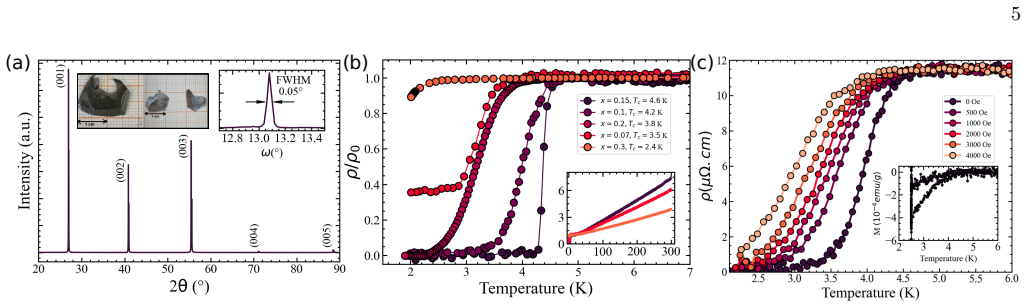
- Superconductivity emerges upon Se substitution in the ZrTe2 matrix with a clear dependence of Tc on selenium concentration.
- The critical temperature peaks at x=0.15 with Tc of 4.8 K.
- Calorimetric data indicates modification of both electronic contribution and vibrational modes at low Se substitution.
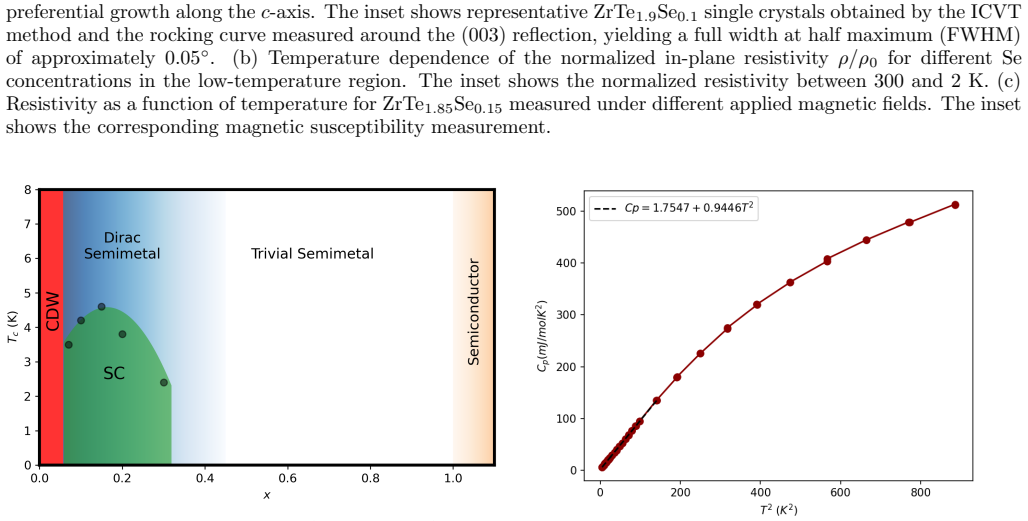
- The system transitions from charge density wave to Dirac semimetal plus superconductivity coexistence and then to semiconductor phase.
- ZrTe1.85Se0.15 is identified as hosting a nontrivial Z2 invariant with nonvanishing surface states in (001) planes.
Where Pith is reading between the lines
- If surface states remain gapless when the bulk becomes superconducting, the material offers a concrete setting in which to test whether topology and pairing can be combined without external fields or proximity effects.
- The interpolation approach between the two end compounds supplies a practical route to scan topology across other isostructural alloy series without recomputing every intermediate composition from scratch.
- Transport or tunneling measurements focused on the (001) face could directly test whether the predicted nonvanishing states survive into the superconducting regime.
- The same substitution window may be worth checking in chemically related transition-metal dichalcogenides to see whether similar coexistence regions appear.
Load-bearing premise
The ab initio calculations combined with Wannier Hamiltonian interpolation between ZrTe2 and ZrSe2 correctly capture the electronic topology and its persistence into the superconducting regime.
What would settle it
An experimental determination that the Z2 invariant becomes trivial or that surface states on the (001) planes vanish once superconductivity sets in at x=0.15 would falsify the claim of a candidate platform for topological superconductivity.
Figures
read the original abstract
This study explores the emergence of superconductivity in high-quality ZrTe$_{2-x}$Se$_x$ crystals, grown via the isothermal chemical vapor transport (ICVT) technique. Resistive, structural, and thermal measurements reveal that substituting Te with Se in the ZrTe$_2$ matrix induces a superconducting state at low temperatures. The critical temperature ($T_c$) exhibits a clear dependence on the selenium concentration, peaking at $x=0.15$ with a $T_c$ of $4.8$ K. Calorimetric data indicates that even a low Se substitution range is capable of modifying both the electronic contribution and the vibrational modes of the crystal lattice. Combined with ab initio calculations and Wannier Hamiltonian interpolation between ZrTe$_2$/ZrSe$_2$, we established an extensive phase diagram mapping the transition from charge density wave (CDW) to the state with coexistence between the Dirac semimetal and superconductivity (SC), up to the semiconductor phase. This coexistence suggests that ZrTe$_{1.85}$Se$_{0.15}$ could be a candidate platform for topological superconductivity, as it hosts a nontrivial $\mathbb Z_2$ invariant, with nonvanishing surface states in its $(001)$ planes.
Editorial analysis
A structured set of objections, weighed in public.
Referee Report
Summary. The manuscript reports the growth of ZrTe_{2-x}Se_x single crystals via isothermal chemical vapor transport and the emergence of superconductivity upon Se substitution, with Tc reaching a maximum of 4.8 K at x=0.15. Resistive, structural, and calorimetric data are combined with ab initio calculations and Wannier Hamiltonian interpolation between ZrTe2 and ZrSe2 to construct a doping-dependent phase diagram spanning CDW, Dirac semimetal plus superconductivity, and semiconducting regimes. The central claim is that ZrTe1.85Se0.15 lies in a region of nontrivial Z2 topology with nonvanishing (001) surface states, making it a candidate platform for topological superconductivity.
Significance. If the topological classification is robust, the work would identify an experimentally accessible doped Dirac semimetal in which superconductivity coexists with protected surface states, offering a platform to test theoretical predictions for topological superconductivity. The integration of crystal growth, multiple experimental probes, and first-principles modeling is a positive feature; however, the significance hinges on whether the interpolated Hamiltonian reliably captures the Z2 invariant inside the superconducting dome.
major comments (1)
- [Abstract / ab initio calculations section] Abstract (phase diagram construction paragraph): the nontrivial Z2 invariant and protected (001) surface states at x=0.15 are obtained from linear/virtual-crystal Wannier interpolation between the ZrTe2 and ZrSe2 end points. Because the Z2 index is fixed by parity eigenvalues at the eight TRIM points, any nonlinear shift in band ordering or gap closing caused by actual atomic substitution or local Se placement can flip the invariant without being reproduced by the interpolation; no direct parity or Wilson-loop calculation at the interpolated composition is shown to confirm the result.
minor comments (2)
- [Theory section] The manuscript should specify the precise method used to extract the Z2 invariant from the interpolated Hamiltonian (e.g., parity eigenvalues versus Wilson loop) and report the parity eigenvalues at each TRIM point for the x=0.15 composition.
- [Experimental results] Figure captions and text should explicitly state whether error bars on Tc, resistivity, and specific-heat data are included and how the superconducting volume fraction was estimated from calorimetry.
Simulated Author's Rebuttal
We thank the referee for their careful reading of the manuscript and for identifying a key methodological point regarding the topological classification. We respond to the major comment below and indicate the planned revision.
read point-by-point responses
-
Referee: [Abstract / ab initio calculations section] Abstract (phase diagram construction paragraph): the nontrivial Z2 invariant and protected (001) surface states at x=0.15 are obtained from linear/virtual-crystal Wannier interpolation between the ZrTe2 and ZrSe2 end points. Because the Z2 index is fixed by parity eigenvalues at the eight TRIM points, any nonlinear shift in band ordering or gap closing caused by actual atomic substitution or local Se placement can flip the invariant without being reproduced by the interpolation; no direct parity or Wilson-loop calculation at the interpolated composition is shown to confirm the result.
Authors: We agree that the virtual-crystal Wannier interpolation constitutes an approximation and that, in principle, nonlinear band shifts or local Se disorder could alter parity eigenvalues at the TRIM points. In the calculations presented, the interpolated Hamiltonian is used to obtain the bands at x=0.15, from which the Z2 invariant is evaluated via parity eigenvalues; the interpolation shows continuous evolution without gap closure at the TRIM points, preserving the invariant of the end members. Nevertheless, to directly address the concern, the revised manuscript will include an explicit tabulation (in the supplementary information) of the parity eigenvalues at the eight TRIM points for the interpolated x=0.15 Hamiltonian, together with a short discussion of the limitations of the virtual-crystal approximation at this doping level. This addition provides the requested direct confirmation while clarifying the scope of the result. revision: yes
Circularity Check
No circularity; topology and phase diagram derived from independent ab initio + Wannier interpolation
full rationale
The paper measures superconductivity experimentally (resistive, calorimetric data) and separately computes the electronic structure and Z2 invariant via ab initio calculations plus Wannier Hamiltonian interpolation between the ZrTe2 and ZrSe2 endpoints. No equation or claim reduces the computed topology or phase diagram to a fit of the measured Tc, nor does any load-bearing step invoke a self-citation whose content is itself unverified or defined by the present result. The interpolation is an external computational technique whose validity is not established by reference to the target superconducting composition inside the paper. This is the normal case of a self-contained derivation against external benchmarks.
Axiom & Free-Parameter Ledger
axioms (1)
- domain assumption Ab initio calculations plus Wannier interpolation between ZrTe2 and ZrSe2 correctly determine the topological invariant and its survival into the SC regime.
Reference graph
Works this paper leans on
-
[1]
Following Fig
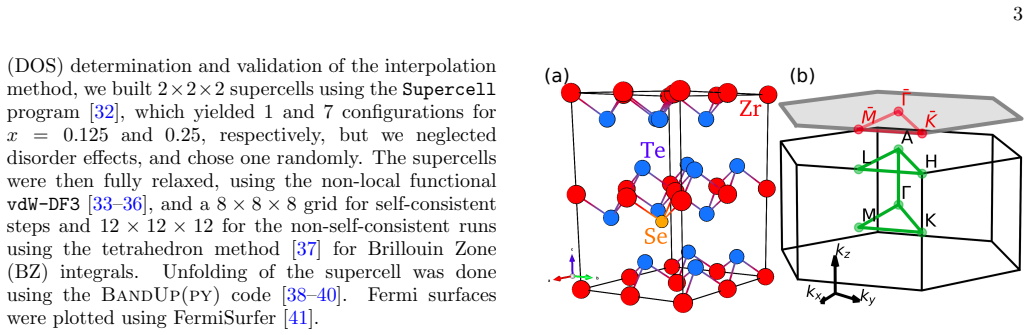
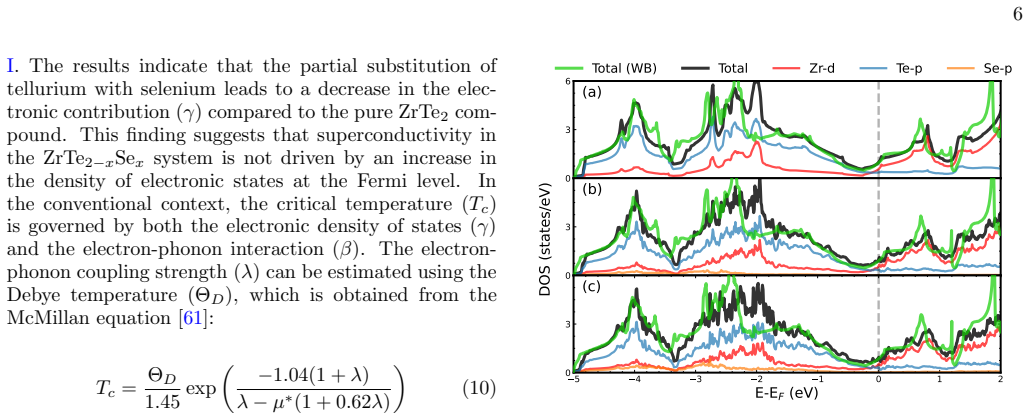
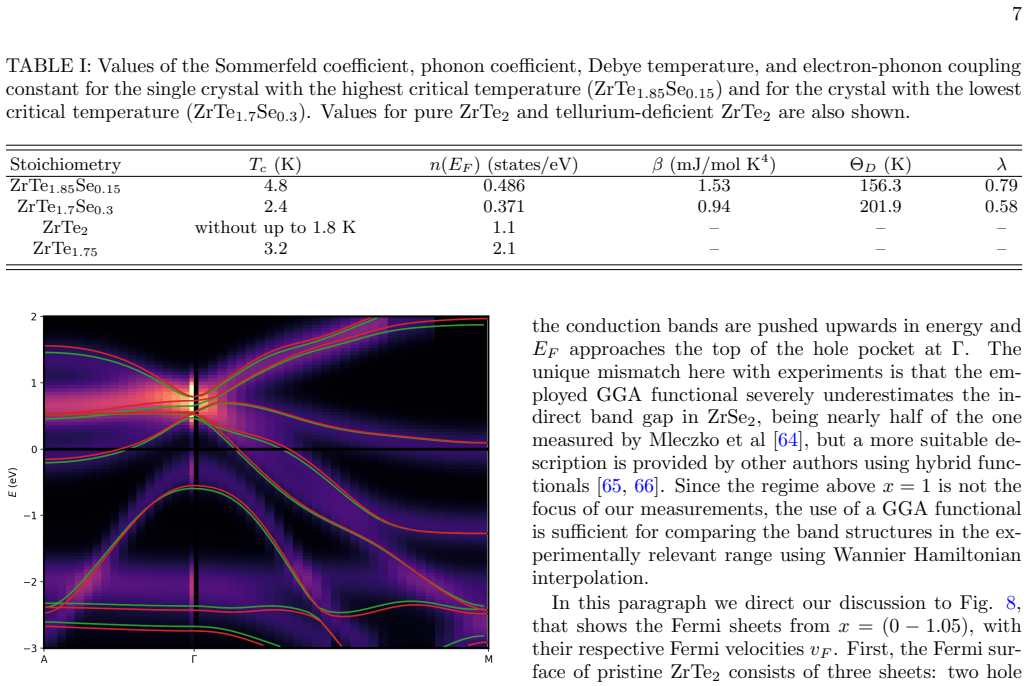
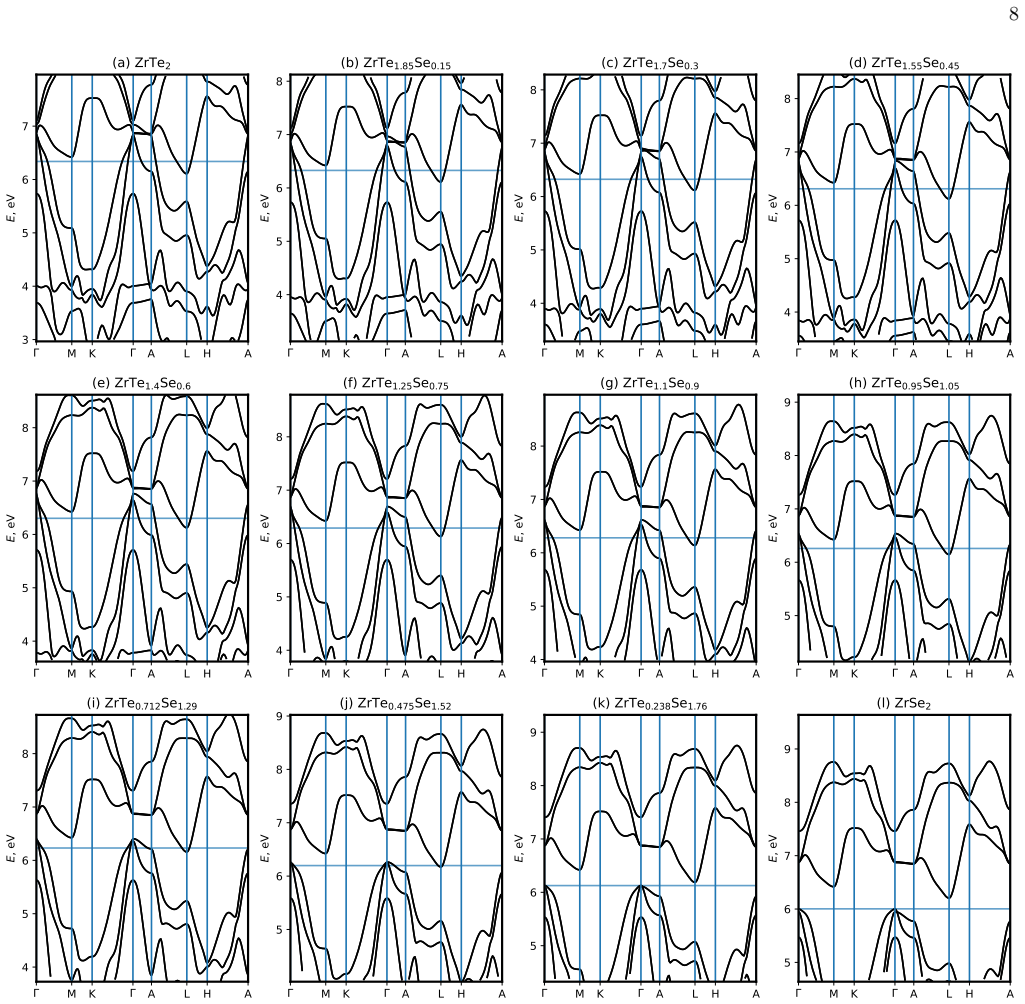
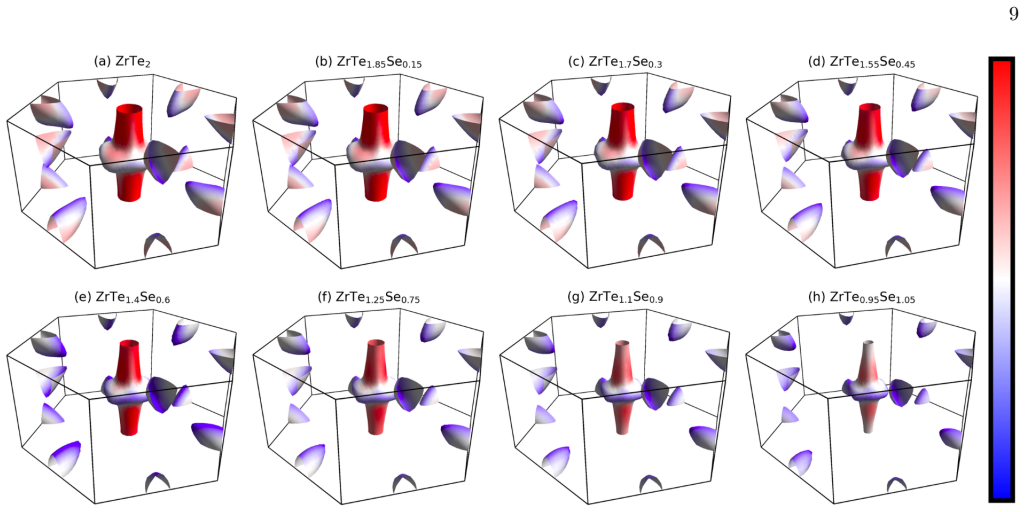
Electronic structure evolution To gain deeper insights into the electronic structure evolution as a function of composition, we start here by examining its DOS in the range of substitution employed in our experiments. Following Fig. 5, which brings the supercell with SOC taken into account and Wannier in- terpolation (green curve) results forx= (0,0.125,0...
-
[2]
Implications for the superconductivity By inspecting the structural effects upon increasing x, from our relaxed structures, it is worth noting that the main modification caused by Se substitution is that of changing Te-Te out-of-plane distanced Te-Te, which is further reduced forx= 0.125 and 0.25. To eluci- date this, the pristine ZrTe 2 has alld Te-Te = ...
-
[3]
What motivates this logic is a work fors-wave super- 10 FIG
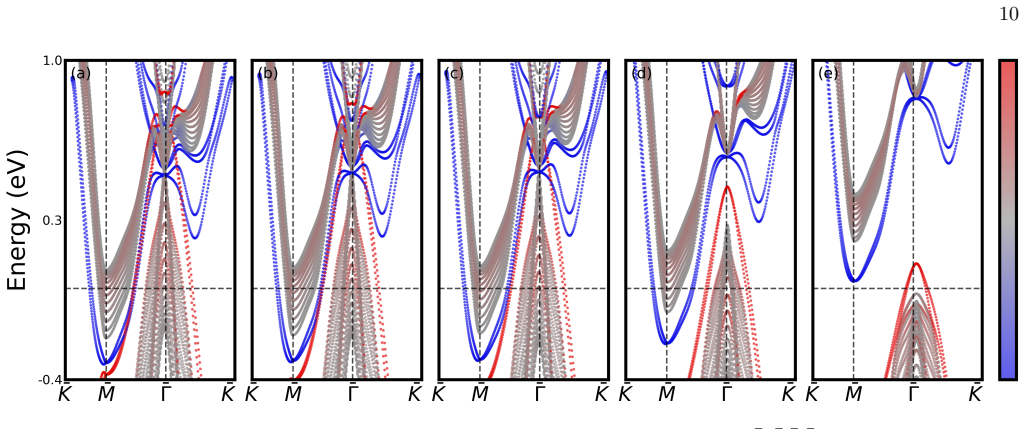
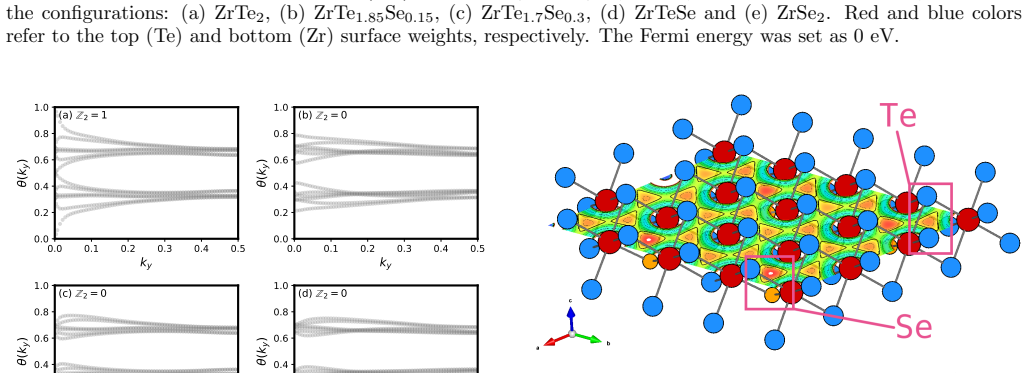
The influence of the higher electronegativity from Se is visible, hosting a much more localized electronic cloud that effectively breaks the underlying periodicity. What motivates this logic is a work fors-wave super- 10 FIG. 9: Calculated surface states on the (001) planes along the high-symmetry path ¯K ¯M ¯Γ ¯Kfor a 14-layer slab, for the configuration...
-
[4]
12(a)), which are necessary for helical surface states [86, 87]
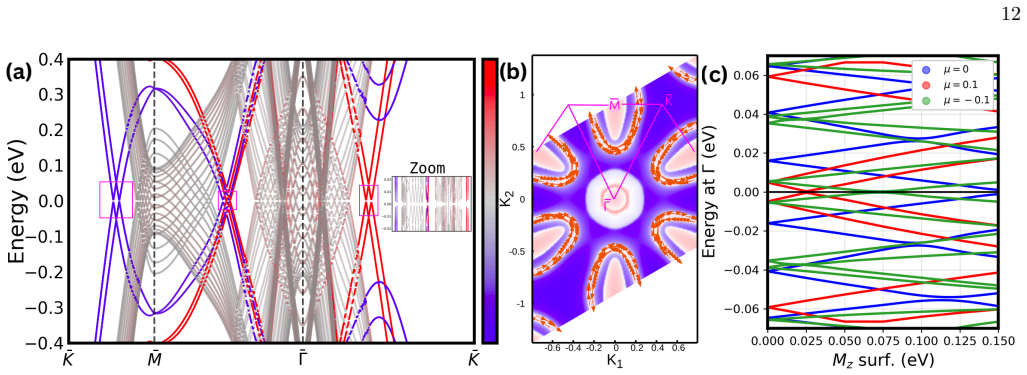
andβ-PdBi 2 [84, 85], its SS are separated from bulk states inkspace and they have a fully gapped SC (re- sults discussed below in Fig. 12(a)), which are necessary for helical surface states [86, 87]. For example, the spin texture of the 2 surface bands of the Zr termination at EF , shown in Fig. 12(b), exhibit the 6 pockets at ¯Mthat generates the spin-l...
2024
-
[5]
Q. Fu, J. Han, X. Wang, P. Xu, T. Yao, J. Zhong, W. Zhong, S. Liu, T. Gao, Z. Zhang, L. Xu, and B. Song, 2d transition metal dichalcogenides: Design, modulation, and challenges in electrocatalysis, Advanced Materials 33, 1907818 (2021)
2021
-
[6]
Zibouche, A
N. Zibouche, A. Kuc, J. Musfeldt, and T. Heine, Transition-metal dichalcogenides for spintronic applica- tions, Annalen der Physik526, 395 (2014)
2014
-
[7]
S. Wu, Y. Du, and S. Sun, Transition metal dichalco- genide based nanomaterials for rechargeable batteries, Chemical Engineering Journal307, 189 (2017)
2017
-
[8]
L. G. Ferreira, M. Marques, and L. K. Teles, Approxi- mation to density functional theory for the calculation of band gaps of semiconductors, Phys. Rev. B78, 125116 (2008)
2008
-
[9]
A. R. P. Montblanch, M. Barbone, I. Aharonovich, and et al., Layered materials as a platform for quantum tech- nologies, Nature Nanotechnology18, 555 (2023)
2023
-
[10]
de Lima, R
B. de Lima, R. de Cassia, F. Santos, L. Correa, T. Grant, A. Manesco, G. Martins, L. Eleno, M. Torikachvili, and A. Machado, Properties and superconductivity in ti- doped nite2 single crystals, Solid State Communications 283, 27 (2018)
2018
-
[11]
L. E. Correa, P. P. Ferreira, L. R. de Faria, T. T. Dorini, M. S. da Luz, Z. Fisk, M. S. Torikachvili, L. T. Eleno, and A. J. Machado, Evidence for multiband superconductiv- ity and charge density waves in ni-doped zrte2, Journal of Alloys and Compounds907, 164477 (2022)
2022
-
[12]
de Faria, F
L. de Faria, F. Abud, L. Correa, L. Ishikura, M. da Luz, M. Torikachvili, and A. Machado, Superconductivity, an- tiferromagnetism, and charge density waves in zrte3 in- tercalated with terbium, Journal of Alloys and Com- pounds1005, 175919 (2024)
2024
-
[13]
Correa, L
L. Correa, L. de Faria, F. Abud, M. da Luz, M. Torikachvili, and A. Machado, Two-band supercon- ductivity in pt-intercalated zrte2, a dirac semimetal, Physica C: Superconductivity and its Applications627, 1354606 (2024)
2024
-
[14]
Q. Gao, Y. H. Chan, Y. Wang, and et al., Evidence of high-temperature exciton condensation in a two- dimensional semimetal, Nature Communications14, 994 (2023)
2023
-
[15]
M. A. Rahimi, A. G. Moghaddam, C. Dykstra, M. Gov- ernale, and U. Z¨ ulicke, Unconventional superconductiv- ity from magnetism in transition-metal dichalcogenides, Phys. Rev. B95, 104515 (2017)
2017
-
[16]
X. Xu, B. Jiang, R. Wang, Z. Qiu, S. Guo, B. Lv, and R. Zhong, Stoichiometry-controlled structural order and tunable antiferromagnetism in fe xnbse2 (0.05≤x≤ 0.38), Phys. Rev. B113, 134420 (2026)
2026
-
[17]
Bahramy, O
M. Bahramy, O. Clark, B. J. Yang, and et al., Ubiqui- tous formation of bulk dirac cones and topological surface states from a single orbital manifold in transition-metal dichalcogenides, Nature Materials17, 21 (2018)
2018
-
[18]
I. Kar, J. Chatterjee, L. Harnagea, Y. Kushnirenko, A. V. Fedorov, D. Shrivastava, B. B¨ uchner, P. Mahadevan, and S. Thirupathaiah, Metal-chalcogen bond-length induced electronic phase transition from semiconductor to topo- logical semimetal in ZrX 2 (x= Se and te), Phys. Rev. B 101, 165122 (2020)
2020
-
[19]
L. E. Correa, P. P. Ferreira, L. R. de Faria, V. M. Fim, M. S. da Luz, M. S. Torikachvili, C. Heil, L. T. F. Eleno, and A. J. S. Machado, Superconductivity in te-deficient zrte2, The Journal of Physical Chemistry C127, 5162 (2023)
2023
-
[20]
Jobic, R
S. Jobic, R. Brec, and J. Rouxel, Anionic polymeric bonds in transition metal ditellurides, Journal of Solid State Chemistry96, 169 (1992)
1992
-
[21]
X. Zhu, W. Ning, L. Li, and et al., Superconductivity and charge density wave in zrte3−xsex, Scientific Reports 6, 26974 (2016)
2016
-
[22]
Muhammad, B
Z. Muhammad, B. Zhang, H. Lv, H. Shan, Z. u. Rehman, S. Chen, Z. Sun, X. Wu, A. Zhao, and L. Song, Transition from semimetal to semiconductor in zrte2 induced by se 13 substitution, ACS Nano14, 835 (2020), pMID: 31860270
2020
-
[23]
H. Lei, X. Zhu, and C. Petrovic, Raising tc in charge density wave superconductor zrte3 by ni intercalation, Europhysics Letters95, 17011 (2011)
2011
-
[24]
L. E. Correa, L. R. de Faria, R. S. Cardoso, N. Chaia, M. S. da Luz, M. S. Torikachvili, and A. J. Machado, Growth of pure and intercalated zrte2, tite2 and hfte2 dichalcogenide single crystals by isothermal chemical va- por transport, Journal of Crystal Growth595, 126819 (2022)
2022
-
[25]
S. Zhu, J. Wu, P. Zhu, C. Pei, Q. Wang, D. Jia, X. Wang, Y. Zhao, L. Gao, C. Li, W. Cao, M. Zhang, L. Zhang, M. Li, H. Gou, W. Yang, J. Sun, Y. Chen, Z. Wang, Y. Yao, and Y. Qi, Pressure-induced superconductivity and topological quantum phase transitions in the topo- logical semimetal zrte2, Advanced Science10, 2301332 (2023)
2023
-
[26]
J. J. Mortensen, A. H. Larsen, M. Kuisma, A. V. Ivanov, A. Taghizadeh, A. Peterson, A. Haldar, A. O. Dohn, C. Sch¨ afer, E. ¨O. J´ onsson, E. D. Hermes, F. A. Nils- son, G. Kastlunger, G. Levi, H. J´ onsson, H. H¨ akkinen, J. Fojt, J. Kangsabanik, J. Sødequist, J. Lehtom¨ aki, J. Heske, J. Enkovaara, K. T. Winther, M. Dulak, M. M. Melander, M. Ovesen, M. ...
2024
-
[27]
J. J. Mortensen, L. B. Hansen, and K. W. Jacobsen, Real- space grid implementation of the projector augmented wave method, Phys. Rev. B71, 035109 (2005)
2005
-
[28]
Enkovaara, C
J. Enkovaara, C. Rostgaard, J. J. Mortensen, J. Chen, M. Du lak, L. Ferrighi, J. Gavnholt, C. Glinsvad, V. Haikola, H. A. Hansen, H. H. Kristoffersen, M. Kuisma, A. H. Larsen, L. Lehtovaara, M. Ljung- berg, O. Lopez-Acevedo, P. G. Moses, J. Ojanen, T. Olsen, V. Petzold, N. A. Romero, J. Stausholm- Møller, M. Strange, G. A. Tritsaris, M. Vanin, M. Walter, ...
2010
-
[29]
P. Giannozzi and coauthors, Quantum espresso: A modu- lar and open-source software project for quantum simula- tions of materials, Journal of Physics: Condensed Matter 21, 395502 (2009)
2009
-
[30]
Giannozzi, O
P. Giannozzi, O. Andreussi, T. Brumme, O. Bunau, M. Buongiorno Nardelli, M. Calandra, R. Car, C. Cavaz- zoni, D. Ceresoli, M. Cococcioni, N. Colonna, I. Carn- imeo, A. Dal Corso, S. de Gironcoli, P. Delugas, R. A. DiStasio, A. Ferretti, A. Floris, G. Fratesi, G. Fugallo, R. Gebauer, U. Gerstmann, F. Giustino, T. Gorni, J. Jia, M. Kawamura, H.-Y. Ko, A. Ko...
2017
-
[31]
J. P. Perdew, K. Burke, and M. Ernzerhof, Generalized gradient approximation made simple, Phys. Rev. Lett. 77, 3865 (1996)
1996
-
[32]
P. E. Bl¨ ochl, Projector augmented-wave method, Phys. Rev. B50, 17953 (1994)
1994
-
[33]
Dal Corso, Pseudopotentials periodic table: From h to pu, Computational Materials Science95, 337 (2014)
A. Dal Corso, Pseudopotentials periodic table: From h to pu, Computational Materials Science95, 337 (2014)
2014
-
[34]
Q. Mao, X. Geng, J. Yang, R. Li, H. Hao, J. Yang, H. Wang, B. Xu, and M. Fang, Synthesis and semicon- ducting behavior of zr (cu, fe) se2−δ single crystals, Phys- ica B: Condensed Matter567, 1 (2019)
2019
-
[35]
E. G. Shkvarina, A. A. Titov, A. S. Shkvarin, J. R. Plaisier, L. Gigli, and A. N. Titov, Thermal stability of the layered modification of cu0.5zrte2 in the tempera- ture range 25–900°c, Acta Crystallographica Section C 74, 1020 (2018)
2018
-
[36]
Okhotnikov, T
K. Okhotnikov, T. Charpentier, and S. Cadars, Supercell program: a combinatorial structure-generation approach for the local-level modeling of atomic substitutions and partial occupancies in crystals, Journal of Cheminformat- ics8, 17 (2016)
2016
-
[37]
Chakraborty, K
D. Chakraborty, K. Berland, and T. Thonhauser, Next- generation nonlocal van der waals density functional, Journal of Chemical Theory and Computation16, 5893 (2020), pMID: 32786912
2020
-
[38]
Thonhauser, S
T. Thonhauser, S. Zuluaga, C. A. Arter, K. Berland, E. Schr¨ oder, and P. Hyldgaard, Spin signature of nonlocal correlation binding in metal-organic frameworks, Phys. Rev. Lett.115, 136402 (2015)
2015
-
[39]
D. C. Langreth, B. I. Lundqvist, S. D. Chakarova- K¨ ack, V. R. Cooper, M. Dion, P. Hyldgaard, A. Kelkka- nen, J. Kleis, L. Kong, S. Li, P. G. Moses, E. Mur- ray, A. Puzder, H. Rydberg, E. Schr¨ oder, and T. Thon- hauser, A density functional for sparse matter, Journal of Physics: Condensed Matter21, 084203 (2009)
2009
-
[40]
Berland, V
K. Berland, V. R. Cooper, K. Lee, E. Schr¨ oder, T. Thon- hauser, P. Hyldgaard, and B. I. Lundqvist, van der waals forces in density functional theory: a review of the vdw- df method, Reports on Progress in Physics78, 066501 (2015)
2015
-
[41]
P. E. Bl¨ ochl, O. Jepsen, and O. K. Andersen, Improved tetrahedron method for brillouin-zone integrations, Phys. Rev. B49, 16223 (1994)
1994
-
[42]
P. V. C. Medeiros, S. Stafstr¨ om, and J. Bj¨ ork, Effects of extrinsic and intrinsic perturbations on the electronic structure of graphene: Retaining an effective primitive cell band structure by band unfolding, Phys. Rev. B89, 041407 (2014)
2014
-
[43]
P. V. C. Medeiros, S. S. Tsirkin, S. Stafstr¨ om, and J. Bj¨ ork, Unfolding spinor wave functions and expec- tation values of general operators: Introducing the unfolding-density operator, Phys. Rev. B91, 041116 (2015)
2015
-
[44]
Iraola, J
M. Iraola, J. L. Ma˜ nes, B. Bradlyn, M. K. Horton, T. Ne- upert, M. G. Vergniory, and S. S. Tsirkin, Irrep: Sym- metry eigenvalues and irreducible representations of ab initio band structures, Comput. Phys. Commun.272, 108226 (2022)
2022
-
[45]
Kawamura, Fermisurfer: Fermi-surface viewer provid- ing multiple representation schemes, Computer Physics Communications239, 197 (2019)
M. Kawamura, Fermisurfer: Fermi-surface viewer provid- ing multiple representation schemes, Computer Physics Communications239, 197 (2019)
2019
-
[46]
S. S. Tsirkin, High performance wannier interpolation of berry curvature and related quantities with wannierberri 14 code, npj Computational Materials7, 33 (2021)
2021
-
[47]
Olsen, Designing in-plane heterostructures of quantum spin hall insulators from first principles: 1t ′ −mos 2 with adsorbates, Phys
T. Olsen, Designing in-plane heterostructures of quantum spin hall insulators from first principles: 1t ′ −mos 2 with adsorbates, Phys. Rev. B94, 235106 (2016)
2016
-
[48]
Cuadrado, R
R. Cuadrado, R. Robles, A. Garc´ ıa, M. Pruneda, P. Or- dej´ on, J. Ferrer, and J. I. Cerd´ a, Validity of the on-site spin-orbit coupling approximation, Phys. Rev. B104, 195104 (2021)
2021
-
[49]
Kurita and T
K. Kurita and T. Koretsune, Systematic first-principles study of the on-site spin-orbit coupling in crystals, Phys. Rev. B102, 045109 (2020)
2020
-
[50]
S. Sadhukhan, S. S. Tsirkin, Y. Zhumagulov, and I. I. Mazin, Study of the nonlinear dependence of anoma- lous hall conductivity on magnetization in weak itiner- ant ferromagnet zrzn2 (2026), arXiv:2604.06441 [cond- mat.mtrl-sci]
work page internal anchor Pith review Pith/arXiv arXiv 2026
-
[51]
tutorial athttps://github.com/wannier-berri/ WannierBerri-tutorial(2026)
Supplementary material athttps://github.com/ wannier-berri/WannierBerri-tutorial; interp. tutorial athttps://github.com/wannier-berri/ WannierBerri-tutorial(2026)
2026
-
[52]
Q. Wu, S. Zhang, H.-F. Song, M. Troyer, and A. A. Soluyanov, Wanniertools : An open-source soft- ware package for novel topological materials, Computer Physics Communications224, 405 (2018)
2018
-
[53]
A. A. Soluyanov and D. Vanderbilt, Computing topolog- ical invariants without inversion symmetry, Phys. Rev. B 83, 235401 (2011)
2011
-
[54]
Gresch, G
D. Gresch, G. Aut` es, O. V. Yazyev, M. Troyer, D. Van- derbilt, B. A. Bernevig, and A. A. Soluyanov, Z2pack: Numerical implementation of hybrid wannier centers for identifying topological materials, Phys. Rev. B95, 075146 (2017)
2017
-
[55]
R. Yu, X. L. Qi, A. Bernevig, Z. Fang, and X. Dai, Equiv- alent expression of𭟋 2 topological invariant for band in- sulators using the non-abelian berry connection, Phys. Rev. B84, 075119 (2011)
2011
-
[56]
A. A. Soluyanov and D. Vanderbilt, Wannier representa- tion of𭟋 2 topological insulators, Phys. Rev. B83, 035108 (2011)
2011
-
[57]
R. D. H. Hinlopen, O. N. Moulding, W. R. Broad, J. Buhot, F. Bangma, A. McCollam, J. Ayres, C. J. Say- ers, E. D. Como, F. Flicker, J. van Wezel, and S. Friede- mann, Lifshitz transition enabling superconducting dome around a charge-order critical point, Science Advances 10, eadl3921 (2024)
2024
-
[58]
S. Wang, Y. Han, S. Sun, S. Wang, C. An, C. Chen, L. Zhang, Y. Zhou, J. Zhou, and Z. Yang, Pressure in- duced nonmonotonic evolution of superconductivity in 6r−tas2 with a natural bulk van der waals heterostruc- ture, Phys. Rev. Lett.133, 056001 (2024)
2024
-
[59]
Monteverde, J
M. Monteverde, J. Lorenzana, P. Monceau, and M. N´ u˜ nez Regueiro, Quantum critical point and super- conducting dome in the pressure phase diagram ofo-tas 3, Phys. Rev. B88, 180504 (2013)
2013
-
[60]
R. Sun, S. Jin, J. Deng, M. Hao, X. Zhong, Y. Ma, M. Li, and X. Chen, Chemical pressure boost record-high super- conductivity in van der waals materials fese1-xsx, Ad- vanced Functional Materials31, 2102917 (2021)
2021
-
[61]
Boubeche, N
M. Boubeche, N. Wang, J. Sun, P. Yang, L. Zeng, Q. Li, Y. He, S. Luo, J. Cheng, Y. Peng, and H. Luo, Anoma- lous charge density wave state evolution and dome-like superconductivity in cuir2te4-xsex chalcogenides, Super- conductor Science and Technology34, 115003 (2021)
2021
-
[62]
L. Li, X. Deng, Z. Wang, and et al., Superconducting order from disorder in 2h-tase 2−xsx, npj Quantum Ma- terials2, 11 (2017)
2017
-
[63]
K. Cho, M. Ko´ nczykowski, S. Teknowijoyo, and et al., Using controlled disorder to probe the interplay between charge order and superconductivity in nbse 2, Nature Communications9, 2796 (2018)
2018
-
[64]
Crivillero, M
A. Crivillero, M. Victoria, J. C. Souza, V. Hasse, M. Schmidt, N. Shitsevalova, S. Gab´ ani, K. Siemensmeyer, K. Flachbart, and S. Wirth, De- tection of surface states in quantum materials zrte2 and tmb4 by scanning tunneling microscopy, Condensed Matter8, 9 (2023)
2023
-
[65]
Dynes, Mcmillan’s equation and the tc of supercon- ductors, Solid State Communications10, 615 (1972)
R. Dynes, Mcmillan’s equation and the tc of supercon- ductors, Solid State Communications10, 615 (1972)
1972
-
[66]
X. Zhu, H. Lei, and C. Petrovic, Coexistence of bulk superconductivity and charge density wave in cu xzrte3, Phys. Rev. Lett.106, 246404 (2011)
2011
-
[67]
Y. Tian, N. Ghassemi, and J. H. Ross, Topological nodal line in zrte 2 demonstrated by nuclear magnetic reso- nance, Phys. Rev. B102, 165149 (2020)
2020
-
[68]
M. J. Mleczko, C. Zhang, H. R. Lee, H.-H. Kuo, B. Magyari-K¨ ope, R. G. Moore, Z.-X. Shen, I. R. Fisher, Y. Nishi, and E. Pop, Hfse 2 and zrse2: Two-dimensional semiconductors with native high-κ oxides, Sci- ence Advances3, e1700481 (2017)
2017
-
[69]
Q. Zhao, Y. Guo, K. Si, Z. Ren, J. Bai, and X. Xu, Elastic, electronic, and dielectric properties of bulk and monolayer zrs2, zrse2, hfs2, hfse2 from van der waals density-functional theory, physica status solidi (b)254, 1700033 (2017)
2017
-
[70]
Qin, X.-J
D. Qin, X.-J. Ge, G.-q. Ding, G.-y. Gao, and J.-T. L¨ u, Strain-induced thermoelectric performance enhancement of monolayer zrse 2, RSC advances7, 47243 (2017)
2017
-
[71]
Z. K. Liu, B. Zhou, Y. Zhang, Z. J. Wang, H. M. Weng, D. Prabhakaran, S.-K. Mo, Z. X. Shen, Z. Fang, X. Dai, Z. Hussain, and Y. L. Chen, Discovery of a three-dimensional topological dirac semimetal, na¡sub¿3¡/sub¿bi, Science343, 864 (2014)
2014
-
[72]
Z. Liu, J. Jiang, B. Zhou, and et al., A stable three- dimensional topological dirac semimetal cd 3as2, Nature Materials13, 677 (2014)
2014
-
[73]
Hoesch, L
M. Hoesch, L. Gannon, K. Shimada, B. J. Parrett, M. D. Watson, T. K. Kim, X. Zhu, and C. Petrovic, Disorder quenching of the charge density wave in zrte3, Phys. Rev. Lett.122, 017601 (2019)
2019
-
[74]
Zhang, Y
R. Zhang, Y. Hu, Y. Cheng, Y. Zhong, X. Chen, J. Li, K. Okazaki, Y. Huang, T. Shang, S. Jin, B. Lv, and H. Ding, Momentum-dependent anisotropy of the charge density wave gap in quasi-1d zrte3–xsex (x = 0.015), Chi- nese Physics B34, 077106 (2025)
2025
-
[75]
Singh, P
M. Singh, P. Saha, A. Chahar, H. Singh, B. Birajdar, D. K. Shukla, and S. Patnaik, Competing role of disorder and charge density wave in superconducting TiSe 1.2s0.8, Phys. Rev. Mater.9, 094802 (2025)
2025
-
[76]
G. Li, L. Zhang, T. Ma, Q. Dai, and L. Zhang, Disorder suppression of charge density waves in the honeycomb holstein model, Phys. Rev. B113, 085144 (2026)
2026
-
[77]
A. D. Becke and K. E. Edgecombe, A simple measure of electron localization in atomic and molecular systems, The Journal of Chemical Physics92, 5397 (1990)
1990
-
[78]
Savin, R
A. Savin, R. Nesper, S. Wengert, and T. F. F¨ assler, Elf: The electron localization function, Angewandte Chemie International Edition in English36, 1808 (1997). 15
1997
-
[79]
Banerjee, A
A. Banerjee, A. Garg, and A. Ghosal, Emergent su- perconductivity upon disordering a charge density wave ground state, Phys. Rev. B98, 104206 (2018)
2018
-
[80]
Z. Y. Liu, J. Li, J. F. Zhang, and et al., Quasi-one- dimensional superconductivity in the pressurized charge- density-wave conductor hfte3, npj Quantum Materials6, 90 (2021)
2021
discussion (0)
Sign in with ORCID, Apple, or X to comment. Anyone can read and Pith papers without signing in.