REVIEW 1 major objections 1 minor 44 references
Fusion readout outperforms grouped Pauli on Floquet circuits but underperforms on VQE for energy estimation in Fibonacci anyon chains.
Reviewed by Pith at T0; open to challenge. T0 means a machine referee read the full paper against a public rubric. the ladder, T0–T4 →
T0 review · grok-4.3
2026-06-29 21:06 UTC pith:7KK44HSI
load-bearing objection The paper delivers a concrete 1D Fibonacci benchmark with circuit-dependent crossovers between fusion and Pauli readout, but asserts 2D relevance without supporting analysis or data. the 1 major comments →
Native topological readout on qubit hardware: a Fibonacci-chain benchmark of measurement-compilation trade-offs
The pith
A machine-rendered reading of the paper's core claim, the machinery that carries it, and where it could break.
Core claim
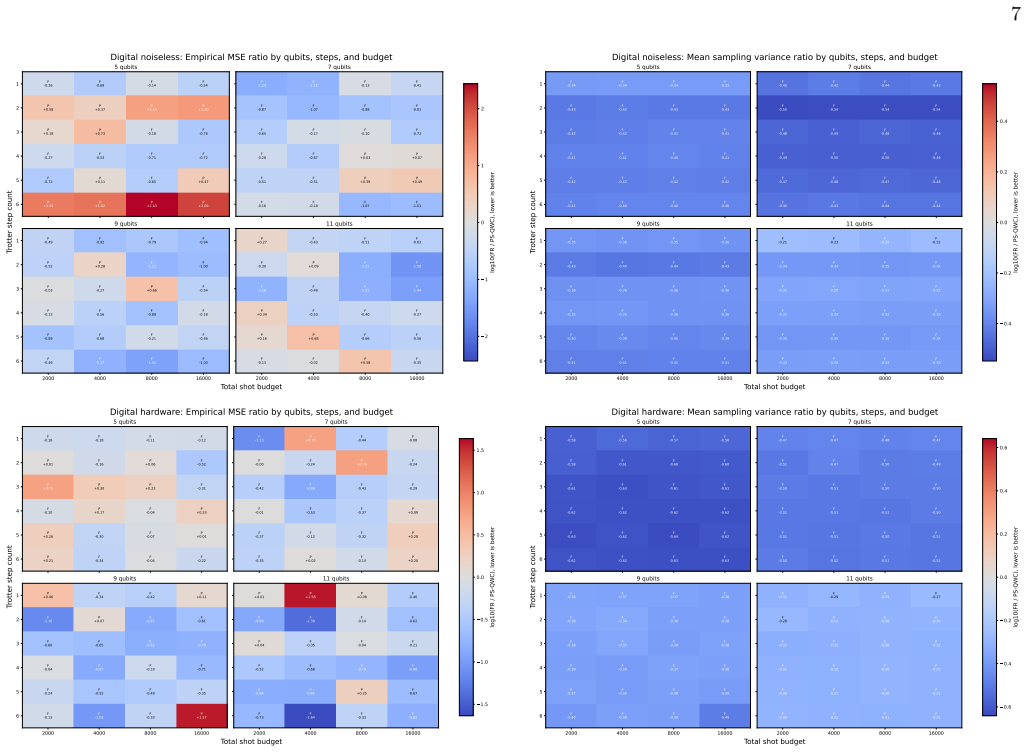
For the Fibonacci anyon chain, the fusion readout method produces lower covariance-aware MSE than grouped Pauli on Floquet circuits, while grouped Pauli produces lower MSE on VQE circuits; the ordering reverses for covariance-aware sampling variance, and explicit shot-budget crossovers mark where each method becomes preferable.
What carries the argument
Fibonacci anyon chain benchmark that compares native fusion readout against grouped-Pauli reconstruction using covariance-aware MSE on energy estimators for Floquet and VQE circuits.
Load-bearing premise
The measurement-compilation trade-offs found for the one-dimensional Fibonacci chain extend to two-dimensional topological models compiled onto superconducting qubit hardware.
What would settle it
A direct repeat of the benchmark on a two-dimensional topological lattice model that finds one readout method uniformly superior across both Floquet and VQE circuits would falsify the reported non-uniformity.
If this is right
- Scaling laws derived from the benchmark predict the circuit depth and shot count at which fusion readout becomes cheaper than Pauli reconstruction.
- Shot-budget crossover points supply an operational rule for selecting the readout method once the circuit class and target precision are known.
- The same comparison framework can be applied to decide readout strategy for any anyonic Hamiltonian whose interactions are a mixture of braiding and fusion terms.
- The absence of a uniform winner implies that hardware compilers must support both native fusion and Pauli-basis paths rather than committing to one.
Where Pith is reading between the lines
- For circuits dominated by time evolution, the extra compilation cost of fusion readout is offset by lower sampling overhead.
- For variational optimization circuits the flexibility of the Pauli basis appears to outweigh the topological structure preserved by fusion readout.
- If future hardware adds native support for anyonic fusion, the crossover points will shift toward fusion readout for both circuit classes.
- The same benchmark could be rerun with different anyon models to test whether the observed pattern of trade-offs is universal.
Editorial analysis
A structured set of objections, weighed in public.
Referee Report
Summary. The manuscript uses the Fibonacci anyon chain as a benchmark model to compare native topological fusion readout against a grouped-Pauli measurement baseline for two circuit classes (Floquet time-evolution and VQE) on NISQ hardware. It reports no uniform winner: fusion readout outperforms on Floquet circuits for both covariance-aware MSE and sampling variance, while grouped Pauli is better on VQE for MSE but worse on variance. Scaling laws and shot-budget crossover points are derived, with the claim that these trade-offs extend to two-dimensional topological models on superconducting and other qubit platforms.
Significance. If the 1D results and scaling laws hold, the work supplies practical, quantitative guidance on when native fusion measurements are preferable to Pauli-basis reconstruction for topological Hamiltonians, directly addressing an open question raised by recent non-Abelian braiding experiments. The covariance-aware MSE metric and explicit crossover calculations are strengths for operational relevance.
major comments (1)
- [Abstract and Conclusion] Abstract (final paragraph) and Conclusion: the assertion that the 1D Fibonacci-chain trade-offs 'extend to two-dimensional topological models compiled on superconducting and other qubit-native platforms' is unsupported. No scaling argument mapping 1D compilation/measurement overheads to 2D braiding costs, no 2D benchmark data, and no discussion of how fusion locality or braiding overheads change qualitatively in 2D are provided. This generalization is load-bearing for the stated broader relevance of the benchmark.
minor comments (1)
- [Abstract] Abstract: 'We based our benchmark' is grammatically inconsistent with the surrounding present-tense description; change to 'We base our benchmark'.
Simulated Author's Rebuttal
We thank the referee for their careful reading and for highlighting the unsupported generalization in the abstract and conclusion. We address this point directly below.
read point-by-point responses
-
Referee: [Abstract and Conclusion] Abstract (final paragraph) and Conclusion: the assertion that the 1D Fibonacci-chain trade-offs 'extend to two-dimensional topological models compiled on superconducting and other qubit-native platforms' is unsupported. No scaling argument mapping 1D compilation/measurement overheads to 2D braiding costs, no 2D benchmark data, and no discussion of how fusion locality or braiding overheads change qualitatively in 2D are provided. This generalization is load-bearing for the stated broader relevance of the benchmark.
Authors: We agree that the manuscript provides no scaling argument, 2D data, or analysis of how fusion locality or braiding overheads differ in 2D, and that the claim is therefore unsupported. The benchmark and all quantitative results are strictly one-dimensional. We will revise the final paragraph of the abstract and the conclusion to remove the assertion that the trade-offs extend to two-dimensional models, limiting the stated relevance to the 1D Fibonacci chain and similar one-dimensional topological Hamiltonians on qubit hardware. revision: yes
Circularity Check
No circularity; derivations are direct empirical comparisons on the 1D model
full rationale
The paper's core results consist of direct numerical benchmarks on the Fibonacci anyon chain for Floquet and VQE circuits, using explicit MSE and covariance-aware variance metrics to compare fusion readout against grouped-Pauli reconstruction. Scaling laws and shot-budget crossovers are computed from these simulations. The statement that results extend to 2D models is presented as contextual relevance rather than a load-bearing premise or derived claim within the analysis chain. No self-definitional loops, fitted inputs renamed as predictions, or self-citation dependencies appear in the provided text. The derivation chain remains self-contained within the 1D computations and does not reduce to its inputs by construction.
Axiom & Free-Parameter Ledger
read the original abstract
Recent demonstrations of non-Abelian braiding of graph vertices on noisy intermediate-scale quantum (NISQ) superconducting processor, and the experimental realization of topological order in general on various quantum hardware platforms necessitate an important question: when does a native (topological) fusion readout genuinely help for topological anyonic Hamiltonians implemented on NISQ hardware? We use the Fibonacci anyons chain as a concrete model for understanding the trade-off between measurement cost and compilation cost in that setting. The comparison is made against a simple grouped-Pauli baseline, and is scored by a covariance-aware mean-squared-error (MSE) of the full energy estimator. We based our benchmark on two different important classes of quantum circuits, namely Floquet time-evolved and variational quantum eigensolver quantum circuits, with the underlying Hamiltonian consisting of both braiding and fusion interaction. Our analysis found that there is not a uniform best method across both problems: the fusion readout method performed better on Floquet-type circuits on both the MSE and covariance-aware sampling variance, while the grouped Pauli method performed better on VQE on the MSE but worse on sampling variance. We derive scaling laws, and compute shot-budget crossover points, where one method is operationally favored above the other. The relevance of this work extends beyond Fibonacci chains to two-dimensional topological models compiled on superconducting and other qubit-native platforms, and can be used as a guide in answering the question of when one should measure in the native operator basis of the target physics, or when it is better to fall back on Pauli-basis reconstruction.
Figures



Reference graph
Works this paper leans on
-
[1]
The nontrivial recoupling move is theFmove for three τanyons with total chargeτ
FibonacciF/Rdata and the induced braid (B-move) operator We work with Fibonacci anyons with topological charge set{1, τ}and fusion rule [25, 26, 28–30, 41] τ×τ=1+τ,(A1) with quantum dimensiondτ =φwhereφ= (1 + √ 5)/2 is the golden ratio. The nontrivial recoupling move is theFmove for three τanyons with total chargeτ. In the standard basis where the interme...
-
[2]
W orked example: a braid-plus-recoupling fusion-projector term (BF4) The simplest local operators in Fibonacci chains are fusion-channel projectors on neighboring anyons. In a fusion-tree basis these are naturally measured in a direct- fusion frame: anFmove recouples the fusion tree so that the relevant fusion outcome is represented as a single intermedia...
2000
-
[3]
Preskill, Quantum computing in the nisq era and be- yond, Quantum2, 79 (2018)
J. Preskill, Quantum computing in the nisq era and be- yond, Quantum2, 79 (2018)
2018
-
[4]
Peruzzo, J
A. Peruzzo, J. McClean, P. Shadbolt, M.-H. Yung, X.-Q. Zhou, P. J. Love, A. Aspuru-Guzik, and J. L. O’Brien, A variational eigenvalue solver on a photonic quantum processor, Nature communications5, 4213 (2014)
2014
-
[5]
J. R. McClean, J. Romero, R. Babbush, and A. Aspuru- Guzik, The theory of variational hybrid quantum- classical algorithms, New Journal of Physics18, 023023 (2016)
2016
-
[6]
Verteletskyi, T.-C
V. Verteletskyi, T.-C. Yen, and A. F. Izmaylov, Measure- ment optimization in the variational quantum eigensolver using a minimum clique cover, Journal of Chemical The- ory and Computation16, 240 (2020)
2020
-
[7]
arXiv preprint arXiv:1907.13623 , year=
P. Gokhaleet al., Minimizing state preparations in vari- ational quantum eigensolver by partitioning into com- mutingfamilies,arXivpreprintarXiv:1907.13623 (2019), arXiv:1907.13623
-
[8]
Gokhale, O
P. Gokhale, O. Angiuli, Y. Ding, K. Gui, T. Tomesh, M. Suchara, M. Martonosi, and F. T. Chong, Opti- mization of simultaneous measurement for variational quantum eigensolver applications, in2020 IEEE Inter- national Conference on Quantum Computing and Engi- neering (QCE)(IEEE, 2020) pp. 379–390
2020
-
[9]
A. F. Izmaylov, T.-C. Yen, and I. G. Ryabinkin, Revis- ing the measurement process in the variational quantum eigensolver: Is it possible to reduce the number of terms in a molecular hamiltonian?, Chemical Science10, 3746 (2019)
2019
-
[10]
J. M. Kübler, A. Arrasmith, L. Cincio, and P. J. Coles, An adaptive optimizer for measurement-frugal varia- tional algorithms, Quantum4, 263 (2020)
2020
-
[11]
A. Gu, A. Lowe, P. A. Dub, P. J. Coles, and A. Arrasmith, Adaptive shot allocation for fast conver- gence in variational quantum algorithms, arXiv preprint arXiv:2108.10434 10.48550/arXiv.2108.10434 (2021)
-
[12]
W. J. Huggins, J. R. McClean, N. C. Rubin, Z. Jiang, N. Wiebe, K. B. Whaley, and R. Babbush, Efficient and noise resilient measurements for quantum chemistry on near-term quantum computers, npj Quantum Informa- tion7, 23 (2021)
2021
-
[13]
Huang, R
H.-Y. Huang, R. Kueng, and J. Preskill, Predicting many properties of a quantum system from very few measure- ments, Nature Physics16, 1050 (2020)
2020
-
[14]
T.-C.YenandA.F.Izmaylov,Exhaustivesearchforcom- muting groups of pauli observables in variational quan- tum eigensolvers, Journal of Chemical Theory and Com- putation19, 1184 (2023)
2023
-
[15]
M. A. Levin and X.-G. Wen, String-net condensation: A physical mechanism for topological phases, Physical Review B71, 045110 (2005)
2005
-
[16]
Gottesman, An introduction to quantum error correc- tion, inQuantum Computation, Proceedings of Symposia in Applied Mathematics, Vol
D. Gottesman, An introduction to quantum error correc- tion, inQuantum Computation, Proceedings of Symposia in Applied Mathematics, Vol. 58 (American Mathemati- cal Society, 2002) pp. 221–235
2002
-
[17]
Dennis, A
E. Dennis, A. Kitaev, A. Landahl, and J. Preskill, Topological quantum memory, Journal of Mathematical Physics43, 4452 (2002)
2002
-
[18]
A. G. Fowler, M. Mariantoni, J. M. Martinis, and A. N. Cleland, Surface codes: Towards practical large-scale quantum computation, Physical Review A86, 032324 (2012)
2012
-
[19]
Bombin, Topological order with a twist: Ising anyons from an abelian model, Physical Review Letters105, 030403 (2010)
H. Bombin, Topological order with a twist: Ising anyons from an abelian model, Physical Review Letters105, 030403 (2010)
2010
-
[20]
B. J. Brown, K. Laubscher, M. S. Kesselring, and J. R. Wootton, Poking holes and cutting corners to achieve clifford gates with the surface code, Physical Review X 7, 021029 (2017)
2017
-
[21]
Bernien, S
H. Bernien, S. Schwartz, A. Keesling, H. Levine, A. Om- ran, H. Pichler, S. Choi, A. S. Zibrov, M. Endres, M. Greiner, V. Vuletić, and M. D. Lukin, Probing many- body dynamics on a 51-atom quantum simulator, Nature 551, 579 (2017)
2017
-
[22]
Browaeys and T
A. Browaeys and T. Lahaye, Many-body physics with in- dividually controlled rydberg atoms, Nature Physics16, 132 (2020)
2020
-
[23]
Google Quantum AIet al., Non-Abelian braiding of graph vertices in a superconducting processor, Nature 618, 264 (2023)
2023
-
[24]
Iqbal, N
M. Iqbal, N. Tantivasadakarn, R. Verresen,et al., Non- Abelian topological order and anyons on a trapped-ion processor, Nature626, 505 (2024)
2024
-
[25]
Xuet al., Non-Abelian braiding of fibonacci anyons with a superconducting quantum processor, Nature Physics20, 1116 (2024)
S. Xuet al., Non-Abelian braiding of fibonacci anyons with a superconducting quantum processor, Nature Physics20, 1116 (2024)
2024
-
[26]
Field and T
B. Field and T. Simula, Introduction to topological quan- tum computation with non-abelian anyons, Quantum Science and Technology3, 045004 (2018)
2018
-
[27]
Nayak, S
C. Nayak, S. H. Simon, A. Stern, M. Freedman, and S. Das Sarma, Non-abelian anyons and topological quan- tum computation, Reviews of Modern Physics80, 1083 (2008)
2008
-
[28]
J. K. Pachos,Introduction to topological quantum com- putation(Cambridge University Press, 2012)
2012
-
[29]
R. N. Pfeifer and S. Singh, Finite density matrix renor- malization group algorithm for anyonic systems, Physical Review B92, 115135 (2015)
2015
-
[30]
Singh, R
S. Singh, R. N. Pfeifer, G. Vidal, and G. K. Brennen, Matrix product states for anyonic systems and efficient simulation of dynamics, Physical Review B89, 075112 (2014)
2014
-
[31]
B. M. Ayeni, S. Singh, R. N. Pfeifer, and G. K. Bren- nen, Simulation of braiding anyons using matrix product states, Physical Review B93, 165128 (2016)
2016
-
[32]
Kirchner, D
N. Kirchner, D. Millar, B. M. Ayeni, A. Smith, J. K. Slingerland, and F. Pollmann, Numerical simulation of non-abelian anyons, Physical Review B107, 195129 (2023)
2023
-
[33]
B. M. Ayeni, R. N. C. Pfeifer, and G. K. Brennen, Phase transitions on a ladder of braided non-abelian anyons, Phys. Rev. B98, 045432 (2018)
2018
-
[34]
Kandala, A
A. Kandala, A. Mezzacapo, K. Temme, M. Takita, M. Brink, J. M. Chow, and J. M. Gambetta, Hardware- efficient variational quantum eigensolver for small molecules and quantum magnets, Nature549, 242 (2017)
2017
-
[35]
B. M. Ayeni, Efficient particle-conserving symmetric quantum circuits, Phys. Rev. A111, 022629 (2025)
2025
-
[36]
Bonet-Monroig, R
X. Bonet-Monroig, R. Babbush, T. E. O’Brien, and C. Ryan-Anderson, Low-cost error mitigation by symme- try verification, Physical Review X10, 031064 (2020). 16
2020
-
[37]
Hadfieldet al., Measurements of quantum hamiltoni- ans with locally-biased classical shadows, Communica- tions in Mathematical Physics391, 951 (2022)
S. Hadfieldet al., Measurements of quantum hamiltoni- ans with locally-biased classical shadows, Communica- tions in Mathematical Physics391, 951 (2022)
2022
-
[38]
Crawford, B
O. Crawford, B. van Straaten, D. Wang, Z. Parks, E. T. Campbell, and S. Brierley, Efficient quantum measure- ment of pauli operators in the presence of finite sampling error, Quantum5, 385 (2021)
2021
-
[39]
Zhaoet al., Measurement reduction in variational quantum algorithms, Physical Review A104, 032406 (2021)
A. Zhaoet al., Measurement reduction in variational quantum algorithms, Physical Review A104, 032406 (2021)
2021
-
[40]
E. T. Campbell, B. M. Terhal, and C. Vuillot, Roads towards fault-tolerant universal quantum computation, Nature549, 172 (2017)
2017
-
[41]
Litinski, A game of surface codes: Large-scale quan- tum computing with lattice surgery, Quantum3, 128 (2019)
D. Litinski, A game of surface codes: Large-scale quan- tum computing with lattice surgery, Quantum3, 128 (2019)
2019
-
[42]
B. M. Ayeni, Native topological readout benchmark research source code,https://github.com/TeeAyeni/ qwc-hamiltonian-benchmark-workflows(2026), gitHub repository, version 1.0.0
2026
-
[43]
R. N. Pfeifer, P. Corboz, O. Buerschaper, M. Aguado, M. Troyer, and G. Vidal, Simulation of anyons with ten- sor network algorithms, Physical Review B82, 115126 (2010)
2010
-
[44]
Qiskit contributors, Qiskit: An open-source framework for quantum computing (2023)
2023
discussion (0)
Sign in with ORCID, Apple, or X to comment. Anyone can read and Pith papers without signing in.