Asymptotically Optimal Depth Fermionic Permutation on 2D Grid Quantum Architecture without Ancillas
Pith reviewed 2026-06-29 21:50 UTC · model grok-4.3
The pith
A fermionic permutation protocol on 2D grids achieves the optimal O(sqrt(N)) depth without ancillas or measurements.
A machine-rendered reading of the paper's core claim, the machinery that carries it, and where it could break.
Core claim
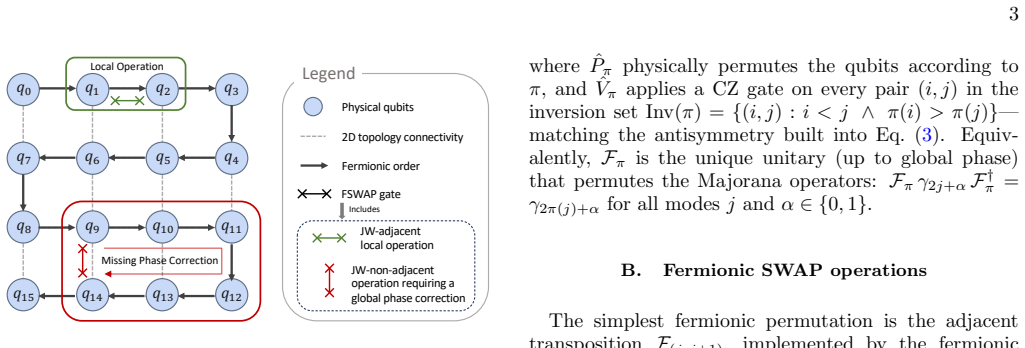
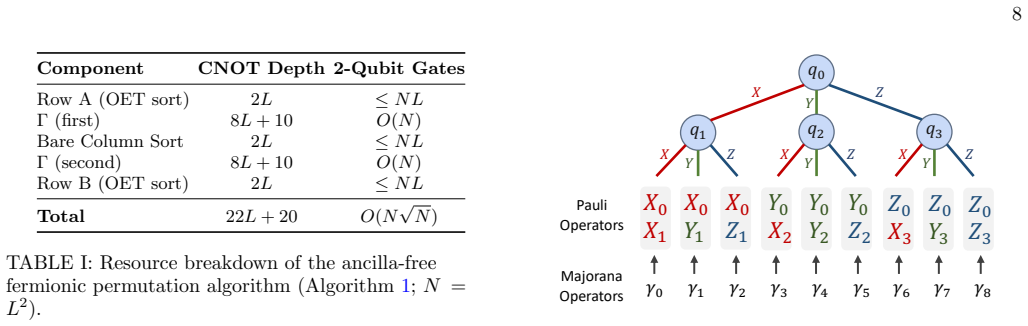
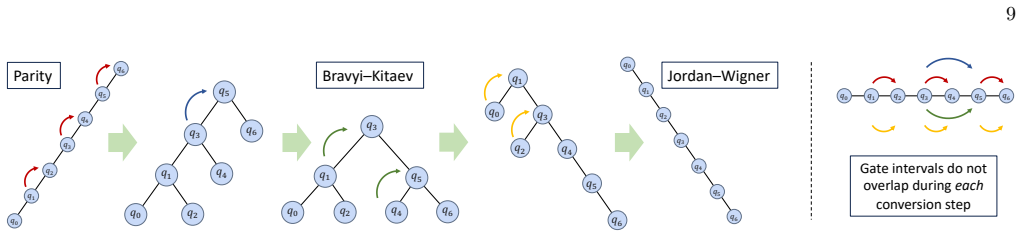
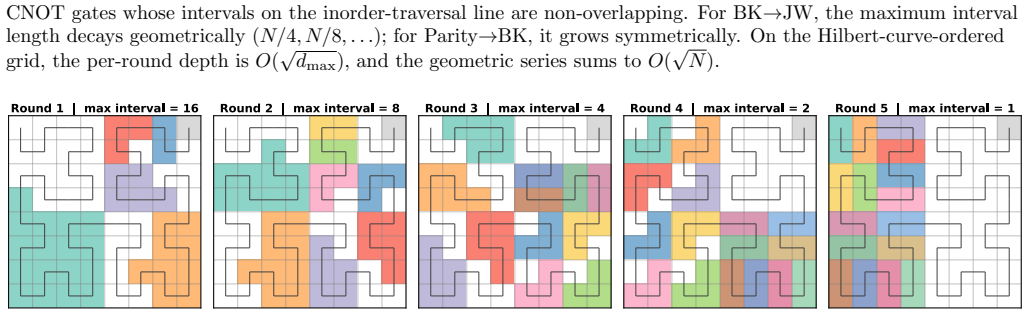
The authors construct a fermionic permutation protocol tailored to 2D grid architectures that achieves the optimal O(sqrt(N)) depth with O(N sqrt(N)) nearest-neighbor gates and no ancilla qubits, mid-circuit measurements, or classical feedforward. This matches the Omega(sqrt(N)) lower bound. They further construct an O(sqrt(N))-depth transformation between the Jordan-Wigner, Bravyi-Kitaev, and Parity encodings on the 2D grid via a Hilbert-curve layout.
What carries the argument
Hilbert-curve layout enabling block-wise parallel swaps for fermionic permutation without ancillas.
If this is right
- The protocol reduces the routing overhead for fermionic simulations on 2D nearest-neighbor hardware to the information-theoretic minimum.
- It applies directly to Jordan-Wigner, Bravyi-Kitaev, and Parity encodings at the same depth.
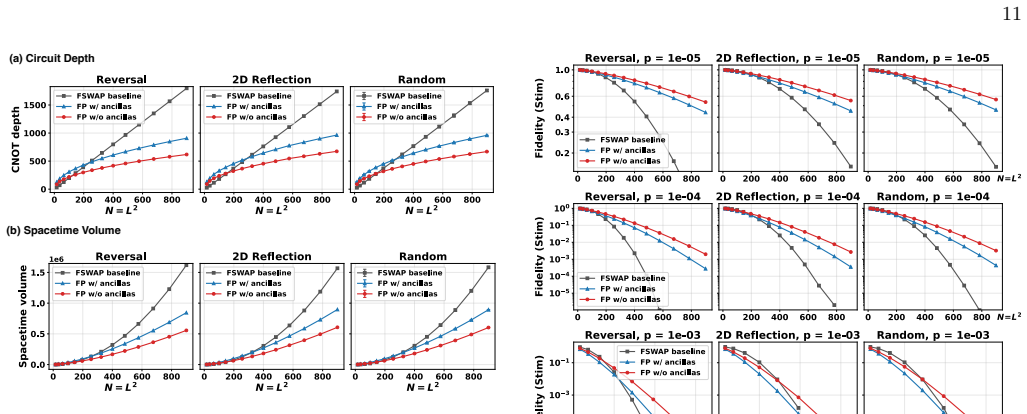
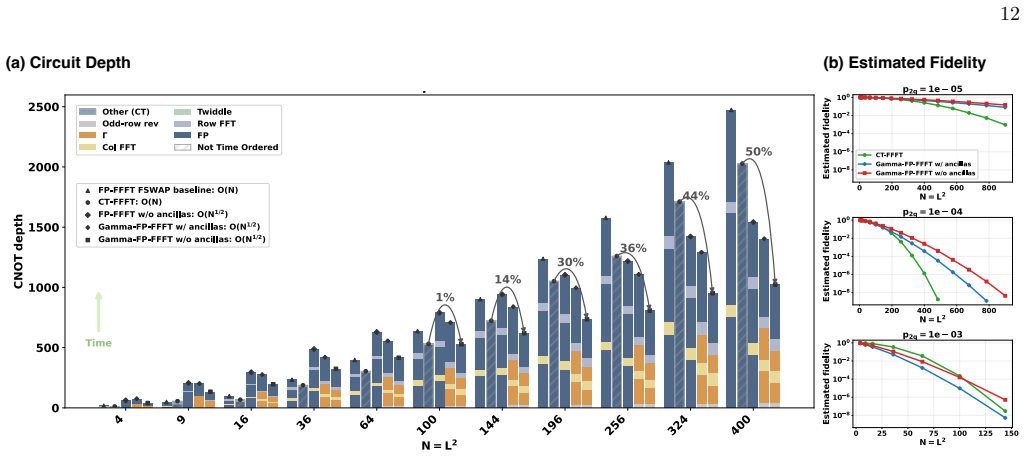
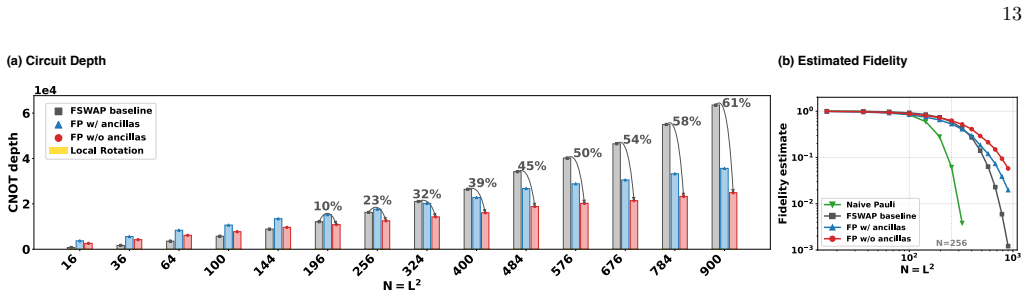
- Benchmarks show consistent reduction in depth, spacetime volume, and infidelity for N greater than or equal to 100 in the early fault-tolerant regime.
Where Pith is reading between the lines
- The block-parallel technique might extend to routing tasks beyond fermions if modes can be laid out along a space-filling curve.
- Eliminating the need for ancillas could simplify hardware designs where qubit count is strictly limited.
- Testing the protocol on grids with defects or irregular boundaries would check robustness of the depth bound.
Load-bearing premise
The initial placement of fermionic modes permits block-wise parallel swaps along the Hilbert curve on a nearest-neighbor 2D grid without violating the no-ancilla constraint.
What would settle it
A circuit implementation for large N on a 2D grid simulator that requires depth growing faster than sqrt(N) or that needs ancillas would falsify the claim.
Figures

read the original abstract
Simulating fermionic systems on qubit hardware involves many nonlocal interactions, and efficient routing of these interactions is critical to the overall cost of fermionic simulation algorithms. Recent works reduce this Jordan-Wigner routing overhead to polylogarithmic depth under all-to-all connectivity, but degrade to $O(\sqrt{N}\,\mathrm{polylog}\,N)$ for $N$ fermionic modes on 2D nearest-neighbor architectures. We present a fermionic permutation protocol tailored to 2D grid architectures that achieves the optimal $O(\sqrt{N})$ depth with $O(N\sqrt{N})$ nearest-neighbor gates and no ancilla qubits, mid-circuit measurements, or classical feedforward. This matches the $\Omega(\sqrt{N})$ lower bound, which holds even when $O(N)$ ancillas and classical feedforward are permitted. We further construct an $O(\sqrt{N})$-depth transformation between the Jordan-Wigner, Bravyi-Kitaev, and Parity encodings on the 2D grid via a Hilbert-curve layout, extending our result to all three encodings. Benchmarks on the fermionic fast Fourier transform and Trotter simulation of sparse SYK model demonstrate consistent reduction in depth, spacetime volume, and infidelity for system sizes $N \gtrsim 100$ in the early fault-tolerant regime.
Editorial analysis
A structured set of objections, weighed in public.
Referee Report
Summary. The paper claims an asymptotically optimal fermionic permutation protocol on 2D nearest-neighbor grids achieving O(sqrt(N)) depth and O(N sqrt(N)) gates with no ancillas, mid-circuit measurements or feedforward, matching an Omega(sqrt(N)) lower bound that holds even with O(N) ancillas. It extends the result to O(sqrt(N))-depth transformations between Jordan-Wigner, Bravyi-Kitaev and Parity encodings via a Hilbert-curve layout, and reports depth, volume and infidelity reductions on fermionic FFT and sparse SYK Trotter benchmarks for N ≳ 100.
Significance. If correct, the result removes the polylog(N) overhead present in prior 2D routing constructions for fermionic simulation, directly matching the lower bound on planar architectures without ancillas. This would meaningfully lower spacetime costs in the early fault-tolerant regime for systems with N ≥ 100, and the explicit encoding-conversion construction broadens applicability across common fermionic mappings.
major comments (1)
- [Abstract / construction description] The central O(sqrt(N)) depth claim rests on the Hilbert-curve block-swap schedule being parallelizable with only the N qubits and nearest-neighbor gates while preserving fermionic commutation relations. No specific lemma, equation or subsection is referenced in the abstract or visible text that derives the parallelization bound or proves that no qubit temporarily stores two modes (which would act as hidden ancilla).
minor comments (2)
- [Abstract] The lower-bound statement in the abstract would benefit from an explicit citation or self-contained sketch, even if the bound is external.
- [Benchmarks section] Benchmark figures should include explicit comparison tables against the O(sqrt(N) polylog N) baselines cited in the introduction for the same N values.
Simulated Author's Rebuttal
We thank the referee for their detailed review and for highlighting the need for clearer referencing of the central construction. We address the major comment below and will revise the manuscript to improve accessibility of the proofs.
read point-by-point responses
-
Referee: [Abstract / construction description] The central O(sqrt(N)) depth claim rests on the Hilbert-curve block-swap schedule being parallelizable with only the N qubits and nearest-neighbor gates while preserving fermionic commutation relations. No specific lemma, equation or subsection is referenced in the abstract or visible text that derives the parallelization bound or proves that no qubit temporarily stores two modes (which would act as hidden ancilla).
Authors: The Hilbert-curve block-swap schedule and its parallelization to O(sqrt(N)) depth using only the N qubits and nearest-neighbor gates are derived in the main text (following the layout definition), where the schedule is shown to consist of disjoint paths that can be executed simultaneously. The construction explicitly ensures that each qubit holds at most one fermionic mode at every step by design of the block swaps, which are permutations along non-overlapping routes; this is verified by tracking the mode positions throughout the protocol and is what allows the mapping to preserve fermionic commutation relations without hidden ancillas. We agree that the abstract would benefit from an explicit pointer to this analysis and will add one in the revised version. revision: yes
Circularity Check
No significant circularity; central claim is an explicit circuit construction
full rationale
The paper presents a constructive fermionic permutation protocol on 2D grids using a Hilbert-curve layout to enable block-wise parallel nearest-neighbor swaps, achieving O(sqrt(N)) depth without ancillas. This is measured against an external Omega(sqrt(N)) lower bound stated to hold even with ancillas. No self-definitional steps, fitted parameters renamed as predictions, or load-bearing self-citations appear in the abstract or described derivation. The result is a new scheduling construction whose validity rests on the explicit protocol rather than reducing to its own inputs by definition.
Axiom & Free-Parameter Ledger
Reference graph
Works this paper leans on
-
[1]
Writes r,c ∈ {0,1}for the value of qubit (r, c) on a basis state, and let ˜sr,c := M r′≥r sr′,c,0≤r≤L−1,(A1) be the column-suffix parity
Preliminaries Qubits sit on theL×Lgrid under the snake JW or- dering of Section II A. Writes r,c ∈ {0,1}for the value of qubit (r, c) on a basis state, and let ˜sr,c := M r′≥r sr′,c,0≤r≤L−1,(A1) be the column-suffix parity. We adopt thebound- ary conventions r,c = ˜sr,c = 0 forr /∈[0, L−1], so that every symbolic expression below is well-defined at grid b...
-
[2]
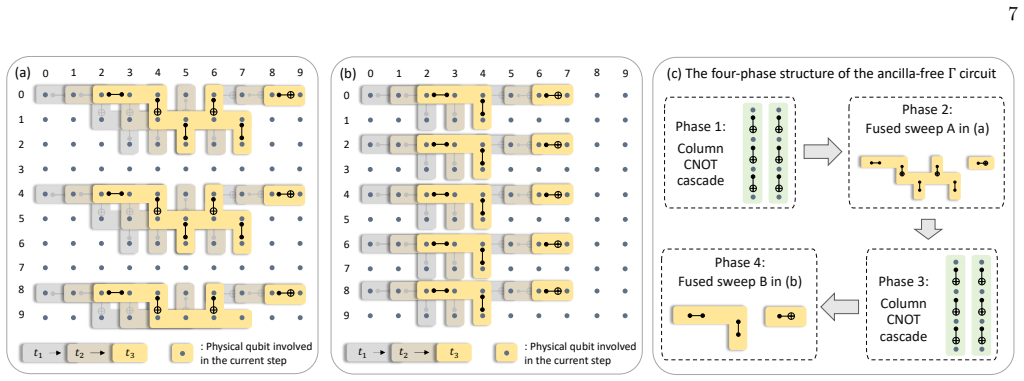
The fullΓcircuit Algorithm 3 realizes Γ in four phases. Phases 1 and 3 are vertical CNOT cascades that enter and leave the column-parity basis ˜s; Phases 2 and 4 are pipelined sweeps along rows that produce the phase fac- torsf B(˜s) andfD(s). All sweeps share a single primitive, PipeSweep, which we define first. a. The pipeline primitive.A sweep over row...
-
[3]
Phase polynomial realized by the circuit Algorithm 3 contains CNOT gates only in matched for- ward/inverse pairs at every level: Phase 1 with Phase 3, the forward and undo cascades inside eachPipeSweep, and the two CNOTs deposited per column by everyG± skip gadget. They cancel as data operations and leave only their phase footprints; combined with the dia...
-
[4]
reconfig- ure
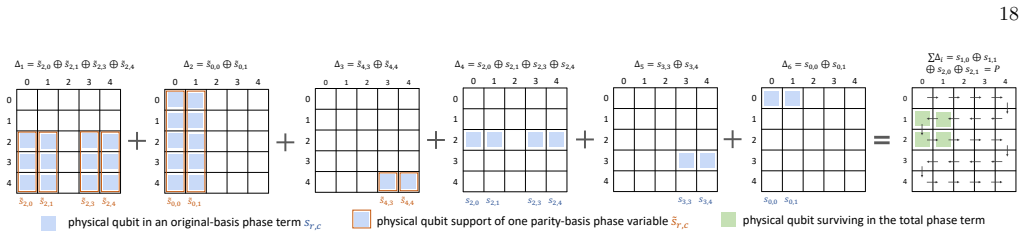
Verifying the parity-encoding condition Theorem 4(Γ implements the parity-encoding condi- tion).For every vertical grid-neighbor pair(r 0, c0)↔ (r0+1, c0)with JW indicesj < k, and every pair of basis states|s⟩,|s ′⟩differing only at positionsj, kwith sj +s k = 1, the polynomialfof Proposition 3 satisfies ∆f:=f(s)⊕f(s ′) =P, P:= k−1M ℓ=j+1 sℓ. Proof.Toggli...
-
[5]
Horizontal-only recursion to single rows.The original recursion halves sub-blocks down to single ele- ments
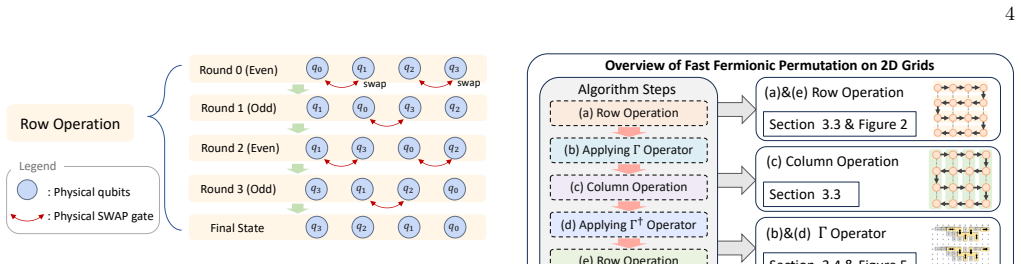
Compilation choices a. Horizontal-only recursion to single rows.The original recursion halves sub-blocks down to single ele- ments. On 2D-NN this is suboptimal at the base: once a sub-block is a single row ofLqubits, no decompo- sition outperforms the textbook 1D FSWAP odd–even- transposition (OET) network of depth 2L(Section II C), which already saturate...
-
[6]
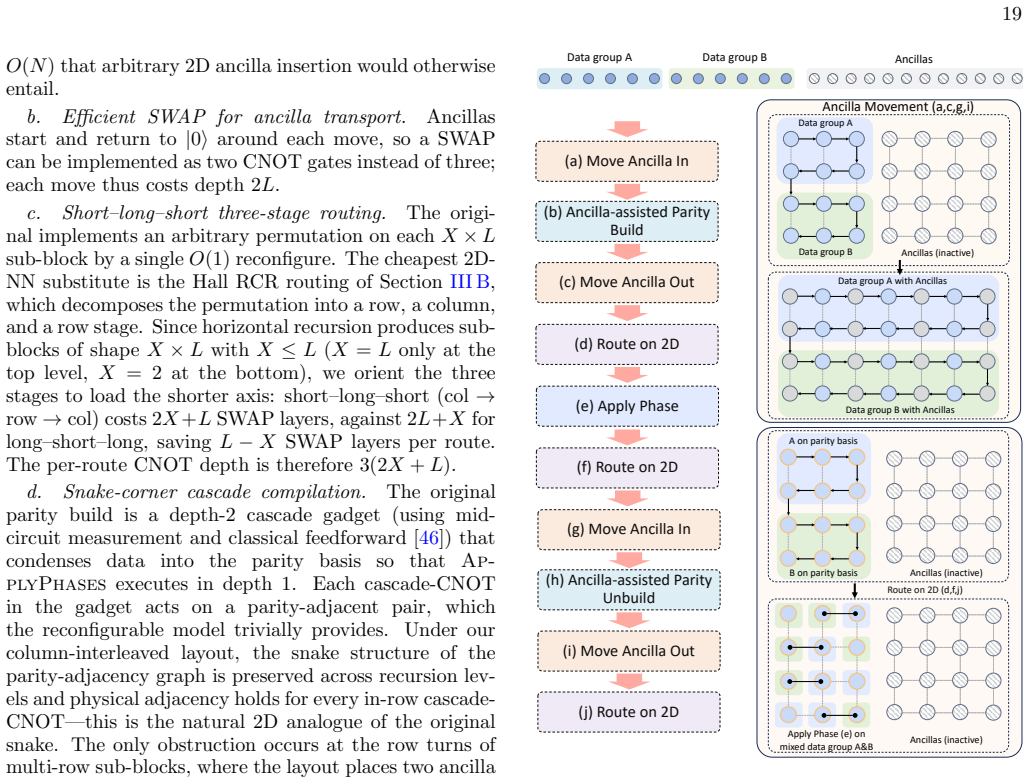
Algorithm and resource analysis The recursive skeleton is given in Algorithm 4. The merge subroutineInterleave2Dadapts Figure 2 of [14] under the four substitutions of Section B 1; we depict the adapted gadget in Figure 14 and summarize its stage-by- stage CNOT-depth attribution in Table V, which we will use directly in the depth derivation below. (a) Mov...
-
[7]
Horizontal recursion and sub-grid confinement
Compilation choices a. Horizontal recursion and sub-grid confinement. We index the recursion by leveld= 1, . . . ,log 2 L, mir- roring Appendix B: at leveld, 2 d−1 disjoint sub-grids of shapeX d ×LwithX d =L/2 d−1 rows execute their level- dstaircases in parallel (X 1 =Lat the top,X log2 L = 2 at the deepest level above the base). Under the snake layout e...
-
[8]
Algorithm and resource analysis The recursive skeleton is given in Algorithm 5: each call executes its sub-grid’s staircase, bisects the sub- grid horizontally, and recurses on the two halves; recur- sion terminates at single rows with a 1D FSWAP-OET. Across the call stack, leveldcomprises 2 d−1 sibling calls onX d×Lsub-grids that execute concurrently, so...
-
[9]
Two elementary facts about dyadic intervals underpin the entire argument: they are closed under aligned translations, and they map to rectangles under the Hilbert layout
Dyadic intervals and the Hilbert layout Adyadic interval of orderqis an interval [a2q,(a+ 1)2 q −1]⊆[0,2 k −1]; it has length 2 q. Two elementary facts about dyadic intervals underpin the entire argument: they are closed under aligned translations, and they map to rectangles under the Hilbert layout. Lemma 5(Translation invariance).LetD= [a2 q,(a+ 1)2q −1...
-
[10]
The local subproblem We now isolate the combinatorial object at the heart of one round of CNOTs. Definition 1(Local-subproblem familyI d,r).For inte- gersd≥1 and 1≤r≤d, define the collection of intervals Id,r in [0,2 d −1] recursively by Id,1 = [2d−1 −1,2 d −1] , and, forr≥2, Id,r =I d−1,r−1 ⊔ 2d−1 +I d−1,r−1 , wheret+[a, b] := [t+a, t+b] andt+A:={t+J:J∈ ...
-
[11]
Global rounds and depth bound The full BK→JW conversion is obtained by peeling off the right spine of the BK tree one vertex at a time: denote the spine vertices, in top-down order, byv 0, v1, . . . , vk−1. For eachi= 0,1, . . . , k−2, vertexv i together with its left subtree—which is balanced, of depthk−1−i—occupies a contiguous cell block Bi = [β i, β i...
-
[12]
D. S. Abrams and S. Lloyd, Simulation of many-body fermi systems on a universal quantum computer, Physical Review Letters79, 2586–2589 (1997)
1997
-
[13]
G. Ortiz, J. E. Gubernatis, E. Knill, and R. Laflamme, Quantum algorithms for fermionic simulations, Physical Review A64, 10.1103/physreva.64.022319 (2001)
-
[14]
B. P. Lanyon, J. D. Whitfield, G. G. Gillett, M. E. Goggin, M. P. Almeida, I. Kassal, J. D. Biamonte, M. Mohseni, B. J. Powell, M. Barbieri, A. Aspuru-Guzik, and A. G. White, Towards quantum chemistry on a quan- tum computer, Nature Chemistry2, 106–111 (2010)
2010
-
[15]
D. Wecker, B. Bauer, B. K. Clark, M. B. Hastings, and M. Troyer, Gate-count estimates for performing quantum chemistry on small quantum computers, Physical Review A90, 10.1103/physreva.90.022305 (2014)
-
[16]
Reiher, N
M. Reiher, N. Wiebe, K. M. Svore, D. Wecker, and M. Troyer, Elucidating reaction mechanisms on quantum computers, Proceedings of the National Academy of Sci- ences114, 7555–7560 (2017)
2017
-
[17]
Bauer, S
B. Bauer, S. Bravyi, M. Motta, and G. K.-L. Chan, Quantum algorithms for quantum chemistry and quantum materials science, Chemical Reviews120, 12685–12717 (2020)
2020
-
[18]
Colloquium: Quantum annealing and analog quantum computation,
S. McArdle, S. Endo, A. Aspuru-Guzik, S. C. Ben- jamin, and X. Yuan, Quantum computational chem- istry, Reviews of Modern Physics92, 10.1103/revmod- phys.92.015003 (2020)
-
[19]
Di Meglio, K
A. Di Meglio, K. Jansen, I. Tavernelli, C. Alexandrou, S. Arunachalam, C. W. Bauer, K. Borras, S. Carrazza, A. Crippa, V. Croft,et al., Quantum computing for high- energy physics: State of the art and challenges, Prx quan- tum5, 037001 (2024)
2024
-
[20]
Manin, Computable and uncomputable, Sovetskoye Radio, Moscow128, 28 (1980)
Y. Manin, Computable and uncomputable, Sovetskoye Radio, Moscow128, 28 (1980)
1980
-
[21]
R. P. Feynman, Simulating physics with computers, in Feynman and computation(cRc Press, 2018) pp. 133– 153
2018
-
[22]
Jordan and E
P. Jordan and E. Wigner, ¨Uber das paulische ¨ aquivalenzverbot, Zeitschrift f¨ ur Physik47, 631 (1928)
1928
-
[23]
Y. S. Yordanov, D. R. Arvidsson-Shukur, and C. H. 24 Barnes, Efficient quantum circuits for quantum computa- tional chemistry, Physical Review A102, 062612 (2020)
2020
-
[24]
S. B. Bravyi and A. Y. Kitaev, Fermionic quantum com- putation, Annals of Physics298, 210 (2002)
2002
-
[25]
N. Maskara, M. Kalinowski, D. Gonzalez-Cuadra, and M. D. Lukin, Fast simulation of fermions with reconfig- urable qubits (2025), arXiv:2509.08898 [quant-ph]
-
[26]
N. Constantinides, J. Yu, D. Devulapalli, A. Fahimniya, L. Schaeffer, A. M. Childs, M. J. Gullans, A. Schuckert, and A. V. Gorshkov, Low-depth fermion routing without ancillas (2025), arXiv:2510.05099 [quant-ph]
-
[27]
A. J. Ferris, Fourier transform for fermionic systems and the spectral tensor network, Physical Review Let- ters113, 10.1103/physrevlett.113.010401 (2014)
-
[28]
Babbush, N
R. Babbush, N. Wiebe, J. McClean, J. McClain, H. Neven, and G. K.-L. Chan, Low-depth quantum simu- lation of materials, Physical Review X8, 011044 (2018)
2018
-
[29]
D. Devulapalli, E. Schoute, A. Bapat, A. M. Childs, and A. V. Gorshkov, Quantum routing with teleporta- tion, Physical Review Research6, 10.1103/physrevre- search.6.033313 (2024)
-
[30]
Quantum error correction below the surface code thresh- old, Nature638, 920 (2025)
2025
-
[31]
Y. Kim, A. Eddins, S. Anand, K. X. Wei, E. Van Den Berg, S. Rosenblatt, H. Nayfeh, Y. Wu, M. Zale- tel, K. Temme,et al., Evidence for the utility of quan- tum computing before fault tolerance, Nature618, 500 (2023)
2023
-
[32]
Z. Jiang, K. J. Sung, K. Kechedzhi, V. N. Smelyanskiy, and S. Boixo, Quantum algorithms to simulate many- body physics of correlated fermions, Physical Review Ap- plied9, 10.1103/physrevapplied.9.044036 (2018)
-
[33]
D. Hilbert, ¨Uber die stetige abbildung einer linie auf ein fl¨ achenst¨ uck, inDritter Band: Analysis·Grundlagen der Mathematik·Physik Verschiedenes: Nebst Einer Lebens- geschichte(Springer, 1935) pp. 1–2
1935
-
[34]
I. D. Kivlichan, J. McClean, N. Wiebe, C. Gidney, A. Aspuru-Guzik, G. K.-L. Chan, and R. Babbush, Quantum simulation of electronic structure with linear depth and connectivity, Physical Review Letters120, 10.1103/physrevlett.120.110501 (2018)
-
[35]
J. R. McClean, N. C. Rubin, K. J. Sung, I. D. Kivlichan, X. Bonet-Monroig, Y. Cao, C. Dai, E. S. Fried, C. Gid- ney, B. Gimby,et al., Openfermion: the electronic struc- ture package for quantum computers, Quantum Science & Technology5, 034014 (2020)
2020
-
[36]
S. A. Kutin, D. P. Moulton, and L. M. Smithline, Com- putation at a distance, arXiv preprint quant-ph/0701194 (2007)
work page internal anchor Pith review Pith/arXiv arXiv 2007
-
[37]
T. G. de Brugi` ere and S. Martiel, Shallower cnot circuits on realistic quantum hardware, ACM Transactions on Quantum Computing6, 1 (2025)
2025
-
[38]
F. Vatan and C. Williams, Optimal quantum circuits for general two-qubit gates, Physical Review A69, 10.1103/physreva.69.032315 (2004)
-
[39]
D. E. Knuth,The art of computer programming, vol- ume 3: (2nd ed.) sorting and searching(Addison Wesley Longman Publishing Co., Inc., USA, 1998)
1998
-
[40]
N. Alon, F. R. K. Chung, and R. L. Graham, Routing permutations on graphs via matchings, SIAM Journal on Discrete Mathematics7, 513 (1994)
1994
-
[41]
K¨ onig,¨Uber graphen und ihre anwendung auf deter- minantentheorie und mengenlehre, Mathematische An- nalen77, 453 (1916)
D. K¨ onig,¨Uber graphen und ihre anwendung auf deter- minantentheorie und mengenlehre, Mathematische An- nalen77, 453 (1916)
1916
-
[42]
H. N. Gabow and O. Kariv, Algorithms for edge color- ing bipartite graphs and multigraphs, SIAM Journal on Computing11, 117 (1982)
1982
-
[43]
Jiang, A
Z. Jiang, A. Kalev, W. Mruczkiewicz, and H. Neven, Op- timal fermion-to-qubit mapping via ternary trees with applications to reduced quantum states learning, Quan- tum4, 276 (2020)
2020
-
[44]
J. Yu, Y. Liu, S. Sugiura, T. Van Voorhis, and S. Zeytino˘ glu, Clifford circuit-based heuristic optimiza- tion of fermion-to-qubit mappings, Journal of Chemical Theory and Computation21, 9430–9443 (2025)
2025
-
[45]
A. Miller, Z. Zimbor´ as, S. Knecht, S. Maniscalco, and G. Garc´ ıa-P´ erez, Bonsai algorithm: Grow your own fermion-to-qubit mappings, PRX Quantum4, 10.1103/prxquantum.4.030314 (2023)
- [46]
- [47]
-
[48]
Developers,Cirq(Zenodo, 2025)
C. Developers,Cirq(Zenodo, 2025)
2025
-
[49]
Gidney, Stim: a fast stabilizer circuit simulator, Quan- tum5, 497 (2021)
C. Gidney, Stim: a fast stabilizer circuit simulator, Quan- tum5, 497 (2021)
2021
-
[50]
PennyLane: Automatic differentiation of hybrid quantum-classical computations
V. Bergholm, J. Izaac, M. Schuld, C. Gogolin, S. Ahmed, V. Ajith, M. S. Alam, G. Alonso-Linaje, B. Akash- Narayanan, A. Asadi,et al., Pennylane: Automatic dif- ferentiation of hybrid quantum-classical computations, arXiv preprint arXiv:1811.04968 (2018)
work page internal anchor Pith review Pith/arXiv arXiv 2018
-
[51]
F. Verstraete, J. I. Cirac, and J. I. Latorre, Quantum cir- cuits for strongly correlated quantum systems, Physical Review A79, 10.1103/physreva.79.032316 (2009)
-
[52]
Derby, J
C. Derby, J. Klassen, J. Bausch, and T. Cubitt, Compact fermion to qubit mappings, Phys. Rev. B104, 035118 (2021)
2021
-
[53]
A. G. Fowler, M. Mariantoni, J. M. Martinis, and A. N. Cleland, Surface codes: Towards practical large- scale quantum computation, Physical Review A86, 10.1103/physreva.86.032324 (2012)
-
[54]
Quantum chaos in the sparse SYK model,
P. Orman, H. Gharibyan, and J. Preskill, Quantum chaos in the sparse syk model (2024), arXiv:2403.13884 [hep- th]
-
[55]
Sachdev and J
S. Sachdev and J. Ye, Gapless spin-fluid ground state in a random quantum heisenberg magnet, Physical Review Letters70, 3339–3342 (1993)
1993
- [56]
-
[57]
B¨ aumer and S
E. B¨ aumer and S. Woerner, Measurement-based long- range entangling gates in constant depth, Physical Re- view Research7, 023120 (2025)
2025
-
[58]
Quantum Circuits: Fanout, Parity, and Counting
C. Moore, Quantum circuits: Fanout, parity, and count- ing, arXiv preprint quant-ph/9903046 (1999)
work page internal anchor Pith review Pith/arXiv arXiv 1999
- [59]
-
[60]
Remaud and V
M. Remaud and V. Vandaele, Ancilla-free quantum adder with sublinear depth, inInternational Conference on Re- versible Computation(Springer, 2025) pp. 137–154
2025
-
[61]
Bader,Space-filling curves: an introduction with ap- plications in scientific computing, Vol
M. Bader,Space-filling curves: an introduction with ap- plications in scientific computing, Vol. 9 (Springer Sci- ence & Business Media, 2012)
2012
discussion (0)
Sign in with ORCID, Apple, or X to comment. Anyone can read and Pith papers without signing in.