Early- and Late-Time Modifications to ΛCDM: Implications for the Hubble Tension
Pith reviewed 2026-06-29 20:26 UTC · model grok-4.3
The pith
Correlated early- and late-time modifications reduce the Hubble tension more effectively than either alone.
A machine-rendered reading of the paper's core claim, the machinery that carries it, and where it could break.
Core claim
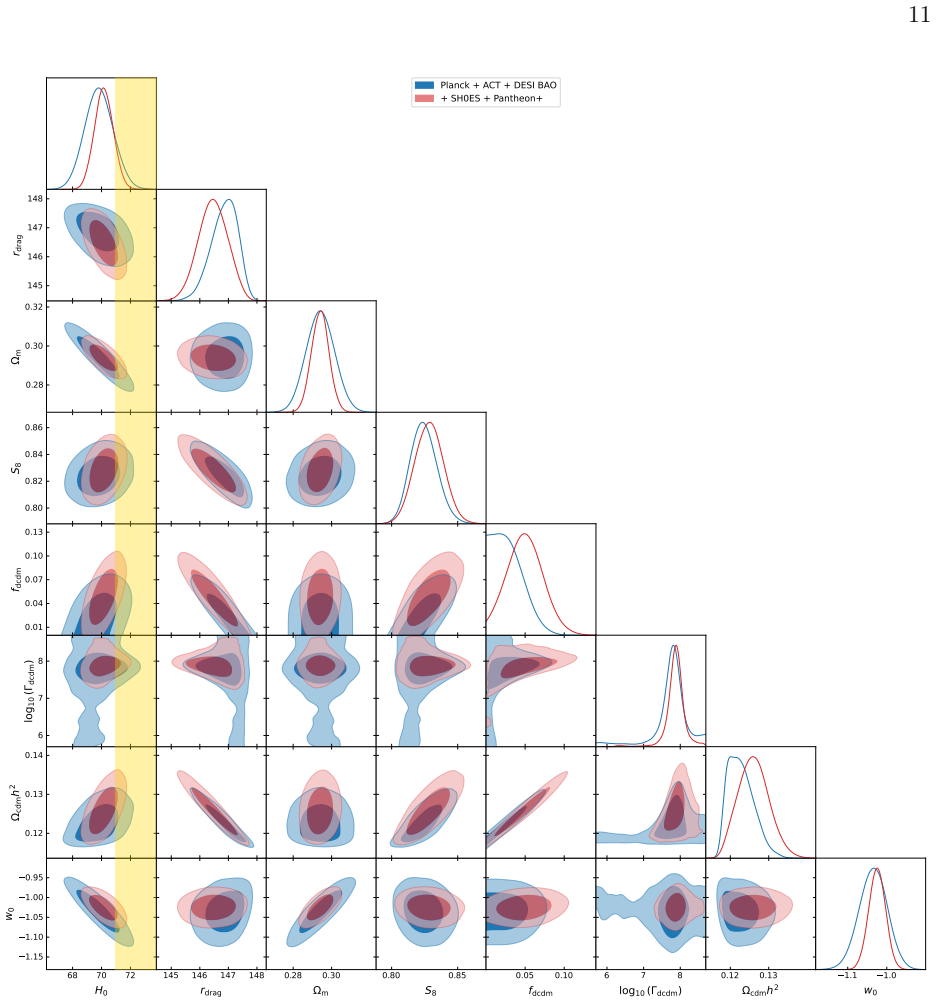
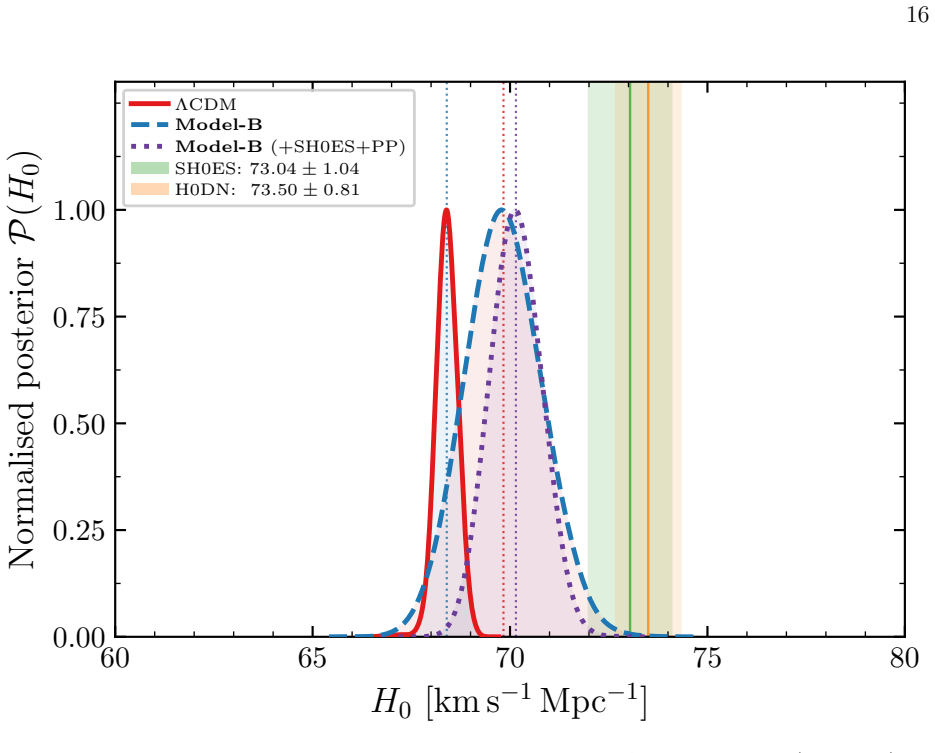
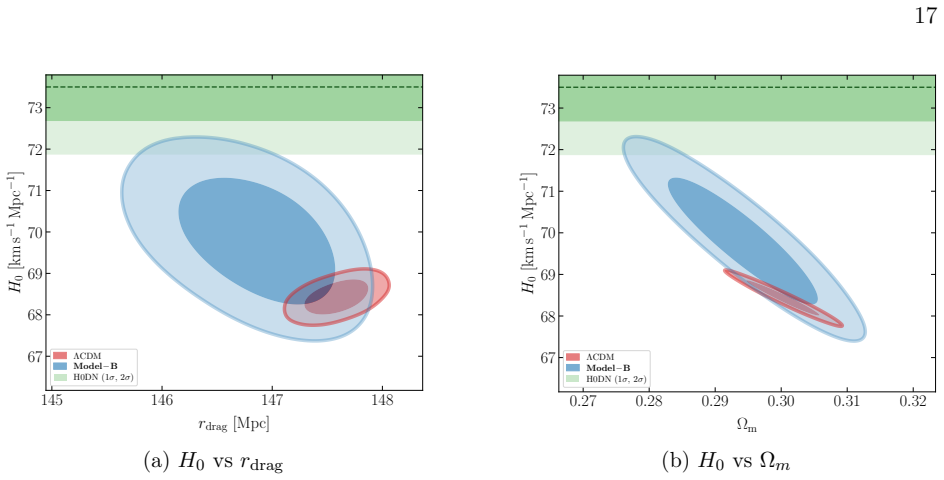
We investigate an extension of Lambda CDM in which a fraction of cold Dark Matter (DM) decays into invisible dark radiation (DR) around the radiation-matter equality epoch, together with a non-standard dark energy (DE) equation of state characterized by w0. The decaying DM component modifies the early expansion history and reduces the sound horizon at baryon drag, while the DE alters the expansion rate at the late times. A comprehensive analysis combining Planck 2018+ACT DR6+DESI DR2+CMB lensing datasets has been carried out to explore the viability of this framework in addressing the H0 tension. This model yields a Hubble constant of H0 = 69.83 ± 0.98 km s^{-1} Mpc^{-1}, reducing the discre
What carries the argument
The joint early-time decaying cold dark matter to dark radiation near radiation-matter equality plus late-time dark energy equation of state w0, which together adjust the full expansion history.
If this is right
- The model returns H0 = 69.83 ± 0.98 km/s/Mpc from Planck+ACT+DESI+CMB lensing data, lowering tension with SH0ES to ~2.2 sigma.
- Including SH0ES and Pantheon+ data shifts the inferred H0 to 70.20 ± 0.66 km/s/Mpc.
- Bayesian evidence indicates the extended model fits the datasets at a level statistically similar to Lambda CDM.
- Combined early and late modifications ease the tension more than isolated early-only or late-only changes.
Where Pith is reading between the lines
- Future precision measurements of the early expansion rate could test whether the predicted sound-horizon reduction is present.
- The result suggests that resolving the Hubble tension may require coordinated adjustments across both early and late cosmic epochs rather than isolated fixes.
- Analogous paired modifications could be examined for consistency with other large-scale structure observables.
Load-bearing premise
The assumption that a fraction of cold dark matter decays into invisible dark radiation specifically around the radiation-matter equality epoch without introducing unmodeled effects on other observables.
What would settle it
A direct measurement of the sound horizon at baryon drag that shows no reduction relative to the standard Lambda CDM prediction would falsify the early-time decaying dark matter component.
Figures
read the original abstract
We investigate an extension of $\Lambda$CDM in which a fraction of cold Dark Matter (DM) decays into invisible dark radiation (DR) around the radiation-matter equality epoch, together with a non-standard dark energy (DE) equation of state characterized by $w_0$. The decaying DM component modifies the early expansion history and reduces the sound horizon at baryon drag, while the DE alters the expansion rate at the late times. A comprehensive analysis combining \texttt{Planck 2018+ACT DR6+DESI DR2+CMB lensing} datasets has been carried out to explore the viability of this framework in addressing the $H_0$ tension. This model yields a Hubble constant of $H_0 = 69.83 \pm 0.98~\mathrm{km\,s^{-1}\,Mpc^{-1}}$, reducing the discrepancy with SH0ES measurement to ${\sim}2.2\sigma$ and local distance network measurement (H0DN) to ${\sim}2.9\sigma$. Further, considering \texttt{SH0ES} and \texttt{Pantheon+}, the inferred value of the Hubble constant becomes $H_0 = 70.20 \pm 0.66~\mathrm{km\,s^{-1}\,Mpc^{-1}}$. The Bayesian evidence suggests that this framework offers a fit to the relevant cosmological datasets at a statistically similar level as $\Lambda$CDM. It is observed that correlated early- and late-time modifications to the cosmological expansion history provide a more effective route to reducing the $H_0$ tension than either class of modification alone.
Editorial analysis
A structured set of objections, weighed in public.
Referee Report
Summary. The manuscript proposes an extension to ΛCDM in which a fraction of cold dark matter decays into invisible dark radiation near the radiation-matter equality epoch (to reduce the sound horizon) together with a constant dark-energy equation-of-state parameter w0. Using the combination Planck 2018 + ACT DR6 + DESI DR2 + CMB lensing, the model yields H0 = 69.83 ± 0.98 km s^{-1} Mpc^{-1}, lowering the tension with SH0ES to ~2.2σ (and with H0DN to ~2.9σ); adding SH0ES + Pantheon+ shifts the value to 70.20 ± 0.66 km s^{-1} Mpc^{-1}. Bayesian evidence is reported to be statistically comparable to that of ΛCDM, and the authors conclude that correlated early- plus late-time modifications resolve the tension more effectively than either class alone.
Significance. If the analysis pipeline is shown to be robust, the work supplies a concrete phenomenological example in which early-time (sound-horizon) and late-time (expansion-rate) adjustments act synergistically on the Hubble tension while preserving a fit quality comparable to ΛCDM. The explicit use of multiple independent datasets and a Bayesian-evidence comparison are positive features that allow quantitative assessment of the claimed improvement.
major comments (3)
- [§3] §3 (Model description): the decay is stated to occur “around the radiation-matter equality epoch” and is chosen specifically to shrink rs; the manuscript provides no demonstration that this timing choice is independent of the H0 data sets, so the reported tension reduction is obtained by construction rather than as an a-priori prediction.
- [Methods / Results] Methods / Results section (prior to Table 1): no priors on the decay fraction f_dec or on w0 are stated, nor are Gelman-Rubin statistics or effective sample sizes reported; without these the quoted H0 posterior and the Bayesian-evidence comparison cannot be reproduced or validated.
- [§4.3] §4.3 and associated tables: the claim that “correlated early- and late-time modifications … provide a more effective route … than either class of modification alone” is asserted but is not supported by a side-by-side comparison of the combined model against the two single-modification baselines (decaying DM only; w0 only) on the same data combination; the synergy advantage therefore remains unquantified.
minor comments (2)
- [Abstract / §4.1] The abstract and §4.1 refer to “invisible dark radiation” without specifying whether the injected DR contributes to N_eff or to the damping tail; a one-sentence clarification would remove ambiguity.
- [Figures] Figure captions and axis labels should explicitly state the data combination used for each posterior (e.g., “Planck+ACT+DESI+CMB lensing only”).
Simulated Author's Rebuttal
We thank the referee for the constructive feedback. We address each major comment below and indicate the revisions that will be made to strengthen the manuscript.
read point-by-point responses
-
Referee: [§3] §3 (Model description): the decay is stated to occur “around the radiation-matter equality epoch” and is chosen specifically to shrink rs; the manuscript provides no demonstration that this timing choice is independent of the H0 data sets, so the reported tension reduction is obtained by construction rather than as an a-priori prediction.
Authors: The decay epoch is fixed a priori at radiation-matter equality because this is the epoch where modifications to H(z) have the largest leverage on the sound horizon integral; this choice follows from standard early-universe physics and is not tuned to any H0 dataset. Nevertheless, we acknowledge that an explicit demonstration of independence would improve clarity. In revision we will add a short discussion (and, if space permits, a supplementary figure) showing the rs shift for the chosen timing when only early-time data are used, confirming that the timing selection precedes the inclusion of late-time or H0 measurements. revision: partial
-
Referee: [Methods / Results] Methods / Results section (prior to Table 1): no priors on the decay fraction f_dec or on w0 are stated, nor are Gelman-Rubin statistics or effective sample sizes reported; without these the quoted H0 posterior and the Bayesian-evidence comparison cannot be reproduced or validated.
Authors: We agree that these details are necessary for reproducibility. In the revised manuscript we will explicitly state the priors adopted for f_dec (flat prior over [0, 0.2]) and w0 (flat prior over [-1.5, -0.5]) and report the Gelman-Rubin convergence criterion (R-1 < 0.01) together with the effective sample sizes for all chains. These additions will be placed in the Methods section immediately before Table 1. revision: yes
-
Referee: [§4.3] §4.3 and associated tables: the claim that “correlated early- and late-time modifications … provide a more effective route … than either class of modification alone” is asserted but is not supported by a side-by-side comparison of the combined model against the two single-modification baselines (decaying DM only; w0 only) on the same data combination; the synergy advantage therefore remains unquantified.
Authors: We accept that a quantitative side-by-side comparison is required to substantiate the synergy claim. In the revised version we will add a dedicated table (or extended Table 1) that reports H0, tension metrics, and Bayesian evidence for the full model, the decaying-DM-only model, and the w0-only model, all run on the identical Planck+ACT+DESI+CMB-lensing combination. This will allow direct assessment of the improvement obtained by the combined modifications. revision: yes
Circularity Check
No significant circularity; standard phenomenological fit and comparison
full rationale
The paper defines a two-parameter extension (DM decay fraction and epoch near equality plus w0) to modify rs and late-time expansion, then reports the outcome of a joint MCMC fit to Planck+ACT+DESI+CMB-lensing (and optionally SH0ES+Pantheon+). The quoted H0 values and the statement that combined modifications reduce tension more than either alone are direct numerical results of those fits and model-to-model comparisons; they do not reduce to the model definition by algebraic identity or by a self-citation chain. No equations are presented that equate a derived quantity to a fitted input by construction, and the central claim remains an empirical statement about posterior tension metrics rather than a tautology.
Axiom & Free-Parameter Ledger
free parameters (2)
- decay fraction
- w0
axioms (2)
- standard math Background evolution follows FLRW metric with standard general relativity
- ad hoc to paper Decay occurs around radiation-matter equality epoch
invented entities (2)
-
decaying cold dark matter component
no independent evidence
-
invisible dark radiation from decay
no independent evidence
Reference graph
Works this paper leans on
-
[1]
Planck Collaboration, Planck 2018 results. vi. cosmological parameters, Astron. Astrophys. 641, A6 (2020)
2018
-
[2]
E. Calabreseet al.(Atacama Cosmology Telescope), The Atacama Cosmology Telescope: DR6 constraints on extended cosmological models, JCAP (11), 063, arXiv:2503.14454 [astro- ph.CO]
-
[3]
M. Betouleet al.(SDSS), Improved Cosmological Constraints from a Joint Analysis of the SDSS-II and SNLS Supernova Samples, Astron. Astrophys.568, A22 (2014), arXiv:1401.4064 [astro-ph.CO]
Pith/arXiv arXiv 2014
-
[4]
S. Alamet al.(eBOSS), Completed SDSS-IV extended Baryon Oscillation Spectroscopic Survey: Cosmological implications from two decades of spectroscopic surveys at the Apache Point Observatory, Phys. Rev. D103, 083533 (2021), arXiv:2007.08991 [astro-ph.CO]. 21
Pith/arXiv arXiv 2021
-
[5]
T. M. C. Abbottet al.(DES), The Dark Energy Survey: Cosmology Results with ∼1500 New High-redshift Type Ia Supernovae Using the Full 5 yr Data Set, Astrophys. J. Lett.973, L14 (2024), arXiv:2401.02929 [astro-ph.CO]
Pith/arXiv arXiv 2024
-
[6]
A. G. Adameet al.(DESI), DESI 2024 III: baryon acoustic oscillations from galaxies and quasars, JCAP (04), 012, arXiv:2404.03000 [astro-ph.CO]
Pith/arXiv arXiv 2024
-
[7]
DESI Collaboration, Desi 2024 vi: Cosmological constraints from the measurements of baryon acoustic oscillations, arXiv e-prints (2024), 2404.03002
Pith/arXiv arXiv 2024
-
[8]
Lodhaet al.(DESI), Extended dark energy analysis using DESI DR2 BAO measurements, Phys
K. Lodhaet al.(DESI), Extended dark energy analysis using DESI DR2 BAO measurements, Phys. Rev. D112, 083511 (2025), arXiv:2503.14743 [astro-ph.CO]
Pith/arXiv arXiv 2025
-
[9]
T. M. C. Abbottet al.(DES), Dark Energy Survey Year 6 Results: Cosmological Constraints from Galaxy Clustering and Weak Lensing (2026), arXiv:2601.14559 [astro-ph.CO]
arXiv 2026
-
[10]
A. G. Riesset al., A Comprehensive Measurement of the Local Value of the Hubble Constant with 1 km s −1 Mpc−1 Uncertainty from the Hubble Space Telescope and the SH0ES Team, Astrophys. J. Lett.934, L7 (2022), arXiv:2112.04510 [astro-ph.CO]
Pith/arXiv arXiv 2022
-
[11]
Di Valentinoet al., Cosmology Intertwined III: f σ8 and S8, Astropart
E. Di Valentinoet al., Cosmology Intertwined III: f σ8 and S8, Astropart. Phys.131, 102604 (2021), arXiv:2008.11285 [astro-ph.CO]
arXiv 2021
-
[12]
I. Pantos and L. Perivolaropoulos, Status of the S8 Tension: A 2026 Review of Probe Discrepancies (2026), arXiv:2602.12238 [astro-ph.CO]
arXiv 2026
- [13]
-
[14]
S. Casertanoet al.(H0DN), The Local Distance Network: a community consensus report on the measurement of the Hubble constant at 1% precision, - (2025), arXiv:2510.23823 [astro-ph.CO]
Pith/arXiv arXiv 2025
-
[15]
L. Verde, T. Treu, and A. G. Riess, Tensions between the Early and the Late Universe, Nature Astron.3, 891 (2019), arXiv:1907.10625 [astro-ph.CO]
Pith/arXiv arXiv 2019
-
[16]
E. Di Valentinoet al., Snowmass2021 - Letter of interest cosmology intertwined II: The hubble constant tension, Astropart. Phys.131, 102605 (2021), arXiv:2008.11284 [astro-ph.CO]
arXiv 2021
-
[17]
L. Perivolaropoulos and F. Skara, Challenges for ΛCDM: An update, New Astron. Rev.95, 101659 (2022), arXiv:2105.05208 [astro-ph.CO]
Pith/arXiv arXiv 2022
-
[18]
B. St¨ olzneret al., KiDS-Legacy: Consistency of cosmic shear measurements and joint cosmolog- ical constraints with external probes, Astron. Astrophys.702, A169 (2025), arXiv:2503.19442 22 [astro-ph.CO]
arXiv 2025
-
[19]
T. M. C. Abbottet al.(DES), Dark Energy Survey Year 6 Results: Cosmological Constraints from Cosmic Shear (2026), arXiv:2602.10065 [astro-ph.CO]
arXiv 2026
-
[21]
E. Camphuiset al.(SPT-3G), SPT-3G D1: CMB temperature and polarization power spectra and cosmology from 2019 and 2020 observations of the SPT-3G Main field, - (2025), arXiv:2506.20707 [astro-ph.CO]
Pith/arXiv arXiv 2019
-
[22]
E. Di Valentino, A. Melchiorri, and J. Silk, Reconciling Planck with the local value of H0 in extended parameter space, Phys. Lett. B761, 242 (2016), arXiv:1606.00634 [astro-ph.CO]
Pith/arXiv arXiv 2016
-
[23]
T. Karwal and M. Kamionkowski, Dark energy at early times, the Hubble parameter, and the string axiverse, Phys. Rev. D94, 103523 (2016), arXiv:1608.01309 [astro-ph.CO]
Pith/arXiv arXiv 2016
-
[24]
W. L. Freedman, Cosmology at a Crossroads, Nature Astron.1, 0121 (2017), arXiv:1706.02739 [astro-ph.CO]
Pith/arXiv arXiv 2017
-
[25]
S. M. Feeney, D. J. Mortlock, and N. Dalmasso, Clarifying the Hubble constant tension with a Bayesian hierarchical model of the local distance ladder, Mon. Not. Roy. Astron. Soc.476, 3861 (2018), arXiv:1707.00007 [astro-ph.CO]
Pith/arXiv arXiv 2018
-
[26]
E. Di Valentino, O. Mena, S. Pan, L. Visinelli, W. Yang, A. Melchiorri, D. F. Mota, A. G. Riess, and J. Silk, In the realm of the Hubble tension—a review of solutions, Class. Quant. Grav.38, 153001 (2021), arXiv:2103.01183 [astro-ph.CO]
Pith/arXiv arXiv 2021
-
[27]
A. Chatterjee, T. R. Choudhury, and S. Mitra, CosmoReionMC: a package for estimating cosmological and astrophysical parameters using CMB, Lyman-α absorption, and global 21 cm data, Mon. Not. Roy. Astron. Soc.507, 2405 (2021), arXiv:2101.11088 [astro-ph.CO]
arXiv 2021
-
[28]
I. J. Allali, P. Singh, J. Fan, and L. Li, Reionization and the Hubble constant: correlations in the Cosmic Microwave Background, JCAP (08), 082, arXiv:2503.05691 [astro-ph.CO]
-
[29]
J. B. Mu˜ noz, J. Mirocha, J. Chisholm, S. R. Furlanetto, and C. Mason, Reionization after JWST: a photon budget crisis?, Mon. Not. Roy. Astron. Soc.535, L37 (2024), arXiv:2404.07250 [astro-ph.CO]
arXiv 2024
-
[30]
M. Liu, Z. Huang, X. Luo, H. Miao, N. K. Singh, and L. Huang, Can Non-standard Recom- bination Resolve the Hubble Tension?, Sci. China Phys. Mech. Astron.63, 290405 (2020), 23 arXiv:1912.00190 [astro-ph.CO]
arXiv 2020
-
[31]
M. Rashkovetskyi, J. B. Mu˜ noz, D. J. Eisenstein, and C. Dvorkin, Small-scale clumping at recombination and the Hubble tension, Phys. Rev. D104, 103517 (2021), arXiv:2108.02747 [astro-ph.CO]
arXiv 2021
-
[32]
S. H. Mirpoorian, K. Jedamzik, and L. Pogosian, Modified recombination and the Hubble tension, Phys. Rev. D111, 083519 (2025), arXiv:2411.16678 [astro-ph.CO]
arXiv 2025
-
[33]
G. P. Lynch, L. Knox, and J. Chluba, DESI observations and the Hubble tension in light of modified recombination, Phys. Rev. D110, 083538 (2024), arXiv:2406.10202 [astro-ph.CO]
arXiv 2024
-
[34]
K. Jedamzik, L. Pogosian, and T. Abel, Hints of primordial magnetic fields at recombination and implications for the Hubble tension, Nature Astron.10, 317 (2026), arXiv:2503.09599 [astro-ph.CO]
arXiv 2026
-
[35]
L. Zhang, X. Chen, M. Kamionkowski, Z.-g. Si, and Z. Zheng, Constraints on radiative dark-matter decay from the cosmic microwave background, Phys. Rev. D76, 061301 (2007), arXiv:0704.2444 [astro-ph]
Pith/arXiv arXiv 2007
-
[36]
A. Chudaykin, D. Gorbunov, and I. Tkachev, Dark matter component decaying after recombination: Lensing constraints with Planck data, Phys. Rev. D94, 023528 (2016), arXiv:1602.08121 [astro-ph.CO]
Pith/arXiv arXiv 2016
-
[37]
E. Di Valentino, A. Melchiorri, E. V. Linder, and J. Silk, Constraining Dark Energy Dynamics in Extended Parameter Space, Phys. Rev. D96, 023523 (2017), arXiv:1704.00762 [astro- ph.CO]
Pith/arXiv arXiv 2017
-
[38]
S. D. Odintsov, D. S´ aez-Chill´ on G´ omez, and G. S. Sharov, Is exponential gravity a viable de- scription for the whole cosmological history?, Eur. Phys. J. C77, 862 (2017), arXiv:1709.06800 [gr-qc]
Pith/arXiv arXiv 2017
-
[39]
R. C. Nunes, Structure formation in f(T ) gravity and a solution for H0 tension, JCAP (05), 052, arXiv:1802.02281 [gr-qc]
-
[40]
E. M¨ ortsell and S. Dhawan, Does the Hubble constant tension call for new physics?, JCAP (09), 025, arXiv:1801.07260 [astro-ph.CO]
-
[41]
V. Poulin, T. L. Smith, T. Karwal, and M. Kamionkowski, Early Dark Energy Can Resolve The Hubble Tension, Phys. Rev. Lett.122, 221301 (2019), arXiv:1811.04083 [astro-ph.CO]
Pith/arXiv arXiv 2019
-
[42]
S. D. Odintsov, D. Saez-Chillon Gomez, and G. S. Sharov, Testing logarithmic correc- tions on R2-exponential gravity by observational data, Phys. Rev. D99, 024003 (2019), 24 arXiv:1807.02163 [gr-qc]
Pith/arXiv arXiv 2019
-
[43]
L. Knox and M. Millea, Hubble constant hunter’s guide, Phys. Rev. D101, 043533 (2020), arXiv:1908.03663 [astro-ph.CO]
arXiv 2020
-
[44]
K. L. Pandey, T. Karwal, and S. Das, Alleviating the H0 and σ8 anomalies with a decaying dark matter model, JCAP (07), 026, arXiv:1902.10636 [astro-ph.CO]
arXiv 1902
-
[45]
D. Wang and D. Mota, Can f(T ) gravity resolve the H0 tension?, Phys. Rev. D102, 063530 (2020), arXiv:2003.10095 [astro-ph.CO]
arXiv 2020
-
[46]
M. Ballardini, M. Braglia, F. Finelli, D. Paoletti, A. A. Starobinsky, and C. Umilt` a, Scalar-tensor theories of gravity, neutrino physics, and the H0 tension, JCAP (10), 044, arXiv:2004.14349 [astro-ph.CO]
arXiv 2004
-
[47]
G. Ballesteros, A. Notari, and F. Rompineve, The H0 tension: ∆ GN vs. ∆Neff, JCAP (11), 024, arXiv:2004.05049 [astro-ph.CO]
arXiv 2004
-
[48]
M. Zumalacarregui, Gravity in the Era of Equality: Towards solutions to the Hubble problem without fine-tuned initial conditions, Phys. Rev. D102, 023523 (2020), arXiv:2003.06396 [astro-ph.CO]
arXiv 2020
-
[49]
S. J. Clark, K. Vattis, and S. M. Koushiappas, Cosmological constraints on late-universe decaying dark matter as a solution to the H0 tension, Phys. Rev. D103, 043014 (2021), arXiv:2006.03678 [astro-ph.CO]
arXiv 2021
-
[50]
B. S. Haridasu and M. Viel, Late-time decaying dark matter: constraints and implications for the H0-tension, Mon. Not. Roy. Astron. Soc.497, 1757 (2020), arXiv:2004.07709 [astro- ph.CO]
arXiv 2020
-
[51]
Wang, Can f(R) gravity relieve H0 and σ8 tensions?, Eur
D. Wang, Can f(R) gravity relieve H0 and σ8 tensions?, Eur. Phys. J. C81, 482 (2021), arXiv:2008.03966 [astro-ph.CO]
arXiv 2021
-
[52]
N. Sch¨ oneberg, G. Franco Abell´ an, A. P´ erez S´ anchez, S. J. Witte, V. Poulin, and J. Les- gourgues, The H0 Olympics: A fair ranking of proposed models, Phys. Rept.984, 1 (2022), arXiv:2107.10291 [astro-ph.CO]
arXiv 2022
- [53]
-
[54]
A. A. Sen, S. A. Adil, and S. Sen, Do cosmological observations allow a negative Λ?, Mon. Not. Roy. Astron. Soc.518, 1098 (2022), arXiv:2112.10641 [astro-ph.CO]. 25
arXiv 2022
-
[55]
D. K. Hazra, A. Antony, and A. Shafieloo, One spectrum to cure them all: signature from early Universe solves major anomalies and tensions in cosmology, JCAP08(08), 063, arXiv:2201.12000 [astro-ph.CO]
-
[56]
M. Kamionkowski and A. G. Riess, The Hubble Tension and Early Dark Energy, Ann. Rev. Nucl. Part. Sci.73, 153 (2023), arXiv:2211.04492 [astro-ph.CO]
Pith/arXiv arXiv 2023
- [57]
-
[58]
A. G´ omez-Valent, A. Favale, M. Migliaccio, and A. A. Sen, Late-time phenomenology required to solve the H0 tension in view of the cosmic ladders and the anisotropic and angular BAO datasets, Phys. Rev. D109, 023525 (2024), arXiv:2309.07795 [astro-ph.CO]
arXiv 2024
-
[59]
S. A. Adil, ¨O. Akarsu, E. Di Valentino, R. C. Nunes, E. ¨Oz¨ ulker, A. A. Sen, and E. Specogna, Omnipotent dark energy: A phenomenological answer to the Hubble tension, Phys. Rev. D 109, 023527 (2024), arXiv:2306.08046 [astro-ph.CO]
arXiv 2024
- [60]
- [61]
-
[62]
G. Efstathiou, E. Rosenberg, and V. Poulin, Improved Planck Constraints on Axionlike Early Dark Energy as a Resolution of the Hubble Tension, Phys. Rev. Lett.132, 221002 (2024), arXiv:2311.00524 [astro-ph.CO]
arXiv 2024
-
[63]
O. Seto and Y. Toda, DESI constraints on the varying electron mass model and axionlike early dark energy, Phys. Rev. D110, 083501 (2024), arXiv:2405.11869 [astro-ph.CO]
arXiv 2024
- [64]
-
[65]
Y. Toda, W. Giar` e, E. ¨Oz¨ ulker, E. Di Valentino, and S. Vagnozzi, Combining pre- and post-recombination new physics to address cosmological tensions: Case study with varying electron mass and sign-switching cosmological constant, Phys. Dark Univ.46, 101676 (2024), arXiv:2407.01173 [astro-ph.CO]. 26
arXiv 2024
-
[66]
E. Di Valentinoet al.(CosmoVerse Network), The CosmoVerse White Paper: Addressing observational tensions in cosmology with systematics and fundamental physics, Phys. Dark Univ.49, 101965 (2025), arXiv:2504.01669 [astro-ph.CO]
Pith/arXiv arXiv 2025
-
[67]
E. M. Teixeira, W. Giar` e, N. B. Hogg, T. Montandon, A. Poudou, and V. Poulin, Implications of distance duality violation for the H0 tension and evolving dark energy, Phys. Rev. D112, 023515 (2025), arXiv:2504.10464 [astro-ph.CO]
arXiv 2025
-
[68]
P. Mukherjee, D. Kumar, and A. A. Sen, Quintessential implications of the presence of AdS in the dark energy sector, Phys. Rev. D113, 063523 (2026), arXiv:2501.18335 [astro-ph.CO]
arXiv 2026
- [69]
-
[70]
R. Shah, P. Mukherjee, and S. Pal, Interacting dark sectors in light of DESI DR2, Mon. Not. Roy. Astron. Soc.542, 2936 (2025), arXiv:2503.21652 [astro-ph.CO]
Pith/arXiv arXiv 2025
-
[71]
E. Mortsell, A. Goobar, J. Johansson, and S. Dhawan, Sensitivity of the Hubble Constant Determination to Cepheid Calibration, Astrophys. J.933, 212 (2022), arXiv:2105.11461 [astro-ph.CO]
arXiv 2022
-
[72]
E. Mortsell, A. Goobar, J. Johansson, and S. Dhawan, The Hubble Tension Revisited: Addi- tional Local Distance Ladder Uncertainties, Astrophys. J.935, 58 (2022), arXiv:2106.09400 [astro-ph.CO]
arXiv 2022
-
[73]
W. L. Freedman, Measurements of the Hubble Constant: Tensions in Perspective, Astrophys. J.919, 16 (2021), arXiv:2106.15656 [astro-ph.CO]
arXiv 2021
-
[74]
K. Jedamzik, L. Pogosian, and G.-B. Zhao, Why reducing the cosmic sound horizon alone can not fully resolve the Hubble tension, Commun. in Phys.4, 123 (2021), arXiv:2010.04158 [astro-ph.CO]
arXiv 2021
-
[75]
J. Evslin, A. A. Sen, and Ruchika, Price of shifting the Hubble constant, Phys. Rev. D97, 103511 (2018), arXiv:1711.01051 [astro-ph.CO]
Pith/arXiv arXiv 2018
-
[76]
Chevallier and D
M. Chevallier and D. Polarski, Accelerating universes with scaling dark matter, Int. J. Mod. Phys. D10, 213 (2001)
2001
-
[77]
E. V. Linder, Exploring the expansion history of the universe, Phys. Rev. Lett.90, 091301 (2003). 27
2003
-
[78]
Z. Berezhiani, A. D. Dolgov, and I. I. Tkachev, Reconciling Planck results with low redshift astronomical measurements, Phys. Rev. D92, 061303 (2015), arXiv:1505.03644 [astro-ph.CO]
Pith/arXiv arXiv 2015
-
[79]
Chudaykin, D
A. Chudaykin, D. Gorbunov, and I. Tkachev, A dark matter component decaying after recombination: lensing constraints with Planck data, EPJ Web Conf.125, 03004 (2016)
2016
-
[80]
L. Xiao, L. Zhang, R. An, C. Feng, and B. Wang, Fractional Dark Matter decay: cosmological imprints and observational constraints, JCAP (01), 045, arXiv:1908.02668 [astro-ph.CO]
arXiv 1908
-
[81]
A. Nygaard, T. Tram, and S. Hannestad, Updated constraints on decaying cold dark matter, JCAP (05), 017, arXiv:2011.01632 [astro-ph.CO]
arXiv 2011
discussion (0)
Sign in with ORCID, Apple, or X to comment. Anyone can read and Pith papers without signing in.