Observation of the Optical Phonons in {α}-MnTe films
Pith reviewed 2026-06-29 20:23 UTC · model grok-4.3
The pith
High crystalline quality of MBE-grown alpha-MnTe films resolves all symmetry-allowed Raman phonon modes.
A machine-rendered reading of the paper's core claim, the machinery that carries it, and where it could break.
Core claim
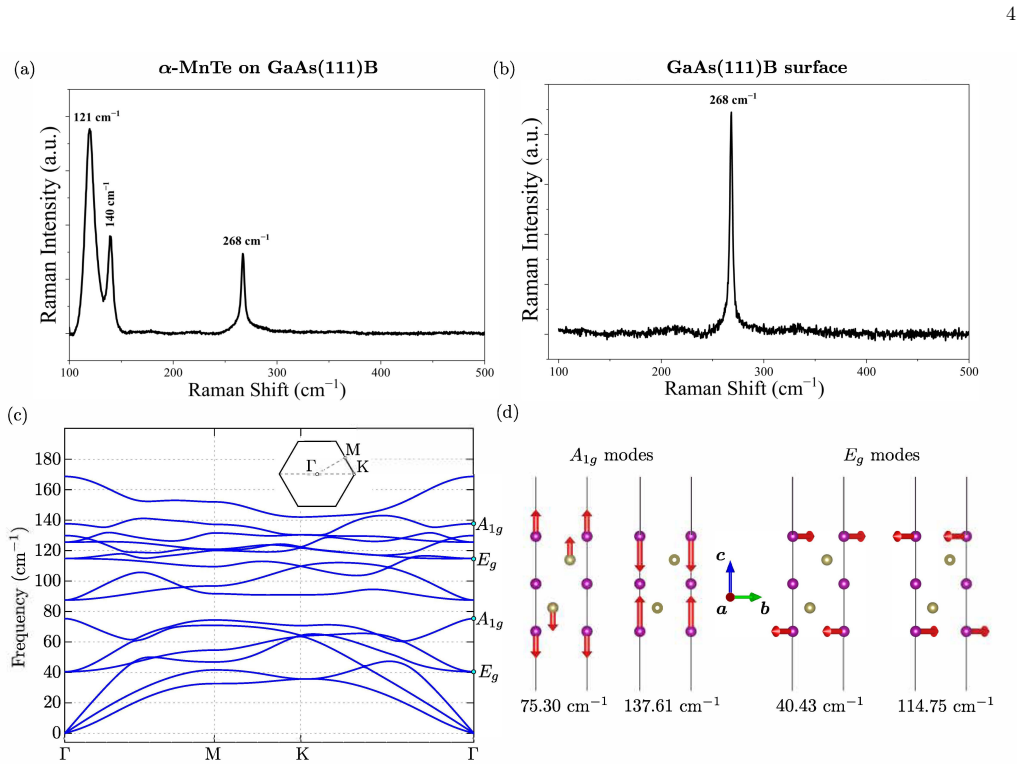
The high crystalline quality of MBE grown alpha MnTe enables the complete experimental resolution of all symmetry allowed Raman active phonon modes, identified through Raman spectroscopy on the films combined with first-principles phonon calculations for the hexagonal NiAs-type lattice.
What carries the argument
Raman spectroscopy on MBE-grown alpha-MnTe films, with mode identification provided by first-principles phonon calculations.
If this is right
- Epitaxial alpha-MnTe on GaAs becomes a usable thin-film platform for experiments on altermagnetism and lattice-coupled excitations.
- All symmetry-allowed Raman modes of the NiAs lattice can now be accessed experimentally in thin-film form.
- The MBE growth process yields material whose vibrational spectrum matches the bulk lattice symmetry without missing modes.
Where Pith is reading between the lines
- Similar MBE growth on other substrates could test whether the full phonon set remains resolvable outside the GaAs(111)B template.
- The resolved phonon modes open a route to measure how lattice vibrations interact with the spin-split bands in this altermagnet.
- Temperature-dependent Raman work on these films could reveal any softening or splitting tied to the Néel transition.
Load-bearing premise
The observed features near 121 and 140 cm^{-1} are the Raman-active phonons of the alpha-MnTe NiAs lattice as predicted by the calculations.
What would settle it
A measurement on the same films at higher resolution or under different polarization conditions that fails to detect the full predicted set of modes, or shows frequencies that deviate from the calculated values, would falsify the assignment and the claim of complete resolution.
Figures
read the original abstract
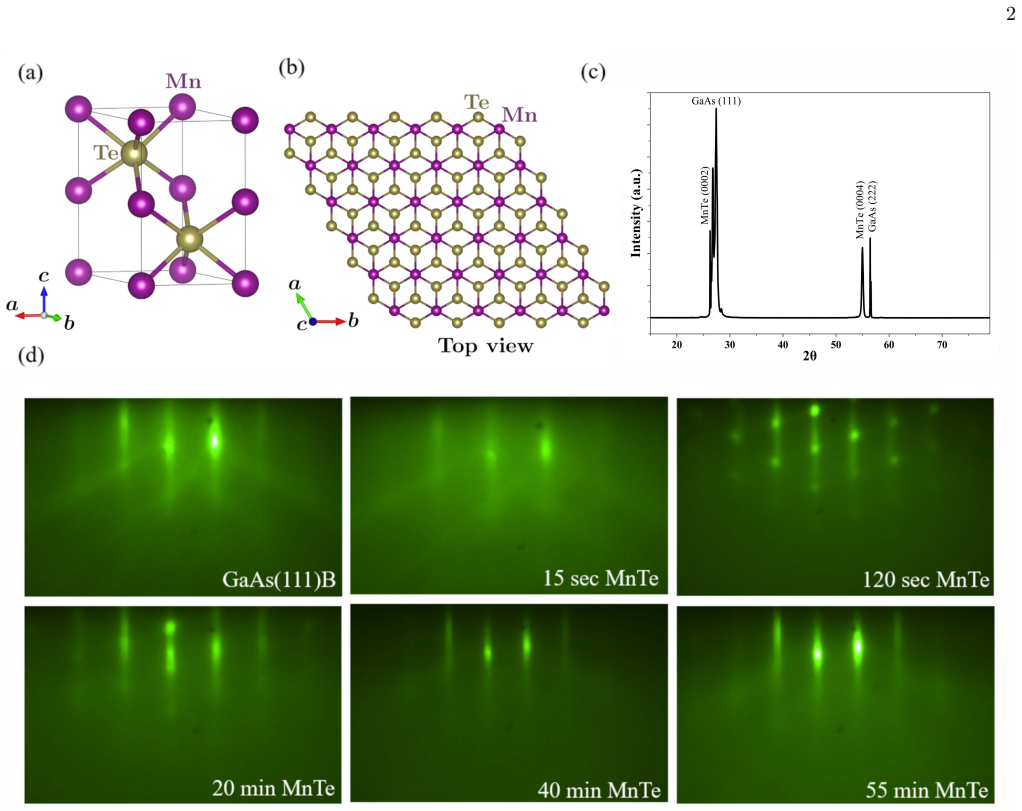
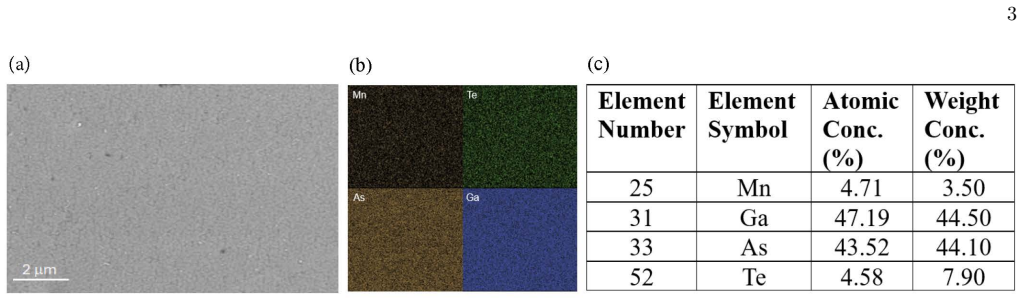
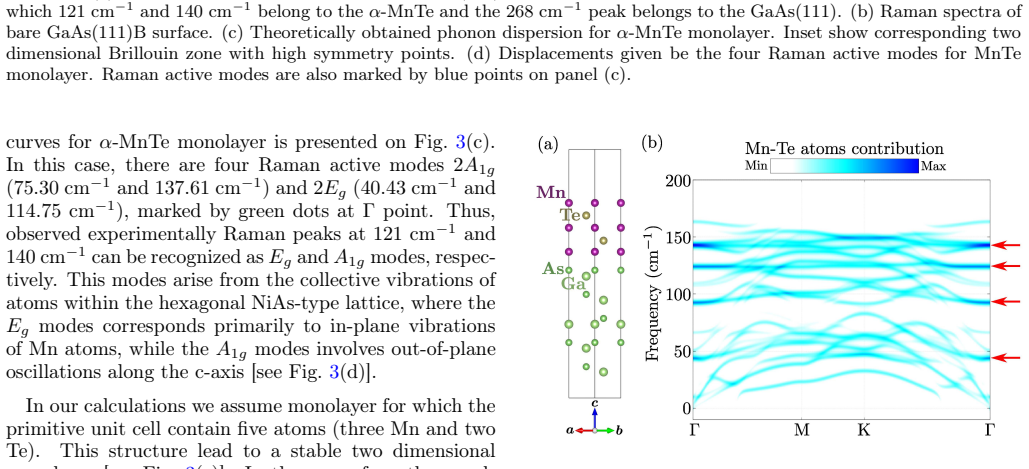
The altermagnetic materials have emerged as model systems for studying spin split electronic structures, yet controlled epitaxial growth on technologically relevant substrates remains challenging. Among the known candidates, MnTe stands out as a prominent altermagnetic material owing to its layered structure and high Neel temperature. Here, we report the molecular beam epitaxy (MBE) growth of high quality alpha MnTe thin films on GaAs(111)B substrates and provide a comprehensive analysis of the growth evolution and structural properties. Raman spectroscopy reveals multiple vibrational features of alpha MnTe including modes near 121, and 140 1/cm. Combined with first principles phonon calculations, these features are identified as the Raman-active phonons of the hexagonal NiAs type lattice. Our results show that the high crystalline quality of MBE grown alpha MnTe enables the complete experimental resolution of all symmetry allowed Raman active phonon modes, highlighting epitaxial alpha MnTe as a robust thin film platform for investigating altermagnetism and its lattice coupled excitations.
Editorial analysis
A structured set of objections, weighed in public.
Referee Report
Summary. The manuscript reports molecular beam epitaxy growth of α-MnTe thin films on GaAs(111)B substrates, structural characterization, and Raman spectroscopy that resolves vibrational features near 121 and 140 cm⁻¹. These features are assigned to the Raman-active phonons of the hexagonal NiAs-type lattice via first-principles DFT phonon calculations. The central claim is that the high crystalline quality enables complete experimental resolution of all symmetry-allowed Raman-active modes, positioning epitaxial α-MnTe as a platform for altermagnetism studies.
Significance. If the mode assignments hold, the work provides a thin-film platform for investigating lattice-coupled excitations in an altermagnetic candidate with high Néel temperature, which would be of interest to the mesoscopic and spintronics communities. The combination of MBE growth with Raman and DFT is a positive element, though the absence of raw spectra, fitting details, and strain-corrected calculations limits the immediate impact.
major comments (2)
- [DFT phonon calculations] DFT phonon calculations section: the calculations use equilibrium bulk lattice constants, but the epitaxial films on GaAs(111)B experience in-plane strain from lattice mismatch (as implied by the growth on a mismatched substrate). Without recomputing phonons at the XRD-determined film lattice parameters, the frequency match used to assign the 121 and 140 cm⁻¹ features to specific Raman-active modes is unreliable and directly undermines the claim of complete resolution of all symmetry-allowed modes.
- [Raman spectroscopy results] Raman spectroscopy results: the abstract and text state that the observed features are identified as the complete set of Raman-active phonons, yet no raw spectra, peak-fitting procedures, linewidths, or uncertainty estimates on the reported frequencies are provided. This prevents independent verification that the 121/140 cm⁻¹ features (and any additional modes) correspond exactly to the symmetry-allowed modes without overlap or substrate contributions.
minor comments (2)
- [Abstract] Wavenumber units are written as "1/cm" in the abstract; standard notation is cm⁻¹ throughout the manuscript.
- [Introduction or discussion] The manuscript would benefit from explicit comparison of the observed frequencies to any prior bulk α-MnTe Raman reports to strengthen the assignment context.
Simulated Author's Rebuttal
We thank the referee for their constructive and detailed review of our manuscript. We address each major comment point by point below, providing the strongest honest defense possible. Where revisions are warranted, we indicate that they will be incorporated.
read point-by-point responses
-
Referee: [DFT phonon calculations] DFT phonon calculations section: the calculations use equilibrium bulk lattice constants, but the epitaxial films on GaAs(111)B experience in-plane strain from lattice mismatch (as implied by the growth on a mismatched substrate). Without recomputing phonons at the XRD-determined film lattice parameters, the frequency match used to assign the 121 and 140 cm⁻¹ features to specific Raman-active modes is unreliable and directly undermines the claim of complete resolution of all symmetry-allowed modes.
Authors: We agree that the epitaxial strain due to lattice mismatch with GaAs(111)B must be considered for precise phonon assignments. The original calculations employed bulk equilibrium lattice constants. We have now performed additional DFT calculations incorporating the in-plane lattice constants determined from XRD on our films. These strain-corrected frequencies exhibit only minor shifts (a few cm⁻¹) that preserve the mode identifications for the observed features at 121 and 140 cm⁻¹. We will add these results, including a brief discussion of strain effects, to the revised manuscript to strengthen the assignments. revision: yes
-
Referee: [Raman spectroscopy results] Raman spectroscopy results: the abstract and text state that the observed features are identified as the complete set of Raman-active phonons, yet no raw spectra, peak-fitting procedures, linewidths, or uncertainty estimates on the reported frequencies are provided. This prevents independent verification that the 121/140 cm⁻¹ features (and any additional modes) correspond exactly to the symmetry-allowed modes without overlap or substrate contributions.
Authors: We concur that including the raw data and analysis details would improve verifiability. The revised manuscript will incorporate the raw Raman spectra, a description of the peak-fitting procedure, the measured linewidths, and uncertainty estimates on the frequencies. These additions will enable independent confirmation that the 121 and 140 cm⁻¹ modes align with the symmetry-allowed phonons and are free from significant substrate overlap. revision: yes
Circularity Check
No circularity: mode assignment rests on independent first-principles calculations
full rationale
The paper reports MBE growth and Raman spectra of α-MnTe films, then states that features near 121 and 140 cm⁻¹ are identified as Raman-active phonons via first-principles phonon calculations. This identification uses external theoretical input rather than any self-referential fit, self-citation chain, or redefinition of the experimental result. No equations, parameters, or uniqueness theorems are shown to reduce the claimed resolution of all symmetry-allowed modes to the data itself. The derivation chain therefore remains self-contained against the cited calculations and does not match any enumerated circularity pattern.
Axiom & Free-Parameter Ledger
axioms (1)
- domain assumption The MBE-grown films possess the hexagonal NiAs-type crystal structure of alpha-MnTe.
Reference graph
Works this paper leans on
-
[1]
J. K. Furdyna, Diluted magnetic semiconductors,J. Appl. Phys.64, R29 (1988)
1988
-
[2]
Žutić, J
I. Žutić, J. Fabian, and S. Das Sarma, Spintronics: Fun- damentals and applications,Rev. Mod. Phys.76, 323 (2004)
2004
-
[3]
Baltz, A
V. Baltz, A. Manchon, M. Tsoi, T. Moriyama, T. Ono, and Y. Tserkovnyak, Antiferromagnetic spintronics,Rev. Mod. Phys.90, 015005 (2018)
2018
-
[4]
Hirohata, K
A. Hirohata, K. Yamada, Y. Nakatani, L. Prejbeanu, B. Diény, P. Pirro, and B. Hillebrands, Review on spin- tronics: Principles and device applications,J. Magn. Magn. Mater.509, 166711 (2020)
2020
-
[5]
S. A. Wolf, D. D. Awschalom, R. A. Buhrman, J. M. D. Coey, D. D. von Molnár, M. L. Roukes, A. Y. Chtchelka- nova, and D. M. Treger, Spintronics: A spin-based elec- tronics vision for the future,Science294, 1488 (2001)
2001
-
[6]
S. S. P. Parkin, M. Hayashi, and L. Thomas, Magnetic domain-wall racetrack memory,Science320, 190 (2008)
2008
-
[7]
Nagaosa, J
N. Nagaosa, J. Sinova, S. Onoda, A. H. MacDonald, and N. P. Ong, Anomalous Hall effect,Rev. Mod. Phys.82, 1539 (2010)
2010
-
[8]
Sinova, S
J. Sinova, S. O. Valenzuela, J. Wunderlich, C. H. Back, and T. Jungwirth, Spin Hall effects,Rev. Mod. Phys.87, 1213 (2015)
2015
-
[9]
Jungwirth, X
T. Jungwirth, X. Martí, P. Wadley, and J. Wunderlich, Antiferromagneticspintronics,Nat. Nanotechnol.11, 231 (2016)
2016
-
[10]
E. V. Gomonay and V. M. Loktev, Spintronics of antifer- romagnetic systems,Low Temp. Phys.40, 17–35 (2014)
2014
-
[11]
Šmejkal, J
L. Šmejkal, J. Sinova, and T. Jungwirth, Emerging re- search landscape of altermagnetism,Phys. Rev. X12, 040501 (2022)
2022
-
[12]
Šmejkal, J
L. Šmejkal, J. Sinova, and T. Jungwirth, Beyond conven- tional ferromagnetism and antiferromagnetism: A phase with nonrelativistic spin and crystal rotation symmetry, Phys. Rev. X12, 031042 (2022)
2022
-
[13]
Šmejkal, R
L. Šmejkal, R. González-Hernández, T. Jungwirth, and J. Sinova, Crystal time-reversal symmetry breaking and spontaneousHalleffectincollinearantiferromagnets,Sci. Adv.6, eaaz8809 (2020)
2020
-
[14]
Krempaský, L
J. Krempaský, L. Šmejkal, S. W. D’Souza, M. Hoffmann, J. Bouaziz, B. B. Sarma, D. Kriegner, Y. Hajlaoui, T. W. Hänke, R. González-Hernández, D. Go, G. Springholz, B. Büchner, K. Výborný, W. Weber, G. Woltersdorf, M. Aeschlimann, J. Minár, J. Sinova, and T. Jungwirth, Altermagnetic lifting of Kramers spin degeneracy,Nature 626, 517–522 (2024)
2024
-
[15]
Mazin, Editorial: Altermagnetism—A new punch line of fundamental magnetism,Phys
I. Mazin, Editorial: Altermagnetism—A new punch line of fundamental magnetism,Phys. Rev. X12, 040002 (2022)
2022
-
[16]
Cheong and F.-T
S.-W. Cheong and F.-T. Huang, Altermagnetism with non-collinear spins,npj Quantum Mater.9, 13 (2024)
2024
-
[17]
R. D. Gonzalez Betancourtet al., Spontaneous anoma- lous Hall effect arising from an unconventional compen- sated magnetic phase in a semiconductor,Phys. Rev. Lett.130, 036702 (2023)
2023
-
[18]
Y. Guo, H. Liu, O. Janson, I. C. Fulga, J. van den Brink, and J. I. Facio, Spin-split collinear antiferromagnets: A large-scale ab-initio study,Mater. Today Phys.32, 100991 (2023)
2023
- [19]
-
[20]
R. B. Regmiet al., Altermagnetism in the layered inter- calated transition metal dichalcogenide CoNb4Se8,Nat. Commun.16, 4399 (2025)
2025
- [21]
- [22]
-
[23]
M. Sprague, M. I. Mondal, A. P. Sakhya, R. B. Regmi, 6 S. Sadhukhan, A. K. Kumay, H. Sheokand, I. I. Mazin, N.J.Ghimire, andM.Neupane, Observationofaltermag- netic spin-splitting in an intercalated transition metal dichalcogenide, arXiv:2508.12985 (2025)
-
[24]
Janik, E
E. Janik, E. Dynowska, J. Bąk-Misiuk, M. Leszczyński, W. Szuszkiewicz, T. Wojtowicz, G. Karczewski, A. K. Zakrzewski, and J. Kossut, Structural properties of cubic MnTe layers grown by MBE,Thin Solid Films267, 74– 78 (1995)
1995
-
[25]
M. E. Vickers, D. A. MacLaren, and G. A. Gehring, Elec- trical properties of NiAs-type MnTe films with preferred orientation,J. Appl. Phys.119, 045304 (2016)
2016
-
[26]
Osumi, S
T. Osumi, S. Souma, T. Aoyama, K. Yamauchi, A. Honma, K. Nakayama, T. Takahashi, K. Ohgushi, and T. Sato, Observation of giant band splitting in altermag- netic MnTe,Phys. Rev. B109, 115102 (2024)
2024
- [27]
-
[28]
R. D. González Betancourt, J. Zubáč, K. Geishendorf, P. Ritzinger, B. Růžičková, T. Kotte, J. Železný, G. Springholz, B. Büchner, A. Thomas, H. Reichlová, D. Kriegner, and T. Jungwirth, Anisotropic magnetoresis- tance in altermagnetic MnTe,Nat. Rev. Phys.6, 683 (2024)
2024
-
[29]
Osumiet al., Observation of giant band splitting in altermagnetic MnTe,Phys
T. Osumiet al., Observation of giant band splitting in altermagnetic MnTe,Phys. Rev. B109, 115102 (2024)
2024
-
[30]
K. P. Kluczyket al., Coexistence of anomalous Hall effect and weak magnetization in a nominally collinear antifer- romagnet MnTe,Phys. Rev. B110, 155201 (2024)
2024
-
[31]
Watanabe, R
R. Watanabe, R. Yoshimi, M. Shirai, T. Tanigaki, M. Kawamura, A. Tsukazaki, K. S. Takahashi, R. Arita, M. Kawasaki, and Y. Tokura, Emergence of interfa- cial conduction and ferromagnetism in MnTe/InP,Appl. Phys. Lett.113, 181602 (2018)
2018
-
[32]
Chilcoteet al., Stoichiometry-induced ferromag- netism in altermagnetic candidate MnTe,Adv
M. Chilcoteet al., Stoichiometry-induced ferromag- netism in altermagnetic candidate MnTe,Adv. Funct. Mater.34, 2405829 (2024)
2024
-
[33]
J. D. Wasscher, Evidence of weak ferromagnetism in MnTe from galvanomagnetic measurements,Solid State Commun.3, 169–171 (1965)
1965
- [34]
-
[35]
S. Bey, M. Zhukovskyi, T. Orlova, S. S. Fields, V. Lauter, H. Ambaye, A. Ievlev, S. P. Bennett, X. Liu, and B. A. Assaf, Interface, bulk and surface structure of heteroepitaxial altermagneticα-MnTe films grown on GaAs(111),Phys. Rev. Mater.9, 074404 (2025)
2025
-
[36]
A.H. Chen, P. R. Raghuvanshi, J. Cook, M. Chilcote, J. Lapano, A. R. Mazza, Q. Lu, S. Kim, Y.-C. Wu, T. Z. Ward, B. J. Lawrie, G. Bian, J. Burns, J. D. Poplawsky, M.-G. Han, Y. Zhu, L. Lindsay, H. Miao, Z. Gai, R. G. Moore, G. Eres, V. R. Cooper, and M. Brahlek, Pro- grammable phase selection between altermagnetic and noncentrosymmetric polymorphs of MnTe...
2026
- [37]
-
[38]
S. Li, J. Wu, B. Liang, L. Liu, W. Zhang, N. Wazir, J. Zhou, Y. Liu, Y. Nie, Y. Hao, P. Wang, L. Wang, Y. Shi, and S. Li, Antiferromagneticα-MnTe: Molten- Salt-Assisted Chemical Vapor Deposition Growth and Magneto-Transport Properties,Chem. Mater.34, 873 (2022)
2022
-
[39]
Zhang, Q
J. Zhang, Q. Lian, Z. Pan, W. Bai, J. Yang, Y. Zhang, X. Tang, and J. Chu, Spin-phonon coupling and two- magnonsscatteringbehaviorsinhexagonalNiAs-typean- tiferromagneticMnTeepitaxialfilms,J Raman Spectrosc. 51, 1383 (2020)
2020
-
[40]
Strauch and B
D. Strauch and B. Dorner, Phonon dispersion in GaAs, J. Phys.: Condens. Matter2, 1457 (1990)
1990
-
[41]
Kommichau, H
G. Kommichau, H. Neumann, and W. Schmitz, Thermal expansion of SrF2 at elevated temperatures,Cryst. Res. Technol.21, 1583 (1986)
1986
-
[42]
P. E. Blöchl, Projector augmented-wave method,Phys. Rev. B50, 17953 (1994)
1994
-
[43]
Kresse and J
G. Kresse and J. Hafner, Ab initio molecular-dynamics simulation of the liquid-metal–amorphous-semiconductor transition in germanium,Phys. Rev. B49, 14251 (1994)
1994
-
[44]
Kresse and J
G. Kresse and J. Furthmúller, Efficient iterative schemes for ab initio total-energy calculations using a plane-wave basis set,Phys. Rev. B54, 11169 (1996)
1996
-
[45]
Kresse and D
G. Kresse and D. Joubert, From ultrasoft pseudopoten- tials to the projector augmented-wave method,Phys. Rev. B59, 1758 (1999)
1999
-
[46]
J. P. Perdew, K. Burke, and M. Ernzerhof, Generalized gradient approximation made simple,Phys. Rev. Lett. 77, 3865 (1996)
1996
-
[47]
A. I. Liechtenstein, V. I. Anisimov, and J. Zaanen, Density-functional theory and strong interactions: Or- bital ordering in Mott–Hubbard insulators,Phys. Rev. B 52, R5467 (1995)
1995
-
[48]
H. J. Monkhorst and J. D. Pack, Special points for Brillouin-zone integrations,Phys. Rev. B13, 5188 (1976)
1976
-
[49]
A. Togo, L. Chaput, T. Tadano, and I. Tanaka, Imple- mentation strategies in phonopy and phono3py,J. Phys. Condens. Matter35, 353001 (2023)
2023
-
[50]
Togo, First-principles phonon calculations with phonopy and phono3py,J
A. Togo, First-principles phonon calculations with phonopy and phono3py,J. Phys. Soc. Jpn.92, 012001 (2023)
2023
-
[51]
Momma and F
K. Momma and F. Izumi, vesta3 for three-dimensional visualization of crystal, volumetric and morphology data, J. Appl. Crystallogr.44, 1272 (2011)
2011
discussion (0)
Sign in with ORCID, Apple, or X to comment. Anyone can read and Pith papers without signing in.