AnySurf: Any Surface Generation with Directed Edge
Pith reviewed 2026-06-30 12:35 UTC · model grok-4.3
The pith
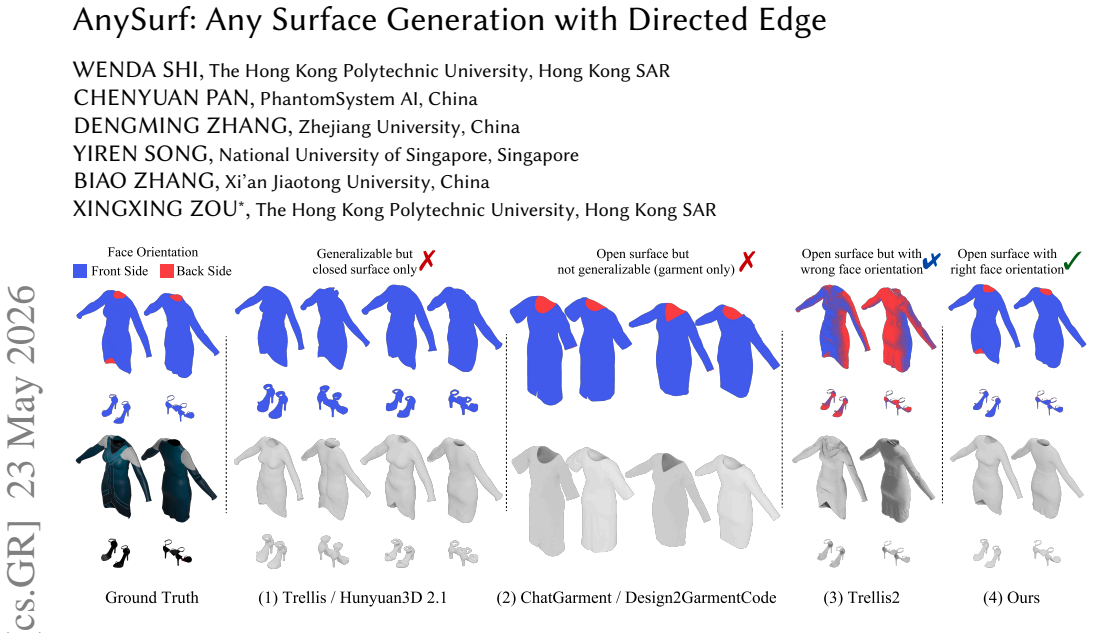
AnySurf uses directed edges on a flexible grid to generate open, closed, and hybrid 3D surfaces with correct face orientations.
A machine-rendered reading of the paper's core claim, the machinery that carries it, and where it could break.
Core claim
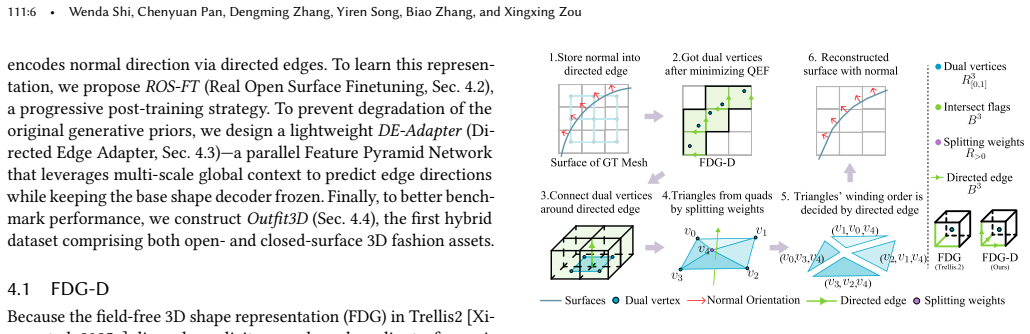
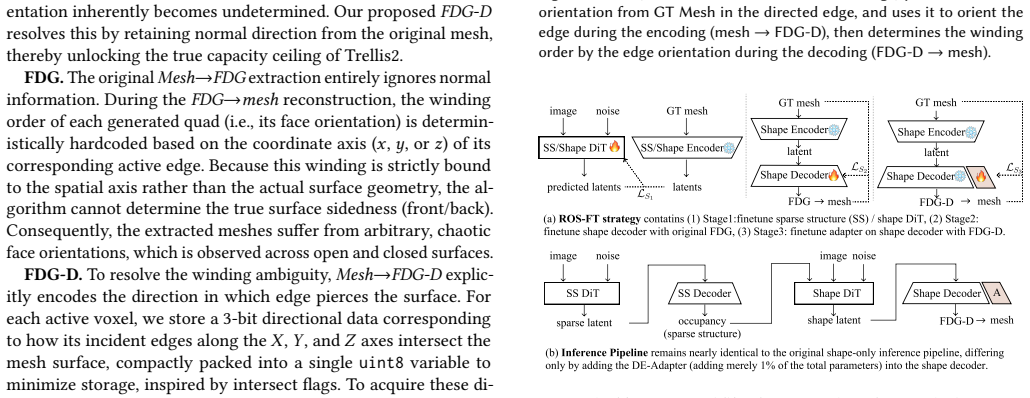
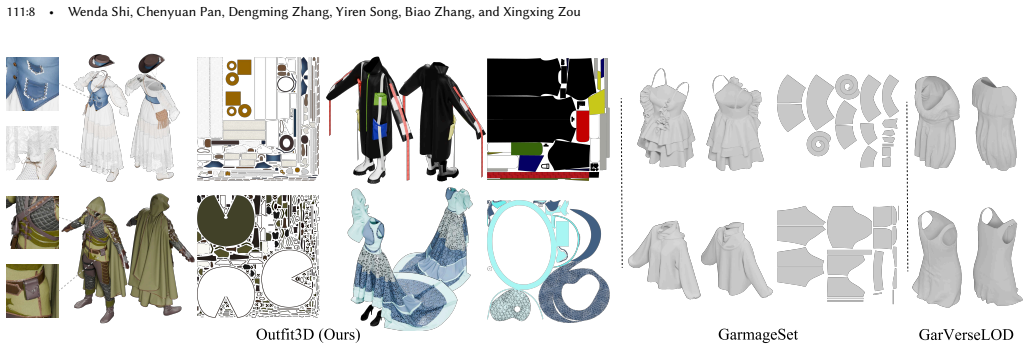
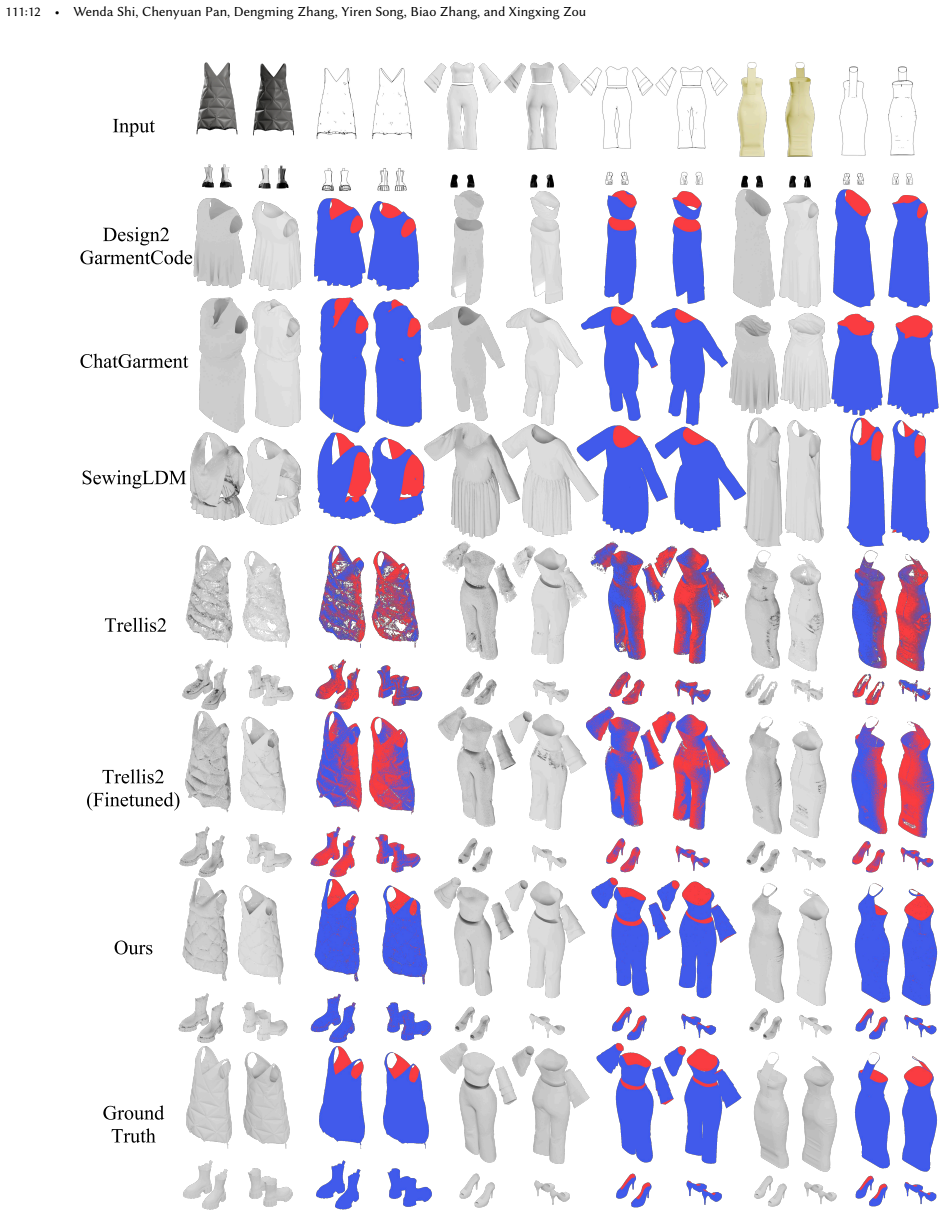
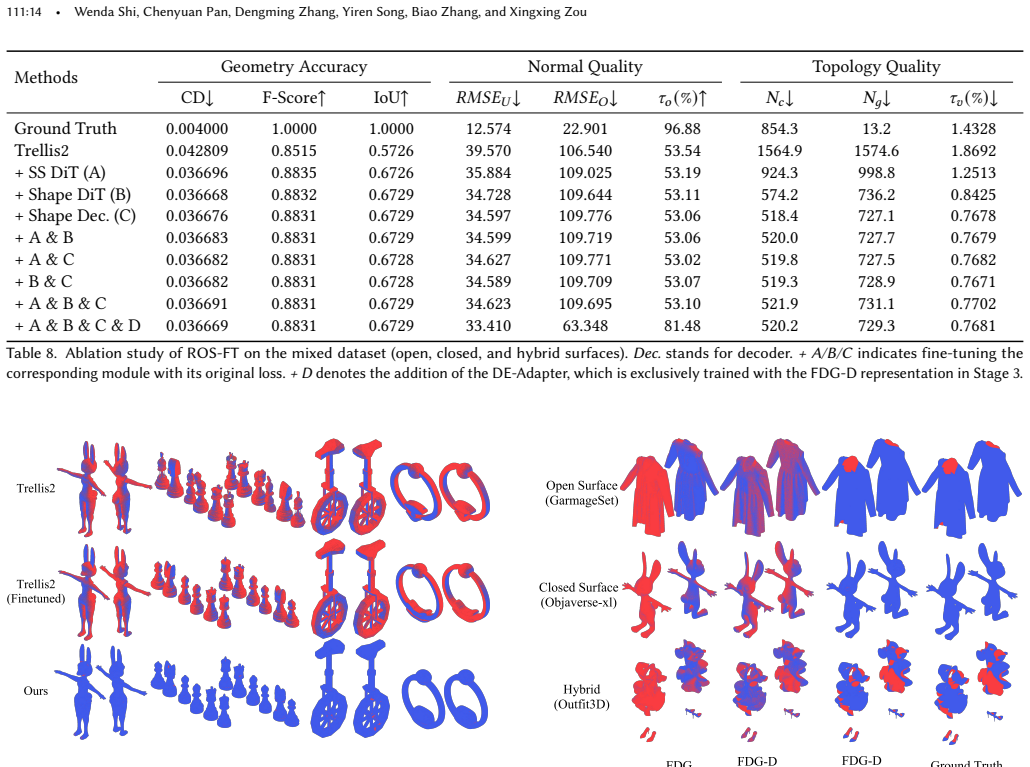
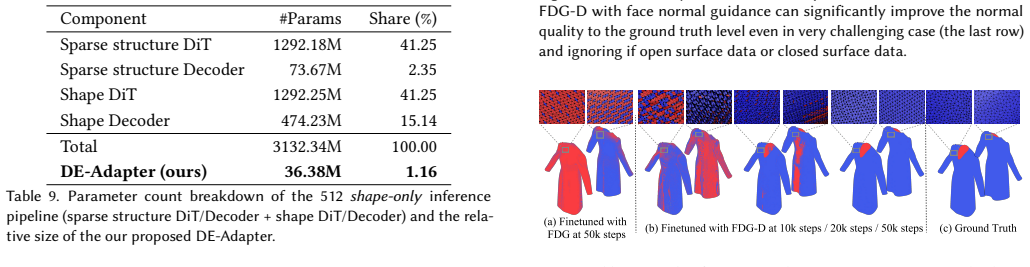
AnySurf is a unified framework that generates open, closed, and hybrid 3D surfaces with accurate face orientation by building on directed-edge enhanced Flexible Dual Grid (FDG-D), whose oriented grid edges retain normal direction information; ROS-FT post-training and a lightweight DE-Adapter with 1 percent extra parameters enable directed-edge learning while the Outfit3D dataset supports training on industrial garments and closed accessories.
What carries the argument
directed-edge enhanced Flexible Dual Grid (FDG-D), which encodes normal direction on oriented grid edges
If this is right
- A single generator can produce garments, shoes, accessories, and closed objects without switching representations or sewing patterns.
- Downstream rendering, simulation, and editing tasks receive meshes that already carry consistent face orientation.
- The 1-percent DE-Adapter can be added to existing generators without retraining the full model from scratch.
- Open-surface generation becomes a standard 3D task rather than a specialized garment-modeling pipeline.
Where Pith is reading between the lines
- The same directed-edge idea could be tested on non-manifold or self-intersecting surfaces that current generators avoid.
- If the adapter preserves performance on closed surfaces, the method may generalize to other grid-based generators beyond the one used here.
- Accurate open-surface normals would directly improve collision detection and cloth simulation without extra normal-correction steps.
Load-bearing premise
Directed-edge information stored in the grid plus the post-training and tiny adapter is enough to produce correct orientations on open surfaces without creating new topology or normal errors.
What would settle it
Generate open surfaces on the Outfit3D test set and count the fraction of faces whose normals point inward or whose edges fail to form a manifold boundary.
Figures

read the original abstract
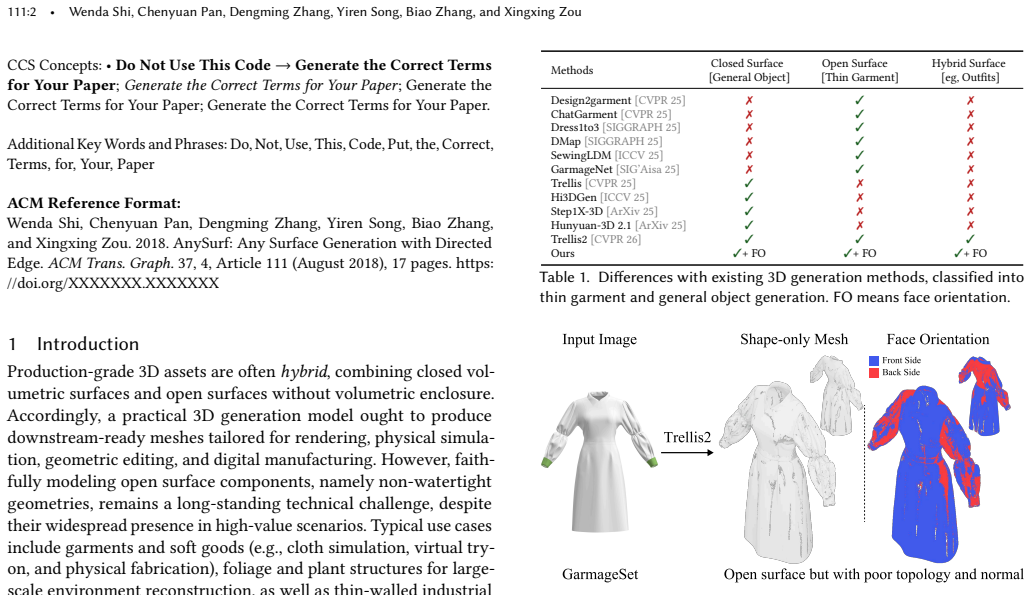
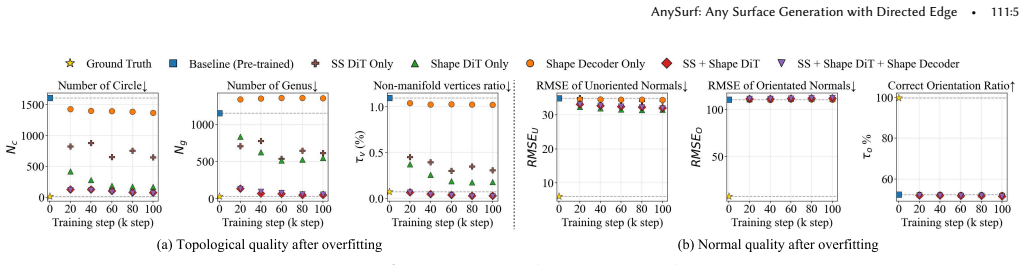
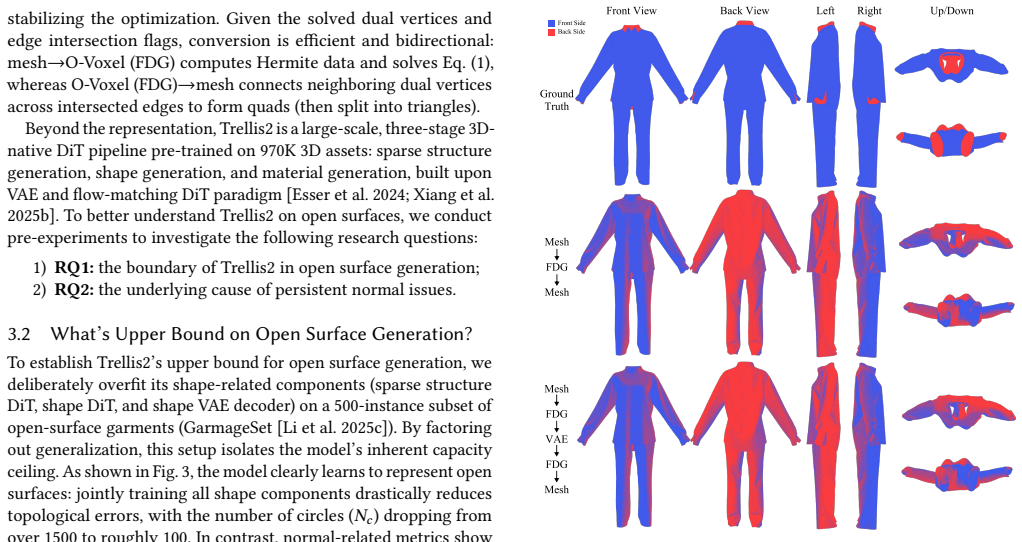
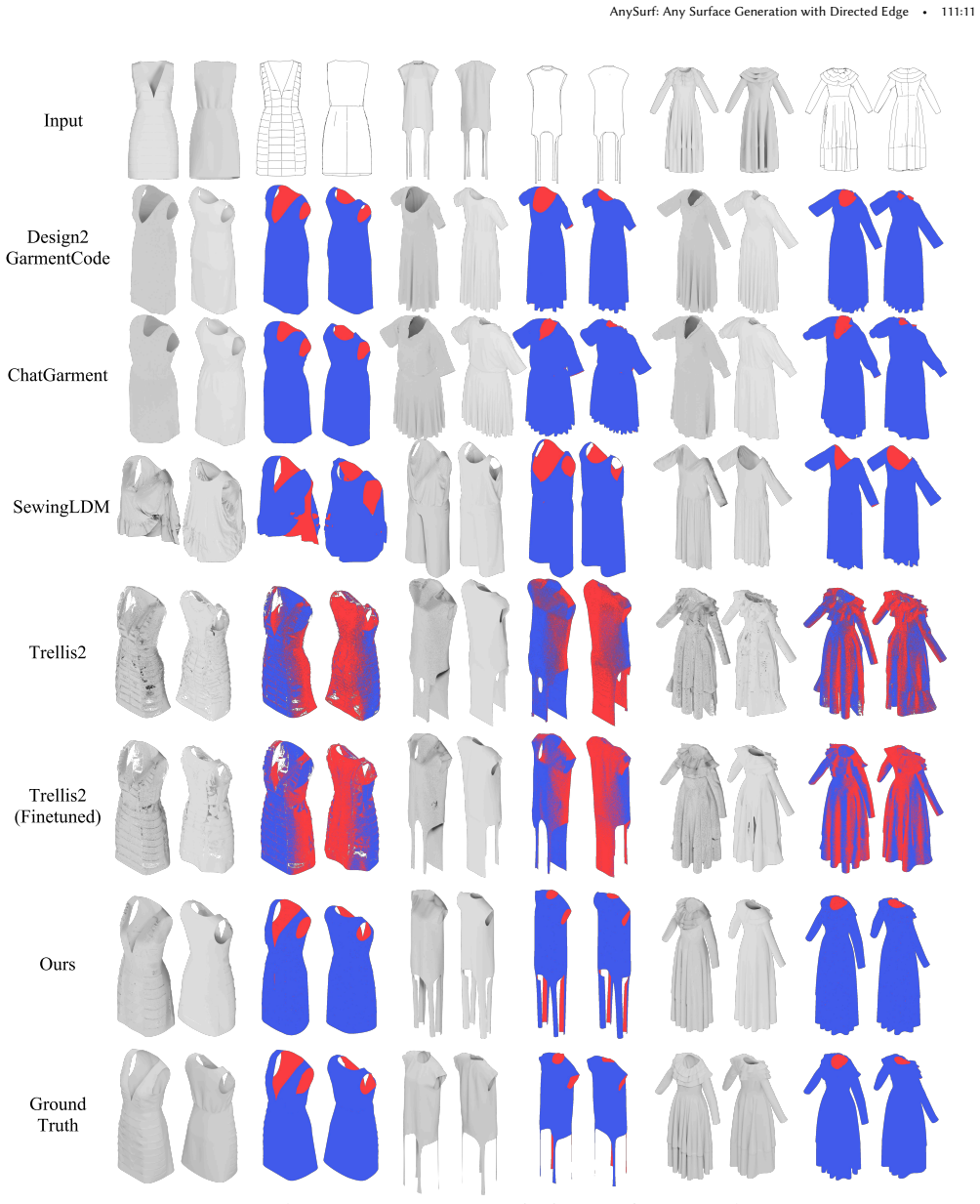
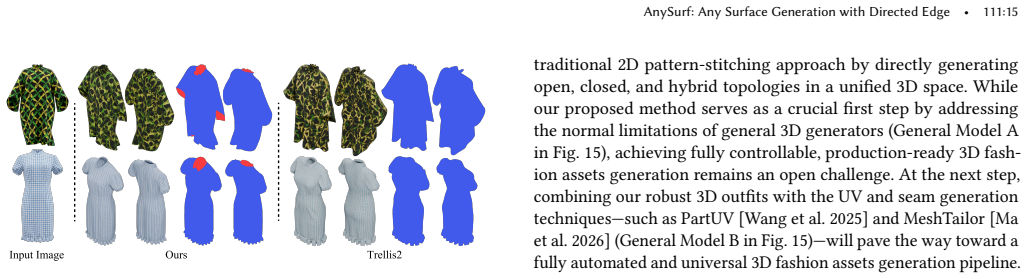
Open surface components prevail in real industrial 3D content and support rendering, physical simulation and geometric editing. Garments serve as a typical open surface type, with numerous existing generation methods leveraging sewing patterns to generate 2D panels and stitch them into 3D shapes. Such domain-specific designs lack scalability and cannot generalize to shoes and accessories. Common field-based 3D generators prioritize watertight meshes and tend to create flawed double-layer structures on open surfaces. Though Trellis2 adopts field-free representation, its open surface results still contain normal and topology errors. We present AnySurf, a unified framework generating open, closed and hybrid 3D surfaces with accurate face orientation. Built on directed-edge enhanced Flexible Dual Grid (FDG-D), our representation retains normal direction information via oriented grid edges. We also propose ROS-FT post-training and a lightweight DE-Adapter with merely 1% extra parameters, facilitating directed edge learning while preserving original generation performance. We further construct Outfit3D dataset containing industrial garments and closed accessories. Our work transforms garment modeling into a universal 3D generation task. Experimental results demonstrate superior mesh quality and better practicality for downstream applications.
Editorial analysis
A structured set of objections, weighed in public.
Referee Report
Summary. The manuscript presents AnySurf, a unified framework for generating open, closed, and hybrid 3D surfaces with accurate face orientation. It builds on a directed-edge enhanced Flexible Dual Grid (FDG-D) representation that retains normal direction information via oriented grid edges, introduces ROS-FT post-training and a lightweight DE-Adapter (1% extra parameters) for directed edge learning, and releases the Outfit3D dataset of industrial garments and closed accessories. The central claim is that this combination produces superior mesh quality without introducing new topology or normal errors, transforming garment modeling into a general 3D generation task.
Significance. If the claims hold with supporting evidence, the work could meaningfully advance 3D surface generation in computer graphics by addressing limitations of watertight-focused field methods and prior open-surface approaches like Trellis2. The lightweight adapter, post-training strategy, and new dataset are potentially useful contributions for practical applications in rendering, simulation, and editing. However, the absence of any quantitative results, ablation studies, error metrics, or implementation details prevents a full assessment of significance or reproducibility.
major comments (1)
- The abstract states that 'experimental results demonstrate superior mesh quality' but provides no metrics, tables, figures, or comparisons to support this central claim. Without such evidence, the sufficiency of FDG-D + ROS-FT + DE-Adapter for accurate face orientation on open surfaces cannot be evaluated.
Simulated Author's Rebuttal
We thank the referee for highlighting the need for quantitative support of our claims. We address the concern point-by-point below and commit to substantial revisions.
read point-by-point responses
-
Referee: The abstract states that 'experimental results demonstrate superior mesh quality' but provides no metrics, tables, figures, or comparisons to support this central claim. Without such evidence, the sufficiency of FDG-D + ROS-FT + DE-Adapter for accurate face orientation on open surfaces cannot be evaluated.
Authors: We agree this is a valid observation for the submitted version. The manuscript text as provided contains only the abstract claim without accompanying quantitative results, ablations, or implementation details. In the revised manuscript we will add a full Experiments section containing: (1) quantitative metrics including normal consistency error, topology error rate, and mesh quality scores on open/closed/hybrid surfaces; (2) direct comparisons against Trellis2 and other baselines with tables and figures; (3) ablation studies isolating FDG-D, ROS-FT, and the DE-Adapter; and (4) implementation details sufficient for reproducibility. These additions will directly substantiate the abstract claim and allow evaluation of the directed-edge components. revision: yes
Circularity Check
No significant circularity
full rationale
The abstract and provided context describe AnySurf as a new unified framework built on a directed-edge enhanced representation (FDG-D) plus two new training components (ROS-FT and the 1%-parameter DE-Adapter). No equations, fitted parameters, or derivation steps are exhibited that reduce any claimed output (accurate face orientation on open surfaces) to an input by construction. No self-citation chains, uniqueness theorems, or ansatzes imported from prior author work are invoked as load-bearing premises. The central claims rest on experimental validation against external benchmarks and a newly constructed dataset rather than on re-derivation of fitted quantities.
Axiom & Free-Parameter Ledger
axioms (1)
- domain assumption Oriented grid edges retain normal direction information
invented entities (3)
-
DE-Adapter
no independent evidence
-
ROS-FT
no independent evidence
-
Outfit3D
no independent evidence
Reference graph
Works this paper leans on
-
[1]
arXiv preprint arXiv:2409.12957 (2024)
pi-gan: Periodic implicit generative adversarial networks for 3d-aware image synthesis. Chao Chen, Yu-Shen Liu, and Zhizhong Han. 2024a. Inferring Neural Signed Distance Functions by Overfitting on Single Noisy Point Clouds through Finetuning Data- Driven based Priors. InAdvances in Neural Information Processing Systems. Honghu Chen, Yuxin Yao, and Juyong...
-
[2]
Objaverse-xl: A universe of 10m+ 3d objects.Advances in Neural Information Processing Systems36 (2024). Matt Deitke, Ruoshi Liu, Matthew Wallingford, Huong Ngo, Oscar Michel, Aditya Kusupati, Alan Fan, Christian Laforte, Vikram Voleti, Samir Yitzhak Gadre, Eli VanderBilt, Aniruddha Kembhavi, Carl Vondrick, Georgia Gkioxari, Kiana Ehsani, Ludwig Schmidt, a...
-
[3]
Flow Matching for Generative Modeling. InICLR. Anran Liu, Cheng Lin, Yuan Liu, Xiaoxiao Long, Zhiyang Dou, Hao-Xiang Guo, Ping Luo, and Wenping Wang. 2024b. Part123: Part-aware 3D Reconstruction from a Single-view Image.arXiv preprint arXiv:2405.16888(2024). Lijuan Liu, Xiangyu Xu, Zhijie Lin, Jiabin Liang, and Shuicheng Yan. 2023b. Towards Garment Sewing...
-
[4]
doi:10.1109/ TCSVT.2026.3686871 Wenda Shi, Yiren Song, Dengming Zhang, Jiaming Liu, and Xingxing Zou
WordCon: Word-level Typography Control in Visual Text Rendering.IEEE Transactions on Circuits and Systems for Video Technology(2026), 1–1. doi:10.1109/ TCSVT.2026.3686871 Wenda Shi, Yiren Song, Dengming Zhang, Jiaming Liu, and Xingxing Zou. 2025. FonTS: Text Rendering With Typography and Style Controls. InProceedings of the IEEE/CVF International Conferen...
-
[5]
PartUV: Part-Based UV Unwrapping of 3D Meshes. InProceedings of the SIGGRAPH Asia 2025 Conference Papers (SA Conference Papers ’25). Association for Computing Machinery, New York, NY, USA, Article 15, 12 pages. doi:10.1145/ 3757377.3763843 Jianfeng Xiang, Xiaoxue Chen, Sicheng Xu, Ruicheng Wang, Zelong Lv, Yu Deng, Hongyuan Zhu, Yue Dong, Hao Zhao, Nichol...
discussion (0)
Sign in with ORCID, Apple, or X to comment. Anyone can read and Pith papers without signing in.