Exact strong zero modes are generic in integrable spin systems with large anisotropy
Pith reviewed 2026-06-30 11:34 UTC · model grok-4.3
The pith
Exact strong zero modes arise generically in integrable anisotropic spin models from quasi-periodicity of R-matrices and tracelessness of K-matrices.
A machine-rendered reading of the paper's core claim, the machinery that carries it, and where it could break.
Core claim
Exact strong zero modes arise generically in a broad family of integrable spin models with anisotropic interactions. Their existence follows from two algebraic properties of the underlying R- and K-matrices—quasi-periodicity in the spectral parameter and tracelessness, respectively—providing a uniform, model-independent mechanism. The framework recovers the known ESZM in XXZ chain and its higher-spin generalizations as special cases and predicts ESZMs in previously unrecognized models.
What carries the argument
The algebraic properties of the R-matrix (quasi-periodicity in the spectral parameter) and K-matrix (tracelessness), which together produce an edge operator that commutes exactly with the Hamiltonian.
If this is right
- The XXZ chain and all its higher-spin generalizations possess exact strong zero modes as direct instances of the mechanism.
- Any new integrable model satisfying the same R-matrix and K-matrix conditions will exhibit exact strong zero modes.
- The construction supplies a uniform algebraic recipe that replaces separate model-by-model derivations.
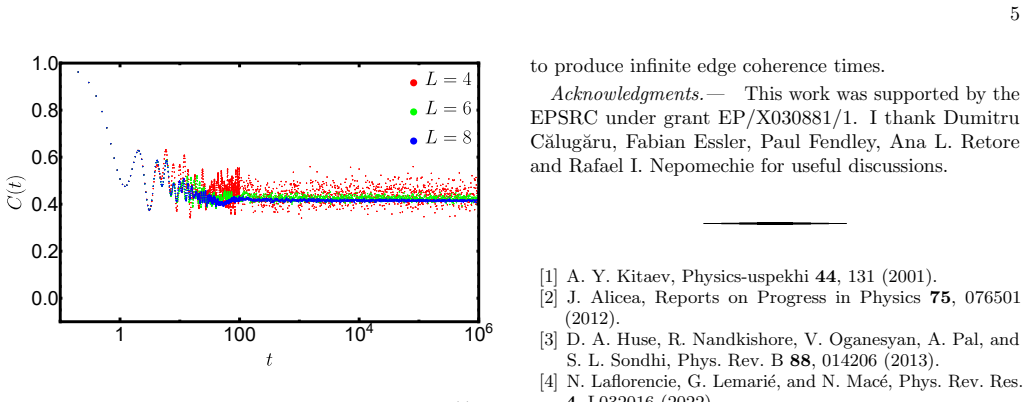
- Edge coherence times remain finite and non-decaying even at finite system size whenever the two matrix conditions hold.
Where Pith is reading between the lines
- The same matrix conditions may identify exact modes in models outside the spin-chain setting if analogous R- and K-objects can be defined.
- Experimental platforms realizing integrable anisotropic chains could test whether coherence persists exactly rather than exponentially long.
- The result suggests checking whether relaxing quasi-periodicity or tracelessness immediately restores the usual exponential suppression of the commutator.
Load-bearing premise
The models must possess R-matrices that are quasi-periodic in the spectral parameter and K-matrices that are traceless, and these properties must be what produce the exact commutation.
What would settle it
An integrable anisotropic spin model whose R-matrix is quasi-periodic and whose K-matrix is traceless, yet whose constructed edge operator fails to commute exactly with the Hamiltonian at finite size.
Figures
read the original abstract
Strong zero modes (SZMs) are edge-localized operators that commute with the Hamiltonian up to corrections exponentially small in system size, yielding anomalously long edge coherence times. In some settings, notably certain integrable models, this commutator can be made to vanish exactly at finite size, defining an exact SZM (ESZM). Existing ESZM constructions in the integrable setting, however, have proceeded model by model and have not been unified into a common framework. Here, I show that ESZMs arise generically in a broad family of integrable spin models with anisotropic interactions. Their existence follows from two algebraic properties of the underlying R- and K-matrices -- quasi-periodicity in the spectral parameter and tracelessness, respectively -- providing a uniform, model-independent mechanism. The framework recovers the known ESZM in XXZ chain and its higher-spin generalizations as special cases and predicts ESZMs in previously unrecognized models.
Editorial analysis
A structured set of objections, weighed in public.
Referee Report
Summary. The manuscript claims that exact strong zero modes (ESZMs) arise generically in integrable spin models with large anisotropy. Their existence is shown to follow from two algebraic properties of the underlying R- and K-matrices: quasi-periodicity in the spectral parameter and tracelessness, respectively. This supplies a uniform, model-independent mechanism that recovers the known ESZM in the XXZ chain and its higher-spin generalizations as special cases while predicting ESZMs in additional models.
Significance. If the central derivation holds, the result unifies previously model-by-model ESZM constructions under a single algebraic criterion. This is a clear strength for generality in the integrable-systems literature and could enable systematic identification of new models with exact edge coherence. The approach is parameter-free once the matrix properties are verified and yields falsifiable predictions for previously unrecognized models.
major comments (2)
- [§3] §3, around the statement following Eq. (8): the proof that [H, Z_edge] = 0 holds identically appears to invoke the full transfer-matrix construction and Yang-Baxter relations in addition to the stated quasi-periodicity of R and tracelessness of K. It is not shown that the commutator vanishes from those two properties alone; an explicit reduction that isolates only those two conditions is needed to support the 'uniform, model-independent' claim.
- [§5] §5, the new-model predictions: the explicit matrix constructions for the 'previously unrecognized models' are given, but the verification that the edge operator commutes exactly relies on the same additional integrability relations used in the XXZ recovery. This weakens the generality argument unless those relations are shown to be implied by quasi-periodicity and tracelessness.
minor comments (2)
- Notation for the spectral-parameter shift in the quasi-periodicity condition is introduced without a dedicated definition paragraph; a short table comparing the shift values across the recovered models would improve readability.
- Figure 2 caption refers to 'the generic case' without specifying which parameter values are plotted; adding the explicit anisotropy values used would clarify the comparison.
Simulated Author's Rebuttal
We thank the referee for the careful reading and constructive comments. The points raised highlight opportunities to make the isolation of the two algebraic properties more explicit, which will strengthen the manuscript's claim of a uniform mechanism. We respond to each major comment below.
read point-by-point responses
-
Referee: [§3] §3, around the statement following Eq. (8): the proof that [H, Z_edge] = 0 holds identically appears to invoke the full transfer-matrix construction and Yang-Baxter relations in addition to the stated quasi-periodicity of R and tracelessness of K. It is not shown that the commutator vanishes from those two properties alone; an explicit reduction that isolates only those two conditions is needed to support the 'uniform, model-independent' claim.
Authors: We agree that an explicit isolation is required to fully substantiate the model-independent claim. In the derivation, the Yang-Baxter equation is used solely to guarantee that the Hamiltonian is obtained from the logarithmic derivative of the transfer matrix; once this definition is in place, the commutator [H, Z_edge] reduces directly to a sum of local terms that cancel by virtue of the quasi-periodicity of R (which aligns the spectral parameters at the edge) and the tracelessness of K (which removes the residual boundary contribution). We will add a new paragraph immediately after Eq. (8) that performs this reduction step by step, showing that no further integrability relations enter the final cancellation. This revision will be incorporated. revision: yes
-
Referee: [§5] §5, the new-model predictions: the explicit matrix constructions for the 'previously unrecognized models' are given, but the verification that the edge operator commutes exactly relies on the same additional integrability relations used in the XXZ recovery. This weakens the generality argument unless those relations are shown to be implied by quasi-periodicity and tracelessness.
Authors: The new models are selected precisely because their R-matrices satisfy quasi-periodicity and their K-matrices are traceless; therefore the general commutator argument of §3 applies verbatim without invoking any model-specific integrability relations beyond those two properties. To make this explicit, we will insert a single clarifying sentence in §5 stating that the edge-operator construction and commutator cancellation follow from the same two algebraic conditions used in the general case. This is a partial revision consisting of added text only. revision: partial
Circularity Check
No circularity; derivation rests on independent algebraic properties of R- and K-matrices
full rationale
The paper derives the generic existence of ESZMs from the quasi-periodicity of the R-matrix in the spectral parameter and the tracelessness of the K-matrix. These are presented as defining algebraic features of the integrable models under study, with the commutator vanishing following directly from them. The abstract and description show no self-definitional reductions, no fitted parameters renamed as predictions, and no load-bearing self-citations; known cases are recovered as special instances of the same properties rather than used to define the result. The central claim therefore remains independent of its inputs.
Axiom & Free-Parameter Ledger
axioms (2)
- domain assumption R-matrices of the models are quasi-periodic in the spectral parameter
- domain assumption K-matrices of the models are traceless
Reference graph
Works this paper leans on
-
[1]
If the R-matrix is in a different gauge, the same following formalism applies with slight modifications [ 68]
̸= 1, P 12, where P is the permutation oper- ator. If the R-matrix is in a different gauge, the same following formalism applies with slight modifications [ 68]. Consider now the impact of the periodicity of the R- matrix on the K-matrix. Let K −(u| {β −}) be a solution of the SRE, possibly featuring some free parameters {β−}. By performing the shift u7→u...
-
[2]
at u = p 2 has the form T ′( p
-
[3]
Further, note that as R12( p
= L+1X j=1 ˜Ψj .(16) The ˜Ψk terms originate from the derivative acting on the R-matrices at site k, such that the pulling-through identity terminates there (and k = L + 1 is the term where the derivative hits the right K-matrix). Further, note that as R12( p
-
[4]
Consequently, ˜Ψk is not confined to a finite neighbourhood of the site k, but generally features a support extending over the entire interval from 1 to k
̸= 1, P 12, ultra-locality does not hold. Consequently, ˜Ψk is not confined to a finite neighbourhood of the site k, but generally features a support extending over the entire interval from 1 to k. The above facts already provide a strong indication that T′ p 2 may be localized at the boundary. The above finding motivates defining an ESZM Ψ for integrable...
-
[5]
A. Y. Kitaev, Physics-uspekhi44, 131 (2001)
2001
-
[6]
Alicea, Reports on Progress in Physics75, 076501 (2012)
J. Alicea, Reports on Progress in Physics75, 076501 (2012)
2012
-
[7]
D. A. Huse, R. Nandkishore, V. Oganesyan, A. Pal, and S. L. Sondhi, Phys. Rev. B88, 014206 (2013)
2013
-
[8]
Laflorencie, G
N. Laflorencie, G. Lemari´ e, and N. Mac´ e, Phys. Rev. Res. 4, L032016 (2022)
2022
-
[9]
S. Kantha and N. Laflorencie, Strong zero modes in random ising-majorana chains (2026), arXiv:2603.05313 [cond-mat.dis-nn]
-
[10]
Exact zero modes in twisted Kitaev chains
K. Kawabata, R. Kobayashi, N. Wu, and H. Katsura, Phys. Rev. B95, 195140 (2017), arXiv:1702.00197 [cond- mat.mes-hall]
work page internal anchor Pith review Pith/arXiv arXiv 2017
-
[11]
Bahri, R
Y. Bahri, R. Ronen, and E. Altman, Nature Communica- tions6, 7341 (2015)
2015
-
[12]
Topological phases with parafermions: theory and blueprints
J. Alicea and P. Fendley, Ann. Rev. Condensed Matter Phys.7, 119 (2016), arXiv:1504.02476 [cond-mat.str-el]
work page internal anchor Pith review Pith/arXiv arXiv 2016
-
[13]
G. J. Sreejith, A. Lazarides, and R. Moessner, Phys. Rev. B94, 045127 (2016)
2016
-
[14]
N. Moran, D. Pellegrino, J. K. Slingerland, and G. Kells, Physical Review B95, 10.1103/physrevb.95.235127 (2017)
-
[15]
C. Monthus, J. Phys. A51, 265303 (2018), arXiv:1803.01348 [cond-mat.dis-nn]
work page internal anchor Pith review Pith/arXiv arXiv 2018
-
[16]
C. B. Da˘ g, L.-M. Duan, and K. Sun, Phys. Rev. B101, 104415 (2020)
2020
-
[17]
I. Mahyaeh and E. Ardonne, Phys. Rev. B101, 085125 (2020), arXiv:1911.03156 [cond-mat.str-el]
-
[18]
M. I. K. Munk, A. Rasmussen, and M. Burrello, Phys. Rev. B98, 245135 (2018), arXiv:1807.09286 [cond-mat.str-el]
work page internal anchor Pith review Pith/arXiv arXiv 2018
-
[19]
L. M. Vasiloiu, F. Carollo, M. Marcuzzi, and J. P. Garra- han, Phys. Rev. B100, 024309 (2019)
2019
-
[20]
V. Svensson and M. Leijnse, Phys. Rev. B110, 155436 (2024), arXiv:2407.09211 [cond-mat.mes-hall]
-
[21]
N. Tausendpfund, A. Mitra, and M. Rizzi, Phys. Rev. Res. 7, 023245 (2025), arXiv:2501.11121 [cond-mat.str-el]
-
[22]
Lehmann, P
J. Lehmann, P. S. de Torres-Solanot, F. Pollmann, and T. Rakovszky, SciPost Phys.14, 140 (2023)
2023
- [23]
-
[24]
C. T. Olund, N. Y. Yao, and J. Kemp, Phys. Rev. B111, L201114 (2025)
2025
- [25]
-
[26]
Wildeboer, T
J. Wildeboer, T. Iadecola, and D. J. Williamson, PRX Quantum3, 020330 (2022)
2022
-
[27]
Y. Kuno and I. Ichinose, Phys. Rev. B108, 045150 (2023), arXiv:2304.05718 [cond-mat.stat-mech]
-
[28]
J. Kemp, N. Y. Yao, C. R. Laumann, and P. Fendley, Journal of Statistical Mechanics: Theory and Experiment 2017, 063105 (2017). 6
2017
-
[29]
I. A. Maceira and F. Mila, Phys. Rev. B97, 064424 (2018)
2018
-
[30]
D. J. Yates, F. H. L. Essler, and A. Mitra, Phys. Rev. B 99, 205419 (2019)
2019
-
[31]
L. M. Vasiloiu, F. Carollo, and J. P. Garrahan, Phys. Rev. B98, 094308 (2018)
2018
-
[32]
Thakurathi, A
M. Thakurathi, A. A. Patel, D. Sen, and A. Dutta, Phys. Rev. B88, 155133 (2013)
2013
-
[33]
Iadecola, L
T. Iadecola, L. H. Santos, and C. Chamon, Phys. Rev. B 92, 125107 (2015)
2015
-
[34]
Khemani, A
V. Khemani, A. Lazarides, R. Moessner, and S. L. Sondhi, Phys. Rev. Lett.116, 250401 (2016)
2016
-
[35]
Potirniche, A
I.-D. Potirniche, A. C. Potter, M. Schleier-Smith, A. Vish- wanath, and N. Y. Yao, Phys. Rev. Lett.119, 123601 (2017)
2017
-
[36]
Kumar, P
A. Kumar, P. T. Dumitrescu, and A. C. Potter, Phys. Rev. B97, 224302 (2018)
2018
- [37]
-
[38]
Mukherjee, R
B. Mukherjee, R. Melendrez, M. Szyniszewski, H. J. Changlani, and A. Pal, Phys. Rev. B109, 064303 (2024)
2024
-
[39]
E. Vernier, H.-C. Yeh, L. Piroli, and A. Mitra, Phys. Rev. Lett.133, 050606 (2024), arXiv:2401.12305
- [40]
-
[41]
X. Mi, M. Sonner, M. Y. Niu, K. W. Lee, B. Foxen, R. Acharya, I. Aleiner, T. I. Andersen, F. Arute, K. Arya, and et al, Science378, 785 (2022), https://www.science.org/doi/pdf/10.1126/science.abq5769
-
[42]
F. Jin, S. Jiang, X. Zhu, Z. Bao, F. Shen, K. Wang, Z. Zhu, S. Xu, Z. Song, J. Chen, and et al, Nature645, 626 (2025)
2025
-
[43]
M. McGinley, A. Nunnenkamp, and J. Knolle, Physi- cal Review Letters122, 10.1103/physrevlett.122.020603 (2019)
-
[44]
Fendley, Journal of Physics A: Mathematical and The- oretical49, 30LT01 (2016)
P. Fendley, Journal of Physics A: Mathematical and The- oretical49, 30LT01 (2016)
2016
-
[45]
Klobas, P
K. Klobas, P. Fendley, and J. P. Garrahan, Phys. Rev. E 107, L042104 (2023)
2023
-
[46]
Rakovszky, P
T. Rakovszky, P. Sala, R. Verresen, M. Knap, and F. Poll- mann, Phys. Rev. B101, 125126 (2020)
2020
-
[47]
P. R. Datla, L. Zhao, W. W. Ho, N. Klco, and H. Loh, Nature Physics22, 355–361 (2026)
2026
-
[48]
F. H. L. Essler, P. Fendley, and E. Vernier, Strong zero modes in integrable spin-s chains (2025), arXiv:2512.07742 [cond-mat.stat-mech]
work page internal anchor Pith review Pith/arXiv arXiv 2025
-
[49]
S. Moudgalya and O. I. Motrunich, Strong zero modes via commutant algebras (2026), arXiv:2603.02326 [cond- mat.stat-mech]
-
[50]
Quasi-local Edge Mode in XXX Spin Chain/Circuit with Interaction Boundary Defect
T. Prosen, Quasi-local Edge Mode in XXX Spin Chain/Circuit with Interaction Boundary Defect (2026), arXiv:2603.17835 [cond-mat.stat-mech]
work page internal anchor Pith review Pith/arXiv arXiv 2026
-
[51]
A. G. Izergin and V. E. Korepin, Communications in Mathematical Physics79, 303 (1981)
1981
-
[52]
Nienhuis, Physical Review Letters49, 1062 (1982)
B. Nienhuis, Physical Review Letters49, 1062 (1982)
1982
-
[53]
Nienhuis, International Journal of Modern Physics B 4, 929 (1990)
B. Nienhuis, International Journal of Modern Physics B 4, 929 (1990)
1990
-
[54]
C. M. Yung and M. T. Batchelor, Nuclear Physics B435, 430 (1995), arXiv:hep-th/9410042
work page internal anchor Pith review Pith/arXiv arXiv 1995
-
[55]
Non compact conformal field theory and the a_2^{(2)} (Izergin-Korepin) model in regime III
E. Vernier, J. L. Jacobsen, and H. Saleur, Journal of Physics A: Mathematical and Theoretical47, 285202 (2014), arXiv:1404.4497
work page internal anchor Pith review Pith/arXiv arXiv 2014
-
[56]
A new look at the collapse of two-dimensional polymers
E. Vernier, J. L. Jacobsen, and H. Saleur, Journal of Statistical Mechanics: Theory and Experiment2015, P09001 (2015), arXiv:1505.07007
work page internal anchor Pith review Pith/arXiv arXiv 2015
-
[57]
L. D. Faddeev and L. A. Takhtajan, Russian Mathemati- cal Surveys34, 11 (1979)
1979
-
[58]
V. E. Korepin, N. M. Bogoliubov, and A. G. Izergin,Quan- tum Inverse Scattering Method and Correlation Functions, Cambridge Monographs on Mathematical Physics (Cam- bridge University Press, Cambridge, 1993)
1993
-
[59]
C. N. Yang, Physical Review168, 1920 (1968)
1920
-
[60]
R. J. Baxter, Annals of Physics70, 193 (1972)
1972
-
[61]
R. J. Baxter,Exactly Solved Models in Statistical Mechan- ics(Academic Press, London, 1982)
1982
-
[62]
I. V. Cherednik, Theoretical and Mathematical Physics 61, 977 (1984)
1984
-
[63]
E. K. Sklyanin, Journal of Physics A: Mathematical and General21, 2375 (1988)
1988
-
[64]
Jimbo, Communications in Mathematical Physics102, 537 (1986)
M. Jimbo, Communications in Mathematical Physics102, 537 (1986)
1986
-
[65]
V. V. Bazhanov, Communications in Mathematical Physics113, 471 (1987)
1987
-
[66]
R. Malara and A. Lima-Santos, Journal of Statistical Me- chanics: Theory and Experiment2006, P09013–P09013 (2006), arXiv:nlin/0412058
work page internal anchor Pith review Pith/arXiv arXiv 2006
-
[67]
An example of a R-matrix without crossing symmetry is the A(1) n−1 series for n > 2, however, still an appropriate Mto consider open BCs can be defined see [80?]
-
[68]
Remarks on the notion of quantum integrability
J.-S. Caux and J. Mossel, Journal of Statistical Me- chanics: Theory and Experiment2011, P02023 (2011), arXiv:1012.3587
work page internal anchor Pith review Pith/arXiv arXiv 2011
-
[69]
P. Fendley, S. Gehrmann, E. Vernier, and F. Verstraete, XYZ integrability the easy way (2025), arXiv:2511.04674 [cond-mat.stat-mech]
-
[70]
Exact strong zero modes in quantum circuits and spin chains with non-diagonal boundary conditions
S. Gehrmann and F. H. L. Essler, Exact strong zero modes in quantum circuits and spin chains with non- diagonal boundary conditions (2025), arXiv:2511.05490 [cond-mat.stat-mech]
work page internal anchor Pith review Pith/arXiv arXiv 2025
-
[71]
These generalizations were obtained from the spin-1/2 chain by fusion to arbitrary spin S in the physical space, while keeping the auxiallary space S = 1/2 fixed. Note, that also the specific case of the A(1) 3 model covered here has been previously constructed in [ 44] corresponding to S = 3 /2, by fusion in both the physical and auxiliary spaces
-
[72]
Then we still obtain a pull-though-identity by R12(p/2 − v)K1(p/2)R12(p/2 + v) ∝R 12(p/2 −v )U1R12(p/2 + v) ∝ R12(p/2 −v )R12(−p/2 + v)U1 ∝U 1
One can also work in a setting where R is not peri- odic but quasi-periodic, yielding the identity K( p 2 ) ∝U . Then we still obtain a pull-though-identity by R12(p/2 − v)K1(p/2)R12(p/2 + v) ∝R 12(p/2 −v )U1R12(p/2 + v) ∝ R12(p/2 −v )R12(−p/2 + v)U1 ∝U 1. An example of this is indeed the gauge used in [ 35]. Here, R is quasi-periodic withp= iπandU=σ z
-
[73]
$A_{n-1}^{(1)}$ Reflection K-Matrices
A. Lima-Santos, Nuclear Physics B644, 568 (2002), arXiv:nlin/0207028
work page internal anchor Pith review Pith/arXiv arXiv 2002
-
[74]
B_{n}^{(1)} and A_{2n}^{(2)}reflection K-matrices
A. Lima-Santos, Nuclear Physics B654, 466–480 (2003), arXiv:nlin/0210046
work page internal anchor Pith review Pith/arXiv arXiv 2003
-
[75]
$C_{n}^{(1)}$, $D_{n}^{(1)}$ and $A_{2n-1}^{(2)}$ reflection K-matrices
A. Lima-Santos and R. Malara, Nuclear Physics B675, 661–684 (2003), arXiv:nlin/0307046
work page internal anchor Pith review Pith/arXiv arXiv 2003
-
[76]
D_{n+1}^(2) Reflection K-matrices
A. Lima-Santos, Nuclear Physics B612, 446–460 (2001), arXiv:nlin/0104062
work page internal anchor Pith review Pith/arXiv arXiv 2001
-
[77]
See Supplemental Material for technical details
-
[78]
Moudgalya and O
S. Moudgalya and O. I. Motrunich, Phys. Rev. B107, 224312 (2023)
2023
-
[79]
Moudgalya and O
S. Moudgalya and O. I. Motrunich, PRX Quantum5, 040330 (2024). 7
2024
-
[80]
Moudgalya and O
S. Moudgalya and O. I. Motrunich, Annals of Physics 455, 169384 (2023)
2023
discussion (0)
Sign in with ORCID, Apple, or X to comment. Anyone can read and Pith papers without signing in.