EFTs with Symmetric Moduli Spaces: the Landscape and the Swampland
Pith reviewed 2026-06-29 20:18 UTC · model grok-4.3
The pith
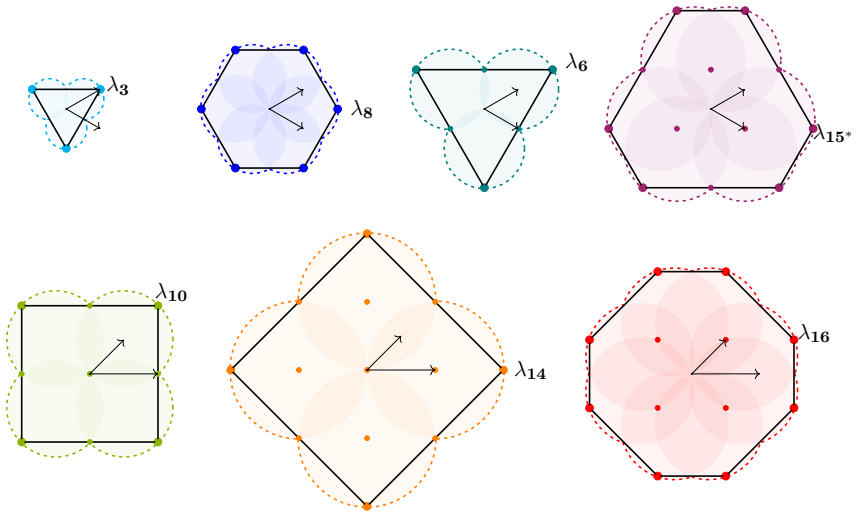
Assuming irreducible representations, only a finite list of symmetric moduli spaces and weight polytopes satisfy the Swampland Distance and Emergent String Conjectures.
A machine-rendered reading of the paper's core claim, the machinery that carries it, and where it could break.
Core claim
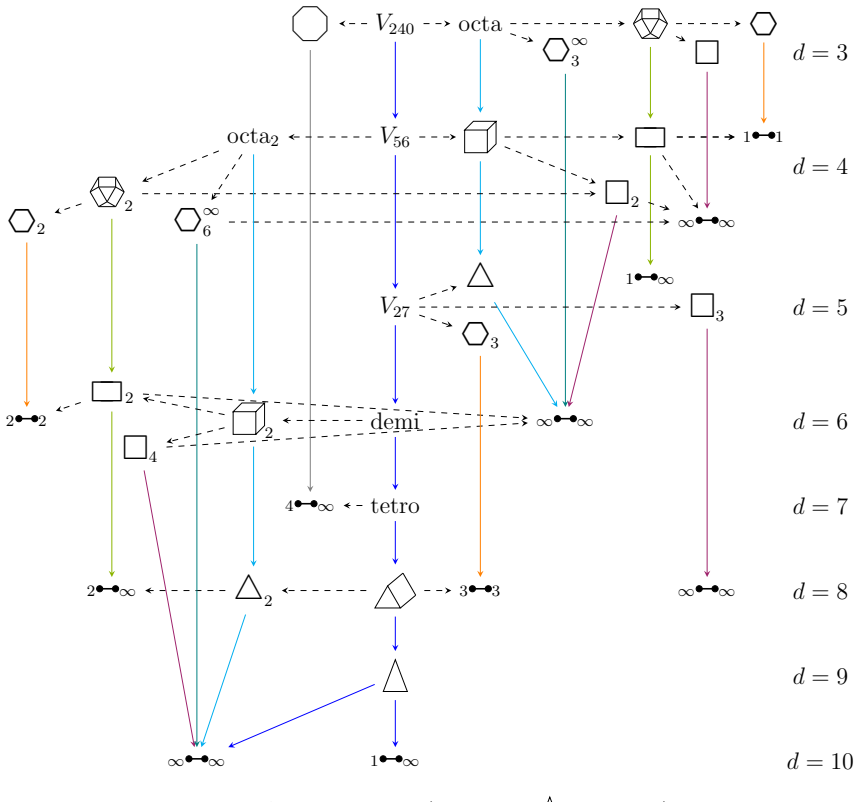
Under the assumption that particle states transform in irreducible representations, the symmetric moduli spaces compatible with the precise mass-decay rates demanded by the Emergent String Conjecture form a finite list; these spaces are related by embeddings or decompactification, most descend from the E8(8) theory via branching rules, yet three remain that cannot arise from string or M-theory compactifications, while the procedure also fixes the required string and brane representations.
What carries the argument
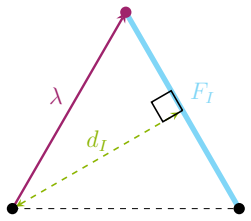
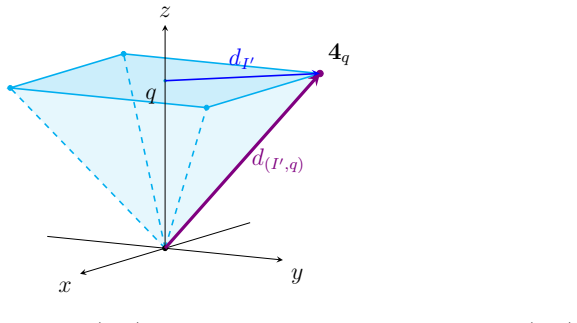
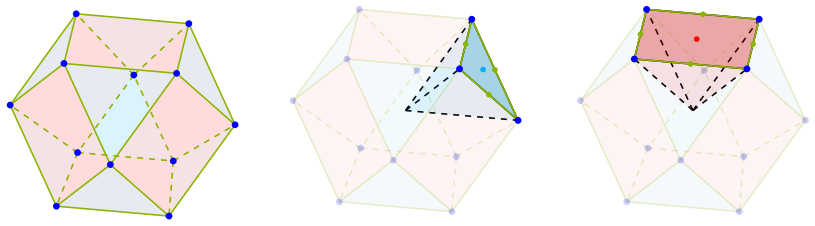
The weight polytope of an irreducible particle representation, which encodes the precise exponential decay rates required by the Swampland Distance Conjecture on a given symmetric moduli space.
If this is right
- All admissible EFTs are connected by moduli-space embeddings or decompactification limits.
- Branching rules under these embeddings must preserve the representation content.
- Most theories in the list arise from an underlying E8(8)-based EFT.
- Three specific cases in the finite list cannot be realized by M- or string-theory compactifications.
- The string and brane representations required in each spectrum are fixed by the same embedding procedure.
Where Pith is reading between the lines
- The finiteness result would imply that the landscape of symmetric-space EFTs consistent with these swampland conjectures is discrete and small.
- If the three exceptional cases truly cannot be realized, they would constitute concrete swampland exclusions beyond the distance conjecture itself.
- Relaxing the irreducible-representation assumption could enlarge the list or produce infinite families, providing a clear test of the assumption's necessity.
- The embedding relations suggest a partial order on the space of allowed EFTs that might extend to other classes of moduli spaces.
Load-bearing premise
That the particle states transform in an irreducible representation.
What would settle it
Explicit construction of a string or M-theory compactification that realizes one of the three exceptional symmetric moduli spaces with an irreducible representation whose decay rates match the conjecture.
Figures
read the original abstract
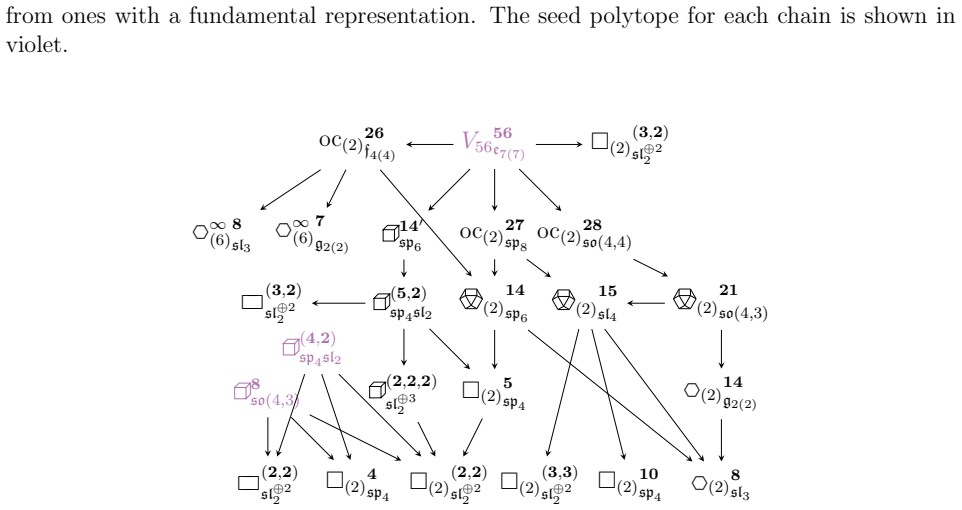
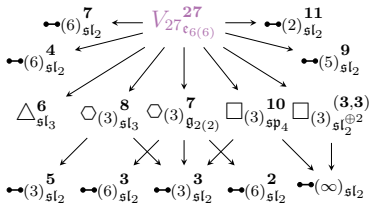
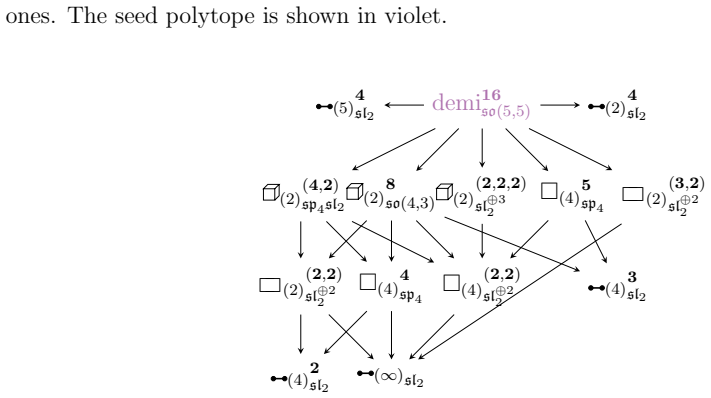
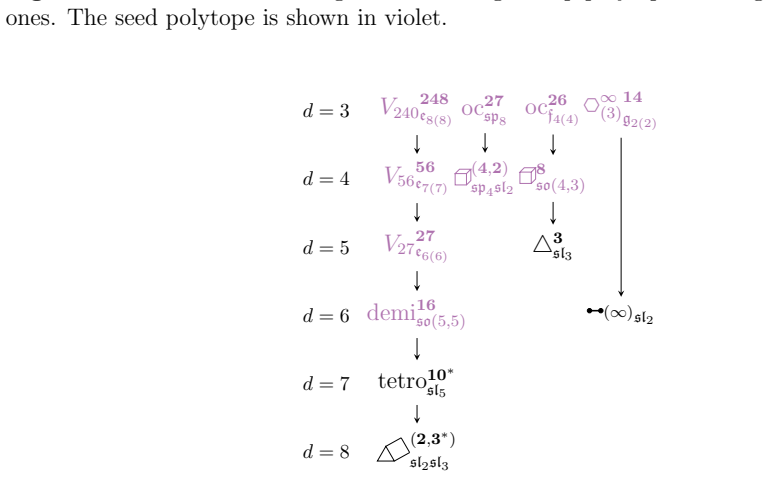
The Swampland Distance Conjecture (SDC) states that, for any infinite-distance limit in the moduli space of a quantum gravity effective field theory (EFT), there should exist an infinite tower of states that become exponentially light. According to the Emergent String Conjecture, such a tower should consist either of tensionless strings or of Kaluza-Klein modes, each with a mass-decay rate that depends in a precise way on the dimension of the effective field theory. In this paper, we use the results obtained in arXiv:2508.18401 on the SDC for symmetric moduli spaces and how these rates are encoded in the weight polytope of the corresponding particle-state representations to determine the symmetric space EFTs and representations that have these decay rates. Remarkably, assuming that the particle states transform in an irreducible representation, the list of possible polytopes and moduli spaces is finite. Different EFTs are related by embedding one moduli space in another or by taking a decompactification limit. Requiring compatibility of the particle representations under such branching, we find that, while most of the theories can be obtained from an EFT based on $E_{8(8)}$, there remain three in our list that appear to be impossible to get from M- or string-theory compactifications. Using the same embedding procedure, we also identify the string and brane representations that should be present in the spectrum.
Editorial analysis
A structured set of objections, weighed in public.
Referee Report
Summary. The manuscript classifies effective field theories with symmetric moduli spaces whose SDC mass-decay rates match those required by the Emergent String Conjecture, using the weight-polytope encoding established in arXiv:2508.18401. Under the explicit assumption that particle states transform in irreducible representations, the admissible polytopes and moduli spaces form a finite list. These theories are related by moduli-space embeddings or decompactification limits; branching rules under embeddings show that most cases descend from an E_{8(8)} EFT, while three cases cannot be realized in M- or string-theory compactifications. The work also identifies the string and brane representations required in the spectrum.
Significance. If the classification holds, the result supplies a concrete, finite list of symmetric-space EFTs consistent with the SDC, together with explicit swampland exclusions and required higher-dimensional objects. The use of embedding relations and branching rules to connect different theories is a methodological strength that could be applied more broadly. The manuscript gives credit to the prior polytope encoding and performs a systematic extension rather than a standalone derivation.
major comments (2)
- [Abstract] Abstract: the finiteness of the list of polytopes and the identification of three unrealizable cases are obtained only after restricting to irreducible representations so that weight polytopes are well-defined and branching rules can be applied. The manuscript states the restriction but supplies no argument that reducible representations are absent or reduce to the irreducible case while preserving the SDC decay rates; if reducible representations are admitted, the set of admissible polytopes need not remain finite and the embedding analysis could admit additional solutions.
- [Classification and embedding analysis] The classification and E_{8(8)} embedding procedure (described after the abstract): the compatibility checks and exclusion of the three cases rest entirely on the SDC rates and polytope encoding imported from arXiv:2508.18401 without re-derivation or independent verification of the weight-polytope matching in this work. This makes the load-bearing steps of the finiteness claim and the swampland exclusions dependent on the unexamined prior results.
Simulated Author's Rebuttal
We thank the referee for their careful reading and constructive comments on our manuscript. We respond point-by-point to the major comments below, indicating where revisions will be made.
read point-by-point responses
-
Referee: [Abstract] Abstract: the finiteness of the list of polytopes and the identification of three unrealizable cases are obtained only after restricting to irreducible representations so that weight polytopes are well-defined and branching rules can be applied. The manuscript states the restriction but supplies no argument that reducible representations are absent or reduce to the irreducible case while preserving the SDC decay rates; if reducible representations are admitted, the set of admissible polytopes need not remain finite and the embedding analysis could admit additional solutions.
Authors: We agree that the restriction to irreducible representations is essential for the weight-polytope formalism and branching rules from arXiv:2508.18401. While the manuscript states the assumption explicitly, we will add a clarifying paragraph in the introduction explaining that any reducible representation decomposes into irreducibles and that the SDC decay rate is governed by the irreducible component yielding the slowest decay (smallest exponent). This reduces the problem to the irreducible case without generating additional admissible polytopes, thereby preserving finiteness. We will also note this in the abstract for emphasis. revision: yes
-
Referee: [Classification and embedding analysis] The classification and E_{8(8)} embedding procedure (described after the abstract): the compatibility checks and exclusion of the three cases rest entirely on the SDC rates and polytope encoding imported from arXiv:2508.18401 without re-derivation or independent verification of the weight-polytope matching in this work. This makes the load-bearing steps of the finiteness claim and the swampland exclusions dependent on the unexamined prior results.
Authors: The manuscript is explicitly an application of the established polytope-encoding framework from arXiv:2508.18401 to classify symmetric-space EFTs and perform the embedding analysis. Our original contributions are the exhaustive enumeration under the irreducibility assumption, the systematic use of branching rules to connect theories, and the identification of the three swampland cases. We do not re-derive the prior results, as is standard for follow-up work, but we will add a concise summary of the relevant SDC-rate and polytope-matching statements from the reference (with explicit citations) in Section 2 to make the dependence transparent and self-contained. revision: partial
Circularity Check
No significant circularity; new classification extends prior encoding without tautological reduction
full rationale
The derivation begins from the SDC rates and polytope encoding imported from arXiv:2508.18401, then imposes the explicit assumption of irreducible representations to obtain finiteness of the list, followed by embedding/branching analysis to relate EFTs and flag three unrealizable cases. This chain does not reduce any output (the finite list, the E8(8) embeddings, or the exclusions) to the inputs by construction; the finiteness and compatibility checks are consequences of the stated assumption plus branching rules applied to the imported data. No self-definitional steps, fitted inputs renamed as predictions, or load-bearing self-citation chains appear. The work is self-contained against external benchmarks because the new results (the specific list and the three exclusions) are not equivalent to quantities already fixed in the cited paper.
Axiom & Free-Parameter Ledger
axioms (2)
- domain assumption Swampland Distance Conjecture holds and its rates are encoded in weight polytopes of representations
- domain assumption Emergent String Conjecture correctly specifies the allowed mass-decay rates for string and KK towers
Reference graph
Works this paper leans on
- [1]
-
[2]
The String Landscape and the Swampland
C. Vafa,The String landscape and the swampland,hep-th/0509212
work page internal anchor Pith review Pith/arXiv arXiv
-
[3]
T. D. Brennan, F. Carta, and C. Vafa,The String Landscape, the Swampland, and the Missing Corner,PoSTASI2017(2017) 015, [arXiv:1711.00864]
work page internal anchor Pith review Pith/arXiv arXiv 2017
-
[4]
The Swampland: Introduction and Review
E. Palti,The Swampland: Introduction and Review,Fortsch. Phys.67(2019), no. 6 1900037, [arXiv:1903.06239]
work page internal anchor Pith review Pith/arXiv arXiv 2019
- [5]
-
[6]
M. van Beest, J. Calder´ on-Infante, D. Mirfendereski, and I. Valenzuela,Lectures on the Swampland Program in String Compactifications,arXiv:2102.01111
-
[7]
M. Gra˜ na and A. Herr´ aez,The Swampland Conjectures: A Bridge from Quantum Gravity to Particle Physics,Universe7(2021), no. 8 273, [arXiv:2107.00087]
-
[8]
On the Geometry of the String Landscape and the Swampland
H. Ooguri and C. Vafa,On the Geometry of the String Landscape and the Swampland, Nucl. Phys. B766(2007) 21–33, [hep-th/0605264]
work page internal anchor Pith review Pith/arXiv arXiv 2007
-
[9]
Black Holes and Large N Species Solution to the Hierarchy Problem
G. Dvali,Black Holes and Large N Species Solution to the Hierarchy Problem,Fortsch. Phys.58(2010) 528–536, [arXiv:0706.2050]
work page internal anchor Pith review Pith/arXiv arXiv 2010
-
[10]
Black Hole Bound on the Number of Species and Quantum Gravity at LHC
G. Dvali and M. Redi,Black Hole Bound on the Number of Species and Quantum Gravity at LHC,Phys. Rev. D77(2008) 045027, [arXiv:0710.4344]
work page internal anchor Pith review Pith/arXiv arXiv 2008
-
[11]
Evaporation of Microscopic Black Holes in String Theory and the Bound on Species
G. Dvali and D. Lust,Evaporation of Microscopic Black Holes in String Theory and the Bound on Species,Fortsch. Phys.58(2010) 505–527, [arXiv:0912.3167]
work page internal anchor Pith review Pith/arXiv arXiv 2010
-
[12]
G. Dvali and C. Gomez,Species and Strings,arXiv:1004.3744
work page internal anchor Pith review Pith/arXiv arXiv
- [13]
-
[14]
Stout,Infinite Distance Limits and Information Theory,arXiv:2106.11313
J. Stout,Infinite Distance Limits and Information Theory,arXiv:2106.11313
-
[15]
Stout,Infinite Distances and Factorization,arXiv:2208.08444
J. Stout,Infinite Distances and Factorization,arXiv:2208.08444
-
[16]
J. Calder´ on-Infante, A. Castellano, A. Herr´ aez, and L. E. Ib´ a˜ nez,Entropy bounds and the species scale distance conjecture,JHEP01(2024) 039, [arXiv:2306.16450]. 66
-
[17]
S.-J. Lee, W. Lerche, and T. Weigand,Tensionless Strings and the Weak Gravity Conjecture,JHEP10(2018) 164, [arXiv:1808.05958]
work page internal anchor Pith review Pith/arXiv arXiv 2018
- [18]
-
[19]
M. Etheredge, B. Heidenreich, S. Kaya, Y. Qiu, and T. Rudelius,Sharpening the Distance Conjecture in diverse dimensions,JHEP12(2022) 114, [arXiv:2206.04063]
-
[20]
N. Gendler and I. Valenzuela,Merging the weak gravity and distance conjectures using BPS extremal black holes,JHEP01(2021) 176, [arXiv:2004.10768]
-
[21]
A. Bedroya and C. Vafa,Trans-Planckian Censorship and the Swampland,JHEP09 (2020) 123, [arXiv:1909.11063]
-
[22]
D. Andriot, N. Cribiori, and D. Erkinger,The web of swampland conjectures and the TCC bound,JHEP07(2020) 162, [arXiv:2004.00030]
- [23]
-
[24]
M. Etheredge, B. Heidenreich, J. McNamara, T. Rudelius, I. Ruiz, and I. Valenzuela, Running decompactification, sliding towers, and the distance conjecture,JHEP12 (2023) 182, [arXiv:2306.16440]
-
[25]
Alice in Warpland: KK modes, Warped Compactifications and the Swampland
S. Raucci, I. Ruiz, and I. Valenzuela,Alice in Warpland: KK modes, Warped Compactifications and the Swampland,arXiv:2603.11163
work page internal anchor Pith review Pith/arXiv arXiv
-
[26]
Sharpening the Weak Gravity Conjecture with Dimensional Reduction
B. Heidenreich, M. Reece, and T. Rudelius,Sharpening the Weak Gravity Conjecture with Dimensional Reduction,JHEP02(2016) 140, [arXiv:1509.06374]
work page internal anchor Pith review Pith/arXiv arXiv 2016
-
[27]
The Swampland Conjecture and F-term Axion Monodromy Inflation
R. Blumenhagen, I. Valenzuela, and F. Wolf,The Swampland Conjecture and F-term Axion Monodromy Inflation,JHEP07(2017) 145, [arXiv:1703.05776]
work page internal anchor Pith review Pith/arXiv arXiv 2017
- [28]
-
[29]
Emergence and the Swampland Conjectures
B. Heidenreich, M. Reece, and T. Rudelius,Emergence of Weak Coupling at Large Distance in Quantum Gravity,Phys. Rev. Lett.121(2018), no. 5 051601, [arXiv:1802.08698]
work page internal anchor Pith review Pith/arXiv arXiv 2018
-
[30]
The Refined Swampland Distance Conjecture in Calabi-Yau Moduli Spaces
R. Blumenhagen, D. Kl¨ awer, L. Schlechter, and F. Wolf,The Refined Swampland Distance Conjecture in Calabi-Yau Moduli Spaces,JHEP06(2018) 052, [arXiv:1803.04989]
work page internal anchor Pith review Pith/arXiv arXiv 2018
-
[31]
S.-J. Lee, W. Lerche, and T. Weigand,A Stringy Test of the Scalar Weak Gravity Conjecture,Nucl. Phys. B938(2019) 321–350, [arXiv:1810.05169]. 67
work page internal anchor Pith review Pith/arXiv arXiv 2019
-
[32]
Distance and de Sitter Conjectures on the Swampland
H. Ooguri, E. Palti, G. Shiu, and C. Vafa,Distance and de Sitter Conjectures on the Swampland,Phys. Lett. B788(2019) 180–184, [arXiv:1810.05506]
work page internal anchor Pith review Pith/arXiv arXiv 2019
-
[33]
P. Corvilain, T. W. Grimm, and I. Valenzuela,The Swampland Distance Conjecture for K¨ ahler moduli,JHEP08(2019) 075, [arXiv:1812.07548]
-
[34]
T. W. Grimm, C. Li, and E. Palti,Infinite Distance Networks in Field Space and Charge Orbits,JHEP03(2019) 016, [arXiv:1811.02571]
work page internal anchor Pith review Pith/arXiv arXiv 2019
-
[35]
G. Buratti, J. Calder´ on, and A. M. Uranga,Transplanckian axion monodromy!?, JHEP05(2019) 176, [arXiv:1812.05016]
- [36]
-
[37]
A. Joshi and A. Klemm,Swampland Distance Conjecture for One-Parameter Calabi-Yau Threefolds,JHEP08(2019) 086, [arXiv:1903.00596]
-
[38]
D. Erkinger and J. Knapp,Refined swampland distance conjecture and exotic hybrid Calabi-Yaus,JHEP07(2019) 029, [arXiv:1905.05225]
-
[39]
F. Marchesano and M. Wiesner,Instantons and infinite distances,JHEP08(2019) 088, [arXiv:1904.04848]
- [40]
-
[41]
F. Baume and J. Calder´ on Infante,Tackling the SDC in AdS with CFTs,JHEP08 (2021) 057, [arXiv:2011.03583]
-
[42]
E. Perlmutter, L. Rastelli, C. Vafa, and I. Valenzuela,A CFT distance conjecture, JHEP10(2021) 070, [arXiv:2011.10040]
-
[43]
D. Klaewer, S.-J. Lee, T. Weigand, and M. Wiesner,Quantum corrections in 4dN= 1 infinite distance limits and the weak gravity conjecture,JHEP03(2021) 252, [arXiv:2011.00024]
- [44]
- [45]
- [46]
-
[47]
Rudelius,Asymptotic scalar field cosmology in string theory,JHEP10(2022) 018, [arXiv:2208.08989]
T. Rudelius,Asymptotic scalar field cosmology in string theory,JHEP10(2022) 018, [arXiv:2208.08989]
-
[48]
F. Baume and J. Calder´ on-Infante,On higher-spin points and infinite distances in conformal manifolds,JHEP12(2023) 163, [arXiv:2305.05693]
-
[49]
Rudelius,Revisiting the refined Distance Conjecture,JHEP09(2023) 130, [arXiv:2303.12103]
T. Rudelius,Revisiting the refined Distance Conjecture,JHEP09(2023) 130, [arXiv:2303.12103]
-
[50]
R. ´Alvarez-Garc´ ıa, S.-J. Lee, and T. Weigand,Non-minimal elliptic threefolds at infinite distance. Part I. Log Calabi-Yau resolutions,JHEP08(2024) 240, [arXiv:2310.07761]
-
[51]
R. ´Alvarez-Garc´ ıa, S.-J. Lee, and T. Weigand,Non-minimal elliptic threefolds at infinite distance II: asymptotic physics,JHEP01(2025) 058, [arXiv:2312.11611]
-
[52]
A. Castellano, I. Ruiz, and I. Valenzuela,Stringy evidence for a universal pattern at infinite distance,JHEP06(2024) 037, [arXiv:2311.01536]
-
[53]
A. Castellano, I. Ruiz, and I. Valenzuela,Universal Pattern in Quantum Gravity at Infinite Distance,Phys. Rev. Lett.132(2024), no. 18 181601, [arXiv:2311.01501]
-
[54]
H. Ooguri and Y. Wang,Universal Bounds on CFT Distance Conjecture, arXiv:2405.00674
-
[55]
J. Calder´ on-Infante and I. Valenzuela,Tensionless String Limits in 4d Conformal Manifolds,arXiv:2410.07309
-
[56]
Exceptional Calabi--Yau spaces: the geometry of $\mathcal{N}=2$ backgrounds with flux
A. Ashmore and D. Waldram,Exceptional Calabi-Yau spaces: the geometry ofN= 2 backgrounds with flux,Fortsch. Phys.65(2017), no. 1 1600109, [arXiv:1510.00022]
work page internal anchor Pith review Pith/arXiv arXiv 2017
- [57]
-
[58]
B. Friedrich, J. Monnee, T. Weigand, and M. Wiesner,Emergent Strings in Type IIB Calabi–Yau Compactifications,arXiv:2504.01066
-
[59]
Backreacted Axion Field Ranges in String Theory
F. Baume and E. Palti,Backreacted Axion Field Ranges in String Theory,JHEP08 (2016) 043, [arXiv:1602.06517]
work page internal anchor Pith review Pith/arXiv arXiv 2016
-
[60]
Super-Planckian Spatial Field Variations and Quantum Gravity
D. Klaewer and E. Palti,Super-Planckian Spatial Field Variations and Quantum Gravity,JHEP01(2017) 088, [arXiv:1610.00010]
work page internal anchor Pith review Pith/arXiv arXiv 2017
-
[61]
M. Etheredge and B. Heidenreich,Geodesic Gradient Flows in Moduli Space, arXiv:2311.18693. 69
-
[62]
M. Etheredge, B. Heidenreich, T. Rudelius, I. Ruiz, and I. Valenzuela,Taxonomy of Infinite Distance Limits,arXiv:2405.20332
-
[63]
M. Etheredge,Dense geodesics, tower alignment, and the Sharpened Distance Conjecture,JHEP01(2024) 122, [arXiv:2308.01331]
-
[64]
EFT strings and dualities in 4d $\mathcal{N}=1$
A. Grieco, I. Ruiz, and I. Valenzuela,EFT strings and dualities in 4dN= 1, arXiv:2504.16984
work page internal anchor Pith review Pith/arXiv arXiv
-
[65]
M. Etheredge, B. Heidenreich, and T. Rudelius,A Distance Conjecture for Branes, arXiv:2407.20316
-
[66]
Etheredge,Taxonomy of branes in infinite distance limits,arXiv:2505.10615
M. Etheredge,Taxonomy of branes in infinite distance limits,arXiv:2505.10615
-
[67]
M. Delgado, D. van de Heisteeg, S. Raman, E. Torres, C. Vafa, and K. Xu,Finiteness and the Emergence of Dualities,arXiv:2412.03640
-
[68]
G. A. Margulis,Discrete Subgroups of Semisimple Lie Groups, vol. 17 ofErgebnisse der Mathematik und ihrer Grenzgebiete (3) [Results in Mathematics and Related Areas (3)]. Springer-Verlag, Berlin, 1991
1991
- [69]
-
[70]
Cribiori and D
N. Cribiori and D. Lust,String dualities and modular symmetries in supergravity: a review, 11, 2024
2024
-
[71]
J. Calder´ on-Infante, A. M. Uranga, and I. Valenzuela,The Convex Hull Swampland Distance Conjecture and Bounds on Non-geodesics,JHEP03(2021) 299, [arXiv:2012.00034]
-
[72]
B. C. Hall,Lie Groups, Lie Algebras, and Representations: An Elementary Introduction, vol. 222 ofGraduate Texts in Mathematics. Springer, New York, 2nd ed., 2003
2003
-
[73]
Satake,On representations and compactifications of symmetric riemannian spaces, Annals of Mathematics71(1960), no
I. Satake,On representations and compactifications of symmetric riemannian spaces, Annals of Mathematics71(1960), no. 1 77–110
1960
-
[74]
Dhillon and A
G. Dhillon and A. Khare,Faces of highest weight modules and the universal weyl polyhedron,Advances in Mathematics319(2017) 111–152
2017
-
[75]
Gosset,On the regular and semi-regular figures in space of n dimensions,Messenger of Mathematics29(1900) 43–48
T. Gosset,On the regular and semi-regular figures in space of n dimensions,Messenger of Mathematics29(1900) 43–48
1900
-
[76]
Blind and R
G. Blind and R. Blind,The semiregular polytopes,Commentarii Mathematici Helvetici 66(1991), no. 1 150–154. 70
1991
-
[77]
Niven,Irrational numbers, vol
I. Niven,Irrational numbers, vol. No. 11 ofThe Carus Mathematical Monographs. Mathematical Association of America, ; distributed by John Wiley & Sons, Inc., New York, 1956
1956
-
[78]
Berndt and C
J. Berndt and C. Olmos,The index conjecture for symmetric spaces, 2020
2020
-
[79]
A. Kollross and A. Rodr´ ıguez-V´ azquez,Totally geodesic submanifolds in exceptional symmetric spaces,arXiv:2202.10775
-
[80]
F. I. Karpelevich,Surfaces of transitivity of semisimple group of motions of a symmetric space,Dokl. Akad. Nauk93(1953) 401–404
1953
discussion (0)
Sign in with ORCID, Apple, or X to comment. Anyone can read and Pith papers without signing in.