REVIEW 2 major objections 2 references
Why LLMs Hallucinate on Structured Knowledge: A Mechanistic Analysis of Reasoning over Linearized Representations
T0 review · 2 major / 0 minor · reviewed 2026-06-29 · grok-4.3
Pith's one-line read LLMs hallucinate on linearized graphs and tables because attention locks onto structural shortcuts while feed-forward layers fail to ground the supplied knowledge.
desk verdict The paper documents consistent correlations between attention concentration on structural shortcuts, feed-forward grounding failures, and hallucinations on linearized graphs/tables, but provides no causal tests. read the letter →
The pith
A machine-rendered reading of the paper's core claim, the machinery that carries it, and where it could break.
The reading
What carries the argument
The paired internal dynamics of attention concentration on shortcut structural cues and semantic-grounding failure inside feed-forward layers when processing linearized structured inputs.
What would settle it
A controlled intervention that forces attention to distribute evenly across the full context or forces feed-forward layers to bind the external knowledge, followed by a drop in hallucination rate on the same inputs, would support the claim; no drop would undermine it.
Extended reading notes
Core claim
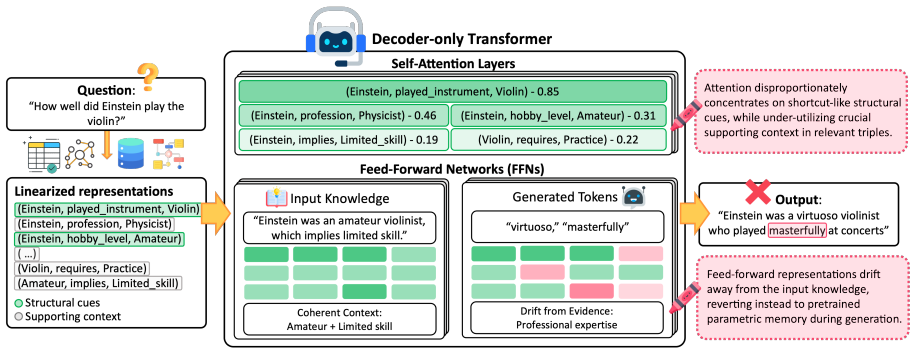
Hallucinations arise from systematic internal dynamics rather than random noise. Attention disproportionately concentrates toward shortcut-like structural cues rather than distributing across the full context. Feed-forward representations fail to ground the provided knowledge, causing the model to revert to parametric memory. Hallucination is consistently associated with failures in semantic grounding within feed-forward layers, while attention allocation exhibits greater task-dependent variability. These mechanistic patterns generalize beyond single-hop graphs to multi-hop and tabular settings.
Load-bearing premise
The measured associations between attention shortcuts, feed-forward grounding failures, and hallucinated outputs reflect causal mechanisms rather than mere correlations.
Editorial extensions
If this is right
- Hallucination is tied more reliably to feed-forward grounding failures than to variability in attention patterns.
- The identified dynamics appear in single-hop graphs, multi-hop graphs, and tabular data alike.
- The patterns support detection of likely hallucinations across different structured-knowledge formats.
- Models default to parametric memory once the supplied knowledge is not grounded in feed-forward representations.
Reading between the lines
- Targeted changes to how feed-forward layers integrate external tokens could reduce reliance on parametric memory.
- Detection methods based on monitoring feed-forward grounding signals may transfer to new structured-input formats.
- The task-dependent nature of attention suggests that mitigation strategies focused only on attention may need per-task tuning.
Editorial analysis
A structured set of objections, weighed in public.
Referee Report
Summary. The paper claims that hallucinations in LLMs when reasoning over linearized structured knowledge (graphs, tables) arise from systematic internal dynamics rather than random noise: attention disproportionately concentrates on shortcut-like structural cues instead of the full context, and feed-forward representations fail to ground the provided knowledge, causing reversion to parametric memory. Hallucination is consistently associated with failures in semantic grounding within feed-forward layers (with attention allocation showing greater task-dependent variability), and these patterns generalize beyond single-hop graphs to multi-hop and tabular settings, supporting hallucination detection.
Significance. If the reported associations hold under scrutiny, the work provides mechanistic insights into LLM failures on knowledge-grounded tasks and identifies patterns that could support improved detection across structured formats. The generalization claim across single-hop, multi-hop, and tabular settings is a potential strength if supported by consistent measurements. However, the absence of causal tests limits the ability to conclude that the identified dynamics drive hallucinations.
major comments (2)
- [Abstract] Abstract: the central claims that hallucinations 'arise from' specific internal dynamics and that patterns 'generalize' and 'enable effective hallucination detection' are stated without any experimental details, dataset descriptions, controls, or statistical tests, so the robustness of the measurements cannot be assessed.
- [Experimental results] Experimental results (throughout): the manuscript reports consistent associations between attention concentration on structural cues, feed-forward grounding failures, and hallucinated outputs across settings, but describes only observational measurements of attention weights and representation similarity; no activation patching, attention ablation, or representation editing experiments are described that would test whether altering those dynamics changes hallucination rates on held-out examples with fixed input knowledge.
Simulated Author's Rebuttal
We thank the referee for the constructive comments. Our work is observational in nature, identifying consistent associations between internal model dynamics and hallucination rates. We address the points below by proposing targeted revisions to language and presentation while preserving the reported measurements.
read point-by-point responses
-
Referee: [Abstract] Abstract: the central claims that hallucinations 'arise from' specific internal dynamics and that patterns 'generalize' and 'enable effective hallucination detection' are stated without any experimental details, dataset descriptions, controls, or statistical tests, so the robustness of the measurements cannot be assessed.
Authors: We agree the abstract uses high-level phrasing without experimental specifics. We will revise it to replace causal language ('arise from') with 'are associated with', note the three settings studied (single-hop graphs, multi-hop graphs, tables), and indicate that detection results are based on the reported correlations. Full dataset descriptions, controls, and statistical details remain in Sections 3–5 of the main text. revision: yes
-
Referee: [Experimental results] Experimental results (throughout): the manuscript reports consistent associations between attention concentration on structural cues, feed-forward grounding failures, and hallucinated outputs across settings, but describes only observational measurements of attention weights and representation similarity; no activation patching, attention ablation, or representation editing experiments are described that would test whether altering those dynamics changes hallucination rates on held-out examples with fixed input knowledge.
Authors: The referee is correct that the study relies on observational measurements (attention weights, representation similarity) rather than causal interventions. We will revise the manuscript throughout to consistently describe the findings as associations and correlations, remove any implication that the dynamics are shown to drive hallucinations, and explicitly note the absence of patching or ablation experiments as a limitation. The strength of the work lies in the consistent patterns observed across three distinct structured-knowledge formats; we do not claim these patterns have been causally validated. revision: yes
Circularity Check
No circularity: purely empirical observational study
full rationale
The paper reports mechanistic observations from attention and representation measurements across graph and table tasks. No equations, parameter fits, derivations, or self-citation chains appear in the provided abstract or described results. All claims are framed as consistent associations between internal dynamics and hallucination outputs rather than quantities defined in terms of themselves or predictions forced by fitted inputs. This is the standard case of an empirical paper whose central content does not reduce to its own inputs by construction.
Assumptions & free parameters
Cite this review
Pith. "Pith review of Why LLMs Hallucinate on Structured Knowledge: A Mechanistic Analysis of Reasoning over Linearized Representations." pith.science (2026). https://pith.science/paper/BDCWMAH7
@misc{pith2026260526362,
  author       = {Pith},
  title        = {Pith review of: Why LLMs Hallucinate on Structured Knowledge: A Mechanistic Analysis of Reasoning over Linearized Representations},
  year         = {2026},
  howpublished = {\url{https://pith.science/paper/BDCWMAH7}},
  note         = {Machine review of arXiv:2605.26362}
}
read the original abstract
In many reasoning tasks, large language models (LLMs) rely on structured external knowledge, such as graphs and tables, which is typically linearized into sequential token representations. However, even when sufficient knowledge is available, LLMs can still produce hallucinated outputs, and the underlying mechanisms behind such failures remain poorly understood. We investigate these mechanisms and find that hallucinations arise from systematic internal dynamics rather than random noise. First, attention disproportionately concentrates toward shortcut-like structural cues rather than distributing across the full context. Second, feed-forward representations fail to ground the provided knowledge, causing the model to revert to parametric memory. Moreover, our results indicate that hallucination is consistently associated with failures in semantic grounding within feed-forward layers, while attention allocation exhibits greater task-dependent variability. Finally, we show that these mechanistic patterns generalize beyond single-hop graphs to multi-hop and tabular settings, enabling effective hallucination detection across structured knowledge formats.
Figures


Figures from the paper (2 more)


Reference graph
Works this paper leans on
-
[1]
the moon is made of marshmallows
KG-GPT: A general framework for reasoning on knowledge graphs using large language models. InFindings of the Association for Computational Lin- guistics: EMNLP 2023, pages 9410–9421, Singapore. Association for Computational Linguistics. Goro Kobayashi, Tatsuki Kuribayashi, Sho Yokoi, and Kentaro Inui. 2024. Analyzing feed-forward blocks in transformers th...
-
[2]
Alon Talmor and Jonathan Berant
Redeep: Detecting hallucination in retrieval- augmented generation via mechanistic interpretabil- ity.arXiv preprint arXiv:2410.11414. Alon Talmor and Jonathan Berant. 2018. The web as a knowledge-base for answering complex questions. InProceedings of the 2018 Conference of the North American Chapter of the Association for Computa- tional Linguistics: Hum...
Reviewed June 29, 2026 · model on record in the stance chip above.
Discussion (0). Sign in to comment.