Search for a new heavy scalar resonance decaying to a pair of Z bosons in the four-lepton final state in proton-proton collisions at sqrt{s} = 13 TeV
Pith reviewed 2026-07-01 16:49 UTC · model grok-4.3
The pith
No significant excess is observed in the search for a new heavy scalar resonance decaying to two Z bosons in four-lepton events.
A machine-rendered reading of the paper's core claim, the machinery that carries it, and where it could break.
Core claim
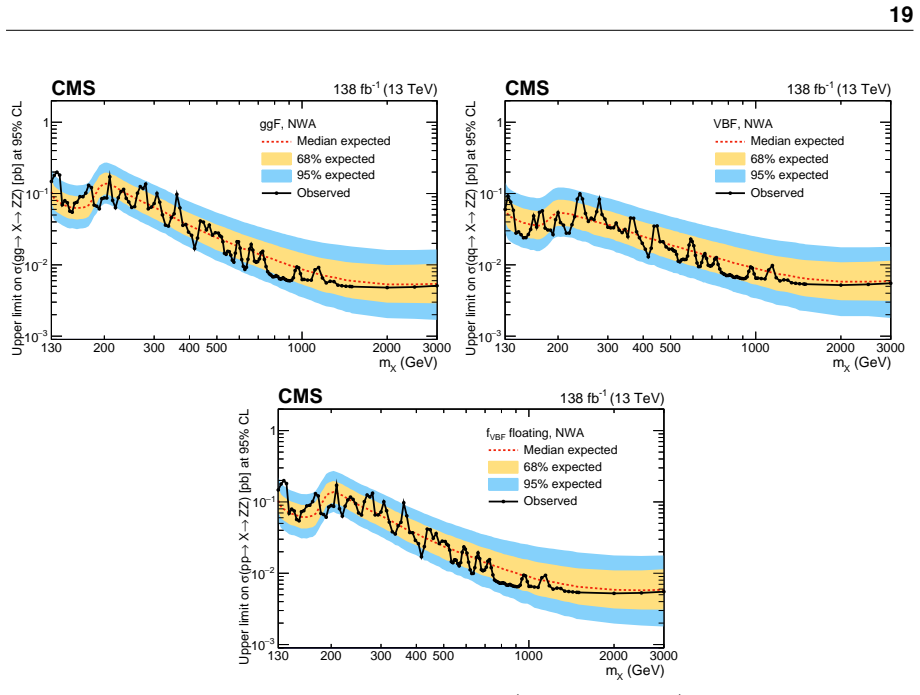
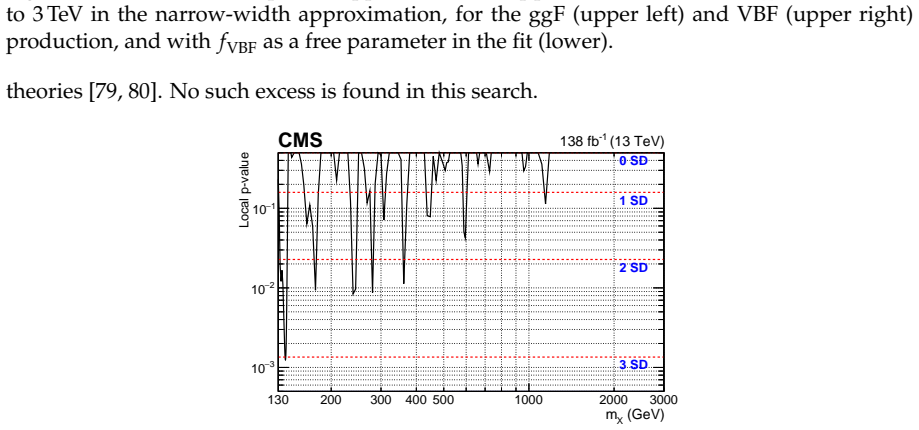
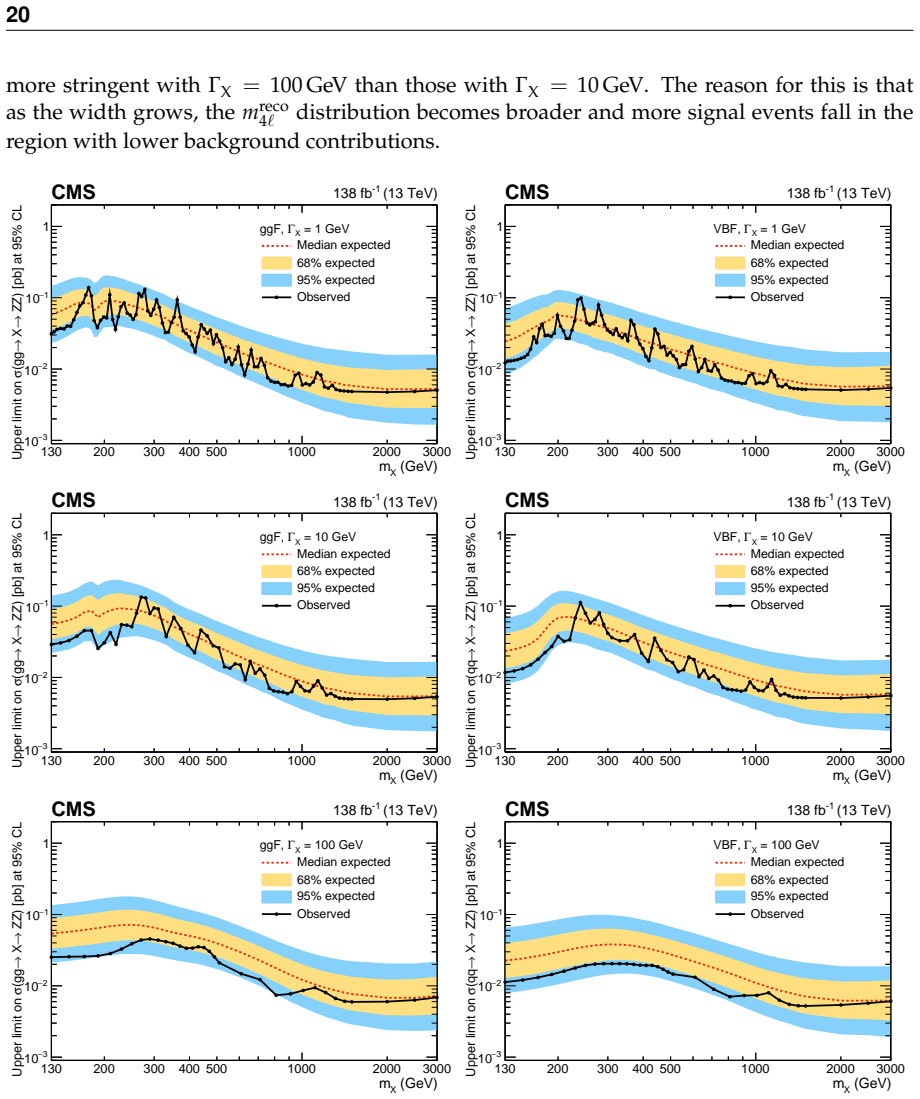
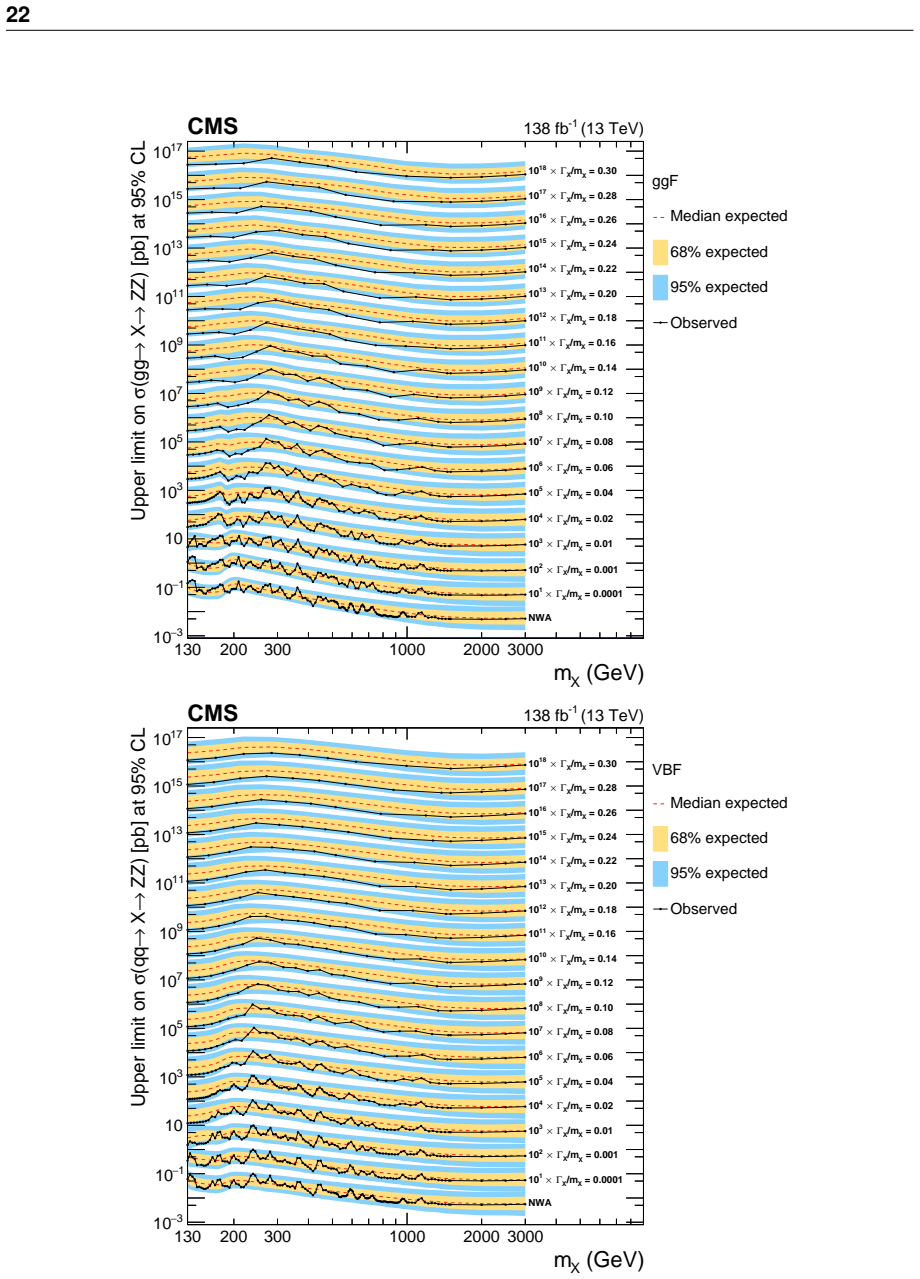
The search finds no significant excess with respect to the standard model background expectation in the examined phase space. Upper limits at the 95 percent confidence level are set on the product of the heavy scalar resonance production cross section and the branching fraction for its decay into two Z bosons. The exclusion limits range from 0.05 to 0.1 pb in the low-mass region to 0.00 pb in the high-mass region.
What carries the argument
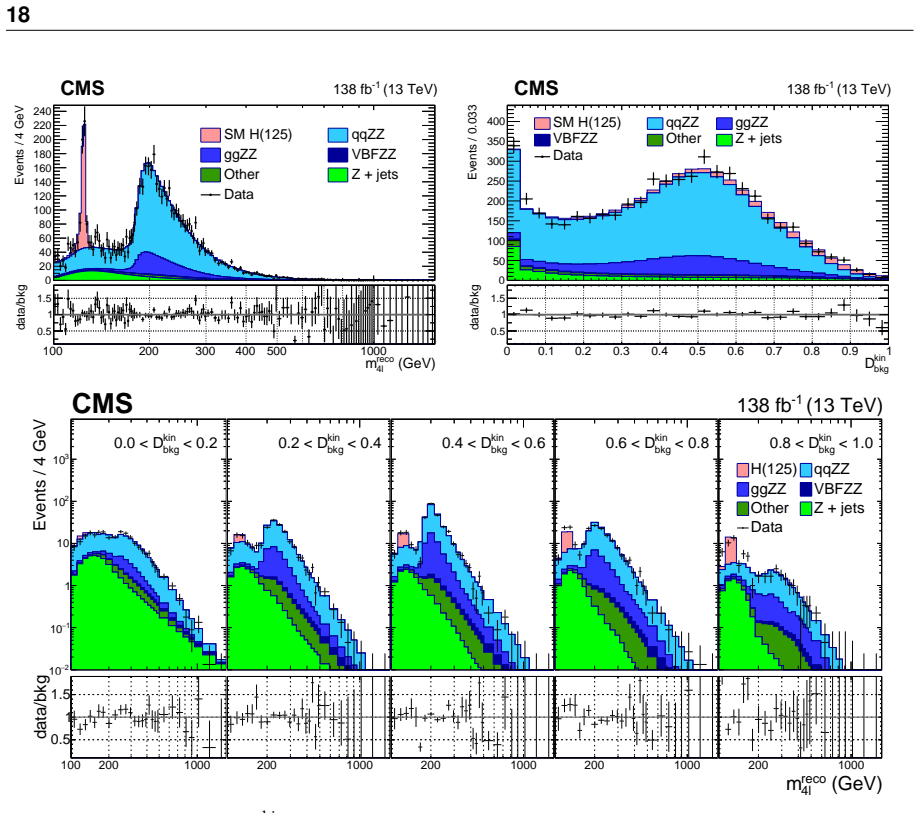
Comparison of the four-lepton invariant mass distribution in data against modeled standard model backgrounds to extract statistical upper limits on possible resonant signals.
If this is right
- Any new heavy scalar must have a production cross section times branching fraction to ZZ below the reported limits across the mass range.
- Both gluon-fusion and vector-boson-fusion production modes for such a resonance are constrained by the same limits.
- Broad-width scenarios including interference with the 125 GeV Higgs boson are also excluded at the stated levels.
- The standard model description of four-lepton events remains consistent with observation up to 3 TeV resonance masses.
Where Pith is reading between the lines
- These limits can be combined with results from other decay channels to further restrict models containing additional scalar particles.
- Higher integrated luminosity at future collider runs would directly improve the sensitivity in the same final state.
- The analysis methods for handling interference in broad resonances provide a template for similar searches in other final states.
Load-bearing premise
The standard model background processes in the four-lepton final state are modeled with sufficient accuracy that any deviation would be attributable to a new resonance rather than mismodeling or unaccounted systematic effects.
What would settle it
A statistically significant excess appearing in the four-lepton invariant mass spectrum above the predicted standard model background in this dataset.
Figures
read the original abstract
A search for a new heavy scalar resonance decaying to two Z bosons, each subsequently decaying to a pair of electrons or muons, is presented. The results are based on a proton-proton collision data set collected by the CMS experiment at the LHC at a center-of-mass energy of 13 TeV, corresponding to an integrated luminosity of 138 fb$^{-1}$. The search is performed over a wide range of resonance masses from 130 GeV to 3 TeV, considering both narrow- and broad-width scenarios, and considering the gluon fusion and vector boson fusion production processes. For the broad-width scenario, the interference between the new resonance, the 125 GeV Higgs boson production, and the continuum background is taken into account. No significant excess with respect to the standard model background expectation is observed in the examined phase space. Upper limits at the 95% confidence level are set on the product of the heavy scalar resonance production cross section and the branching fraction for its decay into two Z bosons. The exclusion limits range from 0.05$-$0.1 pb in the low-mass region to 0.00 pb in the high-mass region.
Editorial analysis
A structured set of objections, weighed in public.
Referee Report
Summary. The manuscript reports results from a search for a new heavy scalar resonance decaying to ZZ (with each Z to leptons) in the four-lepton final state. Using 138 fb^{-1} of 13 TeV pp collision data collected by CMS, the analysis covers resonance masses from 130 GeV to 3 TeV in both narrow- and broad-width scenarios, for gluon-fusion and vector-boson-fusion production modes. Interference with the 125 GeV Higgs and SM continuum is included for the broad-width case. No significant excess above the SM background expectation is observed, and 95% CL upper limits are placed on the product of production cross section and branching fraction to ZZ, ranging from 0.05-0.1 pb at low mass to 0 pb at high mass.
Significance. This is a standard, high-luminosity null-result search in a well-understood final state. When the background modeling and systematic treatment are accurate, the limits provide useful constraints on extended Higgs sectors. The explicit inclusion of interference effects for broad resonances and the use of established CMS statistical procedures (profile likelihood fits with data-driven corrections) are strengths that increase the robustness of the reported exclusion.
minor comments (2)
- [Results section] Figure 5 (or equivalent limit plot): the caption should explicitly state whether the shown curves include or exclude the interference term for the broad-width hypothesis, to avoid reader ambiguity when comparing to theory predictions.
- [Section 4] Section 4 (background estimation): the text states that ZZ continuum is modeled with MC plus data-driven corrections, but a short sentence quantifying the size of the correction in the high-mass tail would improve transparency.
Simulated Author's Rebuttal
We thank the referee for their positive assessment of the manuscript, recognition of its strengths in background modeling and statistical procedures, and recommendation to accept. No major comments were provided for response.
Circularity Check
No circularity: standard experimental limit-setting from data
full rationale
This is a standard CMS experimental search paper reporting observed data compared to SM background predictions in the four-lepton channel. The central results (no excess observed; 95% CL upper limits on σ × B ranging 0.05–0.1 pb to 0 pb) are obtained via profile likelihood fits to data using MC-simulated backgrounds with data-driven corrections and established systematic uncertainties. No equations, self-citations, or ansatze reduce the reported limits to quantities defined by the result itself; the statistical procedure and background modeling are independent of the final limit values and remain externally falsifiable.
Axiom & Free-Parameter Ledger
axioms (1)
- domain assumption Standard model processes accurately predict the background rate and shape in the four-lepton final state after all selections.
Reference graph
Works this paper leans on
-
[1]
ATLAS Collaboration, “Observation of a new particle in the search for the standard model Higgs boson with the ATLAS detector at the LHC”,Phys. Lett. B716(2012) 1, doi:10.1016/j.physletb.2012.08.020,arXiv:1207.7214
work page internal anchor Pith review Pith/arXiv arXiv doi:10.1016/j.physletb.2012.08.020 2012
-
[2]
Observation of a new boson at a mass of 125 GeV with the CMS experiment at the LHC
CMS Collaboration, “Observation of a new boson at a mass of 125 GeV with the CMS experiment at the LHC”,Phys. Lett. B716(2012) 30, doi:10.1016/j.physletb.2012.08.021,arXiv:1207.7235
work page internal anchor Pith review Pith/arXiv arXiv doi:10.1016/j.physletb.2012.08.021 2012
-
[3]
Observation of a new boson with mass near 125 GeV in pp collisions at sqrt(s) = 7 and 8 TeV
CMS Collaboration, “Observation of a new boson with mass near 125 GeV in pp collisions at √s=7 and 8 TeV”,JHEP06(2013) 81,doi:10.1007/JHEP06(2013)081, arXiv:1303.4571. References 25
work page internal anchor Pith review Pith/arXiv arXiv doi:10.1007/jhep06(2013)081 2013
-
[4]
Theory and phenomenology of two-Higgs-doublet models
G. C. Branco et al., “Theory and phenomenology of two-Higgs-doublet models”,Phys. Rept.516(2012) 1,doi:10.1016/j.physrep.2012.02.002,arXiv:1106.0034
work page internal anchor Pith review Pith/arXiv arXiv doi:10.1016/j.physrep.2012.02.002 2012
-
[5]
A Large Mass Hierarchy from a Small Extra Dimension
L. Randall and R. Sundrum, “Large mass hierarchy from a small extra dimension”,Phys. Rev. Lett.83(1999) 3370,doi:10.1103/PhysRevLett.83.3370, arXiv:hep-ph/9905221
work page internal anchor Pith review Pith/arXiv arXiv doi:10.1103/physrevlett.83.3370 1999
-
[6]
Modulus Stabilization with Bulk Fields
W. D. Goldberger and M. B. Wise, “Modulus stabilization with bulk fields”,Phys. Rev. Lett.83(1999) 4922,doi:10.1103/PhysRevLett.83.4922, arXiv:hep-ph/9907447
work page internal anchor Pith review Pith/arXiv arXiv doi:10.1103/physrevlett.83.4922 1999
-
[7]
Gravity particles from Warped Extra Dimensions, predictions for LHC
A. Carvalho, “Gravity particles from warped extra dimensions, predictions for LHC”, 2018.arXiv:1404.0102
work page internal anchor Pith review Pith/arXiv arXiv 2018
-
[8]
Search for a Higgs boson in the mass range from 145 to 1000 GeV decaying to a pair of W or Z bosons
CMS Collaboration, “Search for a Higgs boson in the mass range from 145 to 1000 GeV decaying to a pair of W or Z bosons”,JHEP10(2015) 144, doi:10.1007/JHEP10(2015)144,arXiv:1504.00936
work page internal anchor Pith review Pith/arXiv arXiv doi:10.1007/jhep10(2015)144 2015
-
[9]
CMS Collaboration, “Search for a new scalar resonance decaying to a pair of Z bosons in proton-proton collisions at √s=13 TeV”,JHEP06(2018) 127, doi:10.1007/JHEP06(2018)127,arXiv:1804.01939
work page internal anchor Pith review Pith/arXiv arXiv doi:10.1007/jhep06(2018)127 2018
-
[10]
ATLAS Collaboration, “Search for an additional, heavy Higgs boson in theh→zzdecay channel at √s=8 TeV inppcollision data with the ATLAS detector”,Eur. Phys. J. C76 (2016) 45,doi:10.1140/epjc/s10052-015-3820-z,arXiv:1507.05930
work page internal anchor Pith review Pith/arXiv arXiv doi:10.1140/epjc/s10052-015-3820-z 2016
-
[11]
ATLAS Collaboration, “Search for heavy resonances decaying into a pair of Z bosons in theℓ +ℓ−ℓ′+ℓ′− andℓ +ℓ−ν ¯νfinal states using 139 fb −1 of proton–proton collisions at√s=13 TeV with the ATLAS detector”,Eur. Phys. J. C81(2021) 332, doi:10.1140/epjc/s10052-021-09013-y,arXiv:2009.14791
-
[12]
HEPData record for this analysis, 2026.doi:10.17182/hepdata.172455
-
[13]
The CMS experiment at the CERN LHC
CMS Collaboration, “The CMS experiment at the CERN LHC”,JINST3(2008) S08004, doi:10.1088/1748-0221/3/08/S08004
-
[14]
Development of the CMS detector for the CERN LHC Run 3
CMS Collaboration, “Development of the CMS detector for the CERN LHC Run 3”, JINST19(2024) P05064,doi:10.1088/1748-0221/19/05/P05064, arXiv:2309.05466
-
[15]
Performance of the CMS Level-1 trigger in proton-proton collisions at √s=13 TeV
CMS Collaboration, “Performance of the CMS Level-1 trigger in proton-proton collisions at √s=13 TeV”,JINST15(2020) P10017,doi:10.1088/1748-0221/15/10/P10017, arXiv:2006.10165
-
[16]
CMS Collaboration, “The CMS trigger system”,JINST12(2017) P01020, doi:10.1088/1748-0221/12/01/P01020,arXiv:1609.02366
work page internal anchor Pith review Pith/arXiv arXiv doi:10.1088/1748-0221/12/01/p01020 2017
-
[17]
Performance of the CMS high-level trigger during LHC Run 2
CMS Collaboration, “Performance of the CMS high-level trigger during LHC Run 2”, JINST19(2024) P11021,doi:10.1088/1748-0221/19/11/P11021, arXiv:2410.17038
-
[18]
Electron and photon reconstruction and identification with the CMS experiment at the CERN LHC
CMS Collaboration, “Electron and photon reconstruction and identification with the CMS experiment at the CERN LHC”,JINST16(2021) P05014, doi:10.1088/1748-0221/16/05/P05014,arXiv:2012.06888. 26
-
[19]
CMS Collaboration, “Performance of the CMS muon detector and muon reconstruction with proton-proton collisions at √s=13 TeV”,JINST13(2018) P06015, doi:10.1088/1748-0221/13/06/P06015,arXiv:1804.04528
work page internal anchor Pith review Pith/arXiv arXiv doi:10.1088/1748-0221/13/06/p06015 2018
-
[20]
Description and performance of track and primary-vertex reconstruction with the CMS tracker
CMS Collaboration, “Description and performance of track and primary-vertex reconstruction with the CMS tracker”,JINST9(2014) P10009, doi:10.1088/1748-0221/9/10/P10009,arXiv:1405.6569
work page internal anchor Pith review Pith/arXiv arXiv doi:10.1088/1748-0221/9/10/p10009 2014
-
[21]
Precision luminosity measurement in proton-proton collisions at√s=13 TeV in 2015 and 2016 at CMS
CMS Collaboration, “Precision luminosity measurement in proton-proton collisions at√s=13 TeV in 2015 and 2016 at CMS”,Eur. Phys. J. C81(2021) 800, doi:10.1140/epjc/s10052-021-09538-2,arXiv:2104.01927
-
[22]
CMS luminosity measurement for the 2017 data-taking period at√s=13 TeV
CMS Collaboration, “CMS luminosity measurement for the 2017 data-taking period at√s=13 TeV”, CMS Physics Analysis Summary CMS-PAS-LUM-17-004, 2018
2017
-
[23]
CMS luminosity measurement for the 2018 data-taking period at√s=13 TeV
CMS Collaboration, “CMS luminosity measurement for the 2018 data-taking period at√s=13 TeV”, CMS Physics Analysis Summary CMS-PAS-LUM-18-002, 2019
2018
-
[24]
CMS Collaboration, “Measurements of production cross sections of the Higgs boson in the four-lepton final state in proton–proton collisions at √s=13 TeV”,Eur. Phys. J. C81 (2021) 488,doi:10.1140/epjc/s10052-021-09200-x,arXiv:2103.04956
-
[25]
Measurement of the Inclusive W and Z Production Cross Sections in pp Collisions at sqrt(s) = 7 TeV
CMS Collaboration, “Measurement of the inclusive W and Z production cross sections in pp collisions at √s=7 TeV with the CMS experiment”,JHEP10(2011) 132, doi:10.1007/JHEP10(2011)132,arXiv:1107.4789
work page internal anchor Pith review Pith/arXiv arXiv doi:10.1007/jhep10(2011)132 2011
-
[26]
NLO vector-boson production matched with shower in POWHEG
S. Alioli, P . Nason, C. Oleari, and E. Re, “NLO vector-boson production matched with shower in POWHEG”,JHEP07(2008) 060, doi:10.1088/1126-6708/2008/07/060,arXiv:0805.4802
work page internal anchor Pith review Pith/arXiv arXiv doi:10.1088/1126-6708/2008/07/060 2008
-
[27]
A New Method for Combining NLO QCD with Shower Monte Carlo Algorithms
P . Nason, “A new method for combining NLO QCD with shower Monte Carlo algorithms”,JHEP11(2004) 040,doi:10.1088/1126-6708/2004/11/040, arXiv:hep-ph/0409146
work page internal anchor Pith review Pith/arXiv arXiv doi:10.1088/1126-6708/2004/11/040 2004
-
[28]
Matching NLO QCD computations with Parton Shower simulations: the POWHEG method
S. Frixione, P . Nason, and C. Oleari, “Matching NLO QCD computations with parton shower simulations: the POWHEG method”,JHEP11(2007) 070, doi:10.1088/1126-6708/2007/11/070,arXiv:0709.2092
work page internal anchor Pith review Pith/arXiv arXiv doi:10.1088/1126-6708/2007/11/070 2007
-
[29]
Spin determination of single-produced resonances at hadron colliders
Y. Gao et al., “Spin determination of single-produced resonances at hadron colliders”, Phys. Rev. D81(2010) 075022,doi:10.1103/PhysRevD.81.075022, arXiv:1001.3396
work page internal anchor Pith review Pith/arXiv arXiv doi:10.1103/physrevd.81.075022 2010
-
[30]
On the spin and parity of a single-produced resonance at the LHC
S. Bolognesi et al., “Spin and parity of a single-produced resonance at the LHC”,Phys. Rev. D86(2012) 095031,doi:10.1103/PhysRevD.86.095031,arXiv:1208.4018
work page internal anchor Pith review Pith/arXiv arXiv doi:10.1103/physrevd.86.095031 2012
-
[31]
Constraining anomalous HVV interactions at proton and lepton colliders
I. Anderson et al., “Constraining anomalous HVV interactions at proton and lepton colliders”,Phys. Rev. D89(2014) 035007,doi:10.1103/PhysRevD.89.035007, arXiv:1309.4819
work page internal anchor Pith review Pith/arXiv arXiv doi:10.1103/physrevd.89.035007 2014
-
[32]
A. V . Gritsan, R. Roentsch, M. Schulze, and M. Xiao, “Constraining anomalous Higgs boson couplings to the heavy flavor fermions using matrix element techniques”,Phys. Rev. D94(2016) 055023,doi:10.1103/PhysRevD.94.055023,arXiv:1606.03107
-
[33]
S. Goria, G. Passarino, and D. Rosco, “The Higgs-boson lineshape”,Nucl. Phys. B864 (2012) 530,doi:10.1016/j.nuclphysb.2012.07.006,arXiv:1112.5517. References 27
work page internal anchor Pith review Pith/arXiv arXiv doi:10.1016/j.nuclphysb.2012.07.006 2012
-
[34]
Higgs Pseudo-Observables, Second Riemann Sheet and All That
G. Passarino, C. Sturm, and S. Uccirati, “Higgs pseudo-observables, second Riemann sheet and all that”,Nucl. Phys. B834(2010) 77, doi:10.1016/j.nuclphysb.2010.03.013,arXiv:1001.3360
work page internal anchor Pith review Pith/arXiv arXiv doi:10.1016/j.nuclphysb.2010.03.013 2010
-
[35]
NNLOPS simulation of Higgs boson production
K. Hamilton, P . Nason, E. Re, and G. Zanderighi, “NNLOPS simulation of Higgs boson production”,JHEP10(2013) 222,doi:10.1007/JHEP10(2013)222, arXiv:1309.0017
work page internal anchor Pith review Pith/arXiv arXiv doi:10.1007/jhep10(2013)222 2013
-
[36]
ZZ production at the LHC: fiducial cross sections and distributions in NNLO QCD
M. Grazzini, S. Kallweit, and D. Rathlev, “ZZ production at the LHC: fiducial cross sections and distributions in NNLO QCD”,Phys. Lett. B750(2015) 407, doi:10.1016/j.physletb.2015.09.055,arXiv:1507.06257
work page internal anchor Pith review Pith/arXiv arXiv doi:10.1016/j.physletb.2015.09.055 2015
-
[37]
MCFM for the Tevatron and the LHC
J. M. Campbell and R. K. Ellis, “MCFM for the Tevatron and the LHC”,Nucl. Phys. B Proc. Suppl.205-206(2010) 10,doi:10.1016/j.nuclphysbps.2010.08.011, arXiv:1007.3492
work page internal anchor Pith review Pith/arXiv arXiv doi:10.1016/j.nuclphysbps.2010.08.011 2010
-
[38]
Vector boson pair production at the LHC
J. M. Campbell, R. K. Ellis, and C. Williams, “Vector boson pair production at the LHC”, JHEP07(2011) 018,doi:10.1007/JHEP07(2011)018,arXiv:1105.0020
work page internal anchor Pith review Pith/arXiv arXiv doi:10.1007/jhep07(2011)018 2011
-
[39]
Bounding the Higgs width at the LHC using full analytic results for gg -> 2e 2\mu
J. M. Campbell, R. K. Ellis, and C. Williams, “Bounding the Higgs width at the LHC using full analytic results for gg→e −e+µ−µ+”,JHEP04(2014) 060, doi:10.1007/JHEP04(2014)060,arXiv:1311.3589
work page internal anchor Pith review Pith/arXiv arXiv doi:10.1007/jhep04(2014)060 2014
-
[40]
Signal-background interference effects for $gg \to H \to W^+ W^-$ beyond leading order
M. Bonvini et al., “Signal-background interference effects for gg→H→W +W− beyond leading order”,Phys. Rev. D88(2013) 034032, doi:10.1103/PhysRevD.88.034032,arXiv:1304.3053
work page internal anchor Pith review Pith/arXiv arXiv doi:10.1103/physrevd.88.034032 2013
-
[41]
Production of two Z-bosons in gluon fusion in the heavy top quark approximation
K. Melnikov and M. Dowling, “Production of two Z bosons in gluon fusion in the heavy top quark approximation”,Phys. Lett. B744(2015) 43, doi:10.1016/j.physletb.2015.03.030,arXiv:1503.01274
work page internal anchor Pith review Pith/arXiv arXiv doi:10.1016/j.physletb.2015.03.030 2015
-
[42]
Soft gluon resummation in the signal-background interference process of $gg(\to h^*) \to ZZ$
C. S. Li, H. T. Li, D. Y. Shao, and J. Wang, “Soft gluon resummation in the signal-background interference process ofgg(→h ∗)→ZZ”,JHEP08(2015) 65, doi:10.1007/JHEP08(2015)065,arXiv:1504.02388
work page internal anchor Pith review Pith/arXiv arXiv doi:10.1007/jhep08(2015)065 2015
-
[43]
S. Catani and M. Grazzini, “Next-to-next-to-leading-order subtraction formalism in hadron collisions and its application to Higgs-boson production at the Large Hadron Collider”,Phys. Rev. Lett.98(2007) 222002,doi:10.1103/PhysRevLett.98.222002, arXiv:hep-ph/0703012
work page internal anchor Pith review Pith/arXiv arXiv doi:10.1103/physrevlett.98.222002 2007
-
[44]
NNLO predictions for the Higgs boson signal in the H->WW->lnu lnu and H->ZZ->4l decay channels
M. Grazzini, “NNLO predictions for the Higgs boson signal in the H→WW→ℓνlν and H→ZZ→4ℓdecay channels”,JHEP02(2008) 043, doi:10.1088/1126-6708/2008/02/043,arXiv:0801.3232
work page internal anchor Pith review Pith/arXiv arXiv doi:10.1088/1126-6708/2008/02/043 2008
-
[45]
Heavy-quark mass effects in Higgs boson production at the LHC
M. Grazzini and H. Sargsyan, “Heavy-quark mass effects in Higgs boson production at the LHC”,JHEP09(2013) 129,doi:10.1007/JHEP09(2013)129, arXiv:1306.4581
work page internal anchor Pith review Pith/arXiv arXiv doi:10.1007/jhep09(2013)129 2013
-
[46]
J. Alwall et al., “The automated computation of tree-level and next-to-leading order differential cross sections, and their matching to parton shower simulations”,JHEP07 (2014) 079,doi:10.1007/JHEP07(2014)079,arXiv:1405.0301
work page internal anchor Pith review Pith/arXiv arXiv doi:10.1007/jhep07(2014)079 2014
-
[47]
A Positive-Weight Next-to-Leading-Order Monte Carlo for Heavy Flavour Hadroproduction
S. Frixione, P . Nason, and G. Ridolfi, “A positive-weight next-to-leading-order Monte Carlo for heavy flavour hadroproduction”,JHEP09(2007) 126, doi:10.1088/1126-6708/2007/09/126,arXiv:0707.3088. 28
work page internal anchor Pith review Pith/arXiv arXiv doi:10.1088/1126-6708/2007/09/126 2007
-
[48]
A. V . Gritsan et al., “New features in the JHU generator framework: constraining Higgs boson properties from on-shell and off-shell production”,Phys. Rev. D102(2020) 056022, doi:10.1103/PhysRevD.102.056022,arXiv:2002.09888
-
[49]
T. Sj ¨ostrand et al., “An introduction to PYTHIA 8.2”,Comp. Phys. Commun.191(2015) 159,doi:10.1016/j.cpc.2015.01.024,arXiv:1410.3012
work page internal anchor Pith review Pith/arXiv arXiv doi:10.1016/j.cpc.2015.01.024 2015
-
[50]
Extraction and validation of a new set of CMS PYTHIA8 tunes from underlying-event measurements
CMS Collaboration, “Extraction and validation of a new set of CMS PYTHIA8 tunes from underlying-event measurements”,Eur. Phys. J. C80(2020) 4, doi:10.1140/epjc/s10052-019-7499-4,arXiv:1903.12179
-
[51]
Parton distributions for the LHC Run II
NNPDF Collaboration, “Parton distributions for the LHC Run II”,JHEP04(2015) 040, doi:10.1007/JHEP04(2015)040,arXiv:1410.8849
work page internal anchor Pith review Pith/arXiv arXiv doi:10.1007/jhep04(2015)040 2015
-
[52]
GEANT4 Collaboration, “GEANT4—a simulation toolkit”,Nucl. Instrum. Meth. A506 (2003) 250,doi:10.1016/S0168-9002(03)01368-8
-
[53]
Particle-flow reconstruction and global event description with the CMS detector
CMS Collaboration, “Particle-flow reconstruction and global event description with the CMS detector”,JINST12(2017) P10003,doi:10.1088/1748-0221/12/10/P10003, arXiv:1706.04965
work page internal anchor Pith review Pith/arXiv arXiv doi:10.1088/1748-0221/12/10/p10003 2017
-
[54]
Technical proposal for the Phase-II upgrade of the Compact Muon Solenoid
CMS Collaboration, “Technical proposal for the Phase-II upgrade of the Compact Muon Solenoid”, CMS Technical Proposal CERN-LHCC-2015-010, CMS-TDR-15-02, 2015. doi:10.17181/CERN.VU8I.D59J
-
[55]
XGBoost: A Scalable Tree Boosting System
T. Chen and C. Guestrin, “XGBoost: A scalable tree boosting system”, inProc. 22nd ACM SIGKDD Int. Conf. on Knowledge Discovery and Data Mining, KDD ’16, p. 785. 2016. arXiv:1603.02754.doi:10.1145/2939672.2939785
work page internal anchor Pith review Pith/arXiv arXiv doi:10.1145/2939672.2939785 2016
-
[56]
CMS Collaboration, “Measurements of inclusive and differential cross sections for the Higgs boson production and decay to four-leptons in proton-proton collisions at√s=13 TeV”,JHEP08(2023) 40,doi:10.1007/JHEP08(2023)040, arXiv:2305.07532
-
[57]
Studies of Higgs boson production in the four-lepton final state at√s=13 TeV
CMS Collaboration, “Studies of Higgs boson production in the four-lepton final state at√s=13 TeV”, CMS Physics Analysis Summary CMS-PAS-HIG-15-004, 2016
2016
-
[58]
The anti-k_t jet clustering algorithm
M. Cacciari, G. P . Salam, and G. Soyez, “The anti-kT jet clustering algorithm”,JHEP04 (2008) 063,doi:10.1088/1126-6708/2008/04/063,arXiv:0802.1189
work page internal anchor Pith review Pith/arXiv arXiv doi:10.1088/1126-6708/2008/04/063 2008
-
[59]
Jet energy scale and resolution in the CMS experiment in pp collisions at 8 TeV
CMS Collaboration, “Jet energy scale and resolution in the CMS experiment in pp collisions at 8 TeV”,JINST12(2017) P02014, doi:10.1088/1748-0221/12/02/P02014,arXiv:1607.03663
work page internal anchor Pith review Pith/arXiv arXiv doi:10.1088/1748-0221/12/02/p02014 2017
-
[60]
Pileup mitigation at CMS in 13 TeV data
CMS Collaboration, “Pileup mitigation at CMS in 13 TeV data”,JINST15(2020) P09018, doi:10.1088/1748-0221/15/09/P09018,arXiv:2003.00503
-
[61]
Identification of heavy-flavour jets with the CMS detector in pp collisions at 13 TeV
CMS Collaboration, “Identification of heavy-flavour jets with the CMS detector in pp collisions at 13 TeV”,JINST13(2018) P05011, doi:10.1088/1748-0221/13/05/P05011,arXiv:1712.07158
work page internal anchor Pith review Pith/arXiv arXiv doi:10.1088/1748-0221/13/05/p05011 2018
-
[62]
Heavy flavor identification at CMS with deep neural networks
CMS Collaboration, “Heavy flavor identification at CMS with deep neural networks”, CMS Detector Performance Note CMS-DP-2017-005, 2017. References 29
2017
-
[63]
Performance summary of AK4 jet b tagging with data from proton-proton collisions at 13 TeV with the CMS detector
CMS Collaboration, “Performance summary of AK4 jet b tagging with data from proton-proton collisions at 13 TeV with the CMS detector”, CMS Detector Performance Note CMS-DP-2023-005, 2023
2023
-
[64]
Particle Data Group, “Review of particle physics”,Phys. Rev. D110(2024) 030001, doi:10.1103/PhysRevD.110.030001
-
[65]
Inadequacy of zero-width approximation for a light Higgs boson signal
N. Kauer and G. Passarino, “Inadequacy of zero-width approximation for a light Higgs boson signal”,JHEP08(2012) 116,doi:10.1007/JHEP08(2012)116, arXiv:1206.4803
work page internal anchor Pith review Pith/arXiv arXiv doi:10.1007/jhep08(2012)116 2012
-
[66]
On the energy loss of fast particles by ionisation
L. D. Landau, “On the energy loss of fast particles by ionisation”,J. Phys. (USSR)8 (1944) 417,doi:10.1016/b978-0-08-010586-4.50061-4
-
[67]
CMS Collaboration, “Measurement of the Higgs boson mass and width using the four-lepton final state in proton-proton collisions at √s=13 TeV”,Phys. Rev. D111 (2025) 092014,doi:10.1103/PhysRevD.111.092014,arXiv:2409.13663
-
[68]
Handbook of LHC Higgs cross sections: 4. deciphering the nature of the Higgs sector
LHC Higgs Cross Section Working Group, “Handbook of LHC Higgs cross sections: 4. deciphering the nature of the Higgs sector”. CERN Yellow Reports: Monographs. CERN, 2017.doi:10.23731/CYRM-2017-002
-
[69]
PDF4LHC recommendations for LHC Run II
J. Butterworth et al., “PDF4LHC recommendations for LHC Run II”,J. Phys. G43(2016) 023001,doi:10.1088/0954-3899/43/2/023001,arXiv:1510.03865
work page internal anchor Pith review Pith/arXiv arXiv doi:10.1088/0954-3899/43/2/023001 2016
-
[70]
The CMS statistical analysis and combination tool: COMBINE
CMS Collaboration, “The CMS statistical analysis and combination tool: COMBINE”, Comput. Softw. Big Sci.8(2024) 19,doi:10.1007/s41781-024-00121-4, arXiv:2404.06614
-
[71]
Confidence Level Computation for Combining Searches with Small Statistics
T. Junk, “Confidence level computation for combining searches with small statistics”, Nucl. Instrum. Meth. A434(1999) 435,doi:10.1016/S0168-9002(99)00498-2, arXiv:hep-ex/9902006
work page internal anchor Pith review Pith/arXiv arXiv doi:10.1016/s0168-9002(99)00498-2 1999
-
[72]
Presentation of search results: TheCL s technique
A. L. Read, “Presentation of search results: TheCL s technique”,J. Phys. G28(2002) 2693, doi:10.1088/0954-3899/28/10/313
-
[73]
Procedure for the LHC Higgs boson search combination in Summer 2011
ATLAS and CMS Collaborations, and LHC Higgs Combination Group, “Procedure for the LHC Higgs boson search combination in Summer 2011”, Technical Report CMS-NOTE-2011-005, ATL-PHYS-PUB-2011-11, 2011
2011
-
[74]
Asymptotic formulae for likelihood-based tests of new physics
G. Cowan, K. Cranmer, E. Gross, and O. Vitells, “Asymptotic formulae for likelihood-based tests of new physics”,Eur. Phys. J. C71(2011) 1554, doi:10.1140/epjc/s10052-011-1554-0,arXiv:1007.1727. [Erratum: doi:10.1140/epjc/s10052-013-2501-z]
work page internal anchor Pith review Pith/arXiv arXiv doi:10.1140/epjc/s10052-011-1554-0 2011
-
[75]
P values and nuisance parameters
L. Demortier, “P values and nuisance parameters”, inProc. Workshop, PHYSTAT-LHC, Geneva, Switzerland, June 27-29, 2007, p. 23. 2008.doi:10.5170/CERN-2008-001
-
[76]
Trial factors for the look elsewhere effect in high energy physics
E. Gross and O. Vitells, “Trial factors for the look elsewhere effect in high energy physics”,Eur. Phys. J. C70(2010) 525,doi:10.1140/epjc/s10052-010-1470-8, arXiv:1005.1891
work page internal anchor Pith review Pith/arXiv arXiv doi:10.1140/epjc/s10052-010-1470-8 2010
-
[77]
ATLAS Collaboration, “Search for resonances decaying into photon pairs in 139 fb−1 of pp collisions at √s=13 TeV with the ATLAS detector”,Phys. Lett. B822(2021) 136651, doi:10.1016/j.physletb.2021.136651,arXiv:2102.13405. 30
-
[78]
CMS Collaboration, “Search for a new resonance decaying into two spin-0 bosons in a final state with two photons and two bottom quarks in proton-proton collisions at√s=13 TeV”,JHEP05(2024) 316,doi:10.1007/JHEP05(2024)316, arXiv:2310.01643
-
[79]
Theoretical arguments and experimental signals for a second resonance of the Higgs field
M. Consoli, L. Cosmai, and F. Fabbri, “Theoretical arguments and experimental signals for a second resonance of the Higgs field”,Universe9(2023) 99, doi:10.3390/universe9020099
-
[80]
Second resonance of the Higgs field: motivations, experimental signals, unitarity constraints
M. Consoli and G. Rupp, “Second resonance of the Higgs field: motivations, experimental signals, unitarity constraints”,Eur. Phys. J. C84(2024) 951, doi:10.1140/epjc/s10052-024-13253-z,arXiv:2308.01429. 31 A The CMS Collaboration Yerevan Physics Institute, Yerevan, Armenia A. Hayrapetyan, V . Makarenko , A. Tumasyan1 Institut f ¨ ur Hochenergiephysik, Vie...
discussion (0)
Sign in with ORCID, Apple, or X to comment. Anyone can read and Pith papers without signing in.