Contributions of interference and non-interference components to CP asymmetries in heavy meson decays
Pith reviewed 2026-06-29 17:37 UTC · model grok-4.3
The pith
Phase-space partitioning with Legendre polynomial zeros separates interference and non-interference contributions to CP asymmetries in multi-body heavy meson decays.
A machine-rendered reading of the paper's core claim, the machinery that carries it, and where it could break.
Core claim
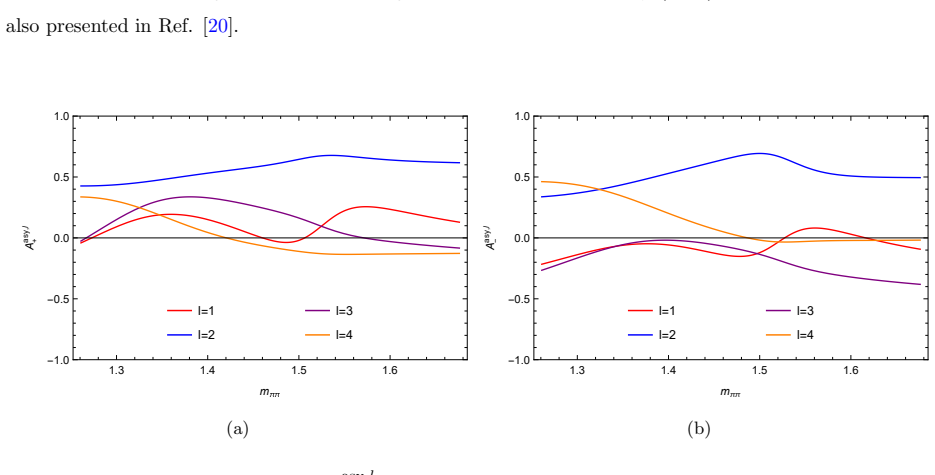
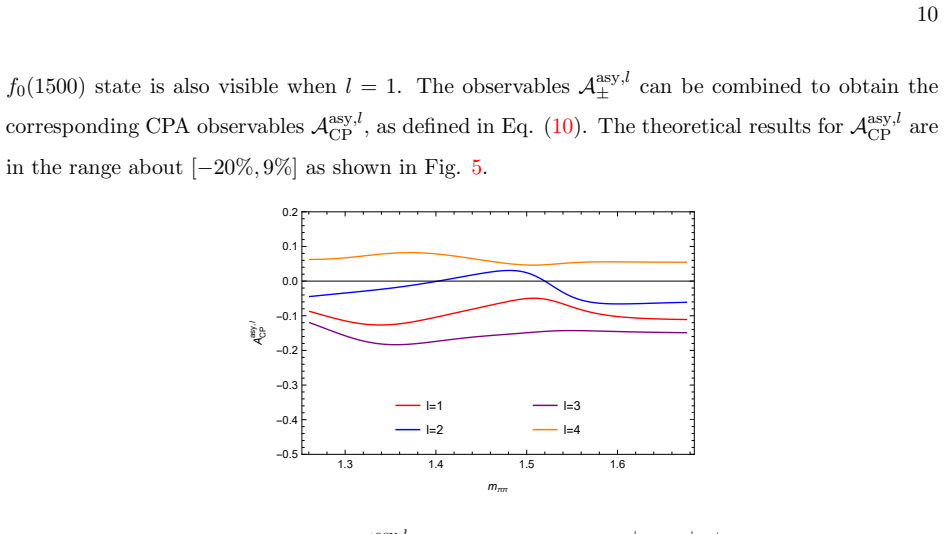
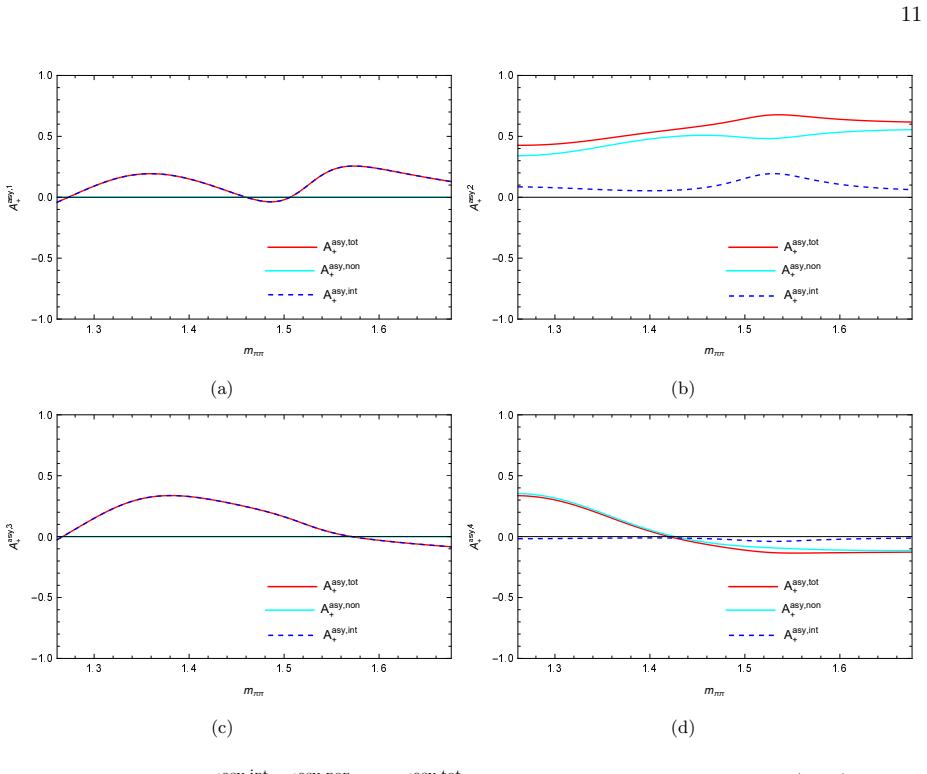
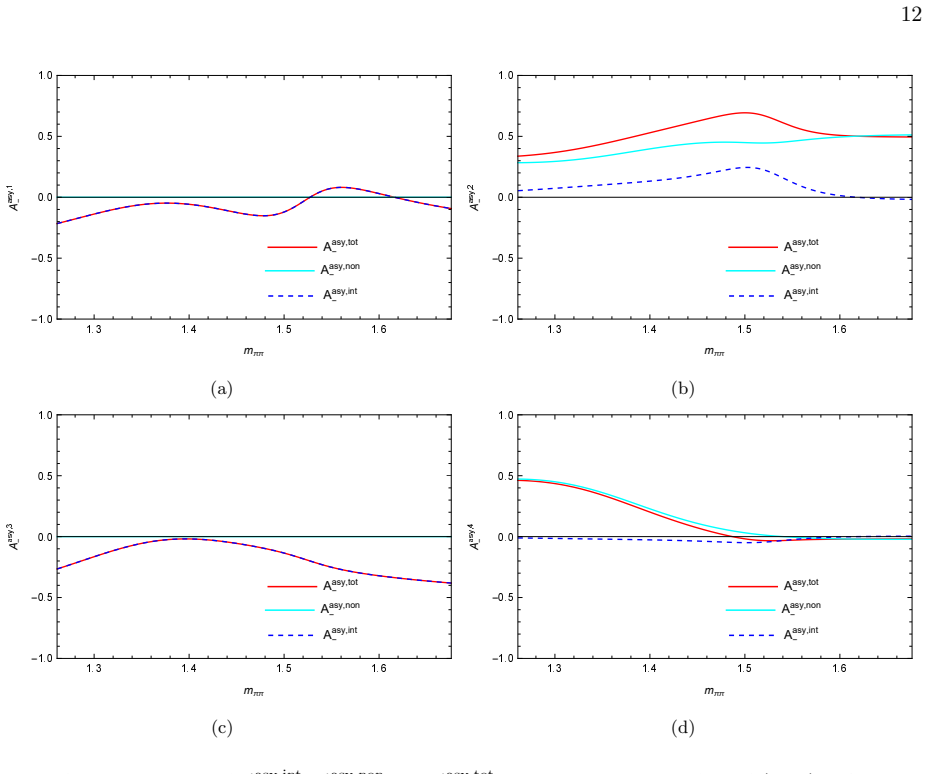
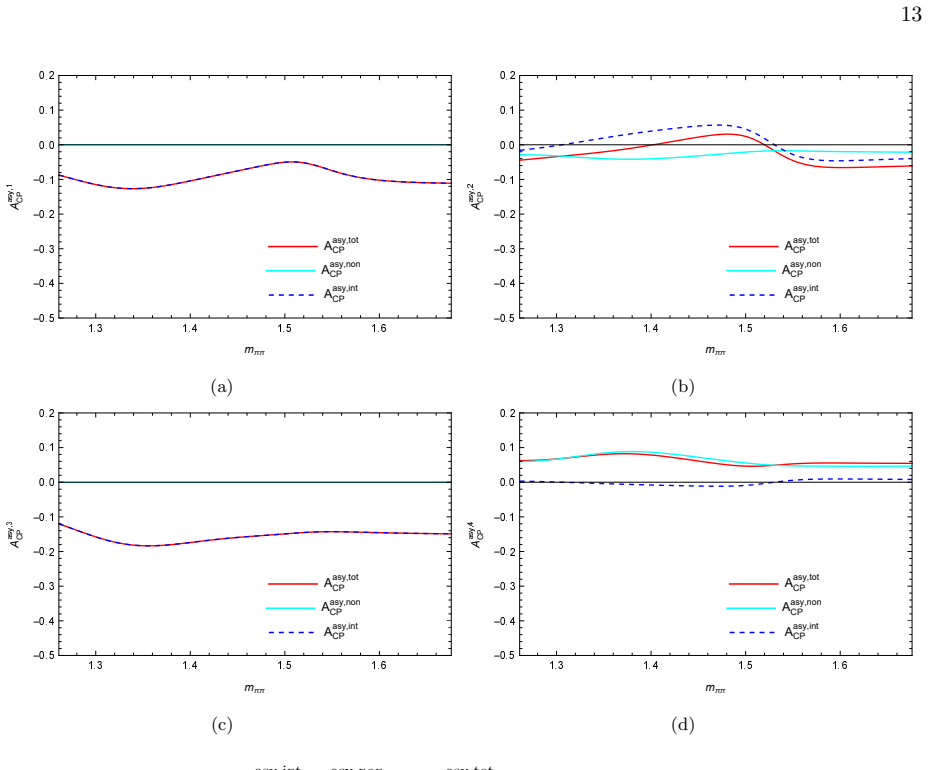
The central claim is that a phase-space partitioning scheme based on the zeros of Legendre polynomials, supplemented by a sign-function weighting procedure, defines observables A±^asy,l and ACP^asy,l that separate interference and non-interference components in CP asymmetries. In the B±→π±π+π− channel near ρ0(1450) analyzed with LHCb data, odd-l schemes prove particularly effective at isolating interference contributions while even-l schemes are more sensitive to non-interference terms.
What carries the argument
The phase-space partitioning scheme based on the zeros of Legendre polynomials supplemented by a sign-function weighting procedure, which defines the observables A±^asy,l and ACP^asy,l.
Load-bearing premise
The partitioning of phase space into regions defined by Legendre polynomial zeros combined with sign weighting correctly isolates interference versus non-interference contributions without introducing uncontrolled biases or losing essential information.
What would settle it
A full amplitude-model fit to the B±→π±π+π− LHCb data that extracts separate interference and non-interference CP asymmetries and finds them inconsistent with the values obtained from the odd-l and even-l partitioned observables would falsify the isolation claim.
Figures
read the original abstract
In multi-body decays of heavy mesons, conventional CP asymmetry observables obtained by integrating over the full phase space are insensitive to the higher-order wave expansion contributions in the decay amplitude squared, and consequently fail to retain information on interference effects among different resonances. To overcome this limitation, one can introduce a phase-space partitioning scheme based on the zeros of Legendre polynomials, supplemented by a sign-function weighting procedure. On such a basis, two observables are defined, namely an asymmetry observable $\mathcal{A}_{\pm}^{\mathrm{asy},l}$, and the corresponding CP asymmetry $\mathcal{A}_{\mathrm{CP}}^{\mathrm{asy},l}$. We further separate the observables into interference and non-interference parts and analyze their respective roles. As an application, the decay channel $B^\pm\rightarrow\pi^\pm\pi^+\pi^-$ are analyzed in the region near the $\rho^0(1450)$ resonance. Using the LHCb data, the results show that odd-$l$ schemes are particularly effective in isolating interference contributions, while even-$l$ schemes are more sensitive to non-interference terms. This new assignment scheme has the potential to be extended to other decay processes, thus enriching the available physical observables.
Editorial analysis
A structured set of objections, weighed in public.
Referee Report
Summary. The manuscript proposes a phase-space partitioning scheme using zeros of Legendre polynomials P_l(cos θ) combined with sign(P_l) weighting to define observables A±^asy,l and ACP^asy,l. These are claimed to separate interference (2 Re A_i A_j*) and non-interference (|A_k|^2) components of |M|^2 in multi-body heavy-meson decays, unlike conventional full-phase-space CP asymmetries. The method is applied to B± → π± π+ π− near ρ0(1450) with LHCb data, concluding that odd-l schemes isolate interference contributions while even-l schemes are more sensitive to non-interference terms.
Significance. If the separation is shown to be free of uncontrolled mixing, the scheme would supply new, l-dependent observables that retain resonance-interference information lost under full integration, extending the toolkit for CP-violation studies in three-body decays. The LHCb application provides a concrete demonstration, but the significance hinges on analytic or numerical validation that the one-variable partitioning does not leak mass-dependent cross terms.
major comments (2)
- [§2.3, Eqs. (8)–(11)] §2.3, Eqs. (8)–(11): the claim that the sign-weighted integrals over regions bounded by zeros of P_l(cos θ) isolate the interference pieces while suppressing |A_k|^2 terms is not accompanied by an explicit projection or orthogonality proof that accounts for the second Dalitz variable (invariant-mass squared). Because the partitioning acts only on the helicity angle, mass-dependent interference structures can in principle mix across bins; no bound on this residual leakage is provided.
- [§3.2, Fig. 4 and Table 1] §3.2, Fig. 4 and Table 1: the numerical results for odd-l versus even-l schemes in the ρ(1450) region rest on the unproven separation; without an auxiliary test (e.g., Monte-Carlo closure with known amplitudes) showing that the extracted A_CP^asy,l indeed tracks only the interference component, the interpretation of the LHCb data comparison remains conditional.
minor comments (2)
- [§2.2] The notation for the weighted integrals (e.g., the precise definition of the sign function and normalization) is introduced without an explicit equation number in the first appearance; adding a numbered display would improve traceability.
- [References] Reference list omits several standard works on angular-moment analyses in three-body decays (e.g., those using Legendre expansions for amplitude extraction); adding 2–3 key citations would place the method in context.
Simulated Author's Rebuttal
We thank the referee for the careful reading of our manuscript and the constructive comments. We address the major comments point by point below, providing clarifications and indicating where revisions will be made to strengthen the presentation.
read point-by-point responses
-
Referee: [§2.3, Eqs. (8)–(11)] the claim that the sign-weighted integrals over regions bounded by zeros of P_l(cos θ) isolate the interference pieces while suppressing |A_k|^2 terms is not accompanied by an explicit projection or orthogonality proof that accounts for the second Dalitz variable (invariant-mass squared). Because the partitioning acts only on the helicity angle, mass-dependent interference structures can in principle mix across bins; no bound on this residual leakage is provided.
Authors: The referee correctly identifies that the manuscript does not include an explicit orthogonality proof that rigorously accounts for the integration over the second Dalitz variable. Our separation is motivated by the orthogonality of the Legendre polynomials in the cos θ variable for the angular dependence in the partial wave expansion. However, mass-dependent coefficients in the amplitude can lead to some residual mixing when the mass integration is performed. We will revise the manuscript by adding a dedicated paragraph in §2.3 discussing this approximation and providing a qualitative bound on the leakage based on the smoothness of the mass dependence in the resonance region. This will be a partial revision. revision: partial
-
Referee: [§3.2, Fig. 4 and Table 1] the numerical results for odd-l versus even-l schemes in the ρ(1450) region rest on the unproven separation; without an auxiliary test (e.g., Monte-Carlo closure with known amplitudes) showing that the extracted A_CP^asy,l indeed tracks only the interference component, the interpretation of the LHCb data comparison remains conditional.
Authors: We agree that the interpretation would be more robust with an explicit Monte Carlo validation using known amplitudes. The current results are presented as an application to real data to demonstrate the practical use of the observables, with the separation justified theoretically in §2. The differences seen for odd and even l are consistent with isolating interference and non-interference terms, respectively. Since performing a full MC closure test requires a complete amplitude model beyond the scope of this paper, we will update the text to make the conditional nature of the interpretation clearer and suggest such tests for future work. This is a partial revision to the discussion section. revision: partial
Circularity Check
No circularity: observables defined independently via partitioning scheme and applied to external LHCb data
full rationale
The paper introduces a phase-space partitioning scheme using zeros of Legendre polynomials P_l(cos θ) together with sign(P_l) weighting to define new observables A±^asy,l and ACP^asy,l. These are constructed directly from the decay amplitude squared without reference to the target CP asymmetry values; the separation into interference and non-interference components follows from the explicit integral definitions over the partitioned regions. The subsequent application to B±→π±π+π− near ρ0(1450) uses published LHCb data as an external benchmark rather than fitting any parameter to reproduce the asymmetries. No self-citation chains, fitted inputs renamed as predictions, or self-definitional reductions appear in the derivation. The central claim therefore remains independent of its own outputs.
Axiom & Free-Parameter Ledger
axioms (1)
- domain assumption The decay amplitude squared can be usefully decomposed and the phase space partitioned via Legendre polynomial zeros such that interference and non-interference terms are isolated by the sign-weighted observables.
Reference graph
Works this paper leans on
-
[1]
int” and “ non
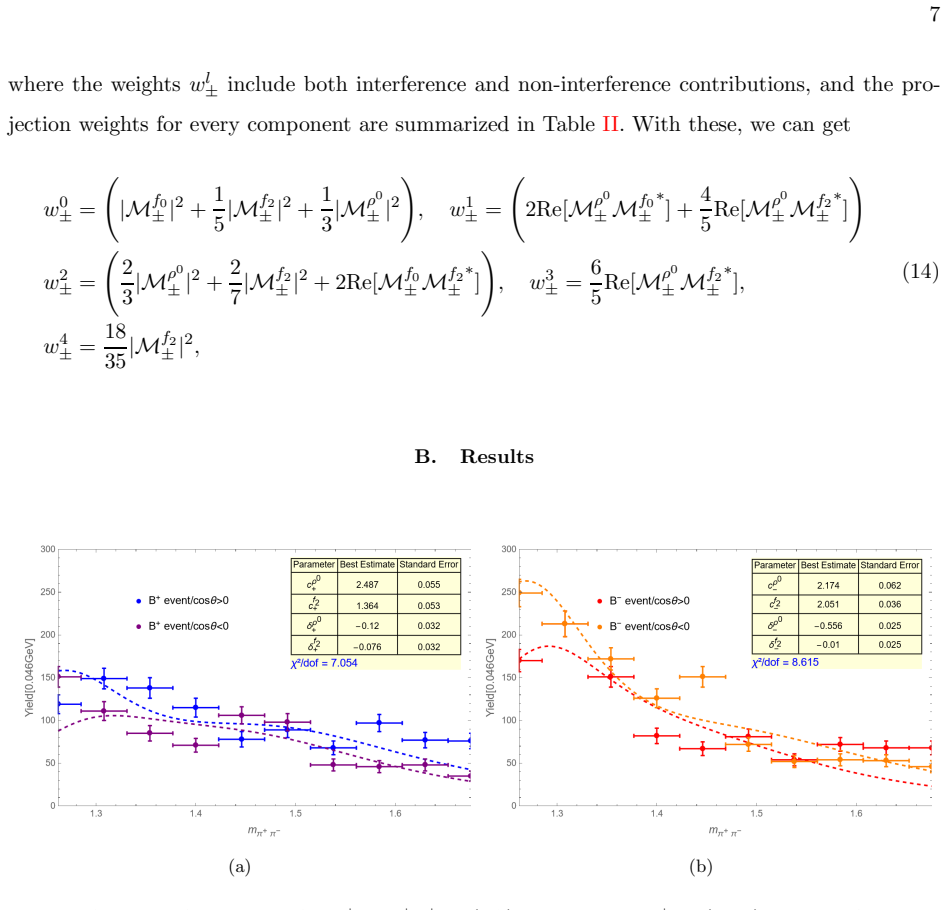
and the relationships between cos n θ and Pl(cos θ), the form of the total amplitude squared can be derived as |Mtot ± |2 = 4∑ l=0 wl ± Pl(cos θ), (13) 7 where the weights wl ± include both interference and non-interference contribut ions, and the pro- jection weights for every component are summarized in Table II. With these, we can get w0 ± = ( |Mf0 ± |...
-
[2]
J. H. Christenson, J. W. Cronin, V. L. Fitch, and R. Turlay, Evide nce for the 2 π Decay of the K 0 2 Meson, Phys. Rev. Lett. 13, 138 (1964)
1964
-
[3]
Kobayashi and T
M. Kobayashi and T. Maskawa, CP Violation in the Renormalizable Th eory of Weak Interaction, Prog. Theor. Phys. 49, 652 (1973)
1973
-
[4]
Observation of Direct CP Violation in K_{S,L} to \pi \pi Decays
A. Alavi-Harati et al. (KTeV), Observation of Direct CP Violation in KS,L → ππ Decays, Phys. Rev. Lett. 83, 22 (1999) , arXiv:hep-ex/9905060
work page internal anchor Pith review Pith/arXiv arXiv 1999
-
[5]
Observation of CP violation in the B^0 meson system
B. Aubert et al. (BaBar), Observation of CP violation in the B0 meson system, Phys. Rev. Lett. 87, 091801 (2001) , arXiv:hep-ex/0107013
work page internal anchor Pith review Pith/arXiv arXiv 2001
-
[6]
Observation of Large CP Violation in the Neutral B Meson System
K. Abe et al. (Belle), Observation of large CP violation in the neutral B meson system, Phys. Rev. Lett. 87, 091802 (2001) , arXiv:hep-ex/0107061
work page internal anchor Pith review Pith/arXiv arXiv 2001
-
[7]
A. Poluektov et al. (Belle), Evidence for direct CP violation in the decay B± → D(∗)K ± , D → K 0 Sπ +π − and measurement of the CKM phase φ 3, Phys. Rev. D 81, 112002 (2010) , arXiv:1003.3360 [hep-ex]
work page internal anchor Pith review Pith/arXiv arXiv 2010
-
[8]
Measurement of CP observables in B+- --> D_CP K+- decays and constraints on the CKM angle gamma
P. del Amo Sanchez et al. (BaBar), Measurement of CP observables in B± → DCP K ± decays and constraints on the CKM angle γ, Phys. Rev. D 82, 072004 (2010) , arXiv:1007.0504 [hep-ex]
work page internal anchor Pith review Pith/arXiv arXiv 2010
-
[9]
First observation of CP violation in the decays of Bs mesons
R. Aaij et al. (LHCb), First observation of CP violation in the decays of B0 s mesons, Phys. Rev. Lett. 110, 221601 (2013) , arXiv:1304.6173 [hep-ex]
work page internal anchor Pith review Pith/arXiv arXiv 2013
-
[10]
Observation of $C\!P$ violation in charm decays
R. Aaij et al. (LHCb), Observation of CP Violation in Charm Decays, Phys. Rev. Lett. 122, 211803 (2019), arXiv:1903.08726 [hep-ex]
work page internal anchor Pith review Pith/arXiv arXiv 2019
-
[11]
R. Aaij et al. (LHCb), Observation of charge–parity symmetry breaking in bary on decays, Nature 643, 1223 (2025) , arXiv:2503.16954 [hep-ex]
-
[12]
J. F. Donoghue, B. R. Holstein, and G. Valencia, Survey of Pres ent and Future Tests of CP Violation, Int. J. Mod. Phys. A 2, 319 (1987)
1987
-
[13]
Valencia, Angular Correlations in the Decay B → V V and CP Violation, Phys
G. Valencia, Angular Correlations in the Decay B → V V and CP Violation, Phys. Rev. D 39, 3339 (1989)
1989
-
[14]
Kayser, Kinematically Nontrivial CP Violation in Beauty Decay, Nucl
B. Kayser, Kinematically Nontrivial CP Violation in Beauty Decay, Nucl. Phys. B Proc. Suppl. 13, 487 (1990)
1990
-
[15]
T-Odd Triple-Product Correlations in Hadronic b Decays
W. Bensalem and D. London, T odd triple product correlations in hadronic b decays, Phys. Rev. D 64, 116003 (2001) , arXiv:hep-ph/0005018
work page internal anchor Pith review Pith/arXiv arXiv 2001
- [16]
-
[17]
Z.-H. Zhang and J.-J. Qi, Analysis of angular distribution asymmet ries and the associated C P asym- metries in three-body decays of bottom baryons, Eur. Phys. J. C 83, 133 (2023) , arXiv:2208.13411 [hep-ph]
-
[18]
R. Hu and Z.-H. Zhang, Data-based analysis of the forward-ba ckward asymmetry in B± → K ± K ∓ K ± , Phys. Rev. D 105, 093007 (2022) , arXiv:2201.07456 [hep-ph] . 16
-
[19]
Z.-H. Zhang and X.-H. Guo, A novel strategy for searching for CP violations in the baryon sector, JHEP 07, 177 , arXiv:2103.11335 [hep-ph]
- [20]
- [21]
-
[22]
R. Aaij et al. (LHCb), Amplitude analysis of the B+ → π +π +π − decay, Phys. Rev. D 101, 012006 (2020), arXiv:1909.05212 [hep-ex]
-
[23]
R. Aaij et al. (LHCb), Observation of Several Sources of CP Violation in B+ → π +π +π − Decays, Phys. Rev. Lett. 124, 031801 (2020) , arXiv:1909.05211 [hep-ex]
-
[24]
Y.-R. Wei and Z.-H. Zhang, Forward-backward asymmetry indu ced CP asymmetry of B± → π ± π ± π ∓ , Phys. Rev. D 106, 113002 (2022) , arXiv:2209.02348 [hep-ph]
-
[25]
H.-Y. Cheng, CP violation in the interference between ρ(770)0 and S-wave in B± → π ± π ± π ∓ decays and its implication for CP asymmetry in B± → ρ0π ± , Phys. Rev. D 106, 113004 (2022) , arXiv:2211.03965 [hep-ph]
-
[26]
Charmless Hadronic B Decays into a Tensor Meson
H.-Y. Cheng and K.-C. Yang, Charmless Hadronic B Decays into a T ensor Meson, Phys. Rev. D 83, 034001 (2011) , arXiv:1010.3309 [hep-ph]
work page internal anchor Pith review Pith/arXiv arXiv 2011
- [27]
-
[28]
Quasi-two-body decays $B_{(s)}\to P f_2(1270)\to P\pi\pi$ in the perturbative QCD approach
Y. Li, A.-J. Ma, Z. Rui, W.-F. Wang, and Z.-J. Xiao, Quasi-two-bod y decays B(s) → P f2(1270) → P ππ in the perturbative QCD approach, Phys. Rev. D 98, 056019 (2018) , arXiv:1807.02641 [hep-ph]
work page internal anchor Pith review Pith/arXiv arXiv 2018
-
[29]
Z.-T. Zou, X. Yu, and C.-D. Lu, Nonleptonic two-body charmless B decays involving a tensor meson in the Perturbative QCD Approach, Phys. Rev. D 86, 094015 (2012) , arXiv:1203.4120 [hep-ph]
work page internal anchor Pith review Pith/arXiv arXiv 2012
-
[30]
Amplitude Analysis of the Decay B+- -> pi+- pi+- pi-+
B. Aubert et al. (BaBar), An amplitude analysis of the decay B± → π ± π ± π ∓ , Phys. Rev. D 72, 052002 (2005), arXiv:hep-ex/0507025
work page internal anchor Pith review Pith/arXiv arXiv 2005
-
[31]
Dalitz Plot Analysis of B+- --> pi+-pi+-pi-+ Decays
B. Aubert et al. (BaBar), Dalitz Plot Analysis of B± → π ± π ± π ∓ Decays, Phys. Rev. D 79, 072006 (2009), arXiv:0902.2051 [hep-ex]
work page internal anchor Pith review Pith/arXiv arXiv 2009
-
[32]
Navas et al
S. Navas et al. (Particle Data Group), Review of particle physics, Phys. Rev. D 110, 030001 (2024)
2024
discussion (0)
Sign in with ORCID, Apple, or X to comment. Anyone can read and Pith papers without signing in.