Unveiling the dark matter nature with reionization relics
Pith reviewed 2026-06-29 16:19 UTC · model grok-4.3
The pith
Reionization relics in Lyα forest and 21 cm maps constrain warm dark matter to masses above 5 keV.
A machine-rendered reading of the paper's core claim, the machinery that carries it, and where it could break.
Core claim
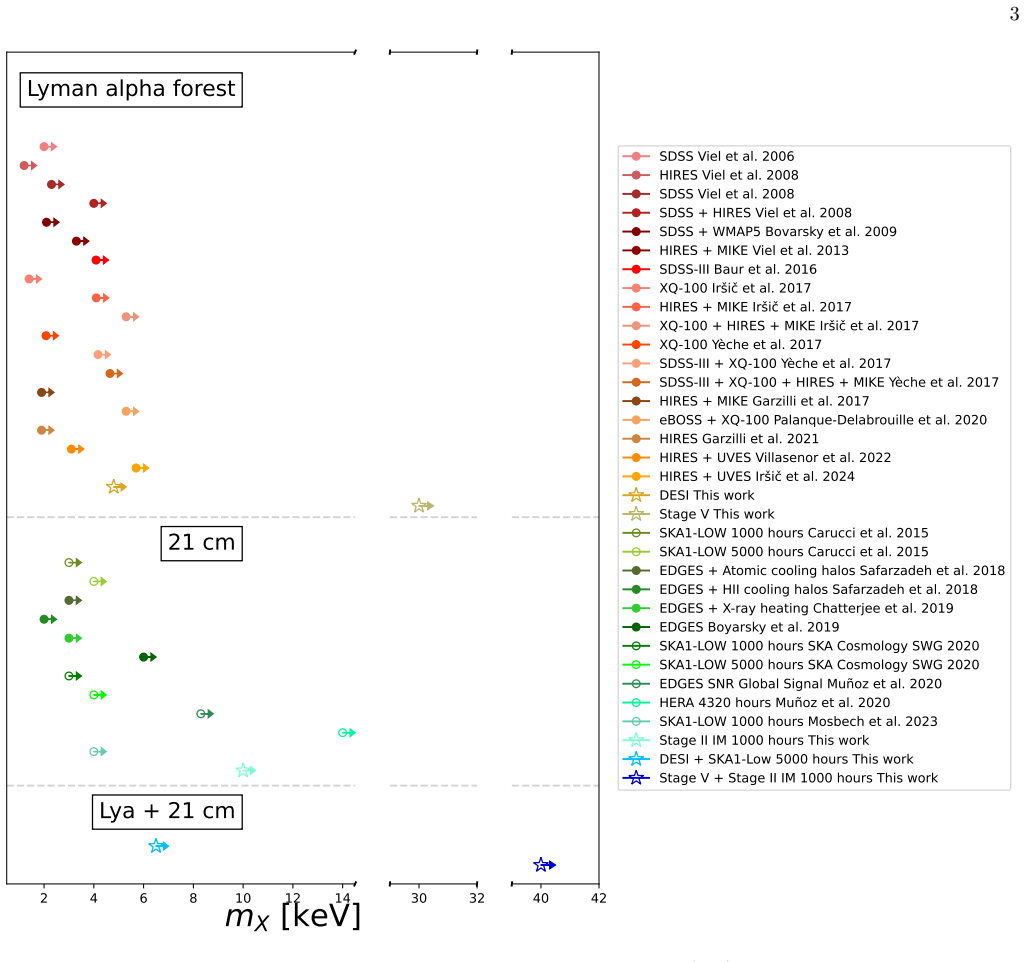
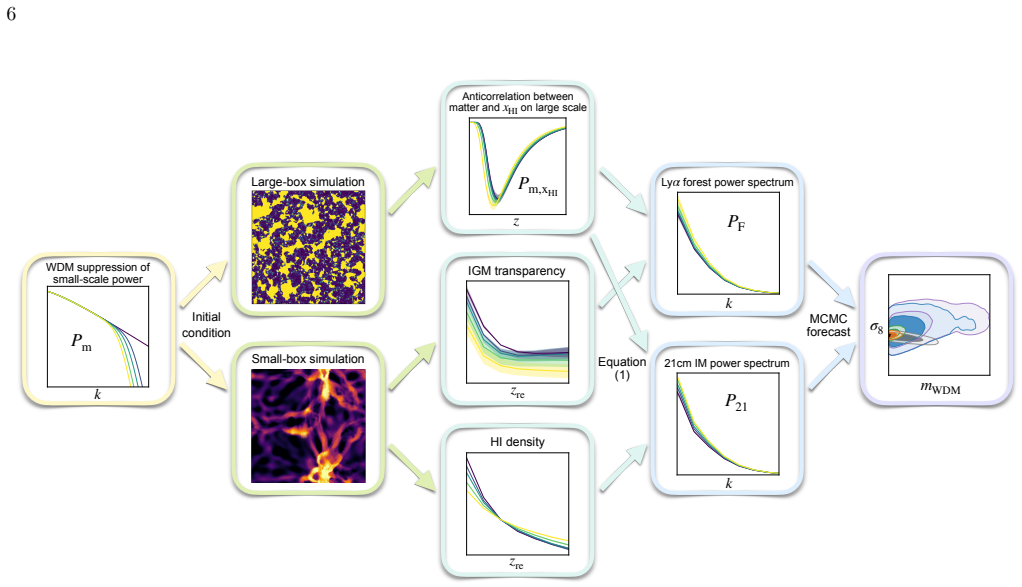
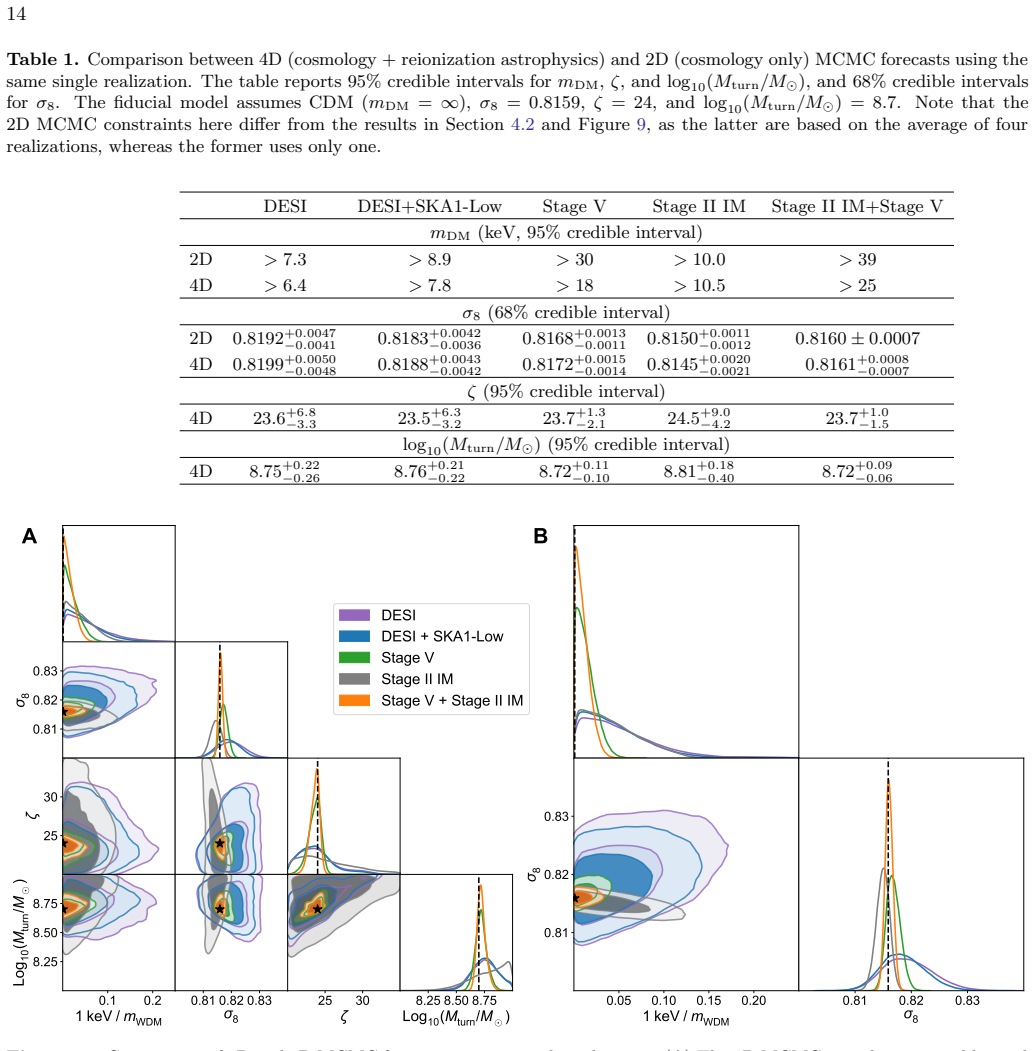
The central claim is that long-lived reionization relics—fluctuations arising because the thermal and dynamical state of the intergalactic medium depends on the local reionization redshift—provide a novel large-scale probe of warm dark matter. The relic strength couples to WDM mass through both suppressed small-scale gas evolution and shifts in the global reionization history, yielding the stated power-spectrum differences and the forecasted mass limits of m_WDM >5.0 keV (DESI), >7.1 keV (DESI+SKA), and up to 39 keV (next-generation surveys).
What carries the argument
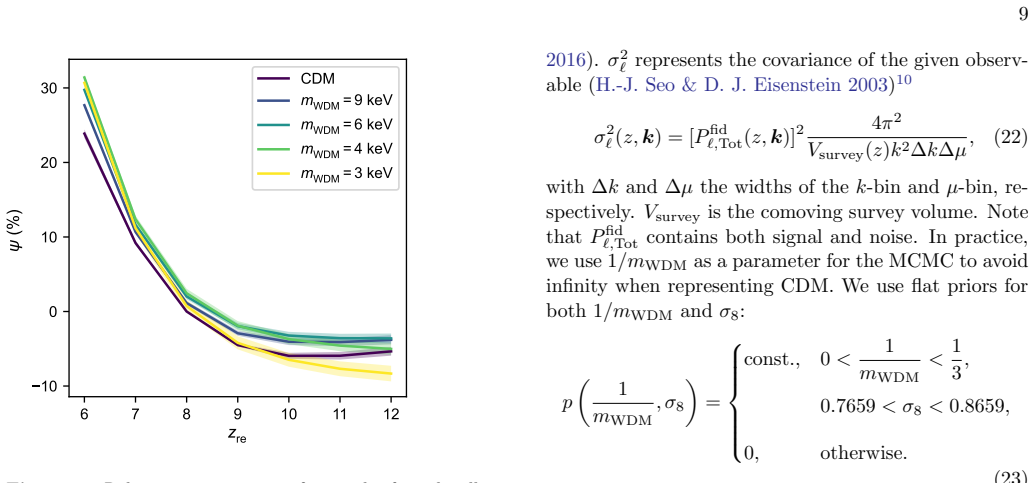
Reionization relics: the additional large-scale fluctuations in Lyα opacity and post-reionization neutral hydrogen whose amplitude is modulated by WDM mass via its effects on small-scale structure formation and reionization timing.
If this is right
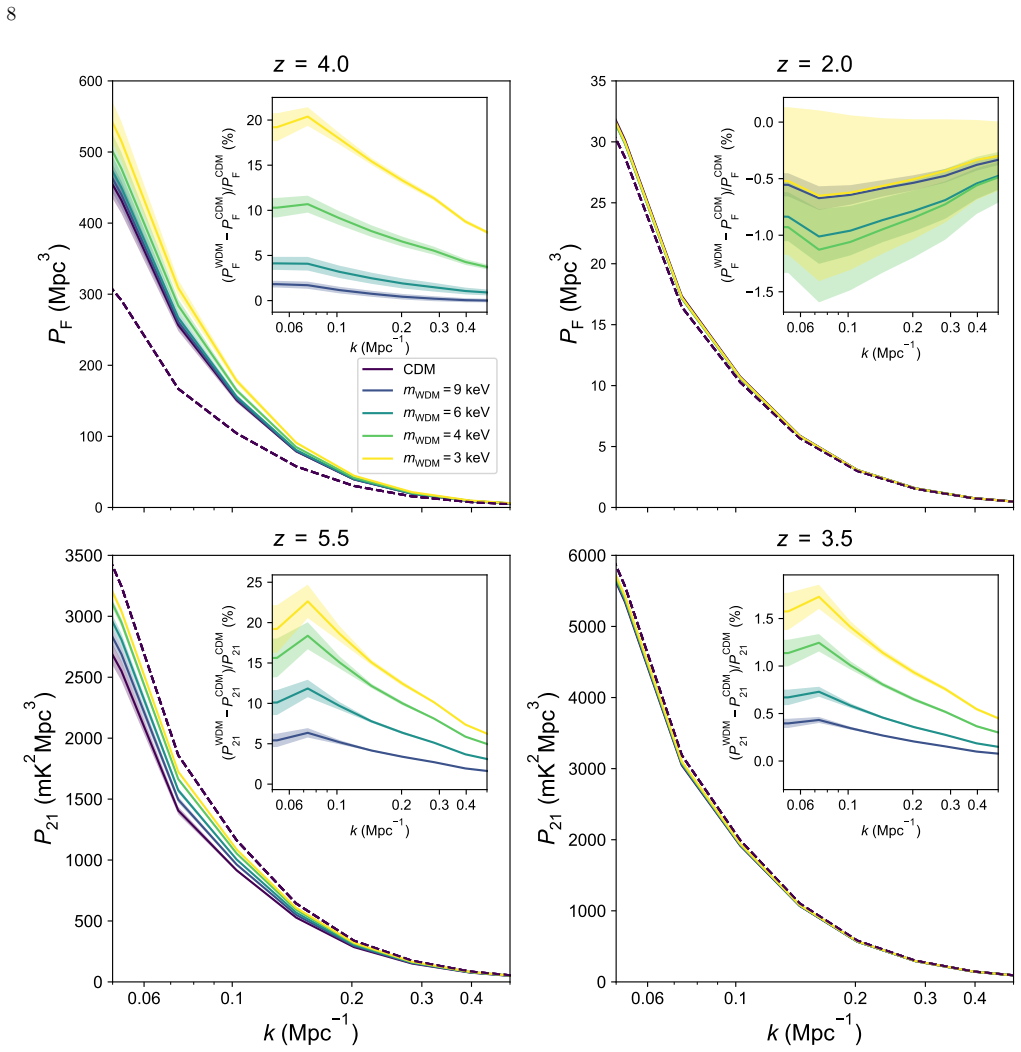
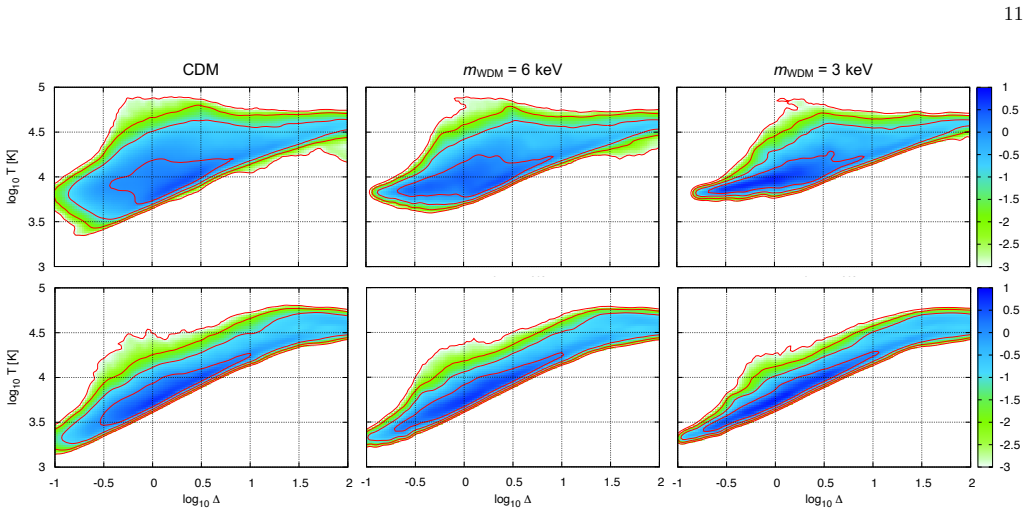
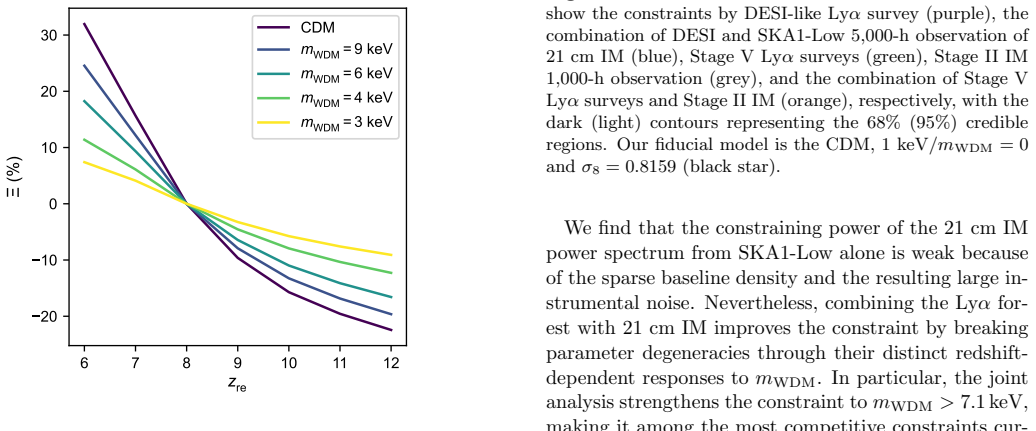
- The Lyα power spectrum at k=0.05 Mpc^{-1}, z=4 differs by ~19% for 3 keV WDM versus CDM when reionization relics are included.
- The 21 cm power spectrum at k=0.05 Mpc^{-1}, z=5.5 shows a comparable ~19% difference.
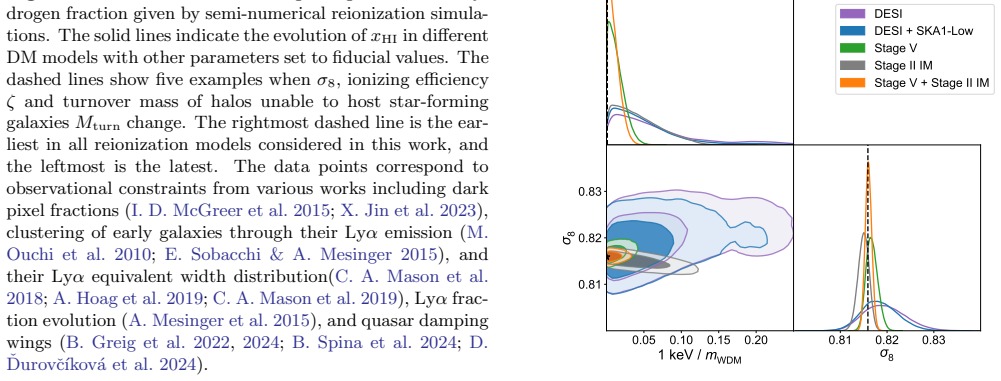
- DESI-like Lyα forest data alone yield m_WDM >5.0 keV at 95% confidence.
- Adding SKA 21 cm intensity mapping raises the limit to m_WDM >7.1 keV.
- Next-generation surveys can push the lower bound from the current 9.7 keV up to 39 keV.
Where Pith is reading between the lines
- The method could be combined with existing small-scale Lyα constraints to break degeneracies between WDM mass and reionization parameters.
- If the relic signal is detected, it would provide an independent test of whether WDM alters the timing of reionization in hydrodynamic simulations.
- The approach might extend to other large-scale intensity-mapping experiments beyond SKA for cross-checks on the same physical coupling.
Load-bearing premise
The 19% power-spectrum difference is assumed to translate directly into mass limits once the coupling of WDM to both gas evolution and reionization history is taken as given.
What would settle it
A direct measurement showing zero difference in the Lyα power spectrum at k=0.05 Mpc^{-1} and z=4 between a 3 keV WDM model and cold dark matter, after including patchy reionization, would falsify the claimed relic imprint strength.
Figures
read the original abstract
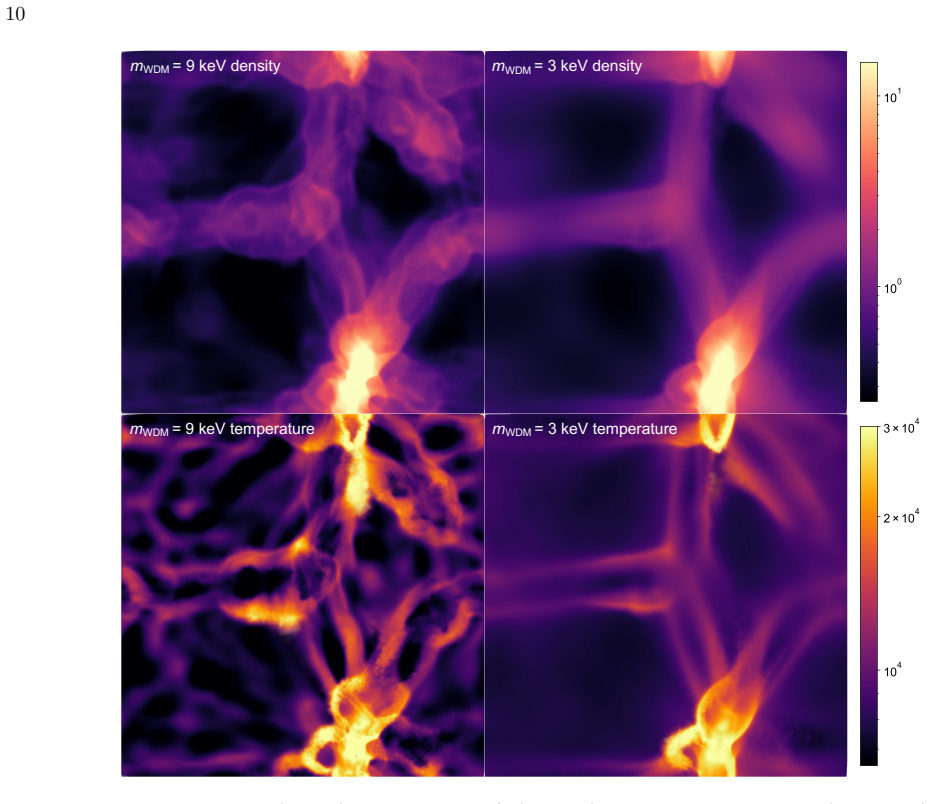
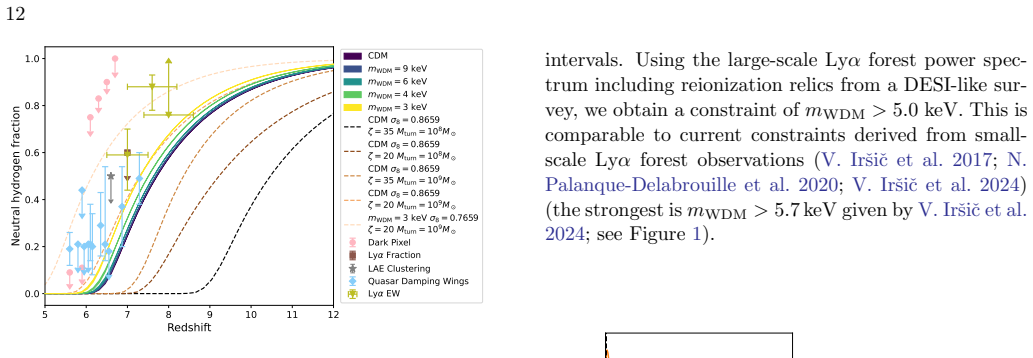
Dark matter constitutes roughly one-fourth of the Universe, yet its physical nature remains unknown. Warm dark matter (WDM), a class of dark matter candidates, has non-negligible velocity dispersion that suppresses the formation of small-scale cosmic structures. Current constraints therefore rely mainly on small-scale probes such as the Lyman-alpha (Ly${\alpha}$) forest and Milky Way observations of satellite galaxies and stellar streams. We propose a novel large-scale probe based on long-lived "reionization relics": because the thermal and dynamical evolution of the intergalactic medium depends on the local reionization redshift, patchy reionization imprints additional large-scale fluctuations in Ly${\alpha}$ forest opacity and post-reionization HI traced by 21 cm intensity mapping. The strength of these imprints depends on WDM through both small-scale gas evolution and WDM-driven changes in the reionization history. For example, the Ly${\alpha}$ (21 cm) power spectrum in 3 keV WDM differs from cold dark matter by ~19% (~19%) at $k=0.05\,{\rm Mpc^{-1}}$ at z=4 (z=5.5) when reionization relics are included. Using Ly${\alpha}$ forest with a covariance model designed to mimic the capabilities of the Dark Energy Spectroscopic Instrument (DESI), we forecast a constraint of $m_{\rm WDM}>5.0\,{\rm keV}$ (95%), which improves to $m_{\rm WDM}>7.1\,{\rm keV}$ when combined with 21 cm intensity-mapping observations from the Square Kilometre Array (SKA). The next-generation surveys can further strengthen the current best lower bounds from 9.7 to 39 keV.
Editorial analysis
A structured set of objections, weighed in public.
Referee Report
Summary. The manuscript proposes using long-lived reionization relics as a novel large-scale probe of warm dark matter (WDM). It reports that including these relics produces ~19% differences in the Lyα forest power spectrum at k=0.05 Mpc^{-1}, z=4 (and similarly for 21 cm at z=5.5) between 3 keV WDM and CDM, and translates this contrast into forecasted 95% lower limits of m_WDM > 5.0 keV from a DESI-like Lyα survey, >7.1 keV when combined with SKA 21 cm intensity mapping, and up to 39 keV with next-generation surveys.
Significance. If the modeling of the relic imprint and its scaling with m_WDM were shown to be robust, the work would provide a useful large-scale complement to existing small-scale WDM bounds. The explicit use of DESI and SKA covariance models is a concrete strength that allows direct comparison with planned observations.
major comments (2)
- [Abstract / Results] Abstract and modeling description: the central 19% power-spectrum contrast at k=0.05 Mpc^{-1} is stated to arise from WDM-driven changes in reionization history, yet no explicit demonstration is given that this contrast survives marginalization over reionization parameters (ionizing efficiency, escape fraction, etc.). Because the forecast limits are derived directly from this contrast, the absence of such tests is load-bearing for the quoted m_WDM bounds.
- [Forecasts] Forecast section: the manuscript provides no error budget, no validation of the relic signal against existing Lyα or 21 cm data, and no assessment of foregrounds or systematics. These omissions directly affect the reliability of the numerical forecasts (m_WDM >5.0 keV, >7.1 keV, and 39 keV).
minor comments (1)
- [Methods] Clarify how the covariance matrix for the DESI-like Lyα survey is constructed and whether it includes the full covariance between different redshift bins.
Simulated Author's Rebuttal
We thank the referee for their thorough review and insightful comments on our manuscript. We address each of the major comments point by point below.
read point-by-point responses
-
Referee: [Abstract / Results] Abstract and modeling description: the central 19% power-spectrum contrast at k=0.05 Mpc^{-1} is stated to arise from WDM-driven changes in reionization history, yet no explicit demonstration is given that this contrast survives marginalization over reionization parameters (ionizing efficiency, escape fraction, etc.). Because the forecast limits are derived directly from this contrast, the absence of such tests is load-bearing for the quoted m_WDM bounds.
Authors: We concur that showing the persistence of the power spectrum contrast after marginalizing over reionization parameters is crucial for the robustness of our forecasts. We will revise the manuscript to include explicit tests varying key reionization parameters such as ionizing efficiency and escape fraction, confirming that the ~19% difference remains significant at the scales of interest. revision: yes
-
Referee: [Forecasts] Forecast section: the manuscript provides no error budget, no validation of the relic signal against existing Lyα or 21 cm data, and no assessment of foregrounds or systematics. These omissions directly affect the reliability of the numerical forecasts (m_WDM >5.0 keV, >7.1 keV, and 39 keV).
Authors: Our forecasts are constructed using the specified covariance models for DESI-like and SKA observations. We will add an expanded discussion of the error budget and potential impacts of foregrounds and systematics in the revised manuscript. Validation of the relic signal is challenging as it represents a novel probe not previously identified in existing datasets; we will clarify this limitation in the text. revision: partial
- Validation of the relic signal against existing Lyα or 21 cm data
Circularity Check
No circularity: forecasts rest on explicit modeled power-spectrum differences without reduction to fitted inputs or self-citations
full rationale
The provided abstract and context contain no equations, self-citations, or ansatzes that reduce the claimed 19% power-spectrum contrast or the resulting m_WDM forecasts to their own inputs by construction. The difference is presented as an output of the reionization-relic modeling (including WDM effects on history and gas evolution), and the DESI/SKA forecasts are standard projections from that modeled signal strength. No load-bearing step matches any enumerated circularity pattern; the derivation chain is self-contained against external benchmarks for the purpose of this analysis.
Axiom & Free-Parameter Ledger
free parameters (1)
- WDM particle mass m_WDM
axioms (2)
- domain assumption Patchy reionization imprints additional large-scale fluctuations in Lyα forest opacity and post-reionization HI that survive to z=4–5.5.
- domain assumption The strength of these imprints depends on WDM through both small-scale gas evolution and WDM-driven changes in the reionization history.
Reference graph
Works this paper leans on
-
[1]
2024, ApJ, 963, 23, doi: 10.3847/1538-4357/ad0f1d
Amiri, M., Bandura, K., Chakraborty, A., et al. 2024, ApJ, 963, 23, doi: 10.3847/1538-4357/ad0f1d
-
[2]
2015, JCAP, 2015, 017, doi: 10.1088/1475-7516/2015/12/017
Arinyo-i-Prats, A., Miralda-Escud´ e, J., Viel, M., & Cen, R. 2015, JCAP, 2015, 017, doi: 10.1088/1475-7516/2015/12/017
-
[3]
Banik, N., Bovy, J., Bertone, G., Erkal, D., & de Boer, T. J. L. 2021, JCAP, 2021, 043, doi: 10.1088/1475-7516/2021/10/043
-
[4]
2016, JCAP, 2016, 012, doi: 10.1088/1475-7516/2016/08/012
Baur, J., Palanque-Delabrouille, N., Y` eche, C., Magneville, C., & Viel, M. 2016, JCAP, 2016, 012, doi: 10.1088/1475-7516/2016/08/012
-
[5]
Bernstein, G. M., Athey, A. E., Bernstein, R., et al. 2002, in Society of Photo-Optical Instrumentation Engineers (SPIE) Conference Series, Vol. 4485, Optical Spectroscopic Techniques, Remote Sensing, and Instrumentation for Atmospheric and Space Research IV, ed. A. M. Larar & M. G. Mlynczak, 453–459, doi: 10.1117/12.454281
-
[6]
2011, JCAP, 2011, 034, doi: 10.1088/1475-7516/2011/07/034
Blas, D., Lesgourgues, J., & Tram, T. 2011, JCAP, 2011, 034, doi: 10.1088/1475-7516/2011/07/034
-
[7]
Bode, P., Ostriker, J. P., & Turok, N. 2001, ApJ, 556, 93, doi: 10.1086/321541
-
[8]
Mozdzen, T. J., & Mahesh, N. 2018, Nature, 555, 67, doi: 10.1038/nature25792
-
[9]
2019, PhRvD, 100, 123005, doi: 10.1103/PhysRevD.100.123005
Rudakovskyi, A., & Valkenburg, W. 2019, PhRvD, 100, 123005, doi: 10.1103/PhysRevD.100.123005
-
[10]
2009, JCAP, 2009, 012, doi: 10.1088/1475-7516/2009/05/012
Boyarsky, A., Lesgourgues, J., Ruchayskiy, O., & Viel, M. 2009, JCAP, 2009, 012, doi: 10.1088/1475-7516/2009/05/012
-
[11]
Braun, R., Bonaldi, A., Bourke, T., Keane, E., & Wagg, J. 2019, arXiv e-prints, arXiv:1912.12699, doi: 10.48550/arXiv.1912.12699
-
[12]
Bull, P., Ferreira, P. G., Patel, P., & Santos, M. G. 2015, ApJ, 803, 21, doi: 10.1088/0004-637X/803/1/21
-
[13]
and Boylan-Kolchin, Michael , year=
Bullock, J. S., & Boylan-Kolchin, M. 2017, ARA&A, 55, 343, doi: 10.1146/annurev-astro-091916-055313
-
[14]
2023, JCAP, 2023, 002, doi: 10.1088/1475-7516/2023/01/002
Cain, C., D’Aloisio, A., Irˇ siˇ c, V., Gangolli, N., & Dhami, S. 2023, JCAP, 2023, 002, doi: 10.1088/1475-7516/2023/01/002
-
[15]
2024, MNRAS, 533, L100, doi: 10.1093/mnrasl/slae067
Trac, H. 2024, MNRAS, 533, L100, doi: 10.1093/mnrasl/slae067
-
[16]
2026, arXiv e-prints, arXiv:2603.25788
Cain, C., Das, A., D’Aloisio, A., et al. 2026, arXiv e-prints, arXiv:2603.25788. https://arxiv.org/abs/2603.25788
-
[17]
Carucci, I. P., & Corasaniti, P.-S. 2019, PhRvD, 99, 023518, doi: 10.1103/PhysRevD.99.023518
-
[18]
P., Villaescusa-Navarro, F., Viel, M., & Lapi, A
Carucci, I. P., Villaescusa-Navarro, F., Viel, M., & Lapi, A. 2015, JCAP, 2015, 047, doi: 10.1088/1475-7516/2015/07/047
-
[19]
Chatterjee, A., Dayal, P., Choudhury, T. R., & Hutter, A. 2019, MNRAS, 487, 3560, doi: 10.1093/mnras/stz1444 Cosmic Visions 21 cm Collaboration, Ansari, R., Arena, E. J., et al. 2018, arXiv e-prints, arXiv:1810.09572. https://arxiv.org/abs/1810.09572
-
[20]
Crighton, N. H. M., Murphy, M. T., Prochaska, J. X., et al. 2015, MNRAS, 452, 217, doi: 10.1093/mnras/stv1182 de Belsunce, R., Philcox, O. H. E., Irˇ siˇ c, V., et al. 2024, MNRAS, 533, 3756, doi: 10.1093/mnras/stae2035
-
[21]
DeBoer, D. R., Parsons, A. R., Aguirre, J. E., et al. 2017, PASP, 129, 045001, doi: 10.1088/1538-3873/129/974/045001
-
[22]
2000, in Society of Photo-Optical Instrumentation Engineers (SPIE) Conference Series, Vol
Kotzlowski, H. 2000, in Society of Photo-Optical Instrumentation Engineers (SPIE) Conference Series, Vol. 4008, Optical and IR Telescope Instrumentation and Detectors, ed. M. Iye & A. F. Moorwood, 534–545, doi: 10.1117/12.395512 DESI Collaboration, Abareshi, B., Aguilar, J., et al. 2022, AJ, 164, 207, doi: 10.3847/1538-3881/ac882b
-
[23]
Dunkley, J., Komatsu, E., Nolta, M. R., et al. 2009, ApJS, 180, 306, doi: 10.1088/0067-0049/180/2/306
-
[24]
2014, JCAP, 2014, 023, doi: 10.1088/1475-7516/2014/05/023
Font-Ribera, A., McDonald, P., Mostek, N., et al. 2014, JCAP, 2014, 023, doi: 10.1088/1475-7516/2014/05/023
-
[25]
2013, JCAP, 2013, 018, doi: 10.1088/1475-7516/2013/05/018
Font-Ribera, A., Arnau, E., Miralda-Escud´ e, J., et al. 2013, JCAP, 2013, 018, doi: 10.1088/1475-7516/2013/05/018
-
[26]
Foreman-Mackey, D., Hogg, D. W., Lang, D., & Goodman, J. 2013, PASP, 125, 306, doi: 10.1086/670067
-
[27]
Furlanetto, S. R., & Oh, S. P. 2006, ApJ, 652, 849, doi: 10.1086/508448 18
-
[28]
Gaikwad, P., Srianand, R., Haehnelt, M. G., & Choudhury, T. R. 2021, MNRAS, 506, 4389, doi: 10.1093/mnras/stab2017
-
[29]
2017, Physics Letters B, 773, 258, doi: 10.1016/j.physletb.2017.08.022
Garzilli, A., Boyarsky, A., & Ruchayskiy, O. 2017, Physics Letters B, 773, 258, doi: 10.1016/j.physletb.2017.08.022
-
[30]
2021, MNRAS, 502, 2356, doi: 10.1093/mnras/stab192
Garzilli, A., Magalich, A., Ruchayskiy, O., & Boyarsky, A. 2021, MNRAS, 502, 2356, doi: 10.1093/mnras/stab192
-
[31]
Gnedin, N. Y. 2000, ApJ, 542, 535, doi: 10.1086/317042
-
[32]
2023, JCAP, 2023, 045, doi: 10.1088/1475-7516/2023/11/045
Gordon, C., Cuceu, A., Chaves-Montero, J., et al. 2023, JCAP, 2023, 045, doi: 10.1088/1475-7516/2023/11/045
-
[33]
Greig, B., Mesinger, A., Davies, F. B., et al. 2022, MNRAS, 512, 5390, doi: 10.1093/mnras/stac825
-
[34]
2024, MNRAS, 530, 3208, doi: 10.1093/mnras/stae1080
Greig, B., Mesinger, A., Ba˜ nados, E., et al. 2024, MNRAS, 530, 3208, doi: 10.1093/mnras/stae1080
-
[35]
2023, AJ, 165, 144, doi: 10.3847/1538-3881/acb212
Guy, J., Bailey, S., Kremin, A., et al. 2023, AJ, 165, 144, doi: 10.3847/1538-3881/acb212
-
[36]
Hirata, C. M. 2018, MNRAS, 474, 2173, doi: 10.1093/mnras/stx2854
-
[37]
2019, ApJ, 878, 12, doi: 10.3847/1538-4357/ab1de7
Hoag, A., Bradaˇ c, M., Huang, K., et al. 2019, ApJ, 878, 12, doi: 10.3847/1538-4357/ab1de7
-
[38]
Fuzzy Cold Dark Matter: The Wave Properties of Ultralight Particles , volume=
Hu, W., Barkana, R., & Gruzinov, A. 2000, PhRvL, 85, 1158, doi: 10.1103/PhysRevLett.85.1158
-
[39]
Hui, L., & Gnedin, N. Y. 1997, MNRAS, 292, 27, doi: 10.1093/mnras/292.1.27 Irˇ siˇ c, V., Xiao, H., & McQuinn, M. 2020, PhRvD, 101, 123518, doi: 10.1103/PhysRevD.101.123518 Irˇ siˇ c, V., Viel, M., Haehnelt, M. G., et al. 2017, PhRvD, 96, 023522, doi: 10.1103/PhysRevD.96.023522 Irˇ siˇ c, V., Viel, M., Haehnelt, M. G., et al. 2024, PhRvD, 109, 043511, doi...
-
[40]
2023, ApJ, 942, 59, doi: 10.3847/1538-4357/aca678
Jin, X., Yang, J., Fan, X., et al. 2023, ApJ, 942, 59, doi: 10.3847/1538-4357/aca678
-
[41]
Kaur, H. D., Gillet, N., & Mesinger, A. 2020, MNRAS, 495, 2354, doi: 10.1093/mnras/staa1323
-
[42]
Kim, S. Y., Peter, A. H. G., & Hargis, J. R. 2018, PhRvL, 121, 211302, doi: 10.1103/PhysRevLett.121.211302
-
[43]
Carswell, R. F. 2007, MNRAS, 382, 1657, doi: 10.1111/j.1365-2966.2007.12406.x
-
[44]
Long, H., Givans, J. J., & Hirata, C. M. 2022, MNRAS, 513, 117, doi: 10.1093/mnras/stac658
-
[45]
Hirata, C. M. 2023, MNRAS, 525, 6036, doi: 10.1093/mnras/stad2639
-
[46]
A., Treu, T., Dijkstra, M., et al
Mason, C. A., Treu, T., Dijkstra, M., et al. 2018, ApJ, 856, 2, doi: 10.3847/1538-4357/aab0a7
-
[47]
A., Fontana, A., Treu, T., et al
Mason, C. A., Fontana, A., Treu, T., et al. 2019, MNRAS, 485, 3947, doi: 10.1093/mnras/stz632
-
[48]
McDonald, P., & Eisenstein, D. J. 2007, PhRvD, 76, 063009, doi: 10.1103/PhysRevD.76.063009
-
[49]
D., Mesinger, A., & D’Odorico, V
McGreer, I. D., Mesinger, A., & D’Odorico, V. 2015, MNRAS, 447, 499, doi: 10.1093/mnras/stu2449
-
[50]
2024, MNRAS, 535, 1035, doi: 10.1093/mnras/stae2438
Meiksin, A., & Puchwein, E. 2024, MNRAS, 535, 1035, doi: 10.1093/mnras/stae2438
-
[51]
2015, MNRAS, 446, 566, doi: 10.1093/mnras/stu2089
Mesinger, A., Aykutalp, A., Vanzella, E., et al. 2015, MNRAS, 446, 566, doi: 10.1093/mnras/stu2089
-
[52]
Mesinger, A., Furlanetto, S., & Cen, R. 2011, MNRAS, 411, 955, doi: 10.1111/j.1365-2966.2010.17731.x
-
[53]
Molaro, M., Irˇ siˇ c, V., Bolton, J. S., et al. 2022, MNRAS, 509, 6119, doi: 10.1093/mnras/stab3416
-
[54]
Hirata, C. M. 2019a, JCAP, 2019, 031, doi: 10.1088/1475-7516/2019/08/031
-
[55]
2019b, MNRAS, 487, 1047, doi: 10.1093/mnras/stz1388
Honscheid, K. 2019b, MNRAS, 487, 1047, doi: 10.1093/mnras/stz1388
-
[56]
2020, MNRAS, 499, 1640, doi: 10.1093/mnras/staa2918
Montero-Camacho, P., & Mao, Y. 2020, MNRAS, 499, 1640, doi: 10.1093/mnras/staa2918
-
[57]
2021, MNRAS, 508, 1262, doi: 10.1093/mnras/stab2569
Montero-Camacho, P., & Mao, Y. 2021, MNRAS, 508, 1262, doi: 10.1093/mnras/stab2569
-
[58]
2025, MNRAS, 536, 1645, doi: 10.1093/mnras/stae2684
Long, H., & Mao, Y. 2025, MNRAS, 536, 1645, doi: 10.1093/mnras/stae2684
-
[59]
2024, MNRAS, 529, 3666, doi: 10.1093/mnras/stae751
Montero-Camacho, P., Zhang, Y., & Mao, Y. 2024, MNRAS, 529, 3666, doi: 10.1093/mnras/stae751
-
[60]
Mosbech, M. R., Boehm, C., & Wong, Y. Y. Y. 2023, JCAP, 2023, 047, doi: 10.1088/1475-7516/2023/03/047 Mu˜ noz, J. B., Dvorkin, C., & Cyr-Racine, F.-Y. 2020, PhRvD, 101, 063526, doi: 10.1103/PhysRevD.101.063526
-
[61]
and Greig, Bradley and Mesinger, Andrei and Mu\ noz, Julian B
Murray, S., Greig, B., Mesinger, A., et al. 2020, The Journal of Open Source Software, 5, 2582, doi: 10.21105/joss.02582
-
[62]
O., Birrer, S., Gilman, D., et al
Nadler, E. O., Birrer, S., Gilman, D., et al. 2021, ApJ, 917, 7, doi: 10.3847/1538-4357/abf9a3 O˜ norbe, J., Davies, F. B., Luki´ c, et al. 2019, MNRAS, 486, 4075, doi: 10.1093/mnras/stz984
-
[63]
2018, JCAP, 2018, 004, doi: 10.1088/1475-7516/2018/05/004
Obuljen, A., Castorina, E., Villaescusa-Navarro, F., & Viel, M. 2018, JCAP, 2018, 004, doi: 10.1088/1475-7516/2018/05/004
-
[64]
2010, ApJ, 723, 869, doi: 10.1088/0004-637X/723/1/869
Ouchi, M., Shimasaku, K., Furusawa, H., et al. 2010, ApJ, 723, 869, doi: 10.1088/0004-637X/723/1/869
-
[65]
2020, JCAP, 2020, 038, doi: 10.1088/1475-7516/2020/04/038
Palanque-Delabrouille, N., Y` eche, C., Sch¨ oneberg, N., et al. 2020, JCAP, 2020, 038, doi: 10.1088/1475-7516/2020/04/038
-
[66]
2013, A&A, 559, A85, doi: 10.1051/0004-6361/201322130
Palanque-Delabrouille, N., Y` eche, C., Borde, A., et al. 2013, A&A, 559, A85, doi: 10.1051/0004-6361/201322130
-
[67]
2019, MNRAS, 484, 933, doi: 10.1093/mnras/stz032 Planck Collaboration, Ade, P
Park, J., Mesinger, A., Greig, B., & Gillet, N. 2019, MNRAS, 484, 933, doi: 10.1093/mnras/stz032 Planck Collaboration, Ade, P. A. R., Aghanim, N., et al. 2016, A&A, 594, A13, doi: 10.1051/0004-6361/201525830 19 Planck Collaboration, Aghanim, N., Akrami, Y., et al. 2020, A&A, 641, A6, doi: 10.1051/0004-6361/201833910
-
[68]
Puchwein, E., Bolton, J. S., Keating, L. C., et al. 2023, MNRAS, 519, 6162, doi: 10.1093/mnras/stac3761 Ram´ ırez-P´ erez, C., P´ erez-R` afols, I., Font-Ribera, A., et al. 2024, MNRAS, 528, 6666, doi: 10.1093/mnras/stad3781
-
[69]
2018, ApJL, 859, L18, doi: 10.3847/2041-8213/aac5e0
Safarzadeh, M., Scannapieco, E., & Babul, A. 2018, ApJL, 859, L18, doi: 10.3847/2041-8213/aac5e0
-
[70]
2015, Proceedings of Science, 19, doi: 10.22323/1.215.0019
Santos, M., Bull, P., Alonso, D., et al. 2015, Proceedings of Science, 19, doi: 10.22323/1.215.0019
-
[71]
Sawala, T., Frenk, C. S., Fattahi, A., et al. 2016, MNRAS, 457, 1931, doi: 10.1093/mnras/stw145
-
[72]
Seo, H.-J., & Eisenstein, D. J. 2003, ApJ, 598, 720, doi: 10.1086/379122
-
[73]
Seo, H.-J., & Hirata, C. M. 2016, MNRAS, 456, 3142, doi: 10.1093/mnras/stv2806
-
[74]
2014, MNRAS, 438, 2664, doi: 10.1093/mnras/stt2392
Sitwell, M., Mesinger, A., Ma, Y.-Z., & Sigurdson, K. 2014, MNRAS, 438, 2664, doi: 10.1093/mnras/stt2392
-
[75]
2015, MNRAS, 453, 1843, doi: 10.1093/mnras/stv1751
Sobacchi, E., & Mesinger, A. 2015, MNRAS, 453, 1843, doi: 10.1093/mnras/stv1751
-
[76]
Spergel, D. N., & Steinhardt, P. J. 2000, PhRvL, 84, 3760, doi: 10.1103/PhysRevLett.84.3760
-
[77]
2024, A&A, 688, L26, doi: 10.1051/0004-6361/202450798
Zhu, Y. 2024, A&A, 688, L26, doi: 10.1051/0004-6361/202450798
-
[78]
Springel, V. 2005, MNRAS, 364, 1105, doi: 10.1111/j.1365-2966.2005.09655.x
-
[79]
Springel, V., Yoshida, N., & White, S. D. M. 2001, NewA, 6, 79, doi: 10.1016/S1384-1076(01)00042-2 Square Kilometre Array Cosmology Science Working Group (SKA Cosmology SWG), Bacon, D. J., Battye, R. A., et al. 2020, PASA, 37, e007, doi: 10.1017/pasa.2019.51 St¨ ucker, J., Angulo, R. E., Hahn, O., & White, S. D. M. 2022, MNRAS, 509, 1703, doi: 10.1093/mnr...
-
[80]
Tinker, J., Kravtsov, A. V., Klypin, A., et al. 2008, ApJ, 688, 709, doi: 10.1086/591439 ˇDurovˇ c´ ıkov´ a, D., Eilers, A.-C., Chen, H., et al. 2024, ApJ, 969, 162, doi: 10.3847/1538-4357/ad4888
work page internal anchor Pith review doi:10.1086/591439 2008
discussion (0)
Sign in with ORCID, Apple, or X to comment. Anyone can read and Pith papers without signing in.