Conditions for domain-free negative capacitance
Pith reviewed 2026-06-29 17:29 UTC · model grok-4.3
The pith
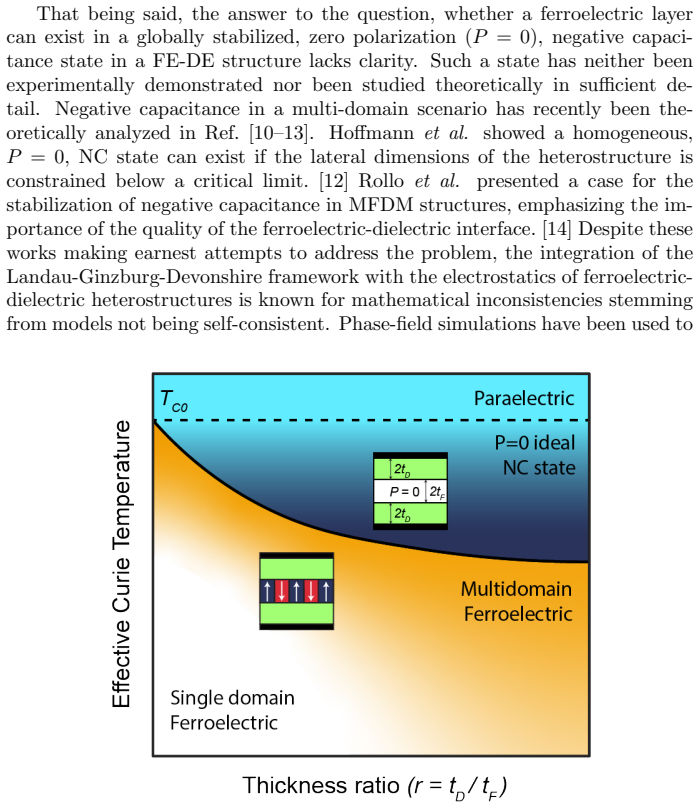
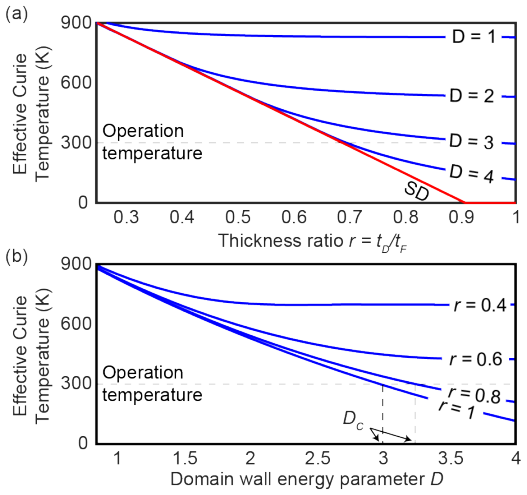
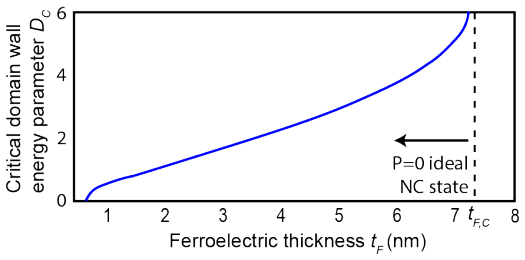
For fixed ferroelectric and dielectric thicknesses, a critical domain wall energy value stabilizes ideal domain-free negative capacitance.
A machine-rendered reading of the paper's core claim, the machinery that carries it, and where it could break.
Core claim
For given thicknesses of the ferroelectric and the dielectric layers, there is a critical value of domain wall energy parameter above which the system would be stabilized in an ideal and robust domain-free negative capacitance state and would be robust against domain formation. Analyses suggest that to achieve ideal negative capacitance, efforts should lie in understanding the means to control the domain wall energy on all fronts, both theory and experiments via high throughput design, discovery, and engineering of ferroelectrics.
What carries the argument
Domain wall energy parameter in the energy minimization model of the ferroelectric-dielectric heterostructure, which sets the boundary between domain-containing and uniform-polarization regimes.
If this is right
- The heterostructure enters a stable domain-free negative capacitance state once domain wall energy exceeds the critical value for the chosen thicknesses.
- Higher domain wall energy increases robustness against any domain formation.
- Material design focused on elevating domain wall energy directly enables the ideal negative capacitance regime.
Where Pith is reading between the lines
- Experimental tuning of domain wall energy in specific material pairs could directly test the location of the critical threshold.
- The same energy-balance logic might apply to other ferroelectric heterostructures where domain suppression is desired.
- Computational searches for ferroelectrics with intrinsically high domain wall energies could accelerate identification of candidate systems.
Load-bearing premise
The model treats domain wall energy as an independent parameter that can be raised without altering other energy terms or boundary conditions.
What would settle it
Fabrication and electrical measurement of ferroelectric-dielectric stacks at fixed thicknesses while varying domain wall energy across the predicted critical value, checking for presence or absence of domains via microscopy or capacitance response.
Figures
read the original abstract
While negative capacitance has been demonstrated in ferroelectric-dielectric heterostructures in the form of capacitance enhancement, all experimental evidence, to date, suggests the existence of domains therein. Here, we address the question: what are the conditions to achieve ideal, domain-free negative capacitance in ferroelectric-dielectric heterostructures? Our main claim is that for given thicknesses of the ferroelectric and the dielectric layers, there is a critical value of domain wall energy parameter -- above which the system would be stabilized in an ideal and robust domain-free negative capacitance state and would be robust against domain formation. Our analyses suggest that to achieve ideal negative capacitance, efforts should lie in understanding the means to control the domain wall energy on all fronts, both theory and experiments via high throughput design, discovery, and engineering of ferroelectrics.
Editorial analysis
A structured set of objections, weighed in public.
Referee Report
Summary. The paper claims that for given thicknesses of the ferroelectric and dielectric layers in a heterostructure, there exists a critical value of the domain wall energy parameter above which the system stabilizes in an ideal, domain-free negative capacitance state that remains robust against domain formation. The authors conclude that efforts to achieve ideal NC should focus on controlling domain wall energy through theory and experiment.
Significance. If the central claim holds, the result would be significant for the negative-capacitance field: it would supply a concrete, thickness-dependent criterion for suppressing domains while preserving the ideal NC response, thereby offering a design principle for material engineering that could move the community beyond the domain-containing states observed in all current experiments.
major comments (1)
- [Abstract] The central claim rests on the existence of a critical domain-wall-energy threshold that can be raised independently while leaving all other energy terms (Landau coefficients, electrostatics, boundary conditions) fixed. The abstract provides no model equations, no explicit functional form for the total energy, and no demonstration that the domain-wall term can be varied without simultaneously altering the polarization profile or the voltage range of negative capacitance. This independence is load-bearing for the reported critical value and must be shown explicitly.
Simulated Author's Rebuttal
We thank the referee for their comments. We respond to the major comment below.
read point-by-point responses
-
Referee: [Abstract] The central claim rests on the existence of a critical domain-wall-energy threshold that can be raised independently while leaving all other energy terms (Landau coefficients, electrostatics, boundary conditions) fixed. The abstract provides no model equations, no explicit functional form for the total energy, and no demonstration that the domain-wall term can be varied without simultaneously altering the polarization profile or the voltage range of negative capacitance. This independence is load-bearing for the reported critical value and must be shown explicitly.
Authors: Abstracts are necessarily concise and do not contain model equations. The full manuscript (Section II) defines the total free-energy functional explicitly as the sum of the Landau polynomial, the electrostatic contribution, and the domain-wall term whose coefficient multiplies |∇P|^2. This coefficient is varied independently while the Landau coefficients, layer thicknesses, and electrostatic boundary conditions are held fixed. For the uniform (domain-free) state the polarization profile is spatially constant, so neither the profile nor the voltage interval of negative capacitance (fixed by the Landau and electrostatic terms alone) changes with the domain-wall coefficient. The critical threshold is obtained by comparing the minimized energy of the uniform state against all admissible domain configurations, as shown by both numerical minimization and analytic estimates in the results. The manuscript therefore supplies the required explicit demonstration. revision: no
Circularity Check
No circularity detected; abstract states claim without exhibiting derivation steps or self-referential reduction
full rationale
The provided abstract asserts the existence of a critical domain-wall-energy threshold for domain-free negative capacitance but supplies no equations, model definitions, or derivation chain. No text is available to inspect for self-definitional parameters, fitted inputs renamed as predictions, or load-bearing self-citations. The reader's note explicitly states that the abstract alone gives no evidence of circularity. Per the rules, circularity requires a quotable reduction (e.g., Eq. X = Eq. Y by construction); none exists here, so the score is 0 and steps is empty.
Axiom & Free-Parameter Ledger
Reference graph
Works this paper leans on
-
[1]
Use of negative capacitance to provide voltage amplification for low power nanoscale devices,
S. Salahuddin and S. Datta, “Use of negative capacitance to provide voltage amplification for low power nanoscale devices,” Nano letters, vol. 8, no. 2, pp. 405–410, 2008
2008
-
[2]
M. E. Lines and A. M. Glass, Principles and applications of ferroelectrics and related materials. Oxford university press, 2001
2001
-
[3]
Depolarizing field and “real
A. Bratkovsky and A. Levanyuk, “Depolarizing field and “real” hystere- sis loops in nanometer-scale ferroelectric films,” Applied physics letters, vol. 89, no. 25, p. 253108, 2006
2006
-
[4]
Domain formation in thin ferroelec- tric films: The role of depolarization energy,
A. Kopal, T. Bahn´ ık, and J. Fousek, “Domain formation in thin ferroelec- tric films: The role of depolarization energy,” Ferroelectrics, vol. 202, no. 1, pp. 267–274, 1997
1997
-
[5]
Displacements of 180 domain walls in electroded ferroelectric single crystals: The effect of surface layers on restoring force,
A. Kopal, P. Mokr` y, J. Fousek, and T. Bahnik, “Displacements of 180 domain walls in electroded ferroelectric single crystals: The effect of surface layers on restoring force,” Ferroelectrics, vol. 223, no. 1, pp. 127–134, 1999
1999
-
[6]
X-ray diffrac- tion studies of 180 ◦ ferroelectric domains in PbTiO 3/SrTiO3 superlattices under an applied electric field,
P. Zubko, N. Stucki, C. Lichtensteiger, and J.-M. Triscone, “X-ray diffrac- tion studies of 180 ◦ ferroelectric domains in PbTiO 3/SrTiO3 superlattices under an applied electric field,” Physical review letters, vol. 104, no. 18, p. 187601, 2010. 7
2010
-
[7]
Negative capacitance in multidomain ferroelectric superlattices,
P. Zubko, J. C. Wojde l, M. Hadjimichael, S. Fernandez-Pena, A. Sen´ e, I. Luk’yanchuk, J.-M. Triscone, and J. ´I˜ niguez, “Negative capacitance in multidomain ferroelectric superlattices,” Nature, vol. 534, no. 7608, pp. 524–528, 2016
2016
-
[8]
Spatially resolved steady-state negative capacitance,
A. K. Yadav, K. X. Nguyen, Z. Hong, P. Garc´ ıa-Fern´ andez, P. Aguado- Puente, C. T. Nelson, S. Das, B. Prasad, D. Kwon, S. Cheema, A. I. Khan, C. Hu, J.´I˜ niguez, J. Junquera, L.-Q. Chen, D. A. Muller, R. Ramamoorthy, and S. Salahuddin, “Spatially resolved steady-state negative capacitance,” Nature, vol. 565, no. 7740, pp. 468–471, 2019
2019
-
[9]
Local negative permittivity and topological phase tran- sition in polar skyrmions,
S. Das, Z. Hong, V. Stoica, M. Gon¸ calves, Y.-T. Shao, E. Parsonnet, E. J. Marksz, S. Saremi, M. McCarter, A. Reynoso, C. Long, A. Hagerstrom, D. Meyers, V. Ravi, B. Prasad, H. Zhou, Z. Zhang, H. Wen, F. G´ omez- Ortiz, P. Garc´ ıa-Fern´ andez, J. Bokor, J.´I˜ niguez, J. W. Freeland, N. D. Orloff, J. Junquera, L.-Q. Chen, S. Salahuddin, D. A. Muller, L. ...
2021
-
[10]
Modeling of negative capacitance in ferroelectric thin films,
H. W. Park, J. Roh, Y. B. Lee, and C. S. Hwang, “Modeling of negative capacitance in ferroelectric thin films,” Advanced Materials, vol. 31, no. 32, p. 1805266, 2019
2019
-
[11]
Multi-domain negative capacitance effects in metal-ferroelectric-insulator-semiconductor/metal stacks: A phase-field simulation based study,
A. K. Saha and S. K. Gupta, “Multi-domain negative capacitance effects in metal-ferroelectric-insulator-semiconductor/metal stacks: A phase-field simulation based study,” Scientific reports, vol. 10, no. 1, pp. 1–12, 2020
2020
-
[12]
On the stabilization of ferroelectric negative capacitance in nanoscale devices,
M. Hoffmann, M. Peˇ si´ c, S. Slesazeck, U. Schroeder, and T. Mikolajick, “On the stabilization of ferroelectric negative capacitance in nanoscale devices,” Nanoscale, vol. 10, no. 23, pp. 10 891–10 899, 2018
2018
-
[13]
Multidomain ferroelectricity as a limiting factor for voltage amplification in ferroelectric field-effect transistors,
A. Cano and D. Jim´ enez, “Multidomain ferroelectricity as a limiting factor for voltage amplification in ferroelectric field-effect transistors,” Applied Physics Letters, vol. 97, no. 13, p. 133509, 2010
2010
-
[14]
Stabi- lization of negative capacitance in ferroelectric capacitors with and without a metal interlayer,
T. Rollo, F. Blanchini, G. Giordano, R. Specogna, and D. Esseni, “Stabi- lization of negative capacitance in ferroelectric capacitors with and without a metal interlayer,” Nanoscale, vol. 12, no. 10, pp. 6121–6129, 2020
2020
-
[15]
Domain-enhanced inter- layer coupling in ferroelectric/paraelectric superlattices,
V. Stephanovich, I. Luk’yanchuk, and M. Karkut, “Domain-enhanced inter- layer coupling in ferroelectric/paraelectric superlattices,” Physical review letters, vol. 94, no. 4, p. 047601, 2005
2005
-
[16]
Coercive field of ultrathin pb (zr 0.52 ti 0.48) o 3 epitaxial films,
N. Pertsev, J. Rodrıguez Contreras, V. Kukhar, B. Hermanns, H. Kohlst- edt, and R. Waser, “Coercive field of ultrathin pb (zr 0.52 ti 0.48) o 3 epitaxial films,” Applied physics letters, vol. 83, no. 16, pp. 3356–3358, 2003. 8
2003
-
[17]
Critical thickness of ultrathin ferroelectric ba ti o 3 films,
Y. Kim, D. Kim, J. Kim, Y. Chang, T. Noh, J. Kong, K. Char, Y. Park, S. Bu, J.-G. Yoon et al., “Critical thickness of ultrathin ferroelectric ba ti o 3 films,” Applied Physics Letters, vol. 86, no. 10, p. 102907, 2005
2005
-
[18]
Scale-free ferroelectricity induced by flat phonon bands in hfo2,
H.-J. Lee, M. Lee, K. Lee, J. Jo, H. Yang, Y. Kim, S. C. Chae, U. Wagh- mare, and J. H. Lee, “Scale-free ferroelectricity induced by flat phonon bands in hfo2,” Science, vol. 369, no. 6509, pp. 1343–1347, 2020
2020
-
[19]
Ferroelectric hfzro x ge and gesn pmosfets with sub-60 mv/decade subthreshold swing, negligible hysteresis, and improved i ds,
J. Zhou, G. Han, Q. Li, Y. Peng, X. Lu, C. Zhang, J. Zhang, Q.-Q. Sun, D. W. Zhang, and Y. Hao, “Ferroelectric hfzro x ge and gesn pmosfets with sub-60 mv/decade subthreshold swing, negligible hysteresis, and improved i ds,” in 2016 IEEE International Electron Devices Meeting (IEDM). IEEE, 2016, pp. 12–2
2016
-
[20]
Negative capacitance ge pfets for performance improvement: Impact of thickness of hfzro x,
J. Li, J. Zhou, G. Han, Y. Liu, Y. Peng, J. Zhang, Q.-Q. Sun, D. W. Zhang, and Y. Hao, “Negative capacitance ge pfets for performance improvement: Impact of thickness of hfzro x,” IEEE Transactions on Electron Devices, vol. 65, no. 3, pp. 1217–1222, 2018
2018
-
[21]
Ultrathin ferroic hfo2–zro2 superlattice gate stack for advanced transistors,
S. S. Cheema, N. Shanker, L.-C. Wang, C.-H. Hsu, S.-L. Hsu, Y.-H. Liao, M. San Jose, J. Gomez, W. Chakraborty, W. Li et al., “Ultrathin ferroic hfo2–zro2 superlattice gate stack for advanced transistors,” Nature, vol. 604, no. 7904, pp. 65–71, 2022
2022
-
[22]
Atomic structure of domain and interphase boundaries in ferroelectric hfo2,
E. D. Grimley, T. Schenk, T. Mikolajick, U. Schroeder, and J. M. LeBeau, “Atomic structure of domain and interphase boundaries in ferroelectric hfo2,” Advanced Materials Interfaces, vol. 5, no. 5, p. 1701258, 2018
2018
-
[23]
Progress and future prospects of negative capacitance electronics: A materials perspective,
M. Hoffmann, S. Slesazeck, and T. Mikolajick, “Progress and future prospects of negative capacitance electronics: A materials perspective,” APL Materials, vol. 9, no. 2, p. 020902, 2021
2021
-
[24]
Do- mains and domain dynamics in fluorite-structured ferroelectrics,
D. H. Lee, Y. Lee, K. Yang, J. Y. Park, S. H. Kim, P. R. S. Reddy, M. Materano, H. Mulaosmanovic, T. Mikolajick, J. L. Jones et al., “Do- mains and domain dynamics in fluorite-structured ferroelectrics,” Applied Physics Reviews, vol. 8, no. 2, p. 021312, 2021. 9
2021
discussion (0)
Sign in with ORCID, Apple, or X to comment. Anyone can read and Pith papers without signing in.