Visualizing Degradation in Anode-Free High-Utilization Aqueous Batteries Across Cell Lifetime
Pith reviewed 2026-06-29 17:22 UTC · model grok-4.3
The pith
Substrate choice determines whether tin plating remains stable at high capacities in anode-free aqueous batteries.
A machine-rendered reading of the paper's core claim, the machinery that carries it, and where it could break.
Core claim
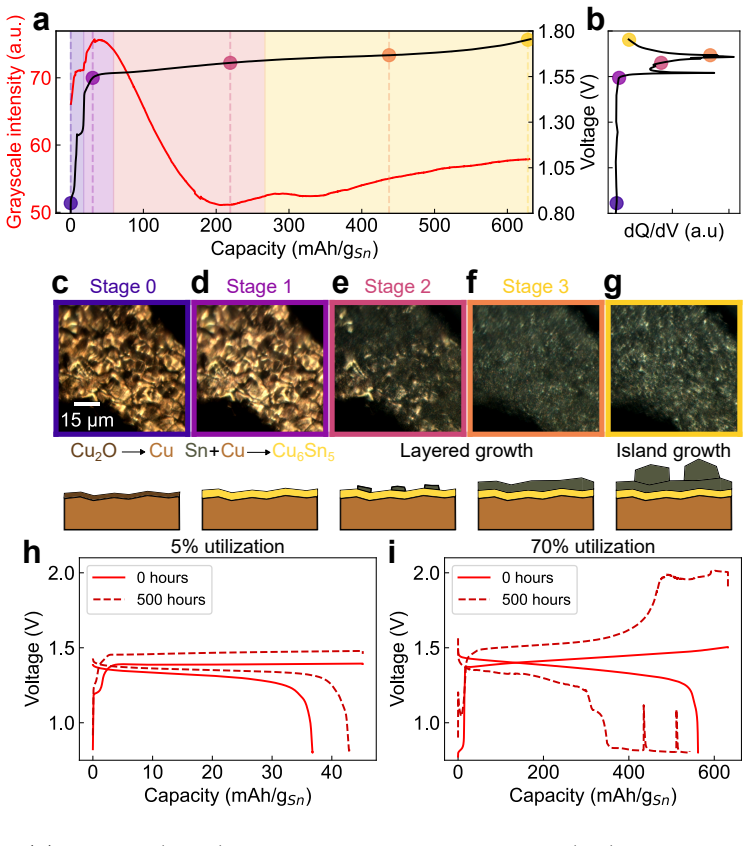
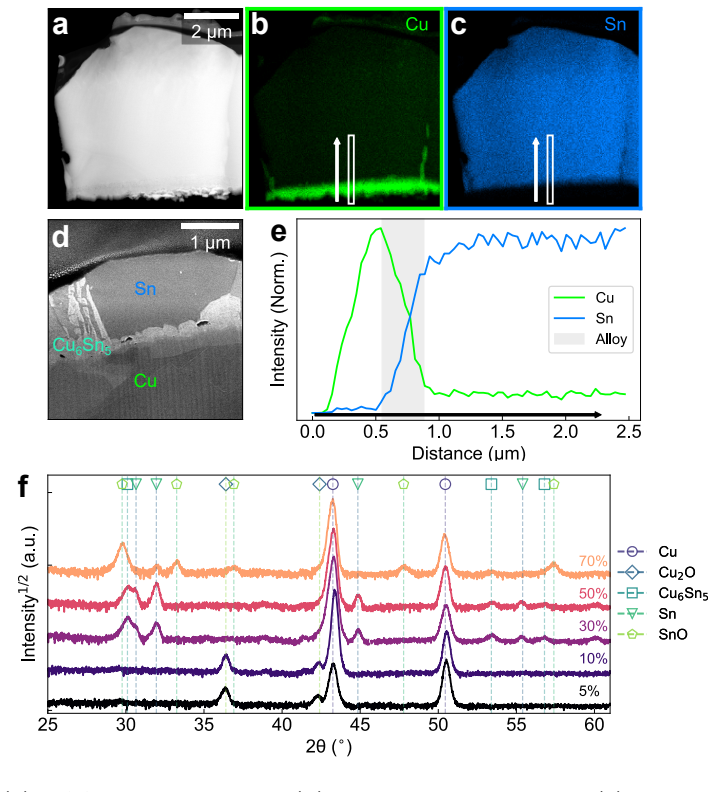
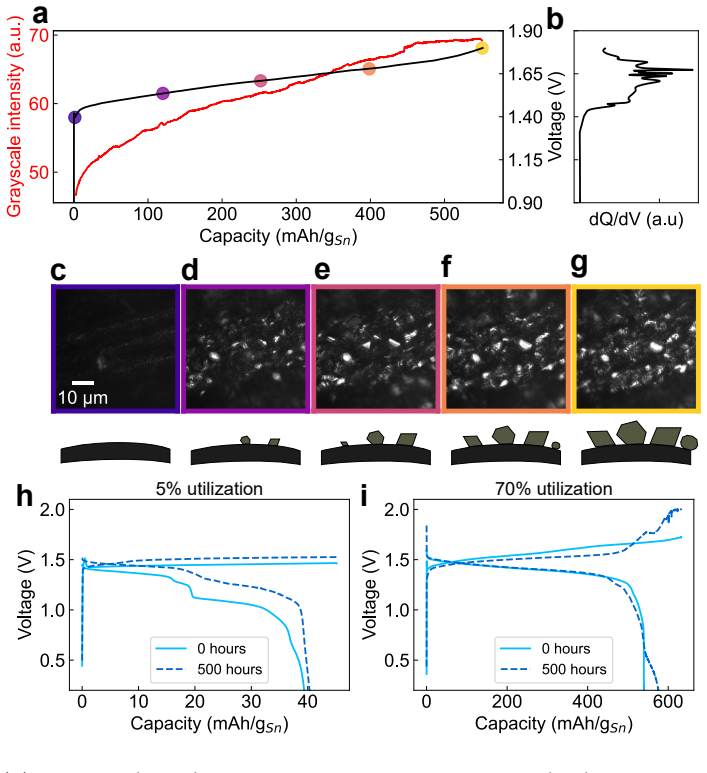
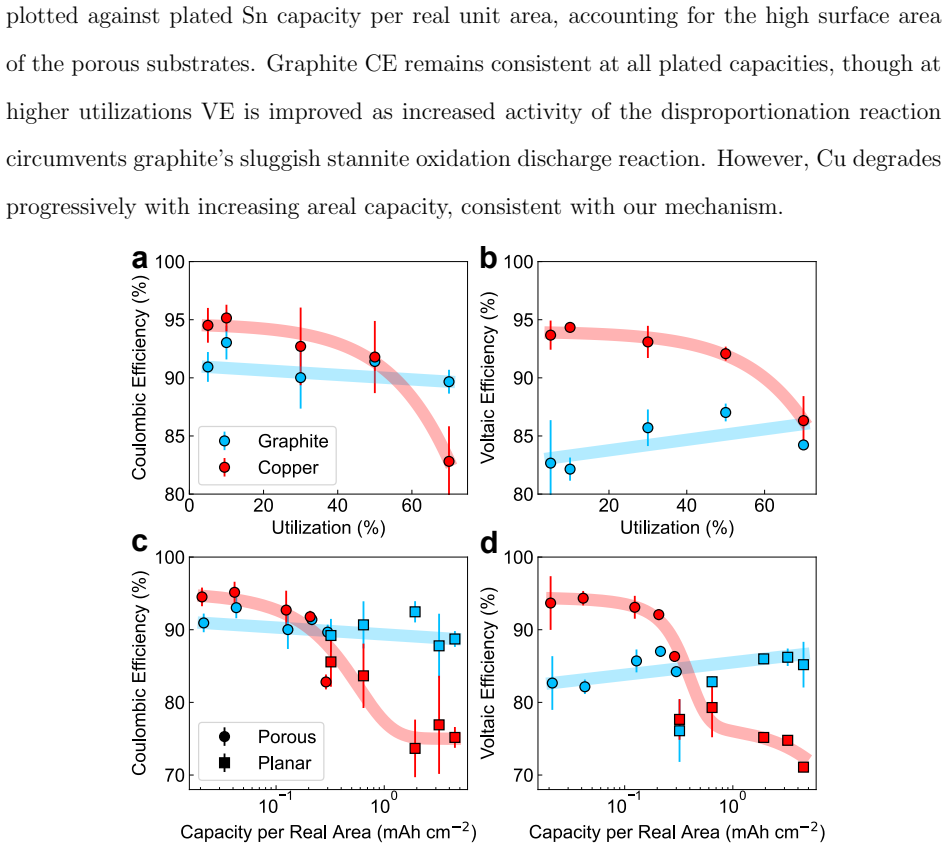
The paper claims that the substrate governs the morphology and stability of plated tin, particularly at high plated capacities. Copper substrates exhibit a multi-stage tin growth mode that produces high overpotentials and irreversible active material loss. Graphite substrates instead display a single-stage growth mode with slower kinetics. Using this insight, the authors construct a high-utilization (70 percent, 630 mAh g^{-1}_Sn) porous graphite substrate Sn anode that combines high efficiency with long lifetime. The observations rest on long-term operando optical imaging of bulk-representative electrodeposition behavior.
What carries the argument
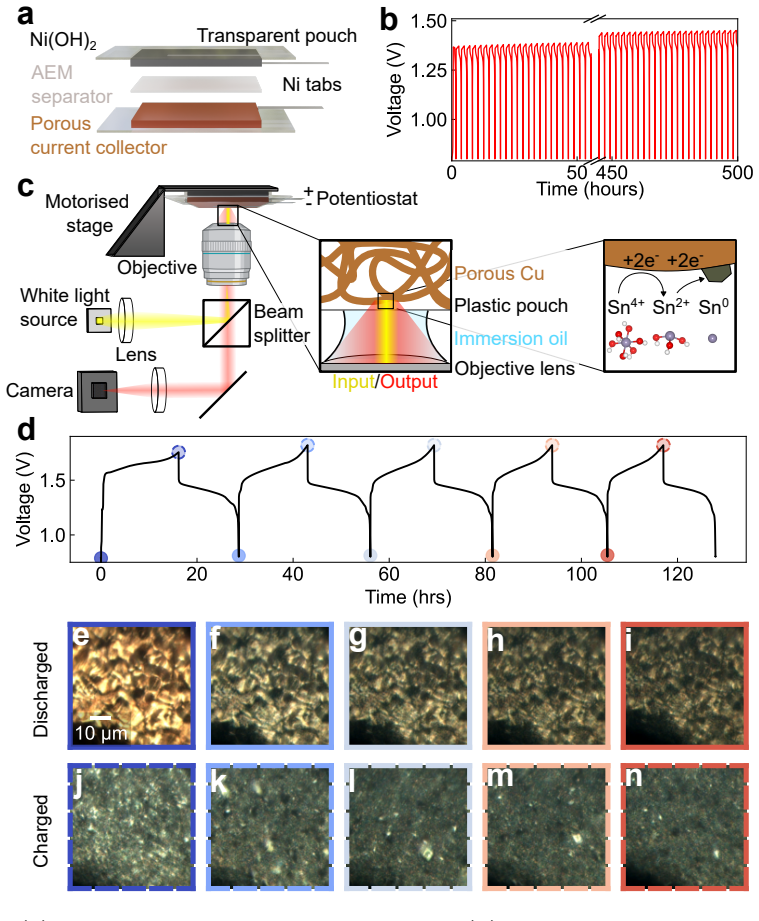
Substrate-dependent tin growth mode (multi-stage on copper versus single-stage on graphite), revealed by custom through-plane operando optical microscopy in pouch cells across full cell lifetime.
If this is right
- Copper substrates cause high overpotentials and irreversible active material loss at high plated capacities.
- Graphite substrates enable a single-stage growth mode that improves stability despite slower kinetics.
- A porous graphite substrate supports a tin anode at 70 percent utilization (630 mAh g^{-1}_Sn) with high efficiency and long lifetime.
- Long-term operando characterization across device lifetime can guide material and device optimization for other electrochemical systems.
Where Pith is reading between the lines
- The same long-term imaging approach could be applied to other reactive metal anodes to screen substrates that avoid multi-stage failure modes.
- Substrate engineering that favors single-stage growth may raise the practical energy density ceiling for aqueous batteries beyond what copper current collectors currently allow.
- Combining the graphite substrate with additional surface treatments not tested here might further increase utilization while preserving the observed stability.
Load-bearing premise
The through-plane optical images captured in the custom pouch-cell setup are representative of bulk electrodeposition behavior without significant optical artifacts, cell geometry effects, or imaging-induced changes to the observed morphology.
What would settle it
If copper and graphite substrates produced identical tin morphologies, overpotentials, and cycle lives under identical high-capacity plating conditions, the claim that substrate governs growth mode and stability would be falsified.
Figures
read the original abstract
Operando microscopy has unveiled key mechanistic insights in battery materials during early cycling, but long-term characterization to unveil material evolution, degradation, and failure remain limited. To address this gap, we develop a custom operando optical microscope that captures images across hundreds of cycles and hours using optically accessible, anode-free pouch cells. We image through-plane, bulk-representative electrodeposition behavior of aqueous tin metal anodes, which are promising due to their high energy density but whose reactivity limits practical cycle life. We show that substrate governs the morphology and stability of plated tin, particularly at high plated capacities. Specifically, copper substrates exhibit a multi-stage tin growth mode, which results in high overpotentials and irreversible active material loss at high plated capacities. In contrast, graphite substrates display a single-stage growth mode with slower kinetics. Using this insight, we balance performance and stability to demonstrate a high-utilization (70%, 630 mAh g$^{-1}_{Sn}$) porous graphite substrate Sn anode with high efficiency and long lifetime. Our results underscore the importance of material and device optimization guided by operando characterization across device lifetime with broad applicability to electrochemical systems.
Editorial analysis
A structured set of objections, weighed in public.
Referee Report
Summary. The paper develops a custom operando optical microscope for imaging through-plane electrodeposition in anode-free aqueous Sn pouch cells over hundreds of cycles. It claims that Cu substrates induce multi-stage Sn growth causing high overpotentials and irreversible active-material loss at high plated capacities, while graphite substrates enable single-stage growth with slower kinetics; this insight is used to demonstrate a 70% utilization (630 mAh g^{-1}_Sn) porous graphite Sn anode with high efficiency and long lifetime.
Significance. If the imaging is representative of bulk behavior, the long-term operando visualization across device lifetime is a clear methodological advance over early-cycle-only studies, and the substrate-dependent growth-mode distinction supplies a concrete design rule for balancing utilization and stability in aqueous metal anodes.
major comments (2)
- The central claim that substrate governs morphology and stability (Abstract) rests on the assumption that through-plane optical images in the custom pouch cell are free of optical artifacts, light-induced plating changes, pouch-geometry distortions, and line-of-sight projection effects and accurately reflect 3D bulk electrodeposition. No cross-validation (SEM, X-ray tomography, or electrochemical modeling) or artifact-ruling experiments are described, leaving the Cu multi-stage vs. graphite single-stage distinction unverified.
- Abstract and results report clear observational distinctions but supply no quantitative error bars on overpotential or capacity-loss values, no raw-image examples, and no statistical assessment of how representative the imaged regions are of the full electrode area.
minor comments (1)
- Methods section should explicitly state the optical resolution, illumination wavelength/intensity, and any controls used to confirm that imaging itself does not alter plating morphology.
Simulated Author's Rebuttal
We thank the referee for their thorough review and valuable comments. We address the major comments point-by-point below, providing the strongest honest defense of the work while acknowledging where revisions can strengthen the presentation.
read point-by-point responses
-
Referee: The central claim that substrate governs morphology and stability (Abstract) rests on the assumption that through-plane optical images in the custom pouch cell are free of optical artifacts, light-induced plating changes, pouch-geometry distortions, and line-of-sight projection effects and accurately reflect 3D bulk electrodeposition. No cross-validation (SEM, X-ray tomography, or electrochemical modeling) or artifact-ruling experiments are described, leaving the Cu multi-stage vs. graphite single-stage distinction unverified.
Authors: The pouch cell architecture uses a thin electrolyte layer and transparent window specifically to enable direct through-plane imaging of bulk electrodeposition while preserving electrochemical behavior. The morphological distinctions are corroborated by independent electrochemical signatures (overpotential evolution and capacity retention) that differ systematically between Cu and graphite. We will revise the manuscript to add an explicit discussion of potential artifacts, the design choices that mitigate them (low light intensity, cell geometry), and the correlation between optical observations and bulk metrics. Full cross-validation with ex-situ 3D techniques was outside the scope of this study focused on long-term operando optical access. revision: partial
-
Referee: Abstract and results report clear observational distinctions but supply no quantitative error bars on overpotential or capacity-loss values, no raw-image examples, and no statistical assessment of how representative the imaged regions are of the full electrode area.
Authors: We agree that these elements improve rigor. The revised manuscript will include error bars on all overpotential and capacity-loss plots (from replicate cells), representative raw images in the SI, and a statistical summary of multiple imaged regions demonstrating consistency across the electrode area. revision: yes
Circularity Check
No circularity: purely experimental imaging study with no equations or fitted derivations
full rationale
The paper reports direct operando through-plane optical microscopy observations of Sn electrodeposition on Cu vs. graphite substrates in custom pouch cells, followed by a practical demonstration of a porous graphite anode achieving 70% utilization. No equations, parameters, or mathematical derivations appear in the provided text. The central claims rest on empirical morphology differences and cycle-life data rather than any reduction of outputs to inputs by construction, self-citation chains, or renamed fits. This is a standard experimental workflow; the imaging method itself is not derived from the results it produces.
Axiom & Free-Parameter Ledger
Reference graph
Works this paper leans on
-
[1]
(8) Lu, X. et al. Unravelling electro-chemo-mechanical processes in graphite/silicon composites for designing nanoporous and microstructured battery electrodes.Nature Nanotechnology2025,20, 1656–1666. (9) Gopal, R. K.; Ma, B.; Bai, P. Mapping Out Fast Charging Safe Limits for High-Loading Lithium-Ion Cells by High-Fidelity Operando Microscopy.Small2026,22...
2020
-
[2]
Water-in-Salt
(13) Xu, D.; Zhang, H.; Xie, J.; Zhou, L.; Yang, F.; Ma, J.; Yu, Y.; Wang, G.; Lu, X. Highly Reversible Tin Film Anode Guided via Interfacial Coordination Effect for High Energy Aqueous Acidic Batteries.Advanced Materials2024,36, 2408067. (14) Zhang, F.; Zhang, X.; Shu, Y.; Xiao, H.; Wang, Q.; Guo, Q.; Wang, Y.; Huang, J.; Xia, Y. Constructing Dense Morph...
2024
-
[3]
A Sn-Fe flow battery with excellent rate and cycle performance.Journal of Power Sources2018,404, 89–95
(47) Zhou, X.; Lin, L.; Lv, Y.; Zhang, X.; Wu, Q. A Sn-Fe flow battery with excellent rate and cycle performance.Journal of Power Sources2018,404, 89–95. (48) Yang, Y.; Xiang, Y.; Yang, Y.; Xie, X.; Mushtaq, F.; Zhang, R.; Daoud, W. A. Urea Induces Uniform Tin Deposition for Long Cycle-Life Tin-based Redox Flow Battery. Advanced Functional Materials2025,3...
2015
discussion (0)
Sign in with ORCID, Apple, or X to comment. Anyone can read and Pith papers without signing in.