REVIEW 2 major objections 1 minor 1 cited by
Cordon-MAS: Defending RAG against Knowledge Poisoning via Information-Flow Control
T0 review · 2 major / 1 minor · reviewed 2026-06-29 · grok-4.3
Pith's one-line read RAG models can detect contradictions in poisoned evidence but still act on it, so isolating the synthesis agent from raw documents blocks the effect.
desk verdict The paper reframes RAG poisoning as an information-flow problem and reports a large drop in attack success, but the audit-to-synthesis link needs explicit checks to confirm it blocks poisoned claims. read the letter →
The pith
A machine-rendered reading of the paper's core claim, the machinery that carries it, and where it could break.
The reading
What carries the argument
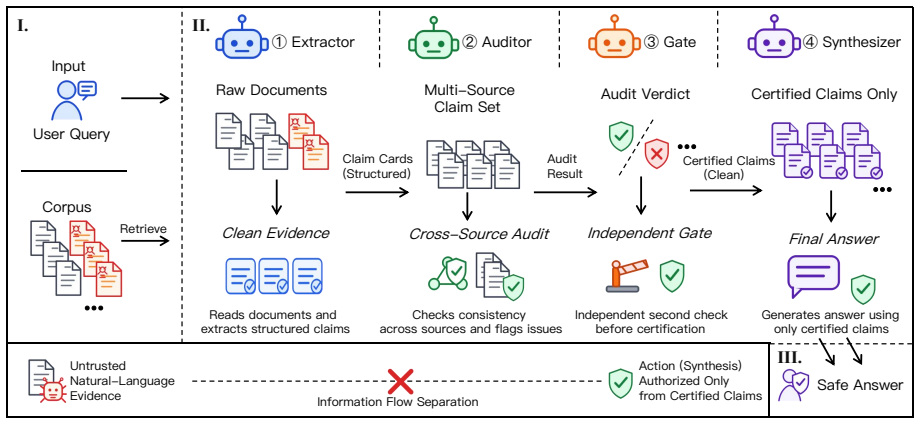
The Cordon Principle—no agent capable of final synthesis may access untrusted natural-language evidence—enforced by compartmentalized agents that hold asymmetric memory privileges.
What would settle it
An experiment in which synthesis agents still lack direct access to poisoned documents yet the generated answers continue to reflect the poisoned claims.
Extended reading notes
Core claim
The central claim is that RAG systems suffer from a monitoring-control gap in which models can identify contradictions in retrieved evidence but nevertheless incorporate poisoned claims into their generated responses. This gap renders detection-based defenses ineffective. The Cordon Principle addresses it by mandating that no agent responsible for final synthesis has access to untrusted natural-language evidence. CORDON-MAS realizes the principle through a multi-agent architecture that separates evidence extraction, cross-source audit, and answer synthesis into components with asymmetric memory privileges. Evaluation on five BEIR datasets confirms a 92.4% relative reduction in attack success
Load-bearing premise
The monitoring-control gap is the dominant failure mode and that blocking direct access to untrusted evidence through asymmetric memory privileges will stop poisoned content from shaping the final synthesis.
Editorial extensions
If this is right
- RAG poisoning must be treated as an information-flow control problem rather than a detection problem.
- Architectures that enforce the Cordon Principle through asymmetric memory privileges achieve large reductions in attack success.
- Separating evidence extraction, cross-source audit, and answer synthesis into distinct agents with restricted privileges becomes a necessary design choice.
- The approach applies across standard retrieval datasets and Confundo-style poisoning attacks.
Reading between the lines
- Similar privilege separation could be tested in other multi-agent LLM systems to close control gaps outside RAG.
- Designers would need to verify that inter-agent messages cannot leak poisoned content indirectly.
- The reframing suggests prioritizing architectural isolation over further improvements in detection accuracy alone.
Editorial analysis
A structured set of objections, weighed in public.
Referee Report
Summary. The paper claims that RAG systems are vulnerable to Confundo-style knowledge poisoning because LLMs exhibit a monitoring-control gap: they can detect contradictions in retrieved evidence yet still act on poisoned claims. It introduces the Cordon Principle (no synthesis-capable agent may access untrusted natural-language evidence) and realizes it via CORDON-MAS, a compartmentalized multi-agent framework that separates evidence extraction, cross-source audit, and answer synthesis using asymmetric memory privileges. On five BEIR datasets the framework is reported to reduce attack success rate by 92.4% relative to undefended RAG, reframing poisoning defense as an information-flow control problem rather than a detection problem.
Significance. If the reported 92.4% reduction is reproducible and the architectural separation demonstrably prevents poisoned natural-language content from reaching the synthesis agent, the work would offer a principled alternative to detection-based defenses for high-stakes RAG deployments. The multi-dataset evaluation and explicit reframing from detection to control are potentially valuable contributions, but the absence of attack details and the unresolved transmission path through the audit agent limit the assessed significance.
major comments (2)
- [Abstract] Abstract: the central empirical claim of a 92.4% reduction in attack success rate is presented without any description of attack implementation, baseline defenses, statistical tests, dataset splits, or evaluation protocol, rendering the result unevaluable.
- [Cordon Principle and CORDON-MAS] Cordon Principle and CORDON-MAS (abstract and framework description): the audit agent necessarily receives the poisoned natural-language evidence and must produce outputs that reach the synthesis agent. No mechanism is specified to guarantee that these outputs are restricted to structured, non-semantic formats that cannot carry poisoned claims; without such a restriction the asymmetric memory privileges do not enforce the stated Cordon Principle.
minor comments (1)
- [Abstract] Abstract: the phrase "Confundo-style poisoning" is introduced without definition or citation.
Simulated Author's Rebuttal
We thank the referee for the detailed and constructive comments. We address each major comment below and indicate planned revisions to the manuscript.
read point-by-point responses
-
Referee: [Abstract] Abstract: the central empirical claim of a 92.4% reduction in attack success rate is presented without any description of attack implementation, baseline defenses, statistical tests, dataset splits, or evaluation protocol, rendering the result unevaluable.
Authors: The abstract is a concise summary subject to length limits; the full manuscript details the attack implementation (Section 4.2), baseline defenses (Section 5.1), statistical tests (Section 5.3), dataset splits (Section 4.1), and evaluation protocol (Section 4.3). To make the central claim more evaluable from the abstract, we will add a brief clause referencing the multi-dataset BEIR evaluation and protocol. revision: yes
-
Referee: [Cordon Principle and CORDON-MAS] Cordon Principle and CORDON-MAS (abstract and framework description): the audit agent necessarily receives the poisoned natural-language evidence and must produce outputs that reach the synthesis agent. No mechanism is specified to guarantee that these outputs are restricted to structured, non-semantic formats that cannot carry poisoned claims; without such a restriction the asymmetric memory privileges do not enforce the stated Cordon Principle.
Authors: The comment correctly notes that the current manuscript text does not explicitly specify the audit agent's output format. The intended design restricts the audit agent to fixed-schema structured outputs (e.g., trust scores and source IDs without transmitting natural-language claims), with asymmetric memory preventing the synthesis agent from accessing raw evidence. We will revise the framework section to explicitly define and enforce this output restriction. revision: yes
Circularity Check
No circularity: empirical evaluation of new architectural framework
full rationale
The paper introduces the Cordon Principle as a new definition and realizes it via CORDON-MAS, an agent-based compartmentalization with asymmetric privileges. The central result is an empirical reduction in attack success rate (92.4% relative) measured on BEIR datasets. No equations, fitted parameters, self-citations, or prior-work ansatzes are invoked in a load-bearing way that would make the reported outcome equivalent to its inputs by construction. The derivation chain is therefore self-contained against external benchmarks.
Assumptions & free parameters
assumptions (1)
- domain assumption Models exhibit a monitoring-control gap where they can detect contradictions in retrieved evidence yet still act on poisoned claims.
invented entities (2)
-
Cordon Principle
-
CORDON-MAS
Cite this review
Pith. "Pith review of Cordon-MAS: Defending RAG against Knowledge Poisoning via Information-Flow Control." pith.science (2026). https://pith.science/paper/INOT54TF
@misc{pith2026260526754,
  author       = {Pith},
  title        = {Pith review of: Cordon-MAS: Defending RAG against Knowledge Poisoning via Information-Flow Control},
  year         = {2026},
  howpublished = {\url{https://pith.science/paper/INOT54TF}},
  note         = {Machine review of arXiv:2605.26754}
}
read the original abstract
Retrieval-augmented generation (RAG) increasingly underpins high-stakes applications, yet remains vulnerable to Confundo-style poisoning where adversarially optimized documents manipulate generated outputs. Existing defenses assume that detecting poisoned evidence prevents harm. We show this assumption is incorrect: models exhibit a monitoring-control gap -- they can detect contradictions in retrieved evidence yet still act on poisoned claims. We introduce the Cordon Principle -- no agent capable of final synthesis may access untrusted natural-language evidence -- and realize it through CORDON-MAS, a compartmentalized framework that enforces this principle architecturally by separating evidence extraction, cross-source audit, and answer synthesis into agents with asymmetric memory privileges. Across five BEIR datasets, CORDON-MAS reduces attack success rate by 92.4\% relative to undefended RAG. This reframes RAG poisoning from a detection problem to an information-flow control problem.
Figures


Figures from the paper (5 more)


Forward citations
Cited by 1 Pith paper
-
TriShieldRAG: A Three-Ring Defense-in-Depth Framework Against Knowledge Corruption in Retrieval-Augmented Generation
A three-ring RAG defense cuts non-adaptive PoisonedRAG attack success from ~91% to ~13% on 10 questions over a 5,000-document Wikipedia base.
Reference graph
Works this paper leans on
-
[1]
AutoGen: Enabling Next-Gen LLM Applications via Multi-Agent Conversation
AutoGen: Enabling next-gen LLM applica- tions via multi-agent conversation.arXiv preprint arXiv:2308.08155. Chong Xiang, Tong Wu, Zexuan Zhong, David Wagner, Danqi Chen, and Prateek Mittal. 2024. Certifiably ro- bust RAG against retrieval corruption.arXiv preprint arXiv:2405.15556. Baolei Zhang, Yuxi Chen, Zhuqing Liu, Lihai Nie, Tong Li, Zheli Liu, and M...
work page Pith review arXiv 2024
-
[2]
Target endorsement: When the RAG system reads the poison document alongside clean documents, the generated answer should en- dorse the attacker’s target claima∗
-
[3]
Pipeline robustness: The poison must survive standard preprocessing (HTML stripping, text extraction, chunking), dense retrieval (Con- triever (Izacard et al., 2022)), and optional paraphrasing or reranking—transformations that naive keyword-injection attacks do not survive
2022
-
[4]
Coltsfoot supports sleep
Semantic relevance: The poison must be top- ically relevant to the target query to ensure retrieval; irrelevant documents would not sur- face in the top-Kretrieval set. The generator is optimized via reinforcement learning or direct preference optimization, using the RAG system’s output as a reward signal. The key threat property ispipeline robustness: Co...
-
[5]
Attack scope: Our experiments cover factual manipulation; Confundo’s opinion manipula- tion and hallucination induction attack types remain to be evaluated
-
[6]
CDCA significantly increases energy expenditure
Model and retriever generalization: All ex- periments use a single retriever (Contriever) and the same LLM backend (DeepSeek-Chat) for all four agents. Results may vary with other combinations. In particular, all four agents sharing the same underlying model may inflate both extraction quality and au- dit effectiveness if the model’s internal rep- resenta...
-
[7]
Adaptive attack coverage: Our adaptive eval- uation uses three strategies we designed; there may be other attack vectors we have not antic- ipated
-
[8]
Query-sampling uncertainty: Our primary evaluation uses 50 queries per dataset; the re- sulting 95% binomial CIs span 5–15 percent- age points. An n=100 validation on SciFact and NQ (Appendix U) confirms the attack sur- face is substantial (VR 65.3% on SciFact) but reveals per-seed variance in defense effective- ness, indicating that 50-query evaluations ...
Show all 17 references
-
[9]
CORDON- MAS achieves 60% average (40–79% across datasets)
Answerability(% of queries where the sys- tem produces an answer rather than rejecting): reported in main-body Table 9. CORDON- MAS achieves 60% average (40–79% across datasets). All baselines except TrustRAG (73%) answer 100% of queries by design
-
[10]
This is asafety prop- erty—refused queries are never wrong—that VR and most baselines lack entirely (they an- swer 100% of queries, including those without sufficient evidence)
Safety-Refusal Rate(% of queries where the system explicitly declines to answer due to insufficient certified evidence): CORDON- MAS 40% average. This is asafety prop- erty—refused queries are never wrong—that VR and most baselines lack entirely (they an- swer 100% of queries,...
-
[11]
Pre-fix configuration (near-total block)
Answer correctness(% of generated answers that are factually correct, LLM-judged against ground truth), computed onanswered queries only(excluding INSUFFICIENT refusals): re- ported below. Pre-fix configuration (near-total block). Be- fore prompt engineering, CORDON-MAS an- sw...
-
[12]
claim_id
for dense retrieval (Karpukhin et al., 2020) (K= 10 ), DeepSeek-Chat as the LLM back- end (DeepSeek-AI, 2024) (with GPT-4o (Ope- nAI, 2023) and Qwen2.5-32B validation in Ap- pendix O), and LangGraph (LangChain AI, 2024) for agent orchestration. Experiments ran on cloud GPU ins...
2020
-
[13]
all factual claims
Query-aware extraction (14% → 32%): The original Extractor prompt asked for “all factual claims” from documents. We added the user query as context and constrained ex- traction to query-relevant claims only, reduc- ing noise extraction and preventing the Audi- tor from being f...
-
[14]
Relaxed Gate threshold (32%→ 58%): The original Gate prompt classified any evidence set with ≤ 2 supporting documents as INSUF- FICIENT. We relaxed this to require only ≥ 1 certified claim from any source, with the ad- ditional rule that single-source claims trigger INSUFFICIE...
-
[15]
I don’t know
Synthesizer trust calibration (58% → 74% on SciFact): The original Synthesizer prompt instructed the model to independently re- evaluate claims. We replaced this with an instruction to trust the Gate’s sufficiency de- termination, preventing the Synthesizer from second-guessin...
2023
-
[16]
Fabricated scientific findings with implausible statistics receive low scores
Factual plausibility (factual_plausibility, 0–1): The LLM independently assesses whether each claim is consistent with established knowledge, using its parametric knowledge. Fabricated scientific findings with implausible statistics receive low scores
-
[17]
This di- rectly addresses the coordinated attack sce- nario
Uniform agreement detection: When all claims agree on a factually dubious asser- tion without independent verification, all are flagged as suspicious (risk ≥ 0.6). This di- rectly addresses the coordinated attack sce- nario. The risk score rule is: if factual_plausibility< 0.3...
2021
Reviewed June 29, 2026 · model on record in the stance chip above.
Discussion (0). Sign in to comment.