Terahertz spin-current transparency through rough interfaces
Pith reviewed 2026-06-29 16:17 UTC · model grok-4.3
The pith
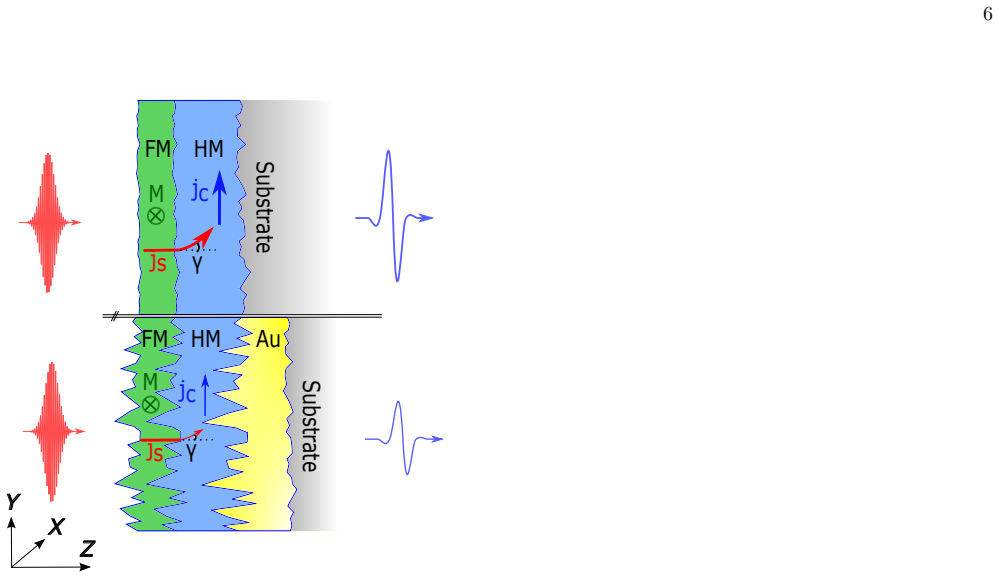
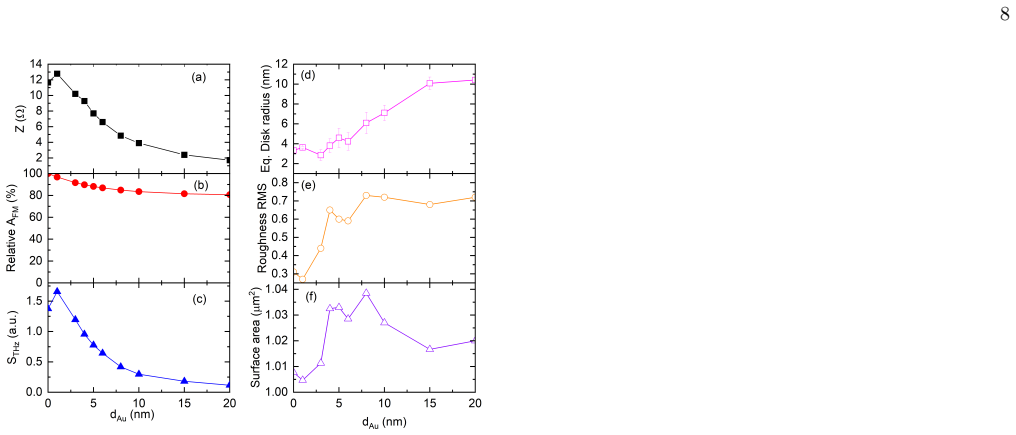
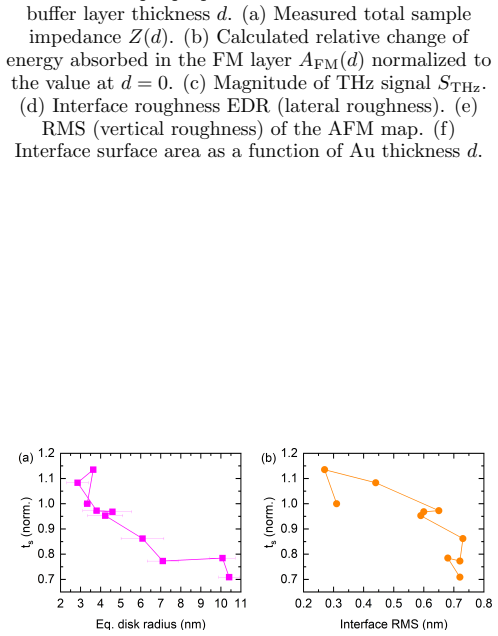
Spin-current transparency at Co|Pt interfaces falls only 30 percent even when roughness and grain size triple.
A machine-rendered reading of the paper's core claim, the machinery that carries it, and where it could break.
Core claim
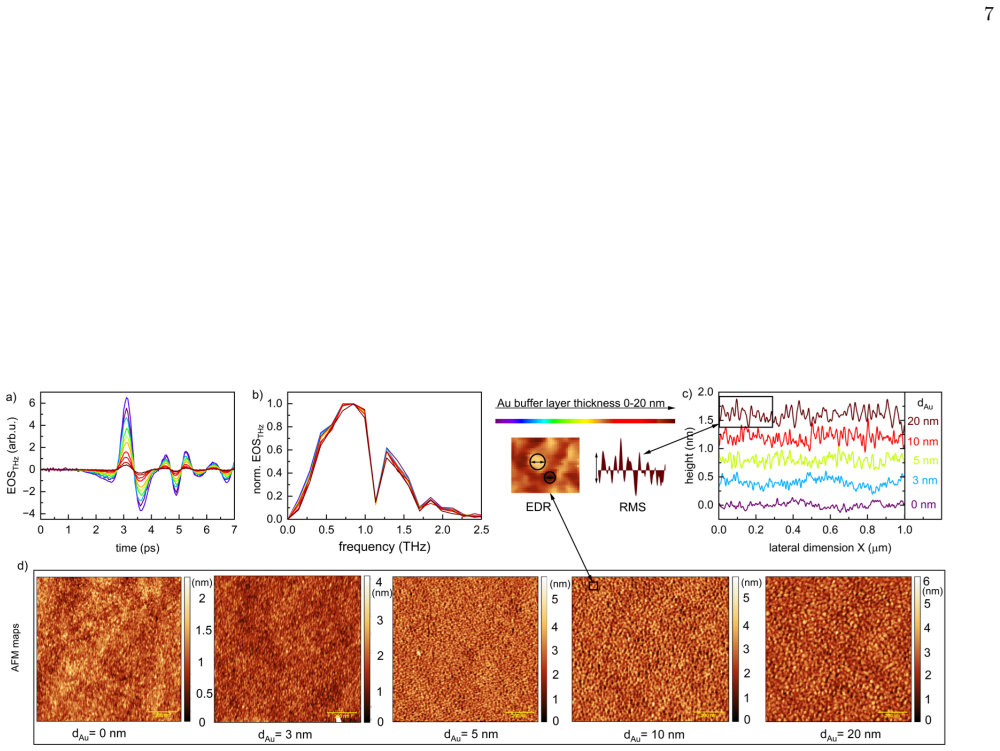
In Co|Pt heterostructures, the interface spin-current transparency ts decreases by approximately 30 percent as root-mean-square roughness and lateral grain size each increase by a factor of three, with no measurable change in the terahertz spectrum, after corrections for sample impedance and optical absorption.
What carries the argument
the extracted interface spin-current transparency ts, obtained from terahertz emission spectroscopy after impedance and absorption corrections
If this is right
- Interfacial spin transport remains relatively robust against morphological variations on ultrafast timescales.
- Terahertz emission spectroscopy can serve as a reliable probe of spin dynamics even across imperfect interfaces.
- Device performance in spintronic applications may tolerate moderate increases in interface roughness without major loss of ultrafast spin transmission.
- The terahertz spectrum itself carries no signature of the roughness-induced changes in transparency.
Where Pith is reading between the lines
- Fabrication processes that allow some roughness could still yield functional ultrafast spintronic elements if the 30 percent drop is acceptable.
- The lack of spectral change suggests that roughness does not introduce strong frequency-dependent scattering in the terahertz range.
- Similar measurements on other material pairs could test whether the observed robustness is specific to Co|Pt or more general.
Load-bearing premise
The corrections for changes in sample impedance and optical absorption isolate the interface spin-current transparency without leftover effects from the Au buffer layer or other layers.
What would settle it
An independent measurement of spin current magnitude, obtained without using the impedance or absorption corrections, that shows a drop larger than 30 percent when roughness triples.
Figures
read the original abstract
Spin transport across interfaces is critical for spintronic devices, yet remains difficult to probe on ultrafast timescales. We use terahertz emission spectroscopy on Co|Pt heterostructures whose interface roughness is tuned through the thickness of an underlying Au buffer layer, while leaving other growth parameters unchanged. From the measured THz electric field, we extract the interface spin-current transparency ts after correcting for the changes in sample impedance and optical absorption of the stack. Surprisingly, we find that ts decreases by only approximately 30% as the interface root-mean-square roughness and the lateral grain size both increase by a factor of three, with no measurable change in the THz spectrum. These results demonstrate that interfacial spin transport is relatively robust against morphological variations on ultrafast timescales, establishing terahertz emission spectroscopy as a reliable probe of spin dynamics across imperfect interfaces.
Editorial analysis
A structured set of objections, weighed in public.
Referee Report
Summary. The manuscript reports an experimental study of spin-current transparency ts across Co|Pt interfaces whose roughness is varied by changing the thickness of an underlying Au buffer layer. Using terahertz emission spectroscopy, the authors measure the emitted THz electric field, apply corrections for sample impedance and optical absorption of the stack, and extract ts. They find that ts decreases by only ~30% when both RMS roughness and lateral grain size increase by a factor of three, with no measurable change in the THz spectrum, concluding that interfacial spin transport is relatively robust to morphological variations on ultrafast timescales.
Significance. If the impedance and absorption corrections are shown to isolate the interface contribution without significant residuals from the Au buffer, the result would establish THz emission spectroscopy as a practical probe of ultrafast spin dynamics at imperfect interfaces and indicate that spin transport remains efficient despite substantial roughness changes. This would be relevant for spintronic device design where interface morphology is difficult to control perfectly.
major comments (2)
- [Abstract and ts extraction section] Abstract and the section describing ts extraction: the claim that corrections for impedance and optical absorption isolate an interface-only ts rests on the unverified assumption that Au-buffer contributions to THz generation and propagation are fully subtracted. No quantitative validation (control samples with fixed roughness but varied Au thickness, or error propagation through the corrections) is described, which directly affects the reliability of the reported 30% trend.
- [Results section] Results section (the paragraph reporting the 30% decrease): the central claim that ts changes by only ~30% for a 3× roughness/grain-size increase lacks reported uncertainties, statistical significance tests, or sensitivity analysis showing that this change exceeds possible systematic residuals from the Au layer. Without these, it is unclear whether the observed trend supports the robustness conclusion.
minor comments (2)
- Notation for the transparency parameter should be standardized (e.g., consistently use t_s with subscript) across text, figures, and equations.
- Figure captions should explicitly state the number of independent samples or measurements averaged for each roughness condition to allow assessment of reproducibility.
Simulated Author's Rebuttal
We thank the referee for the careful and constructive review. The two major comments both concern the validation and statistical presentation of the ts extraction procedure. We address each below and will incorporate the requested quantitative checks in a revised manuscript.
read point-by-point responses
-
Referee: [Abstract and ts extraction section] Abstract and the section describing ts extraction: the claim that corrections for impedance and optical absorption isolate an interface-only ts rests on the unverified assumption that Au-buffer contributions to THz generation and propagation are fully subtracted. No quantitative validation (control samples with fixed roughness but varied Au thickness, or error propagation through the corrections) is described, which directly affects the reliability of the reported 30% trend.
Authors: We agree that the current manuscript does not contain an explicit error-propagation analysis or control-sample series that isolates the Au-buffer contribution at fixed roughness. The corrections themselves are performed using measured sheet resistance and optical transmission/reflection data for each complete stack; however, we did not propagate the uncertainties in those measured quantities through to ts nor test residual Au-driven generation. In the revision we will add both an error-propagation calculation and a sensitivity analysis that assumes plausible residual THz generation or propagation effects from the Au layer. These additions will directly quantify the uncertainty in the extracted ts values. revision: yes
-
Referee: [Results section] Results section (the paragraph reporting the 30% decrease): the central claim that ts changes by only ~30% for a 3× roughness/grain-size increase lacks reported uncertainties, statistical significance tests, or sensitivity analysis showing that this change exceeds possible systematic residuals from the Au layer. Without these, it is unclear whether the observed trend supports the robustness conclusion.
Authors: The manuscript reports the ~30% reduction without accompanying uncertainties or statistical tests. We will revise the Results section to include (i) error bars derived from the standard deviation across multiple independently grown samples at each Au thickness, (ii) a simple statistical comparison confirming the trend exceeds the combined random and estimated systematic uncertainty, and (iii) the sensitivity analysis described in the response to the first comment. These changes will allow a reader to judge whether the observed variation remains significant once plausible Au residuals are taken into account. revision: yes
Circularity Check
No circularity: purely experimental extraction with independent corrections
full rationale
The paper reports direct THz emission measurements on Co|Pt stacks where interface roughness is varied via Au buffer thickness. The quantity ts is obtained by applying impedance and absorption corrections to the measured electric field; no equations, ansatzes, or self-citations are invoked that would make ts equivalent to its own inputs by construction. The result is therefore a measurement against external data rather than a self-referential derivation.
Axiom & Free-Parameter Ledger
free parameters (1)
- impedance and optical absorption corrections
axioms (1)
- domain assumption Changes in Au buffer thickness affect only interface roughness and leave other growth parameters and intrinsic spin properties unchanged.
Reference graph
Works this paper leans on
-
[1]
Wunderlichet al., Science330, 6012 (2010)
J. Wunderlichet al., Science330, 6012 (2010)
2010
-
[2]
Wanget al., Nature Communications14, 1068 (2022)
D. Wanget al., Nature Communications14, 1068 (2022)
2022
-
[3]
Kanget al., npj Spintronics3, 8 (2025)
M.-G. Kanget al., npj Spintronics3, 8 (2025)
2025
-
[4]
V. D. Nguyenet al., npj Spintronics2, 48 (2024)
2024
-
[5]
V. P. Amin and M. D. Stiles, Phys. Rev. B94, 104419 (2016)
2016
-
[6]
Guet al., Physical review B113, 134402 (2026)
N. Guet al., Physical review B113, 134402 (2026)
2026
-
[7]
Jinet al., Applied Materials & Interfaces11, 35458 (2019)
L. Jinet al., Applied Materials & Interfaces11, 35458 (2019)
2019
-
[8]
Rojas-S´ anchezet al., Phys
J.-C. Rojas-S´ anchezet al., Phys. Rev. Lett.112, 106602 (2014)
2014
-
[9]
Guptaet al., Disorder dependence of interface spin memory loss (2020)
K. Guptaet al., Disorder dependence of interface spin memory loss (2020)
2020
-
[10]
Zhuet al., Physical review B99, 180404 (2019)
L. Zhuet al., Physical review B99, 180404 (2019)
2019
-
[11]
Mazinet al., Physical review B84, 014425 (2011)
I. Mazinet al., Physical review B84, 014425 (2011)
2011
-
[12]
Mukhopadhyayet al., npg Asia Materials15, 3835 (2023)
S. Mukhopadhyayet al., npg Asia Materials15, 3835 (2023)
2023
-
[13]
S. N. Pandaet al., Science Advances5, eaav7200 (2019), https://www.science.org/doi/pdf/10.1126/sciadv.aav7200
-
[14]
Jungwirthet al., Nature Nanotechnology11, 231 (2016)
T. Jungwirthet al., Nature Nanotechnology11, 231 (2016)
2016
-
[15]
Baltzet al., Rev
V. Baltzet al., Rev. Mod. Phys.90, 015005 (2018)
2018
-
[16]
Smejkalet al., Physical Review X12, 040501 (2022)
L. Smejkalet al., Physical Review X12, 040501 (2022)
2022
-
[17]
Seifertet al., Nature Photon10, 483 (2016)
T. Seifertet al., Nature Photon10, 483 (2016)
2016
-
[18]
Jechumt´ alet al., Phys
J. Jechumt´ alet al., Phys. Rev. Lett.132, 226703 (2024)
2024
-
[19]
T. S. Seifertet al., Appl. Phys. Lett.120, 180401 (2022)
2022
-
[20]
D. M. Nennoet al., Sci. Rep.9, 13348 (2019)
2019
-
[21]
Liet al., Phys
G. Liet al., Phys. Rev. Mater.3, 084415 (2019)
2019
-
[22]
Wanget al., Comm
Y. Wanget al., Comm. Phys.6, 280 (2023)
2023
-
[23]
Scheueret al., iScience25, 104319 (2022)
L. Scheueret al., iScience25, 104319 (2022)
2022
-
[24]
Torosyanet al., Sci
G. Torosyanet al., Sci. Rep.8, 1311 (2018)
2018
-
[25]
Verbenoet al., J
C. Verbenoet al., J. Magn. Magn. Mater.585, 171124 (2023)
2023
-
[26]
Rouzegaret al., Phys
R. Rouzegaret al., Phys. Rev. B106, 144427 (2022)
2022
-
[27]
T. S. Seifertet al., Jour. of Phys. D: Applied Physics51, 364003 (2018)
2018
-
[28]
Sinovaet al., Rev
J. Sinovaet al., Rev. Mod. Phys.87, 1213 (2015)
2015
-
[29]
Taoet al., Science Advances4, eaat1670 (2018)
X. Taoet al., Science Advances4, eaat1670 (2018)
2018
-
[30]
N´ advorn´ ıket al., Phys
L. N´ advorn´ ıket al., Phys. Rev. X11, 021030 (2021)
2021
-
[31]
Neˇ cas and P
D. Neˇ cas and P. Klapetek, centr.eur.j.phys.10, 181–188 (2012)
2012
-
[32]
Moritaet al., J
M. Moritaet al., J. Appl. Phys.68, 1272–1281 (1990)
1990
-
[33]
Abadiaset al., Appl
G. Abadiaset al., Appl. Phys. Lett.107, 183105 (2015)
2015
-
[34]
Lianget al., Nanoscale Adv.4, 2533 (2022)
S. Lianget al., Nanoscale Adv.4, 2533 (2022)
2022
-
[35]
Malinsk´ yet al., Nanoscale Research Letters7, 241 (2012)
P. Malinsk´ yet al., Nanoscale Research Letters7, 241 (2012)
2012
-
[36]
Gueckstocket al., Advanced Materials33, 2006281 (2021)
O. Gueckstocket al., Advanced Materials33, 2006281 (2021)
2021
-
[37]
Zhuet al., Phys
L. Zhuet al., Phys. Rev. Lett.123, 057203 (2019)
2019
-
[38]
T. K. H. Phamet al., Sci. Rep.8, 13907 (2018)
2018
-
[39]
Bass and W
J. Bass and W. P. Pratt, Jour. of Phys.: Condensed Mat- ter19, 183201 (2007)
2007
-
[40]
Source data available at https://doi.org/10.5281/zenodo.20379022
discussion (0)
Sign in with ORCID, Apple, or X to comment. Anyone can read and Pith papers without signing in.