Practical Anonymous Two-Party Gradient Boosting Decision Tree
Pith reviewed 2026-06-29 16:43 UTC · model grok-4.3
The pith
Two-party gradient boosting decision trees can be trained on vertically partitioned data while hiding shared record identifiers.
A machine-rendered reading of the paper's core claim, the machinery that carries it, and where it could break.
Core claim
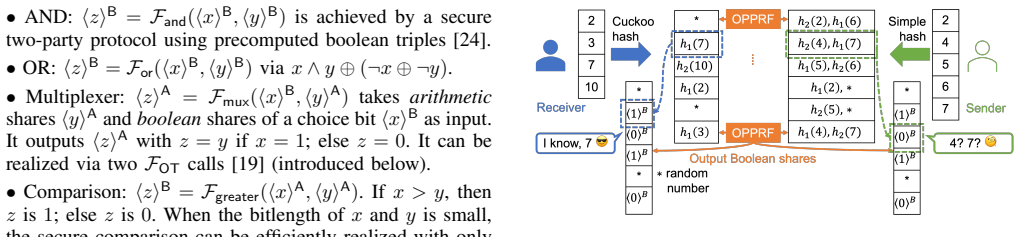
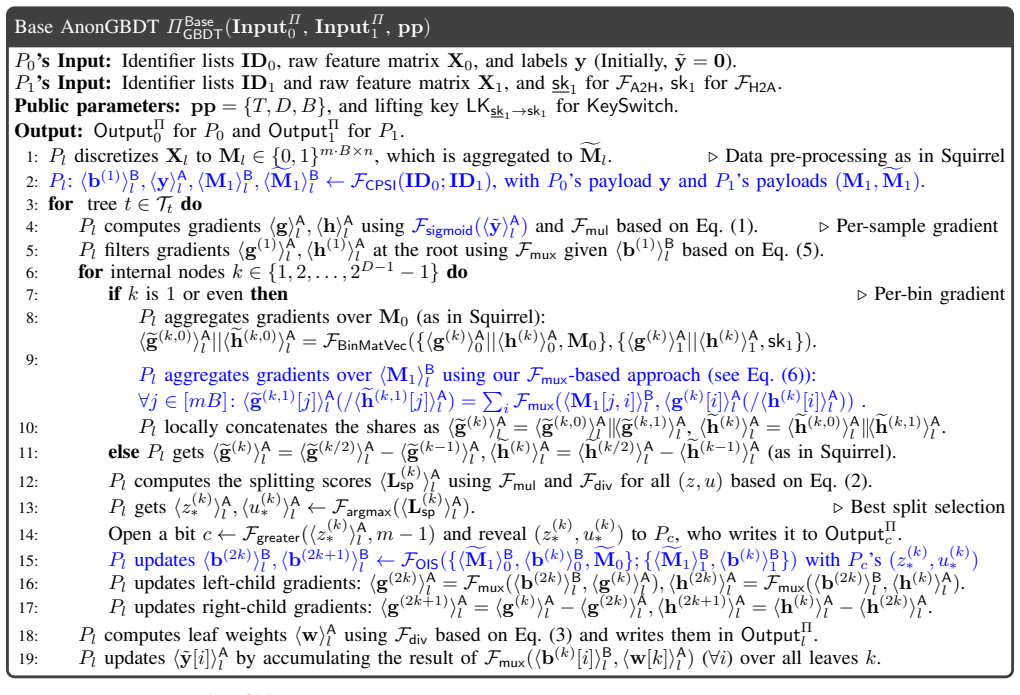
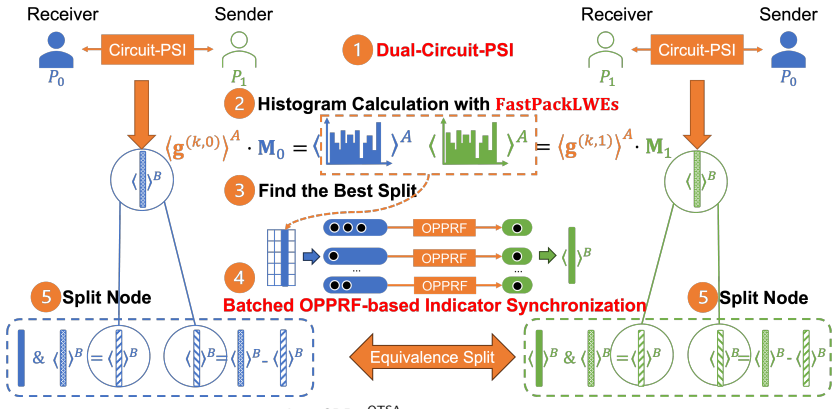
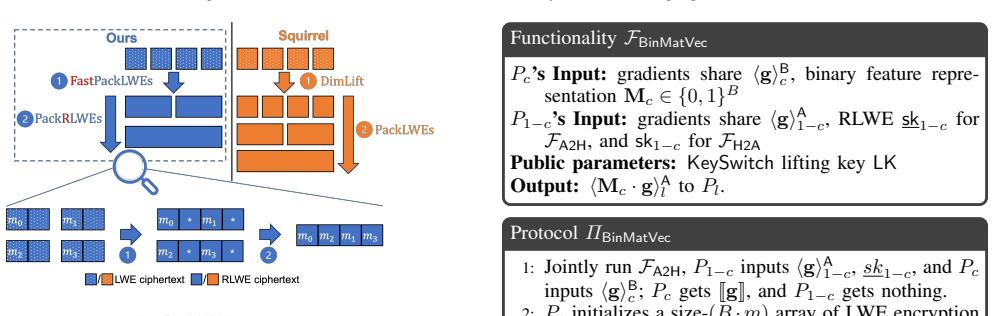
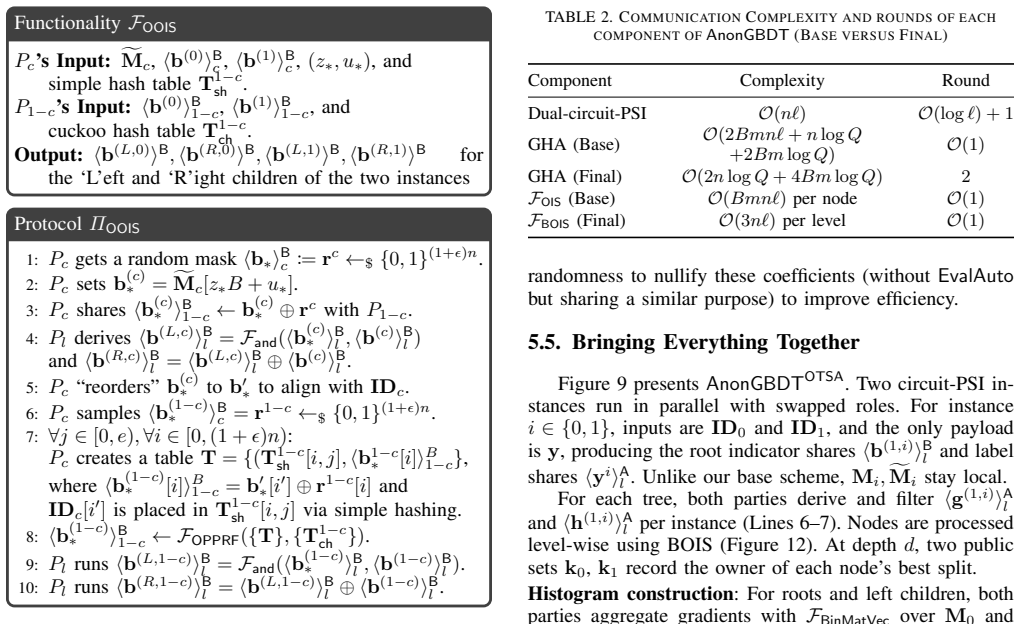
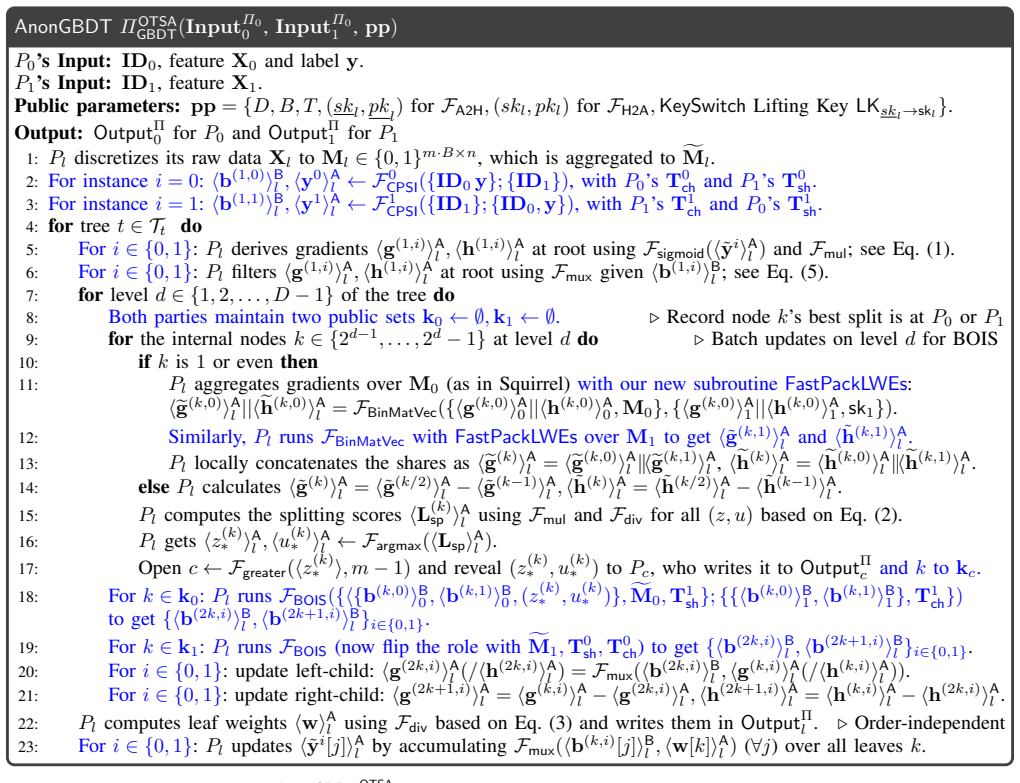
By letting the two parties alternate as receiver in successive circuit-PSI instances and propagating the outputs as shared state through oblivious programmable pseudorandom functions, the protocol performs the necessary pick-then-sum operations over local features without ever materializing a universal record alignment whose cost would scale with domain size; the same design halves the cost of the ciphertext packing step used in prior secure GBDT work, yielding an end-to-end protocol that remains competitive with leaky baselines while hiding which records are shared.
What carries the argument
Alternating dual circuit-PSI with OPPRF state propagation, which lets each party run pick-then-sum locally and carries intersection-derived state forward without domain-size alignment.
If this is right
- The same ID-hiding aggregation can be applied to other vertically partitioned analytics beyond GBDT.
- Secure GBDT training becomes feasible in settings such as finance and healthcare where revealing shared record identifiers is undesirable.
- The halved ciphertext-packing technique reduces overhead in any prior secure machine-learning computation that relied on the earlier packing method.
- Avoiding universal alignment removes the need for parties to agree on a common ID space in advance.
Where Pith is reading between the lines
- The alternating-receiver pattern may generalize to multi-party settings where more than two data owners must hide their intersections.
- The state-propagation technique could be tested on other decision-tree variants or on gradient-boosted models with different splitting criteria.
- If the OPPRF component can be replaced by a lighter primitive, the protocol's concrete cost could drop further on datasets with very large ID domains.
Load-bearing premise
The design assumes that alternating dual circuit-PSI with OPPRF state propagation can be realized without introducing new leakage or prohibitive overhead that scales with domain size, and that the halved ciphertext packing cost translates to end-to-end gains under the concrete parameter choices used in the experiments.
What would settle it
An implementation in which total communication or runtime grows linearly with the size of the ID domain, or in which the parties can still determine which records they share, would show the claimed avoidance of domain-size cost has not been achieved.
Figures


read the original abstract
Structured data is well handled by gradient-boosted decision trees (GBDT), which are usually trained on vertically partitioned features across mutually distrustful parties. High speed and interpretability make GBDTs popular in finance and healthcare, where neural networks may fall short. Enabling secure computation for GBDTs poses unique challenges, requiring secure record alignment for comparison. Relying on private set intersection (PSI) is a de facto approach. Mistaking PSI for a safety measure actually exposes which record identifiers (IDs) are shared between the datasets. Although circuit-PSI could help, it is costly for generic uses. New ideas are needed to efficiently train in a "dark forest". Aiming to hide the IDs, we initiate the study of anonymous GBDT training on split data held by two parties. Dual circuit-PSI in our design lets the parties alternate as receiver to run pick-then-sum over local features. Via oblivious programmable pseudorandom functions, we propagate circuit-PSI outputs as shared state across runs. Avoiding universal alignment, we resolve the neglected dilemma that ID hiding incurs a cost that scales with domain size. Next, we halve the cost of ciphertext packing used to convert single-instruction multiple-data homomorphic encryption from (ring) learning with errors in prior secure GBDT (Usenix Security' 23) and related secure machine-learning computations. Comparative experiments show our protocol remains competitive with leaky approaches in efficiency. Enabling ID-hiding aggregation, our techniques can extend to other vertically partitioned analytics.
Editorial analysis
A structured set of objections, weighed in public.
Referee Report
Summary. The paper proposes a protocol for anonymous two-party gradient boosting decision tree (GBDT) training on vertically partitioned data. It employs dual circuit-PSI with alternating receiver roles combined with oblivious programmable pseudorandom functions (OPPRF) to propagate shared state and avoid universal alignment, thereby resolving domain-size scaling costs for ID hiding. A secondary contribution halves the ciphertext packing cost when converting SIMD homomorphic encryption based on (ring) LWE, building on prior secure GBDT work. Comparative experiments are claimed to show the protocol remains competitive in efficiency with leaky baselines, with techniques extensible to other vertically partitioned analytics.
Significance. If the efficiency and anonymity claims hold under concrete parameters, the work provides a meaningful step toward practical ID-hiding secure computation for interpretable models in regulated domains such as finance and healthcare. Explicitly tackling the domain-size dilemma for anonymous PSI-based alignment and the packing optimization are concrete technical contributions. The extension claim broadens potential impact beyond GBDT.
major comments (2)
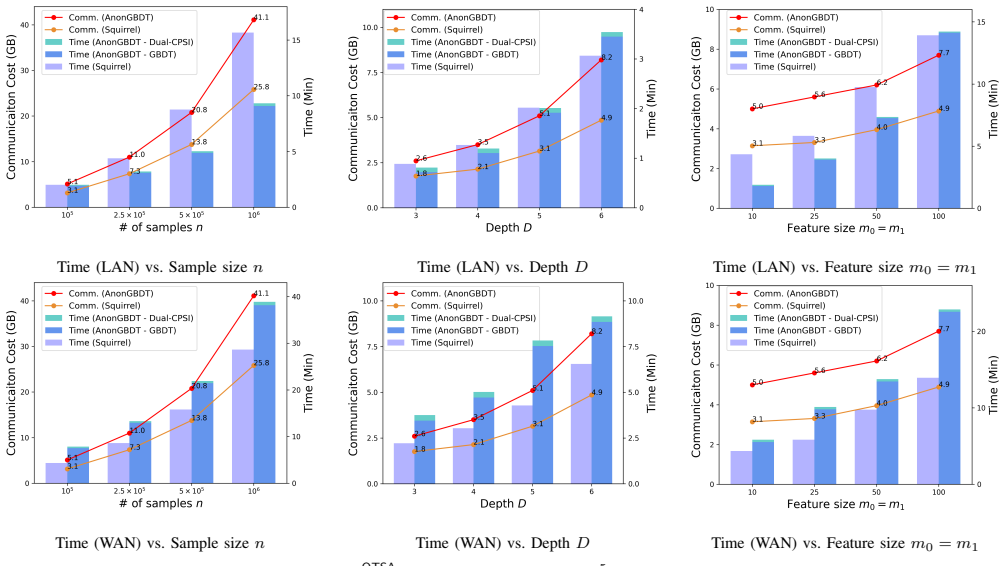
- [§4 (Experiments)] §4 (Experiments): The central competitiveness claim rests on comparative runtime results, yet no parameter analysis or tables demonstrate that OPPRF invocations remain sub-linear in domain size or that the halved packing cost dominates end-to-end runtime under the reported settings and domain sizes. This directly affects whether the 'remains competitive with leaky approaches' result follows from the design.
- [§3 (Protocol)] §3 (Protocol): The security argument that alternating dual circuit-PSI plus OPPRF state propagation introduces no new leakage (beyond the intended anonymity) is load-bearing for the anonymity guarantee but receives only a high-level description; a concrete leakage analysis or reduction to the underlying primitives' security is needed to support the 'dark forest' training claim.
minor comments (2)
- [Abstract] Abstract and §1: The phrase 'comparative experiments show our protocol remains competitive' would be strengthened by naming the leaky baselines and key metrics (e.g., wall-clock time, communication) even at a high level.
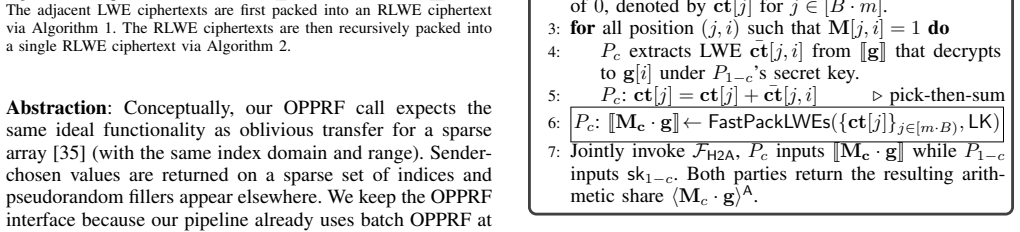
- [§3.2] Notation: The description of 'pick-then-sum over local features' would benefit from an explicit equation or pseudocode fragment showing how circuit-PSI outputs feed into the GBDT split computation.
Simulated Author's Rebuttal
We thank the referee for the thoughtful and constructive report. The two major comments identify areas where the current manuscript would benefit from additional detail. We address each point below and commit to revisions that strengthen the presentation without altering the core claims.
read point-by-point responses
-
Referee: [§4 (Experiments)] §4 (Experiments): The central competitiveness claim rests on comparative runtime results, yet no parameter analysis or tables demonstrate that OPPRF invocations remain sub-linear in domain size or that the halved packing cost dominates end-to-end runtime under the reported settings and domain sizes. This directly affects whether the 'remains competitive with leaky approaches' result follows from the design.
Authors: We agree that the experimental section would be strengthened by explicit parameter sweeps and cost breakdowns. In the revised version we will add tables and figures that (i) measure OPPRF invocation cost versus domain size for the concrete parameters used in the GBDT experiments, confirming sub-linear scaling, and (ii) isolate the contribution of the halved ciphertext-packing optimization to end-to-end runtime. These additions will make the competitiveness claim rest on documented measurements rather than aggregate timings alone. revision: yes
-
Referee: [§3 (Protocol)] §3 (Protocol): The security argument that alternating dual circuit-PSI plus OPPRF state propagation introduces no new leakage (beyond the intended anonymity) is load-bearing for the anonymity guarantee but receives only a high-level description; a concrete leakage analysis or reduction to the underlying primitives' security is needed to support the 'dark forest' training claim.
Authors: The current security discussion in §3 is indeed high-level. We will expand it to include an explicit leakage profile for the alternating dual circuit-PSI + OPPRF composition, showing that the only information revealed is the intended anonymity set (i.e., no additional leakage on record identifiers or feature values). Where possible we will sketch reductions to the security of the underlying circuit-PSI and OPPRF primitives. This concrete analysis will be added without changing the protocol itself. revision: yes
Circularity Check
No significant circularity; protocol built on external primitives without self-referential reductions.
full rationale
The paper presents a protocol construction for anonymous two-party GBDT training that relies on standard existing primitives (circuit-PSI, OPPRF, ring-LWE HE) and introduces dual circuit-PSI alternation plus halved ciphertext packing as design choices. No equations, fitted parameters, or load-bearing claims in the provided abstract or description reduce the anonymity or efficiency assertions to self-definitions, self-citations, or inputs by construction. The competitiveness statement rests on comparative experiments rather than a closed derivation loop. This matches the most common honest finding of a self-contained construction paper.
Axiom & Free-Parameter Ledger
axioms (2)
- domain assumption Security of circuit-PSI and OPPRF primitives under the semi-honest model
- domain assumption Ring-LWE based homomorphic encryption supports the claimed ciphertext packing optimization
Reference graph
Works this paper leans on
-
[1]
TitAnt: Online real-time transaction fraud detection in Ant Financial,
S. Cao, X. Yang, C. Chen, J. Zhou, X. Li, and Y . Qi, “TitAnt: Online real-time transaction fraud detection in Ant Financial,”Proc. VLDB Endow., vol. 12, no. 12, pp. 2082–2093, 2019
2082
-
[2]
Where medical statistics meets artificial intelligence,
D. J. Hunter and C. Holmes, “Where medical statistics meets artificial intelligence,”New England Journal of Medicine, vol. 389, no. 13, pp. 1211–1219, 2023
2023
-
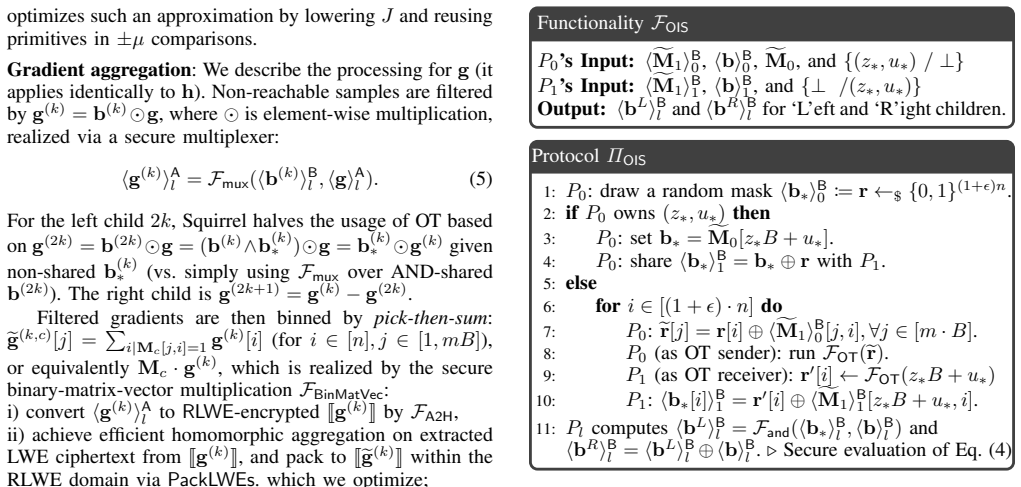
[3]
Model ensem- ble for click prediction in Bing search ads,
X. Ling, W. Deng, C. Gu, H. Zhou, C. Li, and F. Sun, “Model ensem- ble for click prediction in Bing search ads,” inWWW (Companion), 2017, pp. 689–698
2017
-
[4]
SoK: Cryptographic neural-network computation,
L. K. L. Ng and S. S. M. Chow, “SoK: Cryptographic neural-network computation,” inS&P, 2023, pp. 497–514
2023
-
[5]
Squirrel: A scalable secure two-party computation framework for training gradient boosting decision tree,
W. Lu, Z. Huang, Q. Zhang, Y . Wang, and C. Hong, “Squirrel: A scalable secure two-party computation framework for training gradient boosting decision tree,” inUSENIX Security, 2023, pp. 6435– 6451
2023
-
[6]
PriVDT: An efficient two-party cryptographic framework for vertical decision trees,
H. Chen, H. Li, Y . Wang, M. Hao, G. Xu, and T. Zhang, “PriVDT: An efficient two-party cryptographic framework for vertical decision trees,”IEEE Trans. Inf. Forensics Secur., vol. 18, pp. 1006–1021, 2023
2023
-
[7]
Large-scale secure XGB for vertical federated learn- ing,
W. Fang, D. Zhao, J. Tan, C. Chen, C. Yu, L. Wang, L. Wang, J. Zhou, and B. Zhang, “Large-scale secure XGB for vertical federated learn- ing,” inCIKM, 2021, pp. 443–452
2021
-
[8]
Privacy preserv- ing vertical federated learning for tree-based models,
Y . Wu, S. Cai, X. Xiao, G. Chen, and B. C. Ooi, “Privacy preserv- ing vertical federated learning for tree-based models,”Proc. VLDB Endow., vol. 13, no. 11, pp. 2090–2103, 2020
2090
-
[9]
Efficient private matching and set intersection,
M. J. Freedman, K. Nissim, and B. Pinkas, “Efficient private matching and set intersection,” inEUROCRYPT, 2004, pp. 1–19
2004
-
[10]
Efficient batched oblivious PRF with applications to private set intersection,
V . Kolesnikov, R. Kumaresan, M. Rosulek, and N. Trieu, “Efficient batched oblivious PRF with applications to private set intersection,” inCCS, 2016, pp. 818–829
2016
-
[11]
Unique in the shopping mall: On the reidentifiability of credit card metadata,
Y .-A. D. Montjoye, L. Radaelli, V . K. Singh, and A. S. Pentland, “Unique in the shopping mall: On the reidentifiability of credit card metadata,”Science, vol. 347, no. 6221, pp. 536–539, 2015
2015
-
[12]
On deploying secure computing: Private intersection-sum-with-cardinality,
M. Ion, B. Kreuter, A. E. Nergiz, S. Patel, S. Saxena, K. Seth, M. Raykova, D. Shanahan, and M. Yung, “On deploying secure computing: Private intersection-sum-with-cardinality,” inEuroS&P, 2020, pp. 370–389
2020
-
[13]
Efficient circuit-based PSI with linear communication,
B. Pinkas, T. Schneider, O. Tkachenko, and A. Yanai, “Efficient circuit-based PSI with linear communication,” inEUROCRYPT Part III, 2019, pp. 122–153
2019
-
[14]
VOLE-PSI: Fast OPRF and circuit- PSI from vector-OLE,
P. Rindal and P. Schoppmann, “VOLE-PSI: Fast OPRF and circuit- PSI from vector-OLE,” inEUROCRYPT Part II, 2021, pp. 901–930
2021
-
[15]
Blazing fast PSI from improved OKVS and subfield VOLE,
S. Raghuraman and P. Rindal, “Blazing fast PSI from improved OKVS and subfield VOLE,” inCCS, 2022, pp. 2505–2517
2022
-
[16]
PSI- Stats: Private set intersection protocols supporting secure statistical functions,
J. H. M. Ying, S. Cao, G. S. Poh, J. Xu, and H. W. Lim, “PSI- Stats: Private set intersection protocols supporting secure statistical functions,” inACNS, 2022, pp. 585–604
2022
-
[17]
Private set operations from oblivious switching,
G. Garimella, P. Mohassel, M. Rosulek, S. Sadeghian, and J. Singh, “Private set operations from oblivious switching,” inPKC Part II, 2021, pp. 591–617
2021
-
[18]
Secure-computation-friendly pri- vate set intersection from oblivious compact graph evaluation,
J. P. K. Ma and S. S. M. Chow, “Secure-computation-friendly pri- vate set intersection from oblivious compact graph evaluation,” in AsiaCCS, 2022, pp. 1086–1097
2022
-
[19]
CrypTFlow2: Practical 2-party secure inference,
D. Rathee, M. Rathee, N. Kumar, N. Chandran, D. Gupta, A. Rastogi, and R. Sharma, “CrypTFlow2: Practical 2-party secure inference,” in CCS, 2020, pp. 325–342
2020
-
[20]
Efficient homomorphic conversion between (ring) LWE ciphertexts,
H. Chen, W. Dai, M. Kim, and Y . Song, “Efficient homomorphic conversion between (ring) LWE ciphertexts,” inACNS, 2021, pp. 460– 479
2021
-
[21]
Let’s stride blindfolded in a forest: Sublinear multi-client decision trees evaluation,
J. P. K. Ma, R. K. H. Tai, Y . Zhao, and S. S. M. Chow, “Let’s stride blindfolded in a forest: Sublinear multi-client decision trees evaluation,” inNDSS, 2021
2021
-
[22]
XGBoost: A scalable tree boosting system,
T. Chen and C. Guestrin, “XGBoost: A scalable tree boosting system,” inKDD, 2016, pp. 785–794
2016
-
[23]
LightGBM: A highly efficient gradient boosting decision tree,
G. Ke, Q. Meng, T. Finley, T. Wang, W. Chen, W. Ma, Q. Ye, and T. Liu, “LightGBM: A highly efficient gradient boosting decision tree,” inNeurIPS, 2017, pp. 3146–3154
2017
-
[24]
ABY - A framework for efficient mixed-protocol secure two-party computation,
D. Demmler, T. Schneider, and M. Zohner, “ABY - A framework for efficient mixed-protocol secure two-party computation,” inNDSS, 2015
2015
-
[25]
Efficient multiparty protocols using circuit randomiza- tion,
D. Beaver, “Efficient multiparty protocols using circuit randomiza- tion,” inCRYPTO, 1991, pp. 420–432
1991
-
[26]
Secure computation with fixed-point numbers,
O. Catrina and A. Saxena, “Secure computation with fixed-point numbers,” inFC, 2010, pp. 35–50
2010
-
[27]
Improved garbled circuit building blocks and applications to auctions and computing minima,
V . Kolesnikov, A. Sadeghi, and T. Schneider, “Improved garbled circuit building blocks and applications to auctions and computing minima,” inCANS, 2009, pp. 1–20
2009
-
[28]
How to exchange secrets with oblivious transfer,
M. O. Rabin, “How to exchange secrets with oblivious transfer,” IACR Cryptol. ePrint Arch. 2005/187, 2005
2005
-
[29]
Ferret: Fast extension for correlated OT with small communication,
K. Yang, C. Weng, X. Lan, J. Zhang, and X. Wang, “Ferret: Fast extension for correlated OT with small communication,” inCCS, 2020, pp. 1607–1626
2020
-
[30]
Fully homomorphic encryption from ring-lwe and security for key dependent messages,
Z. Brakerski and V . Vaikuntanathan, “Fully homomorphic encryption from ring-lwe and security for key dependent messages,” inCRYPTO, 2011, pp. 505–524
2011
-
[31]
Security and composition of multiparty cryptographic protocols,
R. Canetti, “Security and composition of multiparty cryptographic protocols,”J. Cryptol., vol. 13, no. 1, pp. 143–202, 2000
2000
-
[32]
Secure softmax/sigmoid for machine-learning computation,
Y . Zheng, Q. Zhang, S. S. M. Chow, Y . Peng, S. Tan, L. Li, and S. Yin, “Secure softmax/sigmoid for machine-learning computation,” inACSAC, 2023, pp. 463–476
2023
-
[33]
SHAFT: Secure, handy, accurate, and fast transformer inference,
A. Y . L. Kei and S. S. M. Chow, “SHAFT: Secure, handy, accurate, and fast transformer inference,” inNDSS, 2025
2025
-
[34]
Communication-efficient secure logistic regression,
A. Amit, P. Stanislav, R. Mariana, S. Phillipp, and S. Karn, “Communication-efficient secure logistic regression,” inEuroS&P, 2024, pp. 440–467
2024
-
[35]
Are you the one to share? Secret transfer with access structure,
Y . Zhao and S. S. M. Chow, “Are you the one to share? Secret transfer with access structure,”Proc. Priv. Enhancing Technol., vol. 2017, no. 1, pp. 149–169, 2017
2017
-
[36]
Federated transformer: Multi- party vertical federated learning on practical fuzzily linked data,
Z. Wu, J. Hou, Y . Diao, and B. He, “Federated transformer: Multi- party vertical federated learning on practical fuzzily linked data,” in NeurIPS, 2024
2024
-
[37]
Distributed learning of deep neural network over multiple agents,
O. Gupta and R. Raskar, “Distributed learning of deep neural network over multiple agents,”J. Netw. Comput. Appl., vol. 116, pp. 1–8, 2018
2018
-
[38]
Cheetah: Lean and fast secure two-party deep neu- ral network inference,
SecretFlow, “Cheetah: Lean and fast secure two-party deep neu- ral network inference,” https://github.com/secretflow/spu/tree/main/ libspu/mpc/cheetah, 2024
2024
-
[39]
Homomorphic encryption for arithmetic of approximate numbers,
J. H. Cheon, A. Kim, M. Kim, and Y . S. Song, “Homomorphic encryption for arithmetic of approximate numbers,” inASIACRYPT Part I, 2017, pp. 409–437
2017
-
[40]
Microsoft SEAL (release 4.1),
K. Laine, “Microsoft SEAL (release 4.1),” https://github.com/ Microsoft/SEAL, 2023, Microsoft Research, Redmond, W A, USA
2023
-
[41]
LIBSVM data: Classification (binary class),
C.-J. Lin, “LIBSVM data: Classification (binary class),” https://www. csie.ntu.edu.tw/∼cjlin/libsvmtools/datasets/binary.html, 2024
2024
-
[42]
eXtreme gradient boosting,
D. D. M. L. Community, “eXtreme gradient boosting,” https://github. com/dmlc/xgboost, 2024
2024
-
[43]
Efficient permu- tation correlations and batched random access for two-party compu- tation,
S. Peceny, S. Raghuraman, P. Rindal, and H. Shah, “Efficient permu- tation correlations and batched random access for two-party compu- tation,” inPKC Part IV, 2025, pp. 76–109
2025
-
[44]
Private matching for compute,
P. Buddhavarapu, A. Knox, P. Mohassel, S. Sengupta, E. Taubeneck, and V . Vlaskin, “Private matching for compute,” IACR Cryptol. ePrint Arch. 2020/599, 2020
2020
-
[45]
Can you find the one for me?
Y . Zhao and S. S. M. Chow, “Can you find the one for me?” inWPES, co-located with CCS, 2018, pp. 54–65
2018
-
[46]
Privacy preserving data mining,
Y . Lindell and B. Pinkas, “Privacy preserving data mining,” in CRYPTO, 2000, pp. 36–54
2000
-
[47]
Understanding privacy risk of publishing decision trees,
Z. Zhu and W. Du, “Understanding privacy risk of publishing decision trees,” inDBSec, 2010, pp. 33–48
2010
-
[48]
SecureXGB: A secure and efficient multi-party protocol for vertical federated XGBoost,
Z. Han, X. Cheng, W. Zhao, J. Fu, Z. He, and S. Su, “SecureXGB: A secure and efficient multi-party protocol for vertical federated XGBoost,”SIGMOD, vol. 3, no. 1, pp. 1–26, 2025
2025
-
[49]
Efficient de- cision tree training with new data structure for secure multi-party computation,
K. Hamada, D. Ikarashi, R. Kikuchi, and K. Chida, “Efficient de- cision tree training with new data structure for secure multi-party computation,”Proc. Priv. Enhancing Technol, pp. 343–364, 2023
2023
-
[50]
Securely training decision trees efficiently,
D. Bhardwaj, S. Saravanan, N. Chandran, and D. Gupta, “Securely training decision trees efficiently,” inCCS, 2024, pp. 4673–4687
2024
-
[51]
Ents: An efficient three-party training framework for decision trees by communication optimization,
G. Lin, W. Han, W. Ruan, R. Zhou, L. Song, B. Li, and Y . Shao, “Ents: An efficient three-party training framework for decision trees by communication optimization,” inCCS, 2024, pp. 4376–4390
2024
-
[52]
SecureBoost: A lossless federated learning framework,
K. Cheng, T. Fan, Y . Jin, Y . Liu, T. Chen, D. Papadopoulos, and Q. Yang, “SecureBoost: A lossless federated learning framework,” IEEE Intell. Syst., vol. 36, no. 6, pp. 87–98, 2021
2021
-
[53]
VF2Boost: Very fast vertical federated gradient boosting for cross- enterprise learning,
F. Fu, Y . Shao, L. Yu, J. Jiang, H. Xue, Y . Tao, and B. Cui, “VF2Boost: Very fast vertical federated gradient boosting for cross- enterprise learning,” inSIGMOD, 2021, pp. 563–576
2021
-
[54]
Label inference attacks against vertical federated learning,
C. Fu, X. Zhang, S. Ji, J. Chen, J. Wu, S. Guo, J. Zhou, A. X. Liu, and T. Wang, “Label inference attacks against vertical federated learning,” inUSENIX Security, 2022, pp. 1397–1414
2022
-
[55]
Eliminating label leakage in tree- based vertical federated learning,
H. Takahashi, J. Liu, and Y . Liu, “Eliminating label leakage in tree- based vertical federated learning,” arXiv:2307.10318, 2023
-
[56]
Practical secure decision tree learning in a teletreatment application,
S. de Hoogh, B. Schoenmakers, P. Chen, and H. op den Akker, “Practical secure decision tree learning in a teletreatment application,” inFC, 2014, pp. 179–194
2014
-
[57]
Secure training of decision trees with continuous attributes,
M. Abspoel, D. Escudero, and N. V olgushev, “Secure training of decision trees with continuous attributes,”Proc. Priv. Enhancing Technol., vol. 2021, no. 1, pp. 167–187, 2021
2021
-
[58]
SiGBDT: Large-scale gradient boosting decision tree training via function secret sharing,
Y . Jiang, F. Mei, T. Dai, and Y . Li, “SiGBDT: Large-scale gradient boosting decision tree training via function secret sharing,” inAsi- aCCS, 2024, pp. 274–288
2024
-
[59]
NodeGuard: A highly efficient two-party computation framework for training large-scale gradient boosting decision tree,
T. Dai, Y . Jiang, Y . Li, and F. Mei, “NodeGuard: A highly efficient two-party computation framework for training large-scale gradient boosting decision tree,” inDeep Learning Security and Privacy (DLSP) Workshop, co-located with S&P, 2024, pp. 95–103
2024
-
[60]
SoK: Privacy-preserving collaborative tree-based model learning,
S. Chatel, A. Pyrgelis, J. R. Troncoso-Pastoriza, and J. Hubaux, “SoK: Privacy-preserving collaborative tree-based model learning,” Proc. Priv. Enhancing Technol., vol. 2021, no. 3, pp. 182–203, 2021
2021
-
[61]
Vertical federated learning without revealing intersection member- ship,
J. Sun, X. Yang, Y . Yao, A. Zhang, W. Gao, J. Xie, and C. Wang, “Vertical federated learning without revealing intersection member- ship,” arXiv:2106.05508, 2021
-
[62]
OpenVFL: A vertical federated learn- ing framework with stronger privacy-preserving,
Y . Yang, X. Chen, Y . Pan, J. Shen, Z. Cao, X. Dong, X. Li, J. Sun, G. Yang, and R. H. Deng, “OpenVFL: A vertical federated learn- ing framework with stronger privacy-preserving,”IEEE Trans. Inf. Forensics Secur., vol. 19, pp. 9670–9681, 2024
2024
-
[63]
Improved multiplication triple generation over rings via RLWE-based AHE,
D. Rathee, T. Schneider, and K. K. Shukla, “Improved multiplication triple generation over rings via RLWE-based AHE,” inCANS, 2019, pp. 347–359
2019
-
[64]
(Leveled) fully ho- momorphic encryption without bootstrapping,
Z. Brakerski, C. Gentry, and V . Vaikuntanathan, “(Leveled) fully ho- momorphic encryption without bootstrapping,”ACM Trans. Comput. Theory, vol. 6, no. 3, pp. 13:1–13:36, 2014
2014
-
[65]
Linear private set union from multi-query reverse private membership test,
C. Zhang, Y . Chen, W. Liu, M. Zhang, and D. Lin, “Linear private set union from multi-query reverse private membership test,” inUSENIX Security, 2023, pp. 337–354. Appendix A. Optimizations in Sigmoid A.1. Secure Decimal Multiplication for Trigono- metric Functions Fmul relies on Beaver triples [25] fora·b=cin secret shares, which can be efficiently impl...
2023
-
[66]
ThenScomputes⟨b ∗⟩B 0 =⟨b ∗⟩B 1 ⊕fM0[z∗B+u ∗]; elseSplays the sender ofF OT with input of the XOR of randomly chosenr(=⟨b ∗⟩B 0 ) and⟨ fM1⟩B 0 as in Line 8
If(z ∗, u∗)is owned byP 0,Sreceives⟨b ∗⟩B 1 fromP 0 (Line 3). ThenScomputes⟨b ∗⟩B 0 =⟨b ∗⟩B 1 ⊕fM0[z∗B+u ∗]; elseSplays the sender ofF OT with input of the XOR of randomly chosenr(=⟨b ∗⟩B 0 ) and⟨ fM1⟩B 0 as in Line 8. 2)Splays the role ofF and with inputs of⟨b ∗⟩B 0 ,⟨b⟩ B 0 to obtain⟨b L⟩B 0 , then sets⟨b R⟩B 0 =⟨b L⟩B 0 ⊕ ⟨b⟩B 0 as Line 11. To prove th...
-
[67]
For treet∈ T t,Splays the role ofF sigmoid,F mul, and Fmux with input⟨b (1,i)⟩B 0 and⟨y i⟩A 0 to derive the gradients ⟨g(1,i)⟩A 0 ,⟨h (1,i)⟩A 0 , fori∈ {0,1}as Lines 5–6. 3)∀internal nodekof treet, ifkis a root/left node,Splays the role ofF BinMatVec alternately to obtain ⟨˜g(k,i)⟩A 0 ||⟨˜h(k,i)⟩A 0 fori∈ {0,1}, which are concatenated as Line 13; elseScal...
-
[68]
For treet,Splays the role ofF div with inputs ⟨g(k,0)⟩A 0 ,⟨h (k,0)⟩A 0 to obtain the weight⟨w⟩ A 0 as Line 22
-
[69]
To prove the simulation is indistinguishable from the real protocol, we consider the following hybrids
For treet,Splays the role ofF mux with inputs ⟨b(k,i)⟩B 0 ,⟨w[k]⟩ A 0 to update⟨ ˜yi⟩A 0 (i∈ {0,1}) as Line 23. To prove the simulation is indistinguishable from the real protocol, we consider the following hybrids. Hybrid0. The same as the real protocol. Hybrid1. Lines 2–3 (Π OTSA GBDT) use replacedF CPSI. Hybrid2. Lines 5–6 use replacedF sigmoid,F mul,F...
2026
discussion (0)
Sign in with ORCID, Apple, or X to comment. Anyone can read and Pith papers without signing in.