Experimental and theoretical studies of hyperfine structures in ²¹Na
Pith reviewed 2026-06-29 14:49 UTC · model grok-4.3
The pith
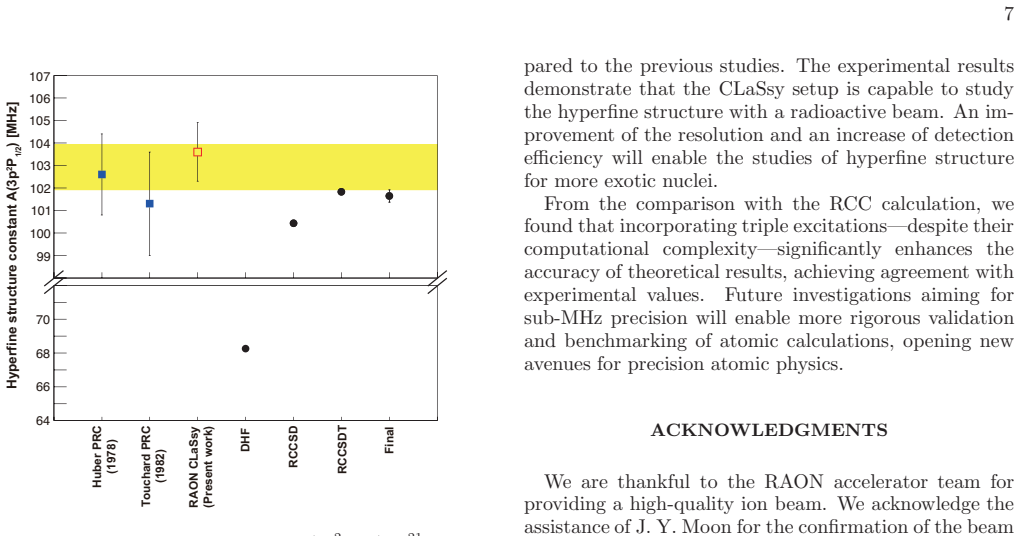
The hyperfine structure constants of 21Na are 103.6 MHz and 954.9 MHz, with calculations showing the importance of triple excitations.
A machine-rendered reading of the paper's core claim, the machinery that carries it, and where it could break.
Core claim
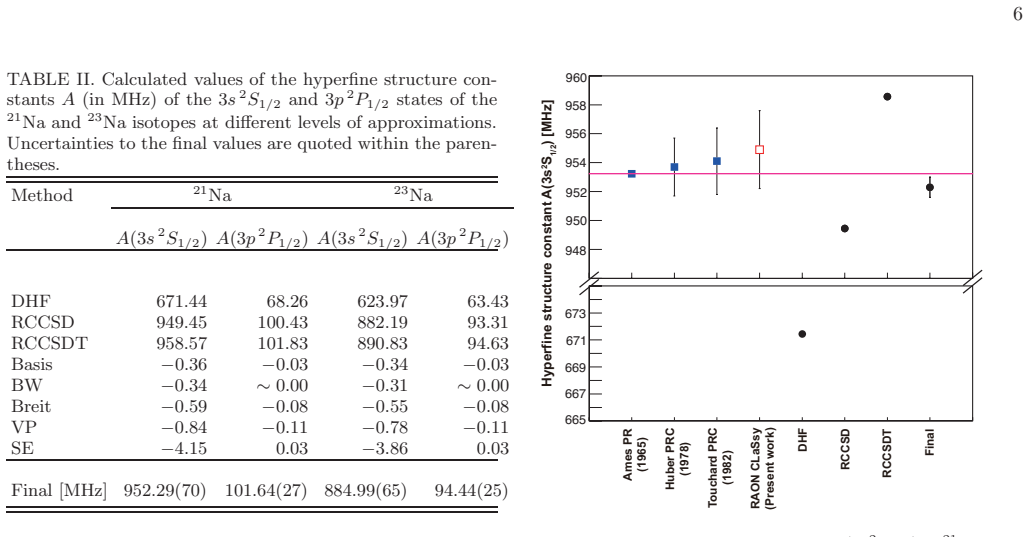
The hyperfine structure constants of 21Na were measured to be 103.6(10)stat(9)syst MHz for A(3p 2P1/2) and 954.9(11)stat(25)syst MHz for A(3s 2S1/2). A systematic comparison with the state-of-the-art ab-initio relativistic coupled cluster calculations shows the role of higher-order correlation effects such as triple excitations in 21Na.
What carries the argument
Collinear laser spectroscopy for measuring hyperfine constants, compared against relativistic coupled-cluster theory that includes triple excitations.
If this is right
- The extracted A values serve as benchmarks for testing theoretical models of hyperfine interactions in neutron-deficient nuclei.
- Higher-order correlation effects like triple excitations are necessary for precise theoretical predictions in sodium isotopes.
- The successful measurement confirms the CLaSsy setup's ability to handle radioactive beams for future experiments.
Where Pith is reading between the lines
- These results may inform nuclear structure studies by providing precise electromagnetic moment data for 21Na.
- Similar comparisons could be applied to other light radioactive isotopes to test the limits of current many-body methods.
- Improved theory might allow extraction of nuclear properties from hyperfine data with higher confidence.
Load-bearing premise
The statistical and systematic uncertainties reported fully account for all experimental effects, enabling a direct comparison to theory without hidden biases.
What would settle it
An independent high-precision measurement of the A constants in 21Na that lies outside the combined uncertainty ranges of the reported values.
Figures
read the original abstract
We measured the hyperfine structure constants, $A(3s^2S_{1/2})$ and $A(3p^2P_{1/2})$, of the neutron-deficient isotope $^{21}\text{Na}$ using CLaSsy, a setup dedicated to collinear laser spectroscopy at RAON. The hyperfine structure constants of $^{21}\text{Na}$ were measured to be $103.6(10)_{\mathrm{stat}}(9)_{\mathrm{syst}}$ MHz for $A(3p^2P_{1/2})$ and $954.9(11)_{\mathrm{stat}}(25)_{\mathrm{syst}}$ MHz for $A(3s^2S_{1/2})$. A systematic comparison with the state-of-the-art ab-initio relativistic coupled cluster calculations shows the role of higher-order correlation effects such as triple excitations in $^{21}$Na. Furthermore, the measurement demonstrates a capability of the CLaSsy setup to conduct collinear laser spectroscopy experiments with a radioactive beam.
Editorial analysis
A structured set of objections, weighed in public.
Referee Report
Summary. The manuscript reports collinear laser spectroscopy measurements of the hyperfine constants A(3s ²S_{1/2}) = 954.9(11)stat(25)syst MHz and A(3p ²P_{1/2}) = 103.6(10)stat(9)syst MHz in ²¹Na using the CLaSsy setup at RAON. These experimental values are compared to relativistic coupled-cluster calculations, with the discrepancy attributed to the importance of triple excitations; the work also serves as a demonstration of the setup for radioactive-beam studies.
Significance. If the extracted A constants are free of unaccounted bias, the results supply a useful benchmark for testing higher-order correlation effects in ab-initio calculations of light, neutron-deficient nuclei and validate a new collinear spectroscopy facility. The explicit inclusion of both statistical and systematic uncertainties in the abstract is a positive feature.
major comments (2)
- [§4] §4 (Data analysis and fitting): The systematic uncertainty budget for A(3s ²S_{1/2}) (25 MHz) must be shown to fully incorporate possible line shifts arising from residual beam-velocity spread and weak neighboring-isotope contamination; without an explicit propagation of these effects through the hyperfine-interval fit, the claim that the measured values can be directly compared to theory to isolate triple-excitation contributions is not yet load-bearing.
- [§5] §5 (Theory comparison): The statement that discrepancies with the relativistic coupled-cluster results are due to missing triple excitations assumes the experimental A values are unbiased at the quoted syst level; a sensitivity test showing how a 25 MHz shift in the 3s constant would alter the inferred role of triples would strengthen this attribution.
minor comments (2)
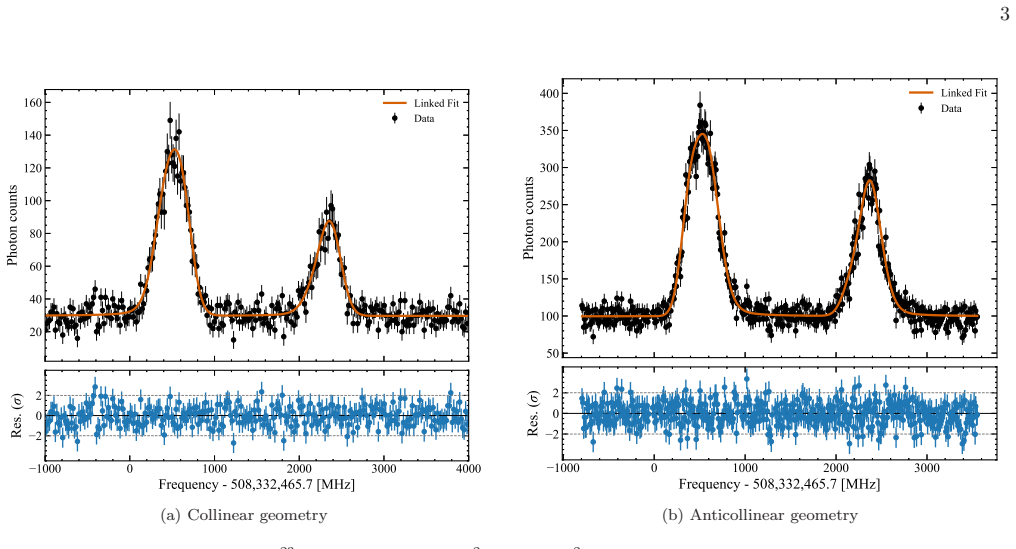
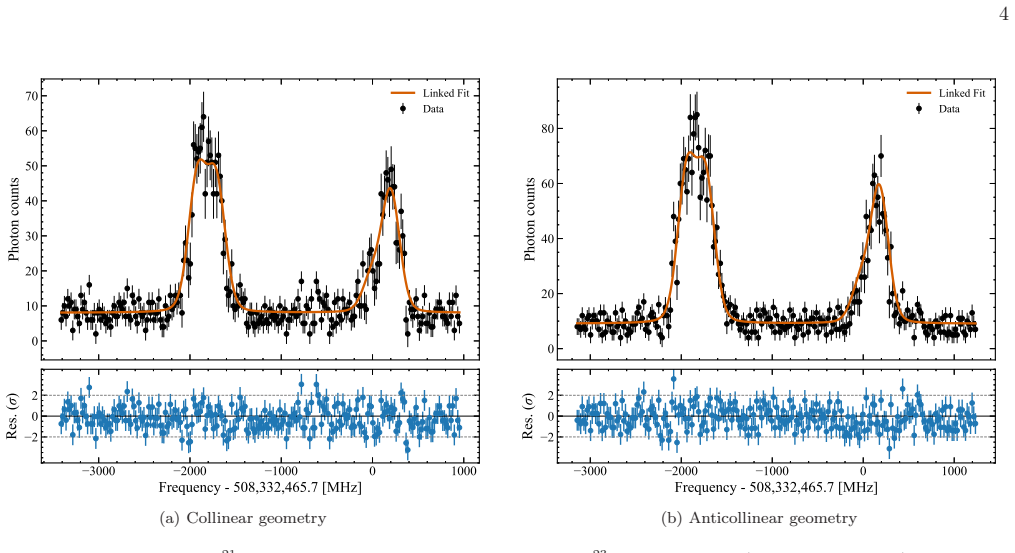
- Figure 3 (or equivalent spectrum figure): axis labels and fit residuals should be enlarged for readability; current font size makes it difficult to assess fit quality by eye.
- Table 1 (or results table): add a column or footnote explicitly listing the individual contributions to the quoted systematic uncertainties.
Simulated Author's Rebuttal
We thank the referee for the constructive comments and positive assessment of the work. We address each major comment below and have revised the manuscript accordingly to strengthen the presentation of the systematic uncertainties and the theory comparison.
read point-by-point responses
-
Referee: [§4] §4 (Data analysis and fitting): The systematic uncertainty budget for A(3s ²S_{1/2}) (25 MHz) must be shown to fully incorporate possible line shifts arising from residual beam-velocity spread and weak neighboring-isotope contamination; without an explicit propagation of these effects through the hyperfine-interval fit, the claim that the measured values can be directly compared to theory to isolate triple-excitation contributions is not yet load-bearing.
Authors: We agree that an explicit propagation of residual beam-velocity spread and neighboring-isotope contamination through the hyperfine fit is needed to fully substantiate the systematic uncertainty. In the revised manuscript we have expanded §4 with a dedicated subsection describing Monte Carlo simulations that inject these effects into the line-shape model and propagate them to the extracted A values. The simulations confirm that both contributions remain well within the quoted 25 MHz budget; a new table summarizing all systematic terms and their propagation has been added. revision: yes
-
Referee: [§5] §5 (Theory comparison): The statement that discrepancies with the relativistic coupled-cluster results are due to missing triple excitations assumes the experimental A values are unbiased at the quoted syst level; a sensitivity test showing how a 25 MHz shift in the 3s constant would alter the inferred role of triples would strengthen this attribution.
Authors: We have performed the requested sensitivity test. Shifting the experimental A(3s ²S_{1/2}) by the full ±25 MHz systematic uncertainty and repeating the comparison with CCSD and CCSD(T) results shows that the improvement obtained by including triple excitations remains statistically significant. This analysis has been added as a new paragraph and supplementary figure in §5, reinforcing the attribution while leaving the overall conclusions unchanged. revision: yes
Circularity Check
Experimental hyperfine constants extracted independently of theoretical calculations
full rationale
The paper's central results are the measured A(3p 2P1/2) and A(3s 2S1/2) values obtained by fitting hyperfine intervals in collinear laser spectroscopy spectra of 21Na. These are determined directly from observed resonance positions and line shapes in the CLaSsy setup. The subsequent comparison to ab-initio relativistic coupled-cluster calculations occurs after the experimental extraction and does not enter the fitting procedure or error budget. No equations or steps reduce the reported A constants to prior theoretical inputs by construction, and no self-citation chain is invoked to justify the measurement itself. The derivation chain is therefore self-contained against external spectral data.
Axiom & Free-Parameter Ledger
Reference graph
Works this paper leans on
-
[1]
A silicon carbide (SiC) target was irradiated with a 12 µ A, 70 MeV proton beam delivered from the RAON cyclotron [ 18]
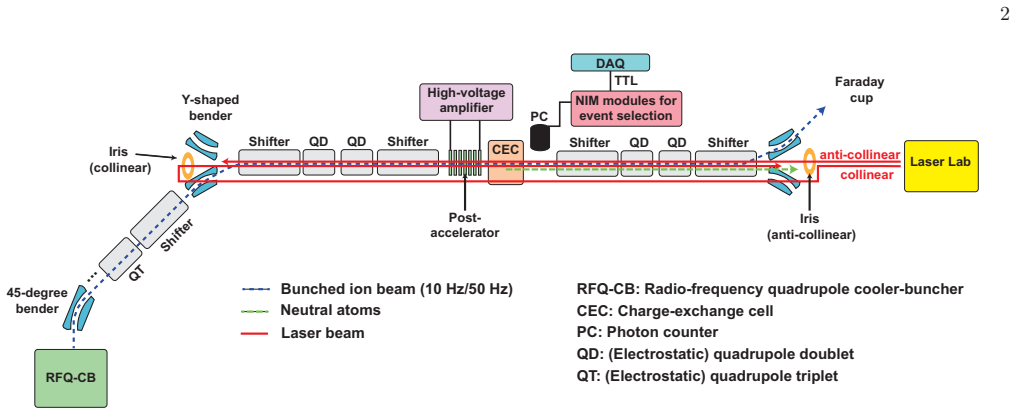
Beams of stable 23Na and unstable 21Na were produced us- ing the isotope separation on-line (ISOL) technique. A silicon carbide (SiC) target was irradiated with a 12 µ A, 70 MeV proton beam delivered from the RAON cyclotron [ 18]. Reaction products were extracted as singly charged ions from surface ionization (Na +), mass- separated by a dipole magnet, an...
-
[2]
1 MHz, corresponding to the estimated power- broadened Lorentzian widths under the laser-power and beam-diameter conditions described in Sec
4–53. 1 MHz, corresponding to the estimated power- broadened Lorentzian widths under the laser-power and beam-diameter conditions described in Sec. II. The maximum absolute deviation of the extracted hyperfine constants from the nominal result was assigned as the systematic uncertainty associated with the Lorentzian contribution to the line shape. For 23Na...
-
[3]
base contri- bution
46 MHz for A(3s 2S1/2). (iv) Minor contributions. Possible contributions from the acceleration-voltage read-back, laser-frequency fluc- tuations, and geometric uncertainties were not included in the final budget. The effect of beam-energy uncer- tainty is strongly suppressed in the combined collinear and anti-collinear analysis, residual laser-frequency fluc-...
1978
-
[4]
B. K. Sahoo, G. Gopakumar, R. K. Chaudhuri, B. P. Das, H. Merlitz, U. S. Mahapatra, and D. Mukherjee, Phys. Rev. A 68, 040501 (2003)
2003
-
[5]
B. K. Sahoo, R. K. Chaudhuri, B. P. Das, H. Merlitz, and D. Mukherjee, Phys. Rev. A 72, 032507 (2005)
2005
-
[6]
A. V. Volotka, D. A. Glazov, O. V. Andreev, V. M. Shabaev, I. I. Tupitsyn, and G. Plunien, Phys. Rev. Lett. 108, 073001 (2012)
2012
-
[7]
Li, Y.-M
C.-B. Li, Y.-M. Yu, and B. K. Sahoo, Phys. Rev. A 97, 022512 (2018)
2018
-
[8]
Ohayon, R
B. Ohayon, R. G. Ruiz, Z. Sun, G. Ha- gen, T. Papenbrock, and B. K. Sahoo, Phys. Rev. C 105, L031305 (2022)
2022
-
[9]
Pescht, H
K. Pescht, H. Gerhardt, and E. Matthias, Z. Phys. A 281, 199 (1977)
1977
-
[10]
NNDC, Nudat 3.0, https://www.nndc.bnl.gov/nudat3/ (2026), accessed: 2026-02-13
2026
-
[11]
Campbell, I
P. Campbell, I. D. Moore, and M. R. Pearson, Prog. Part. Nucl. Phys. 86, 127 (2016)
2016
-
[12]
X. F. Yang, S. Wang, S. Wilkins, and R. G. Ruiz, Prog. Part. Nucl. Phys. 129, 104005 (2023)
2023
-
[13]
Koszor´ us, R
´A. Koszor´ us, R. De Groote, B. Cheal, P. Campbell, and I. Moore, Eur. Phys. J. A 60, 20 (2024)
2024
-
[14]
S. Choi, Y. S. Chung, I.-S. Hong, J. Lee, Y. Jung, Y. Kim, M. Kwon, T. Shin, and S.-W. Hong, J. Korean Phys. Soc. 87, 447 (2025)
2025
-
[15]
Chung, S.-W
Y.-S. Chung, S.-W. Hong, H.-M. Jang, T.-K. Ki, H.-J. Kim, Y. J. Kim, M. Kwon, J. Lee, K. Tshoo, and T. Shin, J. Korean Phys. Soc. 82, 613 (2023)
2023
-
[16]
S. J. Park, S. G. Jo, C. Lim, K. Tshoo, C. Ham, D. G. Kim, D. Kwak, S. J. Pyeun, T. Shin, J. B. Kim, et al., J. Korean Phys. Soc. 87, 649 (2025)
2025
-
[17]
Lim et al., J
C. Lim et al., J. Instrum. 21 (5), P05026
-
[18]
O. Ames, E. A. Phillips, and S. S. Glickstein, Phys. Rev. 137, B1157 (1965)
1965
-
[19]
Huber, F
G. Huber, F. Touchard, S. B¨ uttgenbach, C. Thibault, R. Klapisch, H. Duong, S. Liberman, J. Pinard, J. Vialle, P. Juncar, et al., Phys. Rev. C 18, 2342 (1978)
1978
-
[20]
Touchard, J
F. Touchard, J. Serre, S. B¨ uttgenbach, P. Guim- bal, R. Klapisch, M. de Saint Simon, C. Thibault, H. Duong, P. Juncar, S. Liberman, et al., Phys. Rev. C 25, 2756 (1982)
1982
-
[21]
Y.-H. Yeon, S. Heo, H.-J. Yim, H.-J. Woo, K.-H. Yoo, J.- W. Jeong, T. Hashimoto, W. Hwang, D.-J. Park, S. Nam, et al., J. Korean Phys. Soc. 87, 596 (2025)
2025
-
[22]
Hashimoto, H
T. Hashimoto, H. Yim, J. Kim, Y.-H. Park, S. Heo, 8 K. Yoo, C. Yun, H. Ishiyama, and J. Lee, Nucl. Instrum. Methods B 556, 165504 (2024)
2024
-
[23]
Kaufman, Optics Comm
S. Kaufman, Optics Comm. 17, 309 (1976)
1976
-
[24]
D. A. Steck, Sodium d line data, https://steck.us/alkalidata/sodiumnumbers.1.6.pdf (2003), accessed: 2026-05-21
2003
-
[25]
C. J. Foot, Atomic Physics (Oxford University Press, 2005)
2005
-
[26]
W. Gins, B. van den Borne, R. de Groote, and G. Neyens, Computer Phys. Comm. 297, 109053 (2024)
2024
-
[27]
Klose, K
A. Klose, K. Minamisono, and P. F. Mantica, Phys. Rev. A 88, 042701 (2013)
2013
-
[28]
W. Yei, A. Sieradzan, and M. Havey, Phys. Rev. A 48, 1909 (1993)
1909
-
[29]
Arimondo, M
E. Arimondo, M. Inguscio, and P. Violino, Rev. Mod. Phys. 49, 31 (1977)
1977
-
[30]
Lindgren and J
I. Lindgren and J. Morrison, Atomic Many-body Theory (Springer-Verlag, 1982)
1982
-
[31]
B. K. Sahoo, S. Majumder, R. K. Chaudhuri, B. Das, and D. Mukherjee, J. Phys. B: At., Mol. and Opt. Phy. 37, 3409 (2004)
2004
-
[32]
B. K. Sahoo, Phys. Rev. A 93, 022503 (2016)
2016
-
[33]
B. K. Sahoo, Phys. Rev. A 111, L060801 (2025)
2025
-
[34]
B. K. Sahoo, Phys. Rev. A 92, 052506 (2015)
2015
-
[35]
N. J. Stone, At. Data Nuc. Data Tab. 90, 75 (2005)
2005
discussion (0)
Sign in with ORCID, Apple, or X to comment. Anyone can read and Pith papers without signing in.