REVIEW 2 major objections 2 minor 63 references
Object Pose and Shape Estimation for Grasping: Does it Work?
T0 review · 2 major / 2 minor · reviewed 2026-06-29 · grok-4.3
Pith's one-line read Modular pose and shape estimation with antipodal sampling outperforms end-to-end grasp synthesis on single-view RGB-D images.
desk verdict The paper claims modular pose/shape estimation plus antipodal sampling beats end-to-end grasp synthesis on single-view parallel-jaw tasks, but the abstract gives no numbers to support it. read the letter →
The pith
A machine-rendered reading of the paper's core claim, the machinery that carries it, and where it could break.
The reading
What carries the argument
The modular grasp pipeline consisting of single-view pose and shape estimation followed by antipodal grasp sampling on the reconstructed objects.
What would settle it
Running the same experiments on a new object set or scene where the modular pipeline produces fewer or lower-quality grasps than the end-to-end baseline would falsify the performance advantage.
Extended reading notes
Core claim
Modular methods that estimate object pose and shape then apply antipodal sampling generate more valid grasps than end-to-end grasp synthesis methods across tested scenes and object sets; the advantage is most pronounced for small objects, while both encoder-decoder and diffusion-based estimators show partial degradation in cluttered environments.
Load-bearing premise
The tested pose and shape estimators produce reconstructions accurate enough for antipodal sampling to yield collision-free, stable grasps in the single-view RGB-D test scenes.
Editorial analysis
A structured set of objections, weighed in public.
Referee Report
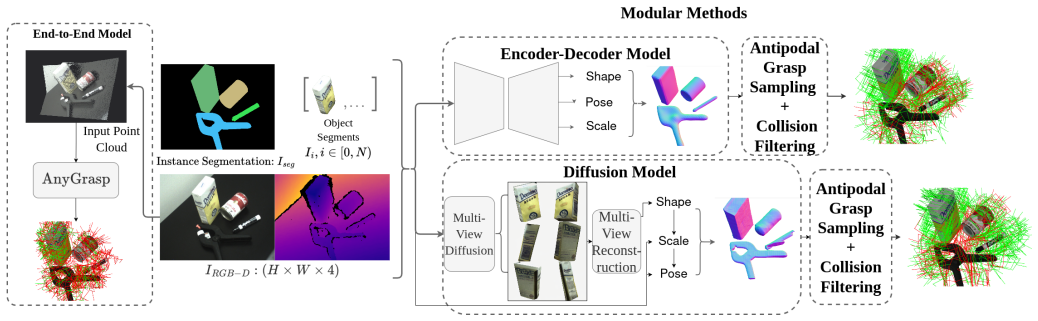
Summary. The paper investigates whether recent category-agnostic object pose and shape estimation methods (encoder-decoder models such as SAM3D, LRM, CRISP and diffusion models such as InstantMesh, Zero123, SceneComplete) combined with antipodal grasp sampling can outperform a chosen end-to-end grasp synthesis method for 7-DoF parallel-jaw grasps from single-view RGB(-D) inputs. It reports that the modular pipelines outperform the end-to-end baseline across all experiments, including on small objects, provides failure-mode and runtime analysis for the two estimation paradigms, and demonstrates an extension that augments the estimators with vision-language models to produce language-conditioned grasps with performance comparable to the LERF-TOGO baseline.
Significance. If the empirical comparison is properly quantified, the work would supply concrete evidence on the practical maturity of current pose/shape estimators for downstream grasping, showing modular pipelines' advantages in grasp coverage and small-object handling while identifying clutter as a remaining limitation. The runtime/failure analysis and the VLM-augmented language-conditioned demonstration add usable engineering insight into trade-offs between modular and integrated approaches.
major comments (2)
- [Abstract and experimental results] Abstract and experimental results section: the claim that 'the modular methods outperform the end-to-end method in all our experiments' and 'are able to synthesize plenty of grasps, even for small objects, where the end-to-end methods fail' is unsupported by any quantitative metrics (success rates, grasp counts, quality scores), dataset specifications, number of trials, error bars, or statistical tests, rendering the central empirical claim unverifiable.
- [Experimental setup] Experimental setup: the weakest assumption that the chosen pose/shape estimators produce estimates accurate enough for antipodal sampling to yield valid grasps is stated but never tested with direct measurements of pose/shape error versus grasp success; without such correlation the outperformance conclusion cannot be isolated from estimator quality.
minor comments (2)
- [Abstract and §1] The abstract and introduction should explicitly name the specific end-to-end baseline and the three modular pipelines (including which estimator each uses) rather than referring only to generic categories.
- [Figures and tables] Figure captions and result tables (if present) should include the exact scene counts, object categories, and input modalities to allow replication.
Simulated Author's Rebuttal
We thank the referee for the constructive feedback on strengthening the empirical claims and isolating the contributions of the modular pipeline. We address each major comment below.
read point-by-point responses
-
Referee: [Abstract and experimental results] Abstract and experimental results section: the claim that 'the modular methods outperform the end-to-end method in all our experiments' and 'are able to synthesize plenty of grasps, even for small objects, where the end-to-end methods fail' is unsupported by any quantitative metrics (success rates, grasp counts, quality scores), dataset specifications, number of trials, error bars, or statistical tests, rendering the central empirical claim unverifiable.
Authors: We agree that the abstract should explicitly include quantitative metrics to support the claims. The experimental results section reports grasp success rates, coverage counts, and comparisons on small objects across the tested methods and datasets, but these details are not summarized numerically in the abstract. We will revise the abstract to report specific success rates, grasp counts, dataset specifications, number of trials, and any available error bars or statistical information from the experiments. revision: yes
-
Referee: [Experimental setup] Experimental setup: the weakest assumption that the chosen pose/shape estimators produce estimates accurate enough for antipodal sampling to yield valid grasps is stated but never tested with direct measurements of pose/shape error versus grasp success; without such correlation the outperformance conclusion cannot be isolated from estimator quality.
Authors: We agree that an explicit correlation between measured pose/shape estimation error and downstream grasp success would strengthen the isolation of the outperformance conclusion. The manuscript states that modular effectiveness is contingent on estimation accuracy and includes failure-mode analysis, but does not provide direct per-estimate error versus grasp-success plots. We will add such correlation analysis in the revision using the pose/shape error data collected during the experiments. revision: yes
Circularity Check
No significant circularity in empirical benchmark
full rationale
The paper is an experimental comparison study evaluating modular pose/shape estimation pipelines (using external models like SAM3D, LRM, CRISP, InstantMesh) against an end-to-end grasp synthesizer on single-view RGB(-D) inputs. No mathematical derivations, equations, fitted parameters, or self-referential predictions are present. The central claim rests on direct experimental observations of grasp success rates, with explicit acknowledgment that performance depends on estimator accuracy. No load-bearing steps reduce to self-definition, fitted inputs, or self-citation chains; the work is self-contained against external benchmarks and datasets.
Assumptions & free parameters
Cite this review
Pith. "Pith review of Object Pose and Shape Estimation for Grasping: Does it Work?." pith.science (2026). https://pith.science/paper/OTDEECT4
@misc{pith2026260526944,
  author       = {Pith},
  title        = {Pith review of: Object Pose and Shape Estimation for Grasping: Does it Work?},
  year         = {2026},
  howpublished = {\url{https://pith.science/paper/OTDEECT4}},
  note         = {Machine review of arXiv:2605.26944}
}
read the original abstract
The problem of object pose and shape estimation has seen key advancements lately. Encoder-decoder (e.g., SAM3D, LRM, CRISP) and diffusion-based models (e.g., InstantMesh, Zero123, SceneComplete) have shown category-agnostic shape encoding capacity and open-set generalizability. In this work, we ask the question: Are the object pose and shape estimation methods mature enough, such that when used with antipodal grasp sampling, can outperform the end-to-end grasp synthesis methods? We explore this question in detail by scoping our study to parallel jaw grippers, 7-DoF grasps, and single-view RGB(-D) image as input. We implement and compare a state-of-the-art, end-to-end grasp synthesis method and three modular methods, which first estimate the object pose and shape for all objects in the scene, and generate grasps using antipodal sampling. We observe that the modular methods outperform the end-to-end method in all our experiments. The modular methods are able to synthesize plenty of grasps, even for small objects, where the end-to-end methods fail. The effectiveness of the modular methods is contingent on the accuracy of the pose and shape estimation, and suffers partial degradation in cluttered scenes - a limitation of the existing pose and shape estimation methods. We also analyze the failure modes and run-times for the three modular methods, which use two different ways of object pose and shape estimation: one based on an encoder-decoder model, while another a diffusion model. Finally, we demonstrate that the single-view object pose and shape estimation methods can be augmented with vision-language models to yield language-conditioned grasps from just single-view RGB-D image as input. We notice comparable performance to the state-of-the-art LERF-TOGO baseline.
Figures


Figures from the paper (5 more)


Reference graph
Works this paper leans on
-
[1]
Anygrasp: Robust and efficient grasp perception in spatial and temporal domains,
H.-S. Fang, C. Wang, H. Fang, M. Gou, J. Liu, H. Yan, W. Liu, Y . Xie, and C. Lu, “Anygrasp: Robust and efficient grasp perception in spatial and temporal domains,”IEEE Trans. Robotics, vol. 39, pp. 3929–3945, Jun. 2023
2023
-
[2]
Language embedded radiance fields for zero-shot task-oriented grasping,
A. Rashid, S. Sharma, C. M. Kim, J. Kerr, L. Y . Chen, A. Kanazawa, and K. Goldberg, “Language embedded radiance fields for zero-shot task-oriented grasping,” 2023
2023
-
[3]
Robot grasp synthesis algorithms: A survey,
K. Shimoga, “Robot grasp synthesis algorithms: A survey,”Intl. J. of Robotics Research, vol. 15, no. 3, pp. 230–266, 1996
1996
-
[4]
Robotic grasping and contact: a review,
A. Bicchi and V . Kumar, “Robotic grasping and contact: a review,” in IEEE Intl. Conf. on Robotics and Automation (ICRA), 2000
2000
-
[5]
Data-driven grasp synthesis—a survey,
J. Bohg, A. Morales, T. Asfour, and D. Kragic, “Data-driven grasp synthesis—a survey,”IEEE Trans. Robotics, vol. 30, no. 2, pp. 289–309, 2014
2014
-
[6]
Dex-net 2.0: Deep learning to plan robust grasps with synthetic point clouds and analytic grasp metrics,
J. Mahler, J. Liang, S. Niyaz, M. Laskey, R. Doan, X. Liu, J. A. Ojea, and K. Goldberg, “Dex-net 2.0: Deep learning to plan robust grasps with synthetic point clouds and analytic grasp metrics,” 2017
2017
-
[7]
Da 2 dataset: Toward dexterity-aware dual-arm grasping,
G. Zhai, Y . Zheng, Z. Xu, X. Kong, Y . Liu, B. Busam, Y . Ren, N. Navab, and Z. Zhang, “Da 2 dataset: Toward dexterity-aware dual-arm grasping,” IEEE Robotics and Automation Letters (RA-L), vol. 7, no. 4, pp. 8941– 8948, 2022
2022
-
[8]
A billion ways to grasps - an evaluation of grasp sampling schemes on a dense, physics-based grasp data set,
C. Eppner, A. Mousavian, and D. Fox, “A billion ways to grasps - an evaluation of grasp sampling schemes on a dense, physics-based grasp data set,” inProc. of the Intl. Symp. of Robotics Research (ISRR), 2019
2019
Show all 63 references
-
[9]
GDR-Net: Geometry- Guided Direct Regression Network for Monocular 6D Object Pose Estimation,
G. Wang, F. Manhardt, F. Tombari, and X. Ji, “GDR-Net: Geometry- Guided Direct Regression Network for Monocular 6D Object Pose Estimation,” inIEEE Conf. on Computer Vision and Pattern Recognition (CVPR), pp. 16611–16621, 2021
2021
-
[10]
Normalized object coordinate space for category-level 6d object pose and size estimation,
H. Wang, S. Sridhar, J. Huang, J. Valentin, S. Song, and L. Guibas, “Normalized object coordinate space for category-level 6d object pose and size estimation,” inIEEE Conf. on Computer Vision and Pattern Recognition (CVPR), pp. 2642–2651, 2019
2019
-
[11]
GDRNPP: A geometry-guided and fully learning-based object pose estimator,
X. Liu, R. Zhang, C. Zhang, G. Wang, J. Tang, Z. Li, and X. Ji, “GDRNPP: A geometry-guided and fully learning-based object pose estimator,”IEEE Trans. Pattern Anal. Machine Intell., vol. 47, no. 7, pp. 5742–5759, 2025
2025
-
[12]
Category-level 6d object pose estimation in the wild: A semi-supervised learning approach and a new dataset,
Y . Fu and X. Wang, “Category-level 6d object pose estimation in the wild: A semi-supervised learning approach and a new dataset,”Conf. on Neural Information Processing Systems (NeurIPS), vol. 35, pp. 27469–27483, 2022
2022
-
[13]
Sgpa: Structure-guided prior adaptation for category-level 6d object pose estimation,
K. Chen and Q. Dou, “Sgpa: Structure-guided prior adaptation for category-level 6d object pose estimation,” inIntl. Conf. on Computer Vision (ICCV), pp. 2773–2782, 2021
2021
-
[14]
Dualposenet: Category- level 6d object pose and size estimation using dual pose network with refined learning of pose consistency,
J. Lin, Z. Wei, Z. Li, S. Xu, K. Jia, and Y . Li, “Dualposenet: Category- level 6d object pose and size estimation using dual pose network with refined learning of pose consistency,” inIntl. Conf. on Computer Vision (ICCV), pp. 3560–3569, 2021
2021
-
[15]
Multiview compressive coding for 3d reconstruction,
C.-Y . Wu, J. Johnson, J. Malik, C. Feichtenhofer, and G. Gkioxari, “Multiview compressive coding for 3d reconstruction,” inIEEE Conf. on Computer Vision and Pattern Recognition (CVPR), 2023
2023
-
[16]
LRM: Large reconstruction model for single image to 3d,
Y . Hong, K. Zhang, J. Gu, S. Bi, Y . Zhou, D. Liu, F. Liu, K. Sunkavalli, T. Bui, and H. Tan, “LRM: Large reconstruction model for single image to 3d,” 2024
2024
-
[17]
CRISP: Object pose and shape estimation with test-time adaptation,
J. Shi, R. Talak, H. Zhang, D. Jin, and L. Carlone, “CRISP: Object pose and shape estimation with test-time adaptation,” inIEEE Conf. on Computer Vision and Pattern Recognition (CVPR), 2025
2025
-
[18]
Pre-train, self-train, distill: A simple recipe for supersizing 3d reconstruction,
K. A. Vasudev, A. Gupta, and S. Tulsiani, “Pre-train, self-train, distill: A simple recipe for supersizing 3d reconstruction,” inIEEE Conf. on Computer Vision and Pattern Recognition (CVPR), 2022
2022
-
[19]
Zeroshape: Regression-based zero-shot shape reconstruction,
Z. Huang, S. Stojanov, A. Thai, V . Jampani, and J. M. Rehg, “Zeroshape: Regression-based zero-shot shape reconstruction,” inIEEE Conf. on Computer Vision and Pattern Recognition (CVPR), 2024
2024
-
[20]
Instantmesh: Efficient 3d mesh generation from a single image with sparse-view large reconstruction models,
J. Xu, W. Cheng, Y . Gao, X. Wang, S. Gao, and Y . Shan, “Instantmesh: Efficient 3d mesh generation from a single image with sparse-view large reconstruction models,”arXiv preprint arXiv:2404.07191, 2024
2024 arXiv
-
[21]
Zero-1-to-3: Zero-shot one image to 3d object,
R. Liu, R. Wu, B. Van Hoorick, P. Tokmakov, S. Zakharov, and C. V ondrick, “Zero-1-to-3: Zero-shot one image to 3d object,” inIntl. Conf. on Computer Vision (ICCV), 2023
2023
-
[22]
Shap-e: Generating conditional 3d implicit functions,
H. Jun and A. Nichol, “Shap-e: Generating conditional 3d implicit functions,”arXiv preprint arXiv:2305.02463, 2023
2023 arXiv
-
[23]
NeuralLift-360: Lifting an in-the-wild 2d photo to a 3d object with 360° views,
D. Xu, Y . Jiang, P. Wang, Z. Fan, Y . Wang, and Z. Wang, “NeuralLift-360: Lifting an in-the-wild 2d photo to a 3d object with 360° views,” inIEEE Conf. on Computer Vision and Pattern Recognition (CVPR), 2023
2023
-
[24]
RealFusion: 360 reconstruction of any object from a single image,
L. Melas-Kyriazi, C. Rupprecht, I. Laina, and A. Vedaldi, “RealFusion: 360 reconstruction of any object from a single image,” inIEEE Conf. on Computer Vision and Pattern Recognition (CVPR), 2023
2023
-
[25]
SceneComplete: Open-World 3D Scene Completion in Complex Real World Environments for Robot Manipulation,
A. Agarwal, G. Singh, B. Sen, T. Lozano-P ´erez, and L. P. Kael- bling, “SceneComplete: Open-World 3D Scene Completion in Complex Real World Environments for Robot Manipulation,”arXiv preprint arxiv:2410.23643, Oct. 2024
2024
-
[26]
Sam 3d: 3dfy anything in images,
S. D. Team, X. Chen, F.-J. Chu, P. Gleize, K. J. Liang, A. Sax, H. Tang, W. Wang, M. Guo, T. Hardin, X. Li, A. Lin, J. Liu, Z. Ma, A. Sagar, B. Song, X. Wang, J. Yang, B. Zhang, P. Doll ´ar, G. Gkioxari, M. Feiszli, and J. Malik, “Sam 3d: 3dfy anything in images,”arxiv pre-pri...
2025 arXiv
-
[27]
Self6D: Self-supervised monocular 6D object pose estimation,
G. Wang, F. Manhardt, J. Shao, X. Ji, N. Navab, and F. Tombari, “Self6D: Self-supervised monocular 6D object pose estimation,” inEuropean Conf. on Computer Vision (ECCV)(A. Vedaldi, H. Bischof, T. Brox, and J.-M. Frahm, eds.), pp. 108–125, Nov. 2020
2020
-
[28]
ShapeICP: Iterative category-level object pose and shape estimation from depth,
Y . Zhang and J. Leonard, “ShapeICP: Iterative category-level object pose and shape estimation from depth,” 2024
2024
-
[29]
Learning canonical shape space for category-level 6d object pose and size estimation,
D. Chen, J. Li, Z. Wang, and K. Xu, “Learning canonical shape space for category-level 6d object pose and size estimation,” inIEEE Conf. on Computer Vision and Pattern Recognition (CVPR), pp. 11973–11982, 2020
2020
-
[30]
Shape prior deformation for categorical 6d object pose and size estimation,
M. Tian, M. H. Ang, and G. H. Lee, “Shape prior deformation for categorical 6d object pose and size estimation,” inEuropean Conf. on Computer Vision (ECCV), pp. 530–546, Springer, 2020
2020
-
[31]
Fsd: Fast self-supervised single rgb-d to categorical 3d objects,
M. Lunayach, S. Zakharov, D. Chen, R. Ambrus, Z. Kira, and M. Z. Irshad, “Fsd: Fast self-supervised single rgb-d to categorical 3d objects,” inIEEE Intl. Conf. on Robotics and Automation (ICRA), pp. 14630–14637, IEEE, 2024
2024
-
[32]
Novel view synthesis with diffusion models,
D. Watson, W. Chan, R. Martin-Brualla, J. Ho, A. Tagliasacchi, and M. Norouzi, “Novel view synthesis with diffusion models,”arxiv preprints arxiv:2210.04628, 2022
2022
-
[33]
GraspNet-1Billion: A large- scale benchmark for general object grasping,
H.-S. Fang, C. Wang, M. Gou, and C. Lu, “GraspNet-1Billion: A large- scale benchmark for general object grasping,” inIEEE Conf. on Computer Vision and Pattern Recognition (CVPR), 2020
2020
-
[34]
Grasping in the wild: Learning 6DoF closed-loop grasping from low-cost demonstrations,
S. Song, A. Zeng, J. Lee, and T. Funkhouser, “Grasping in the wild: Learning 6DoF closed-loop grasping from low-cost demonstrations,”IEEE Robotics and Automation Letters (RA-L), vol. 5, no. 3, pp. 4978–4985, 2020
2020
-
[35]
Contact- graspnet: Efficient 6-dof grasp generation in cluttered scenes,
M. Sundermeyer, A. Mousavian, R. Triebel, and D. Fox, “Contact- graspnet: Efficient 6-dof grasp generation in cluttered scenes,” 2021
2021
-
[36]
RGB Matters: Learning 7-DoF grasp poses on monocular rgbd images,
M. Gou, H.-S. Fang, Z. Zhu, S. Xu, C. Wang, and C. Lu, “RGB Matters: Learning 7-DoF grasp poses on monocular rgbd images,” inIEEE Intl. Conf. on Robotics and Automation (ICRA), 2021
2021
-
[37]
Deep learning approaches to grasp synthesis: A review,
R. Newbury, M. Gu, L. Chumbley, A. Mousavian, C. Eppner, J. Leitner, J. Bohg, A. Morales, T. Asfour, D. Kragic, D. Fox, and A. Cosgun, “Deep learning approaches to grasp synthesis: A review,”IEEE Trans. Robotics, vol. 39, pp. 3994–4015, Jun. 2023
2023
-
[38]
BOP challenge 2020 on 6D object localization,
T. Hodaˇn, M. Sundermeyer, B. Drost, Y . Labb´e, E. Brachmann, F. Michel, C. Rother, and J. Matas, “BOP challenge 2020 on 6D object localization,” European Conference on Computer Vision Workshops (ECCVW), 2020
2020
-
[39]
PoseCNN: A convolutional neural network for 6D object pose estimation in cluttered scenes,
Y . Xiang, T. Schmidt, V . Narayanan, and D. Fox, “PoseCNN: A convolutional neural network for 6D object pose estimation in cluttered scenes,” inRobotics: Science and Systems (RSS), 2018
2018
-
[40]
FreeZe: Training- free zero-shot 6d pose estimation with geometric and vision foundation models,
A. Caraffa, D. Boscaini, A. Hamza, and F. Poiesi, “FreeZe: Training- free zero-shot 6d pose estimation with geometric and vision foundation models,” inEuropean Conf. on Computer Vision (ECCV), 2024
2024
-
[41]
Co-op: Correspondence-based novel object pose estimation,
S. Moon, H. Son, D. Hur, and S. Kim, “Co-op: Correspondence-based novel object pose estimation,” inIEEE Conf. on Computer Vision and Pattern Recognition (CVPR), 2025
2025
-
[42]
FoundationPose: Unified 6d pose estimation and tracking of novel objects,
J. K. Bowen Wen, Wei Yang and S. Birchfield, “FoundationPose: Unified 6d pose estimation and tracking of novel objects,” inIEEE Conf. on Computer Vision and Pattern Recognition (CVPR), 2024
2024
-
[43]
GigaPose: Fast and robust novel object pose estimation via one correspondence,
V . N. Nguyen, T. Groueix, M. Salzmann, and V . Lepetit, “GigaPose: Fast and robust novel object pose estimation via one correspondence,” in IEEE Conf. on Computer Vision and Pattern Recognition (CVPR), 2024
2024
-
[44]
GenFlow: Generalizable recurrent flow for 6d pose refinement of novel objects,
S. Moon, H. Son, D. Hur, and S. Kim, “GenFlow: Generalizable recurrent flow for 6d pose refinement of novel objects,” inIEEE Conf. on Computer Vision and Pattern Recognition (CVPR), 2024
2024
-
[45]
Megapose: 6d pose estimation of novel objects via render & compare,
Y . Labb´e, L. Manuelli, A. Mousavian, S. Tyree, S. Birchfield, J. Tremblay, J. Carpentier, M. Aubry, D. Fox, and J. Sivic, “Megapose: 6d pose estimation of novel objects via render & compare,” 2022
2022
-
[46]
Graspit! a versatile simulator for robotic grasping,
A. Miller and P. Allen, “Graspit! a versatile simulator for robotic grasping,” vol. 11, no. 4, pp. 110–122, 2004
2004
-
[47]
Learning task-oriented grasping for tool manipulation from simulated self-supervision,
K. Fang, Y . Zhu, A. Garg, A. Kurenkov, V . Mehta, L. Fei-Fei, and S. Savarese, “Learning task-oriented grasping for tool manipulation from simulated self-supervision,”Intl. J. of Robotics Research, vol. 39, no. 2-3, pp. 202–216, 2020
2020
-
[48]
Language-driven grasp detection,
A. D. Vuong, M. N. Vu, B. Huang, N. Nguyen, H. Le, T. V o, and A. Nguyen, “Language-driven grasp detection,” inIEEE Conf. on Computer Vision and Pattern Recognition (CVPR), 2024
2024
-
[49]
D(R,O) Grasp: A unified representation of robot and object interaction for cross-embodiment dexterous grasping,
Z. Wei, Z. Xu, J. Guo, Y . Hou, C. Gao, Z. Cai, J. Luo, and L. Shao, “D(R,O) Grasp: A unified representation of robot and object interaction for cross-embodiment dexterous grasping,” inIEEE Intl. Conf. on Robotics and Automation (ICRA), 2025
2025
-
[50]
kPAM-SC: Generalizable manipulation planning using keypoint affordance and shape completion,
W. Gao and R. Tedrake, “kPAM-SC: Generalizable manipulation planning using keypoint affordance and shape completion,” inIEEE Intl. Conf. on Robotics and Automation (ICRA), pp. 6527–6533, 2021
2021
-
[51]
A geometric approach for grasping unknown objects with multifingered hands,
M. Kiatos, S. Malassiotis, and I. Sarantopoulos, “A geometric approach for grasping unknown objects with multifingered hands,”IEEE Trans. Robotics, vol. 37, no. 3, pp. 735–746, 2021
2021
-
[52]
Simultaneous object reconstruction and grasp prediction using a camera- centric object shell representation,
N. Chavan-Dafle, S. Popovych, S. Agrawal, D. D. Lee, and V . Isler, “Simultaneous object reconstruction and grasp prediction using a camera- centric object shell representation,” inIEEE/RSJ Intl. Conf. on Intelligent Robots and Systems (IROS), pp. 1396–1403, 2022
2022
-
[53]
Robotic pick-and-place with uncertain object instance segmentation and shape completion,
M. Gualtieri and R. Platt, “Robotic pick-and-place with uncertain object instance segmentation and shape completion,”IEEE Robotics and Automation Letters (RA-L), vol. 6, no. 2, pp. 1753–1760, 2021
2021
-
[54]
Robust grasp planning over uncertain shape completions,
J. Lundell, F. Verdoja, and V . Kyrki, “Robust grasp planning over uncertain shape completions,” inIEEE/RSJ Intl. Conf. on Intelligent Robots and Systems (IROS), pp. 1526–1532, 2019
2019
-
[55]
Synergies Between Affordance and Geometry: 6-DoF Grasp Detection via Implicit Repre- sentations,
Z. Jiang, Y . Zhu, M. Svetlik, K. Fang, and Y . Zhu, “Synergies Between Affordance and Geometry: 6-DoF Grasp Detection via Implicit Repre- sentations,” inRobotics: Science and Systems (RSS), 2021
2021
-
[56]
Learning 6-dof grasping interaction via deep geometry-aware 3d representations,
X. Yan, J. Hsu, M. Khansari, Y . Bai, A. Pathak, A. Gupta, J. Davidson, and H. Lee, “Learning 6-dof grasping interaction via deep geometry-aware 3d representations,” inIEEE Intl. Conf. on Robotics and Automation (ICRA), 2018
2018
-
[57]
Robotic grasping through combined image-based grasp proposal and 3d reconstruction,
D. Yang, T. Tosun, B. Eisner, V . Isler, and D. Lee, “Robotic grasping through combined image-based grasp proposal and 3d reconstruction,” inIEEE Intl. Conf. on Robotics and Automation (ICRA), 2021
2021
-
[58]
Scarp: 3d shape completion in arbitrary poses for improved grasping,
B. Sen, A. Agarwal, G. Singh, B. B., S. Sridhar, and M. Krishna, “Scarp: 3d shape completion in arbitrary poses for improved grasping,” inIEEE Intl. Conf. on Robotics and Automation (ICRA), Jun. 2023
2023
-
[59]
Learning-Free Grasping of Unknown Objects Using Hidden Superquadrics,
Y . Wu, W. Liu, Z. Liu, and G. S. Chirikjian, “Learning-Free Grasping of Unknown Objects Using Hidden Superquadrics,” inRobotics: Science and Systems (RSS), Jul. 2023
2023
-
[60]
Centergrasp: Object-aware implicit representation learning for simulta- neous shape reconstruction and 6-dof grasp estimation,
E. Chisari, N. Heppert, T. Welschehold, W. Burgard, and A. Valada, “Centergrasp: Object-aware implicit representation learning for simulta- neous shape reconstruction and 6-dof grasp estimation,”IEEE Robotics and Automation Letters (RA-L), vol. 9, no. 6, pp. 5094–5101, 2024
2024
-
[61]
Marching cubes: A high resolution 3d surface construction algorithm,
W. Lorensen and H. Cline, “Marching cubes: A high resolution 3d surface construction algorithm,” inSIGGRAPH, pp. 163–169, 1987
1987
-
[62]
BrushNet: A plug-and-play image inpainting model with decomposed dual-branch diffusion,
X. Ju, X. Liu, X. Wang, Y . Bian, Y . Shan, and Q. Xu, “BrushNet: A plug-and-play image inpainting model with decomposed dual-branch diffusion,”arxiv pre-print arxiv:2403.06976, 2024
2024
-
[63]
PyBullet: a python module for physics simulation for games, robotics and machine learning
“PyBullet: a python module for physics simulation for games, robotics and machine learning.” http://pybullet.org, 2024
2024
Reviewed June 29, 2026 · model on record in the stance chip above.
Discussion (0). Sign in to comment.