A tridiagonal matrix-valued process with stochastic resetting for arbitrary Dyson index β>0
Pith reviewed 2026-07-01 16:23 UTC · model grok-4.3
The pith
A symmetric tridiagonal matrix process with simultaneous stochastic resetting has a long-time eigenvalue distribution that exactly matches the stationary state of resetting Dyson Brownian motion for any β > 0.
A machine-rendered reading of the paper's core claim, the machinery that carries it, and where it could break.
Core claim
The β-SRTMP process, obtained by subjecting the β-TMP to simultaneous resetting of all entries to zero at rate r, reaches a stationary state whose joint eigenvalue distribution coincides with the stationary joint distribution of the positions of the resetting Dyson Brownian motion for arbitrary β > 0. The β-IRTMP process with independent resetting yields a different stationary ensemble whose properties are harder to compute analytically.
What carries the argument
The β-TMP whose off-diagonal entries evolve as independent Cox-Ingersoll-Ross processes with parameters tuned to the row index k so that the eigenvalue joint law remains exactly solvable and reproduces β-ensemble level repulsion.
If this is right
- The long-time joint eigenvalue PDF of the β-SRTMP is given in closed form and equals the resetting DBM stationary PDF.
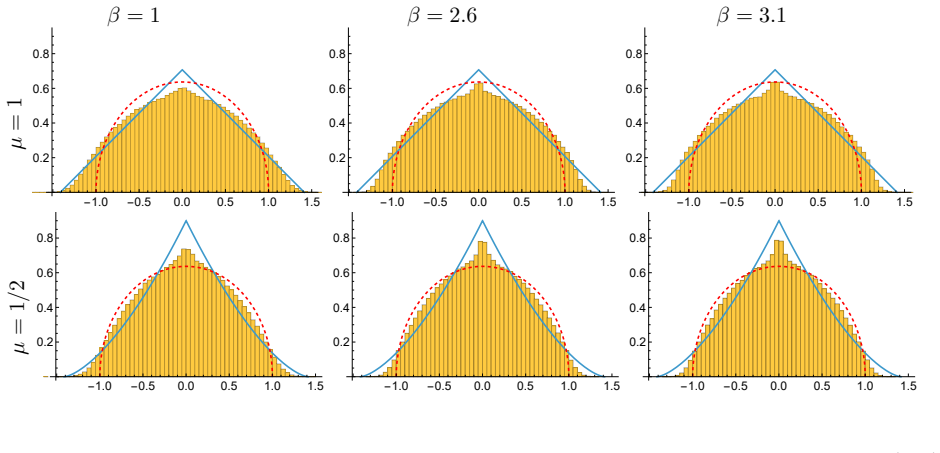
- The average eigenvalue density of the β-SRTMP stationary state can be compared directly to numerical samples from the β-IRTMP.
- The construction supplies an explicit matrix model for the annealed partition function of a one-dimensional disordered tight-binding Hamiltonian.
- Exact solvability holds at all finite times before resetting reaches stationarity.
Where Pith is reading between the lines
- This matrix construction may offer a route to exact results for other non-equilibrium random-matrix models that include resetting.
- Distinguishing simultaneous from independent resetting reveals how global versus local resetting affects the stationary measure in interacting particle systems.
- Similar parameter tuning of diffusion processes might be used to realize other exactly solvable β-ensembles outside the classical Gaussian, Laguerre or Jacobi families.
Load-bearing premise
The row-index dependence of the Cox-Ingersoll-Ross parameters for the off-diagonal entries is chosen so that the eigenvalue repulsion strength remains exactly β for any positive β while preserving independent evolution of each entry.
What would settle it
Generate many independent realizations of the β-SRTMP process until stationarity is reached, extract the empirical joint distribution of the N eigenvalues, and test whether it agrees with the explicit formula for the stationary resetting Dyson Brownian motion.
Figures
read the original abstract
We introduce a symmetric tridiagonal matrix-valued process ($\beta$-TMP) $H(t)$ whose diagonal entries $H_{k,k}(t)$ evolve independently via an Ornstein-Uhlenbeck process starting at the origin and the off-diagonal entries $H_{k,k+1}(t)$ evolve independently via the Cox-Ingersoll-Ross process, starting at the origin and with parameters that depend on the row index $k$. We show that the joint distribution of the entries of the matrix can be computed exactly at all times and moreover, the joint distribution of its $N$ real eigenvalues can be computed exactly at all times too. We then subject this time-evolving matrix-valued process to stochastic resetting with rate $r$ in two different settings: (i) simultaneous resetting of the matrix entries to the origin with rate $r$ ($\beta$-SRTMP process) and (ii) independent resetting of the matrix entries to the origin with rate $r$ ($\beta$-IRTMP process). We show that the joint distribution of the eigenvalues of the $\beta$-SRTMP process at long times can be computed analytically and it coincides with the joint distribution of the positions of the resetting Dyson Brownian motion in its stationary state for arbitrary $\beta>0$. For the $\beta$-IRTMP stationary ensemble, computing analytically the joint distribution of eigenvalues or even the average density of eigenvalues is difficult. However, generating the stationary $\beta$-IRTMP ensemble numerically is relatively straightforward and we compare its numerical average eigenvalue density to the corresponding analytical results for the $\beta$-SRTMP stationary ensemble with same parameter values, showing that they are quite different from each other. Finally, we provide a simple and concrete application of this tridiagonal matrix-valued process in computing the annealed partition function of a disordered quantum tight-binding Hamiltonian on a one-dimensional lattice.
Editorial analysis
A structured set of objections, weighed in public.
Referee Report
Summary. The manuscript introduces the β-tridiagonal matrix process (β-TMP) whose diagonal entries evolve as independent Ornstein-Uhlenbeck processes and off-diagonal entries as independent Cox-Ingersoll-Ross processes with row-index k-dependent parameters. It claims that the joint distribution of the matrix entries and of its eigenvalues can be computed exactly at all times. Two resetting protocols are studied: simultaneous resetting of all entries (β-SRTMP) and independent resetting (β-IRTMP). The central result is that the long-time eigenvalue joint distribution of the β-SRTMP coincides exactly with the stationary distribution of resetting Dyson Brownian motion for arbitrary β>0. Numerical eigenvalue densities are compared between the two resetting ensembles, and the model is applied to compute the annealed partition function of a disordered 1D tight-binding Hamiltonian.
Significance. If the claimed exact solvability holds, the work supplies a rare exactly solvable tridiagonal representation of β-ensembles that functions for any β>0 (not merely integer values) and yields an analytically accessible stationary measure under simultaneous resetting. The coincidence follows directly from matching the time-dependent marginals to the Dumitriu–Edelman law and integrating the resetting kernel; no additional assumptions on eigenvector dynamics are required. The explicit numerical generation of the IRTMP ensemble and the concrete mapping to a quantum Hamiltonian partition function are practical strengths. The construction is parameter-tuned by design yet produces a falsifiable, closed-form prediction for the SRTMP stationary law.
minor comments (3)
- [§2] The explicit functional dependence of the CIR drift and diffusion coefficients on both k and β should be written out in the definition of the β-TMP (presumably §2) so that the parameter choice reproducing the Dumitriu–Edelman law is immediately reproducible.
- [application section] In the application to the tight-binding Hamiltonian, the precise identification between the matrix entries and the on-site/disorder potentials should be stated explicitly, including the disorder averaging procedure.
- Figure captions for the numerical eigenvalue-density plots should list the values of N, r, β, and the number of samples used.
Simulated Author's Rebuttal
We thank the referee for their positive and accurate summary of the manuscript, for highlighting its significance as an exactly solvable tridiagonal representation valid for arbitrary β>0, and for recommending acceptance. The referee's assessment correctly identifies the key results on the time-dependent distributions, the stationary law under simultaneous resetting, the numerical comparison with independent resetting, and the application to the annealed partition function.
Circularity Check
No significant circularity identified
full rationale
The paper defines the β-TMP via explicit independent SDEs (OU on diagonal, CIR on off-diagonals with k-dependent parameters) chosen so the entry marginals exactly reproduce the time-dependent Dumitriu-Edelman tridiagonal law; the eigenvalue joint law then follows from the known static change-of-variables, and the SRTMP stationary law is the resetting integral of that law. This matching with resetting DBM is therefore a direct consequence of the construction rather than an independent derivation, but the steps remain self-contained: the dynamics are specified from scratch, the exact distributions are computed from the SDEs, and no load-bearing self-citation, fitted parameter renamed as prediction, or self-definitional loop is present. The central claim is therefore not equivalent to its inputs by construction in the sense that would trigger a circularity flag.
Axiom & Free-Parameter Ledger
free parameters (2)
- resetting rate r
- CIR process parameters (k-dependent)
axioms (2)
- domain assumption The matrix entries evolve independently according to the specified stochastic differential equations.
- standard math Standard Itô calculus and Fokker-Planck methods suffice to compute the time-dependent distributions.
invented entities (3)
-
β-TMP process
no independent evidence
-
β-SRTMP process
no independent evidence
-
β-IRTMP process
no independent evidence
Reference graph
Works this paper leans on
-
[1]
F. J. Dyson,Statistical theory of the energy levels of complex systems. I, J. Math. Phys.3, 140 (1962)
1962
-
[2]
F. J. Dyson,A Brownian-motion model for the eigenvalues of a random matrix, J. Math. Phys. 3, 1191 (1962)
1962
-
[3]
P. J. Forrester,Log-Gases and Random Matrices, London Mathematical Society monographs (2010)
2010
-
[4]
Dumitriu, A
I. Dumitriu, A. Edelman,Matrix models for beta ensembles, J. Math. Phys.43, 5830 (2002)
2002
-
[5]
Katori, H
M. Katori, H. Tanemura,Symmetry of matrix-valued stochastic processes and noncolliding diffu- sion particle systems, J. Math. Phys.45, 3058 (2004)
2004
-
[6]
Borodin, P
A. Borodin, P. Ferrari, M. Prahofer, T. Sasamoto, J. Warren,Maximum of Dyson Brownian motion and non-colliding systems with a boundary, Electron. Commun. Prob.14, 486 (2009). 25
2009
-
[7]
Allez, J
R. Allez, J. P. Bouchaud, A. Guionnet,Invariant beta ensembles and the Gauss-Wigner crossover, Phys. Rev. Lett.109, 094102 (2012)
2012
-
[8]
Allez, J.-P
R. Allez, J.-P. Bouchaud, S.N. Majumdar, P. Vivo,Invariantβ-Wishart ensembles, crossover densities and asymptotic corrections to the Marcenko-Pastur law, J. Phys. A.: Math. Theor.46, 015001 (2013)
2013
-
[9]
Bun, J.-P
J. Bun, J.-P. Bouchaud, S. N. Majumdar, M. Potters,An instanton approach to largeNHarish- Chandra-Itzykson-Zuber integrals, Phys. Rev. Lett.,113, 070201 (2014)
2014
-
[10]
Allez, L
R. Allez, L. Dumaz,Random matrices in non-confining potentials, J. Stat. Phys.160, 681 (2015)
2015
-
[11]
Landon, H
B. Landon, H. T. Yau,Convergence of local statistics of Dyson Brownian motion, Comm. Math. Phys.,355, 949 (2017)
2017
-
[12]
Grela, S
J. Grela, S. N. Majumdar, G. Schehr,Non-intersecting Brownian bridges in the flat-to-flat geom- etryJ. Stat. Phys.183, 49 (2021)
2021
-
[13]
Mergny, S
P. Mergny, S. N. Majumdar,Stability of large complex systems with heterogeneous relaxation dynamicsJ. Stat. Mech. 123301 (2021)
2021
-
[14]
Touzo, P
L. Touzo, P. Le Doussal, G. Schehr,Interacting, running and tumbling: The active Dyson Brow- nian motionEPL142, 61004 (2023)
2023
-
[15]
Biroli, S
M. Biroli, S. N. Majumdar, G. Schehr,Resetting Dyson Brownian motion, Phys. Rev. E,112, 014101 (2025)
2025
-
[16]
Y. Fyodorov, P. Le Doussal, A. Ossipov,Large deviations of spectral determinants of matrix- valued random Schr¨odinger operators and Dyson Brownian motion in cubic potentials, arXiv: 2511.00954
-
[17]
Evans and S.N
M.R. Evans and S.N. Majumdar,Diffusion with Stochastic Resetting, Phys. Rev. Lett.106, 160601 (2011)
2011
-
[18]
M. R. Evans, S. N. Majumdar,Diffusion with optimal resetting, J. Phys. A: Math. Theor.44, 435001 (2011)
2011
-
[19]
J. C. Cox, J. E. Ingersoll, and S. A. Ross,An intertemporal general equilibrium model of asset prices, Econometrica53, 385 (1985)
1985
-
[20]
Feller,Two singular-diffusion problems, Ann
W. Feller,Two singular-diffusion problems, Ann. Math.54, 173 (1951)
1951
-
[21]
M. R. Evans, S. N. Majumdar, G. Schehr,Stochastic resetting and applications, J. Phys. A. : Math. Theor.53, 193001 (2020)
2020
-
[22]
A. Pal, S. Kostinski, S. Reuveni,The inspection paradox in stochastic resetting, J. Phys. A: Math. Theor.55, 021001 (2022)
2022
-
[23]
Gupta, A
S. Gupta, A. M. Jayannavar,Stochastic resetting: A (very) brief review, Frontiers in Physics10, 789097 (2022)
2022
-
[24]
Nagar, S
A. Nagar, S. Gupta,Stochastic resetting in interacting particle systems: A review, J. Phys. A: Math. Theor.56, 283001 (2023). 26
2023
- [25]
-
[26]
Gupta, S.N
S. Gupta, S.N. Majumdar, G. Schehr,Fluctuating interfaces subject to stochastic resetting, Phys. Rev. Lett.,112, 220601 (2014)
2014
-
[27]
U. Basu, A. Kundu, A. Pal,Symmetric exclusion process under stochastic resetting, Phys. Rev. E100, 032136 (2019)
2019
-
[28]
Magoni, S
M. Magoni, S. N. Majumdar, G. Schehr,Ising model with stochastic resetting, Phys. Rev. Re- search,2, 033182 (R) (2020)
2020
-
[29]
Y. Chen, W. Zhing,Crossover from anomalous to normal diffusion: Ising model with stochastic resetting, Phys. Rev. Research,6, 033189 (2024)
2024
-
[30]
V. K. Anagha, A. Nagar,Stochastic resetting in the infinite range Ising model, accepted for publication in J. Phys. A: Math. Theor. (2026)
2026
-
[31]
C. Aron, M. Kulkarni,Control of spatiotemporal chaos by stochastic resetting, Phys. Rev. E,112, 014220 (2025)
2025
-
[32]
Siboni, P
M. Siboni, P. Sasorov, B. Meerson,Fluctuations of a swarm of Brownian bees, Phys. Rev. E104, 054131 (2021)
2021
-
[33]
O. Vilk, M. Assaf, B. Merrson,Fluctuations and first-passage properties of systems of Brownian particles with reset, Phys. Rev. E106, 024117 (2022)
2022
-
[34]
Di Bello, A
C. Di Bello, A. K. Hartmann, S. N. Majumdar, F. Mori, A. Rosso, G. Schehr,Current fluctuations in stochastically resetting particle systems, Phys. Rev. E108, 014112 (2023)
2023
-
[35]
O. Vilk, B. Meerson,Collective behavior of independent scaled Brownian particles with renewal resetting, Physica A,692, 131542 (2026)
2026
-
[36]
Meerson and O
B. Meerson and O. Vilk, Age-structured hydrodynam- ics of ensembles of anomalously diffusing particles with renewal resetting, Phys. Rev. Res. 8, 023103 (2026)
2026
-
[37]
Biroli, H
M. Biroli, H. Larralde, S. N. Majumdar, G. Schehr,Extreme Statistics and Spacing Distribution in a Brownian Gas Correlated by Resetting, Phys. Rev. Lett.,130, 207101 (2023)
2023
-
[38]
Biroli, S
M. Biroli, S. N. Majumdar, G. Schehr,Critical number of walkers for diffusive search processes with resetting, Phys. Rev. E,107, 064141 (2023)
2023
-
[39]
Biroli, H
M. Biroli, H. Larralde„ S. N. Majumdar, G. Schehr,Exact extreme, order and sum statistics in a class of strongly correlated system, Phys. Rev. E109, 014101 (2024)
2024
-
[40]
de Mauro, M
G. de Mauro, M. Biroli, S. N. Majumdar, G. Schehr,Dynamically emergent correlations in Brown- ian particles subject to simultaneous non-Poissonian resetting protocols, Phys. Rev. E113, 014120 (2026)
2026
-
[41]
Galla,A diffusion approximation for systems with frequent weak resetting, arXiv:2602.21635
T. Galla,A diffusion approximation for systems with frequent weak resetting, arXiv:2602.21635
-
[42]
Biswas, S
A. Biswas, S. N. Majumdar, A. Pal,Target Search Optimization by Threshold Resetting, Phys. Rev. Lett.135, 227101 (2025). 27
2025
-
[43]
Biroli, S
M. Biroli, S. N. Majumdar, G. Schehr.First-passage resetting gas, Europhys. Lett.153, 31002 (2026)
2026
- [44]
-
[45]
Boyer, S
D. Boyer, S. N. Majumdar,Emerging correlations between diffusing particles evolving via simul- taneous resetting with memory, J. Phys. A: Math. Theo.59, 125001 (2026)
2026
-
[46]
Majumder, R
R. Majumder, R. Chattopadhyay, S. Gupta,Kuramoto model subject to subsystem resetting: How resetting a part of the system may synchronize the whole of it, Phys. Rev. E109, 064137 (2024)
2024
-
[47]
Acharya, R
A. Acharya, R. Majumder, S. Gupta,Manipulating Phases in Many-Body Interacting Systems with Subsystem Resetting, Phys. Rev. Lett.135, 127103 (2025)
2025
-
[48]
G. de Mauro, S. N. Majumdar, G. Schehr,Tuning the strength of emergent correlations in a Brownian gas via batch resetting, arXiv:2601.20077
-
[49]
Biroli, M
M. Biroli, M. Kulkarni, S. N. Majumdar, G. Schehr,Dynamically emergent correlations between particles in a switching harmonic trap, Phys. Rev. E109, L032106 (2024)
2024
- [50]
-
[51]
M. R. Evans and S. N. Majumdar,Diffusion with resetting in arbitrary spatial dimension, J. Phys. A47, 285001 (2014)
2014
-
[52]
I. S. Gradshteyn and I. M. Ryzhik,Table of Integrals, Se- ries and Products, 7th edition, Academic Press (San Diego, 2007)
2007
-
[53]
A. Y. Abul-Magd,Random matrix theory within superstatistics, Phys. Rev. E72, 066114 (2005)
2005
-
[54]
Bohigas, J
O. Bohigas, J. X. de Carvalho, M. P. Pato,Disordered ensembles of random matrices, Phys. Rev. E77, 011122 (2008)
2008
-
[55]
A. Y. Abul-Magd, G. Akemann, P. Vivo,Superstatistical generalizations of Wishart–Laguerre ensembles of random matrices, J. Phys. A: Math. Theor.42, 175207 (2009)
2009
-
[56]
R. M. Capocelli and L. M. Ricciardi,A continuous Markovian model for neuronal activity, J. theor. Biol.40, 369 (1973)
1973
-
[57]
R. M. Capocelli and L. M. Ricciardi,a diffusion model for population growth in random environ- ment, Theor. Pop. Biol.5, 28 (1974)
1974
-
[58]
J. C. Hull,Options, Futures, and other Derivatives(Prentice Hall, London, 2011)
2011
-
[59]
S. L. Heston,A closed-form solution for options with stochastic volatility with applications to bond and currency options, Rev. Financ. Stud.6, 327 (1993)
1993
-
[60]
A. A. Dragulescu and V. M. Yakovenko,Probability distribution of returns in the Heston model with stochastic volatility, Quant. Fin.2, 443 (2002)
2002
-
[61]
S. N. Majumdar, A. Rosso,Extreme value statistics in a continuous time branching process: a pedagogical primer, J. Phys. A: Math. Theor.58, 475001 (2025). 28
2025
-
[62]
Masoliver and J
J. Masoliver and J. Perello,First-passage and escape problems in the Feller process, Phys. Rev. E86, 041116 (2012)
2012
-
[63]
Ray,Expediting Feller process with stochastic resetting, Phys
S. Ray,Expediting Feller process with stochastic resetting, Phys. Rev. E106, 034133 (2022). [64]Handbook of Mathematical Functions with Formulas, Graphs, and Mathematical Tables, Edited by M. Abramowitz and I. A. Stegun (Dover, New York, 1965)
2022
-
[64]
Bratley, B
P. Bratley, B. L. Fox, and E.L. Schrage,A Guide to Simulation, Springer-Verlag, New York, 1983. 29
1983
discussion (0)
Sign in with ORCID, Apple, or X to comment. Anyone can read and Pith papers without signing in.