Looking for Condensed Gluons: A Cross-Scale Journey from the Deep Structure of Protons to High-Energy Cosmic Rays -- A Mini-Review
Pith reviewed 2026-06-29 17:03 UTC · model grok-4.3
The pith
Gluon condensation from the ZSR equation produces a broken power law in cosmic gamma-ray spectra
A machine-rendered reading of the paper's core claim, the machinery that carries it, and where it could break.
Core claim
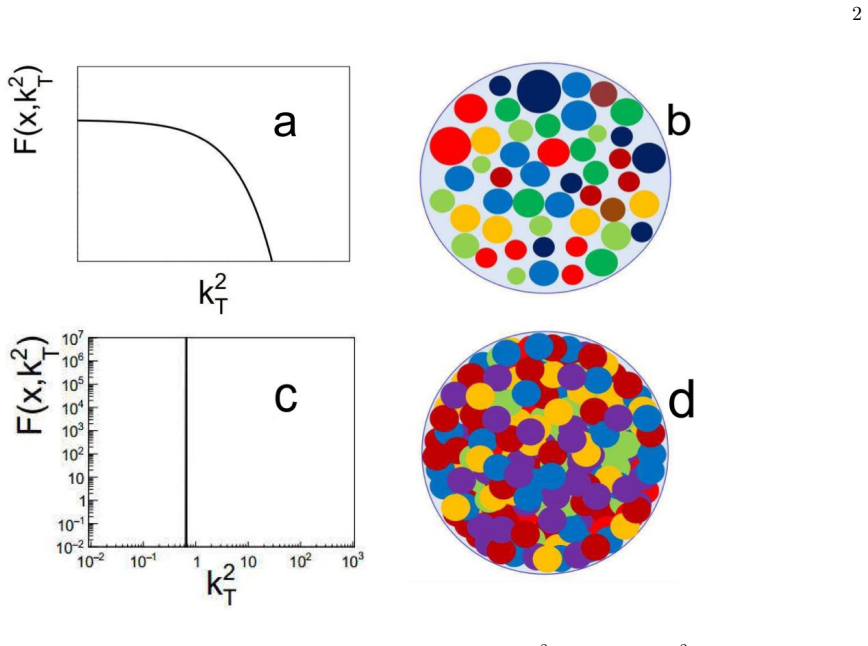
The paper claims that the chaotic solutions and the shadowing-antishadowing synergy inherent in the ZSR equation can drive gluons to aggregate near the critical momentum, thereby forming a novel type of high-density, strongly interacting matter. These changes in microstructure manifest themselves as a broken-power-law feature in high-energy cosmic gamma-ray spectra, thereby offering new insights into the hadronic scenarios underlying certain astrophysical sources. Consequently, GC not only concerns the novel behaviour of quantum chromodynamics under extreme conditions but may also serve as a vital window for probing the deep structure of protons using cosmic-ray signals.
What carries the argument
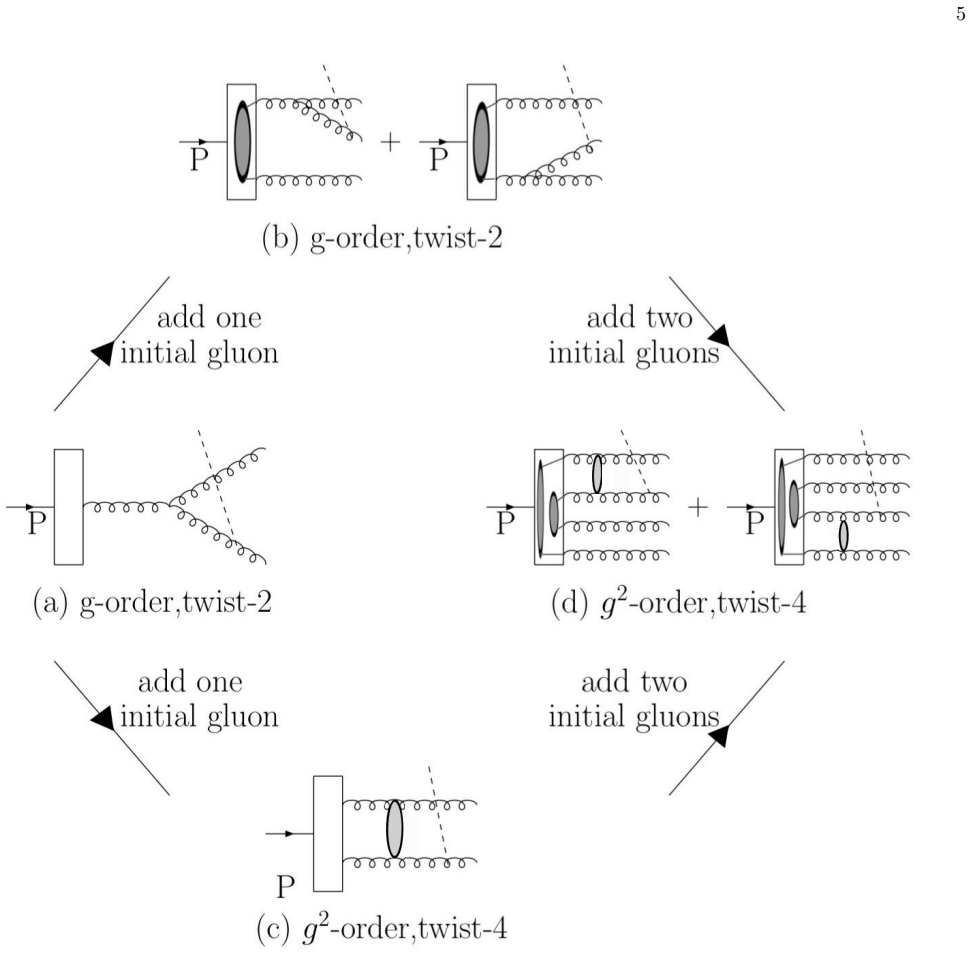
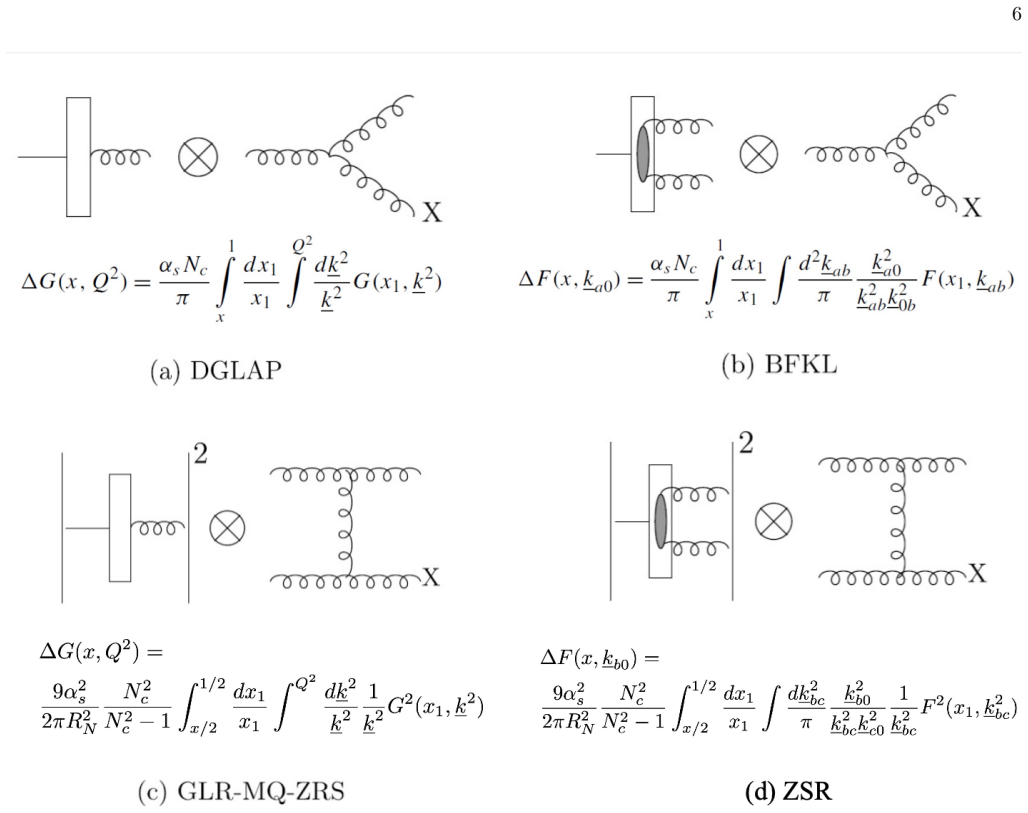
The Zhu-Shen-Ruan (ZSR) equation, a nonlinear evolution equation based on structural symmetry that self-consistently connects to the DGLAP, BFKL and GLR-MQ-ZRS equations; its chaotic solutions and shadowing-antishadowing effects drive gluon aggregation near a critical momentum.
If this is right
- If the GC picture is confirmed, certain features in the high-energy gamma-ray spectrum will need to be re-examined within the deeper context of hadronic dynamics.
- GC may also provide a new entry point for research into pion condensation in nuclear physics and even condensed matter physics.
- With the advancement of higher-precision gamma-ray observations, hadron collision experiments and related theoretical research, the physical picture of GC and its observational criteria are expected to undergo more rigorous testing.
Where Pith is reading between the lines
- Cosmic-ray observations could constrain QCD parameters in kinematic regimes inaccessible to colliders.
- Similar condensation effects might appear in other gauge theories or at different energy scales.
- Confirmation would require re-modeling of how proton structure influences ultra-high-energy particle fluxes.
Load-bearing premise
The assumption that the chaotic solutions and shadowing-antishadowing synergy of the ZSR equation necessarily drive gluons to aggregate near a critical momentum and produce an observable broken-power-law signature that cannot be explained by standard hadronic models or other mechanisms.
What would settle it
High-precision gamma-ray spectra from astrophysical sources that show either no broken-power-law feature or one that standard hadronic interaction models fully reproduce without gluon condensation.
Figures
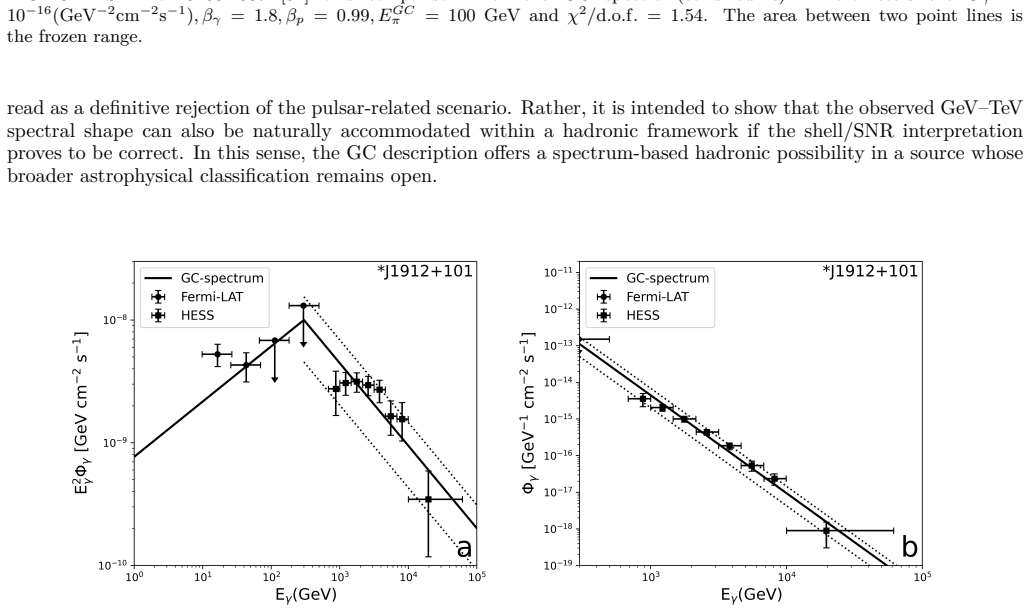
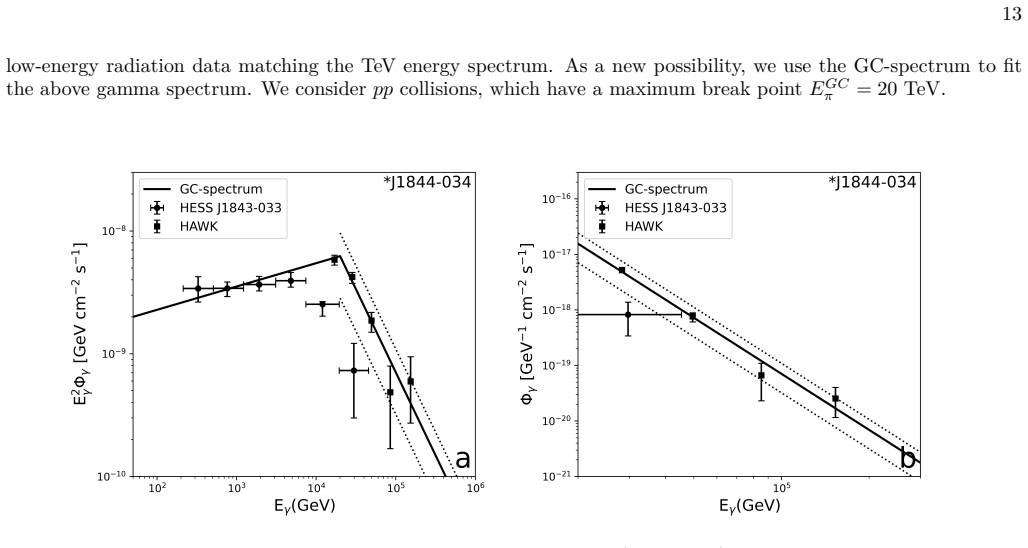
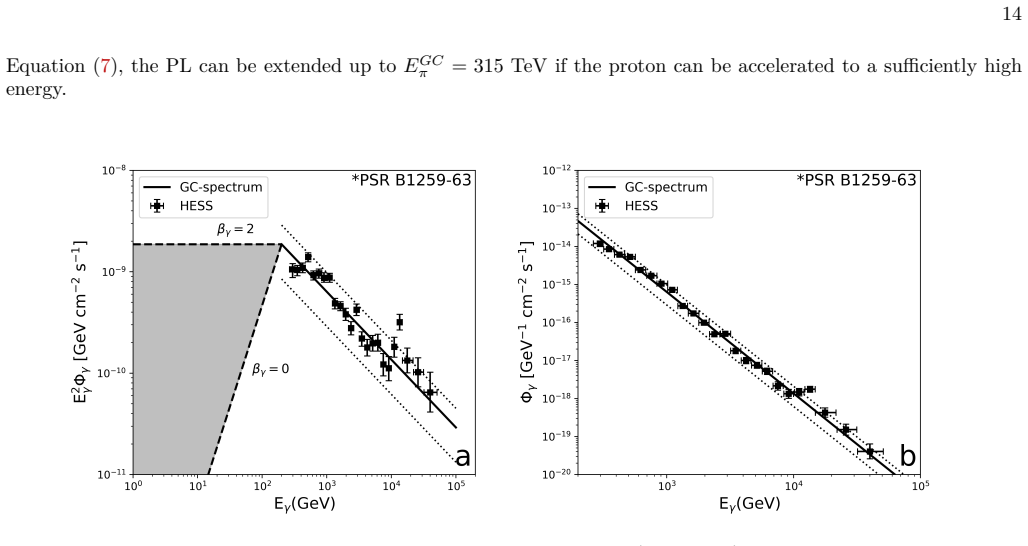
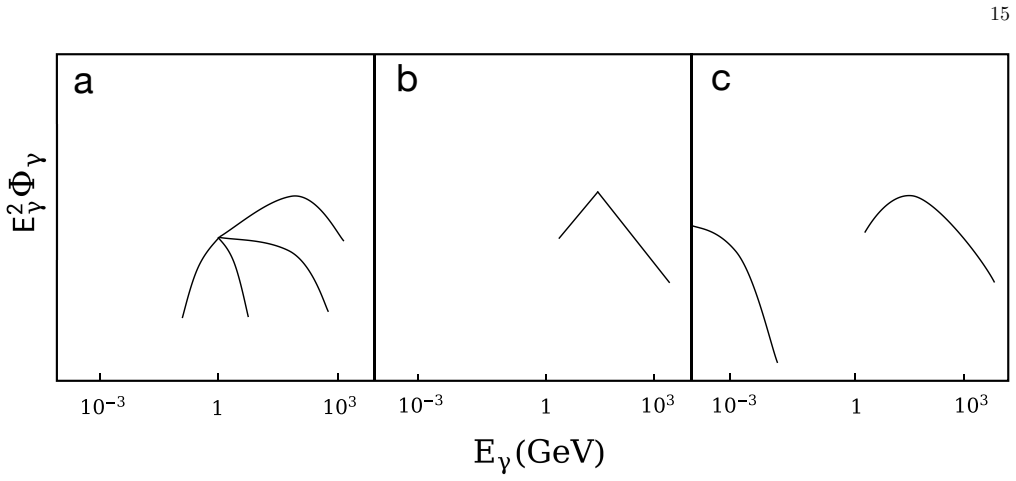
read the original abstract
Quark-gluon dynamics within protons and high-energy radiation phenomena in the universe are typically regarded as two entirely distinct fields. This paper aims to demonstrate that gluon condensation (GC) may serve as a direct bridge between these two fields. We review three key aspects of GC research: first, the Zhu-Shen-Ruan (ZSR) equation, as a nonlinear evolution equation based on structural symmetry, exhibits self-consistent connections with the DGLAP, BFKL and GLR-MQ-ZRS equations, providing a theoretical foundation for the generation of GC; second, the chaotic solutions and the shadowing-antishadowing synergy inherent in this equation can drive gluons to aggregate near the critical momentum, thereby forming a novel type of high-density, strongly interacting matter; third, these changes in microstructure manifest themselves as a broken-power-law feature in high-energy cosmic gamma-ray spectra, thereby offering new insights into the hadronic scenarios underlying certain astrophysical sources. Consequently, GC not only concerns the novel behaviour of quantum chromodynamics under extreme conditions but may also serve as a vital window for probing the deep structure of protons using cosmic-ray signals. With the advancement of higher-precision gamma-ray observations, hadron collision experiments and related theoretical research, the physical picture of GC and its observational criteria are expected to undergo more rigorous testing. Should this picture be confirmed, certain features in the high-energy gamma-ray spectrum will need to be re-examined within the deeper context of hadronic dynamics; simultaneously, GC may also provide a new entry point for research into pion condensation in nuclear physics and even condensed matter physics. Consequently, the significance of the search for GC extends beyond the model itself, reaching into multiple fields of natural science.
Editorial analysis
A structured set of objections, weighed in public.
Referee Report
Summary. The manuscript is a mini-review claiming that gluon condensation (GC), generated via chaotic solutions and shadowing-antishadowing synergy in the Zhu-Shen-Ruan (ZSR) nonlinear evolution equation, bridges the deep structure of protons with high-energy cosmic-ray phenomena. It reviews the self-consistent links of the ZSR equation to the DGLAP, BFKL, and GLR-MQ-ZRS equations as a theoretical foundation, argues that these drive gluons to aggregate near a critical momentum forming novel high-density matter, and asserts that the resulting microstructural changes produce a broken-power-law feature in high-energy cosmic gamma-ray spectra, offering new insights into hadronic scenarios for astrophysical sources and potential tests with future observations.
Significance. If the asserted link between ZSR-driven GC and a unique broken-power-law gamma-ray signature holds with quantitative support and exclusion of alternatives, the work would provide a substantive cross-scale connection between QCD under extreme conditions and astrophysical observations, potentially enabling cosmic-ray data to probe proton structure and suggesting broader implications for condensed-matter analogs such as pion condensation.
major comments (2)
- [Abstract] Abstract, third key aspect: the claim that GC-driven aggregation near critical momentum 'manifests itself as a broken-power-law feature in high-energy cosmic gamma-ray spectra' is presented without an explicit mapping, computed spectrum, or comparison demonstrating why this signature cannot arise from standard DGLAP/BFKL-based hadronic models or other conventional mechanisms.
- [ZSR equation and chaotic solutions] Discussion of chaotic solutions and ZSR connections: the repeated invocation of self-consistent links to DGLAP/BFKL/GLR-MQ-ZRS and definition of observable consequences entirely within the ZSR framework creates a circularity burden that is not addressed by external validation or falsifiable predictions independent of the same equations.
minor comments (1)
- The manuscript would benefit from explicit section headings or subsection numbering when transitioning between the three key aspects reviewed, to improve readability for a cross-disciplinary audience.
Simulated Author's Rebuttal
We thank the referee for the careful reading and constructive comments on our mini-review. We address the major comments point by point below, indicating revisions where they strengthen clarity without altering the review's scope.
read point-by-point responses
-
Referee: [Abstract] Abstract, third key aspect: the claim that GC-driven aggregation near critical momentum 'manifests itself as a broken-power-law feature in high-energy cosmic gamma-ray spectra' is presented without an explicit mapping, computed spectrum, or comparison demonstrating why this signature cannot arise from standard DGLAP/BFKL-based hadronic models or other conventional mechanisms.
Authors: As a mini-review, the manuscript summarizes the ZSR framework and its proposed implications drawn from prior literature rather than presenting new calculations. The abstract condenses the reviewed connection between GC and the spectral feature. We agree the wording could be clarified to avoid implying a direct computation within this paper. We will revise the abstract to state that the broken-power-law is a proposed manifestation based on the reviewed ZSR-driven GC, with explicit references to the sections and cited works discussing the mapping. No new spectrum computation or exhaustive exclusion of alternatives will be added, as these lie outside the review format. revision: partial
-
Referee: [ZSR equation and chaotic solutions] Discussion of chaotic solutions and ZSR connections: the repeated invocation of self-consistent links to DGLAP/BFKL/GLR-MQ-ZRS and definition of observable consequences entirely within the ZSR framework creates a circularity burden that is not addressed by external validation or falsifiable predictions independent of the same equations.
Authors: The self-consistent links are established through explicit derivations showing that ZSR reduces to or is consistent with DGLAP, BFKL, and GLR-MQ-ZRS in appropriate kinematic limits, as detailed in the manuscript sections on the theoretical foundation. These derivations are independent of the chaotic solutions themselves. The chaotic behavior is a specific property of the nonlinear ZSR equation, and the broken-power-law signature in gamma-ray spectra is presented as a testable, falsifiable prediction against observational data. We will insert a clarifying paragraph outlining the independent derivations of the links and emphasizing the external testability via cosmic-ray observations. revision: partial
- Providing an explicit computed spectrum or quantitative comparison that excludes all standard DGLAP/BFKL-based mechanisms, as the work is a mini-review summarizing existing literature and does not contain original numerical results.
Circularity Check
ZSR equation's self-consistent connections and chaotic solutions asserted to produce broken-power-law gamma-ray feature without independent mapping
specific steps
-
self citation load bearing
[Abstract]
"the Zhu-Shen-Ruan (ZSR) equation, as a nonlinear evolution equation based on structural symmetry, exhibits self-consistent connections with the DGLAP, BFKL and GLR-MQ-ZRS equations, providing a theoretical foundation for the generation of GC"
The ZSR equation is named after and developed by the lead author and co-authors of this paper; the theoretical foundation for gluon condensation is supplied by self-consistent connections claimed inside the authors' own framework, rendering the central premise load-bearing on self-citation.
-
self definitional
[Abstract]
"the chaotic solutions and the shadowing-antishadowing synergy inherent in this equation can drive gluons to aggregate near the critical momentum, thereby forming a novel type of high-density, strongly interacting matter; third, these changes in microstructure manifest themselves as a broken-power-law feature in high-energy cosmic gamma-ray spectra"
The aggregation near critical momentum and its manifestation as a broken-power-law feature are presented as direct consequences of the ZSR equation's chaotic solutions and synergy, so the claimed observable signature is equivalent to the framework's own inputs by construction rather than derived from an independent calculation.
full rationale
The paper's derivation chain starts from the authors' own ZSR equation, claims self-consistent links to standard evolution equations to found GC, then asserts that its chaotic solutions and synergy produce gluon aggregation whose microstructure changes manifest as a broken-power-law spectral feature. Both the foundation and the observable signature are defined within the same author-developed framework, with no explicit independent mapping or computation supplied in the abstract. This matches self-citation load-bearing and self-definitional patterns, though as a review some self-reference is expected and the full text might contain additional external anchors.
Axiom & Free-Parameter Ledger
axioms (2)
- domain assumption The ZSR equation exhibits self-consistent connections with DGLAP, BFKL and GLR-MQ-ZRS equations.
- domain assumption Chaotic solutions and shadowing-antishadowing synergy drive gluons to aggregate near critical momentum.
Reference graph
Works this paper leans on
-
[1]
Astrophysical origins of ultrahigh energy cosmic rays
Torres, D.F.; Anchordoqui, L.A. Astrophysical origins of ultrahigh energy cosmic rays. Rept. Prog. Phys. 2004, 67, 1663–
2004
-
[2]
https://doi.org/10.1088/0034-4885/67/9/R03
-
[3]
What is the Quark-Gluon Plasma made of? arXiv 2025, arXiv:2506.07181
Müller, B. What is the Quark-Gluon Plasma made of? arXiv 2025, arXiv:2506.07181
-
[4]
An Introduction to Quantum Field Theory ; Cambridge University Press: Cambridge, UK, 1993
Sterman, G. An Introduction to Quantum Field Theory ; Cambridge University Press: Cambridge, UK, 1993
1993
-
[5]
Deep inelastic e p scattering in perturbation theory
Gribov, V.N.; Lipatov, L.N. Deep inelastic e p scattering in perturbation theory. Sov. J. Nucl. Phys. 1972, 15, 438–450
1972
-
[6]
Calculation of the Structure Functions for Deep Inelastic Scattering and e+ e- Annihilation by Pertur- bation Theory in Quantum Chromodynamics
Dokshitzer, Y.L. Calculation of the Structure Functions for Deep Inelastic Scattering and e+ e- Annihilation by Pertur- bation Theory in Quantum Chromodynamics. Sov. Phys. JETP 1977, 46, 641–653
1977
-
[7]
Altarelli, G.; Parisi, G. Asymptotic Freedom in Parton Language. Nucl. Phys. B 1977, 126, 298–318. https://doi.org/ 10.1016/0550-3213(77)90384-4
-
[8]
Reggeization of the Vector Meson and the Vacuum Singularity in Nonabelian Gauge Theories
Lipatov, L.N. Reggeization of the Vector Meson and the Vacuum Singularity in Nonabelian Gauge Theories. Sov. J. Nucl. Phys. 1976, 23, 338–345
1976
-
[9]
On the Pomeranchuk Singularity in Asymptotically Free Theories
Fadin, V.S.; Kuraev, E.A.; Lipatov, L.N. On the Pomeranchuk Singularity in Asymptotically Free Theories. Phys. Lett. B 1975, 60, 50–52. https://doi.org/10.1016/0370-2693(75)90524-9 . 17
-
[10]
Multiregge processes in the Yang-Mills theory
Kuraev, E.A.; Lipatov, L.N.; Fadin, V.S. Multiregge processes in the Yang-Mills theory. Sov. Phys. JETP 1976, 44, 443– 451
1976
-
[11]
The Pomeranchuk singularity in nonabelian gauge theories
Kuraev, E.A.; Lipatov, L.N.; Fadin, V.S. The Pomeranchuk singularity in nonabelian gauge theories. Sov. Phys. JETP 1977, 45, 199–204
1977
-
[12]
The Pomeranchuk Singularity in Quantum Chromodynamics
Balitsky, I.I.; Lipatov, L.N. The Pomeranchuk Singularity in Quantum Chromodynamics. Sov. J. Nucl. Phys. 1978, 28, 822–829
1978
-
[13]
Gribov, L.V.; Levin, E.M.; Ryskin, M.G. Semihard Processes in QCD. Phys. Rept. 1983, 100, 1–150. https://doi.org/ 10.1016/0370-1573(83)90022-4
-
[14]
Gluon Recombination and Shadowing at Small Values of x
Mueller, A.H.; Qiu, J.w. Gluon Recombination and Shadowing at Small Values of x. Nucl. Phys. B 1986, 268, 427–452. https://doi.org/10.1016/0550-3213(86)90164-1
-
[15]
Operator expansion for high-energy scattering
Balitsky, I. Operator expansion for high-energy scattering. Nucl. Phys. B 1996, 463, 99–160. https://doi.org/10.1016/ 0550-3213(95)00638-9
1996
-
[16]
Small x F(2) structure function of a nucleus including multiple pomeron exchanges
Kovchegov, Y.V. Small x F(2) structure function of a nucleus including multiple pomeron exchanges. Phys. Rev. D 1999, 60, 034008. https://doi.org/10.1103/PhysRevD.60.034008
-
[17]
Unitarization of the BFKL pomeron on a nucleus
Kovchegov, Y.V. Unitarization of the BFKL pomeron on a nucleus. Phys. Rev. D 2000, 61, 074018. https://doi.org/ 10.1103/PhysRevD.61.074018
-
[18]
The Intrinsic glue distribution at very small x
Jalilian-Marian, J.; Kovner, A.; McLerran, L.D.; Weigert, H. The Intrinsic glue distribution at very small x. Phys. Rev. D 1997, 55, 5414–5428. https://doi.org/10.1103/PhysRevD.55.5414
-
[19]
The BFKL equation from the Wilson renormalization group
Jalilian-Marian, J.; Kovner, A.; Leonidov, A.; Weigert, H. The BFKL equation from the Wilson renormalization group. Nucl. Phys. B 1997, 504, 415–431. https://doi.org/10.1016/S0550-3213(97)00440-9
-
[20]
The Wilson renormalization group for low x physics: Towards the high density regime
Jalilian-Marian, J.; Kovner, A.; Leonidov, A.; Weigert, H. The Wilson renormalization group for low x physics: Towards the high density regime. Phys. Rev. D 1998, 59, 014014. https://doi.org/10.1103/PhysRevD.59.014014
-
[21]
Saturation and universality in QCD at small x
Iancu, E.; McLerran, L.D. Saturation and universality in QCD at small x. Phys. Lett. B 2001, 510, 145–154. https: //doi.org/10.1016/S0370-2693(01)00526-3
-
[22]
Weigert, H. Unitarity at small Bjorken x. Nucl. Phys. A 2002, 703, 823–860. https://doi.org/10.1016/S0375-9474(01) 01668-2
-
[23]
Computing quark and gluon distribution functions for very large nuclei
McLerran, L.D.; Venugopalan, R. Computing quark and gluon distribution functions for very large nuclei. Phys. Rev. D 1994, 49, 2233–2241. https://doi.org/10.1103/PhysRevD.49.2233
-
[24]
Gluon distribution functions for very large nuclei at small transverse momentum
McLerran, L.D.; Venugopalan, R. Gluon distribution functions for very large nuclei at small transverse momentum. Phys. Rev. D 1994, 49, 3352–3355. https://doi.org/10.1103/PhysRevD.49.3352
-
[25]
Green’s functions in the color field of a large nucleus
McLerran, L.D.; Venugopalan, R. Green’s functions in the color field of a large nucleus. Phys. Rev. D 1994, 50, 2225–2233. https://doi.org/10.1103/PhysRevD.50.2225
-
[26]
Effective theories for nuclei at high energies
Garcia-Montero, O.; Schlichting, S. Effective theories for nuclei at high energies. Eur. Phys. J. A 2025, 61, 54. https: //doi.org/10.1140/epja/s10050-025-01523-7
-
[27]
Saturation physics and deuteron-Gold collisions at RHIC
Jalilian-Marian, J.; Kovchegov, Y.V. Saturation physics and deuteron-Gold collisions at RHIC. Prog. Part. Nucl. Phys. 2006, 56, 104–231. https://doi.org/10.1016/j.ppnp.2005.07.002
-
[28]
Gelis, F.; Iancu, E.; Jalilian-Marian, J.; Venugopalan, R. The Color Glass Condensate. Ann. Rev. Nucl. Part. Sci. 2010, 60, 463–489. https://doi.org/10.1146/annurev.nucl.010909.083629
-
[29]
Character of Inclusive Spectra and Fluctuations Produced in Inelastic Processes by Multi-Pomeron Exchange
Abramovsky, V.A.; Gribov, V.N.; Kancheli, O.V. Character of Inclusive Spectra and Fluctuations Produced in Inelastic Processes by Multi-Pomeron Exchange. Yad. Fiz. 1973, 18, 595–616
1973
-
[30]
A New approach to parton recombination in a QCD evolution equation
Zhu, W. A New approach to parton recombination in a QCD evolution equation. Nucl. Phys. B 1999, 551, 245–274. https://doi.org/10.1016/S0550-3213(99)00237-0
-
[31]
A New modified Altarelli-Parisi evolution equation with parton recombination in proton
Zhu, W.; Ruan, J.h. A New modified Altarelli-Parisi evolution equation with parton recombination in proton. Nucl. Phys. B 1999, 559, 378–392. https://doi.org/10.1016/S0550-3213(99)00461-7
-
[32]
Properties of the gluon recombination functions
Zhu, W.; Shen, Z.q. Properties of the gluon recombination functions. HEP NP 2005, 29, ,109–114
2005
-
[33]
The chaotic effects in a nonlinear QCD evolution equation
Zhu, W.; Shen, Z.; Ruan, J. The chaotic effects in a nonlinear QCD evolution equation. Nucl. Phys. B 2016, 911, 1–35. https://doi.org/10.1016/j.nuclphysb.2016.06.031
-
[34]
Wang, X.; Cai, Y.; Chen, X. Exploring the impact of anti-shadowing effect on unintegrated gluon distributions in the MD-BFKL equation*. Chin. Phys. C 2024, 48, 093110. https://doi.org/10.1088/1674-1137/ad5bd5
-
[35]
Lalung, M.; Phukan, P.; Sarma, J.K. Small-x analysis on the effect of gluon recombinations inside hadrons in light of the GLR-MQ-ZRS equation. Nucl. Phys. A 2019, 992, 121615. https://doi.org/10.1016/j.nuclphysa.2019.121615
-
[36]
On analytical solutions of the DIS structure functions in the framework of GLR- MQ-ZRS equation
Lalung, M.; Phukan, P.; Sarma, J.K. On analytical solutions of the DIS structure functions in the framework of GLR- MQ-ZRS equation. arXiv 2019, arXiv:1909.13591
-
[37]
The Gluon condensation in high energy cosmic rays
Zhu, W.; Lan, J.; Ruan, J.; Wang, F. The Gluon condensation in high energy cosmic rays. Int. J. Mod. Phys. E 2018, 27, 1850073. https://doi.org/10.1142/S0218301318500738
-
[38]
Narison, S. QCD as a Theory of Hadrons: From Partons to Confinement ; Oxford University Press: Oxford, UK, 2005; Volume 17. https://doi.org/10.1017/9781009290296
-
[39]
Generalized Global Symmetries
Gaiotto, D.; Kapustin, A.; Seiberg, N.; Willett, B. Generalized Global Symmetries. J. High Energy Phys. 2014, 2015,
2014
-
[40]
https://doi.org/10.1007/jhep02(2015)172
-
[41]
Notes on generalized global symmetries in QFT
Sharpe, E. Notes on generalized global symmetries in QFT. Fortsch. Phys. 2015, 63, 659–682. https://doi.org/10. 1002/prop.201500048
2015
-
[42]
Antishadowing effect in the unitarized BFKL equation
Ruan, J.h.; Shen, Z.q.; Yang, J.f.; Zhu, W. Antishadowing effect in the unitarized BFKL equation. Nucl. Phys. B 2007, 760, 128–144. https://doi.org/10.1016/j.nuclphysb.2006.10.020
-
[43]
(Eds.) Bose-Einstein Condensation ; Cambridge University Press: Cambridge, UK, 18
Griffin, A.; Snoke, D.W.; Stringari, S. (Eds.) Bose-Einstein Condensation ; Cambridge University Press: Cambridge, UK, 18
-
[44]
https://doi.org/10.1017/cbo9780511524240
-
[45]
Chaos and Dynamical Systems ; Princeton University Press: Princeton, NJ, USA, 2019
Feldman, D.P. Chaos and Dynamical Systems ; Princeton University Press: Princeton, NJ, USA, 2019
2019
-
[46]
Nonlinear Dynamics and Chaos , 3rd ed.; CRC Press: Boca Raton, FL, USA, 2024
Steven, H.S. Nonlinear Dynamics and Chaos , 3rd ed.; CRC Press: Boca Raton, FL, USA, 2024
2024
-
[47]
The gluon condensation at high energy hadron collisions
Zhu, W.; Lan, J. The gluon condensation at high energy hadron collisions. Nucl. Phys. B 2017, 916, 647–668. https: //doi.org/10.1016/j.nuclphysb.2017.01.021
-
[48]
The gluon condensation in hadron collisions
Zhu, W.; Chen, Q.; Cui, Z.; Ruan, J. The gluon condensation in hadron collisions. Nucl. Phys. B 2022, 984, 115961. https://doi.org/10.1016/j.nuclphysb.2022.115961
-
[49]
Aharonian, F.A. Very High Energy Cosmic Gamma Radiation: A Crucial Window on the Extreme Universe ; World Scientific: Singapore, 2004. https://doi.org/10.1142/4657
-
[50]
2013, Science, 339, 807, 10.1126/science.1231160
Ackermann, M.; et al. Detection of the Characteristic Pion-Decay Signature in Supernova Remnants. Science 2013, 339, 807. https://doi.org/10.1126/science.1231160
-
[51]
Ultrahigh-energy gamma-ray emission associated with black hole–jet systems
Cao, Z.; et al. Ultrahigh-energy gamma-ray emission associated with black hole–jet systems. Natl. Sci. Rev. 2025, 12, nwaf496. https://doi.org/10.1093/nsr/nwaf496
-
[52]
Discovery of new TeV supernova remnant shells in the Galactic plane with H.E.S.S
Gottschall, D.; et al. Discovery of new TeV supernova remnant shells in the Galactic plane with H.E.S.S. AIP Conf. Proc. 2017, 1792, 040030. https://doi.org/10.1063/1.4968934
-
[53]
Araya, M. Detection of GeV Gamma-Rays from HESS J1534 −571 and Multiwavelength Implications for the Origin of the Nonthermal Emission. Astrophys. J. 2017, 843, 12. https://doi.org/10.3847/1538-4357/aa7261
-
[54]
Energy dependent morphology of the pulsar wind nebula HESS J1825-137 with Fermi-LAT
Principe, G.; Mitchell, A.M.W.; Caroff, S.; Hinton, J.A.; Parsons, R.D.; Funk, S. Energy dependent morphology of the pulsar wind nebula HESS J1825-137 with Fermi-LAT. Astron. Astrophys. 2020, 640, A76. https://doi.org/10.1051/ 0004-6361/202038375
2020
-
[55]
Probing the gamma-ray emission from HESS J1834–087 using H.E.S.S
Abramowski, A.; et al. Probing the gamma-ray emission from HESS J1834–087 using H.E.S.S. and Fermi LAT observations. Astron. Astrophys. 2015, 574, A27. https://doi.org/10.1051/0004-6361/201322694
-
[56]
Zhang, H.M.; Xi, S.Q.; Liu, R.Y.; Xin, Y.L.; Liu, S.; Wang, X.Y. Discovery of a spatially extended GeV source in the vicinity of the TeV halo candidate 2HWC J1912+099: A TeV halo or supernova remnant? arXiv 2019, arXiv:1909.13185
-
[57]
HA WC Study of the Very-high-energy γ-Ray Spectrum of HA WC J1844 −034
Albert, A.; et al. HA WC Study of the Very-high-energy γ-Ray Spectrum of HA WC J1844 −034. Astrophys. J. 2023, 954, 205. https://doi.org/10.3847/1538-4357/ace967
-
[58]
Aharonian, F.; et al. H.E.S.S. observations of the 2021 periastron passage of PSR B1259-63/LS 2883. Astron. Astrophys. 2024, 687, A219. https://doi.org/10.1051/0004-6361/202449612
-
[59]
Stability of vacuum and limiting fields
Migdal, A.B. Stability of vacuum and limiting fields. Zh. Eksp. Teor. Fiz. 1971, 61, 2209–2224
1971
discussion (0)
Sign in with ORCID, Apple, or X to comment. Anyone can read and Pith papers without signing in.