Canonical quantization of massive vector field in Schwarzschild black hole background
Pith reviewed 2026-06-29 16:08 UTC · model grok-4.3
The pith
The Proca field admits canonical quantization in Schwarzschild spacetime via the Dirac bracket formalism, yielding consistent operator algebra, Hawking spectrum, and significant condensate near the future horizon.
A machine-rendered reading of the paper's core claim, the machinery that carries it, and where it could break.
Core claim
By implementing the Dirac bracket formalism to treat the constraints inherent in the Proca action, we derive a consistent framework for the commutator algebra of creation and annihilation operators. Following this construction, we define the usual Boulware, Unruh, and Hartle-Hawking vacua. Using the Unruh vacuum, we derive and analyze the Hawking spectrum of the Proca field. Furthermore, we numerically evaluate the Proca condensate constructed from the two-point correlation function, and we find that the condensate becomes significant near the boundary of the future horizon.
What carries the argument
The Dirac bracket formalism applied to the constrained Proca field variables on the Schwarzschild background, which produces the commutator algebra and permits vacuum definitions.
If this is right
- The commutator algebra of creation and annihilation operators for the Proca field is consistent.
- The Hawking spectrum of the Proca field follows from the Unruh vacuum construction.
- The Proca condensate constructed from the two-point function becomes significant near the future horizon boundary.
- The interplay among the different polarization modes affects the quantum observables.
Where Pith is reading between the lines
- The method may be applied to other static black hole metrics to check whether condensate enhancement near the horizon persists.
- Comparison of the derived Hawking spectrum against semiclassical expectations for massive vectors could test the framework.
- The condensate result raises the possibility that massive vector contributions to near-horizon stress-energy differ from those of massless fields.
Load-bearing premise
The Dirac bracket formalism developed for flat-space constrained systems continues to produce a consistent positive-definite inner product and unitary evolution when the background metric is the curved Schwarzschild geometry and the field has a mass term.
What would settle it
An explicit calculation demonstrating that the Dirac brackets yield a non-positive-definite inner product or non-unitary evolution for Proca modes in Schwarzschild coordinates would falsify the quantization framework.
Figures

read the original abstract
We perform a first-principles canonical quantization of a massive vector field, often referred to as the Proca field, in a Schwarzschild spacetime background. While scalar, fermionic, and electromagnetic fields are well studied in this context, the Proca field requires a more nuanced treatment because of the physical nature of the longitudinal polarization mode and the constrained dynamics of the field variables. By implementing the Dirac bracket formalism to treat the constraints inherent in the Proca action, we derive a consistent framework for the commutator algebra of creation and annihilation operators. Following this construction, we define the usual Boulware, Unruh, and Hartle-Hawking vacua. Using the Unruh vacuum, we derive and analyze the Hawking spectrum of the Proca field. Furthermore, we numerically evaluate the Proca condensate constructed from the two-point correlation function $\langle A_\mu(x) A_\nu(x') \rangle$, defined on all three vacuum states. We find that the condensate becomes significant near the boundary of the future horizon. Our results highlight the interplay among the different polarization modes and the significance of the Proca mass in quantum observables.
Editorial analysis
A structured set of objections, weighed in public.
Referee Report
Summary. The manuscript performs a first-principles canonical quantization of the massive vector (Proca) field on a Schwarzschild background. It applies the Dirac bracket formalism to the constrained Proca action to obtain the commutator algebra of creation and annihilation operators, defines the Boulware, Unruh and Hartle-Hawking vacua, extracts the Hawking spectrum in the Unruh vacuum, and numerically evaluates the two-point condensate ⟨A_μ(x)A_ν(x')⟩ on all three vacua, reporting that the condensate becomes significant near the future horizon.
Significance. If the algebraic construction is shown to be consistent, the work would supply a concrete framework for quantizing a massive vector field with a dynamical longitudinal mode in a black-hole geometry. The numerical condensate result would then constitute a falsifiable prediction for the behavior of massive gauge fields near horizons. The paper correctly invokes standard techniques (Dirac brackets, Unruh vacuum) without parameter fitting, which is a methodological strength.
major comments (2)
- [Abstract and constrained-dynamics section] The central claim that the Dirac-bracket algebra yields a positive-definite inner product and unitary evolution for all three polarization modes (including the longitudinal mode) is load-bearing, yet the manuscript supplies neither the explicit mode equations nor the resulting commutators [a_i,a_j†] after reduction on the Schwarzschild background. Without these expressions it is impossible to verify that the curved-space symplectic form and position-dependent mass term do not produce negative-norm states near the horizon.
- [Numerical condensate section] The numerical evaluation of the Proca condensate is presented without error estimates, convergence tests, or a statement of the radial cutoff and mode truncation used. This undermines the quantitative claim that the condensate “becomes significant near the boundary of the future horizon.”
minor comments (2)
- Notation for the three polarization vectors and the decomposition into transverse and longitudinal modes should be introduced once and used consistently.
- The manuscript should cite the original Dirac-bracket literature for constrained systems and at least one prior treatment of massive vector fields in curved space for context.
Simulated Author's Rebuttal
We thank the referee for the careful reading of our manuscript and the constructive comments. We address the two major comments point by point below.
read point-by-point responses
-
Referee: [Abstract and constrained-dynamics section] The central claim that the Dirac-bracket algebra yields a positive-definite inner product and unitary evolution for all three polarization modes (including the longitudinal mode) is load-bearing, yet the manuscript supplies neither the explicit mode equations nor the resulting commutators [a_i,a_j†] after reduction on the Schwarzschild background. Without these expressions it is impossible to verify that the curved-space symplectic form and position-dependent mass term do not produce negative-norm states near the horizon.
Authors: We agree that the explicit mode equations and the reduced commutators [a_i, a_j†] are necessary to allow independent verification of the positive-definite inner product and unitary evolution. The manuscript describes the application of the Dirac-bracket procedure to the constrained Proca action and states that the resulting algebra is consistent for all three polarizations, but does not display the explicit expressions after reduction on the Schwarzschild metric. In the revised version we will insert the mode equations obtained from the Dirac brackets together with the final commutators, thereby making the absence of negative-norm states explicit. revision: yes
-
Referee: [Numerical condensate section] The numerical evaluation of the Proca condensate is presented without error estimates, convergence tests, or a statement of the radial cutoff and mode truncation used. This undermines the quantitative claim that the condensate “becomes significant near the boundary of the future horizon.”
Authors: We accept that the numerical section is insufficiently documented. The condensate was obtained from a mode-sum representation of the two-point function in the three vacua, yet the manuscript omits error bars, convergence checks, and the precise values of the radial cutoff and mode truncation. In the revision we will add these details, including tabulated convergence tests and a statement of the truncation parameters, so that the reported growth of the condensate near the future horizon is placed on a firmer quantitative footing. revision: yes
Circularity Check
No circularity: first-principles application of standard Dirac-bracket quantization
full rationale
The derivation proceeds by applying the established Dirac bracket procedure for constrained systems (Proca action) to the Schwarzschild background, constructing the commutator algebra, defining standard vacua (Boulware, Unruh, Hartle-Hawking), and computing the Hawking spectrum and condensate from the two-point function. No step reduces a claimed prediction or result to a fitted parameter, self-defined quantity, or load-bearing self-citation; the central construction is independent of the target observables and relies on external mathematical techniques rather than re-deriving its own inputs. The positive-definiteness question raised by the skeptic is a potential correctness or applicability issue, not a circularity reduction.
Axiom & Free-Parameter Ledger
Reference graph
Works this paper leans on
-
[1]
× 10-6 ωrh 〈Nωℓm〉 Hawking flux ℓ=2,∀m Even parity(+) Even parity(-) Odd parity 0.5 1.0 1.5 2.0 0
-
[2]
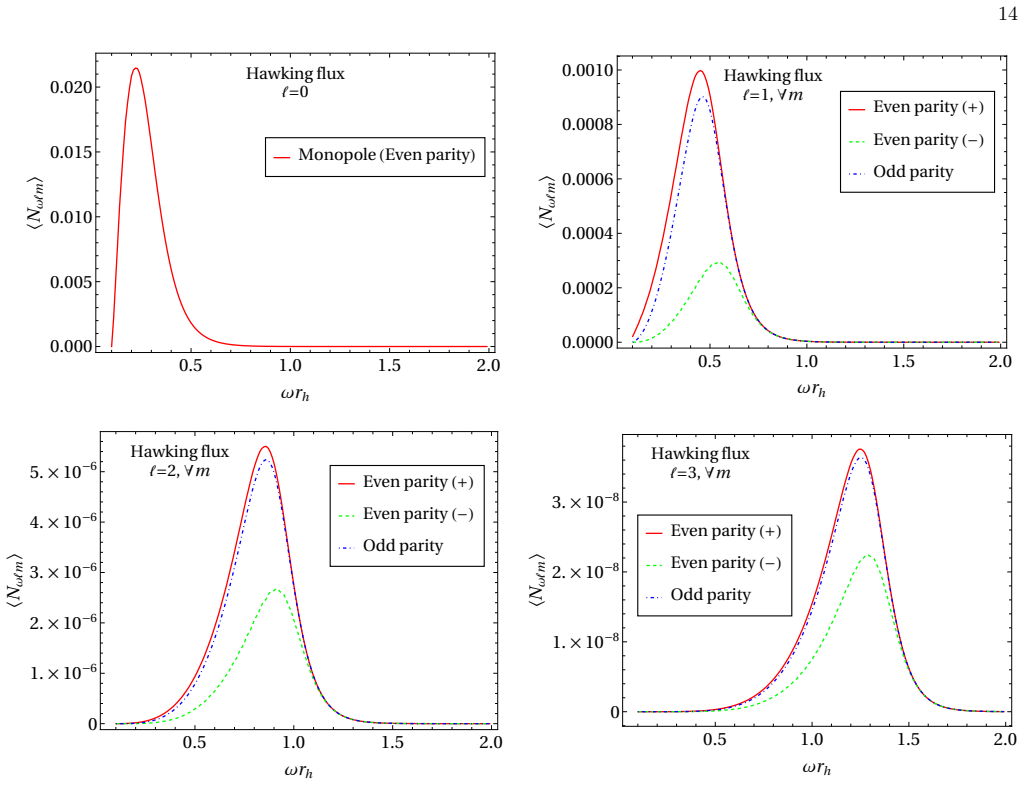
5: The Hawking spectrum has been plotted for different polarizations
× 10-8 ωrh 〈Nωℓm〉 Hawking flux ℓ=3,∀m FIG. 5: The Hawking spectrum has been plotted for different polarizations. Comparisons have been made between differentℓmodes atI +. GB µν′(x, x′) = X λ,ℓ,m Z ∞ µ dω A (ζ) in µ (x)A (ζ) in∗ ν′ (x′) + Z ∞ 0 dω A (ζ) up µ (x)A (ζ) up∗ ν′ (x′) ,(7.3) GU µν′(x, x′) = X λ,ℓ,m Z ∞ µ dω A (ζ) in µ (x)A (ζ) in∗ ν′ (x′) + Z ∞ ...
-
[3]
Towards the Theory of Reheating After Inflation
L. Kofman, A. D. Linde, and A. A. Starobinsky, Phys. Rev. D56, 3258 (1997), arXiv:hep-ph/9704452
work page internal anchor Pith review Pith/arXiv arXiv 1997
-
[4]
S. W. Hawking, Commun. Math. Phys.43, 199 (1975), [Erratum: Commun.Math.Phys. 46, 206 (1976)]
1975
-
[5]
Candelas, Phys
P. Candelas, Phys. Rev. D21, 2185 (1980)
1980
- [6]
-
[7]
N. D. Birrell and P. C. W. Davies,Quantum Fields in Curved Space, Cambridge Monographs on Mathematical Physics (Cambridge University Press, Cambridge, UK, 1982)
1982
-
[8]
L. E. Parker and D. Toms,Quantum Field Theory in Curved Spacetime: Quantized Field and Gravity, Cam- bridge Monographs on Mathematical Physics (Cam- bridge University Press, 2009)
2009
-
[9]
P. C. W. Davies, S. A. Fulling, and W. G. Unruh, Phys. Rev. D13, 2720 (1976)
1976
-
[10]
W. G. Unruh, Phys. Rev. D14, 870 (1976)
1976
-
[11]
Candelas and K
P. Candelas and K. W. Howard, Phys. Rev. D29, 1618 (1984)
1984
-
[12]
K. W. Howard and P. Candelas, Phys. Rev. Lett.53, 403 (1984)
1984
-
[13]
J. B. Hartle and S. W. Hawking, Phys. Rev. D13, 2188 (1976)
1976
-
[14]
Israel, Phys
W. Israel, Phys. Lett. A57, 107 (1976)
1976
-
[15]
Anomaly induced effective actions and Hawking radiation
R. Balbinot, A. Fabbri, and I. L. Shapiro, Phys. Rev. Lett.83, 1494 (1999), arXiv:hep-th/9904074
work page internal anchor Pith review Pith/arXiv arXiv 1999
-
[16]
Particle production and complex path analysis
K. Srinivasan and T. Padmanabhan, Phys. Rev. D60, 024007 (1999), arXiv:gr-qc/9812028
work page internal anchor Pith review Pith/arXiv arXiv 1999
-
[17]
M. K. Parikh and F. Wilczek, Phys. Rev. Lett.85, 5042 (2000), arXiv:hep-th/9907001
work page internal anchor Pith review Pith/arXiv arXiv 2000
-
[18]
S. P. Robinson and F. Wilczek, Phys. Rev. Lett.95, 011303 (2005), arXiv:gr-qc/0502074
work page internal anchor Pith review Pith/arXiv arXiv 2005
-
[19]
B. R. Majhi, Phys. Rev. D79, 044005 (2009), arXiv:0809.1508 [hep-th]
work page internal anchor Pith review Pith/arXiv arXiv 2009
-
[20]
Hawking black body spectrum from tunneling mechanism
R. Banerjee and B. R. Majhi, Phys. Lett. B675, 243 (2009), arXiv:0903.0250 [hep-th]
work page internal anchor Pith review Pith/arXiv arXiv 2009
-
[21]
An exact derivation of the Hawking effect in canonical formulation
S. Barman, G. M. Hossain, and C. Singha, Phys. Rev. D97, 025016 (2018), arXiv:1707.03614 [gr-qc]
work page internal anchor Pith review Pith/arXiv arXiv 2018
-
[22]
Quantum Tunneling and Back Reaction
R. Banerjee and B. R. Majhi, Phys. Lett. B662, 62 (2008), arXiv:0801.0200 [hep-th]
work page internal anchor Pith review Pith/arXiv arXiv 2008
-
[23]
S. M. Christensen and S. A. Fulling, Phys. Rev. D15, 2088 (1977)
2088
-
[24]
V. Balakumar, R. P. Bernar, and E. Winstanley, Phys. Rev. D106, 125013 (2022), arXiv:2205.14483 [hep-th]
- [25]
-
[26]
P. R. Anderson, W. A. Hiscock, and D. A. Samuel, Phys. Rev. Lett.70, 1739 (1993)
1993
-
[27]
D. G. Boulware, Phys. Rev. D12, 350 (1975)
1975
-
[28]
I. Volobuev, V. Egorov, and M. Smolyakov, Teor. Mat. Fiz.225, 591 (2025), arXiv:2410.07049 [gr-qc]
-
[29]
L. C. Crispino, A. Higuchi, and G. E. Matsas, Physical Review D63, 124008 (2001), arXiv:gr-qc/0011070
work page internal anchor Pith review Pith/arXiv arXiv 2001
-
[30]
Candelas, P
P. Candelas, P. Chrzanowski, and K. W. Howard, Phys. Rev. D24, 297 (1981)
1981
-
[31]
Hawking radiation for a Proca field in D-dimensions
C. Herdeiro, M. O. P. Sampaio, and M. Wang, Phys. Rev. D85, 024005 (2012), arXiv:1110.2485 [gr-qc]. 24
work page internal anchor Pith review Pith/arXiv arXiv 2012
-
[32]
V. P. Frolov, P. Krtous, D. Kubizn´ ak, and J. E. Santos, Phys. Rev. Lett.120, 231103 (2018), arXiv:1804.00030 [hep-th]
work page internal anchor Pith review Pith/arXiv arXiv 2018
- [33]
-
[34]
M. Fabbrichesi, E. Gabrielli, and G. Lanfranchi, (2020), 10.1007/978-3-030-62519-1, arXiv:2005.01515 [hep-ph]
work page internal anchor Pith review Pith/arXiv arXiv doi:10.1007/978-3-030-62519-1 2020
-
[35]
A. Marriott-Best, M. Peloso, and G. Tasinato, Phys. Rev. D111, 103511 (2025), arXiv:2502.13116 [astro- ph.CO]
-
[36]
J. March-Russell and J. G. Rosa, Phys. Rev. D113, L101304 (2026), arXiv:2205.15277 [gr-qc]
-
[37]
E. C. G. Stueckelberg, Helv. Phys. Acta11(1938)
1938
-
[38]
H. Ruegg and M. Ruiz-Altaba, Int. J. Mod. Phys. A19, 3265 (2004), arXiv:hep-th/0304245
work page internal anchor Pith review Pith/arXiv arXiv 2004
-
[39]
A. Belokogne and A. Folacci, Phys. Rev. D93, 044063 (2016), arXiv:1512.06326 [gr-qc]
work page internal anchor Pith review Pith/arXiv arXiv 2016
-
[40]
S. W. Hawking, M. J. Perry, and A. Strominger, Phys. Rev. Lett.116, 231301 (2016), arXiv:1601.00921 [hep- th]
work page internal anchor Pith review Pith/arXiv arXiv 2016
-
[41]
Hell, JCAP01, 056 (2022), arXiv:2109.05030 [hep-th]
A. Hell, JCAP01, 056 (2022), arXiv:2109.05030 [hep-th]
-
[42]
P. A. M. Dirac, Can. J. Math.2, 129 (1950)
1950
-
[43]
P. G. Bergmann, Phys. Rev.75, 680 (1949)
1949
-
[44]
P. G. Bergmann and I. Goldberg, Phys. Rev.98, 531 (1955)
1955
-
[45]
Lectures on Constrained Systems
G. Date, inRefresher Course for College Teachers(2010) arXiv:1010.2062 [gr-qc]
work page internal anchor Pith review Pith/arXiv arXiv 2010
-
[46]
Das,Lectures on quantum field theory(World Scien- tific, 2020)
A. Das,Lectures on quantum field theory(World Scien- tific, 2020)
2020
-
[47]
P. A. Dirac,Lectures on quantum mechanics(Courier Corporation, 2013)
2013
-
[48]
D. N. Page, Phys. Rev. D13, 198 (1976)
1976
-
[49]
J. G. Rosa and S. R. Dolan, Phys. Rev. D85, 044043 (2012), arXiv:1110.4494 [hep-th]
work page internal anchor Pith review Pith/arXiv arXiv 2012
-
[50]
Black-hole hair from vector dark matter accretion
F. Hancock and H. Witek, (2025), arXiv:2506.06554 [gr- qc]
work page internal anchor Pith review Pith/arXiv arXiv 2025
-
[51]
J. Percival and S. R. Dolan, Phys. Rev. D102, 104055 (2020), arXiv:2008.10621 [gr-qc]
- [52]
-
[53]
Separation of Maxwell equations in Kerr-NUT-(A)dS spacetimes
P. Krtous, V. P. Frolov, and D. Kubizn´ ak, Nucl. Phys. B934, 7 (2018), arXiv:1803.02485 [hep-th]
work page internal anchor Pith review Pith/arXiv arXiv 2018
-
[54]
Minucci and R
M. Minucci and R. Panosso Macedo, General Relativity and Gravitation57, 33 (2025)
2025
-
[55]
On analytic solutions of wave equations in regular coordinate systems on Schwarzschild background
D. Philipp and V. Perlick, (2015), arXiv:1503.08101 [gr- qc]
work page internal anchor Pith review Pith/arXiv arXiv 2015
-
[56]
V. B. Bezerra, H. S. Vieira, and A. A. Costa, Class. Quant. Grav.31, 045003 (2014), arXiv:1312.4823 [gr-qc]
work page internal anchor Pith review Pith/arXiv arXiv 2014
-
[57]
H. S. Vieira, V. B. Bezerra, and C. R. Muniz, Annals Phys.350, 14 (2014), arXiv:1401.5397 [gr-qc]
work page internal anchor Pith review Pith/arXiv arXiv 2014
-
[58]
Unruh, Physical Review D14, 3251 (1976)
W. Unruh, Physical Review D14, 3251 (1976)
1976
- [59]
-
[60]
Balakumar,Aspects of quantum charged scalar field theory in curved spacetime: Black hole superradiance and Hadamard renormalisation, Ph.D
V. Balakumar,Aspects of quantum charged scalar field theory in curved spacetime: Black hole superradiance and Hadamard renormalisation, Ph.D. thesis, Sheffield U. (2022)
2022
-
[61]
K. M. Vispute and R. Karmakar, will be submitted soon (2026)
2026
-
[62]
C. L. Benone, E. S. de Oliveira, S. R. Dolan, and L. C. B. Crispino, Phys. Rev. D89, 104053 (2014), arXiv:1404.0687 [gr-qc]
work page internal anchor Pith review Pith/arXiv arXiv 2014
-
[63]
Poisson,A Relativist’s Toolkit: The Mathematics of Black-Hole Mechanics(Cambridge University Press, 2009)
E. Poisson,A Relativist’s Toolkit: The Mathematics of Black-Hole Mechanics(Cambridge University Press, 2009)
2009
-
[64]
Novikov and V
I. Novikov and V. Frolov,Physics of black holes, Vol. 27 (Springer Science & Business Media, 2013)
2013
-
[65]
Henneaux and C
M. Henneaux and C. Teitelboim,Quantization of Gauge Systems(Princeton University Press, 1994)
1994
-
[66]
H. J. Rothe and K. D. Rothe,Classical and quantum dy- namics of constrained Hamiltonian systems(World Sci- entific, Singapore, 2010)
2010
- [67]
- [68]
-
[69]
Some Remarks on the Quantization of Gauge Theories
R. Vathsan, J. Math. Phys.37, 1713 (1996), [Erratum: J.Math.Phys. 37, 6590 (1996)], arXiv:hep-th/9507066
work page internal anchor Pith review Pith/arXiv arXiv 1996
-
[70]
P. Chingangbam and P. Sharan, (1999), arXiv:quant- ph/9910049
-
[71]
H. P. Pavel and V. N. Pervushin, Int. J. Mod. Phys. A 14, 2285 (1999), arXiv:hep-th/9706220
work page internal anchor Pith review Pith/arXiv arXiv 1999
-
[72]
P. W. Graham, J. Mardon, and S. Rajendran, Phys. Rev. D93, 103520 (2016), arXiv:1504.02102 [hep-ph]
work page internal anchor Pith review Pith/arXiv arXiv 2016
- [73]
-
[74]
Greiner and J
W. Greiner and J. Reinhardt,Field quantization (Springer Science & Business Media, 2013)
2013
- [75]
-
[76]
R. Balbinot and A. Fabbri, Universe10, 18 (2024), arXiv:2311.09943 [gr-qc]
-
[77]
D. G. Boulware, Phys. Rev. D11, 1404 (1975)
1975
-
[78]
M. D. Kruskal, Phys. Rev.119, 1743 (1960)
1960
-
[79]
I. D. Novikov and V. P. Frolov,PHYSICS OF BLACK HOLES(Kluwer Academic, Dordrecht, Netherlands, 1989)
1989
-
[80]
S. A. Fulling and S. N. M. Ruijsenaars, Phys. Rept.152, 135 (1987)
1987
discussion (0)
Sign in with ORCID, Apple, or X to comment. Anyone can read and Pith papers without signing in.