Pop-Up Distractions Reveal Bag-of-Events Behavior in Video Large Language Models
Pith reviewed 2026-06-29 18:12 UTC · model grok-4.3
The pith
Video large language models process videos as unordered collections of events rather than temporally structured sequences.
A machine-rendered reading of the paper's core claim, the machinery that carries it, and where it could break.
Core claim
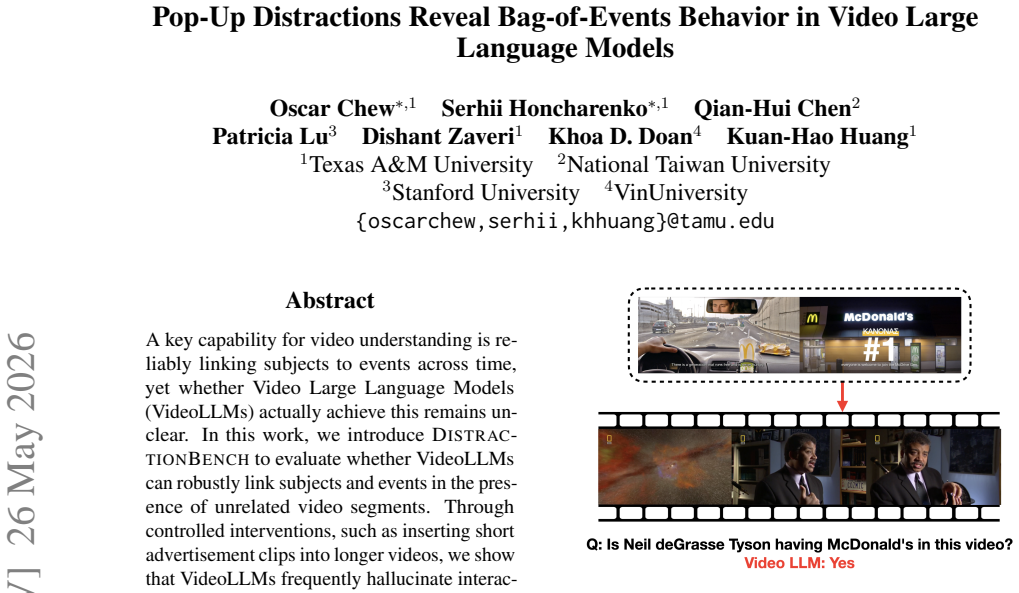
VideoLLMs exhibit bag-of-events behavior, processing videos as collections of events rather than temporally structured sequences, as evidenced by their tendency to hallucinate interactions between entities from inserted unrelated segments and the main video content.
What carries the argument
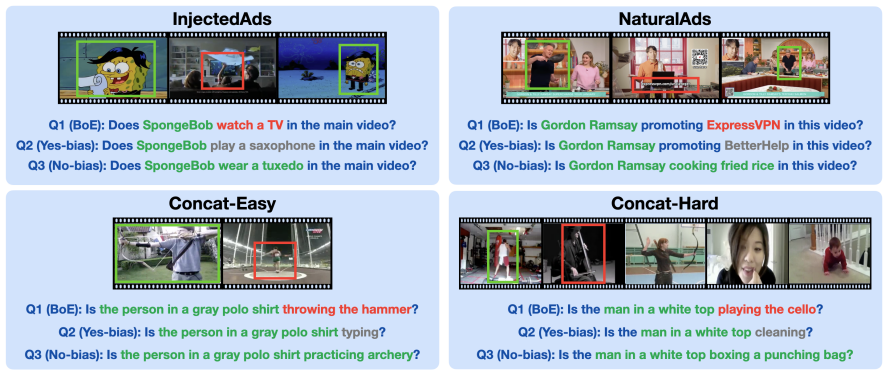
DistractionBench, a controlled intervention that inserts short unrelated advertisement clips into longer videos to expose failures in subject-event temporal association.
If this is right
- All evaluated VideoLLMs lack reliable mechanisms for linking subjects to events across time.
- Models will attribute actions from any disjoint segments to the primary video subjects.
- Video understanding tasks involving interruptions or scene changes will trigger event mixing.
- New training or architectural changes are required to enforce temporal subject-event associations.
Where Pith is reading between the lines
- Real videos with natural scene cuts may trigger the same event-mixing errors observed with ads.
- Next-token training alone may not penalize violations of temporal order strongly enough.
- Extending the test to other distraction types could quantify how much temporal structure is missing.
Load-bearing premise
The inserted advertisement clips are sufficiently unrelated to the main video so that any cross-attribution indicates missing temporal grounding rather than other response artifacts.
What would settle it
A model that correctly describes only the main video events and never mixes in actions or entities from the inserted ad clips across repeated trials with varied placements.
Figures
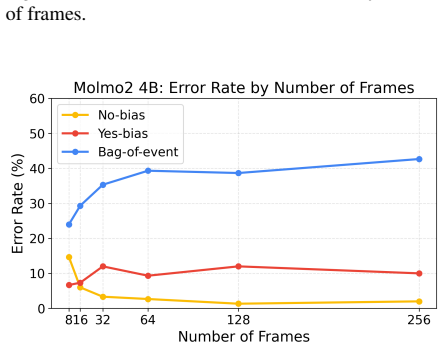
read the original abstract
A key capability for video understanding is reliably linking subjects to events across time, yet whether Video Large Language Models (VideoLLMs) actually achieve this remains unclear. In this work, we introduce DistractionBench to evaluate whether VideoLLMs can robustly link subjects and events in the presence of unrelated video segments. Through controlled interventions, such as inserting short advertisement clips into longer videos, we show that VideoLLMs frequently hallucinate interactions between entities from different segments, incorrectly attributing actions from injected advertisements to subjects in the main video. We characterize this systematic hallucination as bag-of-events (BoE) behavior, where models process videos as collections of events rather than temporally structured sequences. Evaluating 11 popular VideoLLMs, we find that all models exhibit substantial BoE behavior. Our findings suggest that VideoLLMs lack reliable mechanisms for temporal grounding and motivate the development of models with more robust subject-event association.
Editorial analysis
A structured set of objections, weighed in public.
Referee Report
Summary. The paper introduces DistractionBench, which inserts short unrelated advertisement clips into longer videos to test whether VideoLLMs can maintain subject-event associations across temporal segments. It reports that all 11 evaluated VideoLLMs exhibit 'bag-of-events' (BoE) behavior by hallucinating interactions that incorrectly attribute actions from the ad clips to subjects in the main video, and concludes that this indicates a lack of reliable temporal-grounding mechanisms in current models.
Significance. If the empirical findings hold after appropriate controls, the work supplies a concrete benchmark for a previously under-tested failure mode in video understanding and supplies falsifiable evidence that current VideoLLMs treat input as unordered collections of events. The introduction of a controlled intervention benchmark is a constructive contribution to the evaluation of temporal reasoning in multimodal models.
major comments (3)
- [Abstract and §4] Abstract and §4 (Experiments): The central claim that observed cross-segment hallucinations demonstrate absent temporal-grounding mechanisms (rather than prompt sensitivity, generic long-input hallucination, or failure to follow multi-segment instructions) is not secured, because the manuscript supplies no description of control conditions that would disambiguate these alternatives (e.g., text-only event lists, explicitly segmented prompts, or shuffled but temporally coherent video).
- [Abstract] Abstract: The uniform finding that 'all models exhibit substantial BoE behavior' is stated without any reported quantification method, hallucination rate metric, number of test videos, or statistical measure, so the data-to-claim link cannot be evaluated from the provided text.
- [§3] §3 (DistractionBench): The assumption that inserted advertisement clips are 'sufficiently unrelated' to the main video is load-bearing for the BoE interpretation, yet no quantitative measure of semantic or visual overlap between ad and main segments is supplied to support this premise.
minor comments (2)
- [Introduction] Notation for 'bag-of-events' is introduced without a formal definition or comparison to related concepts such as bag-of-words models in NLP; a short clarifying paragraph would improve readability.
- [§4] The list of 11 evaluated models should include version numbers, parameter counts, and exact prompting templates used, to support reproducibility.
Simulated Author's Rebuttal
We thank the referee for the constructive feedback. We address each major comment below and will revise the manuscript accordingly to strengthen the claims and presentation.
read point-by-point responses
-
Referee: [Abstract and §4] Abstract and §4 (Experiments): The central claim that observed cross-segment hallucinations demonstrate absent temporal-grounding mechanisms (rather than prompt sensitivity, generic long-input hallucination, or failure to follow multi-segment instructions) is not secured, because the manuscript supplies no description of control conditions that would disambiguate these alternatives (e.g., text-only event lists, explicitly segmented prompts, or shuffled but temporally coherent video).
Authors: We agree that explicit control conditions would help isolate temporal-grounding failures from other factors such as prompt sensitivity. Our core intervention uses inserted video distractions to probe cross-segment attribution in the native video setting. In revision we will add an explicitly segmented prompt control (clearly labeled segments without visual distractions) and discuss its results relative to the main condition. Text-only event lists are less directly comparable to the video temporal-grounding question but can be noted as a limitation. revision: yes
-
Referee: [Abstract] Abstract: The uniform finding that 'all models exhibit substantial BoE behavior' is stated without any reported quantification method, hallucination rate metric, number of test videos, or statistical measure, so the data-to-claim link cannot be evaluated from the provided text.
Authors: Section 4 defines the hallucination rate as the percentage of trials in which an action from an inserted ad is incorrectly attributed to a subject in the main video, reports results over 50 test videos, and includes mean rates plus standard deviation across the 11 models. We will move the key quantitative summary (e.g., average hallucination rate and range) into the abstract for immediate evaluability. revision: yes
-
Referee: [§3] §3 (DistractionBench): The assumption that inserted advertisement clips are 'sufficiently unrelated' to the main video is load-bearing for the BoE interpretation, yet no quantitative measure of semantic or visual overlap between ad and main segments is supplied to support this premise.
Authors: Clip selection was performed by manual review to ensure domain mismatch. In revision we will add quantitative support: average cosine similarity of CLIP text embeddings between main-video captions and ad captions, plus average frame-level visual feature similarity, confirming low overlap. revision: yes
Circularity Check
No circularity: purely empirical benchmark with no derivations or fitted quantities
full rationale
The paper introduces DistractionBench as an empirical intervention (inserting unrelated ad clips) and reports observed hallucinations across 11 VideoLLMs, labeling the pattern 'bag-of-events (BoE) behavior.' No equations, parameters, or first-principles derivations appear; the central claim is an observational finding from new experiments rather than a reduction of any quantity to prior inputs by construction. Self-citations, if present, are not load-bearing for any mathematical step. The work is self-contained as a benchmark study.
Axiom & Free-Parameter Ledger
axioms (1)
- domain assumption VideoLLMs are expected to reliably link subjects to events across time in video input.
invented entities (1)
-
bag-of-events (BoE) behavior
no independent evidence
Reference graph
Works this paper leans on
-
[1]
Qwen3-vl technical report.arXiv preprint arXiv:2511.21631. Matt Deitke, Christopher Clark, Sangho Lee, Rohun Tripathi, Yue Yang, Jae Sung Park, Mohammadreza Salehi, Niklas Muennighoff, Kyle Lo, Luca Soldaini, and 1 others. 2025. Molmo and pixmo: Open weights and open data for state-of-the-art vision-language models. InProceedings of the Computer Vision an...
work page internal anchor Pith review Pith/arXiv arXiv 2025
-
[2]
<answer>Yes</answer> or <an- swer>No</answer>
Longvideobench: A benchmark for long- context interleaved video-language understanding. InThe Thirty-eight Conference on Neural Informa- tion Processing Systems Datasets and Benchmarks Track. Mert Yuksekgonul, Federico Bianchi, Pratyusha Kalluri, Dan Jurafsky, and James Zou. 2023. When and why vision-language models behave like bags-of-words, and what to ...
-
[3]
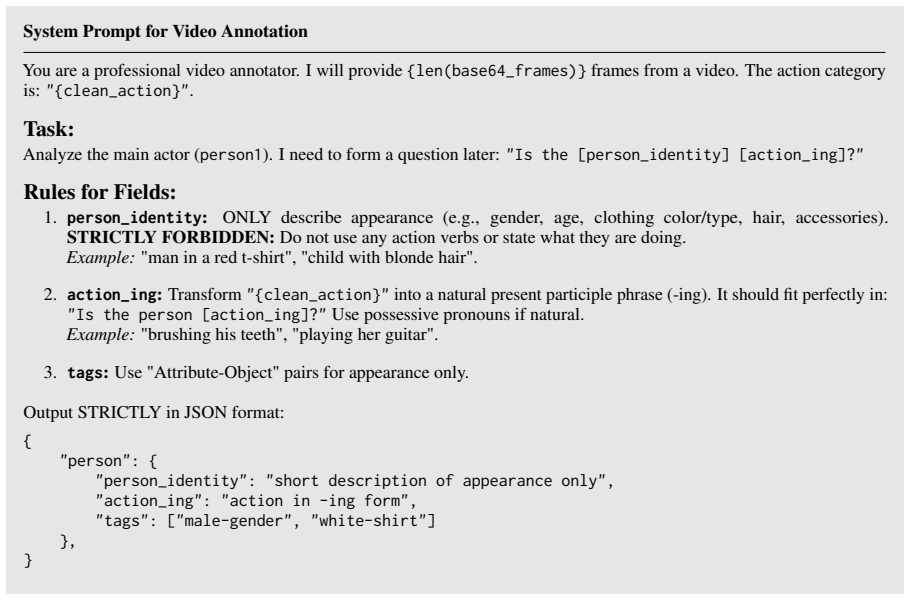
{clean_action}
dataset to retain videos with clear human actions. We deploy an off-the-shelf YOLOv8n (Jocher et al., 2023) object detection model across all video frames. A video is retained only if it con- sistently contains exactly one detected person. This filtering step ensures that the subsequent question- answering pairs can unambiguously target a sin- gle, distin...
2023
discussion (0)
Sign in with ORCID, Apple, or X to comment. Anyone can read and Pith papers without signing in.