Autonomic Federated-Market Orchestration for the Edge-Cloud Continuum
Pith reviewed 2026-06-29 15:34 UTC · model grok-4.3
The pith
Decentralised price-based allocation matches centralised welfare on tree and series-parallel service graphs under gross-substitutes valuations.
A machine-rendered reading of the paper's core claim, the machinery that carries it, and where it could break.
Core claim
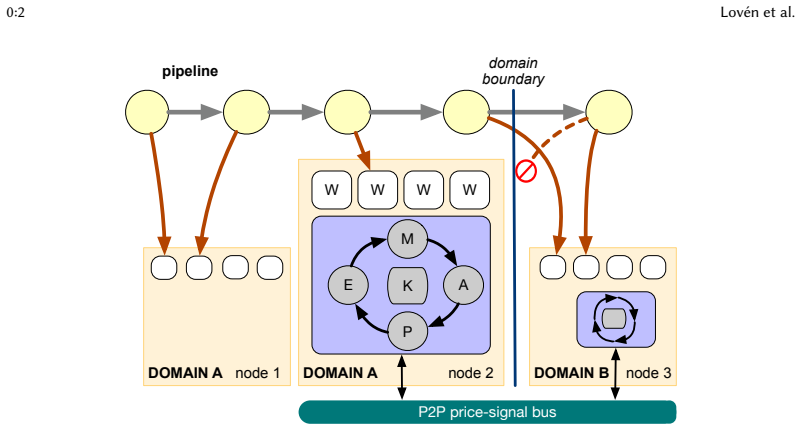
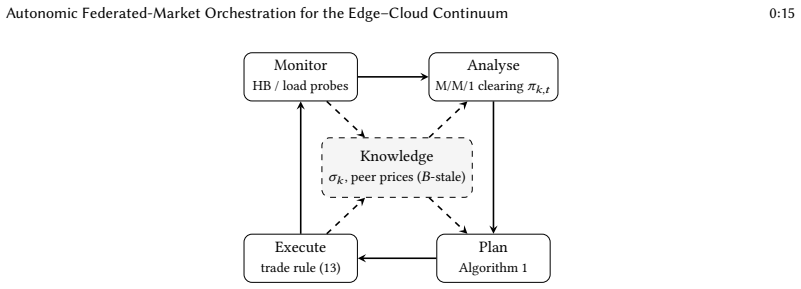
The paper establishes a Walrasian convergence proposition: under gross-substitutes valuations on tree and series-parallel service-dependency DAGs, decentralised price-based allocation matches the welfare of a centralised oracle. The claim is embedded in the Plan step of a MAPE-K loop that performs marginal-cost clearing-price analysis and placement over a polymatroidal feasibility region, then dispatches across federated brokers using bounded-staleness price signals.
What carries the argument
The Walrasian convergence proposition for price-based allocation, which equates decentralised and centralised welfare on restricted DAG structures.
If this is right
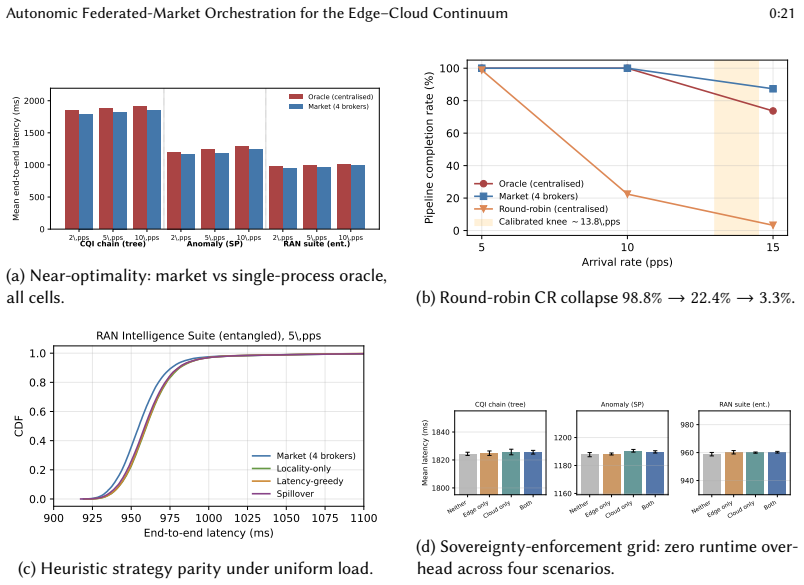
- The market mechanism sustains completion rates above 98 percent under broker death and network partition.
- Sovereignty enforcement adds no measurable runtime overhead.
- Market allocation preserves completion rates across increasing arrival rates where round-robin drops from 98.8 percent to 3.3 percent.
- At equal process count the federated market stays within plus or minus 1.5 percent of a four-shard centralised orchestrator.
Where Pith is reading between the lines
- The same price-signal substrate could coordinate placement decisions across additional administrative boundaries once the dependency restriction is met.
- Admission control and information completeness emerge as direct consequences of the price-discovery process rather than separate policy layers.
- If real service graphs can be approximated by series-parallel reductions, the convergence result would cover a wider class of practical workflows.
Load-bearing premise
Service-dependency graphs are restricted to trees or series-parallel structures and valuations satisfy the gross-substitutes property.
What would settle it
A workload on a non-tree, non-series-parallel DAG or with valuations that violate gross substitutes in which the market mechanism produces strictly lower total welfare than the central oracle.
Figures
read the original abstract
The edge-cloud computing continuum demands self-management mechanisms that scale across autonomous administrative domains while honouring tenant- and operator-specified data sovereignty. We present Neural Pub/Sub, a federated-broker autonomic substrate whose self-organising behaviour emerges from market-based price signals rather than centralised control. Its MAPE-K control loop closes over per-broker health and load monitoring, marginal-cost clearing-price analysis, placement planning over a polymatroidal feasibility region, federated cross-domain dispatch, and shared peer subscription summaries with bounded-staleness price signals. The Plan step is anchored in a Walrasian convergence proposition: under gross-substitutes valuations on tree and series-parallel service-dependency DAGs, decentralised price-based allocation matches the welfare of a centralised oracle. We evaluate the substrate on a 4-VM, 4-domain, 48-worker federated edge-cloud testbed (single data centre, 50 ms emulated WAN) in a 1005-run campaign augmented by a fair-process-count sharded-oracle comparator. The federated market dominates a single-process oracle by 2-4% with 45 of 45 per-seed wins (sign-test p ~ 2.8e-14, Hodges-Lehmann median -39.6 ms); against a four-shard centralised orchestrator at equal process count the gap stays within +/-1.5% across all nine (pipeline, load) cells. Round-robin completion rate collapses 98.8% -> 22.4% -> 3.3% across arrival rates 5/10/15 pps while the market preserves completion; the advantage decomposes into three Walrasian properties (information completeness, admission control, price discovery). Federation withstands broker death and network partition (completion rate >= 98.7% across 75 cells), and sovereignty enforcement adds no measurable runtime overhead across 60 governance-grid runs. Heterogeneous-domain stressors and cross-site WAN deployment remain future work.
Editorial analysis
A structured set of objections, weighed in public.
Referee Report
Summary. The manuscript presents Neural Pub/Sub, a federated-broker autonomic substrate for edge-cloud continuum orchestration. It uses a MAPE-K control loop driven by market price signals for self-organization across domains while enforcing data sovereignty. The Plan step is anchored in a Walrasian convergence proposition asserting that, under gross-substitutes valuations on tree and series-parallel service-dependency DAGs, decentralized price-based allocation matches the welfare of a centralized oracle. Evaluation on a 4-VM/4-domain/48-worker testbed (1005 runs) shows the federated market outperforming single-process and sharded oracles by 2-4% in latency with statistical significance, preserving completion rates under load where round-robin fails, and maintaining robustness to broker failures and partitions.
Significance. If the Walrasian equivalence holds, the work supplies a principled, mechanism-design foundation for scalable self-management in multi-administrative-domain edge-cloud systems. The experimental decomposition into information completeness, admission control, and price discovery, together with the sovereignty and fault-tolerance results, would strengthen the case for market-based autonomic substrates over purely centralized or heuristic alternatives.
major comments (1)
- [Abstract] Abstract (Plan step): the Walrasian convergence proposition is stated without a theorem formulation, proof sketch, or derivation steps showing how gross-substitutes plus the tree/series-parallel restriction imply equivalence to the centralized oracle. This is load-bearing for the claim that the market mechanism is theoretically anchored rather than heuristic.
minor comments (2)
- [Evaluation] The testbed description (4-VM, 4-domain, 50 ms emulated WAN) should explicitly state whether the service-dependency DAGs used in the 1005 runs satisfy the tree or series-parallel restriction required by the proposition.
- [Plan step] Notation for the polymatroidal feasibility region and marginal-cost clearing prices is introduced without a compact reference to the precise mathematical definition employed.
Simulated Author's Rebuttal
We thank the referee for the positive summary and significance assessment. We address the major comment below.
read point-by-point responses
-
Referee: [Abstract] Abstract (Plan step): the Walrasian convergence proposition is stated without a theorem formulation, proof sketch, or derivation steps showing how gross-substitutes plus the tree/series-parallel restriction imply equivalence to the centralized oracle. This is load-bearing for the claim that the market mechanism is theoretically anchored rather than heuristic.
Authors: We agree the abstract states the proposition concisely without a full theorem or derivation due to length limits. The manuscript body (Section 4) formulates it as Proposition 1 with a proof sketch: gross-substitutes valuations ensure a unique equilibrium price vector via tatonnement, while the tree/series-parallel DAG restriction allows a dynamic-programming recursion over sub-DAGs that computes the welfare-maximizing allocation in polynomial time, matching the centralized optimum. We will revise the abstract to cite 'Proposition 1' and note the key assumptions enabling equivalence. If the referee requests, we can lengthen the proof sketch in the main text. revision: yes
Circularity Check
No circularity: central claim invokes external economic theorem without internal reduction.
full rationale
The paper anchors its Plan step in a stated Walrasian convergence proposition under gross-substitutes valuations on restricted DAGs, presented as a standard result rather than derived or fitted within the manuscript. No equations, parameters, or self-citations reduce the welfare-equivalence claim to the paper's own inputs by construction. Experiments compare implementations but do not substitute for or circularly validate the proposition. The derivation chain remains self-contained against external benchmarks.
Axiom & Free-Parameter Ledger
axioms (1)
- domain assumption Gross-substitutes valuations hold on tree and series-parallel service-dependency DAGs
Reference graph
Works this paper leans on
-
[1]
2024.3GPP TS 23.288: Architecture enhancements for 5G System (5GS) to support network data analytics services
3GPP. 2024.3GPP TS 23.288: Architecture enhancements for 5G System (5GS) to support network data analytics services. Technical Report TS 23.288 V18.6.0. 3rd Generation Partnership Project. Release 18
2024
-
[2]
2024.3GPP TS 28.541: Management and orchestration; 5G Network Resource Model (NRM); Stage 2 and stage 3
3GPP. 2024.3GPP TS 28.541: Management and orchestration; 5G Network Resource Model (NRM); Stage 2 and stage 3. Technical Report TS 28.541 V18.7.0. 3rd Generation Partnership Project. Release 18
2024
-
[3]
3GPP. 2024. 5G; Architecture enhancements for 5G System (5GS) to support network data analytics services (3GPP TS 23.288). Technical Specification, Release 18. Accessed 2026-05-04
2024
-
[4]
3GPP. 2024. 5G; Procedures for the 5G System (5GS) (3GPP TS 23.502). Technical Specification, Release 18
2024
-
[5]
3GPP. 2024. 5G; System architecture for the 5G System (5GS) (3GPP TS 23.501). Technical Specification, Release 18
2024
-
[6]
3GPP. 2024. Management and orchestration; Concepts, use cases and requirements (3GPP TS 28.530). Technical Specification, Release 18
2024
-
[7]
Anthropic. 2024. Model Context Protocol (MCP). https://modelcontextprotocol.io
2024
-
[8]
Lawrence M Ausubel. 2004. An efficient ascending-bid auction for multiple objects.American Economic Review94, 5 (2004), 1452–1475
2004
-
[9]
Katz, Ben Clifford, Rohan Kumar, Lukasz Lacinski, Ryan Chard, Justin M
Yadu Babuji, Anna Woodard, Zhuozhao Li, Daniel S. Katz, Ben Clifford, Rohan Kumar, Lukasz Lacinski, Ryan Chard, Justin M. Wozniak, Ian Foster, Michael Wilde, and Kyle Chard. 2019. Parsl: pervasive parallel programming in Python. InProceedings of the 28th International Symposium on High-Performance Parallel and Distributed Computing (HPDC). 25–36
2019
-
[10]
Franklin, Joseph M
Peter Bailis, Shivaram Venkataraman, Michael J. Franklin, Joseph M. Hellerstein, and Ion Stoica. 2014. Quantifying eventual consistency with PBS. InCommunications of the ACM, Vol. 57. 93–102. 0:32 Lovén et al
2014
-
[11]
Faizul Bari, Shihabur Rahman Chowdhury, Reaz Ahmed, Raouf Boutaba, and Otto Carlos M
Md. Faizul Bari, Shihabur Rahman Chowdhury, Reaz Ahmed, Raouf Boutaba, and Otto Carlos M. B. Duarte. 2016. Orchestrating virtualized network functions.IEEE Transactions on Network and Service Management13, 4 (2016), 725–739
2016
-
[12]
Pete Beckman, Jack Dongarra, Nicola Ferrier, Geoffrey Fox, Terry Moore, Dan Reed, and Micah Beck. 2020. Harnessing the computing continuum for programming our world.Fog Computing: Theory and Practice(2020), 215–230
2020
-
[13]
BerriAI. 2024. LiteLLM: Call All LLM APIs Using the OpenAI Format. Accessed 2026-05-04. https://docs.litellm.ai/ docs/routing
2024
-
[14]
2019.Kubeflow and Kubeflow Pipelines
Ekaba Bisong. 2019.Kubeflow and Kubeflow Pipelines. Apress, 671–685
2019
-
[15]
Eirina Bourtsoulatze, David Burth Kurka, and Deniz Gündüz. 2019. Deep joint source-channel coding for wireless image transmission. InIEEE International Conference on Acoustics, Speech and Signal Processing (ICASSP). IEEE, 4514–4518
2019
-
[16]
Radu Calinescu, Carlo Ghezzi, Marta Kwiatkowska, and Raffaela Mirandola. 2012. Self-adaptive software needs quantitative verification at runtime.Commun. ACM55, 9 (2012), 69–77
2012
-
[17]
Paris Carbone, Stephan Ewen, Gyula Fóra, Seif Haridi, Stefan Richter, and Kostas Tzoumas. 2017. State management in Apache Flink: Consistent stateful distributed stream processing.Proceedings of the VLDB Endowment10, 12 (2017), 1718–1729
2017
-
[18]
Antonio Carzaniga and et al. 2001. Design and evaluation of a wide-area event notification service.ACM Transactions on Computer Systems (TOCS)19, 3 (2001), 332–383
2001
-
[19]
Betty H. C. Cheng, Rogério de Lemos, Holger Giese, Paola Inverardi, Jeff Magee, Jesper Andersson, Basil Becker, Nelly Bencomo, Yuriy Brun, Bojan Cukic, et al. 2009. Software Engineering for Self-Adaptive Systems: A Research Roadmap. InSoftware Engineering for Self-Adaptive Systems. Lecture Notes in Computer Science, Vol. 5525. Springer, 1–26
2009
-
[20]
CrewAI. 2024. CrewAI: Framework for orchestrating role-playing autonomous AI agents. https://www.crewai.com
2024
-
[21]
Jeffrey Dean and Sanjay Ghemawat. 2008. MapReduce: Simplified data processing on large clusters.Commun. ACM 51, 1 (2008), 107–113
2008
-
[22]
Maechling, Rajiv Mayani, Weiwei Chen, Rafael Ferreira da Silva, Miron Livny, and Kent Wenger
Ewa Deelman, Karan Vahi, Gideon Juve, Mats Rynge, Scott Callaghan, Philip J. Maechling, Rajiv Mayani, Weiwei Chen, Rafael Ferreira da Silva, Miron Livny, and Kent Wenger. 2015. Pegasus, a workflow management system for science automation.Future Generation Computer Systems46 (2015), 17–35
2015
-
[23]
R. J. Duffin. 1965. Topology of series-parallel networks.J. Math. Anal. Appl.10, 2 (1965), 303–318
1965
-
[24]
Jack Edmonds. 1970. Submodular functions, matroids, and certain polyhedra. InCombinatorial Structures and their Applications (Proc. Calgary Internat. Conf., 1969). Gordon and Breach, 69–87
1970
-
[25]
ETSI. 2014. Network Functions Virtualisation (NFV); Management and Orchestration (GS NFV-MAN 001). Group Specification
2014
-
[26]
ETSI. 2019. Zero-touch network and Service Management (ZSM); Reference Architecture (GS ZSM 002). Group Specification
2019
-
[27]
Patrick Th Eugster and et al. 2003. The many faces of publish/subscribe.ACM computing surveys (CSUR)35, 2 (2003), 114–131
2003
-
[28]
2005.Submodular Functions and Optimization(2 ed.)
Satoru Fujishige. 2005.Submodular Functions and Optimization(2 ed.). Elsevier
2005
-
[29]
Gagan Goel, Vahab Mirrokni, and Renato Paes Leme. 2015. Polyhedral clinching auctions and the adwords polytope. J. ACM62, 3 (2015), 1–27
2015
-
[30]
Google. 2025. Agent2Agent (A2A) Protocol. https://a2a-protocol.org
2025
-
[31]
R. L. Graham. 1966. Bounds for certain multiprocessing anomalies.Bell System Technical Journal45, 9 (1966), 1563–1581
1966
-
[32]
Faruk Gul and Ennio Stacchetti. 1999. Walrasian equilibrium with gross substitutes.Journal of Economic Theory87, 1 (1999), 95–124
1999
-
[33]
Taicheng Guo, Xiuying Chen, Yaqi Wang, Ruidi Chang, Shichao Pei, Nitesh V Chawla, Olaf Wiest, and Xiangliang Zhang
-
[34]
Large language model based multi-agents: A survey of progress and challenges.arXiv preprint arXiv:2402.01680 (2024)
work page internal anchor Pith review Pith/arXiv arXiv 2024
-
[35]
IBM. 2006. An Architectural Blueprint for Autonomic Computing. IBM White Paper. https://www-03.ibm.com/ autonomic/pdfs/AC%20Blueprint%20White%20Paper%20V7.pdf
2006
-
[36]
Alexander S Kelso and Vincent P Crawford. 1982. Job matching, coalition formation, and gross substitutes.Econometrica 50, 6 (1982), 1483–1504
1982
-
[37]
Jeffrey O. Kephart and David M. Chess. 2003. The Vision of Autonomic Computing.Computer36, 1 (2003), 41–50. doi:10.1109/MC.2003.1160055
-
[38]
Changhoon Kim, Anirudh Sivaraman, Naga Katta, Antonin Bas, Advait Dixit, and Lawrence J. Wobker. 2015. In-band Network Telemetry via Programmable Dataplanes. InACM SIGCOMM Demo
2015
-
[39]
Hyunjoo Kim and Manish Parashar. 2011. CometCloud: an autonomic cloud engine. InCloud Computing: Principles and Paradigms. Wiley, 275–297. Autonomic Federated-Market Orchestration for the Edge–Cloud Continuum 0:33
2011
-
[40]
Henna Kokkonen, Susanna Pirttikangas, and Lauri Lovén. 2023. EISim: A Platform for Simulating Intelligent Edge Orchestration Solutions. InProc. IEEE/ACM Symposium on Edge Computing (SEC), Poster Session. 1–2. Open-source: https://github.com/hennas/EISim
2023
-
[41]
KServe Contributors. 2024. KServe: Highly scalable and standards based model inference platform on Kubernetes. https://kserve.github.io/website/. Accessed 2026-05-04
2024
-
[42]
Kubernetes SIG Scheduling. 2024. Kueue: Kubernetes-native Job Queueing. https://kueue.sigs.k8s.io/. Accessed 2026-05-04
2024
-
[43]
Yu-Kwong Kwok and Ishfaq Ahmad. 1999. Static scheduling algorithms for allocating directed task graphs to multiprocessors.Comput. Surveys31, 4 (1999), 406–471
1999
-
[44]
LangChain. 2024. LangGraph: Agent Runtime and Orchestration Framework. Accessed 2026-05-04. https://www. langchain.com/langgraph
2024
-
[45]
Benny Lehmann, Daniel Lehmann, and Noam Nisan. 2006. Combinatorial auctions with decreasing marginal utilities. Games and Economic Behavior55, 2 (2006), 270–296
2006
-
[46]
Letaief, Yuanming Shi, Jianmin Lu, and Jianhua Lu
Khaled B. Letaief, Yuanming Shi, Jianmin Lu, and Jianhua Lu. 2022. Edge Artificial Intelligence for 6G: Vision, Enabling Technologies, and Applications.IEEE Journal on Selected Areas in Communications40, 1 (2022), 5–36. doi:10.1109/JSAC.2021.3126076
-
[47]
Linux Foundation Networking. 2024. ONAP Architecture Overview (Open Network Automation Platform). https: //www.onap.org/. Accessed 2026-05-04
2024
-
[48]
Xi Liu, Jun Liu, Hong Wu, and Jing Dong. 2024. A family of truthful mechanisms for resource allocation with multi- attribute demand in mobile edge computing.Cluster Computing27 (2024), 11595–11610. doi:10.1007/s10586-024-04552-x
- [49]
-
[50]
Lauri Lovén, Abhishek Kumar, Alexander Engelhardt, Alaa Saleh, Roberto Morabito, Xiaoli Liu, Naser Hossein Motlagh, and Sasu Tarkoma. 2026. Neural Router: Semantic Content Matching for Agentic AI.arXiv preprint arXiv:2605.25701 (2026)
work page internal anchor Pith review Pith/arXiv arXiv 2026
-
[51]
Lauri Lovén, Ella Peltonen, Erkki Harjula, and Susanna Pirttikangas. 2021. Weathering the Reallocation Storm: Large-Scale Analysis of Edge Server Workload. In2021 Joint European Conference on Networks and Communications & 6G Summit (EuCNC/6G Summit). IEEE, 317–322. doi:10.1109/EuCNC/6GSummit51104.2021.9482593
work page internal anchor Pith review Pith/arXiv arXiv doi:10.1109/eucnc/6gsummit51104.2021.9482593 2021
-
[52]
Lauri Lovén, Ella Peltonen, Leena Ruha, Erkki Harjula, and Susanna Pirttikangas. 2022. A dark and stormy night: Reallocation storms in edge computing.EURASIP Journal on Wireless Communications and Networking2022, 1 (2022),
2022
-
[53]
doi:10.1186/s13638-022-02170-y
- [54]
-
[55]
Haoxiang Luo, Yinqiu Liu, Ruichen Zhang, Jiacheng Wang, Gang Sun, Dusit Niyato, Hongfang Yu, Zehui Xiong, Xianbin Wang, and Xuemin Shen. 2025. Toward edge general intelligence with multiple-large language model (Multi-LLM): Architecture, trust, and orchestration.arXiv preprint arXiv:2507.00672(2025)
-
[56]
Dimitrios Michael Manias, Ali Chouman, and Abdallah Shami. 2024. Semantic routing for enhanced performance of LLM-assisted intent-based 5G core network management and orchestration. InIEEE Global Communications Conference (GLOBECOM). IEEE, 1–6
2024
-
[57]
Paul Milgrom and John Roberts. 1990. Rationalizability, learning, and equilibrium in games with strategic complemen- tarities.Econometrica58, 6 (1990), 1255–1277
1990
-
[58]
Philipp Moritz, Robert Nishihara, Stephanie Wang, Alexey Tumanov, Richard Liaw, Eric Liang, Melih Elibol, Zongheng Yang, William Paul, Michael I Jordan, and Ion Stoica. 2018. Ray: A distributed framework for emerging AI applications. InUSENIX Symposium on Operating Systems Design and Implementation (OSDI). 561–577
2018
-
[59]
Morris, Volodymyr Kuleshov, Vitaly Shmatikov, and Alexander M
John X. Morris, Volodymyr Kuleshov, Vitaly Shmatikov, and Alexander M. Rush. 2023. Text Embeddings Reveal (Almost) As Much As Text. InProc. EMNLP
2023
-
[60]
Noam Nisan and Ilya Segal. 2006. The communication requirements of efficient allocations and supporting prices. Journal of Economic Theory129, 1 (2006), 192–224
2006
-
[61]
Not Diamond. 2024. Not Diamond: Intelligent AI Model Routing. Accessed 2026-05-04. https://docs.notdiamond.ai/ docs/what-is-model-routing
2024
-
[62]
NVIDIA. 2024. NVIDIA Triton Inference Server. https://developer.nvidia.com/triton-inference-server. Accessed 2026-05-04
2024
-
[63]
O-RAN Alliance. 2024. O-RAN Architecture Description (O-RAN.WG1.OAD). Technical Specification, R003. Accessed 2026-05-04
2024
-
[64]
O-RAN Alliance. 2024. O-RAN Non-RT RIC Architecture (O-RAN.WG2.Non-RT-RIC-ARCH). Technical Specification. Accessed 2026-05-04. 0:34 Lovén et al
2024
-
[65]
O-RAN Alliance. 2024. O-RAN Security Requirements and Controls Specification (O-RAN.WG11.Security- Requirements-Spec). Technical Specification. Accessed 2026-05-04
2024
-
[66]
RouteLLM: Learning to Route LLMs with Preference Data
Isaac Ong, Amjad Almahairi, Vincent Wu, Wei-Lin Chiang, Tianhao Wu, Joseph E. Gonzalez, M. Waleed Kadous, and Ion Stoica. 2024. RouteLLM: Learning to Route LLMs with Preference Data. arXiv preprint arXiv:2406.18665
work page internal anchor Pith review Pith/arXiv arXiv 2024
-
[67]
OpenAI. 2025. OpenAI Agents SDK. https://github.com/openai/openai-agents-python
2025
-
[68]
OpenRouter. 2025. OpenRouter: Unified API for AI Models with Intelligent Provider Routing. Accessed 2026-05-04. https://openrouter.ai/docs/guides/routing/provider-selection
2025
-
[69]
P4 Language Consortium. 2023. P4Runtime Specification. https://p4.org/p4-spec/p4runtime/main/P4Runtime-Spec. html. Accessed 2026-05-04
2023
-
[70]
Manish Parashar. 2025. Everywhere and Nowhere: Envisioning a Computing Continuum for Science.Computing in Science & Engineering27, 1 (2025), 51–56. doi:10.1109/MCSE.2025.3543924
-
[71]
Esa Piri, Pekka Ruuska, Teemu Kanstrén, Jukka Mäkelä, Jari Korva, Atso Hekkala, Ari Pouttu, Olli Liinamaa, Matti Latva- aho, Kari Vierimaa, and Harri Valasma. 2016. 5GTN: A test network for 5G application development and testing. In 2016 European Conference on Networks and Communications (EuCNC). IEEE, 313–318. doi:10.1109/EuCNC.2016.7561054
- [72]
-
[73]
Alaa Saleh, Roberto Morabito, Schahram Dustdar, Sasu Tarkoma, Susanna Pirttikangas, and Lauri Lovén. 2025. Towards Message Brokers for Generative AI: Survey, Challenges, and Opportunities.Comput. Surveys58, 1 (2025), 1–37. doi:10.1145/3742891
-
[74]
Alaa Saleh, Sasu Tarkoma, Anders Lindgren, Praveen Kumar Donta, Schahram Dustdar, Susanna Pirttikangas, and Lauri Lovén. 2025. Memindex: Agentic event-based distributed memory management for multi-agent systems.ACM Transactions on Autonomous and Adaptive Systems(2025). doi:10.1145/3774946
-
[75]
Mazeiar Salehie and Ladan Tahvildari. 2009. Self-Adaptive Software: Landscape and Research Challenges.ACM Transactions on Autonomous and Adaptive Systems (TAAS)4, 2 (2009), 1–42. doi:10.1145/1516533.1516538
-
[76]
Emilio Calvanese Strinati and Sergio Barbarossa. 2021. 6G Networks: Beyond Shannon Towards Semantic and Goal-Oriented Communications.Computer Networks190 (2021), 107930. doi:10.1016/j.comnet.2021.107930
-
[77]
Villegas, Hausi A
Gabriel Tamura, Norha M. Villegas, Hausi A. Müller, João Pedro Sousa, Basil Becker, Gabor Karsai, Serge Mankovskii, Mauro Pezzè, Bradley Schmerl, Ladan Tahvildari, and Kenny Wong. 2013. Towards practical runtime verification and validation of self-adaptive software systems. InSoftware Engineering for Self-Adaptive Systems II (LNCS 7475). Springer, 108–132
2013
-
[78]
2012.Publish/subscribe systems: design and principles
Sasu Tarkoma. 2012.Publish/subscribe systems: design and principles. John Wiley & Sons
2012
- [79]
-
[80]
Haluk Topcuoglu, Salim Hariri, and Min-You Wu. 2002. Performance-effective and low-complexity task scheduling for heterogeneous computing.IEEE Transactions on Parallel and Distributed Systems13, 3 (2002), 260–274
2002
discussion (0)
Sign in with ORCID, Apple, or X to comment. Anyone can read and Pith papers without signing in.