Semantic Robustness Probing via Inpainting: An Interactive Tool for Safety-Critical Object Detection
Pith reviewed 2026-06-29 18:48 UTC · model grok-4.3
The pith
SemProbe is a tool that generates controlled semantic variations in deployment images via diffusion inpainting to test object detector robustness against operational factors.
A machine-rendered reading of the paper's core claim, the machinery that carries it, and where it could break.
Core claim
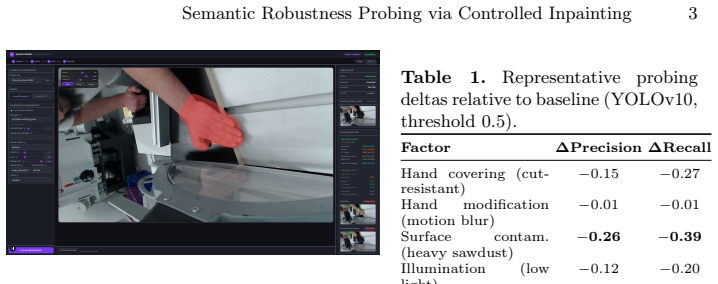
SemProbe enables semantic robustness probing by letting users create masks on deployment images, select operational design domain factors or custom prompts, and apply diffusion-based controlled inpainting; the system then runs model inference automatically and records before-and-after comparisons with performance deltas, producing traceable artifacts suitable for safety evaluation workflows, as shown on hand detection for dimension saws.
What carries the argument
SemProbe tool that couples manual or automatic masking with diffusion-based controlled inpainting driven by operational design domain factors or prompts.
If this is right
- Batch jobs and parallel seed variations allow systematic coverage of multiple factors on the same image set.
- Automatic inference and delta display make robustness gaps visible without manual post-processing.
- Structured logging of all probes supports documentation required in safety certification processes.
- The workflow can target any object detector once images and relevant operational factors are supplied.
Where Pith is reading between the lines
- The same inpainting approach could be applied to other safety-critical vision tasks such as pedestrian detection or medical imaging.
- Integration with formal verification tools might turn the generated variants into test cases for certification standards.
- If the inpainted images prove realistic, the method could reduce the need for expensive real-world data collection campaigns.
Load-bearing premise
Diffusion-based inpainting on the chosen masks produces variations that faithfully represent real operational design domain factors rather than introducing unrealistic artifacts.
What would settle it
Collect real images that differ from the originals only by the exact factors used in the prompts, run the same detector on them, and check whether the performance deltas match those obtained from the inpainted versions.
Figures

read the original abstract
Testing object detectors in safety-critical domains requires semantically meaningful probes beyond pixel-level corruptions. We present SemProbe, a tool for semantic robustness probing: users upload deployment images, create masks manually or automatically, select operational design domain-derived factors (or custom prompts), and run diffusion-based controlled inpainting. The system supports batch jobs, parallel seed/workflow variations, and configurable generation parameters. After each output, model inference runs automatically and displays annotated before/after comparisons with performance deltas. All probes are logged as structured artifacts, enabling traceable robustness evidence aligned with safety evaluation workflows. We demonstrate \textsc{SemProbe} on hand detection for dimension saws, targeting factors from insurance-oriented test criteria.
Editorial analysis
A structured set of objections, weighed in public.
Referee Report
Summary. The paper introduces SemProbe, an interactive tool for semantic robustness probing of object detectors in safety-critical settings. Users upload deployment images, generate masks (manual or automatic), select ODD-derived factors or custom prompts, apply diffusion-based controlled inpainting, and obtain automatic model inference with before/after annotated comparisons and performance deltas. The system supports batch jobs, parallel variations, configurable parameters, and structured logging of probes. A demonstration is provided on hand detection for dimension saws using insurance-oriented test criteria.
Significance. If the inpainting method can be shown to generate controlled, semantically faithful variations that align with real operational factors, the tool would offer a practical workflow for generating traceable robustness evidence beyond pixel-level corruptions, supporting safety evaluation standards. The batch processing, logging, and automatic inference features are well-aligned with deployment needs.
major comments (1)
- [Abstract] Abstract (and demonstration section): The described use case on hand detection supplies no quantitative results, performance metrics, error analysis, or validation data (e.g., comparison of inpainted images to real ODD variants, fidelity metrics, or detector robustness deltas against ground-truth changes). This absence is load-bearing for the central claim that diffusion-based inpainting produces valid semantic probes.
Simulated Author's Rebuttal
We thank the referee for the constructive feedback and for recognizing the tool's alignment with safety evaluation workflows. We respond to the single major comment below.
read point-by-point responses
-
Referee: [Abstract] Abstract (and demonstration section): The described use case on hand detection supplies no quantitative results, performance metrics, error analysis, or validation data (e.g., comparison of inpainted images to real ODD variants, fidelity metrics, or detector robustness deltas against ground-truth changes). This absence is load-bearing for the central claim that diffusion-based inpainting produces valid semantic probes.
Authors: We agree that the demonstration section provides only a qualitative workflow illustration and lacks the requested quantitative validation. The manuscript positions SemProbe as a tool for enabling such probes rather than as an empirical study validating the underlying inpainting model. Nevertheless, the absence of metrics such as fidelity scores or robustness deltas does weaken support for the claim of producing valid semantic probes. In the revised manuscript we will expand the demonstration section with quantitative results on the hand-detection example, including inpainting fidelity metrics (e.g., FID, LPIPS), comparison against available real ODD variants, and before/after detector performance deltas with error analysis. revision: yes
Circularity Check
No circularity; tool introduction is self-contained
full rationale
The paper presents SemProbe as a new interactive tool and workflow for semantic robustness probing of object detectors via user-driven diffusion inpainting on masks with ODD-derived prompts. No equations, parameter fitting, predictions of derived quantities, or self-citation chains appear in the provided description. The central contribution is the tool itself and its logging of artifacts; the validity of inpainting as a proxy is an external empirical assumption, not a self-referential definition or fitted input renamed as output. This matches the default case of a non-circular tool paper.
Axiom & Free-Parameter Ledger
Forward citations
Cited by 1 Pith paper
-
Train, Test, Re-evaluate: Schedule-Sensitive Evaluation of Generative Data for Hand Detection
Multi-stage training that first mixes real and inpainted synthetic hand images then fine-tunes on real data improves mAP on glove-wearing test images over real-only baselines.
Reference graph
Works this paper leans on
-
[1]
Apache 2.0 (January 2026).https://huggingface.co/black-forest-labs/FLUX.2-klein-4B
Black Forest Labs: FLUX.2 [klein] — 4B-parameter rectified flow transformer for unified text-to-image generation and mask-based editing. Apache 2.0 (January 2026).https://huggingface.co/black-forest-labs/FLUX.2-klein-4B
2026
-
[2]
Seifen, T.: AI-based assistance system for dimension saws (Focus on IFA’s work No. 0450e). DGUV/IFA, issue 08/2024 (2024)
2024
-
[3]
Official Journal of the European Union, L 165 (2023)
EuropeanParliamentandCouncil:Regulation(EU)2023/1230onmachineryprod- ucts. Official Journal of the European Union, L 165 (2023)
2023
-
[4]
Official Journal of the European Union, L series (2024)
European Parliament and Council: Regulation (EU) 2024/1689 laying down har- monised rules on artificial intelligence (AI Act). Official Journal of the European Union, L series (2024)
2024
-
[5]
Ecker, Matthias Bethge, and Wieland Brendel
Michaelis, C., Mitzkus, B., Geirhos, R., et al.: Benchmarking robustness in object detection: Autonomous driving when winter is coming. arXiv:1907.07484 (2019)
-
[6]
In: ICCV (2023)
Mao, X., et al.: COCO-O: A benchmark for object detectors under natural distri- bution shifts. In: ICCV (2023)
2023
-
[7]
In: WACV (2024)
Fang, H., et al.: Data augmentation for object detection via controllable diffusion models. In: WACV (2024)
2024
-
[8]
Zhu, J., et al.: ODGEN: Domain-specific object detection data generation with diffusion models. arXiv:2405.15199 (2024)
-
[9]
In: CVPR (2025)
Yang, C., et al.: DriveGEN: Generalized and robust 3D detection in driving via controllable text-to-image diffusion generation. In: CVPR (2025)
2025
-
[10]
DGUV Test Information 05 (2021)
DGUV Test: General Principles for Assessing the Safety of Artificial Intelligence (AI). DGUV Test Information 05 (2021)
2021
-
[11]
ISO: ISO 34503:2023 — Road vehicles — Taxonomy for operational design domain for automated driving systems (2023)
2023
-
[12]
com/ultralytics/ultralytics
Jocher, G., Chaurasia, A., Qiu, J.: Ultralytics YOLO (2023).https://github. com/ultralytics/ultralytics
2023
discussion (0)
Sign in with ORCID, Apple, or X to comment. Anyone can read and Pith papers without signing in.