The Compressive Knowledge Graph Hypothesis: Which Graph Facts Matter for Scientific Hypothesis Generation?
Reviewed by Pith T0 review T1 audit T2 compute T3 formal T4 kernel 2026-06-29 16:56 UTCgrok-4.3pith:XJVSEARYrecord.jsonopen to challenge →
The pith
Compact scientifically structured subgraphs recover most useful signal from full knowledge graphs for hypothesis generation.
A machine-rendered reading of the paper's core claim, the machinery that carries it, and where it could break.
Core claim
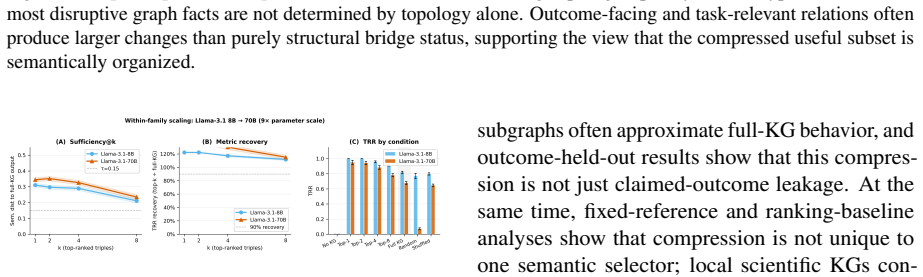
Across Mistral-7B, Llama-3.1-70B, and Gemini 2.5 Flash, KG-guided hypothesis generation for battery materials exhibits selective and model-dependent utility; graph context alters outputs, yet no-KG baselines already recover much of the same content from model priors, while compact top-k subgraphs (including when claimed-outcome triples are held out) approximate full-KG behavior and this recovery is not restricted to semantic ranking rules since random and topology-based subsets also recover substantial signal.
What carries the argument
Perturbations of local KGs along density, ontology richness, topology, and control structure, scored by provided-graph and fixed-reference metrics, that isolate the contribution of specific graph facts to hypothesis quality.
If this is right
- KG utility remains selective and model-dependent even after perturbations.
- No-KG outputs already recover substantial graph content from model priors.
- Compact top-k subgraphs approximate full-KG behavior including with held-out triples.
- Signal compression is not unique to semantic ranking; random and topology-based subsets recover much of the same signal.
Where Pith is reading between the lines
- If the pattern holds, KG construction for hypothesis generation could prioritize high-signal subgraphs over exhaustive local coverage.
- The same redundancy may appear in scientific domains beyond battery materials where models already encode substantial domain knowledge internally.
- A direct test would apply the same density and topology perturbations to KGs drawn from other scientific fields and compare recovery rates.
Load-bearing premise
The perturbation operations and the two evaluation metrics isolate the causal contribution of specific graph facts to hypothesis quality without substantial confounding from model priors or metric artifacts.
What would settle it
If compact top-k or random subgraphs consistently produce lower-quality hypotheses than full local graphs on the same models and materials when measured by the provided-graph metric, the compressive hypothesis would be falsified.
Figures


read the original abstract
Knowledge graphs (KGs) can provide structured scientific context to language models, but it remains unclear which graph facts actually shape the generated hypotheses. We study KG-guided hypothesis generation for battery materials across Mistral-7B, Llama-3.1-70B, and Gemini 2.5 Flash. We perturb local KGs by varying density, ontology richness, topology, and control structure, and evaluate outputs with both provided-graph and fixed-reference metrics. Across models, KG utility is selective and model-dependent: graph context changes outputs, but no-KG outputs also recover substantial graph content from model priors. Compact top-k subgraphs often approximate full-KG behavior, including when claimed-outcome triples are held out. At the same time, compression is not unique to one semantic ranking rule, random and topology-based subsets can also recover much of the signal. These results support a redundancy-aware Compressive KG hypothesis: useful KG signal is often recoverable from compact, scientifically structured subgraphs rather than requiring the full local graph.
Editorial analysis
A structured set of objections, weighed in public.
Referee Report
Summary. The paper examines which facts from local knowledge graphs (KGs) matter for LLM-based scientific hypothesis generation in battery materials. Using Mistral-7B, Llama-3.1-70B, and Gemini 2.5 Flash, it perturbs KGs along axes of density, ontology richness, topology, and control structure, then evaluates hypothesis quality via provided-graph and fixed-reference metrics. Key findings are that KG utility is selective and model-dependent, no-KG baselines recover substantial graph content from priors, and compact top-k (or even random/topology-based) subgraphs often match full-KG performance even when claimed-outcome triples are held out. These observations are framed as support for a redundancy-aware "Compressive Knowledge Graph Hypothesis."
Significance. If the perturbation results and metric comparisons prove robust after proper controls, the work would indicate that scientifically structured KGs contain substantial redundancy for hypothesis generation tasks, allowing compact subgraphs to substitute for full local graphs. This could inform more efficient KG-augmented LLM pipelines in materials science and related domains. The empirical framing (rather than axiomatic) and explicit acknowledgment of prior leakage are strengths, though the absence of reported quantitative outcomes limits immediate impact assessment.
major comments (2)
- [Abstract] Abstract: The experimental design and headline outcomes are described, but the abstract supplies no quantitative results, statistical tests, exact definitions of the provided-graph and fixed-reference metrics, sample sizes, or controls for model-prior leakage. The central compressive hypothesis therefore rests on unshown experimental details whose soundness cannot be evaluated from the given text.
- [Abstract] Abstract (perturbation and evaluation description): The claim that differences in hypothesis quality can be causally attributed to specific perturbed graph facts (rather than model priors) is load-bearing for the compressive hypothesis, yet the text notes that no-KG outputs already recover substantial graph content. Without reported controls (e.g., ablation of metric overlap with memorized scientific outcomes or surface-triple matching), it is unclear whether top-k/random/topology subsets appearing equivalent to full KGs demonstrates KG-internal redundancy or simply prior dominance across all conditions.
Simulated Author's Rebuttal
We thank the referee for the detailed and constructive report. We address each major comment below and indicate where revisions will be made to the manuscript.
read point-by-point responses
-
Referee: [Abstract] Abstract: The experimental design and headline outcomes are described, but the abstract supplies no quantitative results, statistical tests, exact definitions of the provided-graph and fixed-reference metrics, sample sizes, or controls for model-prior leakage. The central compressive hypothesis therefore rests on unshown experimental details whose soundness cannot be evaluated from the given text.
Authors: We agree that the abstract is currently high-level and omits key quantitative and methodological details. In the revised version we will expand the abstract to include headline quantitative outcomes (e.g., performance of top-k and other subsets relative to full KG and no-KG baselines), brief definitions of the provided-graph and fixed-reference metrics, sample sizes, and explicit reference to the no-KG condition as a control for prior leakage. This will make the central claims evaluable directly from the abstract. revision: yes
-
Referee: [Abstract] Abstract (perturbation and evaluation description): The claim that differences in hypothesis quality can be causally attributed to specific perturbed graph facts (rather than model priors) is load-bearing for the compressive hypothesis, yet the text notes that no-KG outputs already recover substantial graph content. Without reported controls (e.g., ablation of metric overlap with memorized scientific outcomes or surface-triple matching), it is unclear whether top-k/random/topology subsets appearing equivalent to full KGs demonstrates KG-internal redundancy or simply prior dominance across all conditions.
Authors: This concern about disentangling graph contributions from priors is well-taken. The manuscript already reports a no-KG baseline that quantifies prior recovery and employs a fixed-reference metric that scores against established scientific outcomes. The key comparative result is that compact subsets match full-KG performance while both exceed the no-KG baseline, even when claimed-outcome triples are held out; this pattern is what supports the compressive hypothesis. We did not, however, include explicit ablations for metric overlap with memorized content beyond the no-KG condition. We will strengthen the discussion section to address this potential confound more explicitly and will add a targeted control experiment if feasible within the revision timeline. revision: partial
Circularity Check
No significant circularity: empirical perturbation study with independent metrics
full rationale
The paper conducts an empirical study by perturbing local KGs along density, ontology, topology, and control axes, then measuring hypothesis quality via provided-graph and fixed-reference metrics across multiple LLMs. No equations, derivations, fitted parameters renamed as predictions, or self-citation chains appear in the provided text. The compressive KG hypothesis is presented as an observation supported by the experimental outcomes rather than a quantity defined in terms of its own inputs. The evaluation design treats metric differences as evidence of KG signal recoverability, with explicit acknowledgment of model priors in no-KG baselines; this framing does not reduce the central claim to a tautology by construction. The work is self-contained against external benchmarks (actual model outputs and graph subsets) and does not invoke uniqueness theorems or ansatzes from prior self-citations.
Axiom & Free-Parameter Ledger
axioms (1)
- domain assumption Language models encode substantial scientific knowledge in their parameters that can be elicited without explicit graph context.
invented entities (1)
-
Compressive Knowledge Graph Hypothesis
no independent evidence
Reference graph
Works this paper leans on
-
[1]
Rationalization for Explainable NLP: A Sur- vey.arXiv e-prints, arXiv:2301.08912. Lovisa Hagström, Sara Vera Marjanovi ´c, Haeun Yu, Arnav Arora, Christina Lioma, Maria Maistro, Pepa Atanasova, and Isabelle Augenstein. 2024. A Reality Check on Context Utilisation for Retrieval-Augmented Generation.arXiv e-prints, arXiv:2412.17031. Haoyu Han, Yu Wang, Harr...
-
[2]
Costas Mavromatis and George Karypis
Think-on-Graph 2.0: Deep and Faithful Large Language Model Reasoning with Knowledge-guided Retrieval Augmented Generation.arXiv e-prints, arXiv:2407.10805. Costas Mavromatis and George Karypis. 2024. GNN- RAG: Graph Neural Retrieval for Large Language Model Reasoning.arXiv e-prints, arXiv:2405.20139. Shirui Pan, Linhao Luo, Yufei Wang, Chen Chen, Jiapu Wa...
-
[3]
Improving Scientific Hypothesis Generation with Knowledge Grounded Large Language Models. arXiv e-prints, arXiv:2411.02382. Michihiro Yasunaga, Antoine Bosselut, Hongyu Ren, Xikun Zhang, Christopher D Manning, Percy Liang, and Jure Leskovec. 2022. Deep Bidirectional Language-Knowledge Graph Pretraining.arXiv e- prints, arXiv:2210.09338. Xikun Zhang, Antoi...
-
[4]
ERNIE: Enhanced Language Representation with Informative Entities
Measuring the inferential values of relations in knowledge graphs.Algorithms, 18(1). Zhengyan Zhang, Xu Han, Zhiyuan Liu, Xin Jiang, Maosong Sun, and Qun Liu. 2019. ERNIE: En- hanced Language Representation with Informative Entities.arXiv e-prints, arXiv:1905.07129. A Qualitative Case Study Table 5 shows one representative example. The no- KG output gives...
work page internal anchor Pith review Pith/arXiv arXiv 2019
-
[5]
The full-KG output specifies a pressure-compensating phase-change material sys- tem and links it to thermal instability, capacity fade, and impedance growth
Paper 1: Thermal management for lithium-ion UUV batteries. The full-KG output specifies a pressure-compensating phase-change material sys- tem and links it to thermal instability, capacity fade, and impedance growth
-
[6]
The full-KG output focuses on thixotropic, shear-thinning inks and volatile co- solvent control to reduce coffee-ring effects and non-uniform morphology
Paper 2: Additive manufacturing of sodium-ion battery components. The full-KG output focuses on thixotropic, shear-thinning inks and volatile co- solvent control to reduce coffee-ring effects and non-uniform morphology
-
[7]
The full- KG output specifies a low-molecular-weight fluori- nated ether additive and links it to dense electrical double-layer ordering, screening, and desolvation impedance
Paper 3: Polymer-gel electrolyte design. The full- KG output specifies a low-molecular-weight fluori- nated ether additive and links it to dense electrical double-layer ordering, screening, and desolvation impedance
-
[8]
The full-KG output proposes a conformal LiAlO2 coating and connects it to hydrofluoric-acid neu- tralization, parasitic surface reactions, and cycling stability
Paper 4: High-nickel NCM cathode stabilization. The full-KG output proposes a conformal LiAlO2 coating and connects it to hydrofluoric-acid neu- tralization, parasitic surface reactions, and cycling stability
-
[9]
no graph signal available,
Paper 5: Lithium-ion battery recycling. The full- KG output proposes mild electrochemical disso- lution at the cathode-current collector interface to weaken binder adhesion and reduce material loss and cross-contamination. A.3 Model-Specific Top Graph Examples and Prompting Guidance Table 4 summarizes the model-specific prompt- ing guidance derived from t...
2095
discussion (0)
Sign in with ORCID, Apple, or X to comment. Anyone can read and Pith papers without signing in.