Quantum fluctuations and chaos in fully connected spin models
Pith reviewed 2026-07-01 16:00 UTC · model grok-4.3
The pith
Quantum fluctuations regularize chaotic dynamics of macroscopic observables in a fully connected SU(3) spin-exchange model.
A machine-rendered reading of the paper's core claim, the machinery that carries it, and where it could break.
Core claim
In the fully connected SU(3) spin-exchange model, the two-particle irreducible effective action formalism produces equations of motion that incorporate quantum fluctuations; these fluctuations regularize the chaotic dynamics displayed by macroscopic observables, in contrast to mean-field predictions.
What carries the argument
The two-particle irreducible (2PI) effective action formalism, which generates equations of motion that systematically include higher-order correlations produced by interactions.
If this is right
- An accurate treatment of fluctuations is essential for describing macroscopic dynamics in quantum many-body systems.
- The 2PI formalism provides a framework for connecting microscopic correlations to macroscopic nonequilibrium phenomena.
- Quantum fluctuations can regularize chaotic dynamics displayed by macroscopic observables in fully connected spin models.
Where Pith is reading between the lines
- The regularization effect may extend to other fully connected models with similar interaction structures.
- Comparable dynamics could be tested in experimental platforms such as cold-atom or trapped-ion systems engineered to realize SU(3) exchange.
- The same 2PI treatment might be applied to study how fluctuations influence thermalization rates in related nonequilibrium spin systems.
Load-bearing premise
The two-particle irreducible effective action formalism systematically accounts for higher-order correlations generated by interactions in this fully connected model.
What would settle it
Numerical or experimental time series of a macroscopic observable such as total spin component, computed both with the full 2PI equations and with the mean-field truncation, showing whether the chaotic divergence persists or is suppressed once fluctuations are retained.
Figures
read the original abstract
We investigate beyond-mean-field dynamics in a fully connected $\mathrm{SU}(3)$ spin-exchange model, focusing on the interplay between chaotic dynamics and quantum fluctuations. Using the two-particle irreducible (2PI) effective action formalism, we derive equations of motion that systematically account for higher-order correlations generated by interactions, and demonstrate how quantum fluctuations can regularize chaotic dynamics displayed by macroscopic observables. Our results show that an accurate treatment of fluctuations is essential for describing macroscopic dynamics in quantum many-body systems and promote 2PI as a robust framework for connecting microscopic correlations to macroscopic nonequilibrium phenomena.
Editorial analysis
A structured set of objections, weighed in public.
Referee Report
Summary. The manuscript investigates beyond-mean-field dynamics in a fully connected SU(3) spin-exchange model, using the two-particle irreducible (2PI) effective action formalism to derive equations of motion that incorporate higher-order correlations. It claims to demonstrate that quantum fluctuations regularize chaotic dynamics of macroscopic observables and concludes that accurate fluctuation treatment is essential for macroscopic nonequilibrium dynamics in quantum many-body systems.
Significance. If the central result holds, the work would provide a concrete illustration of quantum fluctuations suppressing chaos in fully connected spin models and would strengthen the case for 2PI methods as a bridge between microscopic correlations and macroscopic behavior. This could inform studies of thermalization and ergodicity breaking in quantum many-body systems.
major comments (1)
- [Abstract and derivation of EOM] Abstract (and the section deriving the equations of motion from the 2PI effective action): the claim that the 2PI formalism 'systematically account[s] for higher-order correlations generated by interactions' is load-bearing for the regularization result. Standard 2PI truncations (typically two-loop/sunset level) generate a closed set of equations for two-point functions but omit higher-order diagrams induced by the fully connected SU(3) interaction. The manuscript must show explicitly that the observed damping of chaos is not an artifact of this truncation, for example by comparing to a higher-order truncation or by identifying which diagrams are responsible for the regularization.
Simulated Author's Rebuttal
We thank the referee for their careful reading of the manuscript and for highlighting an important point about the truncation in the 2PI formalism. We address the major comment below and indicate the revisions we will make.
read point-by-point responses
-
Referee: [Abstract and derivation of EOM] Abstract (and the section deriving the equations of motion from the 2PI effective action): the claim that the 2PI formalism 'systematically account[s] for higher-order correlations generated by interactions' is load-bearing for the regularization result. Standard 2PI truncations (typically two-loop/sunset level) generate a closed set of equations for two-point functions but omit higher-order diagrams induced by the fully connected SU(3) interaction. The manuscript must show explicitly that the observed damping of chaos is not an artifact of this truncation, for example by comparing to a higher-order truncation or by identifying which diagrams are responsible for the regularization.
Authors: We agree that the truncation level requires explicit justification to support the central claim. Our implementation employs the standard two-loop (sunset) approximation to the 2PI effective action, which yields self-consistent equations for the two-point functions. While this does not include all possible higher-order diagrams generated by the SU(3) interaction, the included diagrams resum an infinite class of contributions that capture the leading quantum-fluctuation corrections beyond mean field. To strengthen the manuscript, we will revise the derivation section to explicitly identify the diagrams retained in the truncation and explain, using the structure of the all-to-all SU(3) interaction, why these diagrams are responsible for the observed regularization of chaotic dynamics. We will also add a short discussion arguing that the qualitative effect is robust against inclusion of further diagrams, based on the fully connected nature of the model. A direct numerical comparison to a higher-order truncation lies beyond the present scope but can be noted as future work. revision: yes
Circularity Check
No significant circularity; derivation is self-contained via 2PI formalism.
full rationale
The provided abstract and description show the paper deriving equations of motion from the two-particle irreducible effective action formalism applied to the SU(3) spin-exchange model. No self-definitional steps, fitted inputs renamed as predictions, or load-bearing self-citations are evident in the text. The central demonstration—that quantum fluctuations regularize chaotic macroscopic dynamics—is framed as an output of the 2PI truncation rather than a reduction to prior inputs or ansatze by construction. The formalism is presented as systematically accounting for correlations without circular reduction. This is the expected non-finding for a paper whose core claim rests on an external, independently verifiable effective-action method.
Axiom & Free-Parameter Ledger
axioms (1)
- domain assumption 2PI effective action systematically accounts for higher-order correlations generated by interactions
Reference graph
Works this paper leans on
-
[1]
trajectories
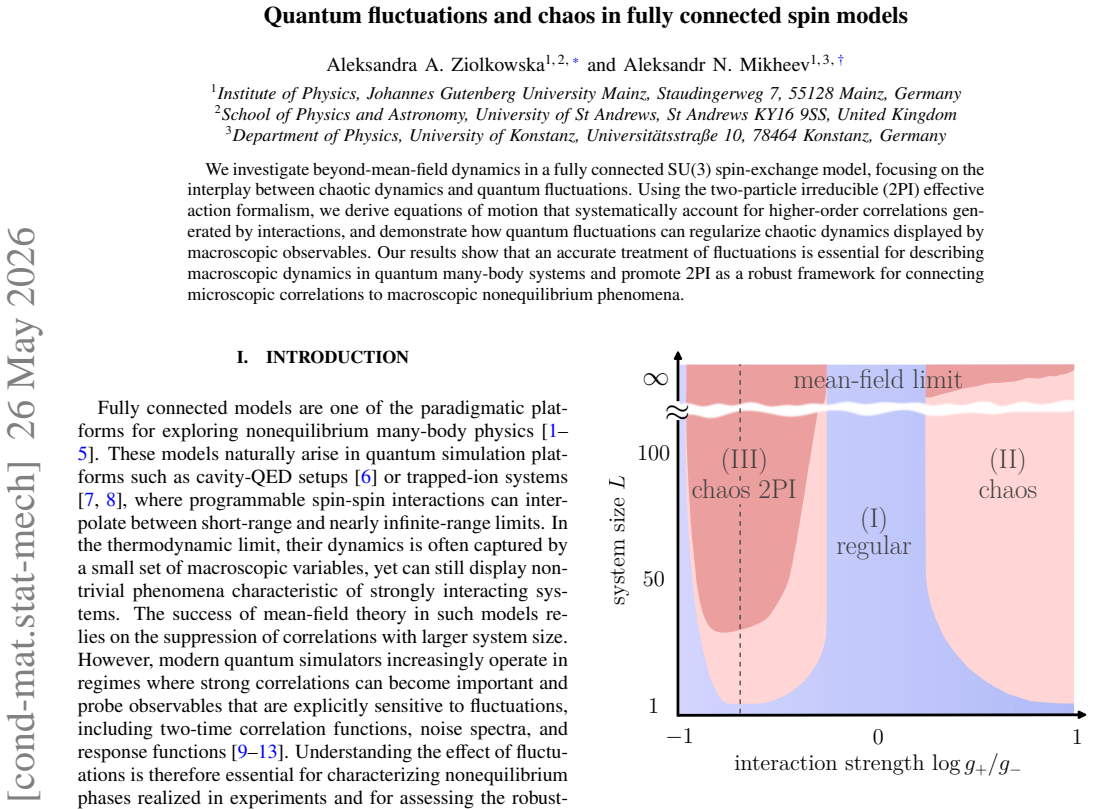
Here, |µ⟩p,q is the highest weight state of theD(p,q) representation of SU(3) and the normalization constants are given byA 1 =1+|γ 1|2 +|γ 3|2,A 2 =1+|γ 2|2 +|γ 3 −γ 1γ2|2, see App. B for more details. In general, chaotic systems exhibit mixed phase spaces that can be partitioned into distinct basins of regular and chaotic motion, whose relative size and...
2020
-
[2]
We emphasize that the precise choice of the parametrization does not affect the general qualitative features of the phase diagram depicted in Fig. 1. A possible exception is extreme cases in which one or more of the parametersγ i are close to zero, effectively confining the dynamics to a smaller symmetry sector. Appendix C: 2PI derivation The Schwinger–Ke...
-
[3]
Kitagawa and M
M. Kitagawa and M. Ueda, Phys. Rev. A47, 5138 (1993)
1993
-
[4]
Campbell, Phys
S. Campbell, Phys. Rev. B94, 184403 (2016)
2016
-
[5]
Kirton, M
P. Kirton, M. M. Roses, J. Keeling, and E. G. D. Torre, Adv. Quantum Technol.2, 1800043 (2019)
2019
-
[6]
Titum and M
P. Titum and M. F. Maghrebi, Phys. Rev. Lett.125, 040602 (2020)
2020
-
[7]
Sehrawat, C
A. Sehrawat, C. Srivastava, and U. Sen, Phys. Rev. B104, 085105 (2021)
2021
-
[8]
Ritsch, P
H. Ritsch, P. Domokos, F. Brennecke, and T. Esslinger, Rev. Mod. Phys.85, 553 (2013)
2013
-
[9]
Monroe, W
C. Monroe, W. C. Campbell, L.-M. Duan, Z.-X. Gong, A. V . Gorshkov, P. W. Hess, R. Islam, K. Kim, N. M. Linke, G. Pagano, P. Richerme, C. Senko, and N. Y . Yao, Rev. Mod. Phys.93, 025001 (2021)
2021
-
[10]
Foss-Feig, G
M. Foss-Feig, G. Pagano, A. C. Potter, and N. Y . Yao, Annu. Rev. Condens. Matter Phys.16, 145 (2025)
2025
-
[11]
J. Ye, K. Zhang, Y . Li, Y . Chen, and W. Zhang, Ann. Phys.328, 103–138 (2013)
2013
-
[12]
Landig, F
R. Landig, F. Brennecke, R. Mottl, T. Donner, and T. Esslinger, Nat. Commun.6, 7046 (2015)
2015
-
[13]
G ¨arttner, J
M. G ¨arttner, J. G. Bohnet, A. Safavi-Naini, M. L. Wall, J. J. Bollinger, and A. M. Rey, Nat. Phys.13, 781–786 (2017)
2017
-
[14]
D. Wei, A. Rubio-Abadal, B. Ye, F. Machado, J. Kemp, K. Srakaew, S. Hollerith, J. Rui, S. Gopalakrishnan, N. Y . Yao, I. Bloch, and J. Zeiher, Science376, 716–720 (2022)
2022
-
[15]
L. K. Joshi, F. Ares, M. K. Joshi, C. F. Roos, and P. Calabrese, Phys. Rev. Lett.135, 160601 (2025)
2025
-
[16]
Boneberg, I
M. Boneberg, I. Lesanovsky, and F. Carollo, Phys. Rev. A106, 012212 (2022)
2022
-
[17]
M. Xu, D. A. Tieri, E. C. Fine, J. K. Thompson, and M. J. Hol- land, Phys. Rev. Lett.113, 154101 (2014)
2014
-
[18]
T. L. Heugel, A. Eichler, R. Chitra, and O. Zilberberg, SciPost Phys. Core6, 053 (2023)
2023
-
[19]
D. Nagy, G. K ´onya, G. Szirmai, and P. Domokos, Phys. Rev. Lett.104, 130401 (2010)
2010
-
[20]
K ´onya, D
G. K ´onya, D. Nagy, G. Szirmai, and P. Domokos, Phys. Rev. A 86, 013641 (2012)
2012
-
[21]
Brennecke, R
F. Brennecke, R. Mottl, K. Baumann, R. Landig, T. Donner, and T. Esslinger, Proc. Nat. Acad. Sci.110, 11763–11767 (2013)
2013
-
[22]
R. Kubo, J. Phys. Soc. Jpn.17, 1100 (1962)
1962
-
[23]
Van Kampen, Physica74, 215 (1974)
N. Van Kampen, Physica74, 215 (1974)
1974
-
[24]
Gardiner,Handbook of Stochastic Methods for Physics, Chemistry, and the Natural Sciences, Springer complexity (Springer, 2004)
C. Gardiner,Handbook of Stochastic Methods for Physics, Chemistry, and the Natural Sciences, Springer complexity (Springer, 2004)
2004
-
[25]
Kirton and J
P. Kirton and J. Keeling, New J. Phys.20, 015009 (2018)
2018
-
[26]
Plankensteiner, C
D. Plankensteiner, C. Hotter, and H. Ritsch, Quantum6, 617 13 (2022)
2022
-
[27]
A. K. Rajagopal and E. C. G. Sudarshan, Phys. Rev. A10, 1852 (1974)
1974
-
[28]
Schack and A
R. Schack and A. Schenzle, Phys. Rev. A41, 3847 (1990)
1990
-
[29]
Pa ˇskauskas and M
R. Pa ˇskauskas and M. Kastner, J. Stat. Mech.2012, P02005 (2012)
2012
-
[30]
S ´anchez-Barquilla, R
M. S ´anchez-Barquilla, R. E. F. Silva, and J. Feist, J. Chem. Phys.152, 034108 (2020)
2020
-
[31]
Fowler-Wright, K
P. Fowler-Wright, K. B. Arnard ´ottir, P. Kirton, B. W. Lovett, and J. Keeling, Phys. Rev. Res.5, 033148 (2023)
2023
- [32]
-
[33]
D. R. Reichman, F. L. H. Brown, and P. Neu, Phys. Rev. E55, 2328 (1997)
1997
-
[34]
Kira and S
M. Kira and S. W. Koch, Phys. Rev. A78, 022102 (2008)
2008
-
[35]
Bertini, F
B. Bertini, F. H. Essler, S. Groha, and N. J. Robinson, Phys. Rev. Lett.115, 180601 (2015)
2015
-
[36]
P. J. Robinson, I. S. Dunn, and D. R. Reichman, Phys. Rev. B 105, 224305 (2022)
2022
-
[37]
Sza ´nkowski, SciPost Phys
P. Sza ´nkowski, SciPost Phys. Lect. Notes68, 1 (2023)
2023
-
[38]
Danielewicz, Annals Phys.152, 239 (1984)
P. Danielewicz, Annals Phys.152, 239 (1984)
1984
-
[39]
Berges, AIP Conf
J. Berges, AIP Conf. Proc.739, 3 (2004)
2004
-
[40]
Morrison and A
S. Morrison and A. S. Parkins, Phys. Rev. A77, 043810 (2008)
2008
-
[41]
Larson, EPL90, 54001 (2010)
J. Larson, EPL90, 54001 (2010)
2010
-
[42]
R. J. Valencia-Tortora, S. P. Kelly, T. Donner, G. Morigi, R. Fazio, and J. Marino, Phys. Rev. Res.5, 023112 (2023)
2023
-
[43]
Porras and J
D. Porras and J. I. Cirac, Phys. Rev. Lett.92, 207901 (2004)
2004
-
[44]
Korenblit, D
S. Korenblit, D. Kafri, W. C. Campbell, R. Islam, E. E. Ed- wards, Z.-X. Gong, G.-D. Lin, L. Duan, J. Kim, K. Kim, and C. Monroe, New J. Phys.14, 095024 (2012)
2012
-
[45]
H. J. Lipkin, N. Meshkov, and A. J. Glick, Nucl. Phys.62, 188 (1965)
1965
-
[46]
Meshkov, A
N. Meshkov, A. J. Glick, and H. J. Lipkin, Nucl. Phys.62, 199 (1965)
1965
-
[47]
Glick, H
A. Glick, H. Lipkin, and N. Meshkov, Nucl. Phys.62, 211 (1965)
1965
- [48]
-
[49]
E. J. Davis, G. Bentsen, L. Homeier, T. Li, and M. H. Schleier- Smith, Phys. Rev. Lett.122, 010405 (2019)
2019
-
[50]
Dahlbom, C
D. Dahlbom, C. Miles, H. Zhang, C. D. Batista, and K. Barros, Phys. Rev. B106, 235154 (2022)
2022
-
[51]
Baym and L
G. Baym and L. P. Kadanoff, Phys. Rev.124, 287 (1961)
1961
-
[52]
Weinberg,The Quantum Theory of Fields(Cambridge Uni- versity Press, 1995)
S. Weinberg,The Quantum Theory of Fields(Cambridge Uni- versity Press, 1995)
1995
-
[53]
J. M. Luttinger and J. C. Ward, Phys. Rev.118, 1417 (1960)
1960
-
[54]
J. M. Cornwall, R. Jackiw, and E. Tomboulis, Phys. Rev. D10, 2428 (1974)
1974
-
[55]
Hutt and H
A. Hutt and H. Haken, eds.,Synergetics, 1st ed., Encyclope- dia of Complexity and Systems Science Series (Springer, New York, NY , 2020)
2020
-
[56]
Casetti, R
L. Casetti, R. Gatto, and M. Modugno, Phys. Rev. E57, R1223 (1998)
1998
-
[57]
S. G. Matinyan and B. M¨uller, Phys. Rev. Lett.78, 2515 (1997)
1997
-
[58]
Altland and F
A. Altland and F. Haake, Phys. Rev. Lett.108, 073601 (2012)
2012
-
[59]
Altland and F
A. Altland and F. Haake, New J. Phys.14, 073011 (2012)
2012
-
[60]
Gnutzmann, F
S. Gnutzmann, F. Haake, and M. Kus, J. Phys. A: Math. Gen. 33, 143 (2000)
2000
-
[61]
Polkovnikov, Ann
A. Polkovnikov, Ann. Phys.325, 1790 (2010)
2010
-
[62]
J. H. Wilson and V . Galitski, Phys. Rev. Lett.106, 110401 (2011)
2011
discussion (0)
Sign in with ORCID, Apple, or X to comment. Anyone can read and Pith papers without signing in.