Generative Animations: A Multi-Model Pipeline for Prompt-Driven Motion Synthesis
Pith reviewed 2026-06-29 18:35 UTC · model grok-4.3
The pith
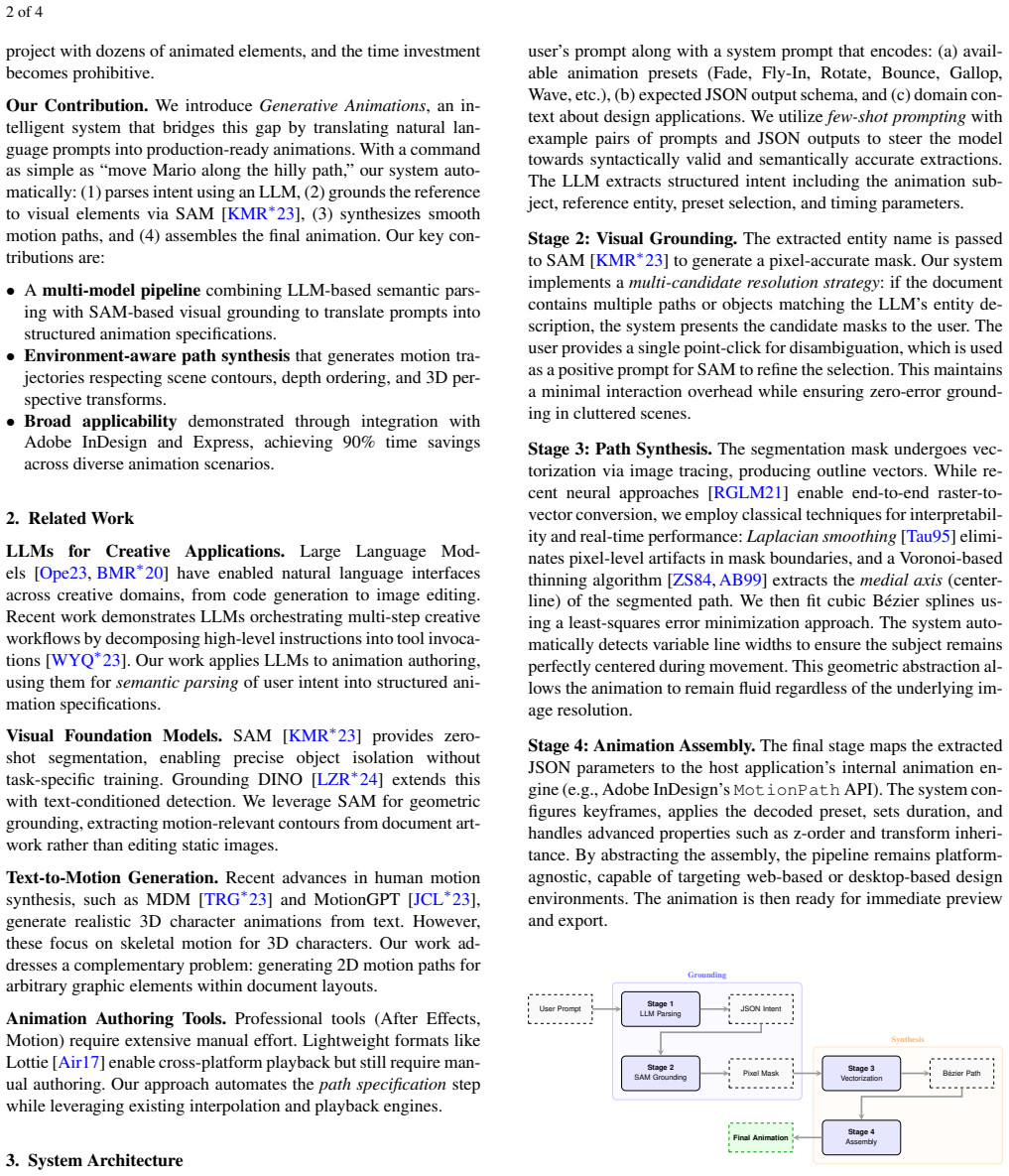
Chaining LLMs with SAM turns natural language prompts into motion paths that respect scene geometry and occlusions.
A machine-rendered reading of the paper's core claim, the machinery that carries it, and where it could break.
Core claim
By chaining Large Language Models for semantic parsing with the Segment Anything Model for visual grounding, the pipeline automatically generates motion paths that respect scene geometry, handle depth-based occlusions, and honor 3D perspective transforms, as shown through three use cases of contour-following trajectories, orbital animations with z-order awareness, and perspective-aligned motion on transformed objects.
What carries the argument
The multi-model pipeline chaining LLMs for semantic parsing with SAM for visual grounding to produce geometrically accurate motion paths from prompts.
If this is right
- Designers can generate complex animations directly from text descriptions instead of manually selecting presets or plotting points.
- Generated paths automatically respect scene geometry, depth occlusions, and 3D perspective transforms.
- Three concrete demonstrations show contour-following, z-order-aware orbital motion, and perspective-aligned paths on transformed objects.
- The approach eliminates separate configuration of timing properties by deriving them from the prompt and scene analysis.
Where Pith is reading between the lines
- If the pipeline generalizes, it could lower the skill threshold for creating custom motion in documents or interfaces for users without animation training.
- The same chaining idea might extend to generating paths in video sequences or interactive 3D environments if the visual grounding step can be repeated across frames.
- Failure cases where the LLM misparses spatial relations or SAM segments incorrectly would point to where additional validation steps become necessary.
Load-bearing premise
Off-the-shelf LLMs and SAM can be chained without custom training, error correction, or manual overrides to reliably output geometrically accurate motion paths from natural language prompts.
What would settle it
Test the pipeline on a scene containing known depth occlusions or perspective distortions and verify whether the output motion paths cross through occluded regions or violate perspective rules.
Figures
read the original abstract
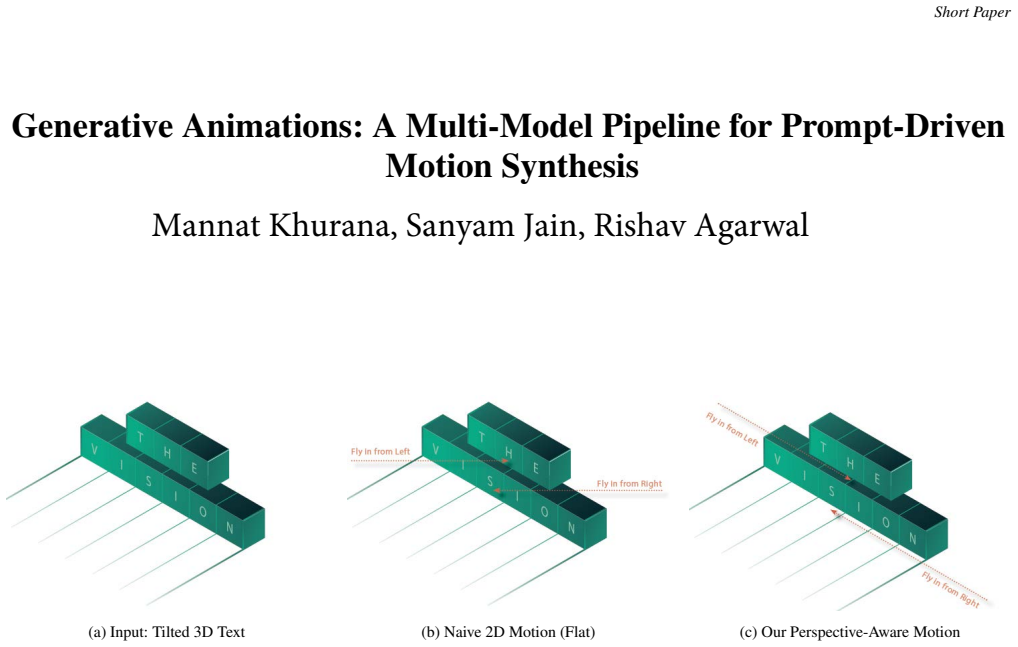
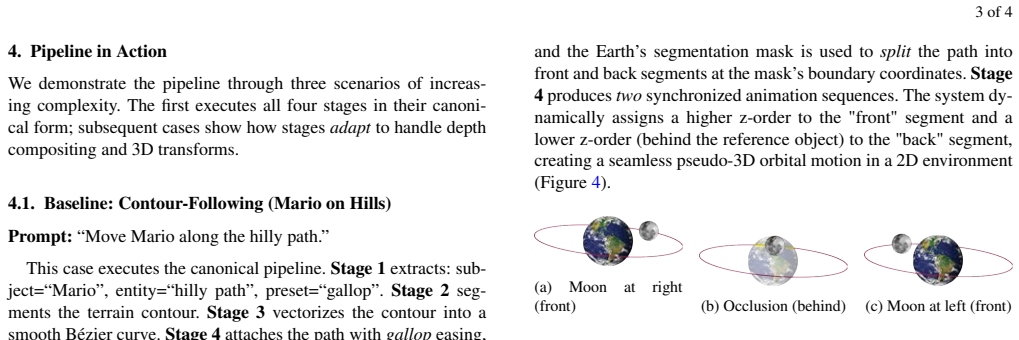
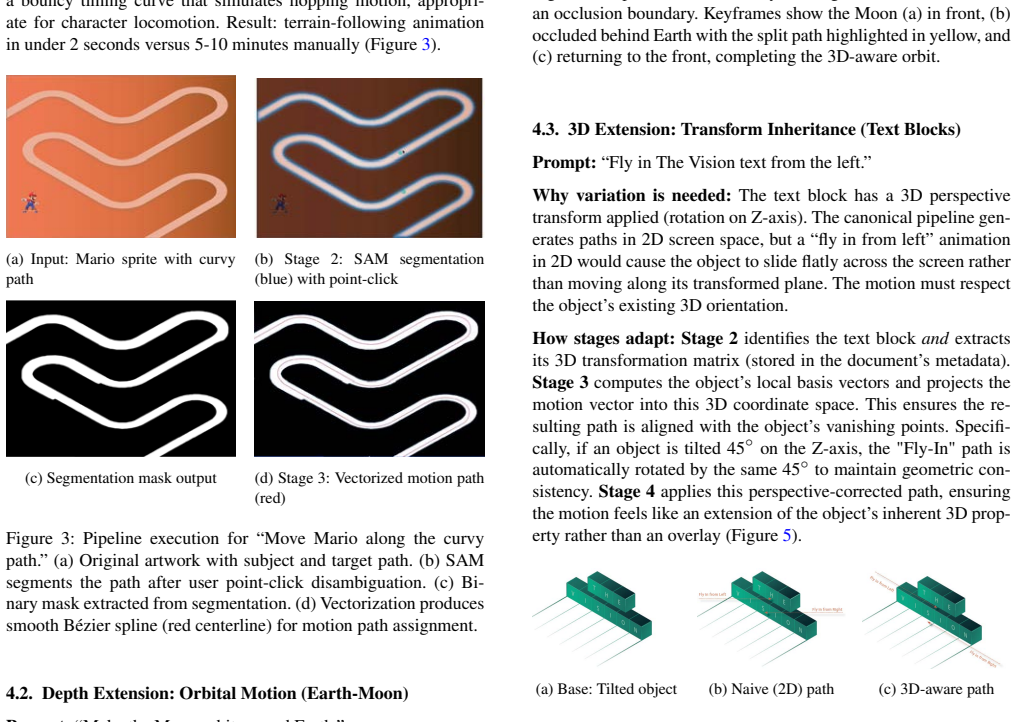
Animation elevates digital documents into immersive experiences, yet creating custom motion paths remains cumbersome, requiring designers to manually select presets, plot B\'ezier points, and configure timing properties. We introduce Generative Animations, a system that transforms natural language prompts into production-ready animations. By chaining Large Language Models (LLMs) for semantic parsing with the Segment Anything Model (SAM) for visual grounding, our pipeline automatically generates motion paths that respect scene geometry, handle depth-based occlusions, and honor 3D perspective transforms. We demonstrate the system through three use cases: contour-following trajectories, orbital animations with z-order awareness, and perspective-aligned motion on transformed objects.
Editorial analysis
A structured set of objections, weighed in public.
Referee Report
Summary. The manuscript introduces Generative Animations, a multi-model pipeline that chains LLMs for semantic parsing of natural language prompts with SAM for visual grounding to automatically produce motion paths for animations. It claims these paths respect scene geometry, handle depth-based occlusions, and honor 3D perspective transforms, and demonstrates the approach via three use cases: contour-following trajectories, orbital animations with z-order awareness, and perspective-aligned motion.
Significance. If the geometric guarantees could be substantiated, the work would offer a practical advance in reducing manual effort for custom animation paths in digital documents by leveraging off-the-shelf models. However, the complete absence of quantitative evaluation, error metrics, or implementation details prevents any assessment of whether the central claims hold.
major comments (3)
- [Abstract] Abstract: the central claim that chaining LLMs and SAM 'automatically generates motion paths that respect scene geometry, handle depth-based occlusions, and honor 3D perspective transforms' is unsupported, as the manuscript supplies no modules, depth estimators, camera parameters, or projective routines that would convert 2D SAM masks into occlusion-aware or perspective-correct trajectories.
- The manuscript contains no quantitative results, success rates, error metrics, ablation studies, or baseline comparisons to validate the assertion of automatic, geometrically correct path generation across the three use cases.
- No description is given of the precise chaining procedure, prompt engineering, error-correction steps, or any post-processing that would be required to achieve the stated 3D capabilities from purely 2D segmentation and text reasoning.
Simulated Author's Rebuttal
We thank the referee for their detailed comments. We address each point below and propose revisions where appropriate to clarify the scope and limitations of our work.
read point-by-point responses
-
Referee: [Abstract] Abstract: the central claim that chaining LLMs and SAM 'automatically generates motion paths that respect scene geometry, handle depth-based occlusions, and honor 3D perspective transforms' is unsupported, as the manuscript supplies no modules, depth estimators, camera parameters, or projective routines that would convert 2D SAM masks into occlusion-aware or perspective-correct trajectories.
Authors: We acknowledge that the abstract overstates the automatic geometric capabilities. The pipeline uses LLMs to interpret prompts and generate high-level motion descriptions, and SAM to ground objects in 2D, with the 3D aspects being handled through specific heuristics in each use case rather than general modules. No depth estimators or projective routines are present. We will revise the abstract to tone down these claims to reflect what is actually demonstrated in the use cases. revision: yes
-
Referee: [—] The manuscript contains no quantitative results, success rates, error metrics, ablation studies, or baseline comparisons to validate the assertion of automatic, geometrically correct path generation across the three use cases.
Authors: The work is presented as a demonstration of a novel pipeline through three illustrative use cases rather than a comprehensive evaluation. Quantitative metrics would require a benchmark dataset and defined measures for geometric fidelity, which are not standard in this emerging area. We will add a limitations section discussing the lack of quantitative evaluation and the challenges in defining such metrics. revision: partial
-
Referee: [—] No description is given of the precise chaining procedure, prompt engineering, error-correction steps, or any post-processing that would be required to achieve the stated 3D capabilities from purely 2D segmentation and text reasoning.
Authors: The manuscript describes the overall pipeline in the methods section, but we agree that additional details on the exact LLM prompts, chaining logic, and any post-processing steps would improve reproducibility. We will expand the methods section with more precise descriptions, example prompts, and pseudocode for the procedure. revision: yes
Circularity Check
No circularity: high-level system description with no derivations or equations
full rationale
The paper presents a pipeline description chaining LLMs and SAM for animation generation but contains no equations, fitted parameters, mathematical derivations, or self-citations that could reduce any claim to its inputs by construction. The central claim about generating geometrically accurate paths is an assertion about system behavior rather than a derived result from prior steps within the paper. No load-bearing steps match any of the enumerated circularity patterns.
Axiom & Free-Parameter Ledger
Reference graph
Works this paper leans on
-
[1]
[AB99] A MENTA N., B ERN M.: Surface reconstruction by V oronoi fil- tering. Discrete & Computational Geometry 22, 4 (1999), 481–504. doi:10.1007/PL00009475. 2 [Air17] A IRBNB DESIGN : Lottie: Render after effects animations na- tively. https://lottie.airbnb.tech/,
-
[2]
2 [BMR∗20] B RO WN T., M ANN B., R YDER N., S UBBIAH M., K APLAN J. D., D HARIWAL P., N EELAKANTAN A., S HYAM P., S ASTRY G., ASKELL A., ET AL .: Language models are few-shot learners. In Ad- vances in Neural Information Processing Systems (NeurIPS) (2020), vol. 33, pp. 1877–1901. 2 [JCL∗23] J IANG B., C HEN X., L IU W., Y U J., Y U G., C HEN T.: Mo- tion...
discussion (0)
Sign in with ORCID, Apple, or X to comment. Anyone can read and Pith papers without signing in.