Amorphous vs. Short-Range-Ordered Complexions: Consequences for Grain-Boundary-Mediated Plasticity in Nanocrystalline Al-Ni Alloys
Pith reviewed 2026-06-29 16:46 UTC · model grok-4.3
The pith
Amorphous grain-boundary complexions promote homogeneous plasticity in nanocrystalline Al-Ni alloys while short-range-ordered complexions increase strength at the expense of localization.
A machine-rendered reading of the paper's core claim, the machinery that carries it, and where it could break.
Core claim
Amorphous complexions act as dislocation sinks, suppressing shear localization and promoting homogeneous plasticity through shear transformation zones, but at the cost of lower strength. SRO complexions generate higher strength but also promote heterogeneous stress concentrations across the GB network, leading to intense shear localization regardless of Ni concentration. This contrast reflects a fundamental shift in governing mechanism, from shear-transformation-zone-controlled behavior in amorphous complexion alloys to GB-stress-heterogeneity-controlled behavior in SRO complexion alloys.
What carries the argument
The distinction between uniform amorphous intergranular films and semi-amorphous complexions containing FCC-type and BCC-type short-range order, which alters dislocation interactions and stress distribution at grain boundaries.
If this is right
- Amorphous complexions enable more uniform plastic flow through shear transformation zones.
- SRO complexions lead to higher strength but intense shear bands due to stress heterogeneity.
- The governing plasticity mechanism changes with complexion type independent of nickel content.
- Engineering grain boundary structure via annealing can tune strength and ductility in these alloys.
Where Pith is reading between the lines
- Controlling the degree of short-range order in grain boundaries could be used to balance strength and ductility in other nanocrystalline materials.
- Experimental validation at intermediate temperatures might reveal gradual transitions in deformation behavior.
- Similar complexion effects may influence fatigue or creep resistance in these alloys.
Load-bearing premise
The observed differences in plasticity arise primarily from the structural differences in the complexions produced by the two annealing temperatures rather than from other aspects of the simulation setup.
What would settle it
An experiment showing no change in shear localization behavior when annealing produces different levels of short-range order in the grain boundaries.
Figures
read the original abstract
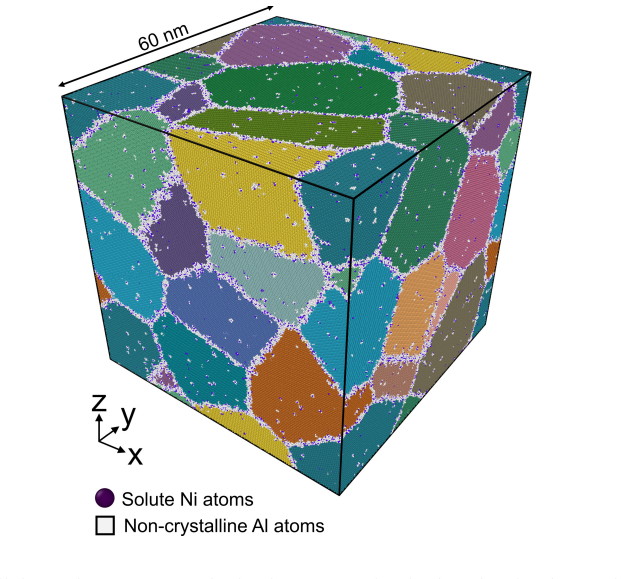
Amorphous grain-boundary (GB) complexions in thermally stable nanocrystalline alloys are commonly assumed to be structurally homogeneous, yet their disordered nature makes them susceptible to local short-range ordering (SRO). The influence of local SRO on GB-mediated plasticity mechanisms in such complexions remains poorly understood. This article employs large-scale Monte Carlo and molecular dynamics simulation to address this gap through simulations of nanocrystalline Al-Ni alloys at two Ni concentrations, 2 at.% and 4 at.%. Annealing at 913 K produces thick uniform amorphous intergranular film complexions, while annealing at 378 K produces semi-amorphous complexions containing FCC-type and BCC-type SRO. These two complexion states produce fundamentally different mechanical responses. Amorphous complexions act as dislocation sinks, suppressing shear localization and promoting homogeneous plasticity through shear transformation zones, but at the cost of lower strength. SRO complexions generate higher strength but also promote heterogeneous stress concentrations across the GB network, leading to intense shear localization regardless of Ni concentration. This contrast reflects a fundamental shift in governing mechanism, from shear-transformation-zone-controlled behavior in amorphous complexion alloys to GB-stress-heterogeneity-controlled behavior in SRO complexion alloys. These findings highlight the potential of complexion engineering to tailor the mechanical properties of nanocrystalline materials.
Editorial analysis
A structured set of objections, weighed in public.
Referee Report
Summary. The manuscript uses Monte Carlo and molecular dynamics simulations of nanocrystalline Al-Ni alloys (2 at.% and 4 at.% Ni) to compare two GB complexion states: thick uniform amorphous intergranular films produced by annealing at 913 K versus semi-amorphous films containing FCC- and BCC-type SRO produced by annealing at 378 K. It reports that amorphous complexions act as dislocation sinks, enabling homogeneous plasticity via shear transformation zones at the expense of lower strength, while SRO complexions raise strength but induce heterogeneous GB stress concentrations that drive intense shear localization independent of Ni content, indicating a shift from STZ-controlled to GB-stress-heterogeneity-controlled deformation mechanisms.
Significance. If the reported mechanism shift is robustly attributable to SRO rather than confounding variables, the work would establish that local ordering within complexions can switch the dominant plasticity pathway in nanocrystalline alloys, providing a concrete route for complexion engineering to balance strength and ductility. The direct comparison across two Ni concentrations and the use of large-scale atomistic methods are positive features that support generality within the simulated regime.
major comments (1)
- [Abstract/Methods] Abstract and §3 (or equivalent methods/results sections): the two annealing temperatures produce complexions that differ simultaneously in SRO content and in GB film thickness (thick uniform amorphous films vs. semi-amorphous films). Because GB thickness is independently known to modulate dislocation absorption capacity and local stress concentrations, the central attribution of the plasticity-mechanism switch to the presence/absence of FCC/BCC SRO requires explicit isolation of SRO from thickness (e.g., via additional simulations that hold thickness or segregation profiles fixed while varying only ordering). Without such controls the causal claim remains under-determined.
minor comments (2)
- [Methods] The interatomic potential used for both Monte Carlo and MD steps should be validated against known Al-Ni ordering tendencies or experimental GB structures; absence of such validation leaves open whether the observed SRO stabilization is potential-specific.
- [Methods/Results] Specific system sizes, number of distinct GBs sampled, strain rates, and statistical measures of stress heterogeneity should be stated explicitly to allow assessment of finite-size and sampling effects on the reported localization behavior.
Simulated Author's Rebuttal
We thank the referee for the constructive comment on potential confounding factors in our comparison of complexion states. We address the concern point-by-point below.
read point-by-point responses
-
Referee: [Abstract/Methods] Abstract and §3 (or equivalent methods/results sections): the two annealing temperatures produce complexions that differ simultaneously in SRO content and in GB film thickness (thick uniform amorphous films vs. semi-amorphous films). Because GB thickness is independently known to modulate dislocation absorption capacity and local stress concentrations, the central attribution of the plasticity-mechanism switch to the presence/absence of FCC/BCC SRO requires explicit isolation of SRO from thickness (e.g., via additional simulations that hold thickness or segregation profiles fixed while varying only ordering). Without such controls the causal claim remains under-determined.
Authors: We agree that the two annealing temperatures simultaneously alter both SRO content and GB film thickness, and that thickness is known to affect dislocation absorption and stress concentrations. Our structural analysis links the observed stress heterogeneities specifically to the FCC- and BCC-type SRO clusters present only in the lower-temperature films; the high-temperature films are uniformly amorphous without such clusters. The mechanism shift is consistent across both Ni concentrations despite any thickness variation. While dedicated simulations holding thickness fixed would provide stronger isolation, such controls are outside the scope of the present study. We will add a dedicated paragraph in the revised discussion section explicitly acknowledging the thickness difference and justifying the attribution to SRO on the basis of the local structural and stress characterizations already performed. revision: partial
Circularity Check
Direct simulation comparison; no derivation reduces to inputs by construction
full rationale
The paper reports outcomes from two distinct Monte Carlo + MD protocols (annealing at 913 K vs. 378 K) on nanocrystalline Al-Ni models, then compares the resulting GB complexions and their plasticity responses. No equations, fitted parameters, or predictions are defined; the claimed mechanism shift is presented as an observed contrast between the two simulation states. No self-citations are invoked as load-bearing uniqueness theorems, and no ansatz or renaming of known results occurs. The central claim therefore remains an empirical finding from the simulations rather than a tautological reduction to prior inputs.
Axiom & Free-Parameter Ledger
Reference graph
Works this paper leans on
-
[1]
Zhou, N., T. Hu, and J. Luo, Grain boundary complexions in multicomponent alloys: Challenges and opportunities. Current Opinion in Solid State and Materials Science, 2016. 20(5): p. 268-277. https://doi.org/10.1016/j.cossms.2016.05.001
-
[2]
Ding, J., Z. Shang, Y.F. Zhang, R. Su, J. Li, H. Wang, and X. Zhang, Tailoring the thermal stability of nanocrystalline Ni alloy by thick grain boundaries. Scripta Materialia, 2020. 182: p. 21-26. https://doi.org/10.1016/j.scriptamat.2020.02.032
-
[4]
Schuler, J.D., C.M. Grigorian, C.M. Barr, B.L. Boyce, K. Hattar, and T.J. Rupert, Amorphous intergranular films mitigate radiation damage in nanocrystalline Cu- Zr. Acta Materialia, 2020. 186: p. 341- 354. https://doi.org/10.1016/j.actamat.2019.12.048
-
[5]
Current Opinion in Solid State and Materials Science, 2016
Rupert, T.J., The role of complexions in metallic nano -grain stability and deformation. Current Opinion in Solid State and Materials Science, 2016. 20(5): p. 257-267. https://doi.org/10.1016/j.cossms.2016.05.005
-
[6]
Schuler, J.D. and T.J. Rupert, Materials selection rules for amorphous complexion formation in binary metallic alloys. Acta Materialia, 2017. 140: p. 196- 205. https://doi.org/10.1016/j.actamat.2017.08.042
-
[7]
Pan, Z. and T.J. Rupert, Effect of grain boundary character on segregation-induced structural transitions. Physical Review B, 2016. 93(13): p. 134113. 10.1103/PhysRevB.93.134113
-
[8]
Pan, Z. and T.J. Rupert, Formation of ordered and disordered interfacial films in immiscible metal alloys. Scripta Materialia, 2017. 130: p. 91- 95. https://doi.org/10.1016/j.scriptamat.2016.11.025
-
[9]
Lei, T., E.C. Hessong, D.S. Gianola, and T.J. Rupert, Binary nanocrystalline alloys with strong glass forming interfacial regions: Complexion stability, segregation competition, and diffusion pathways. Materials Characterization, 2023. 206: p. 113415. https://doi.org/10.1016/j.matchar.2023.113415
-
[10]
Xu, K., X. Sheng, A. Mathew, E. Flores, H. Wang, Y. Kulkarni, and X. Zhang, Mechanical Behavior and Thermal Stability of Nanocrystalline Metallic Materials with Thick Grain Boundaries. JOM, 2024. 76(6): p. 2914-2928. 10.1007/s11837- 024-06585-4
-
[11]
Khalajhedayati, A. and T.J. Rupert, High -Temperature Stability and Grain Boundary Complexion Formation in a Nanocrystalline Cu- Zr Alloy. JOM, 2015. 67(12): p. 2788-2801. 10.1007/s11837-015-1644-9
-
[12]
Khalajhedayati, A., Z. Pan, and T.J. Rupert, Manipulating the interfacial structure of nanomaterials to achieve a unique combination of strength and ductility. Nature 21 Communications, 2016. 7(1): p. 10802. 10.1038/ncomms10802
-
[13]
Turlo, V. and T.J. Rupert, Grain boundary complexions and the strength of nanocrystalline metals: Dislocation emission and propagation. Acta Materialia,
-
[14]
151: p. 100-111. https://doi.org/10.1016/j.actamat.2018.03.055
-
[15]
Van Swygenhoven, H., P.M. Derlet, and A. Hasnaoui, Atomic mechanism for dislocation emission from nanosized grain boundaries. Physical Review B, 2002. 66(2): p. 024101. 10.1103/PhysRevB.66.024101
-
[16]
Balbus, G.H., F. Wang, and D.S. Gianola, Suppression of shear localization in nanocrystalline Al–Ni–Ce via segregation engineering. Acta Materialia, 2020. 188: p. 63-78. https://doi.org/10.1016/j.actamat.2020.01.041
-
[17]
Garg, P. and T.J. Rupert, Local structural ordering determines the mechanical damage tolerance of amorphous grain boundary complexions. Scripta Materialia,
-
[18]
237: p. 115712. https://doi.org/10.1016/j.scriptamat.2023.115712
-
[19]
Pan, Z. and T.J. Rupert, Spatial variation of short -range order in amorphous intergranular complexions. Computational Materials Science, 2017. 131: p. 62-68. https://doi.org/10.1016/j.commatsci.2017.01.033
-
[20]
Jha, R.K., R. Kumar, A. Dutta, and S. Mandal, Implication of site -specific segregation on grain boundary structural transition and deformation response in nanocrystalline Ni -Nb alloy. Computational Materials Science, 2024. 233: p. 112766. https://doi.org/10.1016/j.commatsci.2023.112766
-
[21]
Journal of computational physics, 1995
Plimpton, S., Fast parallel algorithms for short-range molecular dynamics. Journal of computational physics, 1995. 117(1): p. 1-19
1995
-
[22]
Mishin, Y., M.J. Mehl, and D.A. Papaconstantopoulos, Embedded- atom potential for $B2\ ensuremath{-}\mathrm{NiAl}$. Physical Review B, 2002. 65 (22): p. 224114. 10.1103/PhysRevB.65.224114
-
[23]
Erhart, A
Sadigh, B., P. Erhart, A. Stukowski, A. Caro, E. Martinez, and L. Zepeda -Ruiz, Scalable parallel Monte Carlo algorithm for atomistic simulations of precipitation in alloys. Physical Review B, 2012. 85(18): p. 184203
2012
-
[24]
Pan, Z. and F. Sansoz, Heterogeneous solute segregation suppresses strain localization in nanocrystalline Ag-Ni alloys. Acta Materialia, 2020. 200: p. 91-100. https://doi.org/10.1016/j.actamat.2020.08.074
-
[25]
Kattner, U. and B. Burton, ASM Handbook Volume 3: Alloy Phase Diagrams. ASM International: Geauga County, OH, USA, 1992: p. 2-44
1992
-
[26]
Computer Physics Communications, 2015
Hirel, P., Atomsk: A tool for manipulating and converting atomic data files. Computer Physics Communications, 2015. 197: p. 212-219
2015
-
[27]
Modelling and Simulation in Materials Science and Engineering, 2009
Stukowski, A., Visualization and analysis of atomistic simulation data with OVITO–the Open Visualization Tool. Modelling and Simulation in Materials Science and Engineering, 2009. 18(1): p. 015012
2009
-
[28]
Ackermann, and P
Mahladisa, M., L. Ackermann, and P. Ngoepe, Structural properties of gold clusters at different temperatures: : NRF / Royal Society programme. South African 22 journal of science, 2005. 101: p. 471-474
2005
-
[29]
Kittel, C. and P. McEuen, Kittel's Introduction to Solid State Physics . 2018: John Wiley & Sons
2018
-
[30]
Wu, G., C. Liu, L. Sun, Q. Wang, B. Sun, B. Han, J.- J. Kai, J. Luan, C.T. Liu, K. Cao, Y. Lu, L. Cheng, and J. Lu, Hierarchical nanostructured aluminum alloy with ultrahigh strength and large plasticity. Nature Communications, 2019. 10(1): p
2019
-
[31]
10.1038/s41467-019-13087-4
-
[32]
Ding, J., E. Ma, M. Asta, and R.O. Ritchie, Second-Nearest-Neighbor Correlations from Connection of Atomic Packing Motifs in Metallic Glasses and Liquids. Scientific Reports, 2015. 5(1): p. 17429. 10.1038/srep17429
-
[33]
Larsen, P.M., S. Schmidt, and J. Schiøtz, Robust structural identification via polyhedral template matching. Modelling and Simulation in Materials Science and Engineering, 2016. 24(5): p. 055007. 10.1088/0965-0393/24/5/055007
-
[34]
Steif, P.S., F. Spaepen, and J.W. Hutchinson, Strain localization in amorphous metals. Acta Metallurgica, 1982. 30(2): p. 447-455. https://doi.org/10.1016/0001- 6160(82)90225-5
-
[35]
Qian, L ., W. Yang, J. Luo, Y. Wang, K.C. Chan, and X.- S. Yang, Amorphous Thickness-Dependent Strengthening–Softening Transition in Crystalline – Amorphous Nanocomposites. Nano Letters, 2023. 23(23): p. 11288- 11296. 10.1021/acs.nanolett.3c03848
-
[36]
Argon, A.S., Plastic deformation in metallic glasses. Acta Metallurgica, 1979. 27(1): p. 47-58. https://doi.org/10.1016/0001-6160(79)90055-5
-
[37]
Sansoz, F. and X. Ke, Hall –Petch strengthening limit through partially active segregation in nanocrystalline Ag -Cu alloys. Acta Materialia, 2022. 225: p. 117560. https://doi.org/10.1016/j.actamat.2021.117560
-
[38]
Packard, C.E. and C.A. Schuh, Initiation of shear bands near a stress concentration in metallic glass. Acta Materialia, 2007. 55(16): p. 5348- 5358. https://doi.org/10.1016/j.actamat.2007.05.054
-
[39]
Perepezko, J.H., S.D. Imhoff, M. -W. Chen, J.- Q. Wang, and S. Gonzalez, Nucleation of shear bands in amorphous alloys. Proceedings of the National Academy of Sciences, 2014. 111(11): p. 3938-3942. 10.1073/pnas.1321518111
discussion (0)
Sign in with ORCID, Apple, or X to comment. Anyone can read and Pith papers without signing in.