REVIEW 2 major objections 22 references
LLMs recognize Hong Kong stylistic features mainly through surface-level words rather than deeper stylistic structure.
Reviewed by Pith at T0; open to challenge. T0 means a machine referee read the full paper against a public rubric. the ladder, T0–T4 →
T0 review · grok-4.3
2026-06-29 17:50 UTC pith:U66CCQY7
load-bearing objection The paper's main observation is that LLMs lean on surface features for Hong Kong stylistic recognition in their new benchmark, but the ablation details are too thin to support that cleanly. the 2 major comments →
Probing Cultural Awareness in LLMs: A Case Study of Cross-Culture Aesthetic Stylistics
The pith
A machine-rendered reading of the paper's core claim, the machinery that carries it, and where it could break.
Core claim
In the Hong Kong setting, stylistic recognition in LLMs relies primarily on surface-level linguistic information rather than stylistic structure. This suggests limited sensitivity to Hong Kong-specific stylistic structure. The C4STYLI benchmark shows LLMs differ from humans in recognition, with domain variation and inconsistent alignment between recognition and generation tasks.
What carries the argument
The C4STYLI benchmark of highly stylized translated movie titles and slogans, paired with structural ablation via logistic regression probes that isolate stylistic structure from surface features.
Load-bearing premise
The logistic regression probes cleanly separate stylistic structure from surface linguistic features, and the C4STYLI texts encode distinct Hong Kong versus mainland stylistic structures that humans can reliably distinguish.
What would settle it
An experiment in which humans fail to distinguish the Hong Kong and mainland texts in C4STYLI at above-chance levels, or in which LLMs maintain high recognition accuracy after surface features are removed, would undermine the central claim.
If this is right
- Stylistic recognition and generation performance in LLMs are not consistently aligned.
- LLMs differ from humans in stylistic recognition ability.
- Recognition performance varies across text domains such as movie titles and slogans.
- LLMs show limited sensitivity to Hong Kong-specific stylistic structure in the tested setting.
Where Pith is reading between the lines
- Similar surface-versus-structure probes could be run on other regional Chinese varieties or non-Chinese cultures to check whether the surface reliance pattern is widespread.
- If surface cues dominate, targeted training on examples that emphasize structural differences might shift model behavior toward deeper stylistic capture.
- The C4STYLI texts could serve as a fixed test set for measuring whether future models close the gap with human stylistic discrimination.
Editorial analysis
A structured set of objections, weighed in public.
Referee Report
Summary. The manuscript curates C4STYLI, a benchmark of highly stylized translated movie titles and advertising slogans from Hong Kong and the Chinese Mainland, to evaluate LLMs on behavioral recognition and productive competence in aesthetic stylistics. Extensive evaluations show LLMs differ from humans in stylistic recognition (varying by domain), that recognition and generation performance are not consistently aligned, and that logistic regression probes indicate stylistic recognition in the Hong Kong setting relies primarily on surface-level linguistic information rather than stylistic structure, suggesting limited sensitivity to Hong Kong-specific stylistic structure.
Significance. If the ablation results hold after proper controls, the work offers a concrete empirical benchmark for cultural stylistic awareness in LLMs, grounded in direct model outputs and human comparisons rather than circular definitions. It highlights a potential gap between surface cues and deeper structural sensitivity in cross-cultural settings, which could guide future probing methods and training objectives for cultural competence.
major comments (2)
- [Abstract / structural ablation] Abstract and structural ablation description: the central claim that Hong Kong stylistic recognition relies primarily on surface-level information (rather than structure) is load-bearing on the logistic regression probes successfully isolating stylistic structure from surface features. No details are given on probe input representations, feature sets, how lexical/n-gram cues are orthogonalized or controlled, dataset size, or statistical controls, so the ablation result does not yet support the interpretation of limited sensitivity to Hong Kong-specific structure.
- [Abstract / C4STYLI benchmark] C4STYLI curation and human evaluation: the assumption that the texts encode distinct Hong Kong versus mainland stylistic structures that humans reliably distinguish is central to interpreting the LLM results, yet no information is provided on curation criteria, translation artifact controls (e.g., movie titles/slogans), dataset size, or inter-annotator agreement.
Simulated Author's Rebuttal
We thank the referee for the detailed and constructive comments. We address each major point below and will revise the manuscript to supply the requested methodological details.
read point-by-point responses
-
Referee: [Abstract / structural ablation] Abstract and structural ablation description: the central claim that Hong Kong stylistic recognition relies primarily on surface-level information (rather than structure) is load-bearing on the logistic regression probes successfully isolating stylistic structure from surface features. No details are given on probe input representations, feature sets, how lexical/n-gram cues are orthogonalized or controlled, dataset size, or statistical controls, so the ablation result does not yet support the interpretation of limited sensitivity to Hong Kong-specific structure.
Authors: We agree that the current description of the logistic regression probes is insufficient to support the interpretation. In the revised manuscript we will add a dedicated subsection (or appendix) specifying the probe input representations, the exact feature sets, the procedures used to orthogonalize or control for lexical and n-gram cues, the dataset sizes employed, and the statistical controls applied. These additions will allow readers to evaluate whether the probes successfully isolate stylistic structure. revision: yes
-
Referee: [Abstract / C4STYLI benchmark] C4STYLI curation and human evaluation: the assumption that the texts encode distinct Hong Kong versus mainland stylistic structures that humans reliably distinguish is central to interpreting the LLM results, yet no information is provided on curation criteria, translation artifact controls (e.g., movie titles/slogans), dataset size, or inter-annotator agreement.
Authors: We acknowledge that the manuscript currently provides limited information on benchmark construction. The revised version will include an expanded methods section (and appendix) that details the curation criteria for C4STYLI, the specific controls applied to mitigate translation artifacts in movie titles and slogans, the precise dataset sizes, and the inter-annotator agreement statistics from the human evaluation. These additions will strengthen the grounding for the assumption that the texts encode distinct stylistic structures. revision: yes
Circularity Check
No circularity: empirical benchmark with direct observations
full rationale
The paper is a standard empirical study that curates the C4STYLI benchmark, runs LLMs on recognition/generation tasks, compares to humans, and applies logistic regression probes for ablation. All reported findings rest on observed outputs and human judgments rather than any derivation, equation, or prediction that reduces to its own inputs by construction. No self-definitional steps, fitted inputs renamed as predictions, or load-bearing self-citations appear in the text. The central claim about surface-level reliance in the Hong Kong setting follows from the ablation results themselves, which are not forced by prior definitions or citations within the paper.
Axiom & Free-Parameter Ledger
axioms (1)
- domain assumption The C4STYLI texts contain distinct Hong Kong-specific stylistic structures that can be separated from surface linguistic features by logistic regression probes.
Cite this review
Pith. "Pith review of Probing Cultural Awareness in LLMs: A Case Study of Cross-Culture Aesthetic Stylistics." pith.science (2026). https://pith.science/paper/U66CCQY7
@misc{pith2026260527296,
  author       = {Pith},
  title        = {Pith review of: Probing Cultural Awareness in LLMs: A Case Study of Cross-Culture Aesthetic Stylistics},
  year         = {2026},
  howpublished = {\url{https://pith.science/paper/U66CCQY7}},
  note         = {Machine review of arXiv:2605.27296}
}
read the original abstract
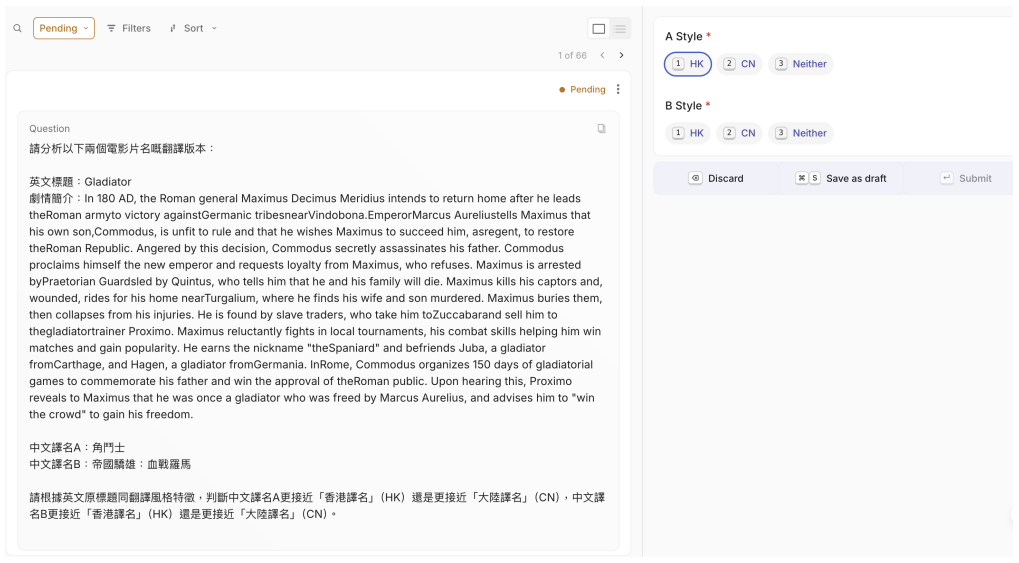
Large Language Models (LLMs) are increasingly deployed in diverse cultural contexts, yet their ability to master aesthetic stylistics, i.e., the strategic use of language to evoke cultural resonance, remains underexplored. We curate C4STYLI, a benchmark of highly stylized translated movie titles and advertising slogans from Hong Kong and the Chinese Mainland, to evaluate LLMs via the lens of behavioral recognition and productive competence. Extensive evaluations show that LLMs differ from humans in stylistic recognition, and this recognition ability varies across text domains. In addition, stylistic recognition and generation performance in LLMs are not consistently aligned. To further examine whether LLMs genuinely capture stylistic information in stylistic recognition, we conduct structural ablation with logistic regression probes. We find that, in the Hong Kong setting, stylistic recognition in LLMs relies primarily on surface-level linguistic information rather than stylistic structure. This suggests limited sensitivity to Hong Kong-specific stylistic structure.
Figures


Reference graph
Works this paper leans on
-
[1]
Cultural adap- tation of recipes.Transactions of the Association for Com- putational Linguistics, 12:80–99,
[Caoet al., 2024 ] Yong Cao, Yova Kementchedjhieva, Ruix- iang Cui, Antonia Karamolegkou, Li Zhou, Megan Dare, Lucia Donatelli, and Daniel Hershcovich. Cultural adap- tation of recipes.Transactions of the Association for Com- putational Linguistics, 12:80–99,
2024
-
[2]
A novel hybrid model for cantonese rumor detection on twitter.Applied Sciences, 10(20):7093,
[Chenet al., 2020 ] Xinyu Chen, Liang Ke, Zhipeng Lu, Hanjian Su, and Haizhou Wang. A novel hybrid model for cantonese rumor detection on twitter.Applied Sciences, 10(20):7093,
2020
-
[3]
Testing the boundaries of LLMs: Dialectal and language-variety tasks
[Faisal and Anastasopoulos, 2025] Fahim Faisal and Anto- nios Anastasopoulos. Testing the boundaries of LLMs: Dialectal and language-variety tasks. In Yves Scherrer, Tommi Jauhiainen, Nikola Ljube ˇsi´c, Preslav Nakov, Jorg Tiedemann, and Marcos Zampieri, editors,Proceedings of the 12th Workshop on NLP for Similar Languages, Vari- eties and Dialects, page...
2025
-
[4]
[Hickey, 2014] Leo Hickey.The Pragmatics of Style (RLE Linguistics B: Grammar)
Association for Computational Linguistics. [Hickey, 2014] Leo Hickey.The Pragmatics of Style (RLE Linguistics B: Grammar). Routledge,
2014
-
[5]
How well do llms handle cantonese? bench- marking cantonese capabilities of large language models
[Jianget al., 2025 ] Jiyue Jiang, Pengan Chen, Liheng Chen, Sheng Wang, Qinghang Bao, Lingpeng Kong, Yu Li, and Chuan Wu. How well do llms handle cantonese? bench- marking cantonese capabilities of large language models. InFindings of the Association for Computational Linguis- tics: NAACL 2025, pages 4464–4505,
2025
-
[6]
Learning to correct for qa reasoning with black-box llms
[Kimet al., 2024 ] Jaehyung Kim, Dongyoung Kim, and Yiming Yang. Learning to correct for qa reasoning with black-box llms. InProceedings of the 2024 Conference on Empirical Methods in Natural Language Processing, pages 8916–8937,
2024
-
[7]
Pycantonese: Can- tonese linguistics and nlp in python
[Leeet al., 2022 ] Jackson Lee, Litong Chen, Charles Lam, Chaak-ming Lau, and Tsz-Him Tsui. Pycantonese: Can- tonese linguistics and nlp in python. InProceedings of the thirteenth language resources and evaluation conference, pages 6607–6611,
2022
-
[8]
Toward a parallel corpus of spo- ken cantonese and written chinese
[Lee, 2011] John SY Lee. Toward a parallel corpus of spo- ken cantonese and written chinese. InProceedings of 5th International Joint Conference on Natural Language Pro- cessing, pages 1462–1466,
2011
-
[9]
Hkcac: the hong kong cantonese adult language corpus
[Leung and Law, 2001] Man-Tak Leung and Sam-Po Law. Hkcac: the hong kong cantonese adult language corpus. International journal of corpus linguistics, 6(2):305–325,
2001
-
[10]
Culturellm: Incor- porating cultural differences into large language mod- els.Advances in Neural Information Processing Systems, 37:84799–84838,
[Liet al., 2024 ] Cheng Li, Mengzhuo Chen, Jindong Wang, Sunayana Sitaram, and Xing Xie. Culturellm: Incor- porating cultural differences into large language mod- els.Advances in Neural Information Processing Systems, 37:84799–84838,
2024
-
[11]
Do large language models understand morality across cul- tures? InProceedings of the 2nd LUHME Workshop, pages 30–39,
[Mohammadiet al., 2025 ] Hadi Mohammadi, Yasmeen FSS Meijer, Efthymia Papadopoulou, and Ayoub Bagheri. Do large language models understand morality across cul- tures? InProceedings of the 2nd LUHME Workshop, pages 30–39,
2025
-
[12]
[Nangiaet al., 2020 ] Nikita Nangia, Clara Vania, Rasika Bhalerao, and Samuel R. Bowman. CrowS-pairs: A chal- lenge dataset for measuring social biases in masked lan- guage models. InProceedings of the 2020 Conference on Empirical Methods in Natural Language Processing (EMNLP), pages 1953–1967, Online, November
2020
-
[13]
[Pawaret al., 2025 ] Siddhesh Pawar, Junyeong Park, Jiho Jin, Arnav Arora, Junho Myung, Srishti Yadav, Faiz Ghi- fari Haznitrama, Inhwa Song, Alice Oh, and Isabelle Au- genstein
Association for Computational Linguistics. [Pawaret al., 2025 ] Siddhesh Pawar, Junyeong Park, Jiho Jin, Arnav Arora, Junho Myung, Srishti Yadav, Faiz Ghi- fari Haznitrama, Inhwa Song, Alice Oh, and Isabelle Au- genstein. Survey of cultural awareness in language mod- els: Text and beyond.Computational Linguistics, pages 1–96,
2025
-
[14]
[Riffaterre, 1978] Michael Riffaterre.Semiotics of poetry, volume
1978
-
[15]
Tracing se- mantic variation in slang
[Sun and Xu, 2022] Zhewei Sun and Yang Xu. Tracing se- mantic variation in slang. In Yoav Goldberg, Zornitsa Kozareva, and Yue Zhang, editors,Proceedings of the 2022 Conference on Empirical Methods in Natural Lan- guage Processing, pages 1299–1313, Abu Dhabi, United Arab Emirates, December
2022
-
[16]
[Wales, 2014] Katie Wales.A dictionary of stylistics
Association for Compu- tational Linguistics. [Wales, 2014] Katie Wales.A dictionary of stylistics. Rout- ledge,
2014
-
[17]
Sentiment augmented attention network for cantonese restaurant review analysis
[Xianget al., 2019 ] Rong Xiang, Ying Jiao, and Qin Lu. Sentiment augmented attention network for cantonese restaurant review analysis. InProceedings of the 8th KDD Workshop on Issues of Sentiment Discovery and Opinion Mining (WISDOM), pages 1–9. KDD WISDOM,
2019
-
[18]
Llm as a mastermind: A survey of strategic reasoning with large language models
[Zhanget al., 2024 ] Yadong Zhang, Shaoguang Mao, Tao Ge, Xun Wang, Yan Xia, Wenshan Wu, Ting Song, Man Lan, and Furu Wei. Llm as a mastermind: A survey of strategic reasoning with large language models. InFirst Conference on Language Modeling,
2024
-
[19]
Does mapo tofu contain cof- fee? probing LLMs for food-related cultural knowledge
[Zhouet al., 2025a ] Li Zhou, Taelin Karidi, Wanlong Liu, Nicolas Garneau, Yong Cao, Wenyu Chen, Haizhou Li, and Daniel Hershcovich. Does mapo tofu contain cof- fee? probing LLMs for food-related cultural knowledge. In Luis Chiruzzo, Alan Ritter, and Lu Wang, editors,Pro- ceedings of the 2025 Conference of the Nations of the Americas Chapter of the Associ...
2025
-
[20]
[Zhouet al., 2025b ] Li Zhou, Lutong Yu, Dongchu Xie, Shaohuan Cheng, Wenyan Li, and Haizhou Li
Association for Computational Linguis- tics. [Zhouet al., 2025b ] Li Zhou, Lutong Yu, Dongchu Xie, Shaohuan Cheng, Wenyan Li, and Haizhou Li. Hanfu- bench: A multimodal benchmark on cross-temporal cultural understanding and transcreation. In Christos Christodoulopoulos, Tanmoy Chakraborty, Carolyn Rose, and Violet Peng, editors,Proceedings of the 2025 Con...
2025
-
[21]
Association for Computational Linguistics. A Experimental Details A.1 Accessed Models For behavioral recognition and productive competence, we evaluate the cultural awareness of 18 large language mod- els (LLMs), spanning six major open-source and closed- source model families. The evaluated models were primarily trained on English, Simplified Chinese, an...
2024
-
[22]
说明|引 导"为主要功能,强调信息的完整性和规范性,受众角色相对被动。 -香港广告标语:以
5 SenseChat-5- Cantonese was released on 23 Apr 2024; and SenseNova-V6- 5-Turbo was released in Jun 2025.6 A.2 Implementation Settings We conduct experiments on our collected dataset, C 4STYLI. Closed-source models are evaluated via their respective APIs, while open-source models are run using vLLM on 4×NVIDIA A6000 GPUs (48GB each). Unless stated oth- er...
2024
discussion (0)
Sign in with ORCID, Apple, or X to comment. Anyone can read and Pith papers without signing in.