Informing AI Policy Assessment using Large-Scale Simulation of Interventions
Pith reviewed 2026-07-05 10:30 UTC · model glm-5.2
The pith
Genetic Algorithm Explores Billions of AI Policy Combos
A machine-rendered reading of the paper's core claim, the machinery that carries it, and where it could break.
Core claim
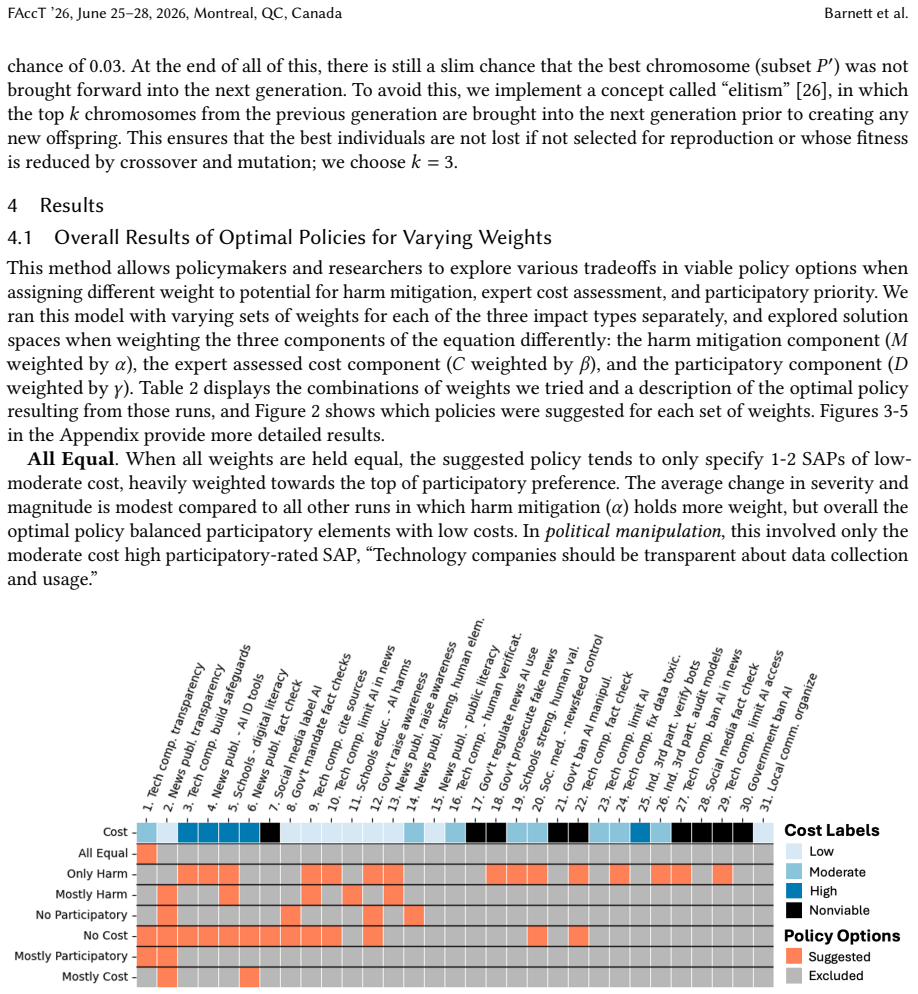
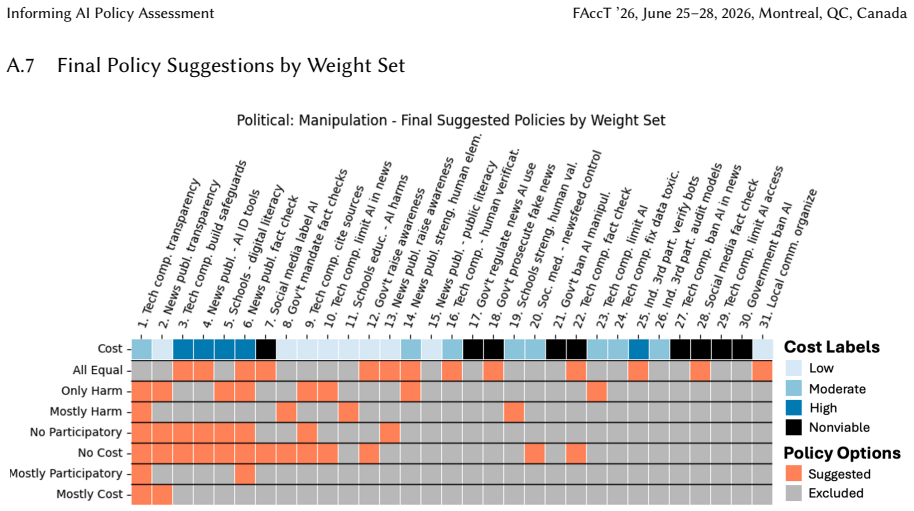
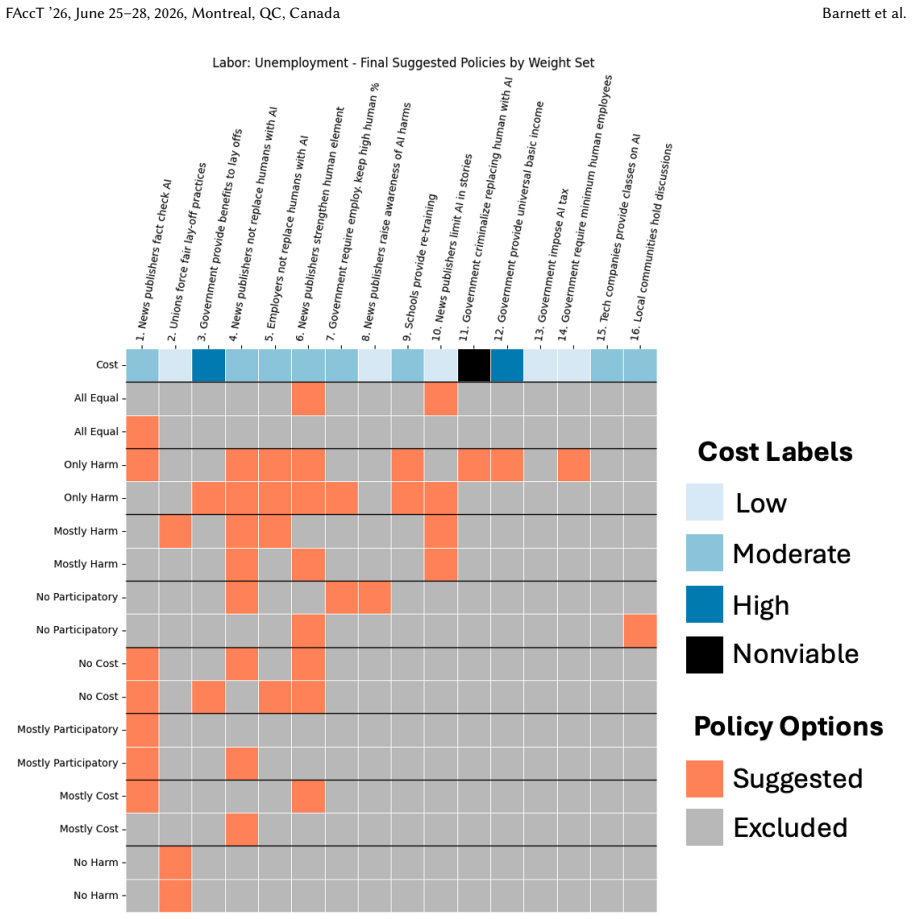
The central finding is that varying the relative weights assigned to harm mitigation, expert-assessed cost, and participatory preference produces materially different policy recommendations — not just in number but in substance. When harm mitigation dominates, the algorithm selects 40-50% of available policy actions including high-cost ones; when cost or participatory preference dominates, it narrows to 1-2 actions. When all three are weighted equally, a small number of low-cost, publicly popular actions emerge. The paper also finds that removing the expert cost component leads the algorithm to select legally or technically infeasible policies 67% of the time, demonstrating that expert input
What carries the argument
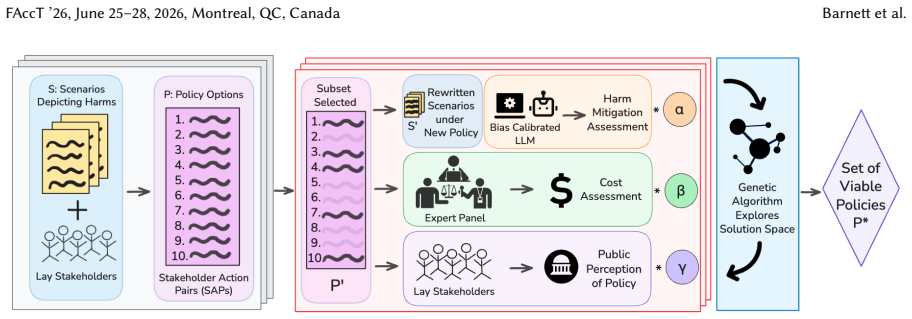
The optimization function F(S, P') = α(M) − β(C) + γ(D), where M is LLM-assessed harm mitigation (via scenario rewriting and evaluation), C is expert-assessed implementation cost, and D is participatory rating from lay stakeholders. A genetic algorithm searches the combinatorial space of policy subsets (up to 2^31 possibilities) to find locally optimal policy bundles under different weight settings (α, β, γ).
If this is right
- Policymakers could use this method as a pre-screening tool before committing to expensive evaluations like randomized controlled trials, narrowing the field of candidate interventions from billions of combinations to a handful of viable bundles.
- The explicit weighting of participatory input alongside expert assessment provides a structured mechanism for incorporating public preference into AI governance, addressing a gap where most risk assessment is expert-only.
- The method generalizes beyond the three harms tested: any domain with scenario-based harm descriptions, stakeholder-proposed actions, expert cost assessment, and participatory rating data could apply the same pipeline.
- The finding that removing expert cost assessment leads to selection of infeasible policies 67% of the time provides quantitative evidence for why participatory and technical-expert inputs are complementary rather than substitutes.
Load-bearing premise
The same LLM (o3-mini) both rewrites scenarios to incorporate policy interventions and then evaluates whether those interventions reduced harm in the rewritten scenario. If the model systematically writes scenarios where policies look more effective than they would be in reality, the relative rankings of policy combinations could be distorted — and the paper's defense that scores are relative does not fully address this, because the bias could favor some policy types over
What would settle it
If an independent human evaluation of the rewritten scenarios found that the LLM's harm-reduction deltas systematically favored certain policy types over others in a way not reflected in human judgment, the relative policy rankings produced by the genetic algorithm would be artifacts of model bias rather than genuine evidence about policy effectiveness.
Figures
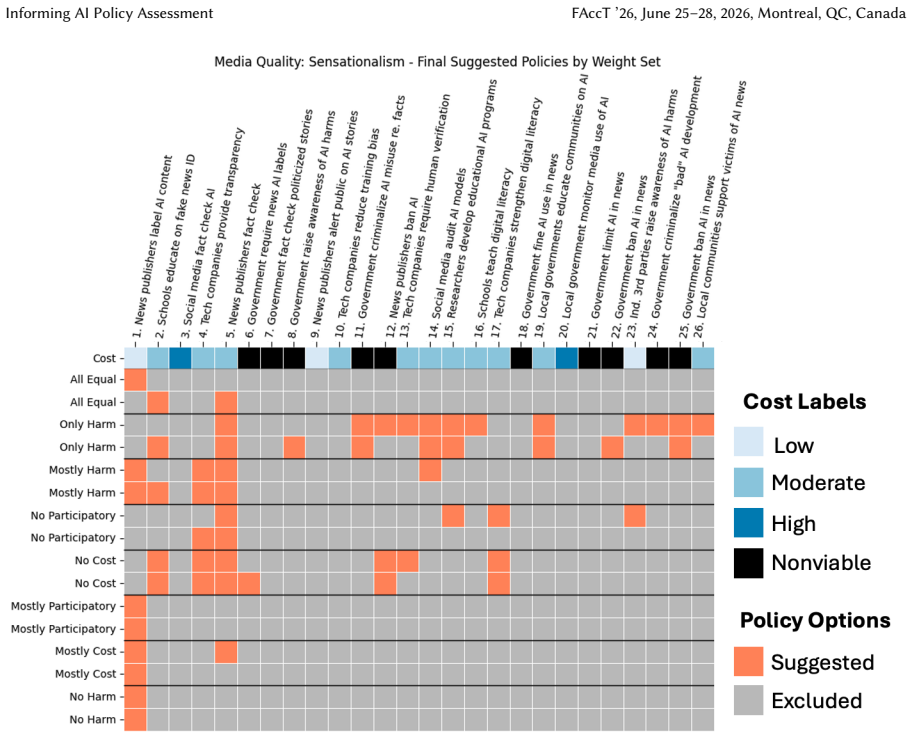
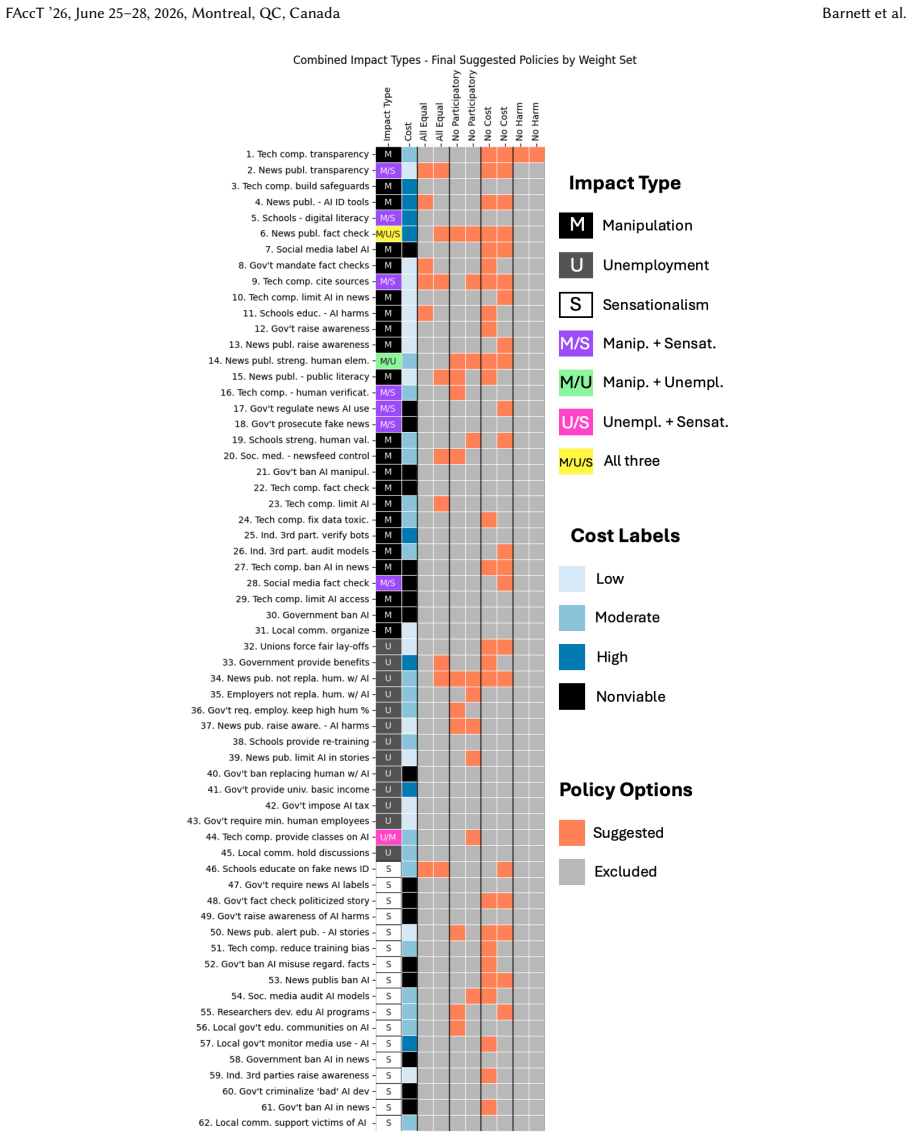
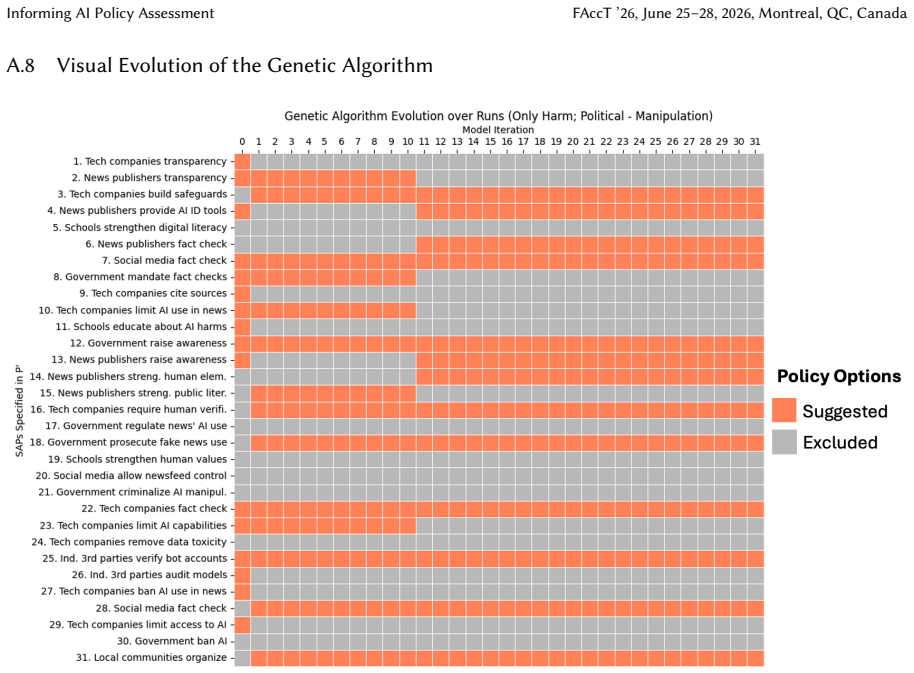
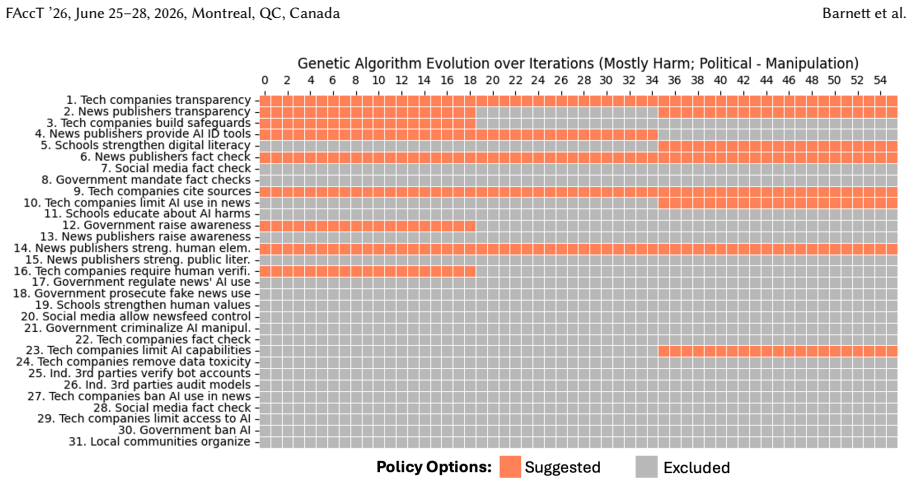
read the original abstract
As the rapid proliferation of AI systems and harms spurs efforts in AI governance around the world, prioritizing among competing policy options has become increasingly challenging for policymakers and researchers. We introduce a methodology for identifying viable policy options to mitigate specified AI harms, helping policymakers and researchers target areas that warrant greater time and resource investment. This method combines participatory evaluation of policies, expert assessment of implementation costs, and an LLM-based assessment of perceived harm mitigation under each policy option. We leverage a genetic algorithm-based simulation study to explore a vast solution space of potential policy combinations, and examine how outcomes change under different weightings of cost, participatory input, and harm mitigation. We find that this method enables exploration of different balances between participatory and expert components, allowing policymakers and researchers to assess how much weight to assign to each. We argue that the diversity of viable policy combinations found by the genetic algorithm could be a useful starting point for deliberation. This method operationalizes existing work on participatory AI by integrating it directly into practical policy development pipelines.
Editorial analysis
A structured set of objections, weighed in public.
Referee Report
Summary. This paper proposes a methodology for identifying viable AI policy options to mitigate specified AI-related harms. The method combines three weighted components in a fitness function optimized via a genetic algorithm: (1) LLM-assessed harm mitigation (M), where an LLM rewrites scenarios under different policy conditions and evaluates the change in severity and magnitude of harm; (2) expert-assessed implementation cost (C); and (3) participatory ratings from lay stakeholders (D). The authors demonstrate the method on three generative AI harms in the media environment (political manipulation, unemployment, media sensationalism), showing how varying the weights (alpha, beta, gamma) produces substantively different policy combinations. The paper also reports on LLM alignment with human ratings (Pearson correlations of 0.794 for severity, 0.707 for magnitude, 0.616 for plausibility on a test set) and includes a cross-model robustness check (o3-mini vs. Claude). Source code is provided via an anonymous repository.
Significance. The paper addresses a genuine and timely problem: how to systematically explore a large space of policy options for AI governance while integrating expert, participatory, and simulated harm-mitigation perspectives. The integration of lay stakeholder data, expert cost assessment, and LLM-based scenario simulation into a single optimization framework is a novel contribution to the FAccT community. The authors provide reproducible code, falsifiable predictions about how weight variations affect policy outputs, and a transparent optimization function with explicitly stated parameters. The framing as a deliberation-support tool rather than an automated decision-maker is appropriate and well-articulated. The paper also commendably discloses limitations including computational costs, the proof-of-concept nature of the work, and the low human inter-rater reliability (0.07) in the original dataset.
major comments (3)
- §3.2: The paper's defense against the generate-then-evaluate self-preference concern is incomplete. The authors state: 'if our employed model were biased in this way, this would manifest as inflated deltas for harm mitigation which would not affect the overall optimization since scores are relative.' This defense addresses only uniform inflation of deltas. The more specific concern is differential bias across policy types: if the LLM rewrites scenarios featuring, e.g., transparency requirements more favorably than scenarios featuring capability limits (because transparency is more narratively tractable), then M would be systematically higher for some policy types regardless of actual mitigation effectiveness. This would distort the relative rankings the genetic algorithm optimizes over. The cross-model check (Claude vs. o3-mini, §3.2) shows that deltas do not significantly differ (p>0.05
- but this tests inter-model consistency, not whether both models share the same policy-type-specific rewriting bias. Two models could both find certain policy types easier to narrate convincingly. The authors should either (a) acknowledge this as a specific limitation and discuss its potential impact on the relative rankings, or (b) provide a targeted test, such as comparing LLM-assessed deltas against human-assessed deltas for a sample of policy subsets stratified by policy type. This is load-bearing because the central claim is that varying weights produces 'substantively different viable policy combinations' useful for deliberation—if the relative M scores are biased across policy types, the diversity of solutions could be an artifact of LLM narrative preferences rather than genuine policy tradeoffs.
- §3.2: The human inter-rater reliability is reported as 0.07 (range [0.03, 0.19]), which is very low. The LLM is aligned to the average of these ratings, but the paper does not report the reliability of the averaged human rating (e.g., the Spearman-Brown corrected reliability of the mean, or the ICC for the aggregate). With 6–7 raters per scenario and an average pairwise kappa of 0.07, the effective reliability of the mean could still be moderate, but this is not shown. The alignment correlations (0.616–0.794) are interpreted without reference to the ceiling imposed by the noise in the ground truth. If the human mean itself is unreliable, the LLM's correlation of 0.794 could be near the reliability ceiling, or it could be substantially below it. The authors should report the effective reliability of the aggregated human ratings to contextualize the alignment results. This matters becauseM
minor comments (8)
- §3.1.1: The population size formula in Eq. (6) / §3.3.1 is written as PopSize = ||P'|| * 2 * (P̄'/P̄') / 2, which simplifies to ||P'||. The intended formula appears to be ||P'|| * 2 * P̄' / 2 based on the worked example (22 * 2 * 7 / 2 = 154, though the text says 201). Please clarify the formula and verify the arithmetic in the example.
- §3.1.3: The cost aggregation uses a sum (Eq. 3), while the participatory component uses an average (Eq. 4). This asymmetry means that adding more SAPs always increases cost but does not increase participatory score (it could decrease it if lower-rated SAPs are added). This is a reasonable design choice but should be explicitly justified, as it affects the optimization dynamics.
- Table 2: The 'Avg. Δ Sev' and 'Avg. Δ Mag' columns show values on a 5-point scale, but it would help to also show the standard deviation or confidence intervals to assess whether differences across weight conditions are statistically meaningful.
- §3.2: The model names 'Claude Opus 4.6' and 'Sonnet 4.5' appear to be hypothetical or future model versions. Please verify these are the correct model identifiers or update to the actual versions used.
- Figure 2: The SAP labels on the x-axis are truncated and difficult to read. Consider using a vertical layout or providing a separate legend mapping shorthand labels to full SAP descriptions.
- §4.2: The statement 'Two thirds of all of the identified suggested policy options were unique' could be more precise—specify the denominator (total number of runs across all weight sets and impact types).
- Appendix A.2: The prompt includes a high-stakes framing ('Mis-scoring will misallocate resources during an escalating information crisis'). This framing could bias the model toward higher severity ratings. Consider testing whether removing this framing changes the alignment results.
- §3.1.2: The plausibility threshold (< 3) resulted in removal of P' from evaluation '< 0.1%' of the time. It would be useful to report the absolute count of how many times this occurred across all runs.
Simulated Author's Rebuttal
We thank the referee for a careful and constructive reading of our manuscript. The two major comments both identify genuine gaps in our validation strategy for the LLM-based harm mitigation component (M). We address each below and explain how the revised manuscript will respond.
read point-by-point responses
-
Referee: §3.2: The paper's defense against the generate-then-evaluate self-preference concern is incomplete. The authors state that if the employed model were biased, this would manifest as inflated deltas which would not affect optimization since scores are relative. This defense addresses only uniform inflation. The more specific concern is differential bias across policy types: if the LLM rewrites scenarios featuring certain policy types more favorably than others (e.g., transparency requirements more narratively tractable than capability limits), then M would be systematically higher for some policy types regardless of actual mitigation effectiveness, distorting relative rankings. The cross-model check tests inter-model consistency, not whether both models share the same policy-type-specific rewriting bias. The authors should either (a) acknowledge this as a specific limitation and discussits
Authors: The referee is correct that our existing defense addresses only uniform inflation of deltas, not differential bias across policy types. This is a fair and important distinction. We agree that if the LLM finds certain policy types more narratively tractable to rewrite convincingly (e.g., transparency requirements vs. capability limits), this could systematically inflate M for those policy types and distort the relative rankings the genetic algorithm optimizes over. Our cross-model robustness check (o3-mini vs. Claude) does not rule out a shared bias across both models, as the referee notes. revision: partial
-
Referee: ...potential impact on the relative rankings, or (b) provide a targeted test, such as comparing LLM-assessed deltas against human-assessed deltas for a sample of policy subsets stratified by policy type. This is load-bearing because the central claim is that varying weights produces substantively different viable policy combinations useful for deliberation—if the relative M scores are biased across policy types, the diversity of solutions could be an artifact of LLM narrative preferences rather than genuine policy tradeoffs.
Authors: We will take both actions the referee suggests. First, we will add an explicit acknowledgment in the Limitations section (§5.1) that differential policy-type-specific rewriting bias is a threat to the validity of the relative M scores, and that our existing controls (cross-model consistency) do not rule out a shared bias of this kind. We will discuss how this could affect the diversity of solutions the genetic algorithm produces. Second, we will conduct a targeted empirical test: we will select a stratified sample of policy subsets (e.g., transparency-type SAPs, capability-limit-type SAPs, education-type SAPs) and compare LLM-assessed deltas against human-assessed deltas from our depth-focused dataset (which has 6–7 raters per scenario for the three impact types). This will allow us to assess whether the LLM's rewriting bias is differential across policy types. We will report the results of this analysis in the revised §3.2. We note that even if some differential bias is found, the framing of the method as a deliberation-support tool rather than an automated decision-maker partially mitigates the concern: the outputs are starting points for human review, not final recommendations. But we agree the limitation must be stated clearly and, where possible, tested empirically. revision: yes
-
Referee: §3.2: The human inter-rater reliability is reported as 0.07 (range [0.03, 0.19]), which is very low. The LLM is aligned to the average of these ratings, but the paper does not report the reliability of the averaged human rating (e.g., the Spearman-Brown corrected reliability of the mean, or the ICC for the aggregate). With 6–7 raters per scenario and an average pairwise kappa of 0.07, the effective reliability of the mean could still be moderate, but this is not shown. The alignment correlations (0.616–0.794) are interpreted without reference to the ceiling imposed by the noise in the ground truth. If the human mean itself is unreliable, the LLM's correlation of 0.794 could be near the reliability ceiling, or it could be substantially below it. The authors should report the effective reliability of the aggregated human ratings to contextualize the alignment results.
Authors: The referee is correct that we should report the effective reliability of the aggregated human ratings and contextualize our alignment correlations against that ceiling. With 6–7 raters per scenario and an average pairwise kappa of 0.07, the Spearman-Brown prophecy formula suggests the effective reliability of the mean could be substantially higher than the pairwise value, but we have not computed or reported this. We will compute the Spearman-Brown corrected reliability of the mean rater and/or the ICC for the aggregate human rating on both the breadth-focused and depth-focused datasets. We will then report these values in §3.2 and explicitly discuss whether our LLM alignment correlations (0.616–0.794) are near, at, or below the reliability ceiling imposed by the human ground truth. This is important context for interpreting the alignment results and we appreciate the referee flagging it. revision: yes
Circularity Check
No significant circularity; self-citations provide empirical data inputs, not load-bearing theoretical claims
full rationale
The paper's derivation chain is not circular. The optimization function F(S, P') = α(M) − β(C) + γ(D) combines three independently sourced components: M from LLM-evaluated scenario rewrites, C from an expert panel, and D from lay stakeholder surveys. None of these components is defined in terms of the output P*. The self-citations to [7] and [8] (same author team) provide empirical data inputs — scenarios, SAPs, and participatory ratings — collected through human studies in prior work, not theoretical claims that would make the present derivation tautological. The LLM alignment (§3.2) uses a train/test split with a newly collected test set (18 scenarios, 109 participants), and the reported correlations (0.794, 0.707, 0.616) are on held-out data. The genetic algorithm's outputs (which policy combinations emerge under different weightings) are emergent from optimization over a large solution space, not defined by construction. The reader's concern about the same LLM (o3-mini) both rewriting and evaluating scenarios is a validity/bias concern — specifically whether differential bias across policy types could distort relative rankings — but this is not circularity: M is not defined in terms of itself, the rewriting prompt (Appendix A.1) explicitly instructs against commenting on policy efficacy, and the evaluation prompt (Appendix A.2) uses a separate panel-of-judges formulation. The paper's defense that 'scores are relative' may be incomplete against differential bias, but that is a correctness risk, not a circular reduction. The one point is assigned for the heavy reliance on self-cited data inputs, which is normal practice but worth noting.
Axiom & Free-Parameter Ledger
free parameters (9)
- α (harm mitigation weight) =
varied: 0.25–1.0
- β (cost weight) =
varied: 0–0.5
- γ (participatory weight) =
varied: 0–0.5
- w_s (severity weight in M) =
0.65
- w_m (magnitude weight in M) =
0.35
- crossover rate =
0.80
- mutation rate =
0.03
- elitism k =
3
- plausibility threshold =
3 (on 5-point scale)
axioms (5)
- domain assumption LLM-generated scenario rewrites faithfully reflect the effect of implementing a given set of policies
- domain assumption LLM ratings of severity, magnitude, and plausibility approximate average human ratings
- domain assumption Expert panel cost assessments are a valid proxy for actual implementation costs
- domain assumption The three harm types (political manipulation, unemployment, sensationalism) are representative enough to demonstrate the method
- domain assumption Genetic algorithm local optima are useful starting points for policy deliberation
Reference graph
Works this paper leans on
-
[1]
Camilla Adelle and Sabine Weiland. 2012. Policy assessment: the state of the art.Impact Assessment and Project Appraisal30, 1 (2012), 25–33. doi:10.1080/14615517.2012.663256
-
[2]
Muhammad Amer, Tugrul U Daim, and Antonie Jetter. 2013. A review of scenario planning.Futures46 (2013), 23–40
work page 2013
-
[3]
Per Dannemand Andersen, Meiken Hansen, and Cynthia Selin. 2021. Stakeholder inclusion in scenario planning—A review of European projects.Technological Forecasting and Social Change169 (2021), 120802
work page 2021
-
[4]
Josh Andres, Chris Danta, Andrea Bianchi, Sungyeon Hong, Zhuying Li, Eduardo Benitez Sandoval, Charles Patrick Martin, and Ned Cooper. 2024. Understanding and Shaping Human-Technology Assemblages in the Age of Generative AI. InCompanion Publication of the 2024 ACM Designing Interactive Systems Conference. 413–416
work page 2024
-
[5]
Jacy Reese Anthis, Ryan Liu, Sean M Richardson, Austin C Kozlowski, Bernard Koch, James Evans, Erik Brynjolfsson, and Michael Bernstein. 2025. LLM social simulations are a promising research method.arXiv preprint arXiv:2504.02234(2025). Informing AI Policy Assessment FAccT ’26, June 25–28, 2026, Montreal, QC, Canada
-
[6]
Brhmie Balaram, Tony Greenham, and Jasmine Leonard. 2018. Artificial Intelligence: real public engagement.RSA, London. Retrieved November5 (2018), 2018
work page 2018
-
[7]
Julia Barnett, Kimon Kieslich, and Nicholas Diakopoulos. 2024. Simulating Policy Impacts: Developing a Generative Scenario Writing Method to Evaluate the Perceived Effects of Regulation. InProceedings of the AAAI/ACM Conference on AI, Ethics, and Society, Vol. 7. 82–93
work page 2024
-
[8]
Julia Barnett, Kimon Kieslich, Natali Helberger, and Nicholas Diakopoulos. 2025. Envisioning Stakeholder-Action Pairs to Mitigate Negative Impacts of AI: A Participatory Approach to Inform Policy Making. InProceedings of the 2025 ACM Conference on Fairness, Accountability, and Transparency. 1424–1449
work page 2025
- [9]
- [10]
-
[11]
James Bisbee, Joshua D Clinton, Cassy Dorff, Brenton Kenkel, and Jennifer M Larson. 2024. Synthetic replacements for human survey data? the perils of large language models.Political Analysis32, 4 (2024), 401–416
work page 2024
-
[12]
Andrea Bonaccorsi, Riccardo Apreda, and Gualtiero Fantoni. 2020. Expert biases in technology foresight. Why they are a problem and how to mitigate them.Technological Forecasting and Social Change151 (2020), 119855
work page 2020
-
[13]
Lena Börjeson, Mattias Höjer, Karl-Henrik Dreborg, Tomas Ekvall, and Göran Finnveden. 2006. Scenario types and techniques: Towards a user’s guide.Futures38, 7 (2006), 723–739
work page 2006
-
[14]
Zana Buçinca, Chau Minh Pham, Maurice Jakesch, Marco Tulio Ribeiro, Alexandra Olteanu, and Saleema Amershi. 2023. Aha!: Facilitating ai impact assessment by generating examples of harms.arXiv preprint arXiv:2306.03280(2023)
work page internal anchor Pith review Pith/arXiv arXiv 2023
-
[15]
Michael Burnam-Fink. 2015. Creating narrative scenarios: Science fiction prototyping at Emerge.Futures70 (2015), 48–55
work page 2015
-
[16]
David L Carroll et al. 1996. Genetic algorithms and optimizing chemical oxygen-iodine lasers.Developments in theoretical and applied mechanics18, 3 (1996), 411–424
work page 1996
-
[17]
John M. Carroll (Ed.). 1995.Scenario–Based Design: Envisioning Work and Technology in System Development. John Wiley & Sons, New York
work page 1995
-
[18]
David Caswell and Shuwei Fang. 2024. AI in Journalism Futures.Initial Report(2024)
work page 2024
-
[19]
Tun-Jen Chang, Sang-Chin Yang, and Kuang-Jung Chang. 2009. Portfolio optimization problems in different risk measures using genetic algorithm.Expert Systems with applications36, 7 (2009), 10529–10537
work page 2009
-
[20]
Myra Cheng, Tiziano Piccardi, and Diyi Yang. 2023. CoMPosT: Characterizing and evaluating caricature in LLM simulations.arXiv preprint arXiv:2310.11501(2023)
work page internal anchor Pith review Pith/arXiv arXiv 2023
-
[21]
Carlos A Coello Coello. 1999. A comprehensive survey of evolutionary-based multiobjective optimization techniques.Knowledge and Information systems1, 3 (1999), 269–308
work page 1999
-
[22]
European Commission. 2024. Proposal for a Regulation of the European Parliament and of the Council laying down harmonised rules on Artificial Intelligence (Artificial Intelligence Act) and amending certain Union legislative acts, Pub. L. No. COM(2021) 206 final
work page 2024
- [23]
-
[24]
Tatevik Davtyan. 2024. An Overview of Global Efforts Towards AI Regulation.Bulletin of Yerevan University C: Jurisprudence15, 2 (41) (2024), 158–174
work page 2024
-
[25]
Giovanni De Gregorio and Pietro Dunn. 2022. The European risk-based approaches: Connecting constitutional dots in the digital age. Common Market Law Review59, 2 (2022)
work page 2022
-
[26]
1975.An analysis of the behavior of a class of genetic adaptive systems.University of Michigan
Kenneth Alan De Jong. 1975.An analysis of the behavior of a class of genetic adaptive systems.University of Michigan
work page 1975
-
[27]
Kenneth A De Jong and William M Spears. 1990. An analysis of the interacting roles of population size and crossover in genetic algorithms. InInternational Conference on Parallel Problem Solving from Nature. Springer, 38–47
work page 1990
-
[28]
Kalyanmoy Deb and Himanshu Jain. 2014. An Evolutionary Many-Objective Optimization Algorithm Using Reference-Point-Based Nondominated Sorting Approach, Part I: Solving Problems With Box Constraints.IEEE Transactions on Evolutionary Computation18, 4 (2014), 577–601. doi:10.1109/TEVC.2013.2281535
-
[29]
K. Deb, A. Pratap, S. Agarwal, and T. Meyarivan. 2002. A fast and elitist multiobjective genetic algorithm: NSGA-II.IEEE Transactions on Evolutionary Computation6, 2 (2002), 182–197. doi:10.1109/4235.996017
-
[30]
Fernando Delgado, Stephen Yang, Michael Madaio, and Qian Yang. 2023. The participatory turn in ai design: Theoretical foundations and the current state of practice. InProceedings of the 3rd ACM Conference on Equity and Access in Algorithms, Mechanisms, and Optimization. 1–23
work page 2023
-
[31]
Ricardo Dominguez-Olmedo, Moritz Hardt, and Celestine Mendler-Dünner. 2024. Questioning the survey responses of large language models.Advances in Neural Information Processing Systems37 (2024), 45850–45878
work page 2024
-
[32]
Yijiang River Dong, Tiancheng Hu, and Nigel Collier. 2024. Can llm be a personalized judge?arXiv preprint arXiv:2406.11657(2024). FAccT ’26, June 25–28, 2026, Montreal, QC, Canada Barnett et al
work page internal anchor Pith review Pith/arXiv arXiv 2024
-
[33]
Larry J Eshelman, Richard A Caruana, and J David Schaffer. 1989. Biases in the crossover landscape. InProceedings of the third international conference on Genetic algorithms. 10–19
work page 1989
-
[34]
G Ezeani, A Koene, R Kumar, N Santiago, and D Wright. 2021. A survey of artificial intelligence risk assessment methodologies.The global state of play and leading practices identified(2021)
work page 2021
-
[35]
Jan Ferrer i Picó, Michelle Catta-Preta, Alex Trejo Omeñaca, Marc Vidal, and Josep Maria Monguet i Fierro. 2025. The time machine: future scenario generation through generative AI tools.Future Internet17, 1 (2025), 48
work page 2025
-
[36]
Carlos M Fonseca, Peter J Fleming, et al . 1993. Genetic algorithms for multiobjective optimization: formulationdiscussion and generalization.. InIcga, Vol. 93. 416–423
work page 1993
-
[37]
2020.The risk-based approach to data protection
Raphaël Gellert. 2020.The risk-based approach to data protection. Oxford University Press
work page 2020
-
[38]
Tarleton Gillespie. 2024. Generative AI and the politics of visibility.Big Data & Society11, 2 (2024), 20539517241252131
work page 2024
-
[39]
David E Golberg. 1989. Genetic algorithms in search, optimization, and machine learning.Addion wesley1989, 102 (1989), 36
work page 1989
-
[40]
David E Goldberg, Kalyanmoy Deb, and James H Clark. 1991. Genetic algorithms, noise, and the sizing of populations.Complex systems 6 (1991), 333–362
work page 1991
-
[41]
2016.Multiple criteria decision analysis
Salvatore Greco, Jose Figueira, and Matthias Ehrgott. 2016.Multiple criteria decision analysis. Vol. 37. Springer
work page 2016
-
[42]
John J Grefenstette. 1986. Optimization of control parameters for genetic algorithms.IEEE Transactions on systems, man, and cybernetics 16, 1 (1986), 122–128
work page 1986
-
[43]
David Hartmann, José Renato Laranjeira De Pereira, Chiara Streitbörger, and Bettina Berendt. 2025. Addressing the regulatory gap: moving towards an EU AI audit ecosystem beyond the AI Act by including civil society.AI and Ethics5, 4 (2025), 3617–3638
work page 2025
-
[44]
Luke Hewitt, Ashwini Ashokkumar, Isaias Ghezae, and Robb Willer. 2024. Predicting results of social science experiments using large language models.Preprint(2024)
work page 2024
-
[45]
Guzyal Hill, Matthew Waddington, and Leon Qiu. 2025. From pen to algorithm: optimizing legislation for the future with artificial intelligence.AI & SOCIETY40, 4 (2025), 3075–3086
work page 2025
-
[46]
Michel Hohendanner, Chiara Ullstein, Dohjin Miyamoto, Emma F Huffman, Gudrun Socher, Jens Grossklags, and Hirotaka Osawa
-
[47]
Metaverse Perspectives from Japan: A Participatory Speculative Design Case Study.Proc. ACM Hum.-Comput. Interact.8, CSCW2, Article 400 (Nov. 2024), 51 pages. doi:10.1145/3686939
-
[48]
John H Holland. 1992.Adaptation in natural and artificial systems: an introductory analysis with applications to biology, control, and artificial intelligence. MIT press
work page 1992
-
[49]
John S. Hollywood. 2025.The Well-Tempered Artificial Intelligence Assistant for Policy Processes: Approximately Optimizing Artificial Intelligence Outputs to Empower Policy Discussions. RAND PEA3888-4. RAND Corporation. https://www.rand.org/content/dam/rand/ pubs/perspectives/PEA3800/PEA3888-4/RAND_PEA3888-4/RAND_PEA3888-4.pdf
work page 2025
-
[50]
John J Horton. 2023.Large language models as simulated economic agents: What can we learn from homo silicus?Technical Report. National Bureau of Economic Research
work page 2023
-
[51]
Abe Bohan Hou, Hongru Du, Yichen Wang, Jingyu Zhang, Zixiao Wang, Paul Pu Liang, Daniel Khashabi, Lauren M Gardner, and Tianxing He. 2025. Can A Society of Generative Agents Simulate Human Behavior and Inform Public Health Policy? A Case Study on Vaccine Hesitancy. InSecond Conference on Language Modeling. https://openreview.net/forum?id=zSbecER9il
work page 2025
-
[52]
Tiancheng Hu, Joachim Baumann, Lorenzo Lupo, Nigel Collier, Dirk Hovy, and Paul Röttger. 2025. SimBench: Benchmarking the Ability of Large Language Models to Simulate Human Behaviors.arXiv preprint arXiv:2510.17516(2025)
work page internal anchor Pith review Pith/arXiv arXiv 2025
-
[53]
Omar Khattab, Arnav Singhvi, Paridhi Maheshwari, Zhiyuan Zhang, Keshav Santhanam, Sri Vardhamanan, Saiful Haq, Ashutosh Sharma, Thomas T Joshi, Hanna Moazam, et al. 2023. Dspy: Compiling declarative language model calls into self-improving pipelines. arXiv preprint arXiv:2310.03714(2023)
work page internal anchor Pith review Pith/arXiv arXiv 2023
-
[54]
Kimon Kieslich, Nicholas Diakopoulos, and Natali Helberger. 2025. Anticipating impacts: using large-scale scenario-writing to explore diverse implications of generative AI in the news environment.AI and Ethics5, 5 (2025), 4555–4577
work page 2025
-
[55]
Kimon Kieslich, Natali Helberger, and Nicholas Diakopoulos. 2026. Scenario-Based Sociotechnical Envisioning (SSE): An Approach to Enhance Systemic Risk Assessments.AI and Ethics(2026)
work page 2026
-
[56]
Run Wild a Little With Your Imagination
Shamika Klassen and Casey Fiesler. 2022. " Run Wild a Little With Your Imagination" Ethical Speculation in Computing Education with Black Mirror. InProceedings of the 53rd ACM Technical Symposium on Computer Science Education-Volume 1. 836–842
work page 2022
-
[57]
Austin Kozlowski and James Evans. 2024. Simulating subjects: The promise and peril of ai stand-ins for social agents and interactions
work page 2024
-
[58]
Tzu-Sheng Kuo, Quan Ze Chen, Amy X Zhang, Jane Hsieh, Haiyi Zhu, and Kenneth Holstein. 2025. PolicyCraft: Supporting Collaborative and Participatory Policy Design through Case-Grounded Deliberation. InProceedings of the 2025 CHI Conference on Human Factors in Computing Systems. 1–24
work page 2025
-
[59]
James Edgar Lim and Julian Savulescu. 2025. AI preference prediction and policy making.AI & SOCIETY(2025), 1–15
work page 2025
-
[60]
Alex Jiahong Lu, Eleanor Villafranca Wikstrom, and Tawanna R Dillahunt. 2024. Contamination, Otherness, and Negotiating Bottom- Up Sociotechnical Imaginaries in Participatory Speculative Design. InProceedings of the Participatory Design Conference 2024: Full Papers-Volume 1. 173–186
work page 2024
-
[61]
Alfred D Martin Jr. 1955. Mathematical programming of portfolio selections.Management Science1, 2 (1955), 152–166. Informing AI Policy Assessment FAccT ’26, June 25–28, 2026, Montreal, QC, Canada
work page 1955
-
[62]
Donald Martin Jr, Vinodkumar Prabhakaran, Jill Kuhlberg, Andrew Smart, and William S Isaac. 2020. Participatory problem formulation for fairer machine learning through community based system dynamics.arXiv preprint arXiv:2005.07572(2020)
work page internal anchor Pith review Pith/arXiv arXiv 2020
-
[63]
Anna-Katharina Meßmer and Martin Degeling. 2023. Auditing Recommender Systems–Putting the DSA into practice with a risk- scenario-based approach.arXiv preprint arXiv:2302.04556(2023)
work page internal anchor Pith review Pith/arXiv arXiv 2023
-
[64]
1998.An introduction to genetic algorithms
Melanie Mitchell. 1998.An introduction to genetic algorithms. MIT press
work page 1998
-
[65]
Jimin Mun, Liwei Jiang, Jenny Liang, Inyoung Cheong, Nicole DeCario, Yejin Choi, Tadayoshi Kohno, and Maarten Sap. 2024. Particip-ai: A democratic surveying framework for anticipating future ai use cases, harms and benefits. InProceedings of the AAAI/ACM Conference on AI, Ethics, and Society, Vol. 7. 997–1010
work page 2024
-
[66]
Priyanka Nanayakkara, Nicholas Diakopoulos, and Jessica Hullman. 2020. Anticipatory ethics and the role of uncertainty.arXiv preprint arXiv:2011.13170(2020)
work page internal anchor Pith review Pith/arXiv arXiv 2020
-
[67]
Blagovesta Nikolova. 2014. The rise and promise of participatory foresight.European journal of futures research2, 1 (2014), 33
work page 2014
-
[68]
NIST. 2024. Artificial intelligence risk management framework: Generative artificial intelligence profile.NIST Trustworthy and Responsible AI Gaithersburg, MD, USA(2024)
work page 2024
-
[69]
Alexandra Olteanu, Solon Barocas, Su Lin Blodgett, Lisa Egede, Alicia DeVrio, and Myra Cheng. 2025. Ai automatons: Ai systems intended to imitate humans.arXiv preprint arXiv:2503.02250(2025)
work page internal anchor Pith review Pith/arXiv arXiv 2025
-
[70]
Carsten Orwat, Jascha Bareis, Anja Folberth, Jutta Jahnel, and Christian Wadephul. 2024. Normative challenges of risk regulation of artificial intelligence.NanoEthics18, 2 (2024), 11
work page 2024
-
[71]
1998.Combinatorial optimization: algorithms and complexity
Christos H Papadimitriou and Kenneth Steiglitz. 1998.Combinatorial optimization: algorithms and complexity. Courier Corporation
work page 1998
-
[72]
Joon Sung Park, Joseph O’Brien, Carrie Jun Cai, Meredith Ringel Morris, Percy Liang, and Michael S Bernstein. 2023. Generative agents: Interactive simulacra of human behavior. InProceedings of the 36th annual acm symposium on user interface software and technology. 1–22
work page 2023
-
[73]
Joon Sung Park, Carolyn Q Zou, Aaron Shaw, Benjamin Mako Hill, Carrie Cai, Meredith Ringel Morris, Robb Willer, Percy Liang, and Michael S Bernstein. 2024. Generative agent simulations of 1,000 people.arXiv preprint arXiv:2411.10109(2024)
work page internal anchor Pith review Pith/arXiv arXiv 2024
-
[74]
Mark Petticrew, Zaid Chalabi, and David R Jones. 2012. To RCT or not to RCT: deciding when ‘more evidence is needed’for public health policy and practice.J Epidemiol Community Health66, 5 (2012), 391–396
work page 2012
-
[75]
Martijn Poel, Eric T Meyer, and Ralph Schroeder. 2018. Big data for policymaking: Great expectations, but with limited progress?Policy & Internet10, 3 (2018), 347–367
work page 2018
-
[76]
1991.Foundations of Genetic Algorithms 1991 (FOGA 1)
Gregory JE Rawlins. 1991.Foundations of Genetic Algorithms 1991 (FOGA 1). Vol. 1. Elsevier
work page 1991
-
[77]
Anka Reuel, Avijit Ghosh, Jenny Chim, Andrew Tran, Yanan Long, Jennifer Mickel, Usman Gohar, Srishti Yadav, Pawan Sasanka Ammanamanchi, Mowafak Allaham, et al. 2025. Who Evaluates AI’s Social Impacts? Mapping Coverage and Gaps in First and Third Party Evaluations.arXiv preprint arXiv:2511.05613(2025)
work page internal anchor Pith review Pith/arXiv arXiv 2025
-
[78]
Friederike Richter, Kirsty Campbell, and Jasmin Riedl. 2025. Lost in translation: why digital twins thrive in research but falter in politics and public administration.Data & Policy7 (2025), e71. doi:10.1017/dap.2025.10027
-
[79]
Gernot Rieder and Judith Simon. 2016. Datatrust: Or, the political quest for numerical evidence and the epistemologies of Big Data.Big Data & Society3, 1 (2016), 2053951716649398
work page 2016
-
[80]
Huw Roberts, Josh Cowls, Emmie Hine, Jessica Morley, Vincent Wang, Mariarosaria Taddeo, and Luciano Floridi. 2023. Governing artificial intelligence in China and the European Union: Comparing aims and promoting ethical outcomes.The Information Society39, 2 (2023), 79–97
work page 2023
discussion (0)
Sign in with ORCID, Apple, or X to comment. Anyone can read and Pith papers without signing in.