A multilevel tensor network compression technique for simulating Lindblad dynamics in superconducting circuits
Pith reviewed 2026-06-29 17:07 UTC · model grok-4.3
The pith
A three-level tensor network compression brings Lindblad dynamics simulations of superconducting circuits to laptop scale.
A machine-rendered reading of the paper's core claim, the machinery that carries it, and where it could break.
Core claim
The authors establish that a multilevel tensor network compression technique, built from global purification, inter-mode entanglement compression, and quantics Fock representation, makes Lindblad simulations of bosonic modes efficient even at high occupations, as demonstrated by reducing transmon ionization and large cat qubit calculations to laptop level with favorable scaling.
What carries the argument
three nested levels of tensor network compression: global purification of the density matrix, compression of connections between modes, and quantics representation of Fock occupation numbers
If this is right
- Large cat qubit dynamics become tractable on standard hardware.
- Transmon ionization studies no longer require supercomputing resources.
- The method supports computer-assisted design of superconducting circuits at larger sizes.
- Orders-of-magnitude speed-ups appear whenever the purity and entanglement assumptions hold.
Where Pith is reading between the lines
- The same compression layers could be tested on other open bosonic systems such as cavity QED or trapped ions.
- If entanglement grows beyond the qubit-like regime, hybrid tensor-network plus other methods might be needed to retain efficiency.
- The favorable scaling suggests that routine inclusion of realistic Lindblad terms in hardware design loops is now within reach.
Load-bearing premise
The density matrix remains close to pure and entanglement between modes stays moderate and qubit-like.
What would settle it
A concrete counter-example would be a Lindblad evolution in which the density matrix becomes highly mixed or inter-mode entanglement grows strong, causing the compression ratios to collapse and eliminating the reported scaling advantage.
Figures
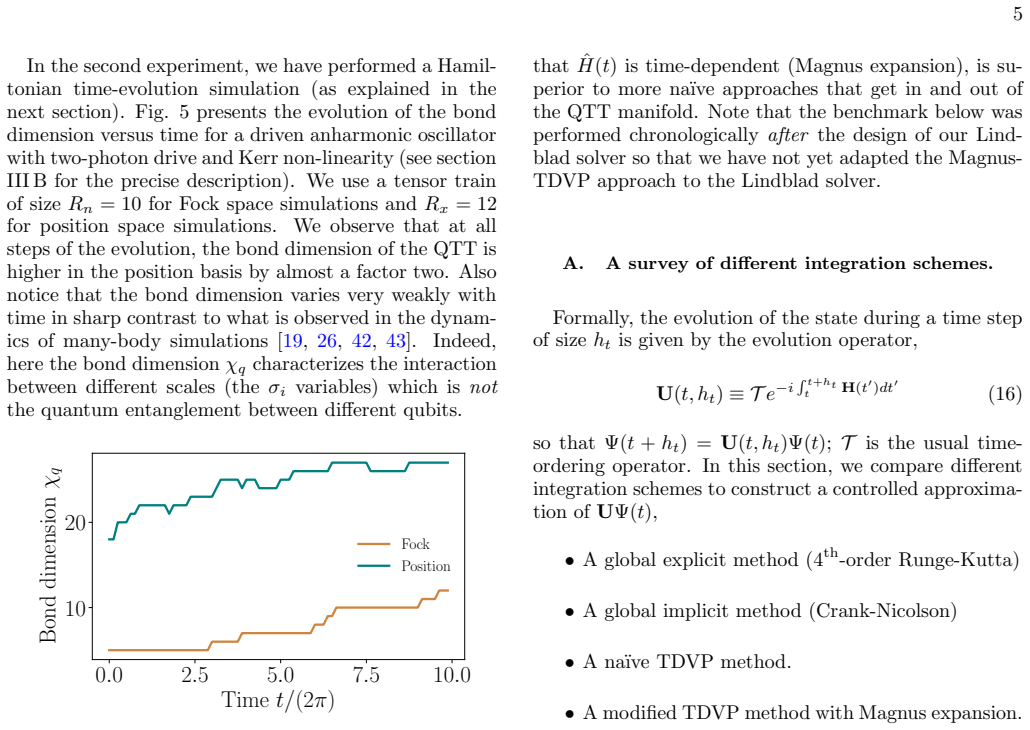
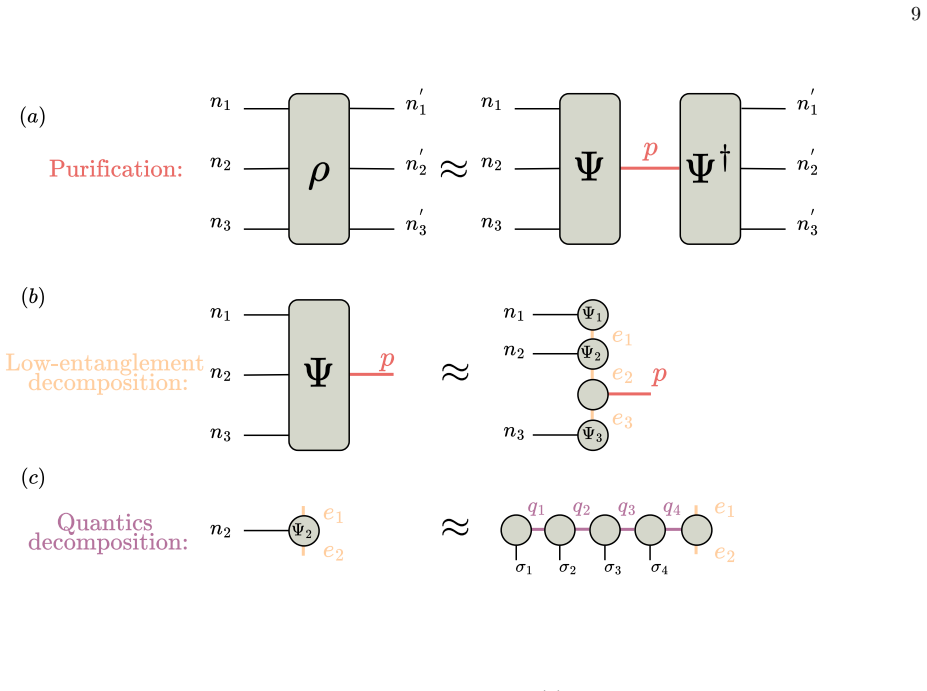
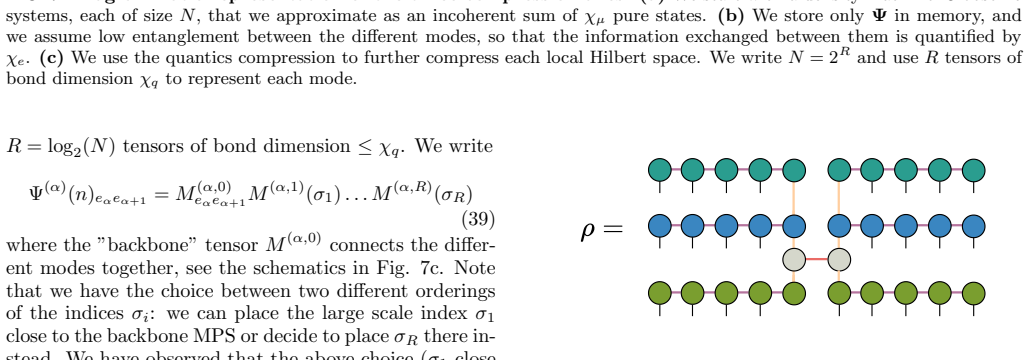
read the original abstract
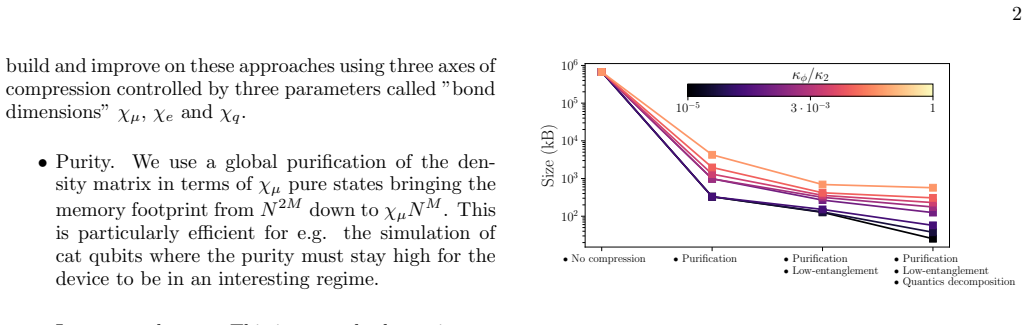
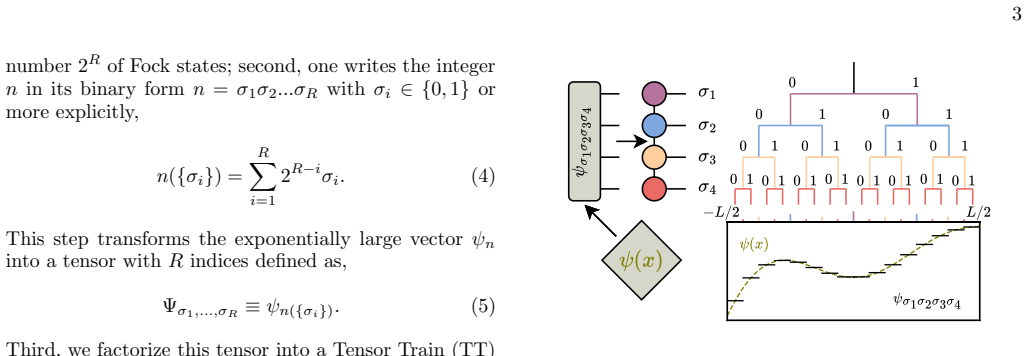
Designing superconducting quantum hardware requires simulation tools that can account for various deviations from ideal scenarios. This, in turn, requires approaches that automatically detect certain structures and leverage them to make the computation affordable. Here, we develop a tensor network based technique to simulate the Lindblad dynamics of a few interacting bosonic modes with a focus on superconducting quantum circuits. The technique detects and takes advantage of two very common situations: (i) the density matrix being pure or not far from pure and (ii) the entanglement between different modes being moderate (typically qubit-like). However, (iii) the occupation of the modes can be arbitrarily high (making na\"ive truncations inefficient). To leverage these features, we use three different nested levels of tensor network compression: (i) we work with a global purification of the density matrix, (ii) we compress the connection between different modes to account for the moderate entanglement and (iii) we use a quantics representation of the Fock occupation number. We showcase the technique for the simulation of large cat qubits as well as for the ionization of transmon qubits, demonstrating orders-of-magnitude speed-up with respect to brute force approaches. In the latter example, it brings the simulation, previously reported on a large supercomputing infrastructure, to laptop level. The favorable scaling with system size should bring genuine computer assisted design of these systems within scope.
Editorial analysis
A structured set of objections, weighed in public.
Referee Report
Summary. The paper introduces a three-level tensor-network compression scheme for Lindblad dynamics of interacting bosonic modes in superconducting circuits. It exploits near-purity of the density matrix via global purification, moderate (qubit-like) inter-mode entanglement via bond-dimension compression, and high Fock-space occupations via quantics encoding. The method is demonstrated on large cat qubits and on transmon ionization, with the latter claimed to reduce a previously supercomputer-scale simulation to laptop level while preserving orders-of-magnitude speed-up over brute-force approaches.
Significance. If the reported scaling holds under the stated assumptions, the technique would materially expand the range of circuit-QED simulations that can be performed on ordinary hardware, supporting iterative hardware design. The nested compression strategy itself is a concrete technical contribution that systematically exploits two ubiquitous features of these systems.
major comments (1)
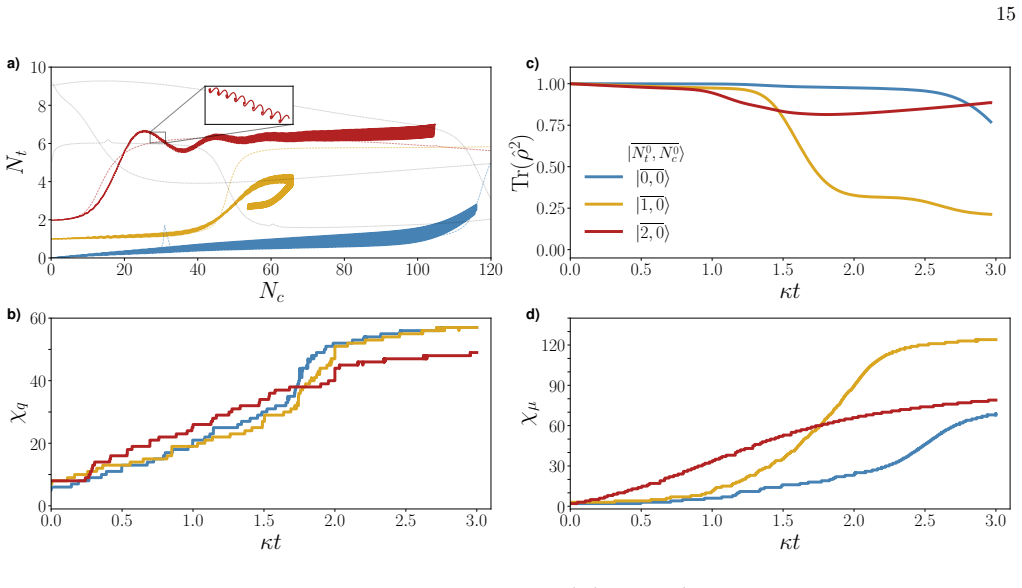
- [transmon ionization results] The central performance claim for transmon ionization (reduction from supercomputer to laptop scale) is load-bearing on the three compression levels remaining effective throughout the trajectory. The manuscript provides no quantitative verification—such as time traces of Tr(ρ²) or the evolution of the inter-mode bond dimensions—that the state remains sufficiently pure and the entanglement sufficiently moderate for the reported compression ratios to be realized.
minor comments (1)
- [methods] Notation for the quantics encoding and the precise definition of the global purification step should be stated explicitly in the methods section so that the three nested compressions can be reproduced from the text alone.
Simulated Author's Rebuttal
We thank the referee for the careful reading and constructive feedback. We address the single major comment below and will incorporate the requested verification in the revised manuscript.
read point-by-point responses
-
Referee: [transmon ionization results] The central performance claim for transmon ionization (reduction from supercomputer to laptop scale) is load-bearing on the three compression levels remaining effective throughout the trajectory. The manuscript provides no quantitative verification—such as time traces of Tr(ρ²) or the evolution of the inter-mode bond dimensions—that the state remains sufficiently pure and the entanglement sufficiently moderate for the reported compression ratios to be realized.
Authors: We agree that the central performance claim would be strengthened by explicit, quantitative confirmation that the three compression levels remain effective over the full trajectory. In the revised manuscript we will add time traces of Tr(ρ²) together with plots of the inter-mode bond-dimension evolution for the transmon-ionization example. These data will directly verify that the state stays sufficiently pure and that entanglement remains moderate, thereby supporting the reported compression ratios and the laptop-scale performance. revision: yes
Circularity Check
No circularity: numerical compression method is self-contained
full rationale
The paper presents a tensor-network algorithm with three explicit compression layers (global purification, inter-mode bond compression, quantics Fock encoding) whose efficiency is conditioned on stated assumptions about purity and moderate entanglement. These assumptions are not derived from the method itself but are external conditions under which the reported speed-ups hold; the paper supplies no equations, fitted parameters, or self-citations that reduce the claimed performance to the inputs by construction. All demonstrations are direct numerical runs on the compressed representation, not predictions forced by prior fits or uniqueness theorems. The work is therefore a standard algorithmic contribution whose validity can be checked against external benchmarks without circular reduction.
Axiom & Free-Parameter Ledger
Reference graph
Works this paper leans on
-
[1]
There is no exact QTT representation of the function √n
MPO of the annihilation operatorˆa We want to construct a MPO for the exponentially large matrixAdefined as, Ann′ ≡ ⟨n|ˆa|n′⟩=δ n+1,n′ √ n′ (8) wherenandn ′ are written in bit format. There is no exact QTT representation of the function √n. However, we can construct an approximate one which converges exponentially withχ q. This is done using TCI with the ...
-
[2]
The MPO of ˆa† is given byT †Busing 4 0 2 4 6 8 10 12 14 Bond dimension ¯χq 10−15 10−11 10−7 10−3 Error 10□ 3 ¯χq 2 R 6 8 10 15 20 ∥ˆa□ˆaapprox∥ ∥ˆa∥ 1 − ⟨α|ˆaapprox|α⟩ α FIG
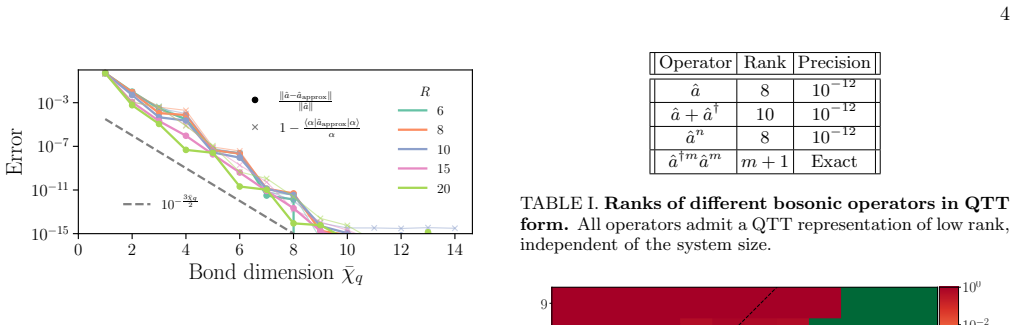
Other MPOs The construction of other MPOs is done following a similar approach. The MPO of ˆa† is given byT †Busing 4 0 2 4 6 8 10 12 14 Bond dimension ¯χq 10−15 10−11 10−7 10−3 Error 10□ 3 ¯χq 2 R 6 8 10 15 20 ∥ˆa□ˆaapprox∥ ∥ˆa∥ 1 − ⟨α|ˆaapprox|α⟩ α FIG. 3.Construction ofˆain QTT form.Evolution of the error of the MPO representing the annihilation operat...
-
[3]
The only modification is that we replace the or- dinary linear algebra operations (e.g
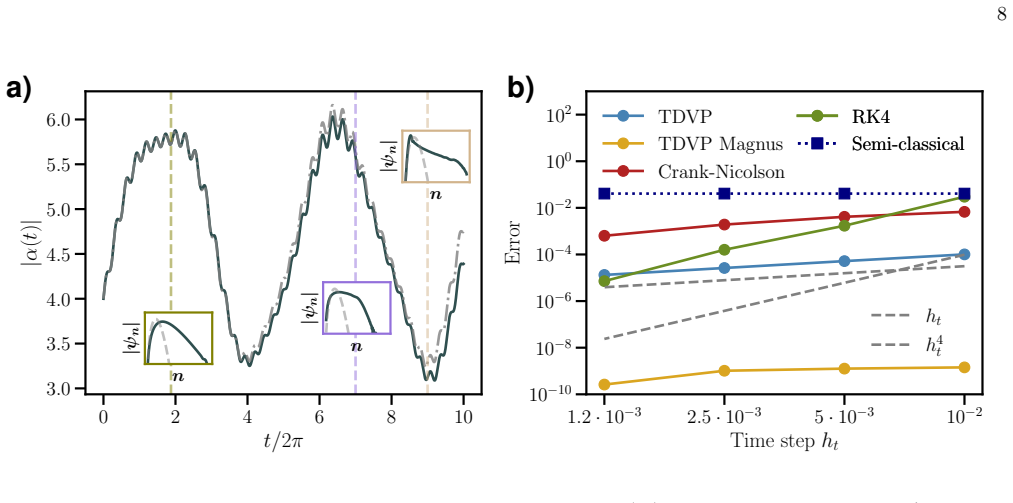
Explicit global Runge-Kutta scheme Global methods amount to taking Eq.(15) as if Ψ(t) was a large vector,H(t) a large matrix and using stan- dard ordinary differential equation solvers to integrate them. The only modification is that we replace the or- dinary linear algebra operations (e.g. a matrix vector product) by their tensor network counterparts, (e...
-
[4]
U t+h t,− ht 2 Ψ(t+h t) =U t, ht 2 Ψ(t) (23) This equation is solved at each step using an alternat- ing least-squares solver such as the one provided in [55]
Implicit global Crank-Nicolson scheme To address this shortcoming, one could use an implicit method such as Crank-Nicolson [54]. U t+h t,− ht 2 Ψ(t+h t) =U t, ht 2 Ψ(t) (23) This equation is solved at each step using an alternat- ing least-squares solver such as the one provided in [55]. Since a very good initial condition is known (Ψ(t+h t) is close to Ψ...
-
[5]
The approach is known as TDVP in the field, and we benchmark it here for quan- tics
Time-Dependent Variational Principle with Magnus expansion An approach that has been shown to be very powerful in the context of many-body dynamics is to find effective equations for d dt M(i)(σ) using the time-dependent vari- ational principle [44, 56], directly working in the tangent space of the QTT manifold. The approach is known as TDVP in the field,...
-
[6]
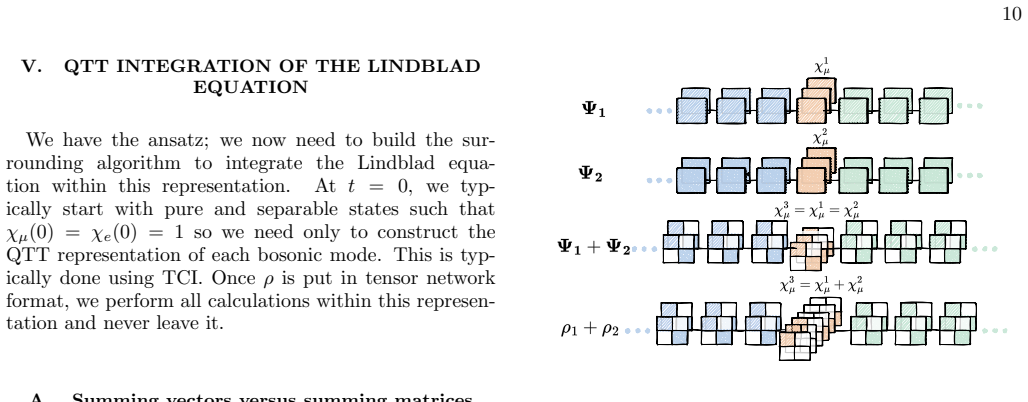
We will need to perform two different sorts of tensor network additions: vector additions and matrix additions. In vector addition, we want to construct Ψ1 +Ψ 2 (40) while in matrix addition we want to construct ρ1 +ρ 2 =Ψ 1Ψ† 1 +Ψ 2Ψ† 2 (41) which is a very different object since (Ψ1 + Ψ2)(Ψ1 + Ψ2)† ̸=Ψ 1Ψ† 1 +Ψ 2Ψ† 2 (42) To perform vector addition, we ...
-
[7]
General Kraus operators algebra A Kraus mapAis defined by a set of matricesA 1...AI (called Kraus operators) such that, A(ρ) = IX i=1 AiρA† i .(46) 11 Such an operator can readily be applied to our represen- tation. Indeed, in terms of our purification, each of the Iterms simply corresponds to a matrix vector multipli- cationΨ→A iΨ(this is a MPO·MPS multi...
-
[8]
The first step is to absorb part of the Lind- blad operators as an effective (non-Hermitian) Hamilto- nian
First and second order schemes Fortunately, this problem has already been solved in the literature. The first step is to absorb part of the Lind- blad operators as an effective (non-Hermitian) Hamilto- nian. We rewrite Eq.(1) as, dˆρ dt =−i h ˆHeff ˆρ−ˆρˆH † eff i +L(ˆρ) (50) with ˆHeff ≡ ˆH− i 2 lX k=1 ˆL† k ˆLk (51) and the jump operator, L(ˆρ)≡ lX k=1 ...
-
[9]
introduces integration schemes valid to any order. In this work, we mostly use the second order scheme, valid up toO(h 3 t ) corrections, that reads, K=U ′ + ht 2 [U L+LU] + h2 t 2 L2.(56) These schemes do not preserve the trace of the density matrix exactly. They can be made trace preserving by adding a renormalization stepρ→ρ/Tr(ρ) after each time step....
2000
-
[10]
To show the scal- ing of the method, we vary the Hilbert space size of the memoryN a = 2Ra while varying the size of the cat qubit|α| 2 ≡N a/3
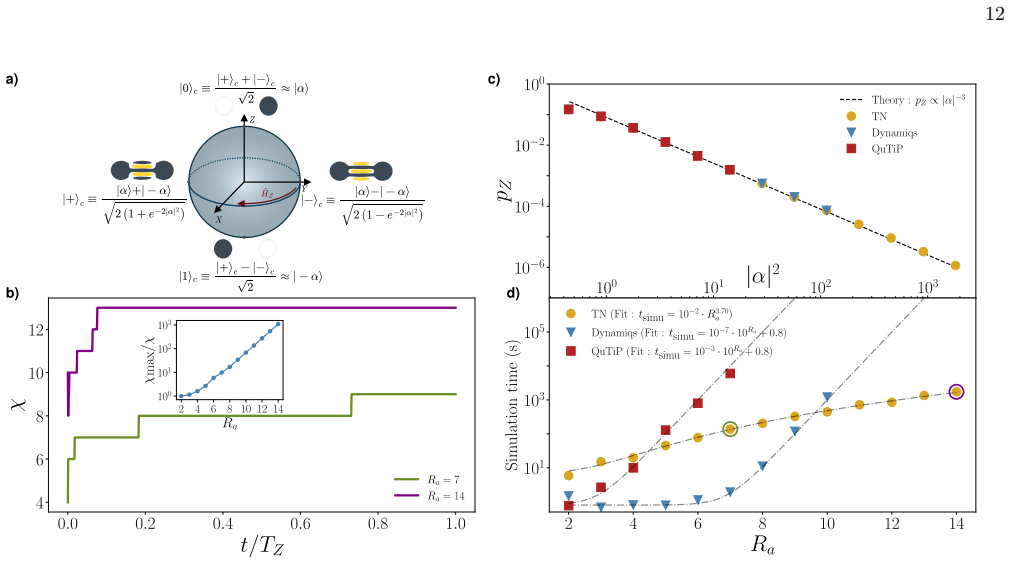
which is optimized for GPUs. To show the scal- ing of the method, we vary the Hilbert space size of the memoryN a = 2Ra while varying the size of the cat qubit|α| 2 ≡N a/3. We take a fixed value ofR b = 4 (Nb = 2 Rb = 16) for the buffer. Fig. 10 presents the results of our simulations. In Fig. 10c, we observe that we accurately obtain the error rate Eq.(6...
-
[11]
EPIQ”, the PEPR “EQUBITFLY
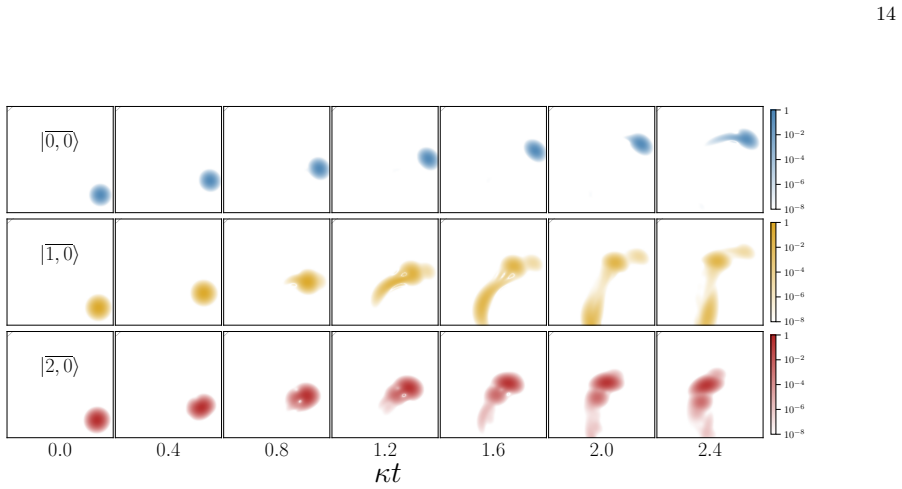
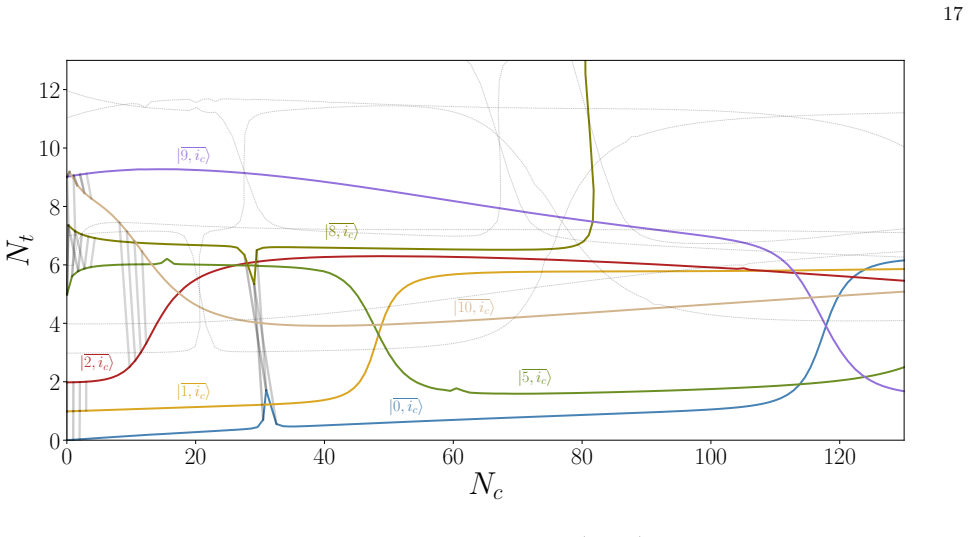
of the cavity during the readout process. In a stan- 15 0 20 40 60 80 100 120 Nc 0 2 4 6 8 10Nt a) 0.0 0.5 1.0 1.5 2.0 2.5 3.0 κt 0.00 0.25 0.50 0.75 1.00 Tr(ˆρ2) |N 0 t , N 0c ⟩ c) |0, 0⟩ |1, 0⟩ |2, 0⟩ 0.0 0.5 1.0 1.5 2.0 2.5 3.0 κt 0 20 40 60χq b) 0.0 0.5 1.0 1.5 2.0 2.5 3.0 κt 0 30 60 90 120χµ d) FIG. 12.Simulation of the dynamics of the Hamiltonian Eq...
2030
-
[12]
Blais, A
A. Blais, A. L. Grimsmo, S. M. Girvin, and A. Wallraff, Rev. Mod. Phys.93, 025005 (2021)
2021
-
[13]
Martinez and Y.-M
B. Martinez and Y.-M. Niquet, Physical Review Applied 17, 024022 (2022)
2022
-
[14]
Clarke and F
J. Clarke and F. K. Wilhelm, Nature453, 1031 (2008)
2008
-
[15]
J. Koch, T. M. Yu, J. Gambetta, A. A. Houck, D. I. Schuster, J. Majer, A. Blais, M. H. Devoret, S. M. Girvin, and R. J. Schoelkopf, Physical Review A76, 042319 (2007)
2007
-
[16]
V. E. Manucharyan, J. Koch, L. I. Glazman, and M. H. Devoret, Science326, 113 (2009)
2009
-
[17]
Kiyooka, C
E. Kiyooka, C. Tangchingchai, L. Noirot, A. Leblanc, B. Brun, S. Zihlmann, R. Maurand, V. Schmitt, E. Du- mur, J.-M. Hartmann, F. Lefloch, and S. De Franceschi, Nano Letters25, 562 (2025)
2025
-
[18]
M. H. Devoret and R. J. Schoelkopf, Science339, 1169 (2013)
2013
-
[19]
C. J. Wood and J. M. Gambetta, Physical Review A97, 17 0 20 40 60 80 100 120 Nc 0 2 4 6 8 10 12Nt |0, ic⟩ |1, ic⟩ |2, ic⟩ |5, ic⟩ |8, ic⟩ |9, ic⟩ |10, ic⟩ FIG. 13.Parametric plot of the eigenstates of the Hamiltonian in the(N t, Nc)plane.The different colors correspond to| 0, ic⟩(blue),| 1, ic⟩(orange),| 2, ic⟩(red) and so on. The nearly vertical dark gra...
2018
-
[20]
Grimm, N
A. Grimm, N. E. Frattini, S. Puri, S. O. Mundhada, S. Touzard, M. Mirrahimi, S. M. Girvin, S. Shankar, and M. H. Devoret, Nature584, 205 (2020)
2020
-
[21]
Mirrahimi, Z
M. Mirrahimi, Z. Leghtas, V. V. Albert, S. Touzard, R. J. Schoelkopf, L. Jiang, and M. H. Devoret, New Journal of Physics16, 045014 (2014)
2014
-
[22]
Guillaud, J
J. Guillaud, J. Cohen, and M. Mirrahimi,Quantum com- putation with cat qubits, SciPost Physics Lecture Notes No. 72 (SciPost Foundation, 2023)
2023
-
[23]
Lindblad, Communications in Mathematical Physics 48, 119 (1976)
G. Lindblad, Communications in Mathematical Physics 48, 119 (1976)
1976
-
[24]
Breuer and F
H.-P. Breuer and F. Petruccione,The Theory of Open Quantum Systems(Oxford University Press, 2002)
2002
- [25]
-
[26]
Lambert, E
N. Lambert, E. Gigu` ere, P. Menczel, B. Li, P. Hopf, G. Su´ arez, M. Gali, J. Lishman, R. Gadhvi, R. Agarwal, A. Galicia, N. Shammah, P. Nation, J. R. Johansson, S. Ahmed, S. Cross, A. Pitchford, and F. Nori, Physics Reports1153, 1 (2026)
2026
-
[27]
Guilmin, A
P. Guilmin, A. Bocquet, E. Genois, D. Weiss, and R. Gautier, Dynamiqs: An open-source python library for gpu-accelerated and differentiable simulation of quan- tum systems,https://github.com/dynamiqs/dynamiqs (2025)
2025
-
[28]
Kr¨ amer, D
S. Kr¨ amer, D. Plankensteiner, L. Ostermann, and H. Ritsch, Computer Physics Communications227, 109 (2018)
2018
-
[29]
I. V. Oseledets, SIAM Journal on Scientific Computing 33, 2295 (2011)
2011
-
[30]
Schollw¨ ock, Annals of Physics326, 96 (2011)
U. Schollw¨ ock, Annals of Physics326, 96 (2011)
2011
-
[31]
Or´ us, Annals of Physics349, 117 (2014)
R. Or´ us, Annals of Physics349, 117 (2014)
2014
-
[32]
Zwolak and G
M. Zwolak and G. Vidal, Physical Review Letters93, 207205 (2004)
2004
-
[33]
C. Oh, K. Noh, B. Fefferman, and L. Jiang, Phys. Rev. A104, 022407 (2021)
2021
-
[34]
K. Noh, L. Jiang, and B. Fefferman, Quantum4, 318 (2020)
2020
-
[35]
Prosen and M
T. Prosen and M. ˇZnidariˇ c, Journal of Statistical Me- chanics: Theory and Experiment2009, P02035 (2009)
2009
-
[36]
Verstraete, J
F. Verstraete, J. J. Garc´ ıa-Ripoll, and J. I. Cirac, Phys- ical Review Letters93, 207204 (2004)
2004
-
[37]
Jaschke, S
D. Jaschke, S. Montangero, and L. D. Carr, Quantum Science and Technology4, 013001 (2018)
2018
-
[38]
A. H. Werner, D. Jaschke, P. Silvi, M. Kliesch, T. Calarco, J. Eisert, and S. Montangero, Physical Re- view Letters116, 237201 (2016)
2016
- [39]
-
[40]
I. V. Oseledets, Doklady Mathematics80, 653 (2009)
2009
-
[41]
B. N. Khoromskij, Constructive Approximation34, 257 (2011)
2011
-
[42]
M. K. Ritter, Y. N´ u˜ nez Fern´ andez, M. Wallerberger, J. von Delft, H. Shinaoka, and X. Waintal, Phys. Rev. Lett.132, 056501 (2024)
2024
-
[43]
N´ u˜ nez Fern´ andez, M
Y. N´ u˜ nez Fern´ andez, M. K. Ritter, M. Jeannin, J.-W. Li, T. Kloss, T. Louvet, S. Terasaki, O. Parcollet, J. von Delft, H. Shinaoka, and X. Waintal, SciPost Phys.18, 104 (2025)
2025
-
[44]
Fannes, B
M. Fannes, B. Nachtergaele, and R. F. Werner, Commu- nications in Mathematical Physics144, 443 (1992)
1992
-
[45]
J. C. Bridgeman and C. T. Chubb, J. Phys. A: Math. Theor.50, 223001 (2017)
2017
-
[46]
I. V. Oseledets, SIAM Journal on Matrix Analysis and Applications31, 2130 (2010)
2010
-
[47]
X. Waintal, C.-H. Huang, and C. W. Groth, arXiv:2601.03035 (2026)
-
[48]
Frankenbach, M
M. Frankenbach, M. K. Ritter, M. Pelz, N. Ritz, J. von Delft, and A. Ge, Physical Review Research7, 043032 (2025). 18
2025
-
[49]
H¨ olscher, P
L. H¨ olscher, P. Rao, L. M¨ uller, J. Klepsch, A. Luckow, T. Stollenwerk, and F. K. Wilhelm, Physical Review Re- search7, 013112 (2025)
2025
-
[50]
De Lathauwer, B
L. De Lathauwer, B. De Moor, and J. Vandewalle, SIAM Journal on Matrix Analysis and Applications21, 1253 (2000)
2000
-
[51]
Oseledets and E
I. Oseledets and E. Tyrtyshnikov, Linear Algebra and its Applications432, 70 (2010)
2010
-
[52]
D. V. Savostyanov, Linear Algebra and its Applications 458, 217 (2014)
2014
-
[53]
Gobert, C
D. Gobert, C. Kollath, U. Schollw¨ ock, and G. Sch¨ utz, Physical Review E71, 036102 (2005)
2005
-
[54]
A. J. Daley, H. Pichler, J. Schachenmayer, and P. Zoller, Physical Review Letters109, 020505 (2012)
2012
-
[55]
Haegeman, C
J. Haegeman, C. Lubich, I. Oseledets, B. Vandereycken, and F. Verstraete, Physical Review B94, 165116 (2016)
2016
-
[56]
Niedermeier, A
M. Niedermeier, A. Moulinas, T. Louvet, J. L. Lado, and X. Waintal, Phys. Rev. Res.8, 023006 (2026)
2026
-
[57]
Al Daas, G
H. Al Daas, G. Ballard, P. Cazeaux, E. Hallman, A. Miedlar, M. Pasha, T. W. Reid, and A. K. Saibaba, SIAM Journal on Scientific Computing45, A74 (2023)
2023
-
[58]
Paeckel, T
S. Paeckel, T. K¨ ohler, A. Swoboda, S. R. Manmana, U. Schollw¨ ock, and C. Hubig, Annals of Physics411, 167998 (2019)
2019
-
[59]
Cama˜ no, E
C. Cama˜ no, E. N. Epperly, and J. A. Tropp, Quantum 10, 2022 (2026)
2022
-
[60]
E. M. Stoudenmire and S. R. White, New Journal of Physics12, 055026 (2010)
2010
-
[61]
Verstraete, D
F. Verstraete, D. Porras, and J. I. Cirac, Physical Review Letters93, 227205 (2004)
2004
-
[62]
Butcher, Applied Numerical Mathematics20, 247 (1996)
J. Butcher, Applied Numerical Mathematics20, 247 (1996)
1996
-
[63]
Runge, Mathematische Annalen46, 167 (1895)
C. Runge, Mathematische Annalen46, 167 (1895)
- [64]
-
[65]
Crank and P
J. Crank and P. Nicolson, Proceedings of the Cambridge Philosophical Society43, 50 (1947)
1947
-
[66]
Gelß, Scikit tt: Tensor Train Toolbox (2022)
P. Gelß, Scikit tt: Tensor Train Toolbox (2022)
2022
-
[67]
Haegeman, J
J. Haegeman, J. I. Cirac, T. J. Osborne, I. Piˇ zorn, H. Ver- schelde, and F. Verstraete, Physical Review Letters107, 070601 (2011)
2011
-
[68]
C. B. Mendl, Journal of Open Source Software3, 948 (2018)
2018
-
[69]
Blanes, F
S. Blanes, F. Casas, J. Oteo, and J. Ros, Physics Reports 470, 151 (2009)
2009
-
[70]
I. P. McCulloch, J. Osborne, and S. N. Saadatmand, Ma- trix Product Toolkit|HOWTO / TimeDependentHamil- tonians (2025)
2025
-
[71]
McCaul, K
G. McCaul, K. Jacobs, and D. I. Bondar, Physical Review Research3, 013017 (2021)
2021
-
[72]
Appel¨ o and Y
D. Appel¨ o and Y. Cheng, Journal of Computational Physics534, 114036 (2025)
2025
-
[73]
Gautier, M
R. Gautier, M. Mirrahimi, and A. Sarlette, PRX Quan- tum4, 040316 (2023)
2023
-
[74]
Putterman, K
H. Putterman, K. Noh, R. N. Patel, G. A. Peairs, G. S. MacCabe, M. Lee, S. Aghaeimeibodi, C. T. Matheny, O. Painter,et al., Physical Review X15, 011070 (2025)
2025
-
[75]
Eisert, M
J. Eisert, M. Cramer, and M. B. Plenio, Reviews of Mod- ern Physics82, 277 (2010)
2010
-
[76]
M. B. Hastings, Journal of Statistical Mechanics: Theory and Experiment , P08024 (2007)
2007
-
[77]
Chamberland, K
C. Chamberland, K. Noh, P. Arrangoiz-Arriola, E. T. Campbell, C. T. Hann, J. Iverson, H. Putterman, T. C. Bohdanowicz, S. T. Flammia, A. Keller, G. Refael, J. Preskill, L. Jiang, and A. H. Safavi-Naeini, PRX Quan- tum3, 010329 (2022)
2022
-
[78]
M. A. Nielsen and I. L. Chuang,Quantum Computation and Quantum Information: 10th Anniversary Edition (Cambridge University Press, 2011)
2011
-
[79]
Cao and J
Y. Cao and J. Lu, Journal of Scientific Computing102, 27 (2025)
2025
-
[80]
Haroche and J.-M
S. Haroche and J.-M. Raimond,Exploring the Quantum: Atoms, Cavities, and Photons(Oxford University Press, 2006)
2006
discussion (0)
Sign in with ORCID, Apple, or X to comment. Anyone can read and Pith papers without signing in.